Department of Economics University of Southampton Southampton SO17 1BJ UK
Discussion Papers in
Economics and Econometrics
A METHOD OF ESTIMATING THE AVERAGE DERIVATIVE, THE MULTIVARIATE CASE
Anurag N Banerjee
No. 0215
A Method of Estimating the Average Derivative, the
multivariate case.
Anurag N Banerjee
¤Department of Economics
University of Southampton
Southampton, UK
Abstract
The paper uses local linear regression to estimate the \direct" Average Derivative
± =E(D[m(x)]);where m(x) is the regression function. The estimate of± is the
weighted average of local slope estimates. We prove the asymptotic normality of the estimate under conditions which are di®erent from the conditions used by HÄ ardle-Stoker (H-S) (1989). Using Monte-Carlo simulation experiments we give some small
sample results comparing our estimator with the H-S estimator under our conditions
for asymptotic normality.
JEL codes: C13, C14, C15
Keywords: Semi-parametric estimation, Average Derivative, Linear regression
1
Introduction
Let (Yt;Xt),t= 1; : : : ; T be a multivariate sample from an unknown distributionF(y;x)
which is generated from the following model
Yt=m(Xt) +ut; t= 1; : : : ; T (1)
where m(x) is the unknown regression function, and the conditional expectation of ut
given Xt is zero, i.e. E(utjXt) = 0. We assume xis a l¡dimensional vector.1
Further, we assume that the regression functionm(x) is di®erentiable. We de¯ne the
average slope or the average derivative (A.D) of the regression functionm(x) as
± =
Z
D[m(x)]f(x)dx=E(D[m(x)]) (2)
where f(x) is the marginal density of X's andD[m(x)] is the ¯rst derivative ofm. We
can argue that± represents sensible "coe±cients" of changes in x. We can also show by
integrating by parts.
±=E(L(X)Y)
where L(X) =¡D[f(X)]=f(X).
The primary interest for Average Derivative Estimation (A.D.E) comes from the Gen-eral Index Model. where
m(x) =G(x0¯)
thenE(D[m]) =E(dG=d(x0¯))¯ is proportional to¯ 8 x: So ±=E[dG=d(x0¯)]¯ =°¯; for some°;is proportional to¯. We can equivalently replace¯ byµ =¯=°, by normalising
asm(x) =G(x0µ) st. E[dG=d(x0µ)] = 1. Thus it can be interpreted as units of change in
y to changes in x. HÄardle and Stoker (1989) gives an application of it with a \Collision
Data".
The use of A.D in the context of Partial Index Models is also useful. For this x is
partitioned as (x(1);x(2)) into a l ¡ l vector of x(1) and l of vector x(2), and partition
± analogously as (±1; ±2). average derivatives will measure the true coe±cient when the
regressions obeys a Partial Index Structure ( Newey and Stoker (1989) ) if
m(x) = G(x0(1)¯;x(2))
then ±1 equals ¯1 up to a scale. With an estimator ±b1 of ±1, we can extend the A.D.E
method to ¯tting a l+ 1 dimensional regression in the second stage, as ^G(x0(1)±b1;x(2)). If
the model is multiple index form as
m(x) =G(x0(1)¯1;x0(2)¯2)
then±2is likewise proportional to¯2(namely E[dG=d(x0(2)¯2)]). Again the A.D.E method
is easily extended.
A.D.E's are also used in speci¯c measurement problems in economics. A primary
ex-ample by HÄardle, Hilderbrand and Jerison (1991) is on measuring the positive de¯niteness
of the aggregate income e®ects matrix for assessing the "Law of Demand".
The A.D.E is used to estimate the following matrix.
±jj0 =E
Ã
dE(YjYj0jx) dx
!
where Yj = demand for the jth good andx = income level.
Further applications are suggested by the central role of derivatives in economic
mod-elling in form of marginal reactions and elasticities. Examples like pro¯t maximisation of
¯rms can be given. In this problem the ¯rm equate their marginal pro¯t derived from a
particular good to the price of that good. The average marginal reaction can be assessed
by the A.D estimate of the marginal pro¯t. One such example is given in Stoker (1992).
2
Method of Estimation.
Several methods have been suggested to estimate ±, the Average Derivative. HÄardle
and Stoker (1989) proposed an \indirect" estimate, ±bhs which is the sample analog of
E[L(X)Y]. This method estimates the covariance betweenL(X) andY, using consistent
non-parametric estimators of f(X) and D[f(X)]. Stoker (1991b) de¯nes the \direct"
Average Derivative Estimate, the sample analog of E(D[m(X)]) as±bd using the average
of the consistant non-parametric estimator ofD[m(X)]:Stoker also shows the asymptotic
equivalence of the \direct" and \indirect" estimators. The consistent estimates used in
the \direct" and \indirect" estimator are generally kernel estimators of the respective
We shall only assume some smoothness properties of the regression function and
mo-ment restrictions on the random variables which we state the next section. One important
di®erence in this method from the other methods is that there are no smoothness
assump-tions on the marginal density of X, i.e. f(x). We do assume that, the support of X is
the compact setS, without loss of generality it is assumed to be a subset of [0;1]l. Unlike
the HÄardle and Stoker method, the Fisher's information L(X) may not exist. Therefore
the \indirect" estimator will not exist as well. For example suppose X is distributed
U[0;1], then L(X) does not exist. This case will not be covered by the method proposed
by HÄardle and Stoker. On the other hand if X is distributed with a Normal density we
cannot use our method since we assume the domain of f(x) to be a compact interval.
Though in this case we can use the HÄardle and Stoker method. So comparisons of our
two methods in terms of the asymptotics cannot be made and our methods complement
the HÄardle and Stoker method.
Let us motivate our method whenxis univariate. Without loss of generality, let S be the interval [0;1]: This interval is then partitioned, in equal intervals. We denote the
partition asP. Let the partition be 0 < t1 < t2 < : : : < tk¡1 <1, we denote (tr; tr+1] as
Hr (Hr is called a bin ). These bins are of equal size (jHrj=h). In the bins, which have
at least 3 observations we linearly regressYtonXt, st. Xt 2Hr. We denote the coe±cient
of the slope of the regression as ^¯r. This is a least squares estimate of the tangent of the
regression curvem(x), in the intervalHr.
We then take the an weighted average of the slopes in each of the binHr. The weights
are taken to be the average number of observations in the binHr.
Let us now generalise the idea when the dimension ofx is l:
Assume without loss of generality, the interval [0;1] is the domain of the marginal
density ofXi. We partition the domain, in equal intervals and denote the partition asPi.
Let the partition be 0< ti1 < ti2< : : : < ti(ki¡1) <1, we denote (t n
r; tnr+1] asHri (Hri is
called a bin in the xthi dimension).These bins are of equal size (jHrij). The partition for
the whole of domain of f(x) is then P=P1£: : :£Pl where Hr =Hr1£: : :£Hrl is the
bin to be considered in this l¡dimensional space. Notice the number of bins is now at
most k = k1£: : :£kl: We shall only consider those bins such that Hr ½ S: Note that
rest of the method is similar to the univariate case.
Suppose we have atleastp ¸l+ 2 points in Hr, we linearly regress yt onxt as
yt= ®r+¯r0xt , s:t Xt2Hr:
We denote the estimate coe±cient of the slope of the regression,¯r as
^
¯r = [Srx]¡
1XT
t=1
(xt¡x¹r)Ifxt 2Hrgyt
where Sr x =
T
X
t=1
(xt¡x¹r) (xt¡x¹r)TIfxt 2Hrg
and ¹xr =
1 T
T
X
t=1
xtIfxt2Hrg:
This is a least squares estimate of the tangent of the regression curve m(x), within the
interval Hr.
We then take the an weighted average of the slopes in each of the binHr. The weights
are taken to be the average number of observations in the binHr, denoted by
wr=
1 T
T
X
t=1
Ifxt 2Hrg:
where I is the indicator function.
De¯nition 1 We de¯ne our Average Derivative estimator as
^ ± =
k
X
r=1
wr¯brIfTr ¸pg
where Tr=wrT, the number of observations in the rth bin and k is the number of bins.
Note that in de¯nition (1), we assume that if there are insu±cient number of
observa-tions to regress, the observaobserva-tions in the bin contribute nothing to the Average Derivative
Estimate.
We will show, under some assumptions made later that asymptotically
p
T(^±¡±) 'N³0; V arfm0(X)g+¾u2§¡1´;
where ¾2
u is the variance of ui's and § is the variance-covariance matrix of X.
We also show that the large sample variance V arfm0(X)g+¾2u§¡1can be consistently
De¯nition 2 We de¯ne the estimated variance of ^± as
^ V =
k
X
r=1
wr¯^r¯^r
0
IfTr ¸pg ¡±^±^0
3
Distributional properties and comparison with HÄ
ardle-Stoker Estimator.
3.1
Large Sample Results
We shall now prove some large sample results under the following assumptions
A1 The support of f(x) is the compact set S ½ [0;1]l and f(x) is uniformly bounded
above by a constantC, for some C >0.
A2 The second derivative of m(x),D2[m];exists and bounded.
A3 The variance ofut isE(u2tjXt) =¾2u, exists and is bounded.
A4 As T ¡! 1,
p
T h¡! 0 and log(T)
T h ¡!0:
We will make some brief comments on the assumptions. The ¯rst assumption (A1) is
not a popular assumption is the non-parametric econometrics literature. This assumption
of f(x) > 0 is necessary to ensure that there is atleast p¡observations in each bin to
perform the required regression (in large sample). However we also want the density to
be bounded above since we do not want to put too much weight on any particular ^¯r:
The smoothness assumption of the regression function (A2) is also necessary for the same
reason. Assumption three (A3) is a standard assumption for linear models. Finally the
last assumption (A4) ensures that the size of the bins shrinks at the rate of pT ; but
the size should not get too small too quickly (log(T)=T h ¡!0) otherwise there will be
insu±cient number of observations in the bin to do a regression.
Theorem 1 Under the stated assumptions A(1) to A(4) we have the following
p
where b± is the A.D.E de¯ned in De¯nition 1.
The interesting thing to observe here is that if m(x) is linear (i.e. m(x) = ®+¯0x)
then the asymptotic variance coincides with the asymptotic variance of the classical Least
Squares estimator of¯. Note that in case ofm(x) being linear, ±=¯. So in this particular
case we get a standard classical result. This implies that in the case of linearity we will
not lose e±ciency when compared to the Least Square Estimation method.
Theorem 2 Under the assumptions A(1) to A(4) we have the following
c
V!P V ar(D[m(X)]) +¾2
u§¡1
where cV is the estimated variance of b± as de¯ned in De¯nition 2.
Theorem (2) facilitates the measurement of precision of ^±as well as the inference on
hy-potheses about±. For instance, getting interval estimates using the estimated covariance
matrix of±;b cV.
Moreover, consider testing restrictions ofHo :± =±0. Tests of this hypothesis can be
based on the Wald type W statistic
W = ³b±¡±o
´0 c
V¡1³±b¡±o
´
(3)
which will have a limiting Â2 distribution.
As a practical application, since we do not require the density f(x) to vanish, our
method can be used to test for linearity or stability by dividing the data into di®erent
regions and calculating the ADE of each region and testing for equality like a Chow test
using (3).
3.2
Small Sample Results
We will now study the small sample properties of our estimator and compare it with
the Hardle Stoker Estimator. We do so by using Monte Carlo simulations on a model
Model
We study a univariate model as described below,
m(x) = 1¡x+x2
u » N(0; ¾u2)
X » U[0;1]
Therefore, for this model:
± = 0
and
V arfD[m(x)]g+¾2
u§¡1=
1 3+ 12¾
2
u
Let us describe the algorithm for computing our estimate.
Algorithim
Step(0) Generatef(Xt; Yt)gTt=1 from the model.
Step(1) Choose the size of the bin such that it satis¯es A(4).
Step(2) Divide the domain into k parts as described before.
Step(3) Compute the Least Square Estimate, ^¯rwith at least 3 observations in each bin,
Hr. Compute the ratio #0fXt2Hrg=T =wr. Multiply and get ^¯rwr.
Step(4) Add ^¯rwr over all bins, Hr and get the estimate ±.
Choice of Bin Size.
As observed before the size of the bin is inversely proportional to the number of partitions.
We describe here an adhoc method of choosing h from the data size (T). We will use
A(4) and the \de¯nition of limit" to choose our bin width. We have,
p
T h¡!0 and log(T)
implies given ² > 0 , 9 T st. for T ¸ T p T h ², and from these two
inequalities we have
log(T) T ² h
²
p
T
From this we ¯xh as follows. Taking equalities on both sides, we have
log(T) T ² =
²
p
T log(T)1=2
T1=4 = ²
so we get
h= log(T)
1=2
T3=4
so
k =
2 6 4
v u u
t T
p
T log(T)
3 7 5
Simulations and Descriptive Statistics.
We generate s (= 1000) datasets of size T (= 50;200;400) from the model we consider.
Then with these data sets we estimate ± with the method described before and get the
estimated value of ± (^±T). We will denote by ±bT(i) as the estimated value of ± of the
ith simulation (i.e. with the ith dataset). With these ±b
T(i) we calculate the following
summary descriptive statistics, to show how the estimator behaves. We shall now give a
brief description of the summary statistics.
Mean of±bT(i)0s = ±bT =
1 s
s
X
i=1 b
±T(i)
Variance of ±bT(i)0s = V(±bT) =
1 s
s
X
i=1
(b±T(i)¡±bT)2
MSE of ±bT(i)0s = M SE(±bT) =
1 s
s
X
i=1
(±bT(i)¡±)2
Further more we will look at the estimate of the Pr(¡p3
T p
V +± ±bT p3T p
V +±),
where V = V ar(D[m(X)]) +¾2u=¾x2. This is a natural statistic to look at, since by the
Theorem in the previous section we know that
Pr(¡p3
T
p
V +± ±bT
3
p
T
p
V +±)asy» ©(¡p3
T
p
V +± ±bT
3
p
T
p
for large T.
So we can look at the following estimate of the above probability as
c
Pr = 1 s
s
X
i=1
I(¡p3
T
p
V +± ±bT(i)
3
p
T
p
V +±)
This probability gives us an estimate of how accurately our±bT estimates±in small samples.
Results
In the model described before, we vary the error variance (¾2
u = 1;4;9), so as the
dis-turbance of the error increases we expect to see a larger variation about the mean of the
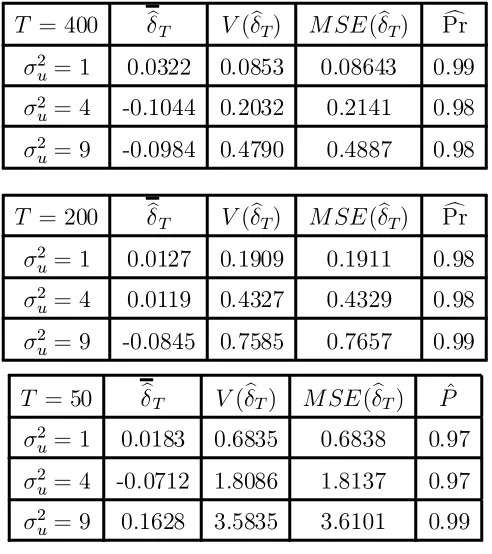
estimates±bT and the actual±(± = 0 in this model). The results are tabulated in Table 1.
We see as expected with the decrease of sample size the variation increases. The closeness
of V(±bT) and MSE(±bT) tells us that our ±bT's are close to the actual, with increasing ¾u2
and sample size T.
[T able1]
3.3
Comparisons with HÄ
ardle-Stoker Method
The HÄardle-Stoker method (1989) uses the indirect estimate
b
±hs =
1 T
T
X
t=1
yt
d
Dfh(xt)
b
fh(xt)
where fbh(xt) and Dfdh(xt) are the kernel density estimates with a bandwidth h: It has
been shown in (HÄardle-Stoker 1989) that under some assumptions
p
T³±bhs¡±
´asy
¼ N³0; V ar(D[m(X)]) +¾u2E(L(X))2´ (4)
when the error term u is uncorrelated with X: In his article, Stoker (1991b), de¯nes the
"direct" estimator of± de¯ned as
b
±d =
1 T
T
X
t=1
D[cm(xt)]I
³ b
fh(xt)> b
´
where mc(xt) is the (Nadaraya-Watson) kernel regression estimator of m(x); is
the H-S estimator, pT ³±bd¡±
´
has the same asymptotic distribution as in (4). Given
this we shall compare only the ±bhs estimator with our proposed ±:b
Comparing the asymptotic variances of the±bhs or ±bd(4) and the asymptotic variance
of ±b (Theorem 1), we see that by Rao-Cramer inequality,
V ar(D[m(X)]) +¾2uE(L(X))2> V ar(D[m(X)]) +¾u2§¡1:
But does this implies that ±bis asymptotically more e±cient than±bhs or b±d ? The answer
to that question is not necessarily so, since assumption (A1) used to derive the asumptotic
violates the assumption of smoothness off needed for the asymptotic normality of
HÄardle-Stoker A.D.E 2. Also H-S assumptions on f violates assumption A1, since we need the
assumption of compact support off for asymptotic normality of ±:. Hence they can onlyb be compared through simulation methods.
We use the same model as in (4) 3. To compute the H-S estimator bandwidth of the
Kernel,h is taken to be T¡2=7, the optimal bandwidth obtained by minimising the MSE
(HÄardle, Hart, Marron and Tsybakov (1991)). We use the Gaussian Kernel to compute
the density.
[T able2]
Generally as expected our proposed A.D.E ±b out performs ±bhs in this simulation, the
reason being that model violates the condition for asymptotic normality of ±bhs: So our
estimator complements the H-S estimator.
4
Conclusion
The paper proposes an alternative method of estimating the Average Derivative Estimate
(A.D.E). We propose the method of averaging the local OLS slopes to estimate the A.D.E.
We prove the asymptotic normality of our A.D.E under some regularity assumptions.
These assumptions are similar but not same as the assumptions under which HÄardle-Stoker
2Assumption 1,f(x) = 0;at the boundary of the support and.assumption 5 all derivatives off(x) of
orderl+ 2;exists. (HÄardle-Stoker, 1989)
3Notice that the assumption that X»U(0;1) violates the assumption of smoothness off needed for
(H-S) proved the (asymptotic) normality of their A.D.E. Stoker (1991b) also de¯nes a
"direct" estimator of±; and shows the assymptotic equivalence of the direct and the
H-S estimator. The H-H-S estimator requires some smoothness conditions on the density of
explanatory variable f(x):Our method we do not require such assumptions but we need
f(x) to have compact support. It might be worthwhile to point out that by not requiring
the density f(x) to vanish, our method can be used to test for linearity or stability by
dividing the data into di®erent regions and calculating the ADE of each region and testing
for equality like a Chow test.
The method described, is applied to a model with single regressor, assuming the
density of x to be uniform. We simulate and compare the small sample results of H-S
estimator with our estimator using various measures of performance. The results also
indicate that our estimator performs better than H-S estimator under the given situation
where asymptotic conditions of the HÄardle Stoker method is not strictly applicable. Our
References
Ahn, H, 1997, Semiparametric Estimation of a Single-Index Model with
Nonparametri-cally Generated Regressors Econometric-Theory; Vol 13(1), pp 3-31.
Banerjee, A.N, 1994, A Method of Estimating the Average Derivative, Universite Catholique
de Louvain CORE Discussion Paper: 9403.
HÄardle, W, 1992, Applied Non Parametric Regression, Cambridge, Cambridge University
Press (Econometric Society Monographs).
HÄardle, W., W.Hilderbrand. and M.Jerison, 1991, Emperical Evidence for the Law of
Demand, Econometrica, Vol 59, pp 1525-1550.
HÄardle, W, and T.M.Stoker, 1989, Investigating Smooth Multiple Regression by the
Method of Average Derivatives, Journal of American Statistical Association, Vol 84, 408, pp 986-995.
HÄardle, W, J.Hart, J.S.Marron, and A.B.Tsybakov, 1992, Bandwidth Choice for Average
Derivative Estimation, Journal of the American Statistical Association, Vol 87, 417,
pp. 218-226
Newey, W.K and T.M. Stoker, 1993, E±ciency of Weighted Average Derivative
Estima-tors and Index Models, Econometrica, Vol 61, pp 1199-1223
Rao, C.R., 1973, Linear Statistical Inference and its Applications, (John Wiley, New
York).
Ser°ing, R.J, 1980, Approximation Theorems of Mathematical Statistics, (John Wiley,
New York).
Stoker, T.M., 1991a, Lectures on Semiparametric Econometrics, (CORE Lecture Series,
Core Foundation, Louvain-la Neuve).
Stoker, T.M, 1991b, Equivalance of Direct, Indirect and Slope Estimators of
Statistics, W.A. Barnett, J,Powell and G, Tauchen, eds., Cambridge University
Tables
Table 1: Simulation results:
T = 400 ±bT V(±bT) M SE(±bT) Prc
¾2
u= 1 0.0322 0.0853 0.08643 0.99
¾2
u= 4 -0.1044 0.2032 0.2141 0.98
¾2
u= 9 -0.0984 0.4790 0.4887 0.98
T = 200 ±bT V(±bT) M SE(±bT) Prc
¾2
u= 1 0.0127 0.1909 0.1911 0.98
¾2
u= 4 0.0119 0.4327 0.4329 0.98
¾2
u= 9 -0.0845 0.7585 0.7657 0.99
T = 50 ±bT V(±bT) M SE(±bT) P^
¾2
u= 1 0.0183 0.6835 0.6838 0.97
¾2
u= 4 -0.0712 1.8086 1.8137 0.97
¾2
u= 9 0.1628 3.5835 3.6101 0.99
Table 2: Comparison with HÄardle-Stoker method
T = 100 ±bhs ±b M SE(±bhs) M SE(^±)
¾2
u= 1 -1.128 0.0575 3.8334 0.2003
¾2
u= 4 1.6077 -0.0328 2.6459 0.6492
¾2
u= 9 -0.1951 -0.1951 4.2662 1.4613
where
Mean of±bhs(i)0s = ±bhs=
1 100
100 X
i=1 b
±hs(i)
MSE of ±bhs(i)0s = M SE(±bhs) =
1 100
100 X
i=1
[image:16.596.167.450.477.669.2]Appendix.
Lemma 1 Under the assumptions, we have as T ! 1;
1) sup
1<r<k
T¡14 ° ° ° ° ° 1 T T X t=1
xtx0tIfxt2Hrg ¡pr¹2 ° ° ° ° ° P !0 2) sup 1<r<k
T¡14 ° ° ° ° ° 1 T T X t=1
xtIfxt2Hrg ¡pr¹1 ° ° ° ° ° P !0 3) sup 1<r<k
T¡14 ° ° ° ° ° 1 T T X t=1
xtutIfxt 2Hrg
° ° ° ° ° P ! 0 4) sup
1<r<kT
¡1 4 ° ° ° ° ° 1 T T X t=1
utIfxt2Hrg
° ° ° ° ° P !0 5) sup
1<r<kT
¡1 4 ° ° ° ° ° 1 T T X t=1
Ifxt2Hrg ¡pr
° ° ° ° ° P !0 where
pr =
Z
Hr
f(x)dx; ¹1=E(xt) and ¹2= E(xtx0t):
Proof of Lemma 1: Observe that, if Mr;(1 r k) are a collection of independent
random variables then,
Pr
(
sup
1<r<kkMrk> "
)
= 1¡
k
Y
r=1
(1¡Pr (kMrk> "))
so
Pr
(
sup
1<r<kk
Mrk> "
) !0 iif k Y r=1
(1¡Pr (kMrk> "))!1
iif
k
X
r=1
Pr (kMrk > ")!0
if
k
X
r=1
EkMrk2! 0 (using Chebyshev's inequality) (5)
1) Let Mr=T¡
1 4 1
T
PT
t=1(xtx0tIfxt 2Hrg ¡pr¹2); so
EkMrk2= p T E ° ° ° ° ° 1 T T X t=1
(xtx0tIfxt2Hrg ¡pr¹2) ° ° ° ° ° 2 p T 1 T2E
° ° ° ° ° T X t=1
xtx0t(Ifxt2 Hrg ¡pr)
° ° ° ° ° 2 +E ° ° ° ° °pr
à 1 T T X t=1
xtx0t¡¹2 !°°° ° ° 2 p T 1 T2E
° ° ° ° ° T X t=1
xtx0t(Ifxt2 Hrg ¡pr)
° ° ° ° ° 2
+p2rE
° ° ° ° °pr
à 1 T T X t=1
xtx0t¡¹2 !°°° ° ° 2 p T 1 T2E
à T
X
t=1
kxtx0tk jIfxt2Hrg ¡prj
!2
+p2
rE ° ° ° ° ° Ã 1 T T X t=1
xtx0t¡¹2 !°°° ° ° 2 p T 1
T2ConstE
à T
X
t=1
jIfxt2Hrg ¡prj
!2 0
B
@ (sincext's are bounded
andE(xtx0t) =¹2
1 C A
=pT 1
T2C onst 2 6 4
PT
t=1E(Ifxt 2Hrg ¡pr)2
+PT
t<t0=1EjIfxt 2Hrg ¡prjEjIfxt2Hrg ¡prj
3 7 5
(since xt's are independent)
=pT 1
T2C onst h
T pr(1¡pr) +
³T 2 ´
(2pr(1¡pr))2
i
Const:
"
1
p
Tpr+pr
p
T h
#
:
Therefore summing overr we get
k
X
r=1
EkMrk2 < Const:
" 1 p T + p T h # :
Hence asT ! 1, the expression above goes to zero since pT h!0:
The proofs of 2) 3) 4) and 5) are similar to 1).
Lemma 2 Assume A(2) and A(4), if Tr ¸p then ,
^
¯r =D[m( ¹xr)] +R(1)r + µr
where,
sup
1 r k
R(1)
r P
=o³T¡12 ´
and µr = [Srx]¡
1XT
t=1
Proof of Lemma 2: We have
^
¯r = [Srx]¡
1X
t2Ir
e
xt;ryt= [Srx]¡
1X
t2Ir
e
xt;rm(xt) +µr;
wherexet;r = (xt¡x¹r)Ifxt 2Hrg and Ir =ft:xt2Hrg:
Take a Taylor series expansion around ¹xr of m(xt);for those xt 's which are in Hr:
m(xt) = m( ¹xr) +xe0t;rD[m( ¹xr)] +
1 2xe
0
t;rD
2
[m(»tr)]xet;r
for some »tr betweenxt and ¹xr: Therefore
[Sr x]¡1
X
t2Ir
e
xt;rm(xt) =D[m( ¹xr)] +R(1)r
where
R(1)r =
1 2
"
Sr x=T
tr(Sr x=T)
#¡1P
t2Irxet;rxe T
t;rD2[m(»tr)]xet;r
tr(Sr x)
and
Srx =
X
t2Ir
e
xt;rxe0t;r
using the previous lemmas. Taking the norm
Note that by lemma (1), we have
1 TS
r x
P !pr
³
¹2¡¹2 1 ´
=pr§
therefore
tr
µ1
TS
r x
¶
P
!prtr(§)
combining we get
Srx=T
tr(Sr x=T)
P
! tr§(§)
"
Sr x=T
tr(Sr x=T)
#¡1
P !
"
§ tr(§)
#¡1
P
Also
° °
°Pt2Irxet;rxe0t;rD
2[m(»
tr)]xet;r
° ° °
tr(Sr x)
P
t2Irkxet;rk
° °
°ex0t;rD2[m(»
tr)]xet;r
° ° °
tr(Sr x)
P
t2Irkxet;rk
° ° °ex0t;rxet;r
° ° °
tr(Sr x)
C onst
p
T h
P
t2Ir
° °
°ex0t;rxet;r
° ° °
tr(Sr x)
Const
=O³pT h´
Hence R(1)
r P
=o³pT´ since by assumptionpT h! 0:
Lemma 3 We have for a given p;
k
X
r=1
wrD[m( ¹xr)]IfTr > pg =
1 T
T
X
t=1
D[m(xt)] +R(2)+R(3)
where R(2); R(3) =P o³T¡1 2
´
:
Proof of Lemma 3: Let us de¯ne
R(2)=
k
X
r=1
wrD[m( ¹xr)]IfTr > pg ¡ k
X
r=1
wrD[m( ¹xr)]IfTr >0g
R(3)=
k
X
r=1
wrD[m( ¹xr)]IfTr >0g ¡
1 T
T
X
t=1
D[m(xt)]
then
kX(T)
r=1
wrD[m( ¹xr)]IfTr> pg=
1 T
T
X
t=1
D[m(xt)] +R(2) +R(3)
We shall now showR(2); R(3) =P o³T¡1 2 ´
° ° °R(2)
° ° °= ° ° ° ° ° k X r=1
wrD[m( ¹xr)] (IfTr > pg ¡IfTr >0g)
° ° ° ° ° = ° °° ° ° k X r=1
wrD[m( ¹xr)]Ifp > Tr >0g
° °° ° ° M1 ° ° ° ° ° k X r=1
wrIfp > Tr >0g
where M1 is the upper bound for D[m( ¹xr)]: Since the random variablePkr=1wrIfp >
Tr>0g is positive we have to show that
E
à k
X
r=1
wrIfp ¸Tr>0g
! !0 therefore E Ã k X r=1
wrIfp¸Tr>0g
!
=
k
X
r=1
E(wrIfp¸Tr >0g)
= 1 T
k
X
r=1
E(TrIfp¸Tr >0g) =
1 T k X r=1 p X j=1
jpjr(1¡pr)T¡j
= 1 T k X r=1 pr 8 < : p X j=1
jpj¡1
r (1¡pr) T¡j
9 = ;
Since Ppj=1jprj¡1(1¡pr)T¡jis bounded we have
E
à k
X
r=1
wrIfp > Tr>0g
!
=O³T¡1´
hence°°°R(2)°°°=o(T¡1)
Now let us consider
° °
°R(3)°°°=
° ° ° °° k X r=1
wrD[m( ¹xr)]IfTr>0g ¡
1 T
T
X
t=1
D[m(xt)]
° ° ° °° ° ° ° ° ° ° k X r=1 wr 0
@D[m( ¹xr)]¡ 1
Tr
X
i2Ir
D[m(xt)]
1
AIfTr>0g ° ° ° ° ° ° k X r=1 wr ° ° ° ° ° ° 1 Tr X
i2Ir
(D[m( ¹xr)]¡D[m(xt)])
° ° ° ° °
°IfTr>0g
k X r=1 wr 1 Tr X
i2Ir
° °
°D2hm(»0
t;r)i°°°kxt¡x¹r)kIfTr >0g
=O 0 @ k X r=1 wr 1 Tr X
i2Ir
kxt¡x¹r)k
1 A =O Ã k X r=1
wrh
!
=O(h) (Since
k
X
r=1
wr= 1)
then°°°R(3)°°°=o³T¡1 2 ´
since by assumption h= o³T¡12 ´
Lemma 4 Under the assumptions, we have
sup
1<r<k p
T°°°µr¡§¡1Sxu
° ° °!P 0
where
µr = [Sxr]¡1 T
X
t=1
(xt¡xt)Ifxt2Hrgut
and Sxu =
1 T
T
X
t=1
(xt¡xt)ut:
Proof of Lemma 4: We have,
µr= [Srx]¡
1
Sxur
=
2
41
Tr
X
t2Ir
e
xt;rxeTt;r
3 5 ¡1 1 Tr T X t=1 e
xt;rut
where
e
xt;r= (xt ¡xt)Ifxt2Hrg
This can be written as
1 wr
Srx
¸¡1
1 wr 1 T T X t=1 e
xt;rut
we have from previous lemmas
Sr x
T
P
=pr§ and wr=P pr
by assumption aspr >0;for all rand § is positive semi-de¯nite, we have
1 wr
Sr x
¸¡1
P
!§¡1; uniformly (6)
also notice that
p
T 1 T2E
° ° ° ° ° 1 T T X t=1
xtutIfxt 2Hrg ¡
1 T
T
X
t=1
xtutpr
° ° ° ° ° 2
=pT 1 T2E
à T
X
t=1k
xtk jIfxt 2Hrg ¡prjut
!2
p
T 1
T2Const 2 6 4 PT t=1 h
E(Ifxt2Hrg ¡pr)2E(u2tjxt)
i
+PTt<t0=1E[jIfxt 2Hrg ¡prjEjIfxt2Hrg ¡prjE(jutut0jjxt)]
following similar steps in the proof of lemma (1)
p
T 1 T2E
° ° ° ° ° 1 T T X t=1
xtutIfxt2Hrg ¡
1 T
T
X
t=1
xtutpr
° ° ° ° ° 2 =O Ã 1 p
Tpr+pr
p
T h
!
since E(u2tjxt) and E(jutut0jjxt) are bounded. Therefore
1 p T k X r=1 E ° ° ° ° ° 1 p T T X t=1
xt(Ifxt2Hrg ¡pr)ut
° ° ° ° ° 2 =O Ã 1 p T + p T h !
Using the same techniques as in lemma 1, we proof that
sup 1<r<k ° ° ° ° ° 1 T T X t=1
xtutIfxt 2Hrg ¡pr
1 T
T
X
t=1
xtut
° ° ° ° ° P !0
we can proof similarly for
sup 1<r<k ° ° ° ° ° 1 T T X t=1
xtIfxt 2Hrg ¡pr
1 T T X t=1 xt ° ° ° ° ° P !0 Therefore sup
1<r<kk
Sxur ¡Sxuk !P 0
Combining with (6) we get the result.
Lemma 5 Under the assumptions,
p
T
k
X
r=1
wrµrIfTr > pg D
!N³0; ¾2u§¡1´:
Proof of Lemma 5: Using the previous lemma we can show that
p
TµrIfTr> pg=P p
T§¡1SxuIfTr > pg+ p
T R(4)
r ;
where sup1 r kR(4)r P
= o³T¡12 ´
: After multiplying and both sides by w0rs and summing
across all the bins we have
p
T
k
X
r=1
wrµrIfp > Trg=P p
T§¡1Sxu k
X
r=1
wrIfTr > pg+ p
T
k
X
r=1
wrIfTr > pgR(4)r :
We can easily show that¯¯¯Pkr=1wrIfTr> pg ¡1
¯ ¯
¯!P 0;and since
° ° ° ° ° k X r=1
wrIfTr > pgR(4)r
° ° ° ° ° ° ° ° °
°1supr kR
We have °°°Pkr=1wrIfTr > pgR(4)r
° ° ° !P 0:
Observe that by central limit theorem and asu !P 0 we have,
p
T Sxu =
1 p T T X t=1
(xt¡¹1)ut¡ p
T(xt¡¹1)u
D
=N³0;§¾2´:
Therefore
p
T§¡1Sxu =D N
³
0;§¡1¾2´:
giving us p T k X r=1
wrµrIfTr > pg !D N
³
0; ¾2
u§¡1
´
:
Proof of Theorem 1: From lemma (2) we can write
p
T±b=pT
k
X
r=1
wr¯brIfTr > pg
=pT
k
X
r=1
wr
³
D[m( ¹xr)] +R(1)r
´
IfTr> pg+ p
T
k
X
r=1
wrIfTr > pgµr
where sup1 r kR(1)r P
=o³T¡12 ´
(since by assumptionpT h! 0):ThereforePkr=1wrR(1)r IfTr >
pg=P o³T¡1 2 ´
:Further using lemma 3 we can write
p
T
k
X
r=1
wrD[m( ¹xr)]IfTr > pg=P
1 p T T X t=1
D[m(xt)] + p
T R(2)+pT R(3):
As ³pT R(2);pT R(3);Pk
r=1wrR(1)r IfTr> pg
´ P
=o³T¡12 ´ ;we have p T k X r=1
wr¯brIfTr > pg P
= p1
T
T
X
t=1
D[m(xt)] + p
T
k
X
r=1
wrIfTr> pgµr:
Using central limit theorem we show that
1 p T T X t=1
D[m(xt)]=D N(0; V ar(D[m(x)]))
and by lemma (5) we have
p
T
k
X
r=1
wrµrIfTr > pg !D N
³
Since Pk
r=1wrµrIfTr > pgand p1T PTt=1D[m(xt)] are uncorrelated by assumption, we
prove that
p
T
k
X
r=1
wr¯brIfTr > pg !D N
³
0; V ar(D[m(x)]) +¾u2§¡1´
Proof of Theorem 2: We shall use lemma (2) and the fact that x! xx0 is continuous
mapping, to show that
b
¯r¯b0r=P D[m( ¹xr)]D[m( ¹xr)]0+µrµ0r:
Then we use the proof of lemma (3) and the factD[m( ¹xr)]D[m( ¹xr)]0 is di®erentiable to
get
k
X
r=1
wr¯br¯b
0
rIfTr > pg=P
1 T
T
X
t=1
D[m(xt)]D[m(xt)]0+ k
X
r=1
wrµrµ0rIfTr > pg
By weak law of large numbers we have,
1 T
T
X
t=1
D[m(xt)]D[m(xt)]0 P
!E³D[m(x)]D[m(x)]0´
As in lemma (4) we can show that
sup
1<r<kT
° °
°µrµ0r ¡§¡1SxuSxu0 §¡1
° ° °!P 0;
and again by weak law of large numbers we have,
T SxuSxu0 P
!¾u2§ asE(SxuSxu0 ) =¾u2§
implying
sup
1<r<k
° °
°Tµrµ0r¡¾2u§¡1
° ° ° !P 0
Therefore
k
X
r=1
wrµrµ0rIfTr > pg =P ¾u2§¡1 k
X
r=1
wrIfTr > pg
P
= ¾2
u§¡1since k
X
r=1
From previous theorem we also know that
b
±!P± =E(D[m(x)])
Hence
c