Original Article
Association of variants in CELSR2-PSRC1-SORT1 with
risk of serum lipid traits, coronary artery
disease and ischemic stroke
Yi-Jiang Zhou
1, Shao-Cai Hong
2, Qian Yang
1, Rui-Xing Yin
1, Xiao-Li Cao
3, Wu-Xian Chen
11Department of Cardiology, Institute of Cardiovascular Diseases, The First Affiliated Hospital, Guangxi Medical University, 22 Shuangyong Road, Nanning 530021, Guangxi, China; 2Department of Cardiology, Guangxi Provin -cial Corps Hospital, Chinese People’s Armed Police Forces, China; 3Department of Neurology, The First Affiliated Hospital, Guangxi Medical University, 22 Shuangyong Road, Nanning 530021, Guangxi, China
Received June 16, 2015; Accepted July 24, 2015; Epub August 1, 2015; Published August 15, 2015
Abstract: Recent genome-wide association studies (GWAS) have identified genetic variants associated with coro
-nary artery disease (CAD), ischemic stroke (IS) and serum lipid traits in different ethnic groups. Some loci were found to affect the risk of CAD and IS. However, there were no data in the southern Chinese populations. Our study was to assess the association of CELSR2-PSRC1-SORT1 rs599839, rs464218 and rs6698443 SNPs and serum lipid levels and the risk of CAD and IS. The genotypes of 3 SNPs were detected in 561 CAD and 527 IS patients, and in 590 healthy controls. The genotypic and allelic frequencies of the rs599839 SNP were different between the con
-trols and IS patients (P < 0.05). The minor G alleles of rs599839 and rs464218 SNPs were associated with higher high-density lipoprotein cholesterol concentrations in CAD and IS patients (P < 0.05); respectively. No association was found between the SNPs of rs599839, rs464218 and rs6698843 at the CELSR2-PSRC1-SORT1 and the risk of CAD or IS. These results will be replicated in the other Chinese populations.
Keywords: CELSR2: cadherin EGF LAG seven-pass G-type receptor 2, PSRC1: proline/serine-rich coiled-coil 1, SORT1: sortilin, coronary artery disease, ischemic stroke, serum lipid traits
Introduction
Cardiovascular disease (CVD) includes coro
-nary artery disease (CAD), cerebrovascular dis
-ease, hypertension, and other CVDs, while
leading cause of death in the world, about 13.9
million (representing 22.9% of all deaths) died
from them. In addition, the CVDs remain among
the top six causes of burden of disease (DALYS)
in 2004 [1]. Ischemic stroke (IS) has some com
-mon risk factors with CAD, such as hyperten
-sion, dyslipidemia, and genetic variants [2].
Concentrations of low- and high-density lipo
-protein cholesterol (LDL-C and HDL-C) and tri
-glyceride (TG) are each positively (or, in the
case of HDL-C, negatively) associated with the
risk of CAD [3, 4].
It is confirmed that genetic
and environmental factors modulated serum
lipid l
evels [5]. Understanding the genes
involved blood lipoprotein
or lipid traits and
the association between common variants and
CAD or IS may inform therapy or preventive
methods.
Over the last 10 years, genome-wide associa
-tion studies (GWAS) have identified
CELSR2-PSRC1-SORT1
variants on chromosome 1p13.3
associated with CAD and plasma lipoproteins
based on populations of European [6, 7], east
-ern Asia [8, 9], south-ern Asia [10],
Middle-Eastern Asia [11], and Africa Americans [12].
These SNPs encodes cadherin EGF LAG
seven-pass G-type receptor 2, proline/serine-rich
coiled-coil 1, and sortilin; respectively. Sortilin,
encoded by
SORT1
, is a receptor for apolipopro
-tein (Apo) B100. It facilitates the formation and
hepatic export of ApoB100-containing lipopro
-teins, regulating plasma LDL-C [13]. However,
little is known about such association in the
southern Chinese people, especially the asso
9544
Int J Clin Exp Pathol 2015;8(8):9543-9551
the association
of
CELSR2-PSRC1-SORT1
rs-599839, rs464218 and rs6698443 SNPs and
serum lipid levels and the risk of CAD and IS.
Materials and methods
Study subjects
A total of 561 patients with CAD and 527
patients with IS were recruited from hospital
-ized patients in the First Affiliated Hospital,
Guangxi Medical University. All of the enrolled
CAD patients were evaluated by coronary angi
-ography due to suspected CAD or unrelated
conditions requiring angiographic evaluation;
the coronary angiograms were analyzed by two
experienced interventional cardiologists. CAD
was defined as significant coronary stenosis (≥
50%) in at least one of the three main coronary
arteries or their major branches (branch diam
-eter ≥ 2 mm). Subjects with congenital heart
disease and type I diabetes mellitus were
excluded. All of the enrolled IS patients
receiv-ed a strict neurological examination and brain
magnetic resonance imaging. The diagnosis of
IS was according to the International
Clas-sification of Diseases (9th Revision). Patients
with a transient ischemic attack, embolic brain
infarction, stroke caused by inflammatory dis
-ease, cardio-embolic stroke, autoimmune dis
-ease, or serious chronic diseases were exclud
-ed from this study. Subjects with a past history
of CAD were also excluded from the study [14].
A total of 590 healthy controls matched by age,
gender, and geographical area were included.
The controls were judged to be free of CAD and
IS by questionnaires, medical history, and clini
-cal examination. All individuals enrolled were
from the Han population in Guangxi, China. A
standard questionnaire was used to ascertain
general information and medical history from
all participants. The study protocol was
ap-proved by the Ethics Committee of the First
Affiliated Hospital, Guangxi Medical University.
Informed consent was obtained from all sub
-jects after receiving a full explanation of the
study.
Genotyping and biochemical analysis
All of the biochemical assays and genotyping in
CAD and IS patients were performed after hos
-pitalization, and all of the venous blood sam
-ples were obtained from the patients and con
[image:2.612.92.528.86.311.2]-trols after at least 12 h of fasting. Genomic
DNA was isolated from peripheral blood
leu-kocytes using the phenol-chloroform method.
We selected single nucleotide polymorphisms
(SNPs) from NCBI dbSNP Build 132 (
http://
www.Ncbi.nlm.nih.gov/SNP/
). Genotyping of
th-e thrth-eth-e SNPs was pth-erformth-ed by thth-e Snapshot
technology platform. All experimental manipu
-lations were completed in the Center for
Hum-an Genetics Research, ShHum-anghai Genesky
Bio-Tech Co. Ltd. The primers were as follows:
rs599839F: 5’-CCCAGATCGCGCCATTAAAC-3’;
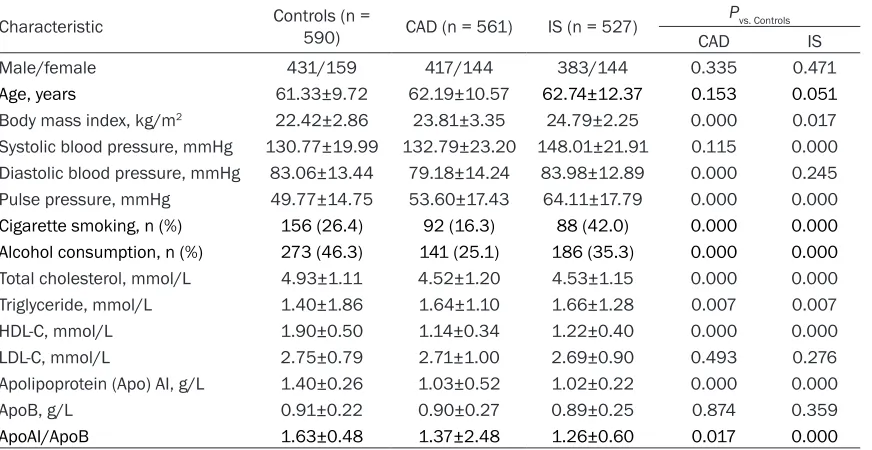
Table 1.
Characteristics of all participants
Characteristic Controls (n = 590) CAD (n = 561) IS (n = 527) Pvs. Controls
CAD IS
Male/female 431/159 417/144 383/144 0.335 0.471
Age, years 61.33±9.72 62.19±10.57 62.74±12.37 0.153 0.051
Body mass index, kg/m2 22.42±2.86 23.81±3.35 24.79±2.25 0.000 0.017
Systolic blood pressure, mmHg 130.77±19.99 132.79±23.20 148.01±21.91 0.115 0.000
Diastolic blood pressure, mmHg 83.06±13.44 79.18±14.24 83.98±12.89 0.000 0.245
Pulse pressure, mmHg 49.77±14.75 53.60±17.43 64.11±17.79 0.000 0.000
Cigarette smoking, n (%) 156 (26.4) 92 (16.3) 88 (42.0) 0.000 0.000
Alcohol consumption, n (%) 273 (46.3) 141 (25.1) 186 (35.3) 0.000 0.000
Total cholesterol, mmol/L 4.93±1.11 4.52±1.20 4.53±1.15 0.000 0.000
Triglyceride, mmol/L 1.40±1.86 1.64±1.10 1.66±1.28 0.007 0.007
HDL-C, mmol/L 1.90±0.50 1.14±0.34 1.22±0.40 0.000 0.000
LDL-C, mmol/L 2.75±0.79 2.71±1.00 2.69±0.90 0.493 0.276
Apolipoprotein (Apo) AI, g/L 1.40±0.26 1.03±0.52 1.02±0.22 0.000 0.000
ApoB, g/L 0.91±0.22 0.90±0.27 0.89±0.25 0.874 0.359
ApoAI/ApoB 1.63±0.48 1.37±2.48 1.26±0.60 0.017 0.000
rs599839R: 5’-TGCCCTCTGAGGAGCCATCTT-3’;
rs464218F:
5’-GTGAGGAGCTGGTGTGCAGTGT-3’; rs464218R:
5’-TGGAATTCGAAGGGACCTT-TTCA-3’; rs6698843F:
5’-ACAGGGCTTCAGGCC-TCCTCT-3’; rs6698843R:
5’-GGCCCAGGTTGC-CCTCTG-3’.
The levels of
total cholesterol (TC),
TG, HDL-C, and LDL-C in the samples were
determined by enzymatic methods with com
-mercially available kits. Serum Apo AI and ApoB
levels were detected by an
immunoturbidim-etric immunoassay using a commercial kit
(RANDOX Laboratories Ltd.) [15]. The normal
values for serum TC, TG, HDL-C, LDL-C, ApoAI,
ApoB and ApoAI to ApoB ratio at our Clinical
Science Experiment Center (Nanning, China)
were 3.10-5.17, 0.56-1.70, 0.91-1.81,
2.70-3.20 mmol/L, 1.00-1.78, 0.63-1.14 g/L, and
1.00-2.50; respectively.
Statistica
l analyses
All statistical analyses were performed using
the statistical software package SPSS 13.0
(SPSS Inc., Chicago, IL, USA). A standard good
-ness-of-fit test was used to test the
Hardy-Weinberg equilibrium. A chi-square analysis
was used to evaluate the difference in geno
-Table 1
compares the general characteristics
and serum lipid levels between the healthy con
-trols and CAD or IS patients. The mean age,
gender distribution, serum LDL-C and ApoB lev
-els were not different between controls and
CAD or IS patients (
P
> 0.05 for all). The CAD
patients had higher BMI, pulse pressure and
serum TG levels, but lower diastolic blood pres
-sure, serum TC, HDL-C, ApoAI levels, ApoAI/
ApoB ratio, and the percentages of subjects
who consumed alcohol or smoked cigarettes
than the controls (
P
< 0.05-0.001). The IS
patients had higher BMI, systolic blood pres
-sure, pulse pres-sure, serum TG levels, and the
percentage of subjects who smoked cigarettes;
and lower serum TC, HDL-C, ApoAI levels,
Apo-AI/ApoB ratio, and the percentage of subjects
who
consumed alcohol than the controls (
P
<
0.05-0.001).
[image:3.612.91.358.97.403.2]Genotypic and allele frequencies
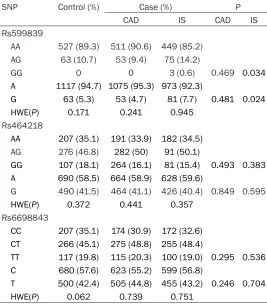
Table 2
describes the genotype and allele fre
-quencies of the
CELSR2-PSRC1-SORT1
SNPs.
The genotype distribution of all 3 SNPs agreed
with Hardy–Weinberg equilibrium (
P
> 0.05 for
all). The genotype and allele frequencies of the
Table 2.
Genotype distribution and allele frequencies of
rs599839 and rs
464218
and rs
6698843
in cases and control
SNP Control (%) Case (%) P
CAD IS CAD IS
Rs599839
AA 527 (89.3) 511 (90.6) 449 (85.2) AG 63 (10.7) 53 (9.4) 75 (14.2)
GG 0 0 3 (0.6) 0.469 0.034
A 1117 (94.7) 1075 (95.3) 973 (92.3)
G 63 (5.3) 53 (4.7) 81 (7.7) 0.481 0.024 HWE(P) 0.171 0.241 0.945
Rs464218
AA 207 (35.1) 191 (33.9) 182 (34.5)
AG 276 (46.8) 282 (50) 91 (50.1)
GG 107 (18.1) 264 (16.1) 81 (15.4) 0.493 0.383 A 690 (58.5) 664 (58.9) 628 (59.6)
G 490 (41.5) 464 (41.1) 426 (40.4) 0.849 0.595
HWE(P) 0.372 0.441 0.357
Rs6698843
CC 207 (35.1) 174 (30.9) 172 (32.6) CT 266 (45.1) 275 (48.8) 255 (48.4)
TT 117 (19.8) 115 (20.3) 100 (19.0) 0.295 0.536 C 680 (57.6) 623 (55.2) 599 (56.8)
T 500 (42.4) 505 (44.8) 455 (43.2) 0.246 0.704
HWE(P) 0.062 0.739 0.751
type distribution and sex ratio
between the groups. The general
characteristics between the
ca-ses and controls were tested
using Student’s unpair
ed
t
-test.
The association betwe
en
geno-types and serum lipid parameters
was tested by analysis of covari
-ance (ANCOVA). Sex, age, body
mass index (BMI), blood pressure,
alcohol consumption, and
ciga-rette smoking were adjusted for
in the statistical analysis. ORs
and 95% CIs were calculated
us-ing conditional logistic regression.
A two-tailed
P
value less than
0.05 was considered to be statis
-tically significant. The pattern of
pair-wise linkage disequilibrium
(LD) between the selected SNPs
was measured by D’ and
r
2using
the SHEsis software.
Results
9546
Int J Clin Exp Pathol 2015;8(8):9543-9551
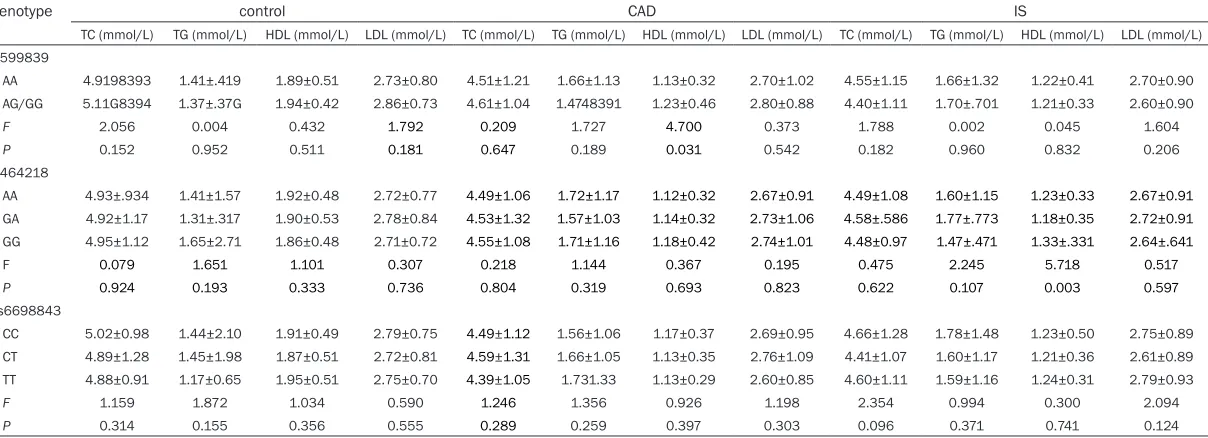
Table 3.
Effect of the genotypes on serum lipid levels in the control and cases
Genotype control CAD IS
TC (mmol/L) TG (mmol/L) HDL (mmol/L) LDL (mmol/L) TC (mmol/L) TG (mmol/L) HDL (mmol/L) LDL (mmol/L) TC (mmol/L) TG (mmol/L) HDL (mmol/L) LDL (mmol/L) rs599839
AA 4.9198393 1.41±.419 1.89±0.51 2.73±0.80 4.51±1.21 1.66±1.13 1.13±0.32 2.70±1.02 4.55±1.15 1.66±1.32 1.22±0.41 2.70±0.90
AG/GG 5.11G8394 1.37±.37G 1.94±0.42 2.86±0.73 4.61±1.04 1.4748391 1.23±0.46 2.80±0.88 4.40±1.11 1.70±.701 1.21±0.33 2.60±0.90
F 2.056 0.004 0.432 1.792 0.209 1.727 4.700 0.373 1.788 0.002 0.045 1.604
P 0.152 0.952 0.511 0.181 0.647 0.189 0.031 0.542 0.182 0.960 0.832 0.206
rs464218
AA 4.93±.934 1.41±1.57 1.92±0.48 2.72±0.77 4.49±1.06 1.72±1.17 1.12±0.32 2.67±0.91 4.49±1.08 1.60±1.15 1.23±0.33 2.67±0.91 GA 4.92±1.17 1.31±.317 1.90±0.53 2.78±0.84 4.53±1.32 1.57±1.03 1.14±0.32 2.73±1.06 4.58±.586 1.77±.773 1.18±0.35 2.72±0.91 GG 4.95±1.12 1.65±2.71 1.86±0.48 2.71±0.72 4.55±1.08 1.71±1.16 1.18±0.42 2.74±1.01 4.48±0.97 1.47±.471 1.33±.331 2.64±.641
F 0.079 1.651 1.101 0.307 0.218 1.144 0.367 0.195 0.475 2.245 5.718 0.517
P 0.924 0.193 0.333 0.736 0.804 0.319 0.693 0.823 0.622 0.107 0.003 0.597
Rs6698843
CC 5.02±0.98 1.44±2.10 1.91±0.49 2.79±0.75 4.49±1.12 1.56±1.06 1.17±0.37 2.69±0.95 4.66±1.28 1.78±1.48 1.23±0.50 2.75±0.89 CT 4.89±1.28 1.45±1.98 1.87±0.51 2.72±0.81 4.59±1.31 1.66±1.05 1.13±0.35 2.76±1.09 4.41±1.07 1.60±1.17 1.21±0.36 2.61±0.89
TT 4.88±0.91 1.17±0.65 1.95±0.51 2.75±0.70 4.39±1.05 1.731.33 1.13±0.29 2.60±0.85 4.60±1.11 1.59±1.16 1.24±0.31 2.79±0.93
F 1.159 1.872 1.034 0.590 1.246 1.356 0.926 1.198 2.354 0.994 0.300 2.094
rs599839, rs464218 and rs6698843 SNPs
were no differences between the controls and
CAD patients (
P
> 0.05). However, the genotype
and allele frequencies of the rs599839 SNP
were different between the controls and IS
patients (
P
< 0.05).
Genotypes and serum lipid levels
As shown in
Table 3
, the minor G alleles of
rs599839 and rs464218 were associated
wi-th high HDL-C concentrations in CAD and IS
patients (
P
< 0.05); respectively. We found that
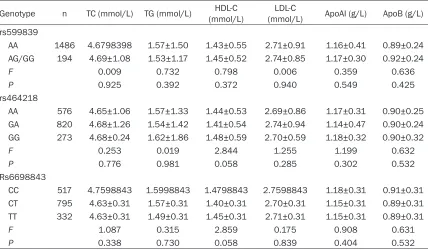
the rs599839, rs464218 and rs6698843
SNPs were not associated with lipoprotein or
lipid-related traits in the total population (
P
>
0.05); respectively (
Table 4
). A weak linkage
disequilibrium was found among the rs599839,
rs464218 and rs6698843 SNPs (
r
2< 0.1).
CELSR2-PSRC1-SORT1 SNPs and the risk of
CAD and IS
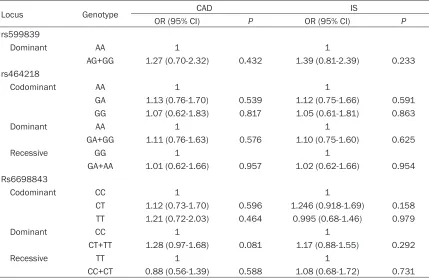
Table 5
shows no association of the rs599839,
rs464218 and rs6698843 SNPs and the risk
of CAD or IS in different genetic models.
Discussion
In this case-control genetic study, we first
reported that the G allele of rs599839 and
rs464218 was associated with high HDL-C con
-centrations in CAD and IS patients. These find
-ings are inconsistent with previous research
results which were associated with LDL-C con
-centrations in the GWAS [16] or in the recent
pooled analysis.
The minor G allele of rs599839
was associated with low LDL-C levels in
Au-strians [17], Indians [18], Japanese population
[19], central Chinese population [20] and
Pa-kistanis [21], and with high TC in Netherland
population [22] Angelakopoulou
et al.
[23]
found that rs599839 SNP was associated with
TC, LDL-C and ApoB in seven prospective stud
-ies. Kathiresan
et al
. [24] showed that the SNPs
of rs599839 and rs646776 were associated
with LDL-C in 18,554 independent participants.
In addition, rs12740374 SNP was strongly
associated with LDL-C in African Americans
[12]. We conjectured that the reason for these
differences may include: (i) the minor allele fre
-quency of rs599839 SNP in the controls (3%)
was much lower than that in the International
HapMap Utah residents with ancestry from
northern and western Europe (32%;
http://hap-map.ncbi.nlm.nih.gov/cgi-perl/gbrowse/hap
-map24_B36/
); (ii) possible gene-gene interac
-tion;
SORT1
encodes sortilin, which is one of
five members of the Vps10p domain receptor
family, a group of multifunctional proteins typi
-cally found in intracellular compartments of the
trans
-Golgi
net
work (TGN) and early endo
-somes [25]. At the 1q42 locus near
GALNT2
for
HDL-C, encodes polypeptide N-acetyl galactos
-Table 4.
Effect of the genotypes on serum lipid levels in the combined population
Genotype n TC (mmol/L) TG (mmol/L) (mmol/L)HDL-C (mmol/L)LDL-C ApoAI (g/L) ApoB (g/L)
rs599839
AA 1486 4.6798398 1.57±1.50 1.43±0.55 2.71±0.91 1.16±0.41 0.89±0.24 AG/GG 194 4.69±1.08 1.53±1.17 1.45±0.52 2.74±0.85 1.17±0.30 0.92±0.24
F 0.009 0.732 0.798 0.006 0.359 0.636
P 0.925 0.392 0.372 0.940 0.549 0.425
rs464218
AA 576 4.65±1.06 1.57±1.33 1.44±0.53 2.69±0.86 1.17±0.31 0.90±0.25 GA 820 4.68±1.26 1.54±1.42 1.41±0.54 2.74±0.94 1.14±0.47 0.90±0.24 GG 273 4.68±0.24 1.62±1.86 1.48±0.59 2.70±0.59 1.18±0.32 0.90±0.32
F 0.253 0.019 2.844 1.255 1.199 0.632
P 0.776 0.981 0.058 0.285 0.302 0.532
Rs6698843
CC 517 4.7598843 1.5998843 1.4798843 2.7598843 1.18±0.31 0.91±0.31
CT 795 4.63±0.31 1.57±0.31 1.40±0.31 2.70±0.31 1.15±0.31 0.89±0.31
TT 332 4.63±0.31 1.49±0.31 1.45±0.31 2.71±0.31 1.15±0.31 0.89±0.31
F 1.087 0.315 2.859 0.175 0.908 0.631
[image:5.612.92.520.84.334.2]9548
Int J Clin Exp Pathol 2015;8(8):9543-9551
aminyl transferase 2, an enzyme involved in
O-linked glycosylation and transfer of
N-ace-tylgalactosamine to the serine or threonine res
-idues on proteins. O-linked glycosylation has a
regulatory role for many proteins [26]. Like this
adjacent genes interactions and linkage dis
-equilibrium on lipid metabolism also need a lot
of molecular and cell biology experiments in
the future. (iii) Diet and physical activity are
strongly associated with serum lipid levels [27,
28]. (iv) The influence of drug treatment; CAD
and IS patients take anti-atherosclerotic medi
-cines, such as statins, fibrates. It is a potential
confounder when evaluating the impact of
some genes on lipids.
A large number of studies have found that
CELSR2-PSRC1-SORT1
polymorphism is asso
-ciated with the risk of CAD [16, 20, 23, 24,
29-31], whereas the SNP of rs646776 showed
no significant associations with CAD in
Leba-nese cohort [11]. In the MORGAM Prospective
Cohorts from Finland, Sweden, France and
Northern Ireland [32], the SNPs of rs599839
and rs4970834 were not strongly associated
with incident CAD and stroke. No significant
associations were observed between the
rs-599839 and rs646776 SNPs and CAD mortal
-ity a Norwegian case-cohort study [33]. In
the
current study, we found that the SNPs of
rs599839, rs464218 and rs6698843 at
CE-
LSR2-PSRC1-SORT1
were uncorrelated with
the risk of CAD. This inconsistent results indi
-cate that the possible effected mechanisms of
these SNPs on CAD are yet unknown. Gender,
race, age or sample size and possible
gene-environment interactions on CAD risks may
cause the reduction of significant associations.
Moreover, after disease started, phenotype for
diagnosis may turn up, but in a specific point in
time, individuals with certain genes may show a
series of alternative phenotypes, affected by
possible environmental exposure. More
re-search is needed.
Although the genotype and allele frequencies
of the rs599839 SNP were higher in IS patients
than in the controls, our findings showed
th-at the SNPs of rs599839, rs464218 and
rs6698843 were not associated with the risk
of IS.
CELSR2-PSRC1-SORT1
was also not the
candidate gene for IS in previous GWAS [34].
There are two limitations in the present study.
First, the number of subjects for minor allele of
SNPs was too small to interpret the associa
-tions of SNPs and the risk of diseases. Second,
the interactions of gene-gene and gene-envi
-Table 5.
CELSR2-PSRC1-SORT1
polymorphisms and association with CAD and IS in different genetic
models
Locus Genotype CAD IS
OR (95% CI) P OR (95% CI) P
rs599839
Dominant AA 1 1
AG+GG 1.27 (0.70-2.32) 0.432 1.39 (0.81-2.39) 0.233
rs464218
Codominant AA 1 1
GA 1.13 (0.76-1.70) 0.539 1.12 (0.75-1.66) 0.591
GG 1.07 (0.62-1.83) 0.817 1.05 (0.61-1.81) 0.863
Dominant AA 1 1
GA+GG 1.11 (0.76-1.63) 0.576 1.10 (0.75-1.60) 0.625
Recessive GG 1 1
GA+AA 1.01 (0.62-1.66) 0.957 1.02 (0.62-1.66) 0.954 Rs6698843
Codominant CC 1 1
CT 1.12 (0.73-1.70) 0.596 1.246 (0.918-1.69) 0.158
TT 1.21 (0.72-2.03) 0.464 0.995 (0.68-1.46) 0.979
Dominant CC 1 1
CT+TT 1.28 (0.97-1.68) 0.081 1.17 (0.88-1.55) 0.292
Recessive TT 1 1
[image:6.612.92.521.96.376.2]ronment on serum lipid levels remain to be
determined. Therefore, larger sample size and
multi-ethnic population studies are needed to
confirm our results.
In conclusion, the present study shows that the
minor G allele of rs599839 and rs464218
SNPs is associated with high HDL-C concentra
-tions in CAD and IS patients, no associa-tions
were found between the SNPs of rs599839,
rs464218 and rs6698843 at
CELSR2-PSRC1-SORT1
and the risk of CAD or IS
.
Acknowledgements
This study was supported by the National
Na-tural Science Foundation of China (No:
3096-0130), and the Science Foundation of Guangxi
Returned Oversea Scholars (No: 0991004).
Disclosure of conflict of interest
None.
Address correspondence to: Dr. Rui-Xing Yin, De-partment of Cardiology, Institute of Cardiovascu-lar Diseases, The First Affiliated Hospital, Guang-xi Medical University, 22 Shuangyong Road, Nanning 530021, Guangxi, China. Tel: +86-771-5358832; Fax: +86-771-5353342; E-mail: yinruixing@163.
com
References
[1] The Burden of Disease: 2004 update, World Health Organization.
[2] Wung SF, Hickey KT, Taylor JY and Gallek MJ. Cardiovascular Genomics. J Nurs Scholarsh
2013; 45: 60-68.
[3] Emerging Risk Factors Collaboration, Di An-gelantonio E, Sarwar N, Perry P, Kaptoge S, Ray KK, Thompson A, Wood AM, Lewington S, Sat
-tar N, Packard CJ, Collins R, Thompson SG and Danesh J. Major lipids, apolipoproteins, and risk of vascular disease. JAMA 2009; 302:
1993-2000.
[4] Sarwar N, Danesh J, Eiriksdottir G, Sigurdsson G, Wareham N, Bingham S, Boekholdt SM, Khaw KT and Gudnason V. Triglycerides and the risk of coronary heart disease: 10,158 inci
-dent cases among 262,525 participants in 29 Western prospective studies. Circulation 2007;
115: 450-458.
[5] Heller DA, de Faire U, Pedersen NL, Dahlén G and McClearn GE. Genetic and environmental influences on serum lipid levels in twins. N Engl J Med 1993; 328: 1150-1156.
[6] Gudbjartsson DF, Bjornsdottir US, Halapi E, Helgadottir A, Sulem P, Jonsdottir GM, Thorlei
-fsson G, Helgadottir H, Steinthorsdottir V, Ste
-fansson H, Williams C, Hui J, Beilby J, War
-rington NM, James A, Palmer LJ, Koppelman GH, Heinzmann A, Krueger M, Boezen HM, Wheatley A, Altmuller J, Shin HD, Uh ST, Cheong HS, Jonsdottir B, Gislason D, Park CS, Rasmus
-sen LM, Porsbjerg C, Han-sen JW, Backer V, Werge T, Janson C, Jönsson UB, Ng MC, Chan J, So WY, Ma R, Shah SH, Granger CB, Quyyumi AA, Levey AI, Vaccarino V, Reilly MP, Rader DJ, Williams MJ, van Rij AM, Jones GT, Trabetti E, Malerba G, Pignatti PF, Boner A, Pescollder
-ungg L, Girelli D, Olivieri O, Martinelli N, Lud
-viksson BR, Ludviksdottir D, Eyjolfsson GI, Ar
-nar D, Thorgeirsson G, Deichmann K, Thom-pson PJ, Wjst M, Hall IP, Postma DS, Gislason T, Gulcher J, Kong A, Jonsdottir I, Thorsteinsdottir U and Stefansson K. Sequence variants affect
-ing eosinophil numbers associate with asthma and myocardial infarction. Nat Genet 2009; 41: 342-347.
[7] Myocardial Infarction Genetics Consortium, Kathiresan S, Voight BF, Purcell S, Musunuru K, Ardissino D, Mannucci PM, Anand S, Engert JC, Samani NJ, Schunkert H, Erdmann J, Reilly MP, Rader DJ, Morgan T, Spertus JA, Stoll M, Girelli D, McKeown PP, Patterson CC, Siscovick DS, O’Donnell CJ, Elosua R, Peltonen L, Salo
-maa V, Schwartz SM, Melander O, Altshuler D, Ardissino D, Merlini PA, Berzuini C, Bernardi
-nelli L, Peyvandi F, Tubaro M, Celli P, Ferrario M, Fetiveau R, Marziliano N, Casari G, Galli M, Ribichini F, Rossi M, Bernardi F, Zonzin P, Piaz
-za A, Mannucci PM, Schwartz SM, Siscovick DS, Yee J, Friedlander Y, Elosua R, Marrugat J, Lucas G, Subirana I, Sala J, Ramos R, Kathire
-san S, Meigs JB, Williams G, Nathan DM, Mac
-Rae CA, O’Donnell CJ, Salomaa V, Havulinna AS, Peltonen L, Melander O, Berglund G, Voight BF, Kathiresan S, Hirschhorn JN, Asselta R, Duga S, Spreafico M, Musunuru K, Daly MJ, Purcell S, Voight BF, Purcell S, Nemesh J, Korn JM, McCarroll SA, Schwartz SM, Yee J, Kathire
-san S, Lucas G, Subirana I, Elosua R, Surti A, Guiducci C, Gianniny L, Mirel D, Parkin M, Burtt N, Gabriel SB, Samani NJ, Thompson JR, Braund PS, Wright BJ, Balmforth AJ, Ball SG, Hall A; Wellcome Trust Case Control Consor
-tium, Schunkert H, Erdmann J, Linsel-Nitschke P, Lieb W, Ziegler A, König I, Hengstenberg C, Fischer M, Stark K, Grosshennig A, Preuss M, Wichmann HE, Schreiber S, Schunkert H, Sa
-mani NJ, Erdmann J, Ouwehand W, Hengsten
-berg C, Deloukas P, Scholz M, Cambien F, Reilly MP, Li M, Chen Z, Wilensky R, Matthai W, Qa
9550
Int J Clin Exp Pathol 2015;8(8):9543-9551
Scheffold T, Berger K, Stoll M, Huge A, Girelli D, Martinelli N, Olivieri O, Corrocher R, Morgan T, Spertus JA, McKeown P, Patterson CC, Schun
-kert H, Erdmann E, Linsel-Nitschke P, Lieb W, Ziegler A, König IR, Hengstenberg C, Fischer M, Stark K, Grosshennig A, Preuss M, Wichmann HE, Schreiber S, Hólm H, Thorleifsson G, Thor
-steinsdottir U, Stefansson K, Engert JC, Do R, Xie C, Anand S, Kathiresan S, Ardissino D, Mannucci PM, Siscovick D, O’Donnell CJ, Sa
-mani NJ, Melander O, Elosua R, Peltonen L, Salomaa V, Schwartz SM, Altshuler D. Geno-me-wide association of early-onset myocardial infarction with single nucleotide polymorphi-sms and copy number variants. Nat Genet
2009; 41: 334-41.
[8] Ozaki K, Ohnishi Y, Iida A, Sekine A, Yamada R, Tsunoda T, Sato H, Sato H, Hori M, Nakamura Y and Tanaka T. Functional SNPs in the lympho
-toxin-alpha gene that are associated with sus
-ceptibility to myocardial infarction. Nat Genet
2002; 32: 650-654.
[9] Wang F, Xu CQ, He Q, Cai JP, Li XC, Wang D, Xiong X, Liao YH, Zeng QT, Yang YZ, Cheng X, Li
C, Yang R, Wang CC, Wu G, Lu QL, Bai Y, Huang
YF, Yin D, Yang Q, Wang XJ, Dai DP, Zhang RF, Wan J, Ren JH, Li SS, Zhao YY, Fu FF, Huang Y,
Li QX, Shi SW, Lin N, Pan ZW, Li Y, Yu B, Wu YX, Ke YH, Lei J, Wang N, Luo CY, Ji LY, Gao LJ, Li L,
Liu H, Huang EW, Cui J, Jia N, Ren X, Li H, Ke T, Zhang XQ, Liu JY, Liu MG, Xia H, Yang B, Shi LS, Xia YL, Tu X and Wang QK. Genome-wide as
-sociation identifies a susceptibility locus for coronary artery disease in the Chinese Han
population. Nat Genet 2011; 43: 345-349. [10] Coronary Artery Disease (C4D) Genetics Con
-sortium. A genome-wide association study in Europeans and South Asians identifies five new loci for coronary artery disease. Nat Genet
2011; 43: 339-344.
[11] Saade S, Cazier JB, Ghassibe-Sabbagh M, You
-hanna S, Badro DA, Kamatani Y, Hager J, Yeret
-zian JS, El-Khazen G, Haber M, Salloum AK, Douaihy B, Othman R, Shasha N, Kabbani S, Bayeh HE, Chammas E, Farrall M, Gauguier D, Platt DE, Zalloua PA; FGENTCARD consortium. Large Scale Association Analysis Identifies Three Susceptibility Loci for Coronary Artery Disease. PLoS One 2011; 6: e29427.
[12] Buyske S, Wu Y, Carty CL, Cheng I, Assimes TL, Dumitrescu L, Hindorff LA, Mitchell S, Ambite JL, Boerwinkle E, Buzkova P, Carlson CS, Co
-chran B, Duggan D, Eaton CB, Fesinmeyer MD, Franceschini N, Haessler J, Jenny N, Kang HM, Kooperberg C, Lin Y, Le Marchand L, Matise TC, Robinson JG, Rodriguez C, Schumacher FR, Voight BF, Young A, Manolio TA, Mohlke KL, Haiman CA, Peters U, Crawford DC and North KE. Evaluation of the metabochip genotyping array in African Americans and implications for
fine mapping of GWAS-identified loci: the PAGE study. PLoS One 2012; 7: e35651.
[13] Kjolby M, Andersen OM, Breiderhoff T, Fjor
-back AW, Pedersen KM, Madsen P, Jansen P, Heeren J, Willnow TE and Nykjaer A. Sort1, En
-coded by the Cardiovascular Risk Locus 1p-13.3, Is a Regulator of Hepatic Lipoprotein Ex
-port. Cell Metab 2010; 12: 213-23.
[14] Wu DF, Yin RX, Cao XL, Chen WX, Aung LH,
Wang W, Huang KK, Huang P, Zeng XN and Wu
J. Scavenger receptor class B type 1 gene rs5888 single nucleotide polymorphism and the risk of coronary artery disease and isch
-emic stroke: A case-control study. Int J Med Sci 2013; 10: 1771-7.
[15] Wu DF, Yin RX, Aung LH, Li Q, Yan TT, Zeng XN,
Huang KK, Huang P, Wu JZ and Pan SL.
Sex-specific association of ACAT-1 rs1044925 SNP and serum lipid levels in the hypercholesterol
-emic subjects. Lipids Health Dis 2012; 11: 9.
[16] Jeemon P, Pettigrew K, Sainsbury C, Prabha
-karan D, Padmanabhan S. Implications of dis
-coveries from genome-wide association stud
-ies in current cardiovascular practice. World J Cardiol 2011; 3: 230-47.
[17] Muendlein A, Geller-Rhomberg S, Saely CH, Winder T, Sonderegger G, Rein P, Beer S, Von
-bank A and Drexel H. Significant impact of chromosomal locus 1p13.3 on serum LDL cholesterol and on angiographically character
-ized coronary atherosclerosis. Atherosclerosis
2009; 206: 494-499.
[18] Walia GK, Gupta V, Aggarwal A, Asghar M, Dud
-bridge F, Timpson N, Singh NS, Kumar MR, Kinra S, Prabhakaran D, Reddy KS, Chandak GR, Smith GD and Ebrahim S. Association of Common Genetic Variants with Lipid Traits in the Indian Population. PLoS One 2014; 9:
e101688.
[19] Nakayama K, Bayasgalan T, Yamanaka K, Ku
-mada M, Gotoh T, Utsumi N, Yanagisawa Y, Okayama M, Kajii E, Ishibashi S, Iwamoto S; Jichi Community Genetics Team (JCOG). Large scale replication analysis of loci associated with lipid concentrations in a Japanese popu
-lation. J Med Genet 2009; 46: 370-4.
[20] Zhou L, Ding H, Zhang X, He M, Huang S, Xu Y, Shi Y, Cui G, Cheng L, Wang QK, Hu FB, Wang D and Wu T. Genetic Variants at Newly Identified Lipid Loci Are Associated with Coronary Heart Disease in a Chinese Han Population. PLoS One 2011; 11: e27481.
Azhar M, Samad A, Ishaq M, Rasheed SZ, Jooma R, Niazi JH, Gardezi AR, Memon NA, Ghaffar A, Rehman FU, Hoffmann MM, Renner W, Kleber ME, Grammer TB, Stephens J, Att-wood A, Koch K, Hussain M, Kumar K, Saleem A, Kumar K, Daood MS, Gul AA, Abbas S, Zafar J, Shahid F, Bhatti SM, Ali SS, Muhammad F, Sagoo G, Bray S, McGinnis R, Dudbridge F, Winkelmann BR, Böehm B, Thompson S, Ou
-wehand W, März W, Frossard P, Danesh J, De
-loukas P. Genetic Determinants of Major Blood Lipids in Pakistanis Compared with Europe
-ans. Circ Cardiovasc Genet 2010; 3: 348-57.
[22] Lu Y, Feskens EJ, Boer JM, Imholz S, Versch
-uren WM, Wijmenga C, Vaarhorst A, Slagboom E, Müller M and Dollé ME. Exploring genetic determinants of plasma total cholesterol levels and their predictive value in a longitudinal study. Atherosclerosis 2010; 213: 200-5.
[23] Angelakopoulou A, Shah T, Sofat R, Shah S, Berry DJ, Cooper J, Palmen J, Tzoulaki I, Wong A, Jefferis BJ, Maniatis N, Drenos F, Gigante B, Hardy R, Laxton RC, Leander K, Motterle A, Simpson IA, Smeeth L, Thomson A, Verzilli C, Kuh D, Ireland H, Deanfield J, Caulfield M, Wal
-lace C, Samani N, Munroe PB, Lathrop M, Fowkes FG, Marmot M, Whincup PH, Whittaker JC, de Faire U, Kivimaki M, Kumari M, Hyppo
-nen E, Power C, Humphries SE, Talmud PJ, Price J, Morris RW, Ye S, Casas JP and Hingo
-rani AD. Comparative analysis of genome-wide association studies signals for lipids, diabetes, and coronary heart disease: Cardiovascular Biomarker Genetics Collaboration. Eur Heart J 2012; 33: 393-407.
[24] Kathiresan S, Melander O, Guiducci C, Surti A, Burtt NP, Rieder MJ, Cooper GM, Roos C, Voight BF, Havulinna AS, Wahlstrand B, Hedner T, Corella D, Tai ES, Ordovas JM, Berglund G, Var
-tiainen E, Jousilahti P, Hedblad B, Taskinen MR, Newton-Cheh C, Salomaa V, Peltonen L, Groop L, Altshuler DM and Orho-Melander M.
Six new loci associated with blood low-density
lipoprotein cholesterol, high-density lipoprotein cholesterol or triglycerides in humans. Nat Genet 2008; 40: 189-97.
[25] Willer CJ, Sanna S, Jackson AU, Scuteri A, Bon
-nycastle LL, Clarke R, Heath SC, Timpson NJ, Najjar SS, Stringham HM, Strait J, Duren WL, Maschio A, Busonero F, Mulas A, Albai G, Swift AJ, Morken MA, Narisu N, Bennett D, Parish S, Shen H, Galan P, Meneton P, Hercberg S, Zele
-nika D, Chen WM, Li Y, Scott LJ, Scheet PA, Sundvall J, Watanabe RM, Nagaraja R, Ebra
-him S, Lawlor DA, Ben-Shlomo Y, Davey-Smith G, Shuldiner AR, Collins R, Bergman RN, Uda M, Tuomilehto J, Cao A, Collins FS, Lakatta E, Lathrop GM, Boehnke M, Schlessinger D, Mohlke KL and Abecasis GR. Newly identified loci that influence lipid concentrations and risk of coronary artery disease. Nat Genet 2008;
40: 161-169.
[26] Kingsley DM, Kozarsky KF, Hobbie L and Kri-eger M. Reversible defects in O-linked glycos-ylation and LDL receptor expression in a UDP-Gal/UDP-GalNAc 4-epimerase deficient mut-ant. Cell 1986; 44: 749-759.
[27] Chitra U, Reddy NK and Balakrishna N. Role of lifestyle variables on the lipid profile of select
-ed South Indian subjects. Indian Heart J 2012;
64: 28-34.
[28] El-Hazmi MA, Warsy AS. Prevalence of plasma lipid abnormalities in Saudi children. Ann Sau
-di Med 2001; 21: 21–5.
[29] Qi L, Ma J, Qi Q, Hartiala J and Allayee H, Ca-mpos H. A Genetic Risk Score and Risk of Myocardial Infarction in Hispanics. Circulation 2011; 123: 374-80.
[30] Lee JY, Lee BS, Shin DJ, Woo Park K, Shin YA,
Joong Kim K, Heo L, Young Lee J, Kyoung Kim
Y, Jin Kim Y, Bum Hong C, Lee SH, Yoon D, Jung Ku H, Oh IY, Kim BJ, Lee J, Park SJ, Kim J, Kawk HK, Lee JE, Park HK, Lee JE, Nam HY, Park HY, Shin C, Yokota M, Asano H, Nakatochi M, Mat
-subara T, Kitajima H, Yamamoto K, Kim HL, Han BG, Cho MC, Jang Y, Kim HS, Euy Park J
and Lee JY. A genome-wide association study
of a coronary artery disease risk variant. J Hum
Genet 2013; 58: 120-6.
[31] Kleber ME, Renner W, Grammer TB, Linsel-Nitschke P, Boehm BO, Winkelmann BR, Bu-gert P, Hoffmann MM and März W. Associa-tion of the single nucleotide polymorphism rs599839 in the vicinity of the sortilin 1 gene with LDL and triglyceride metabolism, coronary heart disease and myocardial infarction. The Ludwigshafen Risk and Cardiovascular Health Study. Atherosclerosis 2010; 209: 492-7.
[32] Karvanen J, Silander K, Kee F, Tiret L, Salomaa V, Kuulasmaa K, Wiklund PG, Virtamo J, Saa
-rela O, Perret C, Perola M, Peltonen L, Cambien F, Erdmann J, Samani NJ, Schunkert H and Ev
-ans A. The Impact of Newly Identified Loci on Coronary Heart Disease, Stroke and Total Mor
-tality in the MORGAM Prospective Cohorts. Genet Epidemiol 2009; 33: 237-46.
[33] Jansen MD, Knudsen GP, Myhre R, Høiseth G, Mørland J, Næss Ø, Tambs K and Magnus P. Genetic variants in loci 1p13 and 9p21 and fatal coronary heart disease in a Norwegian case-cohort study. Mol Biol Rep 2014; 41: 2733-43.
[34] Bevan S, Traylor M, Adib-Samii P, Malik R, Paul NL, Jackson C, Farrall M, Rothwell PM, Sudlow C, Dichgans M and Markus HS. Genetic Herita