Auld Leaky: A Contextual Open Hypermedia Link
Server
Danius T. Michaelides, David E. Millard, Mark J. Weal, David De Roure
Intelligence, Agents, Multimedia,
Dept. of Electronics and Computer Science, University of Southampton, U. K. dtm, dem, mjw, [email protected]
Abstract. The work of the Open Hypermedia Systems Working Group (OHSWG) has lead to the creation of several hypermedia models and a common protocol for Navigational Hypertext. However none of these include a working model of context. In this paper we present how we have extended the Fundamental Open Hypermedia Model (FOHM) to include context and behaviour. We then present Auld Leaky, a lightweight contextual link server that stores and serves structures represented in FOHM, using Context to filter query results.
1
INTRODUCTION
The Open Hypermedia Systems Working Group (OHSWG) has spent several years developing and defining the Open Hypermedia Protocol (OHP) [3] in an attempt to achieve interoperability between Open Hypermedia Systems. This development effort relied on both the definition of a suitable Hypermedia model and also a protocol (either text or API-based) to manipulate it. As Hypermedia is a wide field, the protocol was split into several different domains (Navigational, Spacial and Taxonomic) and OHP-Nav was developed as a text-based protocol that addressed only the OHP-Navigational do-main. However, it has been argued that the community should have concentrated on the model rather than the protocol [11], particularly as several areas of the model, including Context, Behaviour and Computation, were never formally agreed.
Individual research groups within the OHSWG have taken the OHP-Nav model and extended it. Within the IAM group at Southampton we have developed the Fundamen-tal Open Hypermedia Model (FOHM) [12] based on the OHP model, but capable of representing structures from all the discussed domains.
FOHM was always intended to include Context and Behaviour [10]. Recently we have turned our attention to producing a firm definition of context in FOHM and pro-ducing a contextual link server that would be flexible and general enough to use within several projects within our lab.
Version one of this link server will be known as Auld Linky, however the beta-version we are currently using is affectionately known as Auld Leaky.
1.1 Requirements
be easily installed. This meant that we would be aiming at a single executable with a simple API. We wanted the link server to be as lightweight as possible and not require large infrastructures such as databases or middleware systems. The link server should just serve links with no need to access external services. Finally, and most importantly, the link server needed to act contextually. To this end we envisaged extending FOHM to allow context and behaviour objects to be attached to each of the hypermedia objects.
2
FOHM
In its work on interoperability, the OHSWG considered the requirements of several domains of hypertext. The three most frequently mentioned were Navigational [6, 1, 7, 15, 2], Spatial [9, 8, 14] and Taxonomic [13, 4, 5]. The OHP protocol was always more concerned with Navigational Hypertext, however FOHM, which is based on the OHP-Nav data model, is capable of expressing all three domains.
2.1 The Model
In FOHM we describe four first-class objects that are analogous to the objects in the OHP data model. Associations are structures that represent relationships between Data objects. These Data objects are wrappers for any piece of data that lies outside of the scope of the model. They normally represent a document although one could represent any file, stream or other item.
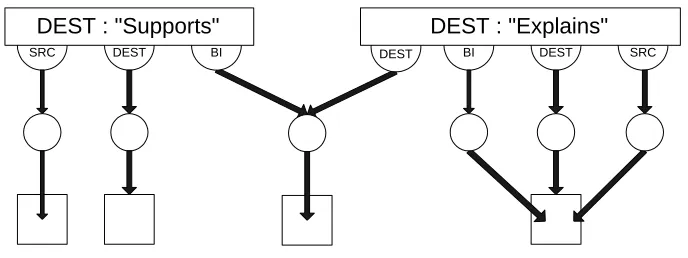
Data objects are not directly placed in the Associations. Instead Reference objects are used, these either point at Data objects in their entirety or at parts of those Data objects, for example the second paragraph of a text document, or the second scene of a film. They are attached to the Association object via Bindings. Each Association also has a structure type and a feature space; each Binding must state its position in that feature space, effectively stating how it is bound to the Association’s structure. A FOHM Navigational structure is illustrated in Figure 1.
Essentially, an Association relates different objects. The Bindings attach References to the Association. The References point to objects in the system. In the illustration the objects are items of Data, but References can also point to other Associations.
2.2 Navigational Hypertext in FOHM
Navigational Hypertext is the most common of the domains that can be represented in FOHM. Its notion of directed links can be modelled easily by a single Association feature “direction” to which Data objects are bound with either a “source”, “destination” or “bi-directional” value.
DEST SRC DEST BI
DEST : "Supports"
BI DEST SRC
[image:3.612.136.480.64.193.2]DEST : "Explains"
Fig. 1. Link Structures in FOHM
3
AULD LEAKY
The Auld Leaky implementation is written in Perl, it consists of a number of compo-nents that can be compiled into a single executable. The core is built around a FOHM implementation which provides basic container objects and APIs for matching struc-tures together. FOHM objects are grouped into linkbases, which are managed by the link server. The link server provides APIs for storing, looking up and querying stored linkbases. The final component consists of a module to expose the link server as a web-server-like process, using HTTP and XML.
3.1 Communication
Auld Leaky communicates using FOHM structures that have been serialised into XML. These are then sent over HTTP connections. Similar to a web server, Leaky responds to the standard HTTP request types:
GET requests are sent with an ID (a simple string), the relevant object is located in the linkbase and returned in the form of XML.
POST requests are sent with a FOHM object in the content of the mes-sage. This is then pattern-matched against the objects in the linkbase (this is explained further in Section 3.2).
PUT requests are sent with a FOHM object in the content of the mes-sage. Leaky then adds this object to the linkbase.
DELETE requests are sent with an ID, the relevant object is located in the linkbase and removed.
3.2 Pattern Matching
first search, meaning that when matching two FOHM objects, first each of their at-tributes are matched, followed by the matching of any sub-objects. Matching immedi-ately fails when any attribute or object matching fails.
In order to facilitate powerful queries, we add extra attributes to the FOHM ob-jects. Firstly, an attribute calledstateindicates the nature of the structure with respect to matching. The attribute has four values; undefined and defined indicate whether the particular object is in a defined state or not (where being undefined means being set to nothing, or null). A third state, variable, marks an object as being a variable. Variables are objects that match any other object of the same type, they are currently anonymous, and can contain some form of constraint to allow for complex matching. Our current im-plementation allows for constraints expressed as perl expressions (utilising perl’seval
in a sandbox), but other constraint languages and suitable evaluators could be used. The fourth value of state, lookup, is used for linkbase loading, and not for matching purposes. Linkbase loading is discussed in section 3.5.
Whilst the use of the state attribute is sufficient for constructing queries, it can often lead to quite verbose structures. Specifically, queries often contain just a few concrete values and the remaining values are variable or just not set to anything (for example an author might want to create an Association without a description attribute). To avoid this, we introduce an extra attribute, calledmissingwhich has two values: variable and undefined. This attribute indicates what state a field in an object should assume if the field is unspecified.
Note that our query objects are FOHM structures which means that we can store them in linkbases.
3.3 Matching Bindings
The Bindings contained within an Association are a special case for matching purposes. The Bindings in an Association are a bag of Binding objects. This presents a problem to our matching algorithm, since there is a choice. For all other FOHM structures there is a strict correspondence between objects in each structure to be matched. To match Binding objects, we have to employ an exhaustive search algorithm to try and find a solution such that all Bindings have been matched with a Binding in the other Associ-ation. The algorithm uses a recursive method of attempting to match a Binding to each available Binding in the other Association. For each successful match, the Bindings are marked as unavailable and a recursive call is made. If the recursive call returns unsuc-cessfully, then matching continues with the next available Binding; if there are none, then the routine fails. If the recursive call returns successfully then a configuration of Binding matches has been found where all the Bindings have been matched.
Binding objects also have extra attributes to control how they are matched. The
optionalattribute indicates that a Binding does not have to be matched against another Binding. For the matching algorithm, this attribute simply means that it can ignore optional bindings and return successfully if only optional Bindings remain unmatched. Therepeatableattribute allows for a Binding to be matched against more than once. This is typically used to match against Associations where the number of Bindings in unknown. For example, the right hand Association in Figure 1. has asrc, twodest
would include thesrcBinding but it would also include a variable Binding for thedest
Bindings to match against. In this case the variable Binding is marked as repeatable, so that it can match any number ofdestBindings.
3.4 Querying
The process of performing a query entails constructing a FOHM structure to be used in the pattern matching and making aPOSTHTTP call to the link server. The link server receives the XML data and converts it into an internal FOHM structure. This is then matched against each object in the linkbase; any matches are accumulated. It is possible for the query to specify the linkbase or scope the search by specifying a more restrictive path in the HTTP request. The matching results are converted to XML and returned to the client. The client will then typically reconstruct the results back into FOHM objects.
3.5 Linkbases, Naming and Loading
Associations, References and Data objects are first class in FOHM; they have anid
value. Linkbases are collections of FOHM structures. We try and preserve URL seman-tics so that an object can be referenced by:
http://servername:port/<linkbase name>/<object id>
The naming scheme used within the linkbases is up to the author, but using a hi-erarchy, if appropriate, is consistent with the URL scheme. Structures can also have local identifiers denoted by#value. Local identifiers are given to structures which do not have their own identity, but need to be referenced, e.g. for cyclic structures. The identifier is only valid within the scope of the communication.
Links are typically loaded into Auld Leaky when the service is started, but can also be stored using thePUTmethod. Note that since link servers load up their structures from URLs, its possible that a URL can be supplied that points to another link server, possibly even a query.
Structures stored can be references to other objects, using thelookupvalue of the state attribute. Theidattribute on such structures, indicates the destination of the refer-ence. Primarily, lookup structures are used for shared objects or for separating out the FOHM structures for easier authoring of linkbases. An open issue is the action of the linkbase when faced with a unknown identifier. Theidcould be a URL; this leads to a number of distributed link service possibilities.
The simplest case is that the link server would just store that it is a reference to an unknown object (although the type is known). The reference would have to be resolved by the client. During the matching process its not clear how the link server should treat the reference. The link server is faced with the problem of matching a (known) FOHM object against just a reference.
quite attractive, but it does required that the reference points to a link server capable of performing the query. This approach is the subject of future work.
An alternative solution to the problem of a reference is to lookup the object from the specified location and store that structure locally. Hence when a structure is loaded into the link server, the server will also load remote structures referenced, so it has all the data it requires. This process could possibly be recursive. The link server effectively has a copy of the actual remote structures, and this raises a number of caching and consistency issues. This solution does mean that the link server is able to perform its matching unhindered.
3.6 Context and Behaviour
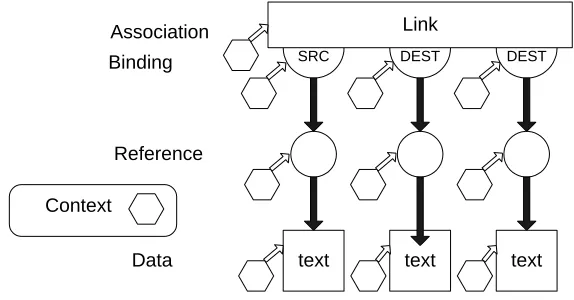
Context and Behaviour objects can be attached to all parts of the FOHM structure as is shown in Figure 2. These objects are opaque to the FOHM description and are defined separately. Any link server that deals in FOHM structures is required to understand the Context definitions, however the Behaviour objects are used only by clients and need not be understood (although they still have to be served).
SRC DEST
text text
Binding Association
Reference
Data
DEST
text Link
[image:6.612.162.449.296.446.2]Context
Fig. 2. Context Placement on FOHM Data Structures
Auld Leaky implements the context object of the FOHM structures as a set of key value pairs called contextvalues. Although a relatively simple mechanism for represent-ing context it is deceptively powerful. Figure 3. shows an example context object.
From this Context object the following information can be identified:
1. The value of context item location is given as “office”.
2. The context item time has a constraint attached to it that defines time as being later than 19:05.
<context>
<contextvalue key="location">office</contextvalue> <contextvalue key="time" state="variable">
<constraint> ( $_[0] gt "19:05"); </constraint> </contextvalue>
<constraint>(!$_[0]->contextvalue("passed_deadline"));</constraint> </context>
Fig. 3. XML Representation of Context Object
<behaviour event="display">
<behaviourvalue key="passed_deadline">true</behaviourvalue> </behaviour>
<behaviour event="traversal">
<behaviourvalue key="location">home</behaviourvalue> <behaviourvalue key="time">+00:05</behaviourvalue> </behaviour>
Fig. 4. XML Representation of Behaviour Object
also has a constraint attached to it. Constraints can be used on any element where the de-fault matching (a string comparison) is not sufficient, in this case by invoking a greater than comparison.
The Context object itself also has a Perl constraint that indicates that a successful match requires that the contextvalue with the key “passed deadline” should not exist.
Behaviour objects are implemented in Auld Leaky in much the same way as Context objects.
For example, Figure 4. shows two Behaviour objects. The first could be attached to a Data object. Each Behaviour object has an event type associated with it. In this case, the event “display” is used to indicate that the Behaviour should be carried out when the object is displayed. This is client dependant and in no way enforced by Auld Leaky. In this case the client interprets the Behaviour in such a way that upon display of this Data item it sets the “passed deadline” flag in the clients context to be true.
The second Behaviour object could be attached to an Association object. The event here is traversal rather than display. When the client follows the Association above the value of time in the client’s context will be increased by five minutes and the location is changed to home.
just as easily be constructed to trigger additional events in the system or to allow objects to express the specifics of how they are displayed.
3.7 Querying in Context
There are two important ways that Context can be used in Auld Leaky. Firstly, since Context objects can be attached to FOHM structures it becomes possible to attach them to the structures sent in queries, these structures then only match if their contexts match as well. Secondly, Context objects can be attached to the queries themselves. This Con-text object acts like a filter on query results. Objects that are returned from the query matching are matched against the supplied query Context. Objects whose Context does not match the query Context are removed from the result set. The Context matching filters down the FOHM structures so that sub-objects can be removed.
For example, this means that if a Binding matches the Context but that the Data object it binds does not, then the Binding, the Data object and the Reference that joins them are all removed from the results set.
An issue raised with this context filtering is that a structure could be filtered such that it would no longer match the original query. For example, a query that required a source binding to a particular URL could find that, due to filtering, all the source bindings had been removed.
The solution we have implemented to this problem is to re-match any structures that get filtered against the original query.
4
APPLICATIONS
As well as allowing contextual filtering of Navigational links it is possible to use Auld Leaky as a contextual structural engine to drive novel applications. In this section we shall briefly explain some of things we have been exploring.
4.1 Hypertext Short Stories
One of the applications constructed using Auld Leaky is the cgi based Hypertext Story Engine. This constructs short stories for the reader on the fly from data and links stored within the linkbase. The client maintains a user profile, in the form of a context, that it uses to find the next appropriate story fragment.
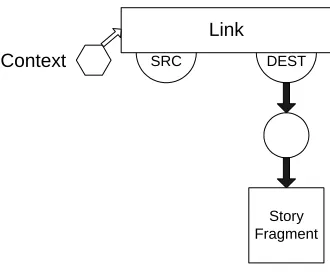
A story is constructed from fragments of text. These are stored as data objects in the linkbase. To link all of these story fragments together, Associations exist within the linkbase. These Associations contain one source Binding that is totally generic (will match any Data item). However, the Association has a Context attached to it. The client constructing the story queries the linkbase with the user context and is returned all of the Associations that match that Context. Figure 5. shows the association structure used in the application.
SRC DEST
Story Fragment
Link
[image:9.612.226.391.64.201.2]Context
Fig. 5. The Short Story Link
attached to the Association and Data objects, resulting in a different set of fragments being offered next time.
We are currently using Context and Behaviour as a way of keeping track of time, characters and also plot progression (for example to restrict basic exposition and back-ground information to the beginning of the story when the scene is being set).
4.2 Contextual Information Systems
Auld Leaky can also be used as a way of accessing factual information. We designed an applet that dynamically builds a document about the history of the City of Glasgow. It does this based on the interest preferences that the user has selected (choosing from areas such as Culture, Industry and Government). Alongside the web server that serves the applet we run a copy of Auld Leaky which is responsible for providing the necessary FOHM structures to the applet.
The dynamic document is represented in FOHM as a transclusive tour (this means that the tour is compiled into a single document). Each item in the tour is a secondary Association which we call ‘level of detail’ (LoD). Each LoD is a list which contained Data items ordered by their length. Context objects attached to each Data item described how relevant that item is to each interest.
The applet uses the interests selected by the user to construct a user context and then queries the whole tour. The link server returns the tour with each LoD included but with Data items that do not match the context removed. The applet then uses the first positioned Data item in each LoD to build the dynamic document.
Fig. 6. The Level of Detail Applet
5
CONCLUSION
In this paper we have presented Auld Leaky, a contextual Link Server that is architec-turally light and yet has the ability to manipulate structures from multiple hypertext domains in a consistent way.
Although Leaky’s use of context and behaviour is quite sophisticated the actual model of context used (a vector of key value pairs) is simple. We are currently working to produce a more complex ontology of context that would make some of the semantics and relationships within Context objects explicit.
The Architectural simplicity of Leaky also makes it an ideal component in a peer to peer distributed system. There are a number of opportunities for incorporating dis-tributed aspects into the link service. In particular further work is needed to provide a strong naming strategy and investigate issues of caching structures. In addition we have identified a number of interesting distributed query issues which need to be explored.
We are also interested in developing the use of context. In particular in regard to narrative structures, where we are looking at using context to produce dynamically gen-erated ‘tours’ of material where the tour contains a narrative structure with a recognis-able ‘beginning’, ‘middle’ and ‘end’. Such dynamic guides can also be tailored towards users’ interests and may vary according to a required length (e.g. a user might request a five minute description). The Glasgow applet and Hypertext Story Engine represent our initial work in this area.
6
ACKNOWLEDGEMENTS
References
1. Kenneth M. Anderson, Richard N. Taylor, and E. James Whitehead. Chimera: Hypertext for Heterogeneous Software Environments. In ECHT ’94. Proceedings of the ACM European
conference on Hypermedia technology, Sept. 18-23, 1994, Edinburgh, Scotland, UK, pages
94–197, 1994.
2. Tim Berners-Lee, Robert Cailliau, A. Luotonen, Henrik Frystyk Nielsen, and A. Secret. The World Wide Web. Communications of the ACM, 37(8):76–82, 1994.
3. Hugh Davis, Siegfried Reich, and David Millard. A proposal for a common navigational hypertext protocol. Technical report, Dept. of Electronics and Computer Science, 1997. Presented at 3.5 Open Hypermedia System Working Group Meeting. Aarhus University, Denmark. September 8-11.
4. Parunak H. Van Dyke. Don’t Link Me In: Set-Based Hypermedia for Taxonomic Reasoning. In Proceedings of the ’91 ACM Conference on Hypertext, Dec. 15-18, 1991, San Antonio,
TX, pages 233–242, 1991.
5. Parunak H. Van Dyke. Hypercubes Grow on Trees (and Other Observations from the Land of Hypersets). In Proceedings of the ’93 ACM Conference on Hypertext, Nov. 14-18, 1993,
Seattle, WA, pages 73–81, 1993.
6. Andrew M. Fountain, Wendy Hall, Ian Heath, and Hugh C. Davis. MICROCOSM: An Open Model for Hypermedia With Dynamic Linking. In A. Rizk, N. Streitz, and J. Andr´e, editors,
Hypertext: Concepts, Systems and Applications (Proceedings of ECHT’90), pages 298–311.
Cambridge University Press, 1990.
7. Kaj Grønbæk and Randall H. Trigg. Design issues for a Dexter-based hypermedia system.
Communications of the ACM, 37(3):40–49, February 1994.
8. Catherine C. Marshall and Frank M. Shipman. Spatial Hypertext: Designing for Change.
Communications of the ACM, 38:88–97, 1995.
9. Catherine C. Marshall and Frank M. Shipman. Spatial Hypertext and the Practice of Infor-mation Triage. In Proceedings of the ’97 ACM Conference on Hypertext, April 6-11, 1997,
Southampton, UK, pages 124–133, 1997.
10. David Millard and Hugh Davis. Navigating Spaces: The Semantics of Cross Domain Inter-operability. In Siegfried Reich and Kenneth M. Anderson, editors, OHS 6 and SC2,
Pro-ceedings of the ..., Published in Lecture Notes in Computer Science, (LNCS 1903), Springer Verlag, Heidelberg (ISSN 0302-9743), pages 129–139, 2000.
11. David Millard, Hugh Davis, and Luc Moreau. Standardizing Hypertext: Where Next for OHP? In Siegfried Reich and Kenneth M. Anderson, editors, OHS 6 and SC2, Proceedings
of the ..., Published in Lecture Notes in Computer Science, (LNCS 1903), Springer Verlag, Heidelberg (ISSN 0302-9743), pages 3–12, 2000.
12. David E. Millard, Luc Moreau, Hugh C. Davis, and Siegfried Reich. FOHM: A Fundamental Open Hypertext Model for Investigating Interoperability Between Hypertext Domains. In
Proceedings of the ’00 ACM Conference on Hypertext, May 30 - June 3, San Antonio, TX,
pages 93–102, 2000.
13. Peter J. N¨urnberg, Erich R. Schneider, and John J. Leggett. Designing digital libraries for the hyper-literate age. Journal of Universal Computer Science, 2(9), 1996.
14. Olav Reinert, Dirk Bucka-Lassen, Claus A. Pedersen, and Peter J. N¨urnberg. CAOS: A Col-laborative and Open Spatial Structure Service Component with Incremental Spatial Parsing. In Proceedings of the ’99 ACM Conference on Hypertext, February 21-25, 1999, Darmstadt,
Germany, pages 49–50, February 1999.
15. John L. Schnase, John L. Leggett, David L. Hicks, Peter J. Nuernberg, and J. Alfredo S´anchez. Design and implementation of the HB1 hyperbase management system. Electronic