Both basic research and commercialization of reproductive biotechnology for canids have not come up to par with that for other domestic animals and humans (Farstad, 2000). An increasing interest and attempts for improvement in semen cryobiol-ogy of canines in last five years (Yu et al., 2002; Núñez-Martínez et al., 2005, 2006; Neagu et al., 2010) have led to well-established cryoprotective protocols allowing better whelping rates (over 70%) (Thomassen et al., 2006) and artificial insemination (AI) of bitches with frozen-thawed semen is now being offered as a routine clinical service by many veterinarians world-wide (Yu et al., 2002).
The present status of canine semen cryopreserva-tion is perplexing and resultant pregnancy rates are highly variable owing to unidentified factors, which influence the functional vitality of cryopreserved dog spermatozoa (Farstad, 2000). The fact that differ-ent individuals of the same species exhibit variable response to the same freezing protocol is one of the
major aspects of semen cryobiology, which needs to be taken into account (Thurston et al., 2001).
One of the ways being applied to overcome the deleterious effects of Reactive Oxygen Species (ROS) is the addition of various antioxidants to the freezing extenders, which improves the se-men quality after thawing. Butylated hydroxy-toluene (BHT) is one such example being tested for its cryoprotective potentiality. BHT has been used successfully for preservation of liquid semen in turkey tom (Donoghue and Donoghue, 1997) and to minimize cryoinjury in ram (Watson and Anderson, 1983), boar (Roca et al., 2004), cattle bull (Shoae and Zamiri, 2008), and goat spermatozoa (Khalifa et al., 2008). However, there are scanty reports (Neagu et al., 2010; Sahashi et al., 2011) re-garding its cryoprotective potentiality and optimal inclusion level in canine semen. This study, there-fore, was conducted to evaluate the cryoprotective potentiality of BHT on canine semen and its optimal
Optimal inclusion level of butylated hydroxytoluene
in semen extender improves the quality of post-thawed
canine sperm
M. Ziaullah
1, A. Ijaz
2, M. Aleem
3, A.K. Mahmood
1, H. Rehman
2, S. Bhatti
1,
U. Farooq
4, M.U. Sohail
21Pet Centre, University of Veterinary and Animal Sciences, Lahore, Pakistan
2Department of Physiology, University of Veterinary and Animal Sciences, Lahore, Pakistan 3Department of Theriogenology, University of Veterinary and Animal Sciences, Lahore, Pakistan 4University College of Veterinary and Animal Sciences, The Islamia University of Bahawalpur,
Pakistan
ABSTRACT:The study was conducted to evaluate the potential cryoprotective effect of butylated hydroxytoluene (BHT) through post-thaw evaluation of canine semen and its optimal inclusion level. Ejaculated canine semen was extended in TRIS-glucose egg yolk extender containing various concentrations of BHT (0.5, 1.0, 1.5, 2.0, and 2.5mM). Semen was frozen at −196°C using 200 × 106 spermatozoa per 0.5 ml straws and post-thaw evaluation
was carried out in terms of sperm motility, viability, plasma membrane integrity, and acrosomal integrity through phase-contrast microscope, supravital staining, hypo-osmotic swelling test, and normal acrosomal ridge, respec-tively. BHT was found to improve (P > 0.005) all post-thawed semen quality parameters at an inclusion level of 1.0mM in the extended semen. However, higher concentrations than this were found to have detrimental effects.
inclusion level. This study on cryopreservation of canine semen will be helpful for emerging practic-ing veterinarians in developpractic-ing countries where the pet ownership is gaining strong footings and so does the demand for cryopreserved canine semen for AI.
MATERIAL AND METHODS
Dogs
Ten healthy, fertile, and proven stud Labrador dogs between the ages of 4 to 8 years were selected for the experiment. The animals were maintained at Rangers Headquarters, Lahore Cantonment, Pakistan and were fed dry feed twice a day with free access to water.
Semen collection and evaluation
Semen collection was carried out once every ten days through digital manipulation (Sahashi et al., 2011) in a conical tube. A total of 100 ejaculates were collected with a mean ejaculate number of 10 per dog. The second fraction (sperm-rich fraction) of the ejaculate was used for initial evaluation and pro-cessing. Semen volume and colour were evaluated macroscopically, whereas the mass motility, scored on a scale from 0 (without movement) to 5 (fast progres-sive movement), was evaluated by light microscopy at 40× (Nazir, 1988). Morphology of spermatozoa was assessed through eosin-nigrosin differential staining technique and 200 cells were counted per slide (Khan and Ijaz, 2007). The concentration was determined by spectrophotometry. Only samples that presented a volume of > 0.8 ml, motility of > 80%, and abnormal spermatozoa of < 20% were selected and pooled in order to have sufficient semen to replicate and elimi-nate the individual effect (Michael et al., 2007). A TRIS-glucose egg yolk extender containing 20% (v/v) egg yolk and 5% glycerol (v/v) at 37°C was used and dilution was achieved with a final sperm concentra-tion of 200 × 106/ml (Pena and Linde-Forsberg, 2000).
Preparation of BHT solution
For BHT addition in semen extender, 220 mg of BHT was dissolved in 1 ml absolute ethyl alcohol and concentrations of 0.5, 1.0, 1.5, 2.0, and 2.5mM were prepared. Allowing the evaporation of ethanol resulted in a thin BHT layer in crystallized form,
adhered to the inner surface of the tubes. Addition of semen (extended) to the tubes and incubation at 37°C for 5 min ensured appropriate uptake of BHT by spermatozoa (Hammerstedt et al., 1976).
Semen cryopreservation
Immediately after the initial analysis of the se-men, the extender was added to it at 37°C. After an equilibrium time of 1 h, the French straws (each of 0.5 ml capacity) were filled and sealed at 4°C in a cold cabinet (Michael et al., 2007). Finally, all the straws were arranged horizontally on a freez-ing grill, 4 cm above the level of liquid N2 till they reached a temperature close to −70°C in vapor. Later on the straws were dipped into the liquid nitrogen at −196°C for freezing (Rota et al., 2006).
Semen thawing and post-thaw analyses
For the analyses, five straws of semen from each treatment were placed in a water bath at 37°C for 30 s and the following four post-thawed semen quality parameters were studied:
Sperm motility. A phase-contrast microscope (40×) was used for the assessment of percentage motility after placing a drop of thawed semen on a pre-warmed slide. Three observations were taken in order to attain a single point (Khan and Ijaz, 2008).
Plasma membrane integrity. The hypo osmo-tic swelling test (HOST) was applied to assess the plasma membrane integrity of the spermatozoa as described earlier (Khan and Ijaz, 2008). 500 µl of hypo-osmotic solution (190 mOsm/l) was mixed with 50 µl of semen sample and the mixture was incubated at 37°C for 45 min. After mixing, a drop (~ 5 µl) was examined under a phase-contrast mi-croscope (40×). A total of 100 spermatozoa were counted in a slide and a mean of three observations per slide was taken. The percentage of spermatozoa having curling of the tail was determined as HOST positive spermatozoa.
Sperm viability. A thin and uniform smear of a small drop of frozen-thawed semen and a couple of drops of the Eosin-Nigrosin stain (1% (w/v) eosin B, 5% (w/v) nigrosin in 3% tri-sodium citrate dehy-drate solution) was made on a pre-warmed slide (Mahmood and Ijaz, 2006). The post-dried smear was observed under a phase-contrast microscope (100×) for unstained heads of spermatozoa, which were taken as live, whereas, completely/partially stained heads were taken as dead. A total of one hundred spermatozoa were counted per slide, each for live and dead spermatozoa.
All the chemicals used in the experiment were purchased from Merck, Darmstadt, Germany and were of analytical grade.
Statistical analysis
Statistical analyses were performed using Sta-tistical Package for Social Science (SPSS® Version 12.0 for Windows®, SPSS Inc., Chicago, USA). Data are presented as mean ± SEM. First, the data were analyzed for normality using the Kolmogorov Smirnov test. Effects of different inclusion levels of BHT (antioxidant) were analyzed using one way Analysis of Variance (ANOVA). Finding the F ratio significant (P < 0.05), the Duncan’s multiple range test (Duncan, 1955) was used to compare the treat-ment means of sperm motility, viability, acrosomal integrity, and plasma membrane integrity.
RESULTS
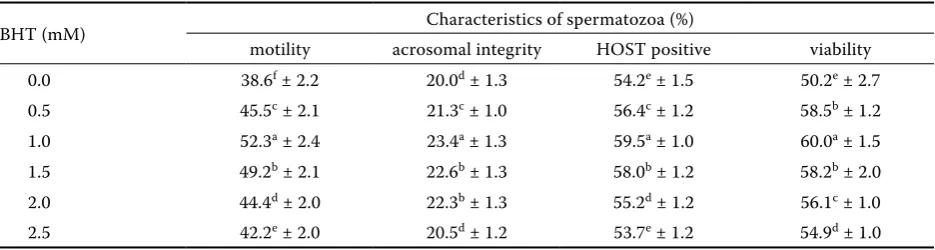
BHT addition at its increasing levels up to 1.0mM significantly (P < 0.05) improved the motility of
post-thawed spermatozoa which at higher levels gradually declined (Table 1). Similar trends were recorded for the remaining parameters with maxi-mum percentages attained at 1.0mM (Table 1).
DISCUSSION
Mammalian spermatozoa are particularly suscep-tible to lipid peroxidation-induced damage, owing to high levels of polyunsaturated fatty acids (PUFAs) and lack of antioxidant enzymes. The polyunsaturat-ed fatty acid membrane undergoes peroxidation as a result of oxidative stress, and physiological func-tions of the spermatozoa are lost (Gavazza et al., 2009). The loss in physiological role of spermatozoa is further compromised during cryopreservation (Alvarez and Storey, 1992). The inclusion of vari-ous exogenvari-ous antioxidants, hence, strengthens the antioxidant system of seminal plasma.
[image:3.595.64.532.597.722.2]The results of the present study clearly depict that the inclusion of BHT in semen extender results in an improved post-thawed canine semen qual-ity in terms of sperm motilqual-ity, acrosomal integ-rity, hypo-osmotic swelling response, and viability. The results are in accordance with a previous study (Neagu et al., 2010), which reported a significant improvement in semen quality through addition of BHT in canine semen. However, owing to the paucity of literature regarding the use of antioxi-dants in canine species, the results need to be dis-cussed in comparison to their use in other animals/ species. Similar improvements in semen quality by the use of BHT have been reported for turkey tom (Donoghue and Donoghue, 1997), cattle bull (Chaterjee and Gagnon, 2001; Shoae and Zamiri, 2008), ram (Watson and Anderson, 1983), goat
Table 1. Effect of BHT inclusion on post-thawed canine semen quality cryopreserved in a TRIS-citrate egg yolk extender
BHT (mM) Characteristics of spermatozoa (%)
motility acrosomal integrity HOST positive viability 0.0 38.6f ± 2.2 20.0d ± 1.3 54.2e ± 1.5 50.2e ± 2.7
0.5 45.5c ± 2.1 21.3c ± 1.0 56.4c ± 1.2 58.5b ± 1.2
1.0 52.3a ± 2.4 23.4a ± 1.3 59.5a ± 1.0 60.0a ± 1.5
1.5 49.2b ± 2.1 22.6b ± 1.3 58.0b ± 1.2 58.2b ± 2.0
2.0 44.4d ± 2.0 22.3b ± 1.3 55.2d ± 1.2 56.1c ± 1.0
2.5 42.2e ± 2.0 20.5d ± 1.2 53.7e ± 1.2 54.9d ± 1.0 a–fdenote difference (P < 0.05) within columns
(Khalifa et al., 2008), and boar (Roca et al., 2004) spermatozoa. The protective effect of antioxidant (BHT) is attributed to two mechanisms: firstly, the incorporation of the compound in the sperm membranes, hence, making them more fluidic and preventing them from the damage (Ijaz et al., 2009) and, secondly, declining the damaging potential of lipid peroxyl radicals by conversion into hydroper-oxides (Thomassen et al., 2006). In order to design an appropriate and efficient cryoprotection proto-col, the interactions between the components of the extender and the antioxidant, however, must be kept into account. As BHT is lipid-soluble, it may remain associated with egg yolk lipids hence scanty free BHT may be available for permeating the sperm plasma membrane (Killian et al., 1989).
In the present work, varying concentrations of BHT (0.5−2.5mM) were assessed and 1.0mM was found to be an optimal inclusion level for canine semen quality improvement. Sahashi et al. (2011) have recently reported an optimal inclusion level of 0.4mM BHT in canine semen. The optimal in-clusion level for BHT seems to be a species spe-cific characteristics as indicated by previous works for boar (Roca et al., 2004), cattle bull (Shoae and Zamiri, 2008), and buffalo bull (Ijaz et al., 2009) se-men recorded as 0.05−2.0, 0.5−1.0, and 1.0−2.0mM, respectively. Variability in results may be due to variability in concentration of spermatozoa used in respective studies.
Higher concentrations of BHT (1.5, 2.0, and 2.5mM), however, decreased the quality of sper-matozoa in the current study. These findings are in accordance with a recent work done, in which BHT at high concentrations of 1.6mM significantly de-creased the sperm motility, viability, and acrosomal integrity in canine semen (Sahashi et al., 2011). The damage inflicted on the sperm membrane during cryopreservation renders the membrane more per-meable to the BHT metabolites which, in turn, has a harmful effect (Shoae and Zamiri, 2008; Sahashi et al., 2011). Similarly, BHT was found to be toxic for cattle bull (Shoae and Zamiri, 2008), goat (Khalifa et al., 2008), human (Aitken and Clarkson, 1988) and boar (Roca et al., 2004) spermatozoa. This toxicity is due to counteracting the ROS-induced oxidative stress by higher antioxidant levels, hence hampering those functions of spermatozoa which are associated with ROS. Furthermore, it might increase the fluidic nature of plasmalemma above a physiological limit, making the spermatozoa vulnerable to acrosomal damage (Shoae and Zamiri, 2008).
CONCLUSION
In a nutshell, BHT at inclusion levels up to 1.0mM in the extended canine semen improved post-thawed sperm motility, viability, plasma membrane integrity, and acrosomal integrity. Higher BHT con-centrations than this, however, have detrimental effects. The use of sensitive and elaborative sperm assays such as flow cytometry need to be included in future investigations in order to study the effect of optimal inclusion levels of BHT. The correlations of this inclusion with fertility rate in canines is also an aspect, yet unexplored.
Acknowledgement
We are thankful to Ms. Misbah Yaseen Toor for contributing in the write up of the manuscript and we appreciate her valuable suggestions.
REFERENCES
Aitken R.J., Clarkson J.S. (1988): Significance of reactive oxygen species and antioxidants in defining the efficacy of spermatozoa preparation techniques. Journal of An-drology, 9, 367−376.
Alvarez J.G., Storey B.T. (1992): Evidence for increased lipid peroxidative damage and loss of superoxide dis-mutase activity as a mode of sublethal cryodamage to human sperm during cryopreservation. Journal of An-drology, 13, 232−241.
Chatterjee S., Gagnon C. (2001): Production of reactive oxygen species by spermatozoa undergoing cooling, freezing, and thawing. Molecular Reproduction and Development, 59, 451−458.
Donoghue A.N., Donoghue D.J. (1997): Effects of water and lipid-soluble antioxidants on turkey sperm viabil-ity, membrane integrviabil-ity, and motility during liquid storage. Poultry Science, 76, 1440−1445.
Duncan D.B. (1955): Multiple range and multiple F-test. Biometrics, 11, 1−42.
Farstad W. (2000): Assisted reproductive technology in canid species. Theriogenology, 53, 175−186.
Gavazza M., Guttiérez A.M., Marmunti M., Palacios A. (2009): Lipid peroxidase assays in canine fresh semen. Revista Veterinaria, 20, 97−102.
hydroxytoluene and cold shock. Biology of Reproduc-tion, 14, 381−397.
Ijaz A., Hussain A., Aleem M., Yousaf M.S., Rehman M. (2009): Butylated hydroxytoluene inclusion in semen extender improves the post-thawed semen quality of Nili-Ravi buffalo (Bubalus bubalis). Theriogenology, 71, 1326−1329.
Khalifa T.A.A., Lymberopoulos A.G., El-Saidy B.E. (2008): Testing usability of butylated hydroxytoluene in con-servation of goat semen. Reproduction in Domestic Animals, 43, 525−530.
Khan M.I.R., Ijaz A. (2007): Assessing undiluted, diluted and frozen-thawed Nili-Ravi buffalo bull sperm by us-ing standard semen assays. Italian Journal of Animal Science, 6, 784−787.
Khan M.I.R., Ijaz A. (2008): Effect of osmotic pressure on motility, plasma membrane integrity and viability in fresh and frozen-thawed buffalo spermatozoa. Ani-mal, 2, 548−553.
Killian G., Honadel T., McNutt T., Henault M., Wegner C., Dunlap D. (1989): Evaluation of butylated hydro-xytoluene as a cryopreservative added to whole or skim milk diluent for bull semen. Journal of Dairy Science, 72, 1291−1295.
Mahmood S.A., Ijaz A. (2006): Effect of cold shock on frozen-thawed spermatozoa of buffalo and cow bulls. In: Proc. 5th Asian Buffalo Congress. Nanjing, P.R.China,
701−708.
Michael A., Alexopoulos C., Pontiki E., Hadjipavlou-Litina D., Saratsis P., Boscos C. (2007): Effect of anti-oxidant supplementation on semen quality and reactive oxygen species of frozen thawed canine spermatozoa. Theriogenology, 68, 204−212.
Nazir M. (1988): Semen Evaluation and Sperm Morphol-ogy. Monograph on reproductive pattern of Riverine buffaloes and recommendations to improve their re-productive performance at small farmer level. PARC, Islamabad, Pakistan.
Neagu V.R., García B.M., Sandoval C.S., Rodríguez A.M., Ferrusola C.O., Fernández L.G., Tapia J.A., Peña F.J. (2010): Freezing dog semen in presence of the antioxidant butylated hydroxytoluene improves postthaw sperm membrane integrity. Theriogenology, 73, 645−650. Núñez-Martínez I., Moran J.M., Peña F.J. (2005): Do
computer-assisted, morphometric-derived sperm char-acteristics reflect DNA status in canine spermatozoa? Reproduction in Domestic Animals, 40, 537−543.
Núñez-Martínez I., Moran J.M., Peña F.J. (2006): A three step statistical procedure to identify sperm kinematic subpopulations in canine ejaculates: changes after cryopreservation. Reproduction in Domestic Animals, 41, 408−415.
Peña A., Linde-Forsberg C. (2000): Effects of spermato-zoal concentration and post-thaw dilution rate on sur-vival after thawing of dog spermatozoa. Theriogenology, 54, 703−716.
Roca J., Gil M.A., Hernandez M., Parrilla I., Vazquez J.M., Martinez E.A. (2004): Survival and fertility of boar spermatozoa after freeze thawing in extender supple-mented with butylated hydroxytoluene. Journal of An-drology, 25, 397−405.
Rota A., Milani C., Cabianca G., Martini M. (2006): Com-parison between glycerol and ethylene glycol for dog semen cryopreservation. Theriogenology, 65, 1848−1858. Sahashi Y., Otsuki T., Higaki S., Nagano M., Yamashita
Y., Hishinuma M. (2011): Effect of butylated hydroxy-toluene on dog sperm longevity in chilling storage and cryopreservation. Journal of Veterinary Medical Sci-ence, 73, 895−899.
Shoae A., Zamiri M.J. (2008): Effect of butylated hydrox-ytoluene on bull spermatozoa frozen in egg yolk-citrate extender. Animal Reproduction Science, 104, 414−418. Thomassen R., Sanson G., Krogenaes A., Fougner J.A.,
Berg K.A., Farstad W. (2006): Artificial insemination with frozen semen in dogs: a retrospective study of 10 years using a nonsurgical approach. Theriogenology, 66, 1645−1650.
Thurston L.M., Watson P.F., Mileham A.J., Holt W.V. (2001): Morphologically distinct sperm subpopulations defined by Fourier shape descriptors in fresh ejaculates correlate with variation in boar semen quality following cryopreservation. Journal of Andrology, 22, 382−394. Watson P., Anderson W. (1983): Influence of butylated
hydroxytoluene (BHT) on the viability of ram sperma-tozoa undergoing cold shock. Journal of Reproduction and Fertility, 69, 229−235.
Yu I., Songsasen N., Godke R.A., Leibo S.P. (2002): Dif-ferences among dogs in response of their spermatozoa to cryopreservation using various cooling and warming rates. Cryobiology, 44, 62−78.
Received: 2011−11−12 Accepted after corrections: 2012−04−03
Corresponding Author