Abstract— In this paper, the differential calculus was used to obtain some classes of ordinary differential equations (ODE) for the probability density function, quantile function, survival function, inverse survival function, hazard function and reversed hazard function of the 3-parameter Weibull distribution. The stated necessary conditions required for the existence of the ODEs are consistent with the various parameters that defined the distribution. Solutions of these ODEs by using numerous available methods are a new ways of understanding the nature of the probability functions that characterize the distribution.
Index Terms— 3-parameter Weibull distribution, differential calculus, probability density function, survival function, quantile function.
I. INTRODUCTION
HE 3-parameter Weibull distribution is a variant of the Weibull distribution and was obtained to improve the flexibility of modeling with Weibull distribution [1]. The distribution has been studied by [2], where they estimated the shape parameter of the distribution. Cran [3] studied extensively the properties of moment estimators of the distribution while [4] proposed the robust estimator for the 3-parameter Weibull distribution. Some other aspects that have been studied includes: conditional expectation [5], parameter estimation under defined censoring [6-7], censoring sampling [8], posterior analysis and reliability [9-10], minimum and robust minimum distance estimation [11-12], three-parameter Weibull equations [13], confidence limits [14], quantile based point estimate of the parameters [15], percentile estimation [16], methods of estimation of parameters [17-21]. Strong computational techniques have now been used in the estimation of parameters of the distribution such as particle swarm optimization [22], differential evolution [23]. Li [24] applied the least square method in the estimation of the parameters of the distribution. Mahmoud [25] observed that the 3-parameter inverse Gaussian distribution can be used and apply as an alternative model for the 3-parameter Weibull distribution. The distribution has been used in the modeling of real life Manuscript received June 30, 2017; revised July 31, 2017. This work was sponsored by Covenant University, Ota, Nigeria.
H. I. Okagbue, A. A. Opanuga and J.G. Oghonyon are with the Department of Mathematics, Covenant University, Ota, Nigeria.
[email protected] [email protected]
M. O. Adamu is with the Department of Mathematics, University of Lagos, Akoka, Lagos, Nigeria.
situations such as: fatigue crack growth [26], step-stress accelerated life test [27], ageing [28], helicopter blade reliability [29], cost estimation [30], time between failures of machine tools [31].
The aim of this research is to develop ordinary differential equations (ODE) for the probability density function (PDF), Quantile function (QF), survival function (SF), inverse survival function (ISF), hazard function (HF) and reversed hazard function (RHF) of 3-parameter Weibull distribution by the use of differential calculus. Calculus is a very key tool in the determination of mode of a given probability distribution and in estimation of parameters of probability distributions, amongst other uses. The research is an extension of the ODE to other probability functions other than the PDF. Similar works done where the PDF of probability distributions was expressed as ODE whose solution is the PDF are available. They include: Laplace distribution [32], beta distribution [33], raised cosine distribution [34], Lomax distribution [35], beta prime distribution or inverted beta distribution [36]. II. PROBABILITY DENSITY FUNCTION
The probability density function of the 3- parameter Weibull distribution is given as;
1
( )
e
x
x
f x
(1) with the parameters
, , , 0,
x
0
.To obtain the first order ordinary differential equation for the probability density function of the 3-parameter Weibull distribution, differentiate equation (1), to obtain;
2
1
1
1
( ) ( )
e
e
x
x
x
x
f x f x
x
(2)
1
1
( )
x
( )
f x
f x
x
(3)
Classes of Ordinary Differential Equations
Obtained for the Probability Functions of
3-Parameter Weibull Distribution
Hilary I. Okagbue, Member, IAENG, Muminu O. Adamu, Abiodun A. Opanuga, Jimevwo G. Oghonyon
The condition necessary for the existence of the equation is
, , ,
0
x
The differential equations can only be obtained forparticular values of
,
and
. When
1
, equation (3) becomes;1
( )
( )
a a
f x
f x
(4)( )
( )
0
a a
f x
f x
(5) When
2
, equation (3) becomes;2
1
2(
)
( )
( )
b b
x
f x
f x
x
(6)2 2 2
(
x
) ( ) (
f x
b2(
x
) ) ( )
f x
b0
(7)When
3
, equation (3) becomes;2 3
2
3(
)
( )
( )
c c
x
f x
f x
x
(8)3 3 3
(
x
) ( ) (2
f x
c3(
x
) ) ( )
f x
c0
(9)Equation (3) is differentiated to obtain;
1
2
2 2
1
( )
( )
1
(
1)
( )
(
)
x
f
x
f x
x
x
f x
x
(10)
The following equations obtained from (3) are needed to simplify equation (10);
1
( )
1
( )
f x
x
f x
x
(11)
1
1
( )
( )
x
f x
x
f x
(12)
1 2
(
1)
1
1
( )
( )
x
f x
x
f x
(13)2 2
(
1)
1
1
( )
( )
x
f x
x
x
f x
(14)Substitute equations (11) and (14) into equation (10);
2 2
1
(
)
( )
( )
( )
( )
1
1
( )
( )
x
f
x
f
x
f x
f x
f x
x
x
f x
(15)
2
2 2
2
( )
(
1) ( )
( )
( )
(
)
(
1)
( )
(
1)
( )
(
)
f
x
f x
f
x
f x
x
f x
f x
x
x
(16)
2
2
( )
(
1) ( )
(
1)
( )
( )
( )
(
)
f
x
f x
f x
f
x
f x
x
x
(17)The condition necessary for the existence of the equation is
0,
0, ( )
0, ,
0
x
x
f x
The second order ordinary differential equation for theprobability density function of the 3-parameter Weibull distribution is given by;
2 2 2
2
(
)
( ) (
)
( )
(
1)
( ) (
1)(
) ( )
( )
0
x
f
x
x
f
x
f
x
x
f x f x
(18)
1
(0)
e
f
(19)1 1
1
(0)
e
f
(20)
III. QUANTILE FUNCTION
The Quantile function of the 3- parameter Weibull distribution is given as;
1
( )
( ln(1
))
Q p
p
(21)The parameters are:
,
0, 0
p
1
. To obtain the first order ordinary differential equation forthe Quantile function of the 3-parameter Weibull distribution, differentiate equation (21), to obtain;
1 1
( )
( ln(1
))
(1
)
Q p
p
p
(22)The condition necessary for the existence of the equation is
,
0, 0
p
1
. Equation (21) can also be written as;1
( ln(1
p
))
Q p
( )
(23)Substitute equation (23) into equation (22);
( )
( )
(1
)( ln(1
))
Q p
Q p
p
p
(24) Equation (23) can also be simplified as;( )
ln(1
p
)
Q p
(25) Substitute equation (25) into equation (24);( ( )
)
( )
(1
)(
( ))
Q p
Q p
p
Q p
1
(
( ))
( )
(1
)
Q p
Q p
p
(27) 1(0.1)
( ln(0.9))
Q
(28) The differential equations can only be obtained forparticular values of
,
and
. When
1
, equation (27) becomes;( )
(1
)
aQ p
p
(29)(1
p Q p
)
a
( )
0
(30) When
2
, equation (27) becomes;2
( )
2(1
)(
( ))
b
b
Q p
p
Q p
(31) 22(1
p
)(
Q p Q p
b( ))
b
( )
0
(32) When
3
, equation (27) becomes;3
2
( )
3(1
)(
( ))
c
c
Q p
p
Q p
(33)2 3
3(1
p
)(
Q p
c( ))
Q p
c
( )
0
(34)IV. SURVIVAL FUNCTION
The survival function of the 3- parameter Weibull distribution is given as;
( )
e
t
S t
(35) To obtain the first order ordinary differential equation for the survival function of the 3-parameter Weibulldistribution, differentiate equation (35), to obtain;
1
( )
e
t
t
S t
(36)The condition necessary for the existence of the equation is
0,
, ,
0
t
.1
( )
t
( )
S t
S t
(37) The differential equations can only be obtained forparticular values of
,
and
. When
1
, equation (37) becomes;1
( )
( )
a a
S t
S t
(38)( )
( )
0
a a
S t
S t
(39) When
2
, equation (37) becomes;2
( )
( )
b b
t
S t
S t
(40) 2( ) 2(
)
( )
0
b b
S t
t
S t
(41) When
3
, equation (37) becomes;2
3
( )
( )
c c
t
S t
S t
(42)3 2
( ) 3(
)
( )
0
c c
S t
t
S t
(43)Equation (37) is differentiated in order to obtain a simplified ordinary differential equation;
1 2
1
( )
t
( )
t
( )
S t
S t
S t
(44)
1 2
2
(
1)
( )
t
( )
t
( )
S t
S t
S t
(45) The condition necessary for the existence of the equation is
, , ,
0
t
. The following equations obtained from (37) are needed to simplify equation (45);1
( )
( )
t
S t
S t
(46) 12
(
1)
(
1)
( )
( )
t
S t
S t
(47)2 2
(
1)
(
1)
( )
(
)
( )
t
S t
t
S t
(48)Substitute equations (46) and (48) into equation (45);
2
( )
(
1) ( )
( )
( )
(
) ( )
S
t
S t
S t
S t
t
S t
(49) The second order ordinary differential equation for the survival function of the 3-parameter Weibull distribution is given by;2
(
t
) ( )
S t S t
( ) (
t
)
S
( ) (
t
1) ( )
S t
0
(50)S
(0)
e
(51)
1
(0)
e
S
(52)Alternatively, the ordinary differential equations can be derived using the results obtained from the probability density function. Equation (3) can be modified using equation (36) to obtain;
1
1
( )
t
( )
S t
S t
t
(53)
When
1
, equation (53) becomes;1
( )
( )
d d
S t
S
t
(54)( )
( )
0
d d
S t
S t
When
2
, equation (53) becomes;2
1
2(
)
( )
( )
e e
t
S t
S t
t
(56)2 2 2
(
t
) ( ) (
S t
e2(
t
) ) ( )
S t
e0
(57)When
3
, equation (53) becomes;2 3
2
3(
)
( )
( )
f f
t
S t
S t
t
(58)3 3 3
(
t
)
S t
f( ) (2
3(
t
) )
S t
f( )
0
(59)
V. INVERSE SURVIVAL FUNCTION
The inverse survival function of the 3- parameter Weibull distribution is given as;
1
1
( )
ln
Q p
p
(60) To obtain the first order ordinary differential equation for the inverse survival function of the 3-parameter Weibull distribution, differentiate equation (60), to obtain;1 1
1
( )
ln
Q p
p
p
(61) 11
ln
( )
1
ln
p
Q p
p
p
(62)
The condition necessary for the existence of the equation is
,
0, 0
p
1
. Equation (60) can also be written as;1
1
ln
Q p
( )
p
(63)1
( ( )
)
ln
Q p
p
(64) Substitute equations (63) into equation (62);( )
( )
1
ln
Q p
Q p
p
p
(65)
Substitute equation (64) into equation (65);
( ( )
)
( )
( ( )
)
Q p
Q p
p Q p
(66) 1( ( )
)
( )
Q p
Q p
p
(67)1
( )
( ( )
)
0
pQ p
Q p
(68)
1
(0.1)
ln10
Q
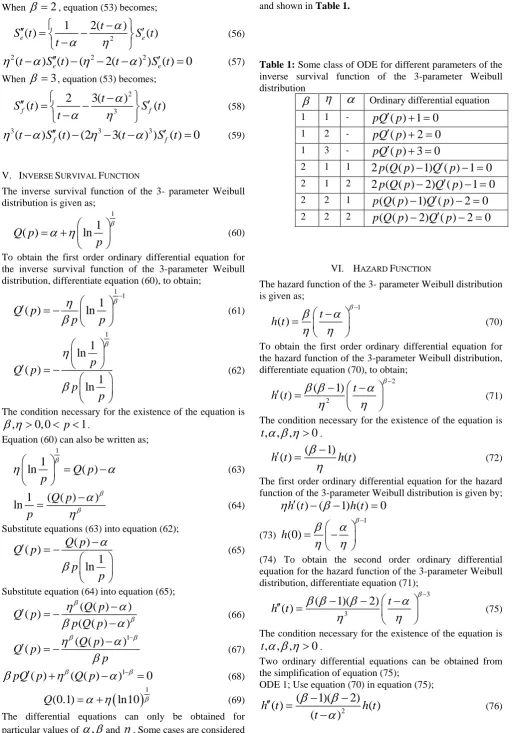
(69)The differential equations can only be obtained for
,
[image:4.595.45.560.51.784.2]and shown in Table 1.
Table 1: Some class of ODE for different parameters of the inverse survival function of the 3-parameter Weibull distribution
Ordinary differential equation1 1 -
pQ p
( ) 1
0
1 2 -
pQ p
( )
2
0
1 3 -
pQ p
( ) 3
0
2 1 1
2 ( ( ) 1)
p Q p
Q p
( ) 1
0
2 1 2
2 ( ( ) 2)
p Q p
Q p
( ) 1
0
2 2 1
p Q p
( ( ) 1)
Q p
( ) 2
0
2 2 2
p Q p
( ( ) 2)
Q p
( ) 2
0
VI. HAZARD FUNCTION
The hazard function of the 3- parameter Weibull distribution is given as;
1
( )
t
h t
(70) To obtain the first order ordinary differential equation for the hazard function of the 3-parameter Weibull distribution, differentiate equation (70), to obtain;2 2
(
1)
( )
t
h t
(71) The condition necessary for the existence of the equation is, , ,
0
t
.(
1)
( )
( )
h t
h t
(72)The first order ordinary differential equation for the hazard function of the 3-parameter Weibull distribution is given by;
h t
( ) (
1) ( )
h t
0
(73)1
(0)
h
(74) To obtain the second order ordinary differential equation for the hazard function of the 3-parameter Weibull distribution, differentiate equation (71);3 3
(
1)(
2)
( )
t
h t
(75) The condition necessary for the existence of the equation is, , ,
0
t
. Two ordinary differential equations can be obtained from the simplification of equation (75); ODE 1; Use equation (70) in equation (75);2
(
1)(
2)
( )
( )
(
)
h t
h t
t
2
(
t
)
h t
( ) (
1)(
2) ( )
h t
0
(77) ODE 2; Use equation (71) in equation (75)
( )
(
2)
( )
(
)
h t
h t
t
(78)(
t
) ( ) (
h t
2) ( )
h t
0
(79)2 2
(
1)
(0)
h
(80) To obtain the third order ordinary differential equation for the hazard function of the 3-parameter Weibull distribution, differentiate equation (75);4 4
(
1)(
2)(
3)
( )
t
h t
(81)The condition necessary for the existence of the equation is
, , ,
0
t
. Three ordinary differential equations can be obtained from the simplification of equation (81); ODE 1; Use equation (70) in equation (81);3
(
1)(
2)(
3)
( )
( )
(
)
h t
h t
t
(82)3
(
t
)
h t
( ) (
1)(
2)(
3) ( )
h t
0
(83) ODE 2; Use equation (71) in equation (81);2
(
2)(
3)
( )
( )
(
)
h t
h t
t
(84) 2(
t
)
h t
( ) (
2)(
3) ( )
h t
0
(85) ODE 3; Use equation (75) in equation (81);(
3)
( )
( )
(
)
h t
h t
t
(86)(
t
)
h t
( ) (
3) ( )
h t
0
(87)3 3
(
1)(
2)
(0)
h
(88)VII. REVERSED HAZARD FUNCTION
The reversed hazard function of the 3- parameter Weibull distribution is given as;
1
e
( )
1 e
tt
t
j t
(89)
To obtain the first order ordinary differential equation for the reversed hazard function of the 3-parameter Weibull distribution, differentiate equation (89), to obtain;
2 1
1
1
2
1
1
e
e
( )
( )
e
(1 e
)
(1 e
)
t
t
t t
t
t
t
t
j t
j t
t
(90) The condition necessary for the existence of the equation is
, , ,
0
t
.1
1
1
( )
( )
e
(1 e
)
t
t
t
t
j t
t
j t
(91)
1
1
( )
t
( )
( )
j t
j t
j t
t
(92)
The differential equations can only be obtained for
particular values of
,
and
. When
1
, equation (92) becomes;1
( )
( )
( )
a a a
j t
j t
j t
(93)
j t
a( )
j t
a( )
j
a2( )
t
0
(94) When
2
, equation (92) becomes;1
( )
( )
( )
b b b
t
j t
j t
j t
t
(95)2 2 2
2 2
(
) ( ) ( (
)
) ( )
(
)
( )
0
b b
b
t
j t
t
j t
t
j
t
(96)Equation (92) is differentiated to obtain;
1
2
2 2
1
( )
( )
( )
1
(
1)
( )
( )
(
)
t
j t
j t
j t
t
t
j t
j t
t
(97) The condition necessary for the existence of the equation is
, , ,
0
1
( )
1
( )
( )
j t
t
j t
j t
t
(98) 11
( )
( )
( )
t
j t
j t
t
f x
(99)1 2
(
1)
1
1
( )
( )
( )
t
j t
j t
t
j t
(100)
2 2
(
1)
1
1
( )
( )
( )
t
j t
j t
t
t
j t
(101) Substitute equations (98) and (101) into equation (97);
2 2
1
1
(
)
( )
( )
( )
( )
1
( )
( )
( )
( )
t
t
j
t
j t
j t
j t
j t
j t
j t
t
j t
(102)
2
2 2
( )
(
1) ( )
( )
( ) ( )
( )
(
)
(
1) ( )
(
1)
( )
j
t
j t
j t
j t j t
j t
t
j t
j t
t
t
(103)
The ODEs can be obtained for the particular values of the distribution. Several analytic, semi-analytic and numerical methods can be applied to obtain the solutions of the respective differential equations [37-51]. Also comparison with two or more solution methods is useful in understanding the link between ODEs and the probability distributions.
VIII. CONCLUDING REMARKS
In this work, differentiation was used to obtain some classes of ordinary differential equations for the probability density function (PDF), quantile function (QF), survival function (SF), inverse survival function (ISF), hazard function (HF) and reversed hazard function (RHF) of the 3-parameter Weibull distribution. In all, the 3-parameters that define the distribution determine the nature of the respective ODEs and the range determines the existence of the ODEs.
ACKNOWLEDGMENT
The authors are unanimous in appreciation of financial sponsorship from Covenant University. The constructive suggestions of the reviewers are greatly appreciated.
REFERENCES
[1] A.M. Razali, A.A. Salih and A.A. Mahdi, “Estimation accuracy of Weibull distribution parameters”, J. Appl. Sci. Res., vol. 5, no.7, pp. 790-795, 2009.
[2] M. Teimouri and A.K. Gupta, “On the Three-parameter Weibull distribution shape parameter estimation”, J. Data Sci., vol.11, pp. 403-414, 2013.
[3] G.W. Cran, “Moment estimators for the 3-parameter Weibull
[4] A. Adatia and L.K. Chan, “Robust estimators of the 3-parameter Weibull distribution”, IEEE Trans. Reliability, vol. 34, no. 4, pp. 347-351, 1985. [5] D. Kundu and M.Z. Raqab, “Estimation of R = P(Y < X) for three-
parameter Weibull distribution”, Stat. Prob. Lett., vol. 79, pp. 1839-1846, 2009.
[6] G.H. Lemon, “Maximum likelihood estimation for the three parameter Weibull distribution based on censored samples”, Technometrics, vol. 17, no. 2, pp. 247-254, 1975.
[7] M. Sirvanci and G. Yang, “Estimation of the Weibull parameters under type I censoring”, J. Amer. Stat. Assoc., vol. 79, pp. 183- 187, 1984.
[8] J. Wyckoff, L.J. Bain and M. Engelhardt, M. (1980) Some complete and censored sampling results for the three-parameter Weibull distribution”, J. Stat. Comput. Simul., vol. 11, no. 2, pp. 139-151, 1980.
[9] S.K. Sinha and J.A. Sloan, “Bayes estimation of the parameters and reliability function of the 3-parameter Weibull distribution”, IEEE
Transc. Reliability, vol. 37, no. 4, pp. 364-369, 1988. [10] E.G. Tsionas, “Posterior analysis, prediction and reliability in
three-parameter Weibull distributions”, Comm. Stat. Theo. Meth., vol. 9, pp. 1435-1449, 2000.
[11] J.R. Hobbs, A.H. Moore and R.M. Miller, “Minimum-distance estimation of the parameters of the 3-parameter Weibull Distribution”, IEEE Transc. Reliability, vol. 34, no. 5, pp. 495-496, 1985.
[12] M.A. Gallagher and A.H. Moore, “Robust minimum-distance estimation using the 3-parameter Weibull distribution”, IEEE Transc. Reliability, vol. 39, no.5, pp. 575-580, 1990.
[13] D.R. Wingo, “Solution of the three-parameter Weibull equations by constrained modified quasi linearization (progressively censored samples)”, IEEE Transc. Reliability, vol. 22, no. 2, pp. 96-102, 1973. [14] H. Hirose, “Maximum likelihood estimation in the 3-parameter
Weibull distribution: A look through the generalized extreme-value distribution”, IEEE Transc. Dielect. Elect. Insul., vol. 3, no. 1, pp. 43-55, 1996.
[15] D.M. Brkic, “Point Estimation of the 3-Weibull parameters based on the appropriated values of the quantiles”, Elektrotehnika Zagreb, vol. 28, no.6, pp. 335-342, 1985.
[16] U. Schmid, “Percentile estimators for the three-parameter Weibull distribution for use when all parameters are unknown”, Comm. Stat. Theo.Meth., vol. 26, no. 3, pp. 765-785, 1997. [17] J.I. McCool, “Inference on the Weibull location parameter”, J. Quality
Tech., vol. 30, no. 2, pp. 119-126, 1998.
[18] V.G. Panchang and R.C. Gupta, “On the determination of three-parameter weibull mle's”, Comm. Stat. Simul. Comput., vol. 18, no. 3, pp. 1037-1057, 1989. [19] E.E. Afify, “A method for estimating the 3-parameter of the Weibull
distribution”, Alex. Eng. J., vol. 39, no. 6, pp. 973-976, 2000. [20] D. Cousineau, “Fitting the three-parameter weibull distribution:
review and evaluation of existing and new methods”, IEEE Transac. Diel. Elect. Insul., vol. 16, no. 1, pp. 281-288, 2009.
[21] G. Tzavelas, “A study of the number of solutions of the system of the log-likelihood equations for the 3-parameter Weibull distribution”, Applications of Maths., vol. 57, no. 5, pp. 531-542, 2012.
[22] H.H. Örkcü, V.S. Özsoy and E. Aksoy, “Estimating the parameters of 3-p Weibull distribution using particle swarm optimization: A comprehensive experimental comparison”, Appl. Math. Computation., vol. 268, pp. 201-226, 2015. [23] H.H. Örkcü, E. Aksoy and M.I. Doʇan, “Estimating the parameters of
3-p Weibull distribution through differential evolution”, Appl. Math. Computation, vol. 251, pp. 211-224, 2015.
[24] Y.M. Li, “A General linear-regression analysis applied to the 3-parameter Weibull distribution. IEEE Transc. Reliability, vol. 43, no. 2, pp. 255-263, 1994. [25] M. Mahmoud, “Bayesian estimation of the 3-parameter inverse
gaussian distribution”, Trabajos de Estadistica, vol. 6, no. 1, pp. 45-62., 1991. [26] H. Itagaki, T. Ishizuka and P.Y. Huang, “Experimental estimation of
the probability distribution of fatigue crack growth lives”, Prob. Engineering Mech., vol. 8, no. 1, pp. 25-34, 1993.
[27] L.C. Tang, Y.S. Sun, T.N. Goh and H.L. Ong, “Analysis of step-stress accelerated-life-test data: a new approach”, EEE Transac. Reliability, vol. 45, no. 1, pp. 69-74, 1996.
[29] A.R. Shahani and M. Babaei, “Helicopter blade reliability: Statistical data analysis and modeling”, Aerospace Sci. Technol., vol. 55, no. 1, pp. 43-48, 2016.
[30] J. Zhao, G. Peng and H. Zhang, “Schedule and cost integrated estimation for complex product modeling based on Weibull distribution”, Proc. IEEE 19th Int. Conf. Computer Supported Cooperative Work in Design, CSCWD, Article number 7230971, pp. 276-280, 2015.
[31] X.Y. Xue, W. Xu and J.H. Li, “Reliability modeling on time between failures of NC machine tools”, Adv. Materials Res., vol. 1028, pp. 145-150, 2014.
[32] N.L. Johnson, S. Kotz and N. Balakrishnan, Continuous univariate distributions, Wiley New York. ISBN: 0-471-58495-9, 1994. [33] W.P. Elderton, Frequency curves and correlation, Charles and Edwin
Layton. London, 1906.
[34] H. Rinne, Location scale distributions, linear estimation and probability plotting using MATLAB, 2010.
[35] N. Balakrishnan and C.D. Lai, Continuous bivariate distributions, 2nd edition, Springer New York, London, 2009.
[36] N.L. Johnson, S. Kotz and N. Balakrishnan, Continuous Univariate Distributions, Volume 2. 2nd edition, Wiley, 1995.
[37] S.O. Edeki, H.I. Okagbue , A.A. Opanuga and S.A. Adeosun, “A semi - analytical method for solutions of a certain class of second order ordinary differential equations”, Applied Mathematics, vol. 5, no. 13, pp. 2034 – 2041, 2014.
[38] S.O. Edeki, A.A Opanuga and H.I Okagbue, “On iterative techniques for numerical solutions of linear and nonlinear differential equations”, J. Math. Computational Sci., vol. 4, no. 4, pp. 716-727, 2014. [39] A.A. Opanuga, S.O. Edeki, H.I. Okagbue, G.O. Akinlabi, A.S.
Osheku and B. Ajayi, “On numerical solutions of systems of ordinary differential equations by numerical-analytical method”, Appl. Math. Sciences, vol. 8, no. 164, pp. 8199 – 8207, 2014.
[40] S.O. Edeki , A.A. Opanuga, H.I. Okagbue , G.O. Akinlabi, S.A. Adeosun and A.S. Osheku, “A Numerical-computational technique for solving transformed Cauchy-Euler equidimensional equations of homogenous type. Adv. Studies Theo. Physics, vol. 9, no. 2, pp. 85 – 92, 2015.
[41] S.O. Edeki , E.A. Owoloko , A.S. Osheku , A.A. Opanuga , H.I. Okagbue and G.O. Akinlabi, “Numerical solutions of nonlinear biochemical model using a hybrid numerical-analytical technique”, Int. J. Math. Analysis, vol. 9, no. 8, pp. 403-416, 2015.
[42] A.A. Opanuga , S.O. Edeki , H.I. Okagbue and G.O. Akinlabi, “Numerical solution of two-point boundary value problems via differential transform method”, Global J. Pure Appl. Math., vol. 11, no. 2, pp. 801-806, 2015.
[43] A.A. Opanuga, S.O. Edeki, H.I. Okagbue and G. O. Akinlabi, “A novel approach for solving quadratic Riccati differential equations”, Int. J. Appl. Engine. Res., vol. 10, no. 11, pp. 29121-29126, 2015. [44] A.A Opanuga, O.O. Agboola and H.I. Okagbue, “Approximate
solution of multipoint boundary value problems”, J. Engine. Appl. Sci., vol. 10, no. 4, pp. 85-89, 2015.
[45] A.A. Opanuga, O.O. Agboola, H.I. Okagbue and J.G. Oghonyon, “Solution of differential equations by three semi-analytical techniques”, Int. J. Appl. Engine. Res., vol. 10, no. 18, pp. 39168-39174, 2015.
[46] A.A. Opanuga, H.I. Okagbue, S.O. Edeki and O.O. Agboola, “Differential transform technique for higher order boundary value problems”, Modern Appl. Sci., vol. 9, no. 13, pp. 224-230, 2015. [47] A.A. Opanuga, S.O. Edeki, H.I. Okagbue, S.A. Adeosun and M.E.
Adeosun, “Some Methods of Numerical Solutions of Singular System of Transistor Circuits”, J. Comp. Theo. Nanosci., vol. 12, no. 10, pp. 3285-3289, 2015.
[48] A.A. Opanuga, E.A. Owoloko, H.I. Okagbue, “Comparison Homotopy Perturbation and Adomian Decomposition Techniques for Parabolic Equations,” Lecture Notes in Engineering and Computer Science: Proceedings of The World Congress on Engineering 2017, 5-7 July, 2017, London, U.K., pp. 24-27.
[49] A. A. Opanuga, E.A. Owoloko, H. I. Okagbue, O.O. Agboola, "Finite Difference Method and Laplace Transform for Boundary Value Problems," Lecture Notes in Engineering and Computer Science: Proceedings of The World Congress on Engineering 2017, 5-7 July, 2017, London, U.K., pp. 65-69.
[50] A.A. Opanuga, H.I. Okagbue, O.O. Agboola, "Irreversibility Analysis of a Radiative MHD Poiseuille Flow through Porous Medium with Slip Condition," Lecture Notes in Engineering and Computer Science: Proceedings of The World Congress on Engineering 2017, 5-7 July, 2017, London, U.K., pp. 167-171.
[51] A.A. Opanuga, E.A. Owoloko, O.O. Agboola, H.I. Okagbue, "Application of Homotopy Perturbation and Modified Adomian Decomposition Methods for Higher Order Boundary Value Problems," Lecture Notes in Engineering and Computer Science: Proceedings of The World Congress on Engineering 2017, 5-7 July, 2017, London, U.K., pp. 130-134.