Original Article
Risk of developing cancers due to low-dose radiation
exposure among medical X-ray workers in
China-results of a prospective study
Furu Wang1*, Quanfu Sun2*, Jin Wang1, Ningle Yu1
1Jiangsu Provincial Center for Disease Prevention and Control, 172 Jiangsu Road, Nanjing 210029, China; 2 Na-tional Institute for Radiological Protection, China CDC, Beijing 100088, China. *Equal contributors.
Received May 2, 2016; Accepted May 20, 2016; Epub November 1, 2016; Published November 15, 2016
Abstract: Previous studies have reported that occupational exposure to radiation has predisposed the workers to various types of cancers. The current study was done to determine the relative risk of developing different types of cancers among medical X-ray workers in China. We adopt cohort study to investigate the incidence of cancer among 3,961 medical diagnostic X-ray workers and 3,742 medical workers who were not engaged in radiation work during 1950~2011 in Jiangsu, and analysis the relative risk (RR) of cancer by Poisson regression model. We found the significant relationship between the risk of malignant tumor and occupational radiation factor (RR = 1.31, 95% CI: 1.11-1.55 for solid cancer and RR = 1.33, 95% CI: 1.13-1.57 for total malignant tumor). In addition, the risk of lung cancer in medical diagnostic X-ray workers was significantly higher than that in control group (RR = 1.45, 95% CI: 1.00-2.09).
Keywords: Cancer, occupational exposure, radiation, risk factor, X-ray
Introduction
Chinese occupational health experts are inten-sifying efforts to improve workers’ health and establish a modern occupational health pro-gram. The use of diagnostic and therapeutic procedures in radiology and nuclear medicine in China has increased continuously with the annual per capita dose doubling over the past two decades [1]. Increases in PET imaging and bone scans were the major contributors to the increasing frequency and magnitude of radia-tion exposure to the popularadia-tion. There is report-ed increase of the occupational diseases such as occupational lung disease, occupational cancer, heavy metal poisoning, industrial che- mical poisoning, and physical factor-induced diseases (noise and heat) have all been on the rise and thus targeted for expanded research, which will serve as a basis for standard setting. Previous studies have shown that occupational exposure to radiation has predisposed the workers to various types of cancers. However,
the findings have been inconclusive. Hence, our
current study explored to determine the risk of
incidence of various types of cancers due to radiation exposure among the health staff working in hospitals. The objective of the study was to determine the relative risk of developing different types of cancers among the health staff working in environments exposed to radiations.
Materials and methods
Recruitment
any kind of cancers at the time of recruitment
or within first five years thereafter. After the
recruitment, the participants were divided into two groups based on their working environ-ment. Among them, 3919 persons were invo- lved in the job of diagnostic X-ray imaging in the department of radiology of the selected hospi-tals and were assigned into exposure group while the other 3715 participants were assi- gned into non-exposure group. In order to re- duce the potential of survival bias, the medical records of those workers, who died or was diag-nosed with any kind of cancer between 1950 and 1980 were also collected and used to gather relevant information on socio-demo-graphics, occupational details and exposure to low-dose ionizing radiation. A structured ques-tionnaire was used to collect information re- garding socio-demographic, occupational and low dose ionizing radiation exposure, by face-to-face interview.
Follow up
After the baseline survey, all the cancer free participants were encouraged to attend the four follow up surveys which conducted at 1986, 1991, 1996 and 2011 respectively. The current study reported the data collected between 1981 and 2011. During the follow up period, information regarding whether the
and relevant medical and death record could not be accessed/found.
Measures
The person-time of stay in the study for each participant was calculated. If the participants stayed in the study and did not develop any kind of cancers during the study period, their person-times were calculated as the time from joining the work to the last follow up. If a partici-pant were dead for other reasons except can-cers, the time periods between the date of join-ing the work and death were taken as his/her person-time. If a participant was lost to follow up, the time period between the latest follow-up and date of joining the work was treated as his/her person-time.
During the study period, if any participant was
diagnosed with any kind of cancer, the first diagnosed cancer was defined as his/her out -come, according to ICD 10 and the details of time, basis and healthcare provider involved in diagnosis were recorded by asking the partici-pants and/or checking the medical records. Mode of diagnosis included: pathological/surgi-cal/radiological/clinical. The time period bet-
ween the time that the first cancer was diag -nosed and date of joining the work was treated as his/her person-time. In our study, solid can-Table 1. Demographic characteristics and exposure status of the
recruited medical workers in Jiangsu, China (N = 7703),
1950-2011
Variable Exposure status Number Person-time Mean SD Exposure status Exposed 3961 149089
Unexposed 3742 166220 Total 7703 315309 Gender Male Exposed 3299 123622 Unexposed 2610 116733 Total 5909 240355 Female Exposed 662 25467
Unexposed 1132 49487 Total 1794 74954
Age at the end of the study Exposed 67.4 8.8
Unexposed 71.6 9.4
Total 69.4 9.3
Age at the recruitment Exposed 27.1 6.4
Unexposed 23.6 5
Total 25.4 6
participants were diagnosed wi- th any kind of cancer was col-lected. When the participant reported that he/she was diag-nosed for any kind of cancer during the study period, infor-mation on the tumor type, date of diagnosis and stage of the disease during diagnosis was also collected. If any partici-pants were censored, their me- dical histories were collected from the selected hospital, to investigate whether they were dead. If they were dead during the study period and censored, their medical history, likely ca- use of death and date of death were collected from the record system of the corresponding hospital. In our study, loss to
[image:2.612.91.365.109.332.2]cer was defined as all the malignant tumors
that occurred except leukemia.
Statistical analysis
Data was double-entered using the softwa- re EpiData 3.0 [2] and multiple logic checks were used to ensure the quality of data. SAS version 9.1 [3] and STATA version 13.0 were used for data analysis. Descriptive analyses were conducted to determine the distributi- on of the demographic factors, cancer preva-lence and the evidence to judge the state of the related cancers. In addition, we performed Poisson regression model to analysis the
rela-tive risk (RR) and 95% confidence interval (CI)
of the exposure by using the following model: e(α*gender+β*age+γ*exposed), adjusted by, age, working
time and gender. In this model, exposure refers
to the exposure status of the participants (1 = exposed, 0 = unexposed).
Since the working environment changed a lot and different kinds of protection equipments
from each participant or their legally authorized representatives (if subjects were sick/dead) prior to the interviews/medical record check-ing. Each of the participants had the discretion to freely decline or withdraw from this survey at
any point of time. The filled-in questionnaires,
written consent documents and computerized data were properly secured.
Results
Demographic characteristics and exposure status
Between the year of 1950 and 2011, overall of 7703 healthcare workers were recruited and followed up, with a total person-time of 315,309 person years. Among them, 3961 were catego-rized as exposed to long-term low dose ionizing radiation while 3742 were unexposed. In our study, only 533 participants were lost-to-follow-up (259 among exposed and 274 among
unex-posed), with an overall retention rate of 93.1% (overall lost-to-follow-up being only about 6.9%).
were implemented, the interest-ed exposure may have different effect on the participants that started to work at different time,
we further performed stratified
logistic regression analysis to know the relative risk of working environmental radiation on dif-ferent kinds of cancers. We str-
atified on age that started to
work (less than 15/15-18/19-24/25-29/30 or more) and the year started to work (before 1960/1960-1969/1970 and la-
ter). In stratified analysis, due to
the limited number of cancer cases, we only selected lung cancer, solid cancer and all can-cers as the outcomes. Gender and aged were further adjusted
in the stratified analysis.
Ethical statement
[image:3.612.91.368.109.290.2]The study process and content were approved by the Ethical Committee of Jiangsu Provincial Center for Disease Prevention and Control (JSCDC). Signed informed consent was obtained Table 2. Number of tumor/cancer, death and cancer related
death among participants in a cohort that involved in health
worker in Jiangsu, China (N = 7703), 1950-2011
Variable Exposure status Number Percentage (%) (%)
Tumor Exposed 444 11.21
Unexposed 375 10.02
Total 819 10.63
Malignant tumor/Cancer Exposed 415 10.48 Unexposed 356 9.51
Total 771 10.00
Death Exposed 587 14.82
Unexposed 618 16.52 Total 1205 15.64 Cancer related death Exposed 296 7.47
Unexposed 257 6.87
Total 553 7.18
Table 3. Tumor diagnosis evidence in a cohort involving health
workers in Jiangsu, China (N = 7703), 1950-2011
Diagnosis method Number Percentage Pathological/cellular/surgical evidence 610 74.48 Radiological, CT and ultrasound evidence 195 23.81
Clinical symptoms 14 1.71
[image:3.612.88.368.338.406.2]The mean age of the participants at the time of the recruitment (time of joining the work) was 25.4±6.0 years old, while the mean age in the exposure group was a little higher (27.1±6.4 years old in the exposed group and 23.6±5.0 years old in the unexposed group). However, at the end of the follow up, the mean age of unex-posed group was higher than exunex-posed group (71.6±9.4 VS 67.4±8.8), while the overall mean age at the end of the study was 69.4±9.3. Table 1 presents the demographic information of the participants.
Cancer incidence proportion and tumor diag-nosis evidence
In our study, during the follow up period, a to-
tal of 819 tumor cases were identified, with
an overall tumor incidence proportion of
10.63%. Among these 819 tumor cases, 771 (94.14%) were malignant tumors (cancers) of
which, 444 belong to the exposure group (415 malignant tumor/cancer cases), with a tumor
incidence proportion of 11.21% (444/3961). A total of 375 tumor cases were identified in
non-exposure group (356 malignant tumor cases),
with a tumor incidence proportion of 10.02%
(375/3742) (Table 2). Table 2 presents the total number of death in both exposed and unexposed group. From the table, we can know that about half (553/1205) of the observed deaths were related to different kinds of can-cers. In our study, the detailed evidence to diag-nose the cases included pathological, cellular
and surgical evidence (610 cases, 74.48%),
Exposure relative risk
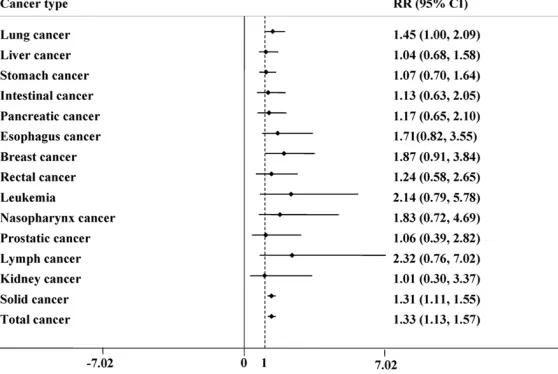
The results of logistic regression demonstrated that even after controlling for age, gender, the working age, the exposure group had higher risk in develop lung cancers, with RR of 1.45
(95% CI: 1.00-2.09) (Figure 1). In addition,
working environmental exposure had a signifi -cantly positive association with solid cancers
(RR=1.31, 95% CI: 1.11-1.55) and all cancers (RR=1.33, 95% CI: 1.13-1.57). Our study also
found that radiation was positively associated with breast cancer, esophagus cancer, leuke-mia and lymphoma, even though they were not
significant.
In stratified analysis, after stratification on the
age at which started working, we found that the participants who started to work at about 15-18years of age had the highest relative risk
in development of lung cancer (RR = 3.21, 95%
CI: 1.25-8.28). For solid cancer and overall
can-cer, significantly positive associations were
found in 25-29 age group, with RR for solid
can-cers and overall cancan-cers of 1.40 (95% CI: 1.06-1.85) and 1.40 (95% CI: 1.07-1.06-1.85), respective -ly (Table 4).
In the models that stratified on the age at which
started to work, we found that the interested
exposure was significantly positive associated
with lung cancer among participants who start-ed to work between the years of 1960-1969.
For solid cancer and overall cancer, significantly
[image:4.612.96.375.75.262.2]positive associations were found in the groups of 1960-1969 and 1970 and later (Table 5).
Figure 1. The results of logistic regression of the cancer relative risk (RR).
radiological, CT and ultra-sound evidence (195 cases,
23.81%), and clinical symp
-toms (14 cases, 1.71%) (Table 3). Among the cancer cases,
the top five cancers were lung
cancer (83 VS 71 between exposed and unexposed gro- up), liver cancer (67 VS 55), stomach cancer (60 VS 60), colorectal cancer (22 VS 25) and pancreatic cancer (21 VS 25), which accounted for ab-
out 64.72% of the overall
Discussion
As a potential carcinogen, working environmen-tal radiation has been studied well in many countries [4]. Cardis et al. conducted a cohort studies among radiation workers in 15 coun-tries, and reported that working environment radiation, even at a low dose may increase the
risk of developing cancers [4]. One study con -ducted among workers employed in 15 facili-ties that generate nuclear power in the United States reported that even though there was no correlation between radiation and different kinds of cancers (May due to the younger age of the participants), a positive correlation was found between radiation and cardiovascular [5].
Several earlier studies have reported the cor-relation between X-ray radiation and cancers in health working environment [6, 7]. A study by Alice et al., between the years of 1983 and 1998 reported that health staff working in an environment of radiation might increase the potential risk of breast cancers [6]. Another
study conducted in Japan and other five coun -tries among 270,000 participants also
identi-fied positive correlation between health staff
working in a radiation environment and leuke-mia [7]. Chobanova also reported that the radi-ology health staff working have increased risk
of cancers, particular for breast cancer [8]. Our
study has been conducted for more than 30 years, from the time the participants were recruited way back in 1981.
In our study, we found that the majority of the participants were male, particularly in the de-
partment of radiology (Male: female = 3.29:1).
We also found that the participants in the expo-sure group were elder than the non-expoexpo-sure group (27.1±6.4 VS 23.6±5.0). This age differ-ence can be explained by the evolution of health care staff in China between 1950 and 1980. After 1950, many hospitals in China started to establish the department of radia-tion, while the health workers in the depart-ment of radiation were experienced doctors transferred from the other departments in the same hospital.
Overall, 771 developed cancers (415 in expo -sure group and 356 in control group). After con-trolling for potential confounders, we found that the exposure was positively correlated with solid cancer and all cancers. These results
were similar with the findings of the previous
[image:5.612.88.524.109.202.2]round follow up, which was conducted at 1996 [9]. However, the present study is much stron-ger than the previous reports, since it has had a longer follow up period, more cases and col-lected more person-years (215, 355 VS 315, 309 person-years).
Table 4. Relative risk of working environmental radiation on different kinds of cancers after stratified on age at work: results from a cohort involving health workers in Jiangsu, China (N = 7703),
1950-2011
Age at work Lung Cancer Solid Cancer All Cancers
Case number RR (95% CI) Case number RR (95% CI) Case number RR (95% CI)
<15 0 - 3 3.17 (0.29-34.93) 3 3.17 (0.29-34.93)
15-18 18 3.21 (1.25-8.28) 64 1.18 (0.67-2.10) 66 1.12 (0.63-1.99) 19-24 41 1.70 (0.91-3.17) 238 1.26 (0.97-1.64) 245 1.25 (0.97-1.62) 25-29 42 1.24 (0.66-2.31) 209 1.40 (1.06-1.85) 215 1.40 (1.07-1.85) ≥30 53 0.80 (0.43-1.50) 234 1.18 (0.85-1.64) 242 1.23 (0.89-1.71)
Table 5. Relative risk of working environmental radiation on different kinds of cancers after
strati-fied on the year started to work: results from a cohort involving health workers in Jiangsu, China (N =
7703), 1950-2011
Year at work Lung Cancer Solid Cancer All Cancers
Case number RR (95% CI) Case number Case number RR (95% CI)
<1960 22 - 72 1.39 (0.75-2.58) 77 1.54 (0.86-2.75)
[image:5.612.88.524.260.329.2]Our study also found that the exposure group had significant higher risk in develop lung can
-cer (RR = 1.45, 95% CI: 1.00-2.09). After per
-forming the stratified analysis, we also found
that the participants in the exposure group who started working at a young age (18 or below) or after 1960 also had a higher risk in developing
lung cancer. Similar findings were also present -ed in the group of solid cancers and all cancers.
One potential reason for this phenomenon is
dose response, since the participants who at the early age were exposed to the radiations than the other health workers, and in turn had higher risk in developing cancers. The correla-tion between risk of cancer and the time of attending work can be explained by the devel-opment of Chinese medical systems. After 1970, X-rays became a popular diagnostic tool and it was widely used by different hospitals in China. However, due to the lack of awareness on protective measures and the lack of protec-tion equipments, the health workers were sel-dom protected, which may potentially increase their risk for cancers. The long latent period of lung cancer could be the main reason for this, as with the increase of age, the risk of develop-ing lung cancer is also increased.
As rare diseases, limited numbers of cancer
cases were identified in our study and this in
turn limited our ability to evaluate the correla-tion between working environmental radiacorrela-tion and different kinds of cancers. In spite of this, we still found out that the majority of the RRs were larger than one. This potentially indicates that the working environmental radiation may
increase the risk of develop these specific can -cers, particularly for esophagus cancer, breast cancer, leukemia and lymph cancer. As a cohort study, we had certain strengths: large sample size, long term follow up, representative
unex-posed group, efficient use of existing medical
records to reduce the potential for survival bias, allowing for induction time and latency
period by using five year cut-point to reduce the potential misclassification of the outcomes,
opportunity to study several types of cancers, and the high retention rate of the cohort. As an observational study, our study also had
several limitations, which may have influenced
the validity of our study. First, the selection bias induced by loss to follow up may have poten-tially biased our results. Second, at the
begin-ning of our study, we did not collect information on alcohol drinking, smoking and other poten-tial confounders, which limited our ability to control the potential confounding in our study. In addition, we did not measure the dose of radiation for each participant, which might
have introduced some exposure misclassifica -tion, and limited our ability to detect the dose-response between the exposure and different kind of cancers. Even with these limitations, we can still conclude that the health staff exposed to a radiation environment at work may poten-tially increase the risk of lung cancer, solid can-cers and total cancan-cers; it may also increase the
risk of other specific cancers.
Conclusions
The incidence risk of lung cancer, solid caner and total malignant tumor in medical
diagnos-tic X-ray workers was significantly higher than
the control group in China. Recommendations
Further study by conducting systematic radia-tion dose estimaradia-tion and dose-effect analysis is particularly important for epidemiological studies to radiation carcinogenesis. Also, potential intervention methods that can be used to bring down the risks are urgently need-ed, in order to reduce the potential risk of dif-ferent cancers.
Acknowledgements
This work was supported by Social develop-ment projects and Technology Support Program
of Jiangsu Province (NO. BE2009684), “Twelfth
Five” Science and Education Health Project
“Innovation Platform for Public Health Emerge-ncy Preparedness and Response” (NO.
ZX20-1109) and National health industry research
and special projects (NO. 201002009). Disclosure of conflict of interest
None.
Address correspondence to: Ningle Yu, Jiangsu Pro- vincial Center for Disease Prevention and Control, 172 Jiangsu Road, Nanjing 210029, China. E-mail: [email protected]
References
procedures in Shanghai, China. Nucl Med Commun 2012; 33: 331-336.
[2] Lauritsen J, Bruus M. EpiData (version 3). A comprehensive tool for validated entry and documentation of data Odense: EpiData Asso -ciation; 2003.
[3] Institute S. The SAS system for Windows. SAS Institute Cary: NC; 1996.
[4] Cardis E, Vrijheid M, Blettner M, Gilbert E, Hakama M, Hill C, Howe G, Kaldor J, Muirhead CR, Schubauer-Berigan M, Yoshimura T, Ber-mann F, Cowper G, Fix J, Hacker C, Heinmiller B, Marshall M, Thierry-Chef I, Utterback D, Ahn YO, Amoros E, Ashmore P, Auvinen A, Bae JM, Solano JB, Biau A, Combalot E, Deboodt P, Diez Sacristan A, Eklof M, Engels H, Engholm G, Gu-lis G, Habib R, Holan K, Hyvonen H, Kerekes A, Kurtinaitis J, Malker H, Martuzzi M, Mastaus-kas A, Monnet A, Moser M, Pearce MS, Rich-ardson DB, Rodriguez-Artalejo F, Rogel A, Tardy H, Telle-Lamberton M, Turai I, Usel M, Veress K. Risk of cancer after low doses of ionising radi-ation: retrospective cohort study in 15 coun-tries. BMJ 2005; 331: 77.
[5] Howe GR, Zablotska LB, Fix JJ, Egel J, Buchan-an J. Analysis of the mortality experience among US nuclear power industry workers af-ter chronic low-dose exposure to ionizing radia-tion. Radiat Rese 2004; 162: 517-526.
[6] Mettler FA Jr, Bhargavan M, Faulkner K, Gilley DB, Gray JE, Ibbott GS, Lipoti JA, Mahesh M, McCrohan JL, Stabin MG, Thomadsen BR, Yo-shizumi TT. Radiologic and nuclear medicine studies in the United States and worldwide: frequency, radiation dose, and comparison with other radiation sources--1950-2007. Ra-diology 2009; 253: 520-531.
[7] Yoshinaga S, Mabuchi K, Sigurdson AJ, Doody MM, Ron E. Cancer risks among radiologists and radiologic technologists: review of epide-miologic studies. Radiology 2004; 233: 313-321.
[8] Chobanova N, Vukov M, Yagova A. Cancer inci-dence among Bulgarian medical radiation workers: epidemiological study. J BUON 2006; 12: 65-69.