4-81-9
Exploitation of the Mycoparasitic Fungus Pythium oligandrum
in Plant Protection
JANA BROOVÁ
Research Institute of Crop Production Division of Plant Medicine, Prague-Ruzynì, Czech Republic
Abstract
BROOVÁJ. (2002): Exploitation of the mycoparasitic fungus Pythium oligandrum in plant protection. Plant Protect. Sci.,
38: 2935.
Pythium oligandrum Drechs. belongs to the order Oomycetes. It is parasitic on many fungi from the same or other orders. The antagonism of P. oligandrum is a multifaceted process dependent on the target species involved. P. oligandrum is nonpathogenic on 12 species of crops from six families. It does not attack their tissue but occurs on the root surface, predominantly in the regions of hypocotyl – taproot, together with plant pathogenic fungi. It utilises the root exudates and fungus hyphae on the root surface, including those of the plant pathogens, for its own support. A growth stimulation of plants was observed. P. oligandrum can be utilised for biological control on a wide spectrum of crop plants. Different methods of application have been developed. The effect of a mycoparasite preparation is more preventive.
Keywords: biological control; soil fungi; antagonism; rhizosphere; growth stimulation; Botrytis cinerea
The importance of plant protection in modern agricul-ture increases as crop yields and concerns about produc-tion quality rise. Plant protecproduc-tion should be sufficiently effective, affordable and considerate of the environment. Integrated pest management takes advantage of a com-plex of methods with minimal effect on harmless organ-isms. The integration of biological with chemical control has a potential for success because of a possible syner-gism of effects.
It is necessary to look for organisms suitable for use in biological control, and to study the mechanisms of their action and the optimal conditions for applying them in plant protection and integrated management systems. One of such organisms is Pythium oligandrum.
Hosts of the mycoparasitePythium oligandrum
Pythium oligandrum Drechs. is a soilborne fungus
be-longing to the order Oomycetes. It is able to live as a sa-prophyte, but is antagonistic to and parasitic on many
fungi from the same or other orders (Table 1). It can pene-trate their hyphae and live on the contents.
Some genera, species and isolates of fungi are more
susceptible to attack by P. oligandrum than others. Some of the attacked ones (e.g. P. aphanidermatum [Edson] Fitzpatrick) are able to wind around and penetrate the mycoparasitic hyphae (CHANG et al. 1993).
For producers of mushrooms could be important that
P. oligandrum inhibited the growth of Agaricus bisporus
(Lange) Singer, especially in mushroom compost with a high nitogen level (FLETCHER et al. 1990).
Mycoparasitism of Sclerotinia sclerotiorum (Lib.) de Bary sclerotia by the three mycoparasitic species of the genus Pythium, including P. oligandrum, was not detect-ed (RIBEIRO & BUTLER 1992).
The type of host fungus markedly influences the efficien-cy of detection of different mycoparasites. Fusarium
cul-morum (W. G. Sm.) Sacc. is most efficient for P. oligandrum.
Table 1. Host of Phytium oligandrum Drechs.
Hosts of Pythium oligandrum Reference
Agaricus bisporus (Lange) Singer FLETCHER et al. 1990 Aphanomyces cochlioides Drechs. MCQUILKEN et al. (1990) Botryotrichum piluliferum Sacc. et March LAING & DEACON (1991 Botrytis cinerea Pers. ex Fr. LAING & DEACON (1991
Fusarium culmorum (W. G. Sm.) Sacc. LAING & DEACON (1991); MULLIGAN & DEACON (1992) Fusarium oxysporum Schlecht.: Fr. LAING & DEACON (1991)
Fusarium oxysporum f.sp. radicis-lycopersici Ja. et S. BENHAMOU et al. (1999) Fusarium solani f.sp. pisi (Hall/Linf.) Sny. Ha BRADSHAW-SMITH et al. (1991) Gaeumannomyces graminis (Sacc.) v. Arx et Olivier VESELÝ & KOUBOVÁ (1993) Mycosphaerella pinodes (Berk. et Blox.) Stone BRADSHAW-SMITH et al. (1991) Ophiostoma sp. Syd. et P. Syd. ÈÍOVÁ & VECOVÁ (1997)
Phialophora sp. Medlar FOLEY & DEACON (1986); LAING & DEACON (1991) Phoma medicaginis var. pinodella (Jones) Boer. BRADSHAW-SMITH et al. (1991)
Phytophthora megasperma Drechs. BENHAMOU et al. (1999) Pythium aphanidermatum (Edson) Filtzpatrick CHANG et al. (1993)
Pythium graminicola Subramanian CHANG et al. (1993); LAING & DEACON (1991) Pythium irregule Buisman HE et al. (1992)
Pythium nunn Lifshitz et al. LAING & DEACON (1991) Pythium spinosum Sawada HE et al. (1992)
Pythium ultimum Trow HE et al. (1992); CHANG et al. (1993); MCQUILKEN et al. (1990) Pythium vexans de Bary CHANG et al. (1993); LAING & DEACON (1991)
Rhizoctonia solani Kühn HE et al. (1992); LAING & DEACON (1991) Trichoderma aureoviride Rifai LAING & DEACON (1991)
Verticillium albo-atrum Reinke et Berthold BENHAMOU et al. (1999)
Antagonism by Pythium oligandrum
The different interactions between Pythium oligandrum and the various plant pathogens show that the antago-nism of P. oligandrum is not a simple process mediated by one simple antimicrobial metabolite. Instead, the stud-ies suggest that each interaction is mediated by highly specific events that ultimately determine the outcome of the interaction. From the scope of ultrastructural and cy-tochemical changes it is evident that the antagonism is a multifaceted process and dependent on the target species involved (BENHAMOU et al. 1999).
Various antagonistic behaviours are found under dif-ferent support conditions (BRADSHAW-SMITH et al. 1991). Growth inhibition of the host mycelium was most pronounced, particularly at high nitrogen levels, when the partners were inoculated simultaneously or if P.
oli-gandrum was inoculated 3 or 5 d earlier. Inoculation with
the mycoparasite 5 d later had no apparent effect on growth of the host fungus (FLETCHER et al. 1990).
The structural changes in hyphae of the pathogens
Py-thium ultimum, P. aphanidermatum, Fusarium oxysporum
f.sp. radicis-lycopersici, Verticillium albo-atrum and
Rhizoctonia solani occurred soon after contact with the
antagonist P. oligandrum. The intimate contact between both partners precedes a sequence of degradation events including aggregation of host cytoplasm and penetration of the altered host hyphae. P. oligandrum grew abundantly on hyphae of a plant pathogen and colonised the agar medium. When transferred to fresh medium, P.
oligan-drum mycelium continued to grow abundantly, while
hyphae of the plant pathogen were unable to grow (BEN
-HAMOU et al. 1999).
In the case of Phytophthora megasperma, hyphal in-teractions did not occur. Its hyphae stopped growing on the first day after inoculation. The morphologic changes of the hyphae were visible at the edge of the colony of the host. Its cells were severely damaged even though there was no contact between hyphae of antagonist and plant pathogen. In most cases the cytoplasm was reduced to some aggregated or vesicular remnants. By contrast, the wall structure appeared preserved (BENHAMOU et al. 1999).
-LEY & DEACON (1986) did not detect a production of toxins.
BENHAMOU et al. (1999) found by light and electron microscopy that hyphae of P. oligandrum established close contact with the plant pathogen host Rhizoctonia
solani by frequent coiling around the hyphae early on
during parasitism. At this stage of the colonisation pro-cess, no external damage was visible on the intertwined hyphae of the host, although some wrinkles could be seen on their surface. There was an abnormal deposition of amorphous wall-like material at sites of potential pene-tration, but the antagonist was able to circumvent this barrier. The interaction of P. oligandrum and R. solani resulted in disorganisation of most of the cytoplasm of the latter (80%) whereas the thick host wall looked well preserved. At a later stage of the interaction, both plant pathogen and antagonist appeared to suffer from some damage, mainly characterised by a marked loss of turgor and by obvious morphological alterations. In P.
oligan-drum the changes in hyphae consisted of disorganisation
of the cytoplasm.
By video microscopy it was found that hyphae of
P. oligandrum typically coiled around the hyphae of its
hosts and penetrated them after 50 min. Tips of host hy-pha were disrupted up to 1.2 mm ahead of the contact points (BERRY et al. 1993).
Although protoplasm of the host mycelium gradually degenerated as it was affected by the parasite, mycelium was newly developed from the protoplasm remaining in the hypha and this also produced oospores, oogonia, and hyphal swellings inside and outside the plant roots (KI
-NOSHITA & ICHITANI 1996).
Hyphae of P. oligandrum grew along the hyphae walls of host P. ultimum and established tight binding. At this early state of parasitism, the surface of hyphae of P.
ulti-mum was turgescent and the integrity of their surface was
similar to that observed in single cultures. Also in a 2-day-old culture the structural integrity of P. ultimum proto-plasm appeared intact, although close examination found a slight retraction of plasmalemma from the wall. Altera-tion and disorAltera-tion of the hyphal cell wall were visible at sites of potential penetration by the antagonist. Three days after inoculation, active growth of the antagonist was associated with pronounced host hyphae collapse and loss of turgor. At a more advanced stage of the parasitic pro-cess, P. oligandrum growth in host hyphae was very ac-tive and associated with marked host necrosis. Hyphae of the antagonist ramified extensively in host hyphae. Similar changes in host cells were observed in P.
aphani-dermatum (BENHAMOU et al. 1999).
P. oligandrum produced oospores abundantly on the
mycelium of Ophiostoma spp. while part of the P.
oli-gandrum colony obtained the nutrients from a pure agar
medium. Inhibition zones were formed by all isolates test-ed, but the width of the zone was different because the
inhibitory ability of isolates varied (ÈÍKOVÁ & VE
-COVÁ 1997).
P. oligandrum can affect the sporulation of attacked
plant pathogens. It caused a marked reduction in the sporulation of Fusarium culmorum. A significant corre-lation was found between the formation of zoospores of
P. oligandrum and the degradation of Fusarium conidia.
Random contact between hyphae of the mycoparasite and those of the host was followed by cessation of growth of the latter, lysis or vacuolation and coagulation of the cy-toplasm, and penetration and growth of the mycoparasite within the afflicted hyphae. Parasitism of conidia was seen as rapid loss of cytoplasm followed by degradation of the cell walls (HOCKENHULL et al. 1995).
LAING & DEACON (1991) did not observe a pre-con-tact inhibition or tropism between P. oligandrum or P. nunn and their plant pathogen hosts, but susceptible host hy-phae stopped growing soon after contact. This reaction was faster in contacts between host tips and sub-apical regions of parasitic hyphae. Cessation of growth was of-ten followed by lysis of host cells at the contact point or by vacuolation of their contents. Penetration of host hy-phae occured in 69 of 148 interactions that were observed.
Pythium oligandrum in soil and the plant rhizosphere
P. oligandrum occurs on plant roots together with plant
pathogens. It was isolated above all from mineral soils with neutral or slightly acidic pH used for agricultural and horticultural purposes. On a farm where the main crops were wheat, rye, beet and carrot, colonyforming units (CFU) counts were generally high (65.3 CFU/g of soil). A single application of metalaxyl-mancozeb to a crop of carrots reduced these counts to a mean of 23.5 CFU/g of soil. Where rotations included carrots, po-tatoes and parsnips, all of which routinely received sprays of metalaxyl and mancozeb, the fungus either had low CFU counts or was not detected. Populations of P.
oli-gandrum were generally low when barley was a major
component of the rotations (WHITE 1992).
The addition of oospores of P. oligandrum to soil did not raise the number of the mycoparasite in it, even after the 6th introduction when the CFU was 1.2 × 10⁸ in
non-sterile soil in Drigall dishes. On the contrary, its numbers gradually went down while simultaneously the number of the antagonist Mucor piriformis Fisher increased. The spectrum of the other mycoflora was not changed during the experiment (VESELÝ 1997).
P. oligandrum actively colonised the endosperms and
necrosis or reduction in shoot growth was not observed (MARTIN & HANCOCK 1987).
Abundant mycelia of P. oligandrum were found on the root surface of cucumber, but a few hyphae penetrated into the roots. There it can easily attack plant pathogens. One day after sugar beet seeds had been planted in field soil, Pythium ultimum had colonised the seed coats of 77% of the untreated seeds but only 10% of the seeds treated with P. oligandrum. Fungal growth on the sur-face of untreated seeds was minimal, whereas treated seeds were covered with dense mycelium. Colonisation of endosperm and radicle by P. ultimum was also higher for untreated seeds (63–71%) than for treated seeds (3–7%). Endosperms colonised by P. ultimum were often necrotic, and the radicles were infected non soon after emergence (MARTIN & HANCOCK 1987).
Zoospores of the two mycoparasitic species P.
oligan-drum and P. periplocum were not attracted to cucumber
roots and were accumulated on the roots in very low num-bers compared to pathogenic species (WULFF et al. 1998).
P. oligandrum was not a component of the rhizosphere
of cress or sugar beet (MCQUILKEN et al. 1990).
The exploitation of Pythium oligandrum
in plant protection
Pythium oligandrum can be used for biological control
in a wide spectrum of crops because of its ability to at-tack fungal plant pathogens. Different methods of appli-cation, such as inoculation of the seed surface with spores before sowing, soil drench or spraying of plants, have been developed. It was found that an application of the mycoparasite had a more preventive effect on the occur-rence of plant diseases, therefore it is important to add it to an environment as early as possible.
Coating sugar beet seeds with oospores of P.
oligan-drum controlled preemergence damping-off caused by P. ultimum as effectively as treating seeds with
fenami-nosulf. The treatment significantly improved seedling emergence. When field soil naturally infested with P.
ulti-mum was amended with oospores of P. oligandrum, the
emergence of sugar beet seedlings was significantly higher than that of untreated controls (MARTIN & HAN
-COCK 1987).
Seeds of cress and sugar beet were coated with oospores of P. oligandrum using two commercial procedures. Both types of treatment reduced damping-off of cress caused by P. ultimum in artificially infested sand and potting compost and by Rhizoctonia solani in artificially infested sand. The level of control was equivalent to fungicide drenches. Damping-off of sugar beet in soil naturally in-fested with Aphanomyces cochlioides and P. ultimum was also reduced by P. oligandrum. The control was equiva-lent to that achieved with hymexazol fungicide seed coat-ing treatments and was related to inoculum potential of
A. cochlioides in the soil. But Pythium oligandrum can
faile to prevent damping-off in soil naturally infested with
A. cochlioides and a low concentration of P. ultimum too
(WHIPS et al. 1993).
Positive effects against Pythium root rot on tulips were obtained when the antagonist was applied with a sandy soil treatment, but bulb dips were less effective (GREFF
et al. 1992).
Treating tomato seeds with zoospores of P. oligandrum reduced seed rot and damping-off caused by P. ultimum and Rhizoctonia solani by 79% and 64%, respectively (HE et al. 1992).
Seed treatment of chickpea by P. oligandrum was also effective against Pythium seed rot and preemergence damping-off in the field (TRAPERO-CASAS et al. 1990).
Interaction between Pythium oligandrumand plants and growth stimulation of plants
Pythium oligandrum was nonpathogenic on 12 species
of economic crop plants of six families. It does not attack their tissues but utilises root exudates and fungus myce-lia, including plant pathogens, on the root surface for its own nutrition.
When hydroponically grown cucumber seedlings were inoculated with zoospores of P. oligandrum, it caused a reduction in root length during the first 2 days. Later, the treated roots quickly reached the length of the control and on the 8th day and remaining experimental period,
stimulation of root elongation was noted. Pythium
oli-gandrum was not pathogenic on cucumber and no
differ-ences in fresh weight between treatment and control were observed (WULFF et al. 1998).
The responses of cucumber to the mycoparasite P.
oli-gandrum and plant pathogen P. ultimum were similar at
first, but differences became apparent later. Pythium
oli-gandrum stimulated phosphate uptake, whereas P. ulti-mum inhibited it. These effects were reflected in changes
in phosphorus metabolism, although neither organism affected phosphate efflux. Pythium oligandrum caused an increase in the auxin – indole-3-acetic acid (IAA) – content and enhanced plant growth, whereas P. ultimum caused a decrease in IAA content and inhibited growth. The results indicated that the negative effects of P.
oli-gandrum on growth and P-metabolism of cucumber were
only temporary, and that presence of the mycoparasite was beneficial to cucumber (KRÁTKÁ et al. 1994).
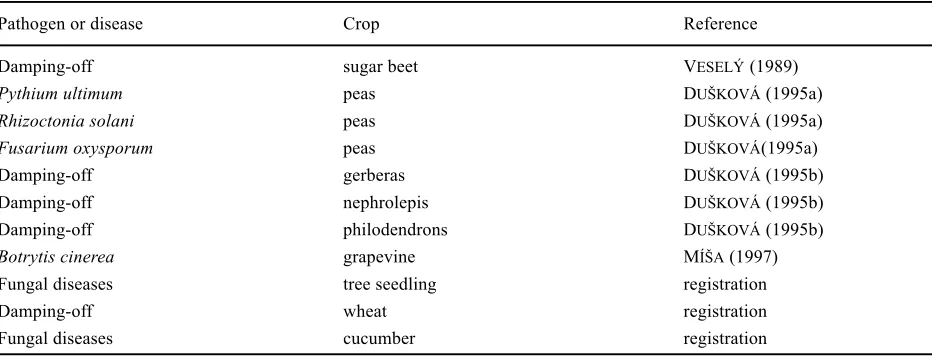
Table 2. Effect of the Pythium oligandrum biopreparation Polyversum
Pathogen or disease Crop Reference
Damping-off sugar beet VESELÝ (1989)
Pythium ultimum peas DUKOVÁ (1995a)
Rhizoctonia solani peas DUKOVÁ (1995a)
Fusarium oxysporum peas DUKOVÁ(1995a)
Damping-off gerberas DUKOVÁ (1995b)
Damping-off nephrolepis DUKOVÁ (1995b)
Damping-off philodendrons DUKOVÁ (1995b)
Botrytis cinerea grapevine MÍA (1997)
Fungal diseases tree seedling registration
Damping-off wheat registration
Fungal diseases cucumber registration
More hyphae of the pathogen P. ultimum than of P.
oli-gandrum penetrated into cucumber roots. Mycelia of both
species and lateral root tissues were stained pale to dark red, depending on the degree of damage (KINOSHITA & ICHITANI 1996).
A treatment of plants with a biopreparation should not only reduce the occurrence of pathogens in the soil, but also prevent infection, for example by stimulation of plant growth. It is evident that a biopreparation including oospores of P. oligandrum has indeed a positive influ-ence on plants even in absinflu-ence of a pathogen.
Polygandron-treated seeds of sugar beet produced healthier plants with both higher germination rate and weight than untreated plants. After treatment an initial retardation in emergence and growth rate was observed until the cotyledons were formed. Afterwards, plant growth was stimulated, with the change from suppres-sion to stimulation occurring at the stage of one to two pairs of true leaves. Stimulation was expressed by taller plants and deep green leaves. The stimulating effects were mostly prominent at harvest. Sometimes a small reduction in the number of plants at harvest was observed, but with-out any significant effect on yields (VESELÝ et al. 1989). After treatment of plants with Polyversum a stimula-tion of plant and root growth was observed often (DUŠ
-KOVÁ 1995b).
Biological preparations based on Pythium oligandrum
The biological preparation Polygandron containing oospores of P. oligandrum conferred protection against damping-off of sugar beet in field trials. The effective-ness of this biological control preparation was similar to that achieved with thiram (VESELÝ et al. 1989).
The biofungicide Polyversum was registered in 1994 and is prepared in the Czech Republic. It contains oospo-res of P. oligandrum at a number of 106–107/g of
prepa-ration. It is licenced for seed and seedling treatment of trees, against fungal diseases of cucumbers and damp-ing-off of wheat.
The efficacy of the treatment of peas by the biofungi-cide Polyversum against Pythium ultimum and
Rhizocto-nia solani was conclusively influenced by properties of
the cultivar and soil quality. The force against Fusarium
oxysporum f.sp. pisi was higher by resistant peas then
the susceptible. There was a distict interaction between pathogens, host and mycoparasite.
The preparation was effective against P. ultimum, with the level of resistance of the cultivar having a significant influence on effect. The biofungicide Polyversum can be used on suitable cultivars and in proper soils (DUŠKOVÁ
1995a).
Roots of plants grown from seeds treated with P.
oli-gandrum were attacked less than those from untreated or
chemically treated seeds (VESELÝ 1991).
In a field trial, seed treatment using a powder prepara-tion of P. oligandrum gave good disease control com-pared with plants treated with Agronal (phenylmercury chloride) or the untreated control (VESELÝ 1993).
The efficacy of biopreparation Polyversum is strongly dependent on natural conditions, as temperature, humid-ity, pH of soil, and plant species or cultivar.
[image:5.595.58.524.587.766.2]Polyversum can successfully be used to establish plants from in vitro cultures, for example of gerberas, nephrol-epis and philodendrons (DUŠKOVÁ 1995b).
Table 2 presents a summary of positive effects of a bio-preparation.
Use of treatments containingPythium oligandrum
oospores on aboveground parts of plants
was tested in a three-year study, and a good effect of the biopreparation Polyversum by foliar application was found. In 1995, when infection pressure was high, the treatment efficacy was 13.2%, while during the lower infection pressure of 1996 the efficacy was 56.8%. In contrast to the biopreparation Polyversum, chemical fun-gicides have a good effect also by early applications in August. The differences in effect between biological or chemical treatment and untreated check were statistical-ly significant. The treatment of grapevine with the bio-preparation had a positive influence on the sensorial properties of wine (MÍŠA 1997).
The inhibition of fermentation by residues from spray-ing the grapevines was investigated. Biopreparations gave better results than chemical spraying. The inhibition was lowest if the preparation Polyversum had been used (KY
-SELÁKOVÁ & NÌMCOVÁ 1997).
R e f e r e n c e s
BENHAMOU N., REY P., PICARD K., TIRILLY Y. (1999): Ultra-structural and cytochemical aspects of the interaction between the mycoparasite Pythium oligandrum and soilborne plant pathogens. Phytopathology, 89: 506517.
BERRY L.A., JONES E.E., DEACON J.W. (1993): Interaction of the mycoparasite Pythium oligandrum with other Pythium species. Biocontrol Sci. Technol., 3: 247260.
BRADSHAW-SMITH R.P., WHALLEY W.M., CRAIG G.D. (1991): Interactions between Pythium oligandrum and the fungal footrot pathogens of peas. Mycol. Res., 95: 861865. CHANG T.T. (1993): Investigation and pathogenicity tests of Pythium species from rhizosphere of Cinnamomum osmo-phloeum. Plant Pathol. Bull., 2: 6670.
ÈÍKOVÁ D., VECOVÁ M. (1997): The effect of biological preparation Polyversum and Ibefungin against fungi of ge-nus Ophistoma s. l. In: XIV. Slovak and Czech Plant Protect. Conf., Nitra: 343344.
DUKOVÁ E. (1995a): Biological fungicides utilization in marginal conditions. In: Int. Sc. Conf. 35th Anniversary
fac-ulty establishment, University of South Bohemia, Facfac-ulty of Agriculture: 197.
DUKOVÁ E. (1995b): New biological fungicides for plant pro-tection registered in the Czech Republic. In: Environmental Biotic Factors in Integrated Plant Disease Control, Poznañ: 211217.
FLETCHER J. T., SMEWIN B. J., OBRIEN A. (1990): Pythium oligandrum associated with a cropping disorder of Agaricus bisporus. Plant Pathology, 39: 603605.
FOLEY M. F., DEACON J.W. (1986): Susceptibility of Pythium spp. and other fungi to antagonism by the mycoparasite Py-thium oligandrum. Soil. Biol., 18: 9195.
GREFF R., DUINEVELD T., DE-GREEFF R. (1992): Towards bi-ological control of Pythium root rot in forced tulips. In: Bull. OILB SROP, 15: 4547.
HE S.S., ZHANG B.X., GE Q.X. (1992): On the antagonism by hyperparasite Pythium oligandrum. Acta Phytopathol. Sini-ca, 22: 7782.
HOCKENHULL J., MADSEN A.M., DAVANLOU M. (1995): Fun-gal parasitic Pythium species: ecology, mode of action and potential utilization. SP Raport States Planteavlsforsog, 4: 3746.
JONES E.E., DEACON J.W. (1995): Comparative physiology and behaviour of the mycoparasites Pythium acanthophoron, P. oligandrum and P. mycoparasiticum. Biocontrol Sci. Tech-nol., 5: 2739.
KINOSHITA T., ICHITANI T. (1996): Hyphal interactions be-tween a mycoparasite, Pythium oligandrum and P. ultimum Light microscopic observations of their interface in cu-cumber root. Nippon Kingakukai Kaiho, 37: 17.
KRÁTKÁ J. (1991) : Study of interactions between a plant and Pythium oligandrum mycoparasite. In: XII. Czechoslov. Plant Protect. Conf.: 245.
KRÁTKÁ J., BERGMANOVÁ E., KÙDELOVÁ A. (1994): Effect of Pythium oligandrum and Pythium ultimum on biochemi-cal changes in cucumber (Cucumis sativus L.). Z. Pfl.-Krank. Pfl. Schutz, 101: 406413.
KYSELÁKOVÁ M., NÌMCOVÁ A. (1997): Study of biofungi-cide efficacy against grey mould on grapevine (Botryotinia fuckeliana de Bary Whetzel). Horticulture, 3: 99104. LAING S.A.K., DEACON J.W. (1991): Video microscopical
com-parison of mycoparasitism by Pythium oligandrum, P. nunn and an unnamed Pythium species. Mycol. Res., 95: 469479. MADSEN A. M., ROBINSON H. L., DEACON J. W. (1995): Be-haviour of zoospore cysts of the mycoparasite Pythium oli-gandrum in relation to their potential for biocontrol of plant pathogens. Mycol. Res., 99: 14171424.
MARTIN F.N., HANCOCK J.G. (1987): The use of Pythium oli-gandrum for biological control of preemergence damping-off caused by P. ultimum. Phytopathology, 77: 10131020. MCQUILKEN M.P., WHIPPS J.M., COOKE R.C. (1990):
Con-trol of damping-off in cress and sugar-beet by commercial seed-coating with Pythium oligandrum. Plant Pathol., 39: 452462.
MÍA D. (1997): Effectiveness of biological treatments against grey mould (Botrytis cinerea Pers. et Fries) in vine. In: XIV. Slovak and Czech Plant Protect. Conf., Nitra: 295296. MULLIGAN, D.F.C., DEACON, J.W. (1992): Detection of
pre-sumptive mycoparasites in soil placed on host-colonized agar plates. Mycol. Res., 96: 605608.
RIBEIRO W.R.C., BUTLER E.E. (1992): Isolation of mycopar-asitic species of Pythium with spiny oogonia from soil in California. Mycol. Res., 96: 857862.
TRAPERO-CASAS A., KAISER W.J., INGRAM D.M. (1990): Control of Pythium seed rot and preemergence damping-off of chickpea in the U.S. Pacific Northwest and Spain. Plant Disease, 74: 563569.
VESELÝ D. (1997): Colonization of the soil-mycoflora follow-ing the introduction of oospores of Pythium oligandrum my-coparasite. In: XIV. Slovak and Czech Plant Protect. Conf., Nitra: 297298.
VESELÝ D., KOUBOVÁ D. (1993): The effect of Pythium oli-gandrum on the health condition of winter wheat roots. Pro-tect. Sci., 29, 3: 193202.
VESELÝ D., VANÈURA V., KUNC F. (1989): Biological control of damping-off pathogens by treating sugar-beet seed with a powdery preparation of the mycoparasite Pythium oligan-drum in large-scale field trials. In: Interrelationships between microorganisms and plants in soil. In: Proc. Int. Symp., Lib-lice, Czechoslovakia: 445449; Develop. Soil Sci., 18.
Souhrn
BROOVÁ J. (2002): Vyuití mykoparazita Pythium oligandrum v ochranì rostlin. Plant Protect. Sci., 38: 2935.
Pythium oligandrum je zástupcem øádu Oomycetes. Je schopno parazitovat na øadì hub a houbových organismù z tého i jiných øádù. Jeho antagonismus je sloitý biochemický proces závislý na interakci s pøísluným hostitelem (BENHAMOU et al. 1999). Jak uvádìjí MARTIN & HANCOCK (1987), je nepatogenní pro 12 druhù hospodáøských rostlin z esti èeledí. Nenapadá jejich pletiva, ale vyuívá pro svou výivu koøenové exsudáty a vlákna jiných hub vyskytujících se na povrchu koøenù vèetnì tìch, která mohou být pro rostlinu patogenní. Byla pozorována stimulace rùstu rostlin. Pøednostnì se Pythium oligandrum na povrchu koøene vyskytuje v oblasti mezi hypokotylem a koøenovou pièkou ve spoleèenství s rostlinnými patogeny (MARTIN & HANCOCK 1987). Pythium oligandrum mùe být vyuito pro biologickou ochranu u irokého spektra hospodáøských plodin. Jsou zkoueny rùzné zpùsoby aplikace. Pouití mykoparazita má spíe preventivní úèinek.
Klíèová slova: biologická ochrana rostlin; pùdní houby; antagonismus; rhizosféra; stimulace rùstu; Botrytis cinerea
Corresponding author:
Ing. JANA BROOVÁ, Výzkumný ústav rostlinné výroby, odbor rostlinolékaøství, 161 06 Praha 6-Ruzynì, Èeská republika tel.: + 420 2 33 02 23 26, fax: + 420 2 33 31 06 36, e-mail: [email protected]
WHIPPS J.M., MCQUILKEN M.P., BUDGE S.P. (1993): Use of fungal antagonists for biocontrol of damping-off and Scle-rotinia diseases. Pesticide Sci., 37: 309313.
WHITE J.G. (1992): The effects of previous cropping and fun-gicides on field populations of Pythium oligandrum. Phyto-parasitica, 20: 117120.
WULFF E.G., PHAM A.T.H., CHÉRIF M., REY P., TIRILLY Y., HOCKEHULL J. (1998): Inoculation of cucumber roots with zoospores of mycoparasitic and plant pathogenic Pythium species: Differential zoospore accumulation, colonization ability and plant growth response. Eur. J. Plant Pathol., 104: 6976.