Three species of aphids commonly attack wheat:
Metopolophium dirhodum (Walker 1849), Sitobion avenae (Fabricius 1775) and Rhopalosiphum padi (Lin-naeus 1758) (C����� & D���� 1980; Š����� 1982; L��� 1977, 1978, 1984; H��������� 1986; P�������� & A� D���� 1997). The abundance and reproduc-tion of cereal aphids depends to a certain degree on the growth stage of the plant, the aphid species (L������ & L���� 1982), climate and weather condi-tions (J���� 1979; H����� 1980), the combination of aphid and wheat winter (H��������� 1984, 1986) and other factors (W�������� & W������ 1979; H��������� 1993, 1994). Concerning population dynamics, H���� and M��������� (2003) state that nutrition and growth stage of the plant may be more significant than the interfamily differ-ences. The abundance of aphids on cereals can be also influenced by the application of agrochemicals. B���� (1971) found that higher doses of nitrogen-based fertilisers promote aphid fertility. Higher nitrogen nutrition creates favorable conditions for aphids because the vegetation period is prolonged
and plant tissues are so�er. The use of phosphorous and potassium fertilisers had a similar effect (B���� 1972). Š����� and K���� (1985) discovered that 2,4D- and MCPA-based herbicides improve the fertility coefficient of aphids on young wheat plants.
MATERIAL AND METHODS
The experiment was performed in the years 1999–2001 at Dolná Malanta, Slovakia, using winter wheat grown in two field management:
Integrated field management (IN): nutrition of the plants was provided by organic and industrial fertilisers. Pesticides were applied to protect the plants against pests, weeds (MCPA agents, cy-anozine and betazone) and fungi (tridermorph, fenpropimorph and propiconazole).
Ecological field management (EK): nutrition of the plants was provided only by organic fertilisers and no pesticides were used.
The area of each system was further divided into two plots that alternated between the ecological
Effects of Different Field Managements on the Abundance
of Cereal Aphids
(
Sternorrhyncha: Aphidoidea
)
J�� PRASLIČKA1 and T������ MIŠTINA2
1Faculty of Natural Sciences, Constantine the Philosopher University in Nitra, Slovak Republic; 2Research Institute of Crop Production, Piešťany, Slovak Republic
Abstract
P�������� J., M������ T. (2004): Effects of different field managements on the abundance of cereal aphids ( Ster-norrhyncha: Aphidoidea).Plant Protect. Sci., 40: 82–86.
The abundance of cereal aphids on winter wheat tillers and ears was determined in two field managements (in-tegrated and ecological) at Dolná Malanta, Slovakia, over the years 1999–2001. The overall average number of aphids detected per tiller in the integrated field management was 22.73, while in the ecological management that number was 15.67; there were thus 31.06% more aphids in the integrated field management. The average number of aphids detected per ear in the integrated field management was 3.64, and in the ecological field management the number was 2.51; again, there were 31.04% more aphids in the integrated field management.
Keywords: cereal aphids; winter wheat; field managements
and integrated field management. Each plot mea-sured 10.7 x 10 m; a boundary strip surrounding it was 1 m wide. Each variant had four replicates of 25 m2, and in each of these 100 tillers were taken at
random and 100 ears at growth stage 69 DC (end of bloom). The samples were collected by first cut-ting whole tillers with ears, followed by cutcut-ting only ears from another set of tillers. The gathered material was brought to the laboratory in plastic boxes and stored at 8 ± 2°C. Later, the aphids on individual tillers and ears from each variant and plot were counted. The aphids were killed and stored in sealed and labeled test tubes with AGO conservation agent; the species were identified by using keys and Miller’s (M����� 1956) and Taylor’s (T����� 1980) descriptions. Statistical analyses were performed by Tukey’s test (A���� 1985).
RESULTS
The abundance of cereal aphids on wheat in the integrated (IN) and ecological (EK) field
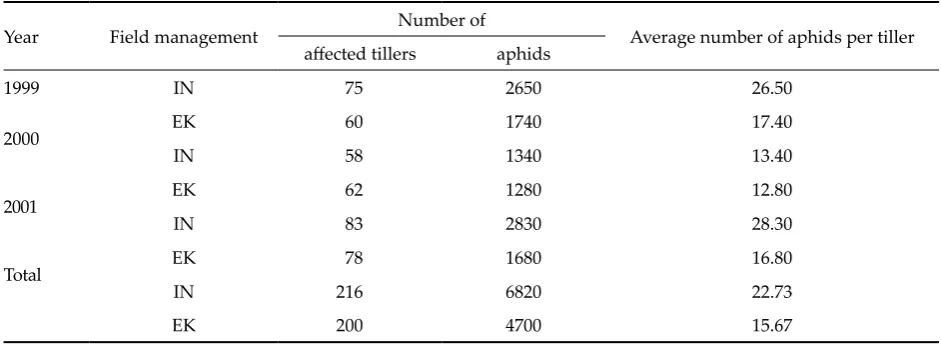
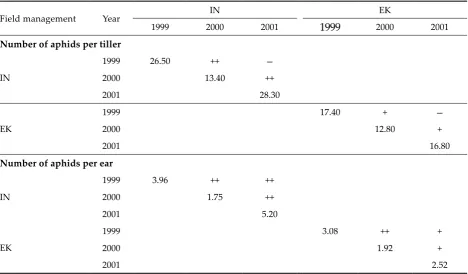
manage-ments is shown in Table 1. The abundance of aphids on tillers varied, depending on the year and the field management used. Every year there were more aphids on plants of the integrated field management. In 1999, the average number of aphids per tiller was 26.50 in system IN and 17.40 in EK, thus the count in IN was 34.34% higher. In 2001, the average number of aphids per tiller was 28.30 in IN and 16.80 in EK, which is 40.64% higher in system IN. The largest difference between the number of aphids in IN and EK was in 2001, the smallest difference was in 2000. Over all years of the experiment (1999–2001), the average number of aphids per tiller was 22.73 in IN and 15.67 in EK, i.e. the number was 31.06% higher in the integrated system. Statistical analysis proved the significance of differences between the two field managements (Table 2). In the years 1999 and 2001 the differences between the field manage-ments were highly significant, but they were low in 2000. Within the IN system, highly significant differences were recorded between the years 1999 and 2000, and between 2000 and 2001. The EK
sys-Table 1. Abundance of cereal aphids on winter wheat tillers in the years 1999–2001
Year Field management Number of Average number of aphids per tiller
affected tillers aphids
1999 IN 75 2650 26.50
2000 EK 60 1740 17.40
IN 58 1340 13.40
2001 EK 62 1280 12.80
IN 83 2830 28.30
Total EK 78 1680 16.80
IN 216 6820 22.73
EK 200 4700 15.67
[image:2.595.62.533.405.577.2]IN – Integrated agricultural system; EK – Ecological agricultural system
Table 2. Comparison of aphid abundance of number of aphids per tiller on whole tillers and of number of aphids per ear on ears of winter wheat in two agricultural systems
1999 2000 2001
IN EK difference IN EK difference IN EK difference
Number of aphids per tiller 26.50 17.40 ++ 13.40 12.80 – 28.30 16.8 ++
Number of aphids per ear 3.96 3.08 + 1.75 1.92 – 5.20 2.52 ++
[image:2.595.64.533.654.725.2]tem showed moderately significant differences between the years. The differences between the years 1999 and 2001 were not significant in both field managements (Table 3).
The abundance of cereal aphids on wheat ears is shown in Table 4. Over the years of the experiment
[image:3.595.64.533.114.388.2]and the two field managements, the abundance of aphids on wheat ears varied. In 1999, the average number of aphids per ear was 3.96 in IN and 3.08 in EK, i.e. it was 22.23% higher in IN. In 2000, the average number of aphids per ear was 1.75 in IN and 1.92 in EK, so that there were 8.86% more aphids
Table 3. Comparison of aphid abundance of number of aphids per tiller on whole tillers and number of aphids per ear on whole ears of winter wheat in integrated and ecological field managements in the years 1999–2001
Field management Year IN EK
1999 2000 2001 1999 2000 2001
Number of aphids per tiller
IN
1999 26.50 ++ –
2000 13.40 ++
2001 28.30
EK
1999 17.40 + –
2000 12.80 +
2001 16.80
Number of aphids per ear
IN
1999 3.96 ++ ++
2000 1.75 ++
2001 5.20
EK
1999 3.08 ++ +
2000 1.92 +
2001 2.52
– insignificant difference (α = 0.05); + moderately significant difference (α = 0.05); ++ highly significant difference (α = 0.01); IN – Integrated field management; EK – Ecological field management
Table 4. Aphid abundance on ears of winter wheat in the years 1999–2001
Year Field management Number of Average number of aphids per ear
affected ears aphids
1999 IN 64 396 3.96
2000 EK 53 308 3.08
IN 42 175 1.75
2001 EK 50 192 1.92
IN 74 520 5.20
Total EK 65 252 2.52
IN 180 1091 3.64
EK 168 752 2.51
[image:3.595.65.536.565.737.2]in IN. In 2001, the average number of aphids per ear was 5.20 in IN and 2.52 in EK, which showed 51.54% aphids more in IN. Over the whole period observed (1999–2001), the average number of aphids per ear was 3.64 in IN and 2.51 in EK, which made for 31.04% more aphids in IN.
The significant differences of our results was proven by statistical analysis while comparing the abundance of aphids in individual field manage-ment (Table 2). Highly significant differences were recorded between individual field managements in the year 2001, moderately significant differences in 1999 and no significant differences in 2000. Significant differences were also found between individual years (Table 3). They were highly sig-nificant between 1999 and 2001, and between 2000 and 2001. The abundance of aphids in wheat ears was influenced also by the different frequency of individual species of aphids.
DISCUSSION
Our results showed that there was a higher number of aphids on the better nurtured plants of the integrated field management. H���� (1994) had demonstrated that better nutrition increased the density of the aphid population. Z����� et al. (2003) have proven that mineral nutrition, mainly nitrogen-based fertilisers, promotes the aphid population, whereas potassium has the oppo-site effect. In our experiments, by fertilising the test fields with nitrogen fertilisers in the IN field management, the overall status of nutrition of the IN plants was better than in the EK. Based on the evidence presented, we may suppose that aphid populations will be higher in the integrated field management of wheat production.
With both field managements, Metopolophium dirhodum was the most numerous species on whole tillers, while on ears alone Sitobion avenae pre-dominated. There were also limited numbers of
Rhopalosiphum padi detected. The abundance of these three aphids was also recorded by D��� (1974), W������ (1975), C����� and D���� (1980), H��������� (1986, 1987) and H���� (1991).
References
A���� J. (1985): Matematická statistika. SNTL, Praha. B���� M. (1971): Vplyv dusíkatého hnojenia na
plod-nost’ vošiek Sitobion avenae (Fabr.) na pšenici. Pol‘-nohospodárstvo, 27: 725–733.
B���� M. (1972): Vplyv fosforečných a draselných hnojív na populačnú dynamiku vošky Sitobion avenae
(Fabr.). Biológia, Bratislava, Ser. B, 27: 129–139. C����� U., D���� A. (1980): The development of
fore-casting systems for cereal aphid outbreaks in Europe. In: Proc. IX. Int. Congr. Pl. Protect., Washington, 1: 170–173.
D��� G.J. (1974): The four dimensions of cereal aphids. Ann. Appl. Biol., 77: 74–85.
H����� H.C�. (1980): Zum Einfluss der Stickstoffdien-gung und vorbeugenden Spritzung von Natronwas-serglas zu Weizenpflanzen auf deren Widerstandskra� gegen Getreidebla�laeuse. Kali-Briefe (Buntehoof),
15: 287–296.
H��������� H. (1984): Růst vzcházející pšenice infesto-vané mšicemi. O�r. Rostl., 20: 131–136.
H��������� H. (1986): Reprodukce obilních mšic na dvou odrůdách ozimé pšenice. Ochr. Rostl., 22: 223–229.
H��������� H. (1987): Behavior and reproduction of cereal aphids in relation to changes in content of water and free amino acids in winter wheat during the growing season. Z. Angew. Ent., 103: 142–147. H��������� H. (1993): Regulace výživného stavu
rostlin z hlediska využití v integrované ochraně obilnin vůči mšicím. In: Zbor. Medzinár. Konf., Nitra: 224–225.
H��������� H. (1994): Polní screening pěti odrůd pše-nice ozimé na rezistenci vůči mšicím. Ochr. Rostl.,
30: 221–231.
H���� A. (1991): Factors determining the peak abun-dance of Metopolophium dirhodum (Homoptera: Aphi-didae) on cereals. Bull. Ent. Res., 81: 57–64.
H���� A. (1994): The effect of plant quality on the abundance of Metopolophium dirhodum (Homoptera: Aphididae) on maize. Eur. J. Ent., 91: 227–236. H���� A., M��������� Z. (2003): Environmental
va-riation of host plant: effects on abundance of cereal aphids. In: XVI. Slovak and Czech Plant Protect. Conf., Nitra: 180.
J���� M.G. (1979): Abundance of aphids on cereals from before 1973 to 1977. J. Appl. Ecol., 16: 1–22. L������ S.R., L���� J.P. (1982): Field studies on the
factors affecting the population dynamics of the bird cherry-oat aphid, Rhopalosiphum padi (L.), in Finland. Ann. Agric. Fenn., 21: 20–31.
L��� H.J.B. (1977): Testing for resistance to aphids in cereals and sugar beet. Bull. SROP, 3: 45–49. L��� H.J.B. (1978): Detection of resistance to aphids
in cereals. Ann. Appl. Biol., 88: 401–406.
wheat to the aphid Sitobion avenae. Ann. Appl. Biol.,
104: 297–305.
M����� F. (1956): Zemědělská entomologie. NČSAV, Praha.
P�������� J., A� D���� S. (1997): Výskyt a parazitácia obilných vošiek na ozimnej pšenici na EXBA SPU Nitra. In: Zbor. XVIth Slovenská a Česká Konf. Ochr.
Rastl., Nitra: 196–197.
Š����� J. (1982): Přelet a výskyt mšic na ozimé pšenici. Ochr. Rostl., 18: 267–275.
Š����� J., K���� F. (1985): Usměrněná chemická ochrana proti škůdcům obilnin. ÚVTIZ, Praha.
T����� L.R. (1980): A handbook for aphid indentifica-tion. Euraphid, Rothamsted.
W�������� G.P., W������ S.D. (1979): The biology and pest status of cereal aphids (Hemipterea: Aphididae) in Europe. Rev. Bull. Ent. Res., 69: 1–32.
W������ S.D. (1975): The nature of the effects of the aphids Sitobion avenae and Metopolophium dirhodum on the growth of wheat. Ann. Appl. Biol., 79: 27–34. Z����� E., Z����� F., H����� J. (2003): Sulphur
nu-trition of plants and their resistance to aphids. In: XVIth Slovak and Czech Plant Protect. Conf., Nitra:
226–227.
Received for publication May 6, 2004 Accepted a�er corrections May 31, 2004
Súhrn
P�������� J., M������ T. (2004): Vplyv rôznych poľnohospodárskych systémov na výskyt obilných vošiek ( Ster-norrhyncha: Aphidoidea). Plant Protect. Sci., 40: 82–86.
V rokoch 1999–2001 sme na lokalite Dolná Malanta sledovali výskyt obilných vošiek na odnožiach a klasoch pše-nice letnej, formy ozimnej v integrovanom a ekologickom poľnohospodárskom systéme. V sledovanom období bol zaznamenaný priemerný počet vošiek na odnoži pšenice v rámci integrovaného poľnohospodárskeho systému 22,73, čo je o 7,06 vošiek (31,06 %) viac ako v ekologickom poľnohospodárskom systéme (15,67). Priemerný po-čet vošiek na klase pšenice v integrovanom systéme bol 3,64, t. j. o 1,13 vošiek (31,04 %) viac ako v ekologickom systéme (2,51).
Kľúčové slová: obilné vošky; pšenica ozimná; poľnohospodárske systémy
Corresponding author:
Prof. Ing. J�� P��������, Univerzita Konštantína Filozofa, Fakulta prírodných vied, Tr. A. Hlinku 1, 949 74, Nitra, Slovenská republika