249
*This paper draws on a prototype model constructed by “EUROMOD: an integrated European tax-benefit model”, financed by the Targeted Socio-Economic Research programme of the European Commission (CT95-3009). The EUROMOD project involves 35 individuals in 18 institutions from 15 countries. Thanks are due to the whole EUROMOD team and Cristina Berliri, François Bourguignon, Tom Healy, Paul Ryan, Jose Sastre-Descals, Holly Sutherland, and Francesca Utili for advice and helpful comments. The views that are expressed, as well as any remaining errors, are the responsibilities of the author alone.
Estimating the Rate of Return to Education
using Microsimulation
CATHAL O’DONOGHUE* University of Cambridge
Abstract: This paper attempts to use microsimulation methods to compare returns to education in four European countries, Germany, Ireland, Italy and the United Kingdom. This paper broadens the type of measure used to measure the return to education to include interactions with public tax-transfer systems and to consider the effect of differential employment rates on education. Mincer style wage equations are estimated for each country in order to model the return to education of gross earnings. These estimates are then incorporated into a microsimulation model to estimate social, private and fiscal returns to education in the countries. Both point estimates and a distribution of the rates of return are described.
I INTRODUCTION
education have focused on the private returns to education (the relationship between the productivity of a worker and their education level). Additionally however, increased education through the increase in labour earnings can lead to higher taxes and lower transfers. This is as a result of the fact that taxes and social benefits are generally related to earnings. This paper shall focus on this issue, looking at the returns to education in four European countries, Germany, Ireland, Italy and the UK in relation to the tax-transfer system.
Traditionally rates of return have simply looked at the gross rate of return: rates of return for those who spend an entire working lifetime in employment and do not factor in periods when the return to education is zero during periods out of work. This paper attempts to estimate a wider measure of the return to education; the net return. Also in addition to reporting internal rates of return, the paper develops a concept similar to the marginal tax rate used in public finance, the marginal rate of benefit, which estimates the rate of return in terms of a marginal change in education. In order to carry out this analysis, a micro-simulation methodology is employed. First, the relationship between earnings and education is modelled using Mincer style earnings equations. These results are fed into a microsimulation model, which estimate the changes to tax liabilities and benefit entitlement due to a marginal change in education levels, enabling the fiscal, private and the social rates of return to be simulated.
II BACKGROUND
This paper takes the human capital approach to returns to education which assumes that education improves a worker’s productivity and thus earnings, that earnings rise over time, that the rate of increase falls with age and that the rate of return falls as educational attainment rises.1
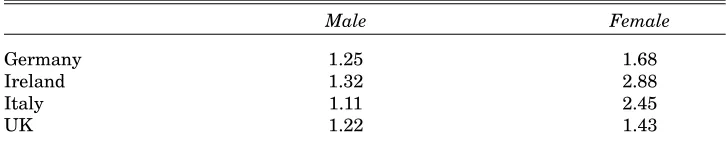
Rates of return measures often ignore the fact of differential employment rates by education level, only considering those with positive earnings. However, the higher educated are more likely to be employed (see Table 1). In the countries studied, this effect is strongest in Ireland and Germany for men and stronger for women in each country, especially Ireland and Italy. More educated workers are likely to be able to perform a wider range of tasks than less educated workers, both because of higher specific human capital and because they are easier to train in new skills. They will thus be able to position themselves higher in the employment queue. Individuals with higher education levels are also likely to
have higher potential wages in work and thus have lower replacement rates, leading to higher labour supply levels. This effect is likely to be compounded by family circumstances for women such as the presence of children, hence the particularly low labour supply rates for less educated married women. Low educated workers are also likely to be more dispensable during economic downturns and thus will tend to have lower employment tenures. This trend has worsened over time as the employment position of the lowest achievers has worsened with respect to the highest achievers (See Glyn and Salverda, 1998).
Table 1: Ratio of Employment for Those with Tertiary Education to Those With Less than Upper Secondary Education for Those Aged 15-59, 1994
Male Female
Germany 1.25 1.68
Ireland 1.32 2.88
Italy 1.11 2.45
UK 1.22 1.43
Source: EUROSTAT (1996).
In response to this trend, recent policies targeted at the unemployed have tried to increase skill levels in order to improve the chances of getting a job. Examples include FÁS training schemes in Ireland, the New Deal in the UK, and the labour market integration aspects of the RMI in France. What evidence is there that this is successful and therefore that differential employment rates affect the rate of return?It is possible that as the best of the poorly educated individuals move to higher levels of education the unemployment levels of both high and low educated individuals increase as the average quality of workers in both groups decrease. There is however little evidence for this. In a study on the impact of rising educational levels on employment in Germany and the USA, Orszag et al. (1998) found that the relative position of the less educated has worsened over time. Although the unemployment rate of the higher educated has broadly followed aggregate trends, the unemployment ratio of the lowest educated to the highest educated has gradually risen.
III METHODOLOGY
Measuring the Return to Education
are equal to discounted costs of education, Cost(δ), where s is the amount of schooling and δ is an extra amount of education.
(Benefit(s +δ)−Benefit(s))tx(1+r)−t t=c
n
∑ = Cost(s +δ)tx(1+r)−t
t=0 c−1
∑ (1)
However the internal rate of return is very expensive in terms of data, requiring the life-time earnings streams. A less demanding measure akin to the marginal tax rate is the marginal benefit rate described in formula (2) which is the ratio of benefit of a marginal difference in education level to the cost of the marginal change in education.2 This effectively is a measure of the rate of return
to an investment at a particular point in time rather than across the life-cycle. Because simulation allows marginal benefits to be calculated for individuals this measure has an advantage that estimates can be produced for sub-groups of the population, such as for different age groups or income levels. It thus allows one to examine the degree of targeting of government policy.
M arg inal Benefit of Education =Benefit(s +δ)−Benefit(s)
Cost(δ) (2)
The benefits and the costs however depend on whose perspective the rate of return is being measured. From society’s point of view the rate of return relevant is the social return to education. In this case we consider only monetary benefits to society from increased total earnings (gross earnings plus employer contributions), ignoring other non-monetary benefits such as reduced crime levels and other spillovers.3 Total costs to society refer to total earnings forgone plus
the direct costs both public and private of education.4 The second concept
examined is the private return to education, which measures the marginal benefit to the individual (net private income: earnings plus transfers minus taxes and contributions) to the private cost of extra schooling (direct private educational costs plus net private income forgone).5 Third, we focus on the fiscal return to
investment in education, where benefits are net government revenue (taxes plus contributions minus transfers) and costs are net revenue forgone plus the public direct cost of education.
2. However that costs and benefits do not occur at the same time. For convenience we make an assumption that discount rates are equal to growth rates, and therefore it is possible to compare price adjusted quantities from different time periods in this manner.
3. In fact Haveman and Wolfe (1984) find that in the USA, standard rate of return estimates capture only about three-fifths of the full-value of education.
4. Note we assume that there are no forgone earnings for those aged under 16.
Our estimates of the return to education extend the concept in a number of ways. First, the measure we use is net returns. Most estimates of the rate of return to education described in the literature are gross rates of return (See Psacharopoulos, 1993). They only account for the rate of return on the basis of individuals with positive earnings and do not factor in the fact that those with higher education levels are also more likely to be in employment. Thus the net rate of return should be higher than the gross rate of return. In addition, because taxes and social transfers are simulated in a microsimulation model, it is possible to measure benefits (and costs) which more closely resemble those experienced by individuals. For example, the existence of tax systems will reduce the private rate of return to education based on net earnings rather than on gross earnings. Progressive tax systems will make this effect more pronounced at higher education levels. In addition, incorporating employer social contributions in social returns will have the effect of increasing returns.
In measuring the return to education, we examine the differences in costs and benefits between two education levels. For the internal rate of return, we look at the difference between actual education levels, such as upper secondary and tertiary, however for the marginal benefit of education, we look at a marginal difference in education of one year.
For both measures we first need the level of earnings at the different levels of education. In estimating internal rates of return, as we do not have access to lifetime earnings streams, we generate pseudo earnings streams using cross-section information by averaging across age and education groups. Age earnings curves based on cross-section data find that earnings fall for higher age groups, however actual cohort information would produce constantly rising wage levels over the lifetime, but with a falling rate of increase. To counteract the cross-section effect we assume a wage growth of 1 per cent per year (See Alsalam and Conley, 1997). We simulate the marginal benefit of education using Mincerian earnings functions, combined with a mechanism to account for increasing employment levels.
Estimating Fiscal Costs and Benefits using Microsimulation
As the benefits and costs of education relating to education are not necessarily available in the datasets used to calculate the returns to education, a simulation method is necessary; in this case the use of microsimulation models (MSM’s). Microsimulation modelling has existed since the 1950s and has been developed to analyse complex interactions at the micro level, frequently the simulation of tax liabilities and benefit entitlements of the household population.6 They take
as their information base, nationally representative micro-datasets which contain data on the labour market, income, expenditure and demographic characteristics of individuals and households.
Microsimulation Models have a number of advantages. In being a micro-analytic framework, they allow analysts to study the impact of public policy at the level of the individual or family. Second, in using a simulation methodology, they allow one to generate missing information and also to pool data from different sources. Most importantly however, they allow one to simulate the impacts of alternative scenarios such as different public policy developments.
This paper uses a microsimulation model developed to carry out cross-country comparisons of tax-benefit systems in different European countries; in this case, Germany, Ireland, Italy and the UK.7 The model takes data from national
household micro-datasets8 and simulates a variety of policy instruments
including, income taxes, employer and personal social insurance contributions, family benefits and social assistance benefits for the year 1994. Combining government policy with income information contained in the base surveys such as employment income, pensions, investment income and social benefits, it is possible to simulate internationally comparable definitions of disposable income. The model simulates taxes and benefits for the units of assessment for which the legislation applies. So for example, social insurance contributions are generally charged to individuals, family benefits paid to families, income taxes charged to either individuals or couples and social assistance benefits paid to either families or households. In order to estimate returns to education it is necessary to apportion receipt of benefits and tax liabilities across the tax/benefit assessment unit to the individuals which comprise the unit. Apportioning taxes and benefits in this manner raises a number of technical issues raised in Sutherland (1996). This paper adopts a number of assumptions used by her, so that where possible child benefits are treated as accruing to the mother of the child and social benefits are divided equally between the adults covered by the assessment unit. Income taxes are sometimes family based in for example Germany and Ireland, therefore in order to assign taxes to individuals, the average tax rate of the assessment unit is used.
7. See Bourguignon et al. (1998) for a detailed description of the model.
Source: Author’s Calculations.
[image:7.499.106.383.81.523.2]Note: Equivalence Scale: square root of household size.
Structure of the Tax-Benefit Systems
The way in which the tax-transfer system interacts with earnings is an important determinant of the returns to education. Figure 1 outlines the distribution of tax (including employer contributions) and benefit rates for each equivalised household disposable income decile in each country. Germany and Italy have both higher average and less progressive tax rates than Ireland and the UK,9 with Italy even having a decline in the rate at the top of the distribution
as a result of lower employer social insurance contributions. The table also highlights the difference between the social insurance model in Germany and Italy, which have earnings related benefits spread across the income distribution and the social assistance model in Ireland and the UK, where benefits are quite closely targeted at the bottom of the distribution. The higher the level of tax-benefits and the greater the progressivity of the system, the higher the marginal effect of education on tax-benefits.
Estimation of Labour Market Returns
Here we describe the estimation of the labour market effect used in the marginal benefit of education calculation. In addition to measuring the relationship between education and earnings for employees, we also measure the relationship for self-employment earnings and those without employment.10
In measuring the impact of education on employee and self-employment earnings, the analysis makes use of OLS earnings functions, described in formula (3) below.11 Here, s is the number of years of schooling (defined in O’Donoghue,
1999), e the potential number of years of experience (Age – minus years of schooling – 6), YG is gross earnings and X other factors such as marital status and number of children.12
ln Yi
G = α + β
1s1+ β2ei 2+ β
.Xi+ εi (3)
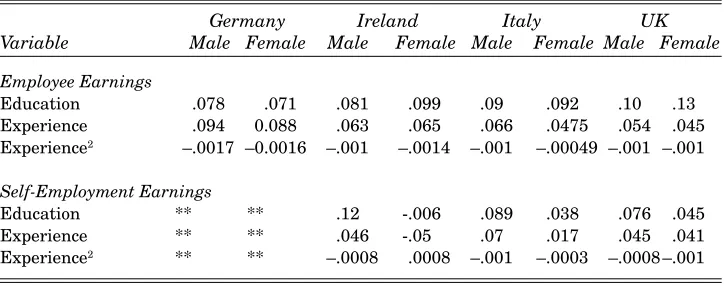
Table 2 reports the education and experience coefficients on gender specific wage equations for logged employment and self-employment earnings for each country. The coefficients of the employment earnings equations have the expected
9. Over the whole distribution, the tax rate is lower in Germany and Italy than Ireland and the UK. However in the top half of the distribution the Germany tax/contribution system is the most progressive.
10. Although increased education levels may lead to increased productivity and higher stock market returns leading to increased pension returns and higher investment income, this paper ignores this in the evaluation of the rate of return to education due to the complexity of the linkage. 11. Callan and Harmon (1997) argue that OLS estimates of returns to education may be biased, reporting that in the literature, OLS tended to bias downwards the returns to education.
format, with positive coefficients on years of education and experience and negative coefficients on the square of experience. This is also mainly the case for self-employment earnings, a result that tends to reject the screening hypothesis. Coefficients on self-employment earnings are not significant for Germany. This however is likely to have more to do with the structure of the labour market, with a relatively small number of self-employed persons rather than the nature of returns to education. As a result of the large vocational segment in the education system, Germany has very identifiable links between education and employment and thus clearer returns to education. Finally, schooling coefficients tend to be inversely related to the wealth of the country indicating some degree of diminishing returns.13
Table 2: Selected Coefficients on Employee and Self-Employment Earnings Equations
Germany Ireland Italy UK
Variable Male Female Male Female Male Female Male Female
Employee Earnings
Education .078 .071 .081 .099 .09 .092 .10 .13
Experience .094 0.088 .063 .065 .066 .0475 .054 .045 Experience2 –.0017 –0.0016 –.001 –.0014 –.001 –.00049 –.001 –.001
Self-Employment Earnings
Education ** ** .12 -.006 .089 .038 .076 .045
Experience ** ** .046 -.05 .07 .017 .045 .041
Experience2 ** ** –.0008 .0008 –.001 –.0003 –.0008 –.001
Source: Author’s Calculations.
Note: Dep. Variables: ln(Employee Earns) and ln(Self Employment Earns).
** means not significant.
In order to estimate net returns to education one needs in addition to estimate the effect of education on employment. The marginal effect of education is likely to increase labour supply and demand. This can occur from increased partici-pation rates or increased number of hours worked per year. Incorporating a detailed model of labour supply and demand is beyond the scope of the paper. Instead the paper avoids the latter issue, by focusing on earnings rather than wage rates and explores the sensitivity of the results to two assumptions about participation rates. (1) As is typically done, explore rates of return to employees only, i.e. assume no employment effect and (2) assume that those with higher
education levels will have the same employment probabilities as those with the same education level in the dataset.
In order to model the marginal effect of education, we need to measure the effect of a marginal increase in education. For those already in employment, we estimate (in formula 4), the effect on earnings, Y, of m extra years of education, allowing for the fact that m extra years of education implies m less years of experience, e . In simulating the marginal effect of education, we could have chosen a positive or a negative marginal amount. As rates of returns diminish with education, choosing a negative marginal amount would result in higher rates of return than a positive amount. We chose the more conservative option, the positive marginal change in education.
Y1/ Y=exp
(β1xm+β2x (−m)+β3x (−2mxe+m 2
)) (4)
For those moving from out-of work to in-work, we model potential in work earnings using formula (3). Using an OLS earnings function estimated on in-work earnings may result in sample selection bias when predicting wages of those currently out-of-work. However the datasets available do not permit the use of techniques such as Heckman procedure (Heckman, 1979) and in any case studies which have incorporated selection bias have found little impact on the rate of return (Psacharopoulos, 1993).
Costs of Education
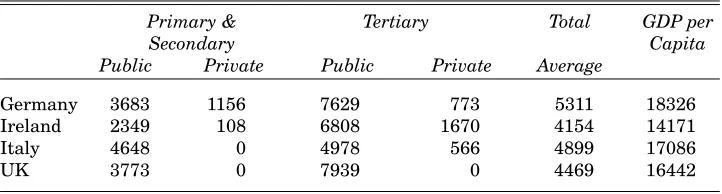
[image:10.499.73.434.499.596.2]Table 3 describes average educational expenditures per student in each country by public and private expenditure and by Primary/Secondary and Tertiary. The difference between the educational expenditures per student is related to the difference between the wealth of the countries. The OECD figures do not contain information on private expenditures in the UK. Containing a substantial private educational sector, social and private rates of return to education will be overestimated as a result.
Table 3: Public and Private Costs of Education (1994) (in ECU)
Primary & Tertiary Total GDP per
Secondary Capita
Public Private Public Private Average
Germany 3683 1156 7629 773 5311 18326
Ireland 2349 108 6808 1670 4154 14171
Italy 4648 0 4978 566 4899 17086
UK 3773 0 7939 0 4469 16442
Perhaps the most important cost of education is the impact of forgone earnings. In estimating forgone earnings, ideally one should use the difference between potential earnings if an individual had worked rather than went to school and the amount of part-time earnings of students. Information on the latter is very varied across the datasets used in this paper and so only forgone earnings are accounted for here. The value of forgone earnings used for each individual depends on the employee earnings functions estimated above and forgone taxes are estimated using a microsimulation model. Lastly we assume that due to youth unemployment, not all individuals have forgone earnings and we thus allow for age/gender specific unemployment rates.
IV RESULTS
Internal Rates of Return
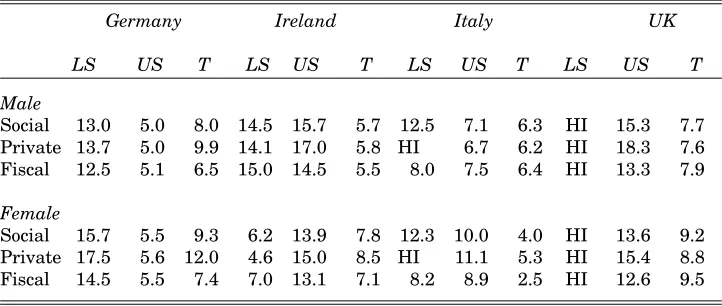
Table 4 reports estimates of the internal rate of return to education in Germany, Ireland, Italy and the UK for each level of education relative to the next lowest level. Incorporating direct costs of education, these estimates will be relatively higher than those produced using regression methods, while measuring net rates of return, estimates will be relatively higher. Because discounting has a greater effect for higher ages, cases where benefit differentials are higher for younger age groups will have higher rates of return than for instances where the relative differential is higher for older people. We must however be cautious in the interpretation of the results as they are quite sensitive to classification decisions made about national educational qualifications. Although datasets exist with better education information, they do not necessarily contain the information necessary to simulate taxes and benefits in a detailed fashion. Nevertheless, overall returns tend to diminish with education level, which corresponds with previous gross estimates.
There are however a number of exceptions. Rates of return for upper secondary education are lower relative to tertiary education in Germany. This is primarily a result of the concentration of those with vocational qualifications in the level below, lower secondary. Those with vocational qualifications tend to have an earnings premium relative to those with equivalent educational qualifications and thus the position of the lower secondary educated individuals, will be closer to the upper secondary educated than in other countries. Only at older ages is the difference in returns substantial, but the discount rate reduces the effect of difference amongst older ages rather than younger ages.
quite low, especially for higher age groups and thus even if earnings differentials are higher, the net return is lower. In the UK on the other-hand, earnings differentials for non-tertiary educated women are quite low relative to university educated women. Also in Italy the position in the lifecycle of the earnings differential and thus the discount rate has a strong effect, where higher earnings differentials for university educated women occur later in life.
Table 4: Internal Rates of Return to Education
Germany Ireland Italy UK
LS US T LS US T LS US T LS US T
Male
Social 13.0 5.0 8.0 14.5 15.7 5.7 12.5 7.1 6.3 HI 15.3 7.7
Private 13.7 5.0 9.9 14.1 17.0 5.8 HI 6.7 6.2 HI 18.3 7.6
Fiscal 12.5 5.1 6.5 15.0 14.5 5.5 8.0 7.5 6.4 HI 13.3 7.9
Female
Social 15.7 5.5 9.3 6.2 13.9 7.8 12.3 10.0 4.0 HI 13.6 9.2
Private 17.5 5.6 12.0 4.6 15.0 8.5 HI 11.1 5.3 HI 15.4 8.8
Fiscal 14.5 5.5 7.4 7.0 13.1 7.1 8.2 8.9 2.5 HI 12.6 9.5
Source: Author’s Calculations.
Notes: 1. Lower Secondary (LS.), Upper Secondary (US) and Tertiary Education (T).
2. HI: returns are high, primarily due to low forgone earnings and no private expenditures.
Marginal Benefit Rate
Table 5 outlines the marginal benefit of education in terms of social, private and fiscal benefits. The values in the table represent the average marginal benefit rate of a marginal increase in education. Two scenarios are considered, at one extreme where the marginal benefit of education does not include any employment response and at the other, where existing employment differentials are maintained.
Here the size of the tax system dominates, so that Italy and Germany with the highest tax rates have the highest ratio of fiscal to social returns. We also notice that although the UK has the highest private and social returns, it has the third highest fiscal returns as a result of the lower tax rate. Comparing the three measures, we find that private returns are higher than social returns which are in turn higher than fiscal returns.
[image:13.499.65.427.351.440.2]If we also consider the employment differential in estimating marginal benefits, we would expect the countries with higher unemployment benefit rates and/or high unemployment levels to have higher fiscal returns. Also the higher the replacement rate, the lower the private returns and the lower the social returns. We notice that in general when considering employment differentials in the measurement of the marginal benefit, fiscal returns increase the most. Thus in using education as a mechanism to promote employment, the state gains relatively more than do those moving into employment. The biggest impact on fiscal returns occurs in Germany, which in addition to having a high employ-ment differential for men has quite high unemployemploy-ment benefits. Fiscal returns increase the least in Italy as a result of a low level of unemployment benefits, which correspondingly result in the highest increase in private returns.
Table 5: Social, Private and Fiscal Marginal Benefits of Education
Social Private Fiscal Social Private Fiscal
Earnings Earnings + Unemployment
Germany 5.0 7.0 3.9 6.7 9.6 5.0
Ireland 8.8 14.4 5.3 10.1 15.7 6.5
Italy 8.2 17.0 5.7 10.3 23.4 6.6
UK 10.3 23.1 4.7 11.7 25.7 5.6
Source: Author’s calculations.
also widen as individuals get older, hence another reason for higher returns. Thus marginal benefits are consistently highest for the 50-65 age group. The next highest group in general are the 30-50 year olds. Marginal benefit rates as measured here are however lowest for the over 65s because in general, labour market earnings cease and thus rates of return tend to diminish to zero. This effect however may differ if pensions were modelled, although inequality levels are in general lower amongst the elderly and so the marginal benefit of education is likely to be much lower than for those of working age.
Table 6: Social, Private and Fiscal Marginal Benefits of Education by Age Group
Germany Ireland Italy UK
Age Soc. Priv. Fisc. Soc. Priv. Fisc. Soc. Priv. Fisc. Soc. Priv. Fisc. <30 6.9 11.1 4.7 3.7 4.7 3.0 7.1 17.8 3.4 10.3 20.0 5.3 <50 6.0 8.1 4.7 13.5 20.9 9.1 12.8 23.5 9.1 14.7 30.6 6.9 <65 13.8 19.4 10.6 21.6 38.4 12.5 16.0 48.2 10.1 15.9 39.7 8.2 >=65 0.2 0.3 0.2 5.4 14.0 1.6 0.9 2.5 0.7 0.6 2.5 0.2 Source: Author’s Calculations.
Note: Employment differentials are applied.
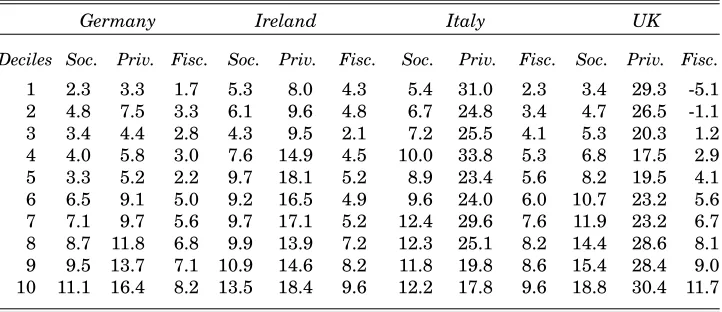
Table 7: Distribution of the Marginal Benefit of Education by Income (Average rate of return per equivalent disposable income quintile)
Germany Ireland Italy UK
Deciles Soc. Priv. Fisc. Soc. Priv. Fisc. Soc. Priv. Fisc. Soc. Priv. Fisc.
1 2.3 3.3 1.7 5.3 8.0 4.3 5.4 31.0 2.3 3.4 29.3 -5.1
2 4.8 7.5 3.3 6.1 9.6 4.8 6.7 24.8 3.4 4.7 26.5 -1.1
3 3.4 4.4 2.8 4.3 9.5 2.1 7.2 25.5 4.1 5.3 20.3 1.2
4 4.0 5.8 3.0 7.6 14.9 4.5 10.0 33.8 5.3 6.8 17.5 2.9
5 3.3 5.2 2.2 9.7 18.1 5.2 8.9 23.4 5.6 8.2 19.5 4.1
6 6.5 9.1 5.0 9.2 16.5 4.9 9.6 24.0 6.0 10.7 23.2 5.6
7 7.1 9.7 5.6 9.7 17.1 5.2 12.4 29.6 7.6 11.9 23.2 6.7
8 8.7 11.8 6.8 9.9 13.9 7.2 12.3 25.1 8.2 14.4 28.6 8.1
9 9.5 13.7 7.1 10.9 14.6 8.2 11.8 19.8 8.6 15.4 28.4 9.0
10 11.1 16.4 8.2 13.5 18.4 9.6 12.2 17.8 9.6 18.8 30.4 11.7
Source: Author’s Calculations. Note Employment differentials are applied.
V CONCLUSIONS
This paper attempts to use microsimulation methods to compare returns to education in four European countries, Germany, Ireland, Italy and the United Kingdom. Previous papers on this subject have tended to focus solely on the gross return to education, both in terms of focusing only on those with in-work incomes and ignoring the impact of tax-benefits. This paper broadens the type of measure used to include interactions with public tax-transfer systems and to consider the effect of differential employment rates on education. The paper considers returns from the perspective of society, the individual and the public finances.
intergenerational benefits are not considered which may redress the balance between social and private benefits to education.
When employment differentials are considered, we find that fiscal returns increase relatively more than do social or private marginal benefits. Thus although our extreme assumption may overstate the effect of education on employment, it emphasises the cost to the exchequer of unemployment and the corresponding returns in terms of lower social spending and higher taxes of increased employment levels.
The results of this paper would therefore give support for policies advocated by the OECD and others and implemented in the UK, whereby because of higher private returns to education, some degree of state/individual co-financing is recommended. Because private marginal benefit tend to be higher for those with higher incomes and because tertiary education has relatively lower rates of return, it may be more effective to have co-financing for tertiary education rather than other levels.
REFERENCES
ALSALAM, N., and R. CONLEY, 1995. “The Rate of Return to Education: A Proposal for an Indicator”, Education and Employment, Paris: OECD.
BOURGUIGNON, F., C. O’DONOGHUE, J. SASTRE-DESCALS, A. SPADARO, and F. UTILI, 1997. “Technical Description of Eur3: a Prototype European Tax-Benefit Model”, University of Cambridge: Microsimulation Research Note MU/RN/25. CALLAN, T., and C. HARMON, 1997. “The Economic Return to Schooling in Ireland”,
UCD Working Paper, WP97/23.
EUROSTAT, 1996. “Labour Force Surveys, 1994”. Luxembourg: EUROSTAT.
GLYN, A., and W. SALVERDA, 1998. “Employment Inequalities”, LoWER Conference Policies for Low-Wage Employment and Social Exclusion in Europe.
HAVEMAN, R.H., and B.L. WOLFE, 1984. “Schooling and Economic Well-Being: The Role of Nonmarket Effects”, Journal of Human Resources, Vol. 19, No. 3, Summer 1984, pp. 377-407.
HECKMAN, J.J., 1979. “Sample Selection and Specification Error”, Econometrica, Vol. 47, No.1, pp. 153-161.
KROCH, E.A., and K. SJOBLOM, 1993. “Schooling as Human Capital or a Signal”,
Journal of Human Resources, Vol. 29, No. 1, Winter 1994, pp. 156-180.
LORENZ, W., and J. WAGNER, 1990. “A Note on Returns to Human Capital in the Eighties: Evidence from Twelve Countries”, Luxembourg Income Study Working Paper, No. 54.
ORSZAG, J.M., E.D. PHELPS, G. ZOEGA, 1998. “Education and the Natural Rate of Unemployment”, Birkbeck College, Dept. of Economics Discussion Papers 98/1. O’DONOGHUE, C., 1999. “Education, Tax-Benefits and Rates of Return”. University of
Cambridge mimeo.
OECD, 1996. Education at a Glance — OECD Indicators, Paris: OECD, Centre for Educational Research and Innovation.
PSACHAROPOULOS, G., 1993. “Returns to Investment in Education: A Global Update”,
SUTHERLAND, H., 1995. “Static Microsimulation Models in Europe: A Survey”, University of Cambridge: Microsimulation Unit Discussion Paper, MU9503.