ACTION TOW
ARDS
ALTERNA
TIVES
Sukhvinder Sandhu 2007
AL
TERNA
TIVE
PATHW
AYS
PROJECT REPOR
CONTENTS
Acknowledgements 3
Foreword by Tim Bishop 4
Background 5
Context and Rationale 5
Aims and Objectives 6
Methodology 7
Key findings 9
Consultation 14
Priorities 15
Outcomes 17
Implementation process 17
Key messages 18
Conclusion 19
References 20
Appendix 1 21
Appendix 2 22
Appendix 3 23
Glossary of terms 25
ACKNOWLEGDMENTS
I would like to thank the service users, carers and staff who shared their personal experiences with the Alternative Pathways project.
Gratitude is expressed to the Delivering Race Equality programme for funding this work.
A special thank you to Sandra Griffiths for her advice, support and guidance throughout the project.
I would also like to thank the Alternative Pathways steering group members Tim Bishop, Robert Jones, Jimmy Glass, Chris Tacey and Richard Fradgley for their input and support.
I would like to thank Sue Balmer for her ongoing support and input into the development of this project.
Thank you to the Mellow team, Tigist Teferi, Aronda Warren, Loleta Cumberbatch and Peter Smith for their ongoing support and their assistance in the planning of project events.
Thank you to Lyla Smith Abass, Anthony Ekundayo Lennon, Derek Ezangu, Lisa Benson, Seun Shote and Diana Walker for the development and performance of the drama pieces for the project.
Gratitude is expressed to Patience Seebohm, Peter Smith and Corrine Douglas for supporting the research phase of this project.
Thank you to Michelle Garner, Selasi Jubey and Oliver Kianchehr for working with the project to ensure carer involvement.
Thank you to Mina Kakaiya for supporting the Alternative Pathways consultation event.
Thanks to Claire Felix for supporting the planning and facilitation of the recovery focus group.
We are also grateful to the following community teams for their input:
Tower Hamlets: Assertive Outreach Team, Bethnal Green and Globe Town CMHT and the Home Treatment Team.
Newham: Assertive Outreach Service, South East CMHT and the Home Treatment Team.
FOREWORD
East London is a great place to live and work, and many people in local communities, in the NHS and in local councils work hard to make it an even greater place. But there is also disadvantage and inequality. This helpful report reflects on that inequality, points to people’s own strengths and aspirations and suggests how we all – as partners - can work together to create positive change – create alternatives.
Tim Bishop
BACKGROUND
The East London NHS Foundation Trust is a Focused Implementation Site for the Department of Health’s Delivering Race Equality (DRE) in Mental Health programme. DRE is the Government’s Response to the Independent Inquiry into the death of David Bennett (Department of Health, January 2005). DRE is an action plan for eliminating discrimination and achieving equality in mental health care for Black and Minority Ethnic groups. Focused Implementation Sites’s are aimed at facilitating and guiding change in BME mental health care by helping to identify and share good practice. Activity in these areas is linked to Value Added Grant projects, Community Engagement projects and Community Development Workers. In April 2006 the Trust received a £40k Value Added Grant from Delivering Race Equality (DRE) programme to develop a local project that supported DRE. The funding was used to develop the Alternative Pathways project. This paper highlights the key findings of the Alternative Pathways project and sets out the actions formulated in response.
CONTEXT & RATIONALE
Mellow was launched in 2000 to contribute to the reduction of the over-representation of young Black African and Caribbean men in mental health services in East London (Appendix 1) and became part of East London NHS Foundation Trust in April 2004. The programme began by commissioning a needs assessment of Mental Health Services provision and needs of young Black African and Caribbean People living in East London1. A needs assessment report was produced
to assist in determining how services can be developed and improved for young Black African and Caribbean (BME) men with mental health difficulties. The report highlighted inequalities in relation to the hospitalisation and care of Black African and Caribbean services users particularly in relation to their pathways into care.
The Count Me in Census 20062 supported these earlier findings by showing that men and women
from the black and white/black mixed groups were significantly more likely than the average to be detained under the Mental Health Act and Black groups were also more likely to be referred to hospitals from the criminal justice system rather than by GPs. The Alternative Pathways project was developed to renew and update the Trusts understanding of why locally some Black and Minority Ethnic groups are disproportionately represented in the detained patient population.
The project also recognises the findings of related community engagement projects such as the Social Action for Health Mental Health Guides Programme3 which targeted Hackney’s Black
African and Caribbean communities, to identify and support ways of addressing the disproportionate numbers of African and Caribbean people in the mental health system and the
1Kukuwa, A & Ofori, J (2000) Report on an assessment of the Mental Health Needs of Young African & Caribbean
men
2The Mental Health Act Commission: Count Me In 2006
3
Mind in Tower Hamlets Community Led Research Project4 which captured the experiences of BME
groups using mental health services.
AIMS AND OBJECTIVES
It is well established that some Black and Minority Ethnic patients with a mental illness are more likely to be detained under the Mental Health Act 19835. The Alternative Pathways Project was
launched by the Trust to explore and change pathways to mental health care for Black and Minority Ethnic service users.
The project had two overall objectives: firstly to map the care pathways taken by 18 service users into detention under the MHA 1983; secondly, based on these findings, work with the teams responsible for managing care pathways to further help them understand the processes which lead to detention and to change practice, systems, policies and resources to lower the disproportionate use of the Mental Health Act 1983. This work reflects the three Delivering Race Equality building blocks: more appropriate and responsive services; community engagement and better information and should lead to:
less fear of mental health services among BME communities and service users;
increased satisfaction with services;
a reduction in the rate of admission of people from BME communities to psychiatric inpatient units;
a reduction in the disproportionate rates of compulsory detention of BME service users in inpatient units;
more BME service users reaching self-reported states of recovery;
a more balanced range of effective therapies, such as peer support services and psychotherapeutic and counselling treatments, as well as pharmacological interventions that are culturally appropriate and effective;
a workforce and organisation capable of delivering appropriate and responsive mental health services to BME communities6.
4Mind in Tower Hamlets: Report Of the Community Led Research Project Focusing on ‘The experiences that Adult
Mental Health Service Users and Survivors from African & Caribbean, Bengali and Somali communities have had of using Mental Health services in Tower Hamlets or other boroughs, March 2007
5
The Mental Health Act Commission: Count Me In 2006
6Delivering Race Equality in Mental Health Care (2005) An action plan for reform inside and outside services and the
METHODOLOGY
The project steering group (Appendix 2) was responsible for guiding and supporting the development of the project which consisted of two stages: research and action. The research stage of the project began in September 2006 and was completed in May 2007. The action phase began in June 2007 and will continue until March 2008.
[image:7.595.117.498.402.724.2]One of the key aims in the initial phase of the project was to identify the ethnic groups that are disproportionately represented in the detained patients group in each East London borough (City of London and Hackney, Tower Hamlets and Newham) covered by the Trust’s Adult mental health services. There are varying perspectives in relation to how over representation is defined; for the purpose of this project local data on the ethnicity of the service users detained under the Mental Health Act 1983 in each locality was compared to the ethnic breakdown of each borough’s general population using the 2001 census data. We selected the ethnic groups showing the highest level of over representation for each borough (Table one) and based on this formula Black Caribbean, Black African and Black other ethnic groups became the focus of this project. Once the inclusion criteria had been agreed the research stage of the project began.
Table 1: Overrepresented ethnic groups in East London August 20067 C I T Y A N D H A C K N E Y A U G U S T 2 0 0 6
E T H N I C I T Y Detentions % Local Population%
Black or Black British Caribbean 29.9 10.3
Black or Black British African 24.6 12.0
White British 18.9 44.1
N E W H A M A U G U S T 2 0 0 6
E T H N I C I T Y Detentions % Local Population %
Black or Black British Caribbean 17 7.4
Black or Black British African 20 13.1
White British 18 33.4
T O W E R H A M L E T S A U G U S T 2 0 0 6
E T H N I C I T Y Detentions % Local Population %
Black or Black British Caribbean 16 2.7
Any Other Black Background 11 0.5
White British 17 42.9
Inclusion criteria
Black African, Black Caribbean ethnic origin (Hackney and Newham)
Black Caribbean, Other Black Background ethnic origin (Tower Hamlets).
Each service user must have a history of being detained under the Mental Health Act 1983 (at least once).
[image:8.595.103.530.318.538.2]18 service users that met the project inclusion criteria were selected from nine community teams in East London. The teams included Community Mental Health Teams, Assertive Outreach Teams and Home Treatment. Table two describes the age, gender and ethnicity profile of the service user sample.
Table 2: Alternative Pathways service user sample: age, gender and ethnicity profile
The project co-ordinator was responsible for conducting the research with assistance from community researchers. The research included the following:
Case file audits
One to one interviews with service users
Focus group with service users
One to one interviews with care co-ordinators
Focus groups with other trust staff
Focus groups with carers
SERVICE USER SAMPLE
Age
Male Female
Black Caribbean Black African Black Caribbean Black African
18 - 25 1
26 - 35 4 2 1
36 - 45 4 4
46 - 55 1 1
Total 9 7 2 Average
age:
KEY FINDINGS
The key findings from the research stage of the project are set out below along with the needs and challenges of each stakeholder group.
1. Case file audits
Once the 18 cases had been selected an audit was conducted which logged all contacts between the team and the service user six months prior to his/her most recent detention under the Mental Health Act 1983. The audit included recording the content of these contacts as well as the service user’s background details. An overview of the sample is provided below:
• Gender: 16 Male, 2 Female.
• Ethnicity: 9 Black African and 9 Black Caribbean.
• Average age 37.
• Collectively the sample had been in contact with mental health services between 2 – 20 years.
• Schizophrenia was the main diagnosis in 15 of the 18 services users.
• All service users in the sample were unemployed.
• Six of the 18 service users were using illicit drugs.
The key themes from the case file audits were as follows:
• The untapped potential of service users in terms of their work/academic experiences.
All 18-service users in the sample were currently unemployed however the majority had work or academic experiences. Seventy eight percent (14) of the sample had academic experiences with 39% (7) having attended university at some stage. Sixty one percent (11) of the sample had work experience.
“Adam is a 29 year old Black African Male. Adam has worked as a market researcher and attends a computing course during the day. He is in the process of obtaining a maths and computer science degree from university, which he has been working towards for 9 years. Adam states that he does not want to remain in receipt of state benefits and wants to be financially independent” (Caption from case notes).
Service users not engaged around medication.
Jackie is a 30-year-old Black African Female, she states, “My mental health is stable but I’m having problems with my medication. From the side effects I get from it. If I didn’t have the side effects I think I would be able to have got on with more things and my life would be better. I’m having a CPA meeting next month to talk about that” (Service user interview).
• Current approach is safety and maintenance as opposed to safety and recovery.
The themes drawn from the case file audits indicate that the current approach to care for service users consists mainly of risk assessment and ensuring compliance with medication. Based on this evidence it seems that in order to change and create new care pathways there is a need for developing approaches that promote recovery from mental illness through motivating service users to take up activities that are responsive to their needs and aspirations and consequently more meaningful.
Sam is a 33 year old Black Caribbean Male, he states “I’d like to get some decent accommodation, get onto a college course such as computing and get on with my poetry” (Caption from case notes).
2. Service users
Sixty one percent (11) of the sample agreed to give a one to one structured interview. The interviews were aimed at exploring people’s experiences of becoming unwell, their first contact with mental health services and their experience of being detained under the MHA 1983. The following themes were drawn from the service user responses:
Lack of insight and limited awareness of mental illness contributed to delays in help seeking at the onset of illness.
Service users frequently referred to the lack of therapeutic and recreational time on the ward.
The side effects of medication and the lack of negotiation on the dose of medication were of key concern to service users.
Mental health teams were reported as being the key source of support to service users in the community.
Daily activities varied amongst the sample but the majority had very little structure.
Being listened to and feeling understood would improve the service user experience.
Promoting Recovery in the Black African and Caribbean community
The participants were asked to define recovery from mental illness. Their responses fell into three categories:
1. Developing strategies to prevent relapse.
One of the participants from the group referred to recovery as “identifying all the ways of not going back to illness”. Another participant described it as “identifying ways of looking after yourself so you don’t repeat illness”.
2. Ability to function and cope on a daily basis.
Other participants focussed on their ability to cope stating “recovery means being able to function on a daily basis, taking care of yourself and your family”.
3. Being respected, listened to and understood by mental health professionals.
Participants referred to their relationship with professionals as being of key importance to their recovery, one of the participants stated “it’s important to feel that we’re both on one level; we need to have equal power in meetings and not be undermined because I have an illness”.
Overall participants said that the following factors had played an important part in supporting their recovery 1) Religion and spirituality, 2) Goal setting, 3) Self management strategies, 4) Talking to others, 5) Activities/Hobbies, 6) Social networks, 7) Education and training. The following suggestions were made by the group in relation to how mental health services could improve the promotion of recovery:
The provision of increased out of hour’s services and floating support.
Being valued, respected and given time by mental health professionals.
Tapping into the service users potential and ambitions.
Identifying the service user’s goals and supporting them in achieving these.
Offering alternative therapies such as talking, relaxation, music, singing and cooking.
Better information on medication and clarification regarding the reasons for the type of medication and dose.
Based on these findings the needs and concerns of service users fall into the following categories:
The need to be respected listened to and understood by mental health professionals.
Increased access to alternative therapies and programmes which support service users to achieve their goals.
3. Mental Health professionals
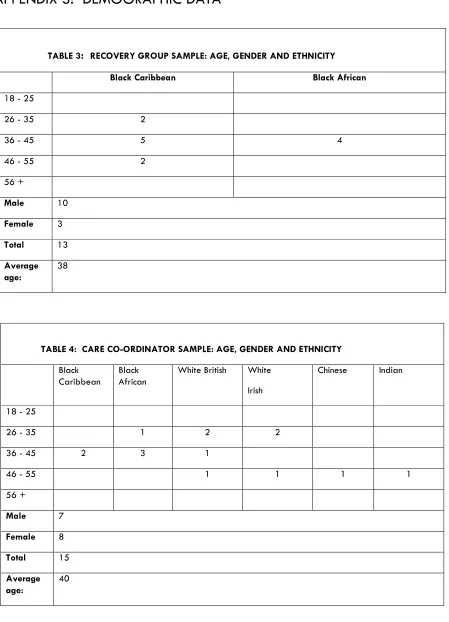
Fifteen one to one structured interviews were conducted with the care co-ordinators of service users from the sample (Table four, Appendix 3). The interview questions explored the care co-ordinator role, the challenges of working with BME communities and the support required to overcome these challenges. The key themes from the interviews are listed below and focus on the need to improve engagement with service users:
Pro-active engagement is necessary to prevent detention; practitioners consistently expressed the desire to work in a more proactive way but stated that high caseloads, paperwork and meeting targets meant that their (care co-ordinator) role is focused on managing cases rather than being therapeutic. The following statements highlight this theme further:
“I don’t care for people like I’d like to because the caseload is high and my time is so limited. I could say that for each case I don’t do enough but I can’t help it, it’s the way it is”
(Care co-ordinator)
“They do an audit each month and if you haven't got a clean sheet of paper you think “oh my god” and then panic sets in and you ignore visits” (Care co-ordinator).
Cultural awareness and exploration of mental health beliefs is necessary to engage BME communities.
“I don’t think there have been any barriers from myself engaging service users from BME backgrounds but I’ve observed barriers with my colleagues” (Care co-ordinator).
Services users’ lack of insight into their mental illness and non-compliance with their medication were cited as the main difficulties staff experience in relation to engaging with service users.
“One of the service users I work with has great potential, I have a big vision and see loads for him but we still have to cross that bridge of him believing he has a mental health problem” (Care co-ordinator).
The challenges of working with BME communities
A focus group with 12 members of Trust staff from a range of disciplines and settings took place in February 2007 to explore the challenges of working with BME communities and the support required to enable them to address these challenges. The themes from the focus group are listed below and focus mainly on improving the service user/mental health worker relationship:
The need to have an awareness of the resources that support recovery and the engagement process.
Improving dialogue around medication with service users to make it more useful and respectful of the service user needs.
How to develop mutual agendas in meetings with service users and support for staff that are ‘stuck’ in a relationship with a service user.
Time constraints due to high caseload and paper work are a barrier to engagement.
The research carried out with staff highlighted the need for developing a framework for delivering services to BME communities which offers staff access to support in dealing with particular issues and people as well as opportunities for learning. The action phase of the project will consider the following support needs for staff:
Developing the skills and knowledge necessary to improve the promotion of recovery.
The need to develop engagement strategies that ensure “real engagement” rather than passive engagement which is about taking medication and the service user playing the “good patient”.
Developing practices that support service users to “self manage” and address issues of “medication management”.
Improve knowledge and awareness of cultural, religious and health beliefs to ensure the use of treatment and care that is delivered in a culturally appropriate way.
4. Carers
In total 14 carers from across three East London localities participated in the research (Table five, Appendix 3). The majority of carers that participated in the research were members of existing carer’s groups and were not the carer’s of the original service user sample selected for this project. Two focus groups and two one to one interviews were carried out with carers to explore their experiences of the using mental health services. The key themes from this consultation are listed below:
• Lack of respect and engagement by mental health professionals.
“In the ward round and CPA meetings they (professionals) agree actions, we’re brought in to make us feel as if we’re part of the decisions but we’re not”
• Lack of information on diagnosis and treatments and insufficient information sharing.
• Ethnicity and culture – stereotypes and misunderstandings.
“As a black woman I sometimes think there is a conspiracy, why is everyone else leaving the ward and not my son?”
Based on these themes and other local research which has investigated carer’s experiences of using hospital services8the priorities for service improvement in relation to carers are:
Supporting carer involvement in decision making and care planning.
Improving the provision of information for carer’s, in particular on their first contact with services.
CONSULTATION
Developing Action towards Alternatives
The themes discussed in this paper were presented to service users, carers and staff at the “Developing Action towards Alternatives” event on 5thJune 2007. The aims of the day were:
To present the findings of the Alternative Pathways research.
To work with service users, carers and professionals to develop joint action plans which respond to the key themes.
Morning session
Forty-five people attended the day which began with a presentation of the DRE programme and the Alternative Pathways findings. The presentation was followed by the performance of a play called “Short Changed” which was based on the experiences of the Alternative Pathways service user sample. The play used a series of dramatic scenes and monologues to explore and highlight the experiences of carers, people who use mental health services and professionals in the mental health system. Following the play an external facilitator took the audience through a process called ‘hot seating’ which allowed the audience to direct questions at characters in the play. The main issues arising from the debate that followed are set out below:
1. The need to improve primary care mental health service provision and the links between primary and secondary care.
The audience felt that there was a lack of appropriate support offered in the early stages of illness in particular on initial contact with GP services.
Participants expressed the need for GPs to develop their knowledge of mental illness so that they are better equipped to detect and treat the early signs of mental distress.
Improved access to counselling at the onset of illness/distress was highlighted as a way of improving early intervention and prevention.
Participants expressed the need to improve the interface between GPs and teams such as the Home Treatment service.
In discussion about how the police and mental health services worked together, participants highlighted the need for a “joint up approach” and “seamless services”.
Suggestions were made for the development of a “single point of access” in the form of a helpline which directs people to the most appropriate services.
The role of gateway workers was mentioned in relation to facilitating access to appropriate services.
2. Carers support
The lack of information and engagement with carers was discussed in response to several scenes in the play.
The participants highlighted the need to improve the information given to carers as well as people who directly use the services and highlighted the need for the development of a carers welcome pack and an induction process which is delivered by the lead nurse or an independent advocacy service.
3. Improve access to alternative treatments and talking therapies
The audience highlighted the lack of treatment options made available to them and expressed the need for a more holistic approach which includes improved access to talking therapies.
Afternoon session
The afternoon session involved dividing participants into smaller groups to consider scenarios taken from the research and develop actions in relation to each. The action points from this event and the recommendations of the local community engagement projects mentioned earlier in this paper have been considered in the identification of the projects priorities and the development of the attached action plan.
PRIORITIES
The following priorities have been developed in response to the research findings. The funding for some of the initiatives linked to these priorities has been secured through the Delivering Race Equality Trailblaser Clinical Network.
Mellow in collaboration with CDW projects and the Mental Health guides programme.
2. Increase awareness and promote models and approaches that promote recovery with Black African and Caribbean service users both within in patient settings and community based services.
The development of CBT groups for Black men across East London.
The development of a mentoring service for Black African and Caribbean service users in Hackney which will offer a range of mentoring from personal support in people’s daily lives as well as tapping into the potential of service users to improve employability and support people to move on to the world of work.
The Pacesetters Programme will be addressing communication and information to service users and carers on the dose, side effects and impact of physical health of medication and will also be clarifying the mental health assessment process with the publication of a guide to psychiatric assessments.
Recruit service user auditors to evaluate the effectiveness/suitability of interventions for Black African and Caribbean communities.
3. The development of pilot programmes aimed at reducing admissions and improving engagement with service users from Black African and Caribbean communities who have a history of repeat hospital admissions.
Pilot the social systems approach within the Home Treatment Team in Tower Hamlets.
A qualitative study into the management and engagement of African and Caribbean men with complex mental health problems with the Assertive Outreach Service in Newham.
4. Undertake a process redesign exercise of the existing CPA process to enhance the workforce’s ability to improve the CPA experience of BME clients and their carers. This will be in connection to the Mental Health Guides Report’s CPA recommendation to improve the CPA experience for Black African and Caribbean service users.
Twelve employment coaches will be recruited across the three localities and will provide support with finding work such as job searches, completion of application forms and coaching for interviews.
Three new locality People Participation posts have been developed and will work in collaboration with the voluntary and third sectors to ensure people who use our services and carers, fully participate in the development and in the running of our mental health services.
Three new locality Equality and Diversity Lead posts have been developed and will work to develop and implement a strategy that supports the broad equalities, diversity and human rights agenda.
OUTCOMES
Progress against the following outcomes has been achieved through the research stage of the project; the action phase of the project will enable us to continue working towards meeting all the identified outcomes:
• A greater understanding of why locally some BME groups are disproportionately represented in the detained patient population.
• Teams developing the knowledge, skills and expertise to address/reduce this over representation.
• Information for commissioners to enable more appropriate commissioning to address over representation.
• Contribute to meeting the aims set out in the 5 year foundation trust plans.
• Improved services, better outcomes and a reduction in compulsion for BME groups.
IMPLEMENTATION PROCESS
The Trust is part of the DRE Clinical Trailblaser Network; this programme includes the development of the projects listed earlier as priorities and work to develop these initiatives is underway. As well as this the following areas of work have been prioritised in relation to implementation the project action plan:
Improving information and dialogue about medication with the service users and carers.
Developing interventions that support the promotion of recovery and improve the CPA experience for Black African and Caribbean service users.
stakeholders in order to identify and develop interventions that will meet the needs identified through the mapping process. This process will aim to encourage the stakeholders and directorates responsible for each area of work to take ownership of the project actions. The Alternative Pathways project will continue to liaise with these groups to establish progress against the identified actions.
Mellow and the Directorate for Social Inclusion will also continue to develop this agenda and ensure that the recommendations of this work are incorporated into future work programmes aimed at addressing the needs of Black African and Caribbean communities. Timescales set for the completion of work in relation to the project priorities is March 2008.
KEY FINDINGS
The Alternative Pathways action plan will assist the trust in responding to the key findings listed below and recognises the involvement of the voluntary sector in supporting us to achieve the expected outcomes.
The untapped potential of service users in terms of their work/academic experiences.
Service users not engaged around medication.
Current approach is safety and maintenance as opposed to safety and recovery.
KEY MESSAGES
The project has developed a framework which can be drawn on by other organisations wishing to improve their understanding of the overrepresentation of BME communities in mental health services. It has also contributed to Mellow’s goal of establishing a more hopeful dialogue about tackling the over representation of Black African and Caribbean communities within mental health services. The following key messages maybe helpful when considering the development of strategies aimed at addressing over representation (Griffiths, 2007):
How is over representation defined? And by whom?
The need for clarity in relation to the pattern of over representation you wish to address i.e. Mental Health Act 1983 detentions, informal admissions and access to psychological therapies.
The need for local dialogue and awareness of the possible causal factors of over representation.
services to both set a target that is rooted in the local context and actively involves them in working towards achieving and monitoring the targets set.
Interventions need to address risk factors and promote protective factors.
Mapping past and current interventions aimed at addressing over representation and evaluating impact.
The need for data which explains the diversity that exists in the over represented ethnic groups in terms of age and gender to allow for the development of targeted interventions.
The need to engage and involve stakeholders and senior management to create ownership of this agenda.
CONCLUSION
REFERENCES
Bridgett, C and Polak, P (2003) Social systems intervention and crisis resolution. British Journal of Psychiatry.
Delivering Race Equality in Mental Health Care (2005) An action plan for reform inside and outside services and the Government's response to the Independent inquiry into the death of David Bennett.
East London Foundation Trust (2006) Local Mental Health Act Data Reports.
Griffiths, S (2007) Understanding and Addressing the Over-representation of Black African and Caribbean people in the mental health system (Unpublished).
Johnson, R & Pilling, D (2007) Improving Hospital Support for Carers. City University London.
Kukuwa, A & Ofori, J (2000) Report on an assessment of the Mental Health Needs of Young African and Caribbean men in East London, City and Hackney Health Authority (ELCHA).
Mind in Tower Hamlets (2007) Report of the Community Led Research Project Focusing on ‘The experiences that Adult Mental Health Service Users and Survivors from African & Caribbean, Bengali and Somali communities have had of using Mental Health services in Tower Hamlets.
Mind in Tower Hamlets: Report Of the Community Led Research Project Focusing on ‘The experiences that Adult Mental Health Service Users and Survivors from African & Caribbean, Bengali and Somali communities have had of using Mental Health services in Tower Hamlets or other boroughs, March 2007.
Mental Health Act Commission (2006). Count Me In: The national census of inpatients in mental health and learning disability services in England and Wales.
APPENDIX 1: MELLOW
MISSION
Mellow is a pioneering East London-based NHS programme committed to improving the experience of African and Caribbean people with mental health problems & promoting their well-being within the community.
PROJECT PROFILE
Mellow was launched in 2000 to contribute to the reduction of the over-representation of young African and Caribbean men in mental health services in East London. As well as developing alternative and sustainable responses to mental distress, Mellow successfully works in partnership with statutory, voluntary and arts-based agencies nationwide, both as a facilitator and a consultancy. With an expanded brief targeting the wider African and Caribbean Community, Mellow became part of the East London & City Mental Health NHS Trust in April 2004. The award-winning project is central to the Trust’s cultural diversity and race equality programmes.
KEY AIMS
Improve the experiences of African and Caribbean mental health clients so that they may achieve greater control over their lives.
Support East London statutory mental health services to implement the Delivering Race Equality Agenda.
Increase client participation in service design, delivery and evaluation.
Provide training, information and support enabling mental health practitioners to deliver services that are more responsive to the needs of African and Caribbean clients.
Encourage, promote and develop community-based programmes that develop African and Caribbean clients’ potential.
APPENDIX 2: ALTERNATIVE PATHWAYS PROJECT STEERING GROUP
Tim Bishop – Director for Social Inclusion.
Sandra Griffiths – Mellow Service Development Manager.
Robert Jones – Head of Equality and Diversity.
Jimmy Glass – Locality Manager, Hackney.
Christine Tacey – Locality Manager, Newham.
APPENDIX 3: DEMOGRAPHIC DATA
TABLE 3: RECOVERY GROUP SAMPLE: AGE, GENDER AND ETHNICITY
Black Caribbean Black African
18 - 25
26 - 35 2
36 - 45 5 4
46 - 55 2
56 +
Male 10
Female 3
Total 13
Average age:
[image:23.595.87.539.124.413.2]38
TABLE 4: CARE CO-ORDINATOR SAMPLE: AGE, GENDER AND ETHNICITY
Black Caribbean
Black African
White British White
Irish
Chinese Indian
18 - 25
26 - 35 1 2 2
36 - 45 2 3 1
46 - 55 1 1 1 1
56 +
Male 7
Female 8
Total 15
Average age:
TABLE 5: CARERS SAMPLE: AGE, GENDER AND ETHNICITY
Black Caribbean
Black African (Somalian)
White British White
Irish
Bangladeshi Columbian
26 - 35 2 1 1
36 - 45 4 1 1 1
46 - 55 1
56 + 1 1 2
Male
Female 14
Total 14
Average age:
GLOSSARY OF TERMS
This paper makes reference to the following terms which may require clarification:
Admission refers to the period from which a person is admitted onto the ward to the time they are discharged.
CDWs (community development workers) were introduced to enable greater understanding and ownership of the issues facing people from BME communities so that real improvement takes place in the commissioning and provision of mental health services across the full age range (CDWs for Black and Minority Ethnic Communities, DOH 2004).
Complianceusually refers to a service user both agreeing to and then undergoing some treatment and is most commonly used in relation to whether a service user takes their medication. Side effects and dislike of medication and lack of insight were the most common reason for non-compliance.
Cultural awareness involves a “gradually developing inner sense of the equality of cultures, an increased understanding of your own and other people’s cultures and a positive interest in how cultures both connect and differ. Such awareness can broaden the mind, increase tolerance and facilitate international communication” (Tomlinson).
Detentionis a terms used to refer to compulsory admission to hospital under the Mental Health Act 1983.
Living in the communityrefers to the period after a person is discharged from the ward and returns to the care of community mental health service.
Pacesetters Programme: the trusts is participating in this DOH led programme which aims deliver equality and diversity improvements and innovations resulting in patient and user involvement in the design and delivery of services.
Pre-admissionrefers to the period prior to being detained under the Mental Health Act 1983 or being admitted to hospital.
Process Mappingis a method for displaying processes that illustrates how a product or service is processed. The aim of the process is to identify elements of the process that can be changed in order to improve the product or service being delivered.
Trailblaser Clinical Networkis a Delivering Race Equality initiative which aims to increase activity in inpatient areas that directly impact on patient care and management in these environments. East London Foundation Trust is part of this network and a number of projects mentioned in this documents as part of this programme.
ALTERNATIVE PATHWAYS ACTION PLAN 2007
Purpose: This action plan will assist the Trust in responding to the findings of the Alternative Pathways project.
1 Within the context of local Mental Health Promotion strategies consolidate and further develop of mental health promotion activities
targeting Black African and Caribbean communities to reduce stigma and promote social inclusion.
Action Outcome
Review current Mental Health Promotion strategies to ensure that they include activities targeting the Black African and Caribbean communities (Lead: Service Development Manager – Mellow).
CDW projects to develop BME specific initiatives that contribute to the mental health and wellbeing agenda.
Work with existing Black African and Caribbean voluntary sector organisations to develop community based packages that reduce the need for detention (Service Development Manager – Mellow).
Increased awareness amongst Black African and Caribbean communities of where to access support for mental health problems.
2 Increase awareness and promote models and approaches that promote recovery with Black African and Caribbean service users both within
in patient settings and community based services.
Development of CBT groups for Black men in Hackney, Newham and Tower Hamlets.
Develop a mentoring service for Black African and Caribbean service users (Mellow).
Develop in reach projects targeting Black African and Caribbean service users (CDWs).
Improve communication and information to service users and their carers about the dose, side effects and impact on physical health of medication (Lead: AP project worker).
Recruit service user auditors to evaluate the effectiveness/suitability of existing interventions for Black African and Caribbean communities as well as new interventions developed through the Alternative Pathways project. (Lead: Service Development Manager – Mellow. This will involve working with Community Engagement Researchers).
3 The development of pilot programmes aimed at reducing admissions and improving engagement with service users from Black African andCaribbean communities who have a history of repeat hospital admissions.
Action Outcome
Implementation and evaluation of the social systems approach within the HTT in Tower Hamlets.
A qualitative study into the management and engagement of African and Caribbean men with complex mental health problems with the Assertive Outreach Service in Newham.
A greater understanding of why locally some BME groups are disproportionately represented in the detained patient population and a greater awareness of approaches that are effective in reducing the disproportionate rates.
4 Undertake a process redesign exercise of the existing CPA process to enhance workforce’s ability to improve the CPA experience of BMEclients and their carers.
Undertake a process redesign exercise of the existing CPA process to enhance workforce’s ability to improve the CPA experience of BME clients and their carers. This will be in connection to the Mental Health Guides Report’s CPA recommendation to improve the CPA experience for Black African and Caribbean service users (Lead: Borough Director, Hackney).
Improved satisfaction of mental health services for Black African and Caribbean service users and their carers.
5 Develop a highly skilled and culturally capable workforce and statutory services which meet the needs of Black African and Caribbeanservice users and carers.
Create shared agreement within the trust of what is meant by the term ‘culturally appropriate services’ (Lead: Robert Jones).
The recruitment of 3 new locality equality and diversity posts and delivery of RECC training to all community teams and ward staff (Lead: Robert Jones).
A highly skilled and culturally capable workforce and services which meet the needs of Black African and Caribbean service users and carers.