Using Similarity Scoring To Improve the Bilingual Dictionary for Word
Alignment
Katharina Probst
Language Technologies Institute Carnegie Mellon University Pittsburgh, PA, USA, 15213 [email protected]
Ralf Brown
Language Technologies Institute Carnegie Mellon University Pittsburgh, PA, USA, 15213
Abstract
We describe an approach to improve the bilingual cooccurrence dictionary that is used for word alignment, and evaluate the improved dictionary using a version of the Competitive Linking algorithm. We demonstrate a problem faced by the Com-petitive Linking algorithm and present an approach to ameliorate it. In particular, we rebuild the bilingual dictionary by cluster-ing similar words in a language and as-signing them a higher cooccurrence score with a given word in the other language than each single word would have other-wise. Experimental results show a signifi-cant improvement in precision and recall for word alignment when the improved dicitonary is used.
1 Introduction and Related Work
Word alignment is a well-studied problem in Natu-ral Language Computing. This is hardly surprising given its significance in many applications: word-aligned data is crucial for example-based machine translation, statistical machine translation, but also other applications such as cross-lingual information retrieval. Since it is a hard and time-consuming task to hand-align bilingual data, the automation of this task receives a fair amount of attention. In this pa-per, we present an approach to improve the bilin-gual dictionary that is used by word alignment al-gorithms. Our method is based on similarity scores
between words, which in effect results in the clus-tering of morphological variants.
One line of related work is research in clustering based on word similarities. This problem is an area of active research in the Information Retrieval com-munity. For instance, Xu and Croft (1998) present an algorithm that first clusters what are assumedly variants of the same word, then further refines the clusters using a cooccurrence related measure. Word variants are found via a stemmer or by clustering all words that begin with the same three letters. An-other technique uses similarity scores based on N-grams (e.g. (Kosinov, 2001)). The similarity of two words is measured using the number of N-grams that their occurrences have in common. As in our ap-proach, similar words are then clustered into equiv-alence classes.
Other related work falls in the category of word alignment, where much research has been done. A number of algorithms have been proposed and eval-uated for the task. As Melamed (2000) points out, most of these algorithms are based on word cooccur-rences in sentence-aligned bilingual data. A source language word
and a target language word
are said to cooccur if
occurs in a source language sen-tence and
occurs in the corresponding target lan-guage sentence. Cooccurrence scores then are then counts for all word pairs
and , where
is in the source language vocabulary and is in the tar-get language vocabulary. Often, the scores also take into account the marginal probabilites of each word and sometimes also the conditional probabilities of one word given the other.
Aside from the classic statistical approach of
(Brown et al., 1990; Brown et al., 1993), a number of other algorithms have been developed. Ahren-berg et al. (1998) use morphological information on both the source and the target languages. This infor-mation serves to build equivalence classes of words based on suffices. A different approach was pro-posed by Gaussier (1998). This approach models word alignments as flow networks. Determining the word alignments then amounts to solving the net-work, for which there are known algorithms. Brown (1998) describes an algorithm that starts with ‘an-chors’, words that are unambiguous translations of each other. From these anchors, alignments are ex-panded in both directions, so that entire segments can be aligned.
The algorithm that this work was based on is the Competitive Linking algorithm. We used it to test our improved dictionary. Competitive Linking was described by Melamed (1997; 1998; 2000). It com-putes all possible word alignments in parallel data, and ranks them by their cooccurrence or by a similar score. Then links between words (i.e. alignments) are chosen from the top of the list until no more links can be assigned. There is a limit on the number of links a word can have. In its basic form the Compet-itive Linking algorithm (Melamed, 1997) allows for only up to one link per word. However, this one-to-one/zero-to-one assumption is relaxed by redefining the notion of a word.
2 Competitive Linking in our work
We implemented the basic Competitive Linking al-gorithm as described above. For each pair of paral-lel sentences, we construct a ranked list of possible links: each word in the source language is paired with each word in the target language. Then for each word pair the score is looked up in the dictio-nary, and the pairs are ranked from highest to lowest score. If a word pair does not appear in the dictio-nary, it is not ranked. The algorithm then recursively links the word pair with the highest cooccurrence, then the next one, etc. In our implementation, link-ing is performed on a sentence basis, i.e. the list of possible links is constructed only for one sentence pair at a time.
Our version allows for more than one link per word, i.e. we do not assume one-to-one or zero-to-one alignments between words. Furthermore, our
implementation contains a threshold that specifies how high the cooccurrence score must be for the two words in order for this pair to be considered for a link.
3 The baseline dictionary
In our experiments, we used a baseline dictionary, rebuilt the dictionary with our approach, and com-pared the performance of the alignment algorithm between the baseline and the rebuilt dictionary. The dictionary that was used as a baseline and as a ba-sis for rebuilding is derived from bilingual sentence-aligned text using a count-and-filter algorithm:
Count: for each source word type, count the
number of times each target word type cooc-curs in the same sentence pair, as well as the total number of occurrences of each source and target type.
Filter: after counting all cooccurrences,
re-tain only those word pairs whose cooccurrence probability is above a defined threshold. To be retained, a word pair
,
must satisfy
"!$#&%!$'(
where )
*+
is the number of times the two words cooccurred.
By making the threshold vary with frequency, one can control the tendency for infrequent words to be included in the dictionary as a result of chance col-locations. The 50% cooccurrence probability of a pair of words with frequency 2 and a single co-occurrence is probably due to chance, while a 10% cooccurrence probability of words with frequency 5000 is most likely the result of the two words being translations of each other. In our experiments, we varied the threshold from 0.005 to 0.01 and 0.02.
It should be noted that there are many possible algorithms that could be used to derive the baseline dictionary, e.g. ,.- , pointwise mutual information,
4 The problem of derivational and inflectional morphology
As the scores in the dictionary are based on surface form words, statistical alignment algorithms such as Competitive Linking face the problem of inflected and derived terms. For instance, the English word
liberty can be translated into French as a noun (lib-ert´e), or else as an adjective (libre), the same
adjec-tive in the plural (libres), etc. This happens quite fre-quently, as sentences are often restructured in trans-lation. In such a case, libert´e, libre, libres, and all the other translations of liberty in a sense share their cooccurrence scores with liberty. This can cause problems especially because there are words that are overall frequent in one language (here, French), and that receive a high cooccurrence count regardless of the word in the other language (here, English). If the cooccurrence score between liberty and an un-related but frequent word is higher than libres, then the algorithm will prefer a link between liberty and
le over a link between liberty and libres, even if the
latter is correct.
As for a concrete example from the training data used in this study, consider the English word oil. This word is quite frequent in the training data and thus cooccurs at high counts with many target lan-guage words 1. In this case, the target language is French. The cooccurrence dictionary contains the following entries for oil among other entries:
oil - et 543 oil - dans 118
oil - p´etrole 259 oil - p´etroli`ere 61 oil - p´etroli`eres 61
It can be seen that words such as et and dans re-ceive higher coccurrence scores with oil than some correct translations of oil, such as p´etroli`ere, and
p´etroli`eres, and, in the case of et, also p´etrole. This
will cause the Competitive Linking algorithm to fa-vor a link e.g. between oil and et over a link between
oil and p´etrole.
In particular, word variations can be due to in-flectional morphology (e.g. adjective endings) and derivational morphology (e.g. a noun being
trans-1
We used Hansards data, see the evaluation section for de-tails.
lated as an adjective due to sentence restructuring). Both inflectional and derivational morphology will result in words that are similar, but not identical, so that cooccurrence counts will score them separately. Below we describe an approach that addresses these two problems. In principle, we cluster similar words and assign them a new dictionary score that is higher than the scores of the individual words. In this way, the dictionary is rebuilt. This will influence the ranked list that is produced by the algorithm and thus the final alignments.
5 Rebuilding the dictionary based on
similarity scores
Rebuilding the dictionary is based largely on sim-ilarities between words. We have implemented an algorithm that assigns a similarity score to a pair of words
. The score is higher for a pair of sim-ilar words, while it favors neither shorter nor longer words. The algorithm finds the number of match-ing characters between the words, while allowmatch-ing for insertions, deletions, and substitutions. The con-cept is thus very closely related to the Edit distance, with the difference that our algorithm counts the matching characters rather than the non-matching ones. The length of the matching substring (which is not necessarily continguous) is denoted by
Match-StringLength). At each step, a character from
is compared to a character from
. If the characters are identical, the count for the MatchStringLength is incremented. Then the algorithm checks for redupli-cation of the character in one or both of the words. Reduplication also results in an incremented
Match-StringLength. If the characters do not match, the
al-gorithm skips one or more characters in either word. Then the longest common substring is put in re-lation to the length of the two words. This is done so as to not favor longer words that would result in a higher MatchStringLength than shorter words. The similarity score of
and
is then computed using the following formula:
' *''
' "!
' #%$
This similarity scoring provides the basis for our newly built dictionary. The algorithm proceeds as follows: For any given source language word
, there are target language words '&
)( such that
the cooccurrence score*'+,+,*
,
Note that in most cases is much smaller than the size of the target language vocabulary, but also much greater than . For the words '&
)( , the
algo-rithm computes the similarity score for each word pair , where . Note that this computation is potentially very complex. The number of word pairs grows exponentially as grows. This problem is addressed by excluding word pairs whose cooccurrence scores are low, as will be discussed in more detail later.
In the following, we use a greedy bottom-up clus-tering algorithm (Manning and Sch¨utze, 1999) to cluster those words that have high similarity scores. The clustering algorithm is initialized to clus-ters, where each cluster contains exactly one of the words&
)( . In the first step, the algorithm
clus-ters the pair of words with the maximum similar-ity score. The new cluster also stores a similarsimilar-ity score
, which in this case is the similarity score of the two clustered words. In the following steps, the algorithm again merges those two clusters that have the highest similarity score
. The clustering can occur in one of three ways:
1. Merge two clusters that each contain one word.
Then the similarity score of the
merged cluster will be the similarity score of the word pair.
2. Merge a cluster*
that contains a single word
and a cluster *
that contains words'& and has "! % !$#
. Then the sim-ilarity score of the merged cluster is the aver-age similarity score of the
-word cluster, av-eraged with the similarity scores between the single word and all
words in the cluster. This means that the algorithm computes the similar-ity score between the single word
in cluster
*
and each of the
words in cluster *
, and averages them with
* : &%(' #*) #+-, ' /. ' # 0 $%!1,/, ' 0 +3254) , # 0&0 6 !1, ' 0
3. Merge two clusters that each contain more than a single word. In this case, the algo-rithm proceeds as in the second case, but av-erages the added similarity score over all word
pairs. Suppose there exists a cluster *
with 7 words& 8 and *
and a cluster*
with words%& and * . Then 9! % !$#
is computed as follows:
&%;: ) % ' #*) #+-,' /. ' # 0 $%!1,/, ' 0 +3254) , # 0&0 !1,/, : 0 +3254)< $=>0 < 6@? = !1, ' 0 !1, : 0
Clustering proceeds until a threshold,
, is exhausted. If none of the possible merges would re-sult in a new cluster whose average similarity score
would be at least
, clus-tering stops. Then the dictionary entries are mod-ified as follows: suppose that words
are clustered, where all words
cooccur with source language word
. Furthermore, denote the cooccurrence score of the word pair
and by
*'+,+,*
. Then in the rebuilt dictionary the
en-try A /B/C #EDGF HHF , A &B/C # 0
will be replaced withA
/B/C #ED % + I 6 F HHF , A /B&C 0 ifC #EJ C 6LKKK C&+
Not all words are considered for clustering. First, we compiled a stop list of target language words that are never clustered, regardless of their similarity and cooccurrence scores with other words. The words on the stop list are the 20 most frequent words in the target language training data. Section M argues
why this exclusion makes sense: one of the goals of clustering is to enable variations of a word to receive a higher dictionary score than words that are very common overall.
Furthermore, we have decided to exclude words from clustering that account for only few of the cooccurrences of
. In particular, a separate thresh-old,*'+,+,* ON
+ , controls how high the cooccurrence
score with
has to be in relation to all other scores between
and a target language word. *'+,+,* ON
+
is expressed as follows: a word
qualifies for clus-tering if !QPP! % # ( % 6 IR !QPP! % 6 (TS *'+,+,* ON +
As before,%&
)( are all the target language words
that cooccur with source language word
.
This exclusion makes sense because words that cooccur infrequently are likely not translations of each other, so it is undesirable to boost their score by clustering. Furthermore, this threshold helps keep the complexity of the operation under control. The fewer words qualify for clustering, the fewer simi-larity scores for pairs of words have to be computed.
6 Evaluation
We trained three basic dictionaries using part of the Hansard data, around five megabytes of data (around 20k sentence pairs and 850k words). The basic dic-tionaries were built using the algorithm described in section 3, with three different thresholds: 0.005, 0.01, and 0.02. In the following, we will refer to these dictionaries as as Dict0.005, Dict0.01, and Dict0.02.
50 sentences were held back for testing. These sentences were hand-aligned by a fluent speaker of French. No one-to-one assumption was enforced. A word could thus align to zero or more words, where no upper limit was enforced (although there is a nat-ural upper limit).
The Competitive Linking algorithm was then run with multiple parameter settings. In one setting, we varied the maximum number of links allowed per word,
NL7
. For example, if the maximum number is 2, then a word can align to 0, 1, or 2 words in the parallel sentence. In other settings, we en-forced a minimum score in the bilingual dictionary for a link to be accepted, *'+
. This means that two words cannot be aligned if their score is below
*'+
. In the rebuilt dictionaries, *'+
is applied in the same way.
The dictionary was also rebuilt using a number of different parameter settings. The two parameters that can be varied when rebuilding the dictionary are the similarity threshold
and the cooc-currence threshold *'+,+,* ON
+ .
enforces that all words within one cluster must have an av-erage similarity score of at least
. The sec-ond threshold,*'+,+,* ON
+ , enforces that only certain
words are considered for clustering. Those words that are considered for clustering should account for more than O *'+,+,* ON
+
of the cooccur-rences of the source language word with any tar-get language word. If a word falls below threshold
*'+,+,* ON
+ , its entry in the dictionary remains
un-changed, and it is not clustered with any other word. Below we summarize the values each parameter was set to.
maxlinks Used in Competitive Linking
algo-rithm: Maximum number of words any word can be aligned with. Set to: 1, 2, 3.
minscore Used in Competitive Linking
algo-rithm: Minimum score of a word pair in the dictionary to be considered as a possible link. Set to: 1, 2, 4, 6, 8, 10, 20, 30, 40, 50.
minsim Used in rebuilding dictionary:
Mini-mum average similarity score of the words in a cluster. Set to: 0.6, 0.7, 0.8.
coocsratio Used in rebuilding dictionary: O
*'+,+,* ON
+ is the minimum percentage of all
cooccurrences of a source language word with any target language word that are accounted for by one target language word. Set to: 0.003.
Thus varying the parameters, we have constructed various dictionaries by rebuilding the three baseline dictionaries. Here, we report on results on three dic-tionaries where minsim was set to 0.7 and
coocsra-tio was set to 0.003. For these parameter settings,
we observed robust results, although other parame-ter settings also yielded positive results.
Precision and recall was measured using the hand-aligned 50 sentences. Precision was defined as the percentage of links that were correctly pro-posed by our algorithm out of all links that were proposed. Recall is defined as the percentage of links that were found by our algorithm out of all links that should have been found. In both cases, the hand-aligned data was used as a gold standard. The F-measure combines precision and recall:
N
- @
!
P
(
@ !
88
@ !
P (
@ !
88 .
The following figures and tables illustrate that the Competitive Linking algorithm performs favorably when a rebuilt dictionary is used. Table 1 lists the improvement in precision and recall for each of the dictionaries. The table shows the values when the
minscore score is set to 50, and up to 1 link was
Dict0.005 Dict0.01 Dict0.02
P Improvement 0.060 0.067 0.057
P p-value 0.0003 0.0042 0.0126
R Improvement 0.094 0.11 0.087
[image:6.612.70.297.65.136.2]R p-value 0.0026 0.0008 0.0037
Table 1: Percent improvement and p-value for recall and precision, comparing baseline and rebuilt dictio-naries at minscore 50 and maxlinks 1.
for these parameter settings, where some of the best results were observed.
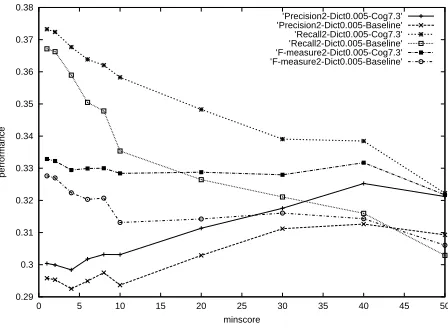
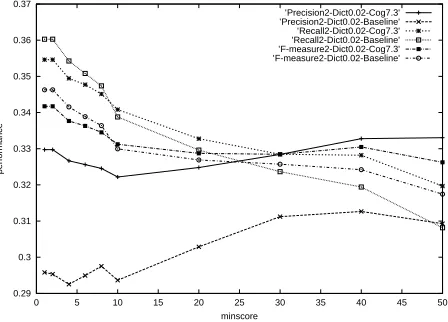
The following figures (figures 1-9) serve to illus-trate the impact of the algorithm in greater detail. All figures plot the precision, recall, and f-measure per-formance against different minscore settings, com-paring rebuilt dictionaries to their baselines. For each dictionary, three plots are given, one for each
maxlinks setting, i.e. the maximum number of links
allowed per word. The curve names indicate the type of the curve (Precision, Recall, or F-measure), the maximum number of links allowed per word (1, 2, or 3), the dictionary used (Dict0.005, Dict0.01, or Dict0.02), and whether the run used the base-line dictionary or the rebuilt dictionary (Basebase-line or Cog7.3).
It can be seen that our algorithm leads to sta-ble improvement across parameter settings. In few cases, it drops below the baseline when minscore is low. Overall, however, our algorithm is robust - it improves alignment regardless of how many links are allowed per word, what baseline dictionary is used, and boosts both precision and recall, and thus also the f-measure.
To return briefly to the example cited in section , we can now show how the dictionary rebuild has affected these entries. In dictionary
they
now look as follows:
oil - et 262 oil - dans 118
oil - p´etrole 434 oil - p´etroli`ere 434 oil - p´etroli`eres 434
The fact that p´etrole, p´etroli`ere, and p´etroli`eres now receive higher scores than et and dans is what causes the alignment performance to increase.
0.25 0.3 0.35 0.4 0.45 0.5
0 5 10 15 20 25 30 35 40 45 50
performance
minscore
’Precision1-Dict0.005-Cog7.3’ ’Precision1-Dict0.005-Baseline’ ’Recall1-Dict0.005-Cog7.3’ ’Recall1-Dict0.005-Baseline’ ’F-measure1-Dict0.005-Cog7.3’ ’F-measure1-Dict0.005-Baseline’
Figure 1: Performance of dictionaries Dict0.005 for up to one link per word
0.29 0.3 0.31 0.32 0.33 0.34 0.35 0.36 0.37 0.38
0 5 10 15 20 25 30 35 40 45 50
performance
minscore
[image:6.612.316.542.68.231.2]’Precision2-Dict0.005-Cog7.3’ ’Precision2-Dict0.005-Baseline’ ’Recall2-Dict0.005-Cog7.3’ ’Recall2-Dict0.005-Baseline’ ’F-measure2-Dict0.005-Cog7.3’ ’F-measure2-Dict0.005-Baseline’
Figure 2: Performance of dictionaries Dict0.005 for up to two links per word
7 Conclusions and Future Work
We have demonstrated how rebuilding a dictionary can improve the performance (both precision and re-call) of a word alignment algorithm. The algorithm proved robust across baseline dictionaries and vari-ous different parameter settings. Although a small test set was used, the improvements are statistically significant for various parameter settings. We have shown that computing similarity scores of pairs of words can be used to cluster morphological variants of words in an inflected language such as French.
[image:6.612.317.541.292.456.2]0.22 0.24 0.26 0.28 0.3 0.32 0.34 0.36 0.38 0.4
0 5 10 15 20 25 30 35 40 45 50
performance
minscore
[image:7.612.77.305.68.230.2]’Precision3-Dict0.005-Cog7.3’ ’Precision3-Dict0.005-Baseline’ ’Recall3-Dict0.005-Cog7.3’ ’Recall3-Dict0.005-Baseline’ ’F-measure3-Dict0.005-Cog7.3’ ’F-measure3-Dict0.005-Baseline’
Figure 3: Performance of dictionaries Dict0.005 for up to three links per word
0.25 0.3 0.35 0.4 0.45 0.5
0 5 10 15 20 25 30 35 40 45 50
performance
minscore
’Precision1-Dict0.01-Cog7.3’ ’Precision1-Dict0.01-Baseline’ ’Recall1-Dict0.01-Cog7.3’ ’Recall1-Dict0.01-Baseline’ ’F-measure1-Dict0.01-Cog7.3’ ’F-measure1-Dict0.01-Baseline’
Figure 4: Performance of dictionaries Dict0.01 for up to one link per word
rebuilding algorithm is independent of the actual word alignment method used.
Furthermore, we plan to explore ways to improve the similarity scoring algorithm. For instance, we can assign lower match scores when the characters are not identical, but members of the same equiva-lence class. The equivaequiva-lence classes will depend on the target language at hand. For instance, in Ger-man, a and ¨a will be assigned to the same equiva-lence class, because some inflections cause a to be-come ¨a. An improved similarity scoring algorithm may in turn result in improved word alignments.
In general, we hope to move automated dictio-nary extraction away from pure surface form statis-tics and toward dictionaries that are more
linguisti-0.3 0.31 0.32 0.33 0.34 0.35 0.36 0.37 0.38
0 5 10 15 20 25 30 35 40 45 50
performance
minscore
[image:7.612.311.540.70.230.2]’Precision2-Dict0.01-Cog7.3’ ’Precision2-Dict0.01-Baseline’ ’Recall2-Dict0.01-Cog7.3’ ’Recall2-Dict0.01-Baseline’ ’F-measure2-Dict0.01-Cog7.3’ ’F-measure2-Dict0.01-Baseline’
Figure 5: Performance of dictionaries Dict0.01 for up to two links per word
0.22 0.24 0.26 0.28 0.3 0.32 0.34 0.36 0.38 0.4
0 5 10 15 20 25 30 35 40 45 50
performance
minscore
[image:7.612.317.542.291.449.2]’Precision3-Dict0.01-Cog7.3’ ’Precision3-Dict0.01-Baseline’ ’Recall3-Dict0.01-Cog7.3’ ’Recall3-Dict0.01-Baseline’ ’F-measure3-Dict0.01-Cog7.3’ ’F-measure3-Dict0.01-Baseline’
Figure 6: Performance of dictionaries Dict0.01 for up to three links per word
cally motivated.
References
Lars Ahrenberg, M. Andersson, and M. Merkel. 1998. A simple hybrid aligner for generating lexical correspon-dences in parallel texts. In Proceedings of
COLING-ACL’98.
Peter Brown, J. Cocke, V.D. Pietra, S.D. Pietra, J. Jelinek, J. Lafferty, R. Mercer, and P. Roossina. 1990. A statis-tical approach to Machine Translation. Computational
Linguistics, 16(2):79–85.
Peter Brown, S.D. Pietra, V.D. Pietra, and R. Mercer. 1993. The mathematics of statistical Machine Trans-lation: Parameter estimation. Computational
[image:7.612.77.301.292.451.2]0.25 0.3 0.35 0.4 0.45 0.5 0.55
0 5 10 15 20 25 30 35 40 45 50
performance
minscore
[image:8.612.75.300.68.230.2]’Precision1-Dict0.02-Cog7.3’ ’Precision1-Dict0.02-Baseline’ ’Recall1-Dict0.02-Cog7.3’ ’Recall1-Dict0.02-Baseline’ ’F-measure1-Dict0.02-Cog7.3’ ’F-measure1-Dict0.02-Baseline’
Figure 7: Performance of dictionaries Dict0.02 for up to one link per word
0.29 0.3 0.31 0.32 0.33 0.34 0.35 0.36 0.37
0 5 10 15 20 25 30 35 40 45 50
performance
minscore
[image:8.612.318.542.69.228.2]’Precision2-Dict0.02-Cog7.3’ ’Precision2-Dict0.02-Baseline’ ’Recall2-Dict0.02-Cog7.3’ ’Recall2-Dict0.02-Baseline’ ’F-measure2-Dict0.02-Cog7.3’ ’F-measure2-Dict0.02-Baseline’
Figure 8: Performance of dictionaries Dict0.02 for up to two links per word
Ralf Brown. 1997. Automated dictionary extraction for ‘knowledge-free’ example-based translation. In
Pro-ceedings of TMI 1997, pages 111–118.
Ralf Brown. 1998. Automatically-extracted thesauri for cross-language IR: When better is worse. In
Proceed-ings of COMPUTERM’98.
Eric Gaussier. 1998. Flow network models for word alignment and terminology extraction from bilingual corpora. In Proceedings of COLING-ACL’98.
Adam Kilgarriff. 1996. Which words are particularly characteristic of a text? A survey of statistical ap-proaches. In Proceedings of AISB Workshop on
Lan-guage Engineering for Document Analysis and Recog-nition.
Serhiy Kosinov. 2001. Evaluation of N-grams confla-tion approach in text-based Informaconfla-tion Retrieval. In
0.24 0.26 0.28 0.3 0.32 0.34 0.36 0.38 0.4
0 5 10 15 20 25 30 35 40 45 50
performance
minscore
[image:8.612.77.301.290.451.2]’Precision3-Dict0.02-Cog7.3’ ’Precision3-Dict0.02-Baseline’ ’Recall3-Dict0.02-Cog7.3’ ’Recall3-Dict0.02-Baseline’ ’F-measure3-Dict0.02-Cog7.3’ ’F-measure3-Dict0.02-Baseline’
Figure 9: Performance of dictionaries Dict0.02 for up to three links per word
Proceedings of International Workshop on Informa-tion Retrieval IR’01.
Christopher D. Manning and Hinrich Sch¨utze, 1999.
Foundations of Statistical Natural Language Process-ing, chapter 14. MIT Press.
Dan I. Melamed. 1997. A word-to-word model of trans-lation equivalence. In Proceedings of ACL’97.
Dan I. Melamed. 1998. Empirical methods for MT lexi-con development. In Proceedings of AMTA’98.
Dan I. Melamed. 2000. Models of translational equiv-alence among words. Computational Linguistics,
26(2):221–249.