Multi-Class Composite N-gram Language Model for Spoken Language
Processing Using Multiple Word Clusters
Hirofumi Yamamoto
ATR SLT
2-2-2 Hikaridai Seika-cho Soraku-gun, Kyoto-fu, Japan
Shuntaro Isogai
Waseda University 3-4-1 Okubo, Shinjuku-ku
Tokyo-to, Japan
Yoshinori Sagisaka
GITI / ATR SLT 1-3-10 Nishi-Waseda Shinjuku-ku, Tokyo-to, Japan
Abstract
In this paper, a new language model, the Multi-Class Composite N-gram, is pro-posed to avoid a data sparseness prob-lem for spoken language in that it is difficult to collect training data. The Multi-Class Composite N-gram main-tains an accurate word prediction ca-pability and reliability for sparse data with a compact model size based on multiple word clusters, called Multi-Classes. In the Multi-Class, the statisti-cal connectivity at each position of the N-grams is regarded as word attributes, and one word cluster each is created to represent the positional attributes. Fur-thermore, by introducing higher order word N-grams through the grouping of frequent word successions, Multi-Class N-grams are extended to Multi-Class Composite N-grams. In experiments, the Multi-Class Composite N-grams re-sult in 9.5% lower perplexity and a 16% lower word error rate in speech recogni-tion with a 40% smaller parameter size than conventional word 3-grams.
1 Introduction
Word N-grams have been widely used as a sta-tistical language model for language processing. Word N-grams are models that give the transition probability of the next word from the previous
N 1word sequence based on a statistical
analy-sis of the huge text corpus. Though word N-grams
are more effective and flexible than rule-based grammatical constraints in many cases, their per-formance strongly depends on the size of training data, since they are statistical models.
In word N-grams, the accuracy of the word prediction capability will increase according to the number of the order N, but also the num-ber of word transition combinations will exponen-tially increase. Moreover, the size of training data for reliable transition probability values will also dramatically increase. This is a critical problem for spoken language in that it is difficult to col-lect training data sufficient enough for a reliable model. As a solution to this problem, class N-grams are proposed.
In class N-grams, multiple words are mapped to one word class, and the transition probabilities from word to word are approximated to the proba-bilities from word class to word class. The perfor-mance and model size of class N-grams strongly depend on the definition of word classes. In fact, the performance of class N-grams based on the part-of-speech (POS) word class is usually quite a bit lower than that of word N-grams. Based on this fact, effective word class definitions are re-quired for high performance in class N-grams.
the word clustering of each Multi-Class for each word, a method is used in which word classes are formed automatically and statistically from a cor-pus, not using a priori knowledge as POS infor-mation. Furthermore, by introducing higher order word N-grams through the grouping of frequent word successions, Multi-Class N-grams are ex-tended to Multi-Class Composite N-grams.
2 N-gram Language Models Based on Multiple Word Classes
2.1 Class N-grams
Word N-grams are models that statistically give the transition probability of the next word from the previousN 1word sequence. This transition
probability is given in the next formula.
p(w i
jw i N+1
;:::;w i 2
;w i 1
) (1)
In word N-grams, accurate word prediction can be expected, since a word dependent, unique connec-tivity from word to word can be represented. On the other hand, the number of estimated param-eters, i.e., the number of combinations of word transitions, isV
N
in vocabulary V. AsV N
will exponentially increase according to N, reliable
estimations of each word transition probability are difficult under a largeN.
Class N-grams are proposed to resolve the problem that a huge number of parameters is re-quired in word N-grams. In class N-grams, the transition probability of the next word from the previousN 1word sequence is given in the next
formula.
p(c i
jc i N+1
;:::;c i 2
;c i 1
)p(w i
jc i
) (2)
Where,c
i represents the word class to which the
wordw
ibelongs.
In class N-grams with C classes, the number
of estimated parameters is decreased from V N
to C N
. However, accuracy of the word predic-tion capability will be lower than that of word N-grams with a sufficient size of training data, since the representation capability of the word depen-dent, unique connectivity attribute will be lost for the approximation base word class.
2.2 Problems in the Definition of Word Classes
In class N-grams, word classes are used to repre-sent the connectivity between words. In the con-ventional word class definition, word connectiv-ity for which words follow and that for which word precedes are treated as the same neighbor-ing characteristics without distinction. Therefore, only the words that have the same word connec-tivity for the following words and the preceding word belong to the same word class, and this word class definition cannot represent the word connec-tivity attribute efficiently. Take ”a” and ”an” as an example. Both are classified by POS as an Indef-inite Article, and are assigned to the same word class. In this case, information about the differ-ence with the following word connectivity will be lost. On the other hand, a different class assign-ment for both words will cause the information about the community in the preceding word con-nectivity to be lost. This directional distinction is quite crucial for languages with reflection such as French and Japanese.
2.3 Multi-Class and Multi-Class N-grams
As in the previous example of ”a” and ”an”, fol-lowing and preceding word connectivity are not always the same. Let’s consider the case of dif-ferent connectivity for the words that precede and follow. Multiple word classes are assigned to each word to represent the following and preced-ing word connectivity. As the connectivity of the word preceding ”a” and ”an” is the same, it is ef-ficient to assign them to the same word class to represent the preceding word connectivity, if as-signing different word classes to represent the fol-lowing word connectivity at the same time. To apply these word class definitions to formula (2), the next formula is given.
p(c t i jc
fN 1 i N+1
;:::;c f2 i 2
;c f1 i 1
)p(w i
jc t i
) (3)
In the above formula,c t
irepresents the word class
in the target position to which the word w i
be-longs, and c fN
i represents the word class in the
3 Automatic Extraction of Word Clusters
3.1 Word Clustering for Multi-Class 2-grams
For word clustering in class N-grams, POS formation is sometimes used. Though POS in-formation can be used for words that do not ap-pear in the corpus, this is not always an optimal word classification for N-grams. The POS in-formation does not accurately represent the sta-tistical word connectivity characteristics. Better word-clustering is to be considered based on word connectivity by the reflection neighboring charac-teristics in the corpus. In this paper, vectors are used to represent word neighboring characteris-tics. The elements of the vectors are forward or backward word 2-gram probabilities to the clus-tering target word after being smoothed. And we consider that word pairs that have a small distance between vectors also have similar word neighbor-ing characteristics (Brown et al., 1992) (Bai et al., 1998). In this method, the same vector is assigned to words that do not appear in the cor-pus, and the same word cluster will be assigned to these words. To avoid excessively rough cluster-ing over different POS, we cluster the words un-der the condition that only words with the same POS can belong to the same cluster. Parts-of-speech that have the same connectivity in each Multi-Class are merged. For example, if differ-ent parts-of-speeche are assigned to ”a” and ”an”, these parts-of-speeche are regarded as the same for the preceding word cluster. Word clustering is thus performed in the following manner.
1. Assign one unique class per word.s.
2. Assign a vector to each class or to each word
X. This represents the word connectivity
at-tribute.
v t
(x)=[p t
(w 1
jx);p t
(w 2
jx);:::;p t
(w N
jx)]
(4)
v f
(x)=[p f
(w 1
jx);p f
(w 2
jx);:::;p f
(w N
jx)]
(5) Where,v
t
(x)represents the preceding word
connectivity,v f
(x)represents the following
word connectivity, andp t
is the value of the
probability of the succeeding class-word 2-gram or word 2-2-gram, whilep
f
is the same for the preceding one.
3. Merge the two classes. We choose classes whose dispersion weighted with the 1-gram probability results in the lowest rise, and merge these two classes:
U new
= X
w
(p(w )D (v(c new
(w ));v(w )))
(6)
U old
= X
w
(p(w )D (v(c old
(w ));v(w )))
(7) where we merge the classes whose merge cost U
new U
old is the lowest. D (v
c ;v
w )
represents the square of the Euclidean dis-tance between vectorv
c and v
w, c
old
repre-sents the classes before merging, and c new
represents the classes after merging.
4. Repeat step 2 until the number of classes is reduced to the desired number.
3.2 Word Clustering for Multi-Class 3-grams
To apply the multiple clustering for 2-grams to 3-grams, the clustering target in the conditional part is extended to a word pair from the single word in 2-grams. Number of clustering targets in the preceding class increases toV
2
fromV in
2-grams, and the length of the vector in the succeed-ing class also increase toV
2
. Therefore, efficient word clustering is needed to keep the reliability of 3-grams after the clustering and a reasonable calculation cost.
To avoid losing the reliability caused by the data sparseness of the word pair in the history of 3-grams, approximation is employed using distance-2 2-grams. The authority of this ap-proximation is based on a report that the asso-ciation of word 2-grams and distance-2 2-grams based on the maximum entropy method gives a good approximation of word 3-grams (Zhang et al., 1999). The vector for clustering is given in the next equation.
v f2
(x)=[p f2
(w 1
jx);p f2
(w 2
jx);:::;p f2
(w N
jx)]
Where,p f2
(yjx)represents the distance-2 2-gram
value from wordxto wordy. And the POS
con-straints for clustering are the same as in the clus-tering for preceding words.
4 Multi-Class Composite N-grams
4.1 Multi-Class Composite 2-grams Introducing Variable Length Word Sequences
Let’s consider the condition such that only word sequence (A;B;C) has sufficient frequency in
sequence(X ;A;B;C;D ). In this case, the value
of word 2-gram p(BjA) can be used as a
reli-able value for the estimation of word B, as the
frequency of sequence (A;B) is sufficient. The
value of word 3-gram p(CjA;B) can be used
for the estimation of word C for the same
rea-son. For the estimation of wordsA andD, it is
reasonable to use the value of the class 2-gram, since the value of the word N-gram is unreli-able (note that the frequency of word sequences
(X ;A)and(C ;D )is insufficient). Based on this
idea, the transition probability of word sequence
(A;B;C ;D) from wordX is given in the next
equation in the Multi-Class 2-gram.
P = p(c t
(A)jc f
(X))p(Ajc t
(A)))
p(BjA)
p(CjA;B)
p(c t
(D )jc f
(C))p(D jc t
(D )) (9)
When word successionA+B+Cis introduced as
a variable length word sequence(A;B;C),
tion (9) can be changed exactly to the next equa-tion (Deligne and Bimbot, 1995) (Masataki et al., 1996).
P = p(c t
(A)jc f
(X))p(A+B+Cjc t
(A))
p(c t
(D )jc f
(C))p(D jc t
(D )) (10)
Here, we find the following properties. The pre-ceding word connectivity of word successionA+
B+Cis the same as the connectivity of wordA,
the first word ofA+B+C. The following
con-nectivity is the same as the last wordC. In these
assignments, no new cluster is required. But con-ventional class N-grams require a new cluster for the new word succession.
c t
(A+B+C)=c t
(A) (11)
c f
(A+B+C)=c f
(C) (12)
Applying these relations to equation (10), the next equation is obtained.
P = p(c t
(A+B+C)jc f
(X))
p(A+B+Cjc t
(A+B+C))
p(c t
(D )jc f
(A+B+C))
p(D jc t
(D )) (13)
Equation(13) means that if the frequency of the
N word sequence is sufficient, we can partially
introduce higher order word N-grams using N
length word succession, thus maintaining the re-liability of the estimated probability and forma-tion of the Class 2-grams. We call Multi-Class Composite 2-grams that are created by par-tially introducing higher order word N-grams by word succession, Multi-Class 2-grams. In addi-tion, equation (13) shows that number of param-eters will not be increased so match when fre-quent word successions are added to the word en-try. Only a 1-gram of word successionA+B+C
should be added to the conventional N-gram pa-rameters. Multi-Class Composite 2-grams are created in the following manner.
1. Assign a Multi-Class 2-gram, for state ini-tialization.
2. Find a word pair whose frequency is above the threshold.
3. Create a new word succession entry for the frequent word pair and add it to a lexicon. The following connectivity class of the word succession is the same as the following class of the first word in the pair, and its preceding class is the same as the preceding class of the last word in it.
4. Replace the frequent word pair in training data to word succession, and recalculate the frequency of the word or word succession pair. Therefore, the summation of probabil-ity is always kept to 1.
4.2 Extension to Multi-Class Composite 3-grams
Next, we put the word succession into the for-mulation of Multi-Class 3-grams. The transition probability to word sequence(A;B;C ;D ;E;F)
from word pair(X ;Y) is given in the next
equa-tion.
P = p(c t
(A+B+C+D )jc f2
(X);c f1
(Y))
p(A+B+C+D jc t
(A+B+C+D ))
p(c t
(E)jc f2
(Y);c f1
(A+B+C+D ))
p(Ejc t
(E))
p(c t
(F)jc f2
(A+B+C+D );c f1
(E))
p(Fjc t
(F)) (14)
Where, the Multi-Classes for word succession
A+B+C+Dare given by the next equations.
c t
(A+B+C+D )=c t
(A) (15)
c f2
(A+B+C+D )=c f2
(D ) (16)
c f1
(A+B+C+D )=c f2
(C);c f1
(D ) (17)
In equation (17), please notice that the class se-quence (not single class) is assigned to the pre-ceding class of the word successions. the class sequence is the preceding class of the last word of the word succession and the pre-preceding class of the second from the last word. Applying these class assignments to equation (14) gives the next equation.
P = p(c t
(A)jc f2
(X);c f1
(Y))
p(A+B+C+D jc t
(A))
p(c t
(E)jc f2
(C);c f1
(D ))
p(Ejc t
(E))
p(c t
(F)jc f2
(D );c f1
(E))
p(Fjc t
(F)) (18)
In the above formation, the parameter increase from the Multi-class 3-gram isp(A+B+C+
D jc t
(A)). After expanding this term, the next
equation is given.
P = p(c t
(A)jc f2
(X);c f1
(Y))
p(Ajc t
(A))
p(BjA)
p(D jA;B;C)
p(c t
(E)jc f2
(C);c f1
(D ))
p(Ejc t
(E))
p(c t
(F)jc f2
(D );c f1
(E))
p(Fjc t
(F)) (19)
In equation (19), the words without B are
es-timated by the same or more accurate models than Multi-Class 3-grams (Multi-Class 3-grams for wordsA,EandF, and word 3-gram and word
4-gram for wordsC andD). However, for word
B, a word 2-gram is used instead of the
Multi-Class 3-grams though its accuracy is lower than the Multi-Class 3-grams. To prevent this decrease in the accuracy of estimation, the next process is introduced.
First, the 3-gram entry p(c t
(E)jc f2
(Y);A+ B+C+D )is removed. After this deletion,
back-off smoothing is applied to this entry as follows.
p(c t
(E)jc f2
(Y);c f1
(A+B+C+D ))
= b(c f2
(Y);c f1
(A+B+C+D ))
p(c t
(E)jc f1
(A+B+C+D )) (20)
Next, we assign the following value to the back-off parameter in equation (20). And this value is used to correct the decrease in the accu-racy of the estimation of wordB.
b(c f2
(Y);c f1
(A+B+C+D ))
= p(c t
(B)jc f2
(Y);c f1
(A))
p(Bjc t
(B))=p(BjA) (21)
After this assignment, the probabilities of words
BandE are locally incorrect. However, the total
probability is correct, since the back-off parame-ter is used to correct the decrease in the accuracy of the estimation of word B. In fact, applying
equations (20) and (21) to equation (14) accord-ing to the above definition gives the next equa-tion. In this equation, the probability for wordB
is changed from a word 2-gram to a class 3-gram.
P = p(c t
(A)jc f2
(X);c f1
(Y))
p(Ajc t
(A))
p(c t
(B)jc f2
(Y);c f1
(A))
p(Bjc t
p(D jA;B;C)
p(c t
(E)jc f2
(C);c f1
(D ))
p(Ejc t
(E))
p(c t
(F)jc f2
(D );c f1
(E))
p(Fjc t
(F)) (22)
In the above process, only 2 parameters are ad-ditionally used. One is word 1-grams of word successions as p(A+ B +C + D ). And the
other is word 2-grams of the first two words of the word successions. The number of combina-tions for the first two words of the word succes-sions is at most the number of word successucces-sions. Therefore, the number of increased parameters in the Multi-Class Composite 3-gram is at most the number of introduced word successions times 2.
5 Evaluation Experiments
5.1 Evaluation of Multi-Class N-grams
We have evaluated Multi-Class N-grams in per-plexity as the next equations.
Entr opy= 1
N X
i l og
2 (p(w
i
)) (23)
Per pl exity=2 Entr opy
(24)
The Good-Turing discount is used for smooth-ing. The perplexity is compared with those of word 2-grams and word 3-grams. The evaluation data set is the ATR Spoken Language Database (Takezawa et al., 1998). The total number of words in the training set is 1,387,300, the vocab-ulary size is 16,531, and 5,880 words in 42 con-versations which are not included in the training set are used for the evaluation.
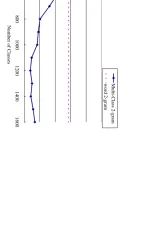
Figure1 shows the perplexity of Multi-Class 2-grams for each number of classes. In the Multi-Class, the numbers of following and preceding classes are fixed to the same value just for com-parison. As shown in the figure, the Multi-Class 2-gram with 1,200 classes gives the lowest per-plexity of 22.70, and it is smaller than the 23.93 in the conventional word 2-gram.
[image:6.595.318.505.111.228.2]Figure 2 shows the perplexity of Multi-Class 3-grams for each number of classes. The num-ber of following and preceding classes is 1,200 (which gives the lowest perplexity in Multi-Class 2-grams). The number of pre-preceding classes is
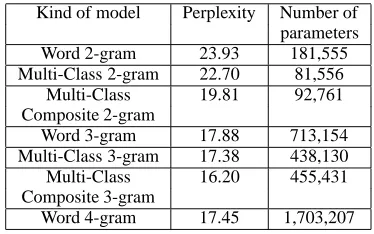
Table 1: Evaluation of Multi-Class Composite N-grams in Perplexity
Kind of model Perplexity Number of parameters Word 2-gram 23.93 181,555 Multi-Class 2-gram 22.70 81,556
Multi-Class 19.81 92,761 Composite 2-gram
Word 3-gram 17.88 713,154 Multi-Class 3-gram 17.38 438,130 Multi-Class 16.20 455,431 Composite 3-gram
Word 4-gram 17.45 1,703,207
changed from 100 to 1,500. As shown in this fig-ure, Multi-Class 3-grams result in lower perplex-ity than the conventional word 3-gram, indicating the reasonability of word clustering based on the distance-2 2-gram.
5.2 Evaluation of Multi-Class Composite N-grams
We have also evaluated Multi-Class Composite N-grams in perplexity under the same conditions as the Multi-Class N-grams stated in the previ-ous section. The Multi-Class 2-gram is used for the initial condition of the Multi-Class Compos-ite 2-gram. The threshold of frequency for in-troducing word successions is set to 10 based on a preliminary experiment. The same word suc-cession set as that of the Multi-Class Composite 2-gram is used for the Multi-Class Composite 3-gram. The evaluation results are shown in Table 1. Table 1 shows that the Multi-Class Compos-ite 3-gram results in 9.5% lower perplexity with a 40% smaller parameter size than the conventional word 3-gram, and that it is in fact a compact and high-performance model.
5.3 Evaluation in Continuous Speech Recognition
Though perplexity is a good measure for the per-formance of language models, it does not al-ways have a direct bearing on performance in lan-guage processing. We have evaluated the pro-posed model in continuous speech recognition. The experimental conditions are as follows:
22.5
23 23.5 24 24.5 25
400 600 800 1000 1200 1400 1600
Number of Classes
Perplexity Multi-Class 2-gram word 2-gram Figure 1: Perple xity of Multi-Class 2-grams
17 17.5 18 18.5 19 19.5 20
100 300 500 700 900 1100 1300 1500
Number of Classes
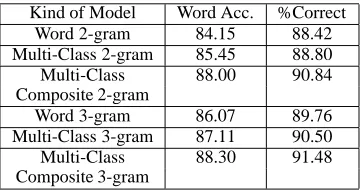
[image:7.595.119.396.87.525.2] [image:7.595.432.778.173.436.2]Table 2: Evaluation of Multi-Class Composite N-grams in Continuous Speech Recognition
Kind of Model Word Acc. %Correct Word 2-gram 84.15 88.42 Multi-Class 2-gram 85.45 88.80 Multi-Class 88.00 90.84 Composite 2-gram
Word 3-gram 86.07 89.76 Multi-Class 3-gram 87.11 90.50 Multi-Class 88.30 91.48 Composite 3-gram
Table 2 shows the evaluation results. As in the perplexity results, the Multi-Class Composite 3-gram shows the highest performance of all mod-els, and its error reduction from the conventional word 3-gram is 16%.
6 Conclusion
This paper proposes an effective word clustering method called Multi-Class. In the Multi-Class method, multiple classes are assigned to each word by clustering the following and preceding word characteristics separately. This word clus-tering is performed based on the word connec-tivity in the corpus. Therefore, the Multi-Class N-grams based on Multi-Class can improve reli-ability with a compact model size without losing accuracy.
Furthermore, Multi-Class N-grams are ex-tended to Multi-Class Composite N-grams. In the Multi-Class Composite N-grams, higher or-der word N-grams are introduced through the grouping of frequent word successions. There-fore, these have accuracy in higher order word N-grams added to reliability in the Multi-Class N-grams. And the number of increased param-eters with the introduction of word successions is at most the number of word successions times 2. Therefore, Multi-Class Composite 3-grams can maintain a compact model size in the Multi-Class N-grams. Nevertheless, Multi-Class Composite 3-grams are represented by the usual formation of 3-grams. This formation is easily handled by a language processor, especially that requires huge calculation cost as speech recognitions.
In experiments, the Multi-Class Composite 3-gram resulted in 9.5% lower perplexity and 16%
lower word error rate in continuous speech recog-nition with a 40% smaller model size than the conventional word 3-gram. And it is confirmed that high performance with a small model size can be created for Multi-Class Composite 3-grams.
Acknowledgments
We would like to thank Michael Paul and Rainer Gruhn for their assistance in writing some of the explanations in this paper.
References
Shuanghu Bai, Haizhou Li, and Baosheng Yuan. 1998. Building class-based language models with contextual statistics. In Proc. ICASSP, pages 173– 176.
P.F. Brown, V.J.D. Pietra, P.V. de Souza, J.C. Lai, and R.L. Mercer. 1992. Class-based n-gram models of natural language. Computational Linguistics, 18(4):467–479.
Sabine Deligne and Frederic Bimbot. 1995. Language
modeling by variable length sequences. Proc.
ICASSP, pages 169–172.
Hirokazu Masataki, Shoichi Matsunaga, and Yosinori Sagusaka. 1996. Variable-order n-gram genera-tion by word-class splitting and consecutive word grouping. Proc. ICASSP, pages 188–191.
M. Ostendorf and H. Singer. 1997. HMM
topol-ogy design using maximum likelihood successive state splitting. Computer Speech and Language, 11(1):17–41.
Tohru Shimizu, Hirofumi Yamamoto, Hirokazu Masa-taki, Shoichi Matsunaga, and Yoshinori Sagusaka. 1996. Spontaneous dialogue speech recognition using cross-word context constrained word graphs. Proc. ICASSP, pages 145–148.
Toshiyuki Takezawa, Tsuyoshi Morimoto, and
Yoshi-nori Sagisaka. 1998. Speech and language
databases for speech translation research in ATR. In Proc. of the 1st International Workshop on East-Asian Language Resource and Evaluation, pages 148–155.
Hirofumi Yamamoto and Yoshinori Sagisaka. 1999. Multi-class composite n-gram based on connection direction. Proc. ICASSP, pages 533–536.