Linguistic Considerations in Automatic Question Generation
Karen Mazidi
HiLT Lab
University of North Texas Denton TX 76207, USA
Rodney D. Nielsen
HiLT Lab
University of North Texas Denton TX 76207, USA
Abstract
As students read expository text, compre-hension is improved by pausing to answer questions that reinforce the material. We describe an automatic question generator that uses semantic pattern recognition to create questions of varying depth and type for self-study or tutoring. Throughout, we explore how linguistic considerations in-form system design. In the described sys-tem, semantic role labels of source sen-tences are used in a domain-independent manner to generate both questions and an-swers related to the source sentence. Eval-uation results show a 44% reduction in the error rate relative to the best prior systems, averaging over all metrics, and up to 61% reduction in the error rate on grammatical-ity judgments.
1 Introduction
Studies of student learning show that answering questions increases depth of student learning, fa-cilitates transfer learning, and improves students’ retention of material (McDaniel et al., 2007; Car-penter, 2012; Roediger and Pyc, 2012). The aim of this work is to automatically generate questions for such pedagogical purposes.
2 Related Work
Approaches to automatic question generation from text span nearly four decades. The vast ma-jority of systems generate questions by select-ing one sentence at a time, extractselect-ing portions of the source sentence, then applying transfor-mation rules or patterns in order to construct a question. A well-known early work is Wolfe’s AUTOQUEST (Wolfe, 1976), a syntactic pattern matching system. A recent approach from Heil-man and Smith (2009, 2010) uses syntactic pars-ing and transformation rules to generate questions.
Syntactic, sentence-level approaches outnumber other approaches as seen in the Question Gen-eration Shared Task Evaluation Challenge 2010 (Boyer and Piwek, 2010) which received only one paragraph-level, semantic entry. Argawal, Shah and Mannem (2011) continue the paragraph-level approach using discourse cues to find appropriate text segments upon which to construct questions at a deeper conceptual level. The uniqueness of their work lies in their use of discourse cues to extract semantic content for question generation. They generate questions of types:why,when,give an example, andyes/no.
In contrast to the above systems, other ap-proaches have an intermediate step of transform-ing input into some sort of semantic represen-tation. Examples of this intermediate step can be found in Yao and Zhang (2010) which uses Minimal Recursive Semantics, and in Olney et al. (2012) which uses concept maps. These ap-proaches can potentially ask deeper questions due to their focus on semantics. A novel question gen-erator by Curto et al. (2012) leverages lexico-syntactic patterns gleaned from the web with seed question-answer pairs.
Another recent approach is Lindberg et al. (2013), which used semantic role labeling to iden-tify patterns in the source text from which ques-tions can be generated. This work most closely parallels our own with a few exceptions: our sys-tem only asks questions that can be answered from the source text, our approach is domain-independent, and the patterns also identify the an-swer to the question.
3 Approach
The system consists of a straightforward pipeline. First, the source text is divided into sentences which are processed by SENNA1 software,
de-1http://ml.nec-labs.com/senna/
scribed in (Collobert et al., 2011). SENNA pro-vides the tokenizing, pos tagging, syntactic con-stituency parsing and semantic role labeling used in the system. SENNA produces separate seman-tic role labels for each predicate in the sentence. For each predicate and its associated semantic ar-guments, a matcher function is called which will return a list of patterns that match the source sen-tence’s predicate-argument structure. Then ques-tions are generated and stored by question type in a question hash table.
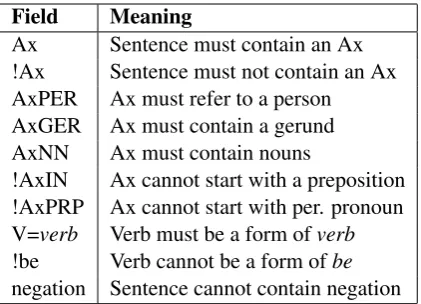
Generation patterns specify the text, verb forms and semantic arguments from the source sentence to form the question. Additionally, patterns indi-cate the semantic arguments that provide the an-swer to the question, required fields, and filter con-dition fields. As these patterns are matched, they will be rejected as candidates for generation for a particular sentence if the required arguments are absent or if filter conditions are present. For ex-ample, a filter for personal pronouns will prevent a question being generated with an argument that starts with a personal pronoun. From: It means that the universe is expanding, we do not want to generate a vague question such as: What does it mean? Coreference resolution, which could help avoid vague question generation, is discussed in Section 5. Table 1 shows selected required and fil-ter fields, Section 3.3 gives examples of their use.
Patterns specify whether verbs should be in-cluded in their lexical form or as they appear in the source text. Either form will include subsequent particles such as: The lungstake inair. The most common use of the verb as it appears in the sen-tence is with the verbbe, as in: Whatwerefused into helium nuclei? This pattern takes the copu-lar be as it appears in the source text. However, most patterns use the lexical form of the main verb along with the appropriate form of the auxiliarydo
(do, does, did), for the subject-auxiliary inversion required in forming interrogatives.
3.1 Pattern Authoring
The system at the time of this evaluation had 42 patterns. SENNA uses the 2005 PropBank cod-ing scheme and we followed the documentation in (Babko-Malaya, 2005) for the patterns. The most commonly used semantic roles are A0, A1 and A2, as well as the ArgM modifiers.2
2Within PropBank, the precise roles of A0 - A6 vary by
predicate.
Field Meaning
Ax Sentence must contain an Ax !Ax Sentence must not contain an Ax AxPER Ax must refer to a person AxGER Ax must contain a gerund AxNN Ax must contain nouns
!AxIN Ax cannot start with a preposition !AxPRP Ax cannot start with per. pronoun V=verb Verb must be a form ofverb
!be Verb cannot be a form ofbe
[image:2.595.312.523.61.213.2]negation Sentence cannot contain negation
Table 1: Selected required and filter fields(Ax is a semantic argument such as A0 or ArgM)
3.2 Software Tools and Source Text
The system was created using SENNA and Python. Importing NLTK within Python provides a simple interface to WordNet from which we de-termine the lexical form of verbs. SENNA pro-vided all the necessary processing of the data, quickly, accurately and in one run.
In order to generate questions, passages were selected from science textbooks downloaded from www.ck12.org. Textbooks were chosen rather than hand-crafted source material so that a more realistic assessment of performance could be achieved. For the experiments in this paper, we selected three passages from the subjects of bi-ology, chemistry, and earth science, filtering out references to equations and figures. The passages average around 60 sentences each, and represent chapter sections. The average grade level is ap-proximately grade 10 as indicated by the on-line readability scorer read-able.com.
3.3 Examples
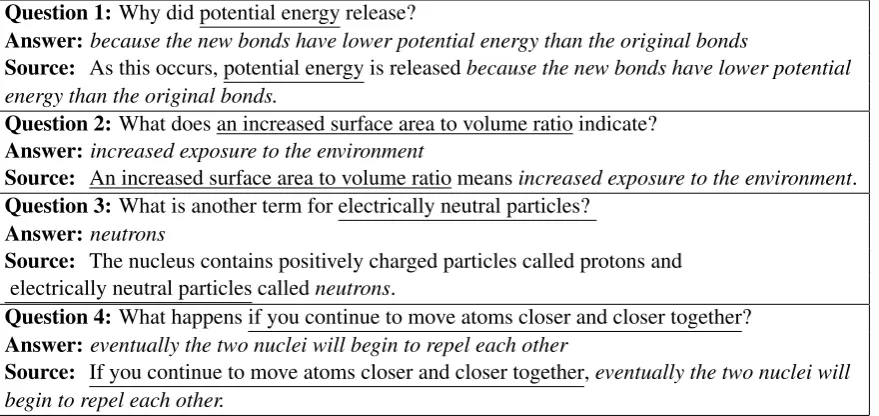
Table 2 provides examples of generated questions. The pattern that generated Question 1 requires ar-gument A1 (underlined in Table 2) and a causation ArgM (italicized). The pattern also filters out sen-tences with A0 or A2. The patterns are designed to match only the arguments used as part of the question or the answer, in order to prevent over generation of questions. The system inserted the correct forms ofrelease anddo, and ignored the phraseAs this occurssince it is not part of the se-mantic argument.
The pattern that generated Question 2 requires A0, A1 and a verb whose lexical form is mean
(itali-Question 1: Why did potential energy release?
Answer:because the new bonds have lower potential energy than the original bonds
Source: As this occurs, potential energy is releasedbecause the new bonds have lower potential energy than the original bonds.
Question 2: What does an increased surface area to volume ratio indicate? Answer:increased exposure to the environment
Source: An increased surface area to volume ratio meansincreased exposure to the environment. Question 3: What is another term for electrically neutral particles?
Answer:neutrons
Source: The nucleus contains positively charged particles called protons and electrically neutral particles calledneutrons.
Question 4: What happens if you continue to move atoms closer and closer together? Answer:eventually the two nuclei will begin to repel each other
[image:3.595.83.523.63.271.2]Source: If you continue to move atoms closer and closer together,eventually the two nuclei will begin to repel each other.
Table 2: Selected generated questions with source sentences
cized) forms the answer and A0 (underlined) be-comes part of the question along with the appro-priate form ofdo. This pattern supplies the word
indicate instead of the source text’smean which broadens the question context.
Question 3 is from the source sentence’s 3rd predicate-argument set because this matched the pattern requirements: A1, A2, V=call. The answer is the text from the A2 argument. The ability to generate questions from any predicate-argument set means that sentence simplification is not re-quired as a preprocessing step, and that the sen-tence can match multiple patterns. For example, this sentence could also match patterns to gener-ate questions such as:What are positively charged particles called?orDescribe the nucleus.
Question 4 requires A1 and an ArgM that in-cludes the discourse cue if. The ArgM (under-lined) becomes part of the question, while the rest of the source sentence forms the answer. This pat-tern also requires that ArgM contain nouns (AxNN from Table 1), which helps filter vague questions.
4 Results
This paper focuses on evaluating generated ques-tions primarily in terms of their linguistic quality, as did Heilman and Smith (2010a). In a related work (Mazidi and Nielsen, 2014) we evaluated the quality of the questions and answers from a pedagogical perspective, and our approach outper-formed comparable systems in both linguistic and pedagogical evaluations. However, the task here is to explore the linguistic quality of generated
questions. The annotators are university students who are science majors and native speakers of En-glish. Annotators were given instructions to read a paragraph, then the questions based on that para-graph. Two annotators evaluated each set of ques-tions using Likert-scale ratings from 1 to 5, where 5 is the best rating, for grammaticality, clarity, and naturalness. The average inter-annotator agree-ment, allowing a difference of one between the annotators’ ratings was 88% and Pearson’s r=0.47 was statistically significant (p<0.001), suggesting a high correlation and agreement between annota-tors. The two annotator ratings were averaged for all the evaluations reported here.
We present results on three linguistic evalua-tions: (1) evaluation of our generated questions, (2) comparison of our generated questions with those from Heilman and Smith’s question gener-ator, and (3) comparison of our generated ques-tions with those from Lindberg, Popowich, Nesbit and Winne. We compared our system to the H&S and LPN&W systems because they produce ques-tions that are the most similar to ours, and for the same purpose: reading comprehension reinforce-ment. The Heilman and Smith system is available online;3Lindberg graciously shared his code with
us.
4.1 Evaluation of our Generated Questions This evaluation was conducted with one file (Chemistry: Bonds) which had 59 sentences, from which the system generated 142 questions. The
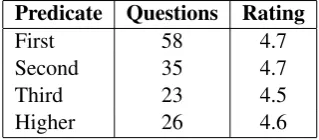
purpose of this evaluation was to determine if any patterns consistently produce poor questions. The average linguistics score per pattern in this evalu-ation was 5.0 to 4.18. We were also interested to know if first predicates make better questions than later ones. The average score by predicate position is shown in Table 3. Note that the Rating column gives the average of the grammaticality, clarity and naturalness scores.
Predicate Questions Rating
First 58 4.7
Second 35 4.7
Third 23 4.5
[image:4.595.307.525.62.119.2]Higher 26 4.6
Table 3: Predicate depth and question quality
Based on this sample of questions there is no significant difference in linguistic scores for questions generated at various predicate positions. Some question generation systems simplify com-plex sentences in initial stages of their system. In our approach this is unnecessary, and simplifying could miss many valid questions.
4.2 Comparison with Heilman and Smith This task utilized a file (Biology: the body) with 56 source sentences from which our system gener-ated 102 questions. The Heilman and Smith sys-tem, as they describe it, takes an over-generate and rank approach. We only took questions that scored a 2.0 or better with their ranking system,4 which
resulted in less than 27% of their top questions. In all, 84 of their questions were evaluated. The questions again were presented with accompany-ing paragraphs of the source text. Questions from the two systems were randomly intermingled. An-notators gave 1 - 5 scores for each category of grammaticality, clarity and naturalness.
As seen in Table 4, our results represent a 44% reduction in the error rate relative to Heilman and Smith on the average rating over all metrics, and as high as 61% reduction in the error rate on gram-maticality judgments. The error reduction calcu-lation is shown below. Note that rating∗ is the
maximum rating of 5.0.
ratingsystem2−ratingsystem1
rating∗−ratingsystem1 ×100.0 (1)
4In our experiments, their rankings ranged from very
small negative numbers to 3.0.
[image:4.595.307.526.168.226.2]System Gram Clarity Natural Avg H&S 4.38 4.13 3.94 4.15 M&N 4.76 4.26 4.53 4.52 Err. Red. 61% 15% 56% 44%
Table 4: Comparison with Heilman and Smith
System Gram Clarity Natural Avg LPN&W 4.57 4.56 4.55 4.57 M&N 4.80 4.69 4.78 4.76 Err. Red. 54% 30% 51% 44%
Table 5: Comparison with Lindberg et al.
4.3 Comparison with Lindberg et al.
For a comparison with the Lindberg, Popowich, Nesbit and Winne system we used a file (Earth science: weather fronts) that seemed most sim-ilar to the text files for which their system was designed. The file has 93 sentences and our tem generated 184 questions; the LPN&W sys-tem generated roughly 4 times as many questions. From each system, 100 questions were randomly selected, making sure that the LPN&W questions did not include questions generated from domain-specific templates such as: Summarize the influ-ence of the maximum amount on the environment.
The phrases Summarize the influence of and on the environmentare part of a domain-specific tem-plate. The comparison results are shown in Table 5. Interestingly, our system again achieved a 44% reduction in the error rate when averaging over all metrics, just as it did in the Heilman and Smith comparison.
5 Linguistic Challenges
Natural language generation faces many linguistic challenges. Here we briefly describe three chal-lenges: negation detection, coreference resolution, and verb forms.
5.1 Negation Detection
[image:4.595.101.261.193.263.2]identifying other negative indicators, which occa-sionally does lead to poor question/answer quality as in the following:
Source sentence: In Darwin’s time and to-day, many people incorrectly believe that evolu-tion means humans come from monkeys.
Question: What does evolution mean? Answer: that humans come from monkeys The negation in the wordincorrectlyis not iden-tified.
5.2 Coreference Resolution
Currently, our system does not use any type of coreference resolution. Experiments with existing coreference software performed well only for per-sonal pronouns, which occur infrequently in most expository text. Not having coreference resolution leads to vague questions, some of which can be filtered as discussed previously. However, further work on filters is needed to avoid questions such as:
Source sentence:Air cools when it comes into contact with a cold surface or when it rises.
Question: What happens when it comes into contact with a cold surface or when it rises?
Heilman and Smith chose to filter out ques-tions with personal pronouns, possessive pronouns and noun phrases composed simply of determiners such asthose. Lindberg et al. used the emPronoun system from Charniak and Elsner, which only han-dles personal pronouns. Since current state-of-the-art systems do not deal well with relative and pos-sessive pronouns, this will continue to be a limi-tation of natural language generation systems for the time being.
5.3 Verb Forms
Since our focus is on expository text, system pat-terns deal primarily with the present and simple past tenses. Some patterns look for modals and so can handle future tense:
Source sentence: If you continue to move atoms closer and closer together, eventually the two nuclei will begin to repel each other.
Question: Discuss what the two nuclei will re-pel.
Light verbs pose complications in NLG because they are highly idiosyncratic and subject to syn-tactic variability (Sag et al., 2002). Light verbs can either carry semantic meaning (takeyour pass-port) or can be bleached of semantic content when
combined with other words as in: make a deci-sion,havea drink,takea walk. Common English verbs that can be light verbs include give, have, make, take. Handling these constructions as well as other multi-word expressions may require both rule-based and statistical approaches. The catena-tive construction also potentially adds complexity (Huddleston and Pullum, 2005), as shown in this example: As the universe expanded, it became less dense andbegantocool. Care must be taken not to generate questions based on one predicate in the catenative construction.
We are also hindered at times by the perfor-mance of the part of speech tagging and parsing software. The most common error observed was confusion between the noun and verb roles of a word. For example in: Plant roots and bacterial decay use carbon dioxide in the process of respira-tion,the wordusewas classified as NN, leaving no predicate and no semantic role labels in this sen-tence.
6 Conclusions
Roediger and Pyc (2012) advocate assisting stu-dents in building a strong knowledge base be-cause creative discoveries are unlikely to occur when students do not have a sound set of facts and principles at their command. To that end, au-tomatic question generation systems can facilitate the learning process by alternating passages of text with questions that reinforce the material learned. We have demonstrated a semantic approach to automatic question generation that outperforms similar systems. We evaluated our system on text extracted from open domain STEM textbooks rather than hand-crafted text, showing the robust-ness of our approach. Our system achieved a 44% reduction in the error rate relative to both the Heil-man and Smith, and the Lindberg et al. system on the average over all metrics. The results shows are statistically significant (p<0.001). Our question generator can be used for self-study or tutoring, or by teachers to generate questions for classroom discussion or assessment. Finally, we addressed linguistic challenges to question generation.
Acknowledgments
References
Agarwal, M., Shah, R., and Mannem, P. 2011. Auto-matic question generation using discourse cues. In Proceedings of the 6th Workshop on Innovative Use of NLP for Building Educational Applications, As-sociation for Computational Linguistics.
Babko-Malaya, O. 2005. Propbank annotation guide-lines. URL: http://verbs.colorado.edu
Blanco, E., and Moldovan, D. 2011. Some issues on detecting negation from text. In FLAIRS Confer-ence.
Boyer, K. E., and Piwek, P., editors. 2010. In Proceed-ings of QG2010: The Third Workshop on Question Generation.Pittsburgh: questiongeneration.org
Carpenter, S. 2012. Testing enhances the transfer of learning. InCurrent directions in psychological sci-ence,21(5), 279-283.
Charniak, E., and Elsner, M. 2009. EM works for pro-noun anaphora resolution. In Proceedings of the 12th Conference of the European Chapter of the Association for Computational Linguistics. Associ-ation for ComputAssoci-ational Linguistics.
Collobert, R., Weston, J., Bottou, L., Karlen, M., Kavukcuoglu, K., & Kuksa, P. 2011. Natural lan-guage processing (almost) from scratch. The Jour-nal of Machine Learning Research, 12, 2493-2537.
Curto, S., Mendes, A., and Coheur, L. 2012. Ques-tion generaQues-tion based on lexico-syntactic patterns learned from the web. Dialogue & Discourse, 3(2), 147-175.
Heilman, M., and Smith, N. 2009. Question gener-ation via overgenerating transformgener-ations and rank-ing.Technical Report CMU-LTI-09-013, Language Technologies Institute, Carnegie-Mellon University.
Heilman, M., and Smith, N. 2010a. Good ques-tion! statistical ranking for question generation. In Proceedings of NAACL/HLT 2010. Association for Computational Linguistics.
Heilman, M., and Smith, N. 2010b. Rating computer-generated questions with Mechanical Turk. In Pro-ceedings of the NAACL-HLT Workshop on Creating Speech and Language Data with Amazon’s Mechan-ical Turk. Association for Computational Linguis-tics.
Huddleston, R. and Pullum, G. 2005. A Student’s In-troduction to English Grammar, Cambridge Univer-sity Press.
Lindberg, D., Popowich, F., Nesbit, J., and Winne, P. 2013. Generating natural language questions to sup-port learning on-line. InProceedings of the 14th Eu-ropean Workshop on Natural Language Generation, (2013): 105-114.
Mannem, P., Prasad, R. and Joshi, A. 2010. Question generation from paragraphs at UPenn: QGSTEC system description. InProceedings of QG2010: The Third Workshop on Question Generation.
Mazidi, K. and Nielsen, R.D. 2014. Pedagogical eval-uation of automatically generated questions. In In-telligent Tutoring Systems.LNCS 8474, Springer In-ternational Publishing Switzerland.
McDaniel, M. A., Anderson, J. L., Derbish, M. H., and Morrisette, N. 2007. Testing the testing effect in the classroom. European Journal of Cognitive Psychol-ogy,19(4-5), 494-513.
Olney, A., Graesser, A., and Person, N. 2012. Ques-tion generaQues-tion from concept maps. Dialogue & Discourse,3(2), 75-99.
Roediger III, H. L., and Pyc, M. 2012. Inexpensive techniques to improve education: Applying cog-nitive psychology to enhance educational practice. Journal of Applied Research in Memory and Cogni-tion, 1.4: 242-248.
Sag, I. A., Baldwin, T., Bond, F., Copestake, A., and Flickinger, D. 2002. Multiword expressions: A pain in the neck for NLP. InComputational Linguistics and Intelligent Text Processing, (pp. 1-15). Springer Berlin Heidelberg.
Sternberg, R. J., & Grigorenko, E. L. 2003. Teach-ing for successful intelligence: Principles, proce-dures, and practices. Journal for the Education of the Gifted, 27, 207-228.
Wolfe, J. 1976. Automatic question generation from text-an aid to independent study. InProceedings of ACM SIGCSE-SIGCUE.