Faster Phrase-Based Decoding by Refining Feature State
Kenneth Heafield Michael Kayser Christopher D. Manning Computer Science Department Stanford University, Stanford, CA, 94305
{heafield,mkayser,manning}@stanford.edu
Abstract
We contribute a faster decoding algo-rithm for phrase-based machine transla-tion. Translation hypotheses keep track of state, such as context for the language model and coverage of words in the source sentence. Most features depend upon only part of the state, but traditional algorithms, including cube pruning, handle state atom-ically. For example, cube pruning will re-peatedly query the language model with hypotheses that differ only in source cov-erage, despite the fact that source cover-age is irrelevant to the langucover-age model. Our key contribution avoids this behav-ior by placing hypotheses into equivalence classes, masking the parts of state that matter least to the score. Moreover, we ex-ploit shared words in hypotheses to itera-tively refine language model scores rather than handling language model state atom-ically. Since our algorithm and cube prun-ing are both approximate, improvement can be used to increase speed or accuracy. When tuned to attain the same accuracy, our algorithm is 4.0–7.7 times as fast as the Moses decoder with cube pruning.
1 Introduction
Translation speed is critical to making suggestions as translators type, mining for parallel data by translating the web, and running on mobile de-vices without Internet connectivity. We contribute a fast decoding algorithm for phrase-based ma-chine translation along with an implementation in a new open-source (LGPL) decoder available at http://kheafield.com/code/.
Phrase-based decoders (Koehn et al., 2007; Cer et al., 2010; Wuebker et al., 2012) keep track of several types of state with translation
hypothe-ses: coverage of the source sentence thus far, con-text for the language model, the last position for the distortion model, and anything else features need. Existing decoders handle state atomically: hypotheses that have exactly the same state can be recombined and efficiently handled via dynamic programming, but there is no special handling for partial agreement. Therefore, features are repeat-edly consulted regarding hypotheses that differ only in ways irrelevant to their score, such as cov-erage of the source sentence. Our decoder bun-dles hypotheses into equivalence classes so that features can focus on the relevant parts of state.
We pay particular attention to the language model because it is responsible for much of the hy-pothesis state. As the decoder builds translations from left to right (Koehn, 2004), it records the last
N −1words of each hypothesis so that they can be used as context to score the firstN −1words of a phrase, whereN is the order of the language model. Traditional decoders (Huang and Chiang, 2007) try thousands of combinations of hypothe-ses and phrahypothe-ses, hoping to find ones that the lan-guage model likes. Our algorithm instead discov-ers good combinations in a coarse-to-fine manner. The algorithm exploits the fact that hypotheses of-ten share the same suffix and phrases ofof-ten share the same prefix. These shared suffixes and prefixes allow the algorithm to coarsely reason over many combinations at once.
Our primary contribution is a new search algo-rithm that exploits the above observations, namely that state can be divided into pieces relevant to each feature and that language model state can be further subdivided. The primary claim is that our algorithm is faster and more accurate than the pop-ular cube pruning algorithm.
2 Related Work
Our previous work (Heafield et al., 2013) devel-oped language model state refinement for
up decoding in syntatic machine translation. In bottom-up decoding, hypotheses can be extended to the left or right, so hypotheses keep track of both their prefix and suffix. The present phrase-based setting is simpler because sentences are constructed from left to right, so prefix infor-mation is unnecessary. However, phrase-based translation implements reordering by allowing hy-potheses that translate discontiguous words in the source sentence. There are exponentially many ways to cover the source sentence and hypotheses carry this information as additional state. A main contribution in this paper is efficiently ignoring coverage when evaluating the language model. In contrast, syntactic machine translation hypotheses correspond to contiguous spans in the source sen-tence, so in prior work we simply ran the search algorithm in every span.
Another improvement upon Heafield et al. (2013) is that we previously made no effort to exploit common words that appear in translation rules, which are analogous to phrases. In this work, we explicitly group target phrases by com-mon prefixes, doing so directly in the phrase table. Coarse-to-fine approaches (Petrov et al., 2008; Zhang and Gildea, 2008) invoke the decoder multiple times with increasingly detailed models, pruning after each pass. The key difference in our work is that, rather than refining models in lock step, we effectively refine the language model on demand for hypotheses that score well. More-over, their work was performed in syntactic ma-chine translation while we address issues specific to phrase-based translation.
Our baseline is cube pruning (Chiang, 2007; Huang and Chiang, 2007), which is both a way to organize search and an algorithm to search through cross products of sets. We adopt the same search organization (Section 3.1) but change how cross products are searched.
Chang and Collins (2011) developed an exact decoding algorithm based on Lagrangian relax-ation. However, it has not been shown to tractably scale to 5-gram language models used by many modern translation systems.
3 Decoding
We begin by summarizing the high-level organiza-tion of phrase-based cube pruning (Koehn, 2004; Koehn et al., 2007; Huang and Chiang, 2007). Sections 3.2 and later show our contribution.
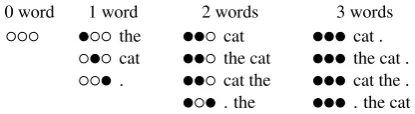
0 word 1 word the cat .
2 words cat the cat cat the . the
[image:2.595.308.516.64.121.2]3 words cat . the cat . cat the . . the cat
Figure 1: Stacks to translate the French “le chat .” into English. Filled circles indicate that the source word has been translated. A phrase translates “le chat” as simply “cat”, emphasizing that stacks are organized by the number of source words rather than the number of target words.
3.1 Search Organization
Phrase-based decoders construct hypotheses from left to right by appending phrases in the target lan-guage. The decoder organizes this search process using stacks(Figure 1). Stacks contain hypothe-ses that have translated the same number of source words. The zeroth stack contains one hypothe-sis with nothing translated. Subsequent stacks are built by extending hypotheses in preceding stacks. For example, the second stack contains hypothe-ses that translated two source words either sepa-rately or as a phrasal unit. Returning to Figure 1, the decoder can apply a phrase pair to translate “le chat” as “cat” or it can derive “the cat” by translat-ing one word at a time; both appear in the second stack because they translate two source words. To generalize, the decoder populates theith stack by pairing hypotheses in thei−jth stack with tar-get phrases that translate source phrases of length
j. Hypotheses remember which source word they translated, as indicated by the filled circles.
The reordering limit prevents hypotheses from jumping around the source sentence too much and dramatically reduces the search space. Formally, the decoder cannot propose translations that would require jumping back more than R words in the source sentence, including multiple small jumps.
In practice, stacks are limited to k hypothe-ses, wherek is set by the user. Smallk is faster but may prune good hypotheses, while largekis slower but more thorough, thereby comprising a time-accuracy trade-off. The central question in this paper is how to select thesekhypotheses.
country a
nations few
[image:3.595.315.515.61.126.2]countries
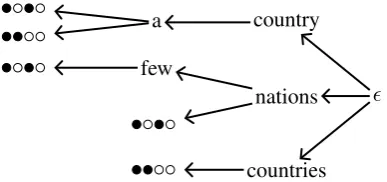
Figure 2: Hypothesis suffixes arranged into a trie. The leaves indicate source coverage and any other hypothesis state.
lated, and the reordering limit. Second, the de-coder searches through these matches to select
k high-scoring hypotheses for placement in the stack. We improve this second step.
The decoder provides our algorithm with pairs consisting of a hypothesis and a compatible source phrase. Each source phrase translates to multiple target phrases. The task is to grow these hypothe-ses by appending a target phrase, yielding new hy-potheses. These new hypotheses will be placed into a stack of sizek, so we are interested in se-lectingknew hypotheses that score highly.
Beam search (Lowerre, 1976; Koehn, 2004) tries every hypothesis with every compatible tar-get phrase then selects the topknew hypotheses by score. This is wasteful because most hypothe-ses are discarded. Instead, we follow cube pruning (Chiang, 2007) in using a priority queue to gen-erate k hypotheses. A key difference is that we generate these hypotheses iteratively.
3.2 Tries
For each source phrase, we collect the set of com-patible hypotheses. We then place these hypothe-ses in a trie that emphasizes the suffix words be-cause these matter most when appending a target phrase. Figure 2 shows an example. While it suf-fices to build this trie on the last N − 1 words that matter to the language model, Li and Khu-danpur (2008) have identified cases where fewer words are necessary because the language model will back off. The leaves of the trie are complete hypotheses and reveal information irrelevant to the language model, such as coverage of the source sentence and the state of other features.
Each source phrase translates to a set of tar-get phrases. Because these phrases will be ap-pended to a hypothesis, the first few words mat-ter the most to the language model. We therefore
which
have diplomatic are
[image:3.595.85.279.65.156.2]that have diplomatic
Figure 3: Target phrases arranged into a trie. Set initalic, leaves reveal parts of the phrase that are irrelevant to the language model.
arrange the target phrases into a prefix trie. An example is shown in Figure 3. Similar to the hy-pothesis trie, the depth may be shorter thanN−1 in cases where the language model will provably back off (Li and Khudanpur, 2008). The trie can also be short because the target phrase has fewer than N −1 words. We currently store this trie data structure directly in the phrase table, though it could also be computed on demand to save mem-ory. Empirically, our phrase table uses less RAM than Moses’s memory-based phrase table.
As an optimization, a trie reveals multiple words when there would otherwise be no branch-ing. This allows the search algorithm to make de-cisions only when needed.
Following Heafield et al. (2013), leaves in the trie take the score of the underlying hypothesis or target phrase. Non-leaf nodes take the maximum score of their descendants. Children of a node are sorted by score.
3.3 Boundary Pairs
The idea is that the decoder reasons over pairs of nodes in the hypothesis and phrase tries before de-vling into detail. In this way, it can determine what the language model likes and, conversely, quickly discard combinations that the model does not like. A boundary pair consists of a node in the hy-pothesis trie and a node in the target phrase trie. For example, the decoder starts at the root of each trie with the boundary pair (, ). The score of a boundary pair is the sum of the scores of the un-derlying trie nodes. However, once some words have been revealed, the decoder calls the language model to compute a score adjustment. For exam-ple, the boundary pair(country,that)has score ad-justment
logp(thatp(that)|country)
when the phrase was scored in isolation, replacing it with a more accurate estimate based on avail-able context. These score adjustments are efficient to compute because the decoder retained a pointer to “that” in the language model’s data structure (Heafield et al., 2011).
3.4 Splitting
Refinement is the notion that the boundary pair (, ) divides into several boundary pairs that re-veal specific words from hypotheses or target phrases. The most straightforward way to do this is simply to split into all children of a trie node. Continuing the example from Figure 2, we could split(, )into three boundary pairs: (country, ), (nations, ), and (countries, ). However, it is somewhat inefficient to separately consider the low-scoring child(countries, ). Instead, we con-tinue to split off the best child (country, ) and leave a note that the zeroth child has been split off, denoted([1+], ). The index increases each time a child is split off.
The the boundary pair ([1+], ) no longer counts(country, )as a child, so its score is lower. Splitting alternates sides. For example, (country, ) splits into (country,that) and (country, [1+]). If one side has completely revealed words that matter to the language model, then splitting continues with the other side. This procedure ensures that the language model score is completely resolved before considering irrelevant differences, such as coverage of the source sentence.
3.5 Priority Queue
Search proceeds in a best-first fashion controlled by a priority queue. For each source phrase, we convert the compatible hypotheses into a trie. The target phrases were already converted into a trie when the phrase table was loaded. We then push the root (, ) boundary pair into the prior-ity queue. We do this for all source phrases under consideration, putting their root boundary pairs into the same priority queue. The algorithm then loops by popping the top boundary pair. It the top boundary pair uniquely describes a hypothesis and target phrase, then remaining features are evalu-ated and the new hypothesis is output to the de-coder’s stack. Otherwise, the algorithm splits the boundary pair and pushes both split versions. Iter-ation continues untilknew hypotheses have been found.
3.6 Overall Algorithm
We build hypotheses from left-to-right and man-age stacks just like cube pruning. The only dif-ference is how thekelements of these stacks are selected.
When the decoder matches a hypothesis with a compatible source phrase, we immediately evalu-ate the distortion feature and updevalu-ate future costs, both of which are independent of the target phrase. Our future costs are exactly the same as those used in Moses (Koehn et al., 2007): the highest-scoring way to cover the rest of the source sentence. This includes the language model score within target phrases but ignores the change in language model score that would occur were these phrases to be appended together. The hypotheses compatible with each source phrase are arranged into a trie. Finally, the priority queue algorithm from the pre-ceding section searches for options that the lan-guage model likes.
4 Experiments
The primary claim is that our algorithm performs better than cube pruning in terms of the trade-off between time and accuracy. We compare our new decoder implementation with Moses (Koehn et al., 2007) by translating 1677 sentences from Chinese to English. These sentences are a deduplicated subset of the NIST Open MT 2012 test set and were drawn from Chinese online text sources, such as discussion forums. We trained our phrase table using a bitext of 10.8 million sentence pairs, which after tokenization amounts to approximately 290 million words on the English side. The bitext con-tains data from several sources, including news ar-ticles, UN proceedings, Hong Kong government documents, online forum data, and specialized sources such as an idiom translation table. We also trained our language model on the English half of this bitext using unpruned interpolated modified Kneser-Ney smoothing (Kneser and Ney, 1995; Chen and Goodman, 1998).
-29.5 -29.0 -28.5 -28.0 -27.5
0 1 2 3 4
Av
erage
model
score
CPU seconds/sentence This Work
Moses
13 14 15
0 1 2 3 4
Uncased
BLEU
CPU seconds/sentence This Work
[image:5.595.78.531.69.290.2]Moses
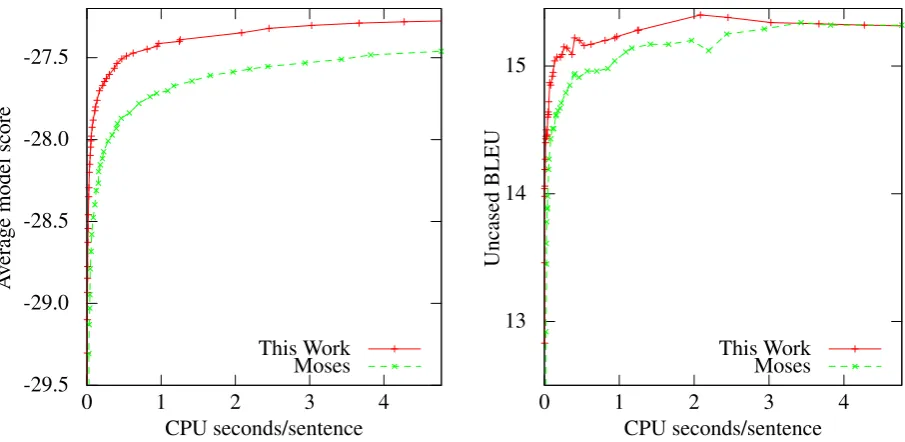
Figure 4: Performance of our decoder and Moses for various stack sizesk.
Moses (Koehn et al., 2007) revision d6df825 was compiled with all optimizations recom-mended in the documentation. We use the in-memory phrase table for speed. Tests were run on otherwise-idle identical machines with 32 GB RAM; the processes did not come close to running out of memory. The language model was com-piled into KenLM probing format (Heafield, 2011) and placed in RAM while text phrase tables were forced into the disk cache before each run. Timing is based on CPU usage (user plus system) minus loading time, as measured by running on empty input; our decoder is also faster at loading. All re-sults are single-threaded. Model score is compa-rable across decoders and averaged over all 1677 sentences; higher is better. The relationship be-tween model score and uncased BLEU (Papineni et al., 2002) is noisy, so peak BLEU is not attained by the highest search accuracy.
Figure 4 shows the results for pop limitsk rang-ing from 5 to 10000 while Table 1 shows select results. For Moses, we also set the stack size to
kto disable a second pruning pass, as is common. Because Moses is slower, we also ran our decoder with higher beam sizes to fill in the graph. Our decoder is more accurate, but mostly faster. We can interpret accuracy improvments as speed im-provements by asking how much time is required to attain the same accuracy as the baseline. By this metric, our decoder is 4.0 to 7.7 times as fast as Moses, depending onk.
Model CPU BLEU
Stack Moses This Moses This Moses This
10 -29.96 -29.70 0.019 0.004 12.92 13.46 100 -28.68 -28.54 0.057 0.016 14.19 14.40 1000 -27.87 -27.80 0.463 0.116 14.91 14.95 10000 -27.46 -27.39 4.773 1.256 15.32 15.28
Table 1: Results for select stack sizesk.
5 Conclusion
We have contributed a new phrase-based search al-gorithm based on the principle that the language model cares the most about boundary words. This leads to two contributions: hiding irrelevant state from features and an incremental refinement algo-rithm to find high-scoring combinations. This al-gorithm is implemented in a new fast phrase-based decoder, which we release as open-source under the LGPL atkheafield.com/code/.
Acknowledgements
References
Daniel Cer, Michel Galley, Daniel Jurafsky, and Christopher D. Manning. 2010. Phrasal: A statis-tical machine translation toolkit for exploring new model features. InProceedings of the NAACL HLT 2010 Demonstration Session, pages 9–12, Los An-geles, California, June. Association for Computa-tional Linguistics.
Yin-Wen Chang and Michael Collins. 2011. Exact de-coding of phrase-based translation models through lagrangian relaxation. In Proceedings of the 2011 Conference on Empirical Methods in Natural Lan-guage Processing, Edinburgh, Scotland, UK, July. Association for Computational Linguistics.
Stanley Chen and Joshua Goodman. 1998. An em-pirical study of smoothing techniques for language modeling. Technical Report TR-10-98, Harvard University, August.
David Chiang. 2007. Hierarchical phrase-based trans-lation. Computational Linguistics, 33:201–228, June.
Kenneth Heafield, Hieu Hoang, Philipp Koehn, Tet-suo Kiso, and Marcello Federico. 2011. Left lan-guage model state for syntactic machine translation. In Proceedings of the International Workshop on Spoken Language Translation, San Francisco, CA, USA, December.
Kenneth Heafield, Philipp Koehn, and Alon Lavie. 2013. Grouping language model boundary words to speed k-best extraction from hypergraphs. In
Proceedings of the 2013 Conference of the North American Chapter of the Association for Computa-tional Linguistics: Human Language Technologies, Atlanta, Georgia, USA, June.
Kenneth Heafield. 2011. KenLM: Faster and smaller language model queries. InProceedings of the Sixth Workshop on Statistical Machine Translation, Edin-burgh, UK, July. Association for Computational Lin-guistics.
Liang Huang and David Chiang. 2007. Forest rescor-ing: Faster decoding with integrated language mod-els. InProceedings of ACL, Prague, Czech Repub-lic, June.
Reinhard Kneser and Hermann Ney. 1995. Improved backing-off for m-gram language modeling. In
Proceedings of the IEEE International Conference on Acoustics, Speech and Signal Processing, pages 181–184.
Philipp Koehn, Hieu Hoang, Alexandra Birch, Chris Callison-Burch, Marcello Federico, Nicola Bertoldi, Brooke Cowan, Wade Shen, Christine Moran, Richard Zens, Chris Dyer, Ondˇrej Bojar, Alexan-dra Constantin, and Evan Herbst. 2007. Moses: Open source toolkit for statistical machine transla-tion. InAnnual Meeting of the Association for Com-putational Linguistics (ACL), Prague, Czech Repub-lic, June.
Philipp Koehn. 2004. Pharaoh: a beam search de-coder for phrase-based statistical machine transla-tion models. In Machine translation: From real users to research, pages 115–124. Springer, Septem-ber.
Zhifei Li and Sanjeev Khudanpur. 2008. A scalable decoder for parsing-based machine translation with equivalent language model state maintenance. In
Proceedings of the Second ACL Workshop on Syn-tax and Structure in Statistical Translation (SSST-2), pages 10–18, Columbus, Ohio, June.
Bruce T. Lowerre. 1976. The Harpy speech recogni-tion system. Ph.D. thesis, Carnegie Mellon Univer-sity, Pittsburgh, PA, USA.
Kishore Papineni, Salim Roukos, Todd Ward, and Wei-Jing Zhu. 2002. BLEU: A method for automatic evalution of machine translation. In Proceedings 40th Annual Meeting of the Association for Com-putational Linguistics, pages 311–318, Philadelphia, PA, July.
Slav Petrov, Aria Haghighi, and Dan Klein. 2008. Coarse-to-fine syntactic machine translation using language projections. In Proceedings of the 2008 Conference on Empirical Methods in Natural Lan-guage Processing, pages 108–116, Honolulu, HI, USA, October.
Joern Wuebker, Matthias Huck, Stephan Peitz, Malte Nuhn, Markus Freitag, Jan-Thorsten Peter, Saab Mansour, and Hermann Ney. 2012. Jane 2: Open source phrase-based and hierarchical statistical ma-chine translation. InProceedings of COLING 2012: Demonstration Papers, pages 483–492, Mumbai, In-dia, December.