Dynamic Simulation of Multiplier Effects of Helium Plasma
and Neutron Irradiation on Microstructural Evolution in Tungsten
Qiu Xu
1, Naoaki Yoshida
2and Toshimasa Yoshiie
1 1Research Reactor Institute, Kyoto University, Osaka 590-0494, Japan
2Research Institute for Applied Mechanics, Kyushu University, Kasuga 816-8580, Japan
Plasma-facing and high heat flux materials in a fusion reactor suffer two types of damage: displacement damage caused mainly by high-energy neutrons and surface damage, such as erosion, sputtering, and blistering, caused by hydrogen and helium plasma. Usually, these two kinds of damage are investigated separately. In the present study, multiplier effects of helium plasma and neutron irradiation on microstructural evolution in tungsten were investigated using computer simulations based on a rate theory. Neutron irradiation with106dpas1at 873 K and a
helium flux of1018m2s1with 10-keV energy were used as typical irradiation conditions. The effects of irradiation temperature and defect
production rate on the interaction between helium and defects were also investigated. The simulation results revealed the rapid diffusion of helium in tungsten. The helium concentration was saturated in tungsten 0.067 mm thick within 0.01 s at 873 K, and the formation of helium-vacancy clusters was nearly uniform in the matrix except at the surfaces facing towards and away from the irradiation after 0.01 s. This meant that the 10-keV helium plasma could enhance formation of helium-vacancy clusters in the region without damage produced by helium. The concentration of 6He-V clusters reached a very high level (106) even after a 1-s irradiation with a defect production rate of106dpas1at
873 K. The concentration of helium-vacancy clusters decreased with increasing irradiation temperature and decreasing defect production rate. The accumulation of helium and the formation of helium-vacancy clusters depended on not only the vacancy concentration, which was determined by the irradiation temperature and defect production rate, and helium concentrations, but also irradiation time.
(Received October 5, 2004; Accepted April 4, 2005; Published June 15, 2005)
Keywords: tungsten, helium plasma, neutron irradiation, helium-vacancy clusters, rate theory
1. Introduction
In a fusion reactor, plasma-facing materials (PFMs) must withstand the damage produced by hydrogen and helium at up to 10 keV of energy and heat loads from the plasma, in addition, the neutrons with high energy, high flux and high fluence similar to the structural components. Important criteria for choosing PFMs are a high melting point, high thermal conductivity and low sputtering erosion. Tungsten, molybdenum (high-Z materials), carbon, carbon fiber com-posites and beryllium (low-Z materials) have been selected as PFMs because they have outstanding thermal properties and erosion resistance. The erosion induced by the plasma in high-Z materials, especially tungsten, is considerably lower than that in low-Z materials, although a disadvantage of high-Z materials is a far lower tolerable impurity concentration within the plasma,1) where the radiative power loss of the plasma is proportional to the square of the charge number of impurity ions.
The peak depth of displacement damage induced by injection of particles of hydrogen and helium with 10 keV in tungsten or molybdenum is about 10–20 nm according to the TRIM code.2)In addition to high concentrations of hydrogen
and helium, high densities of interstitials and vacancies are produced in the near surface of PFMs. The binding energy between a gas atom and a vacancy is very high. For example, the binding energy of a hydrogen-vacancy pair is 1.07 eV in molybdenum and 1.16 eV in tungsten,3) while that of a
helium-vacancy pair is 3.1 eV4)in molybdenum and 4.15 eV in tungsten.5) Thus, hydrogen or helium is trapped by vacancies to form high-density hydrogen or helium bubbles at low temperature. But, hydrogen and helium bubbles grow easily at high temperature, and this leads to blisters on the surface, which is one form of erosion. In addition, a vacancy
can trap more than one gas atom. The binding energy of a gas atom-vacancy pair decreases as the number of gas atoms increases.6)
Our experimental results showed that surface hardness increased upon helium ion irradiation, which was caused by the formation of interstitial-type dislocation loops and helium bubbles, not only at low temperature but also at high temperature. Upon irradiation with 10-keV helium ions to
11022m2, the hardness of tungsten increased threefold at
300 K and about 1.5 fold at 873 K.7)Mechanical properties of
the bulk were influenced as well, even under irradiation using 8-keV helium ions. The stress increased and ductility decreased in molybdenum specimens upon irradiation with 8-keV ions at 300 K to51021m2.8) This suggested that
even 8-keV helium ion irradiation could affect the mechan-ical properties of the bulk. The migration energy of helium in metals is very low. SIMS detected helium at a depth of more than 140 nm from the surface in tungsten after 8-keV helium ion irradiation at 300 K,9)where the damage peak was about 10 nm.
Irradiation damage in PFMs has only been considered at the near surface so far. Since the diffusion coefficients of hydrogen and helium are high and the binding energies with vacancies are large, it is important to investigate the interaction between hydrogen or helium and defects formed by neutron irradiation at depths of more than 10–20 nm, where defects cannot be produced by hydrogen and helium at 10 keV. In the present work, we studied damage evolution in a tungsten matrix under helium and neutron irradiation. We selected this particular system because tungsten is a prime candidate for a high-Z PFM, and the binding energy of a helium-vacancy pair is higher than that of a hydrogen-vacancy pair.
2. Outline of the Model
The damage due to neutron irradiation and the effect of helium produced by the plasma were considered simulta-neously in the present simulations. Although a large number of bubbles and interstitial-type dislocation loops were formed at the near surface by low-energy helium ion irradiation, we omitted defects produced by helium ions. Our main purpose in this study was to investigate the interaction between helium and point defects and their clusters in the matrix. The defect clusters formed at the near surface act as effective sinks for point defects and helium instead of the surface. Thus, these defect clusters do not affect the defect structural evolution in the matrix. Under the initial simulation con-ditions, in contrast to the uniform damage produced by neutron irradiation, the helium distribution had a rectangular shape with its center at 15 nm from the plasma facing surface and a width of 10 nm. Helium, interstitials, and vacancies could migrate freely in the matrix, and their concentrations at the surfaces facing towards and away from the irradiation were zero during the simulation. The changes of point defects, defect clusters and helium concentrations were calculated using the dynamic rate theory with the following assumptions:
(1) Only helium, interstitials, and vacancies are mobile. (2) Maximal number of helium atoms absorbed by a
vacancy is six.
(3) Thermal dissociation is only considered in helium-interstitial clusters.
(4) Effects of cascade collisions, such as inhomogeneous defect production and spontaneous cluster formation, are not included.
In addition, in order to elucidate the main defect reactions dominating microstructural evolution, the formation of vacancy clusters is omitted in the present study since the formation probability of vacancy clusters is smaller than that of interstitial clusters in the initial stage of irradiation.
Throughout this paper, the concentrations are fractional units. The concentrations of interstitials, vacancies, helium and helium-vacancy clusters can be expressed as:
dCi
dt ¼PþDi
@2Ci
@x2 ðMiþMHeÞCiCHeZivMiCiCv
2ZiiMiCi2ZLiMiðCLiCLÞ1=2CiZSiMiCSiCi ZHeiMiCiðCHevþC2HevþC3HevþC4Hev
þC5HevþC6HevÞ ð1Þ
dCv
dt ¼PþDv
@2C
v
@x2 ðMvþMHeÞCvCHeZivMiCiCv
ZvHeMvCvCHeZLvMvðCLiCLÞ1=2Cv
ZSvMvCSvCv ð2Þ
dCHe
dt ¼PHeðxÞ þDHe
@2C
He
@x2 ðMiþMHeÞCiCHe
ðMvþMHeÞCvCHeZHevMHeCHeðCvHe þCv2HeþCv3HeþCv4HeþCv5HeÞ
ZLHeMHeðCLiCLÞ1=2CHeZSHeMHeCSHeCHe þZHeiMiCiðCHevþ2C2Hevþ3C3Hevþ4C4Hev
þ5C5Hevþ6C6HevÞ þZvHeiMvCHeiCv
þEMITHeiCHei ð3Þ
dC2Hev
dt ¼MHeCHeCHevMiCiC2HevMHeCHeC2Hev ð4Þ
dC6Hev
dt ¼MHeCHeC5HevMiCiC6Hev ð5Þ
wherePis the production rate of Frenkel pairs, andDis the diffusion coefficient of point defects or helium.MI,MVand
MHe are the mobility of interstitials, vacancies and helium,
respectively, which is related to the migration activation energyEmbyexpðEm=kTÞ, whereis the jump frequency.
The values ofDequal those ofM.Zis the site numbers of the spontaneous reaction of each process. The first term on the right-hand side of eq. (1) is the production rate of interstitials. The second term represents the diffusion of interstitials. The third term is the interaction between the interstitial and helium. The fourth term is the mutual annihilation of interstitials and vacancies. The fifth term pertains to the formation of a di-interstitials, which is the nucleus of an interstitial-type dislocation loop. The sixth and seventh terms represent the interstitials absorbed by interstitial-type dis-location loops and permanent sinks, such as pre-existing dislocations and grain boundaries, respectively. CSi is the
concentration of permanent sinks for interstitials.CLandCLi
are the concentrations of dislocation loops and of interstitials already absorbed by dislocation loops, respectively. They are expressed as:
dCL
dt ¼ZiiMiC
2
i ð6Þ
dCLi
dt ¼ZLiMiðCLiCLÞ
1=2C
iZLvMvðCLiCLÞ1=2Cv: ð7Þ
The eighth term is the reaction of interstitials and helium-vacancy clusters. The fifth term in eq. (2) pertains to the formation of a helium-vacancy cluster; the other terms are similar to those in eq. (1). In eq. (3), the first term is the helium production rate, which is only produced at a certain depth. It is expressed as:
PHeðxÞ ¼pHe 10nm5x520nm
¼0 05x<10nm; and; x>20nm ð8Þ
The last two terms are helium emission from helium-interstitial clusters by absorption of vacancies and thermal emission from helium-interstitial clusters. The probability of dissociation EMITHei is related to the dissociation energy
Eemit byexpðEemit=kTÞ. Equations (4) and (5) are typical
than 0.054 eV, the value obtained by Dausinger,11)since the purity of tungsten used in the fusion reactor would be low. There was little data on the dissociation energy of helium-interstitial pairs; it was assumed to be 0.5 eV lower than 1.93 eV, the dissociation energy of a helium atom and dislocation.12)
As described above, both the helium and the interstitial and vacancy concentrations in the matrix are nonuniform since the helium diffusion and binding energies with interstitials and vacancies are very high in the tungsten matrix. In order to solve this problem, the tungsten matrix was divided into fifty parts, in each of which the helium, interstitial and vacancy concentrations were uniform. Numerical analysis of the differential equations pertaining each part was performed simultaneously using the Gear method.13)
To increase calculation accuracy and decrease calculation time, the thickness of the sample was selected to be about 0.067 mm, which is roughly the thickness of a typical sample for transmission electron microscopy.
3. Results and Discussion
3.1 Effects of helium on formation of defect clusters
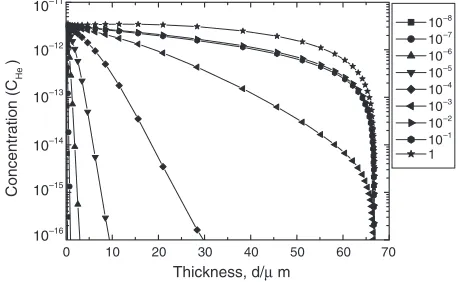
First, the diffusion of helium in defect-free tungsten is discussed. Figure 1 shows the time dependence of helium diffusion in tungsten at 873 K. The helium production rate was 1:6103s1 with the center at 15 nm and 10 nm in
width, which corresponded to a helium flux of1018m2s1.
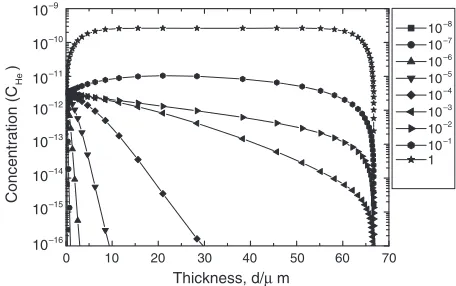
[image:3.595.312.540.73.216.2]The diffusion of helium was rapid. The concentration of helium decreased with increasing depth, and the distribution of helium was saturated after 0.01 s.
Figure 2 shows the variation in helium concentration in the
tungsten matrix at 873 K with a defect production rate of
1106dpas1 under simultaneous helium and neutron
irradiation. With elapsed irradiation time, the helium con-centration in the bulk of the matrix increased. During the first 0.01 s, the change in helium concentration was identical to that observed for helium diffusion in a perfect tungsten matrix (Fig. 1). This indicated that the increase in helium concentration in the bulk of the matrix was independent of the damage produced by neutron irradiation over a period of 0.01 s, and was entirely due to the helium diffusion. With increasing irradiation time, the helium concentration increas-ed due to neutron irradiation, reaching 21010 after 1 s. There was no difference in the helium concentration in the matrix except at the surfaces facing towards and away from the irradiation after 0.1 s. The decrease in the surface concentration of helium was induced by the diffusion of helium to the surface sink.
Figures 3 and 4 show the changes in interstitial and vacancy concentrations in the matrix. In contrast to the case of helium, the generation of interstitials and vacancies in the matrix was uniform. The concentrations of interstitials and vacancies were independent of depth in the matrix except at the two surfaces. Although the dissociation energy of a helium-interstitial pair is 0.5 eV, helium could not be trapped by interstitials at the high temperature of 873 K. It could, however, be trapped by vacancies. With increasing
irradi-Table 1 Parameters used in simulations.
pHe(s1) 1:6103
EI
m(eV) 0.15 eV
EV
m(eV) 1.4 eV10Þ
EHe
m (eV) 0.3 eV10Þ
Eemit (He-I)(eV) 0.5 eV
CS 1010
Z 1
(s1) 1013
0 10 20 30 40 50 60 70
10–16 10–15 10–14 10–13
10–12 10–11
Concentration (C
He
)
Thickness, d/µ m
10–8 10–7 10–6 10–5 10–4 10–3 10–2 10–1 1 10 100
Fig. 1 Time dependence of helium diffusion in perfect tungsten at 873 K.
0 10 20 30 40 50 60 70
10–16
10–15
10–14 10–13
10–12 10–11
10–10 10–9
Concentration (C
He
)
Thickness, d/µ m
10–8 10–7 10–6 10–5 10–4 10–3 10–2 10–1 1
Fig. 2 Time dependence of helium diffusion in tungsten under irradiation with106dpa/s at 873 K.
0 10 20 30 40 50 60 70
10–9
10–10
10–11
10–12
10–13
10–14
10–15
10–16
Concentration (C
i
)
Thickness, d/µ m
10–8 10–7 10–6 10–5 10–4 10–3 10–2 10–1 1
[image:3.595.45.290.78.183.2] [image:3.595.313.540.613.756.2] [image:3.595.55.284.622.766.2]ation time, the vacancy concentration increased. The inter-stitial concentration also increased, but it decreased after 0.01 s of irradiation. The formation of interstitial-type dislocation loops, which is described below, induced a decrease in the interstitial concentration. Interstitial-type dislocation loops absorbed interstitials and grew. Compared with the bulk of the matrix, the interstitial concentration at the surface was lower since interstitials easily diffused to surface sinks, whereas the vacancy concentration was higher at the surface than in the bulk, especially for irradiation times longer than 103s. The increase in vacancy concentration
was caused by the low diffusion of vacancies (due to the high migration energy of a vacancy: 1.4 eV) and the decrease in recombination with interstitials. In addition, after 1 s of irradiation, the interstitial concentration near the surface was higher than that in the matrix. Next, the reason for the interstitial concentration increase is discussed.
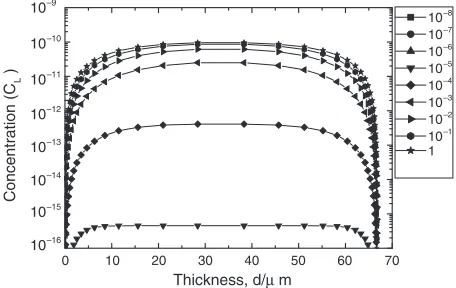
The concentration of interstitial-type dislocation loops increased with irradiation time, as shown in Fig. 5, and was saturated after 0.1 s of irradiation. Saturation of the loop concentration indicated the change from nucleation to growth of interstitial-type dislocation loops between 0.1 to 1 s of irradiation. As described in eqs. (6) and (7), the nucleation of interstitial-type dislocation loops is proportional to the square of the interstitial concentration Ci, while their growth
increases with the difference betweenMiCi andMvCv. The
interstitial concentration was higher at the surface than in the bulk of the matrix at irradiation times shorter than 0.1 s, but the vacancy concentration near the surface was higher. Thus, the difference between MiCi and MvCv was smaller at the
surface than in the bulk of the matrix, which induced an increase in interstitial concentration at the surface for a 1-s irradiation.
Figures 6 and 7 show the variation with irradiation time of the concentration of typical helium-vacancy clusters,i.e., He-V and 6He-He-V clusters. As shown in Fig. 2, since helium could not diffuse to surface away from the irradiation before 0.01 s, the concentration of helium-vacancy clusters decreas-ed with increasing depth except for the concentration of 6He-V clusters near the surface away from the irradiation after 0.01 s of irradiation, as shown in Fig. 7. The concentration of helium-vacancy clusters decreased as the number of helium atoms increased. The high concentration of 6He-V clusters near the surface away from the irradiation after 0.01 s of irradiation is thought to be because the vacancy concentration was higher at the surface and the concentration of helium-vacancy clusters increased with helium-vacancy concentration. After irradiation for 0.1 and 1 s, the distribution of the helium-vacancy concentration from He-V to 5He-V was almost the same. This meant that there was enough helium and vacancies in the matrix to nucleate and grow helium-vacancy clusters, and a high concentration of 6He-V clusters
0 10 20 30 40 50 60 70
10–7
10–8
10–9
10–10
10–11
10–12
10–13
10–14
10–15
10–16
Concentration (C
v
)
Thickness, d/µ m
10–8 10–7 10–6 10–5 10–4 10–3 10–2 10–1 1
Fig. 4 Effect of helium on the vacancy concentration variation under irradiation with106dpa/s at 873 K.
0 10 20 30 40 50 60 70
10–9
10–10
10–11
10–12
10–13
10–14
10–15
10–16
Concentration (C
L
)
Thickness, d/µ m
10–8 10–7 10–6 10–5 10–4 10–3 10–2 10–1 1
Fig. 5 Effect of helium on the formation of interstitial-type dislocation loops under irradiation with106dpa/s at 873 K.
0 10 20 30 40 50 60 70
10–9
10–10
10–11
10–12
10–13
10–14
10–15
10–16
Concentration (C
He-V
)
Thickness, d/µ m
10–8 10–7 10–6 10–5 10–4 10–3 10–2 10–1 1
Fig. 6 Time dependence of formation of the helium-vacancy clusters He-V under irradiation with106dpa/s at 873 K.
0 10 20 30 40 50 60 70
10–5
10–6
10–7
10–8
10–9
10–10
10–11
10–12
10–13
10–14
10–15
10–16
Concentration (C
6He-V
)
Thickness, d/µ m
10–8 10–7 10–6 10–5 10–4 10–3 10–2 10–1 1
[image:4.595.314.540.72.217.2] [image:4.595.56.283.74.219.2] [image:4.595.313.541.276.421.2] [image:4.595.55.283.612.756.2]accumulated as a result. After 1 s, the concentration of 6He-V clusters was 1106, about three orders of magnitude
higher than that of other helium-vacancy clusters. It also meant that nearly all of the vacancies and helium combined to form 6He-V clusters because the vacancy production was
1106dpas1 and average helium production was
1106. It is thought that the high concentration of
6He-V clusters is a helium source from the reaction between interstitials and 6He-V clusters, and helium emission from this reaction increases the helium concentration as shown in Fig. 2.
The irradiation time dependence of defects and helium concentrations in the matrix is summarized in Fig. 8, which is the typical variation in concentration of point defects and defect clusters in the center of the tungsten matrix. Clearly, the concentrations of interstitials and vacancies were not saturated even after irradiation for 1 s; neither was the concentration of 6He-V clusters. On the other hand, the concentrations of interstitial-type dislocation loops, helium, and 1–5He-V clusters were saturated after 1 s.
3.2 Effects of defect production rate on formation of
defect clusters
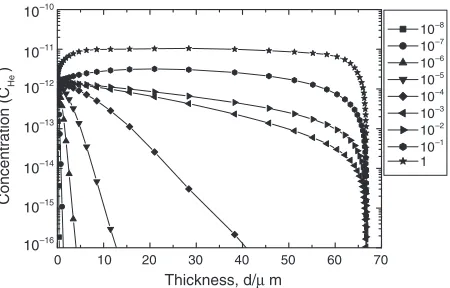
The defect production rate and irradiation temperature are two important factors influencing microstructural evolution. Thus, they also affect the interaction between defects and helium. The effects of defect production rate and irradiation temperature on the formation of defect clusters are discussed in this and the next section, respectively. Figure 9 shows the irradiation time dependence of helium distribution in tungsten at 873 K with a defect production rate of
1108dpas1, which was two orders of magnitude lower
than that shown in Fig. 2. As can be seen in Fig. 2, the helium concentration was determined by the helium diffusion under 0.01 s, and then affected by neutron irradiation over 0.01 s. Thus, we only notice the difference in Figs. 2 and 9 for times longer than 0.01 s. The helium concentration after 0.01 s of irradiation was lower than that under a high defect production rate (see Fig. 2). As shown in Figs. 8 and 10, the interstitial and vacancy concentrations under low defect production rate
were almost two orders of magnitude lower than those under high defect production rate for the same irradiation time. A low vacancy concentration induced low concentrations of helium-vacancy clusters. Conversely, the concentrations of helium-vacancy clusters in Fig. 10 were higher than those in Fig. 8 at the same irradiation dose since the accumulation of helium-vacancy clusters was also determined by irradiation time.
3.3 Effects of irradiation temperature on formation of
defect clusters
Figure 11 shows the time dependence of helium distribu-tion in tungsten at 1073 K irradiated with a defect producdistribu-tion rate of 1106dpas1. Compared with the irradiation at
873 K shown in Fig. 2, the helium concentration was lower after 0.01 s of irradiation. The vacancy concentration was lower in the case of irradiation at 1073 K than at 873 K (see Fig. 12) since vacancy mobility increased with temperature. However, the interstitial concentration was almost the same in the two cases because the interstitial migration energy is low (0.15 eV). The low vacancy concentration led to a low concentration of helium-vacancy clusters, and a low helium emission rate from the interaction of interstitials and 6He-V clusters.
100 10–1 10–2 10–3 10–4 10–5 10–6 10–7 10–8 10–5
10–7
10–9
10–11
10–13
10–15
Concentration
Irradiation Time, t/s
Ci Cv
CL
CHe
CHeV
C6HeV
Fig. 8 Typical variation in concentration of helium, interstitials, vacancies, dislocation loops and helium-vacancy clusters He-V and 6He-V at 0.03 mm under irradiation with106dpa/s at 873 K.
0 10 20 30 40 50 60 70
10–11
10–12
10–13
10–14
10–15
10–16
Concentration (C
He
)
Thickness, d/µ m
10–8 10–7 10–6 10–5 10–4 10–3 10–2 10–1 1
Fig. 9 Time dependence of helium diffusion in tungsten under irradiation with108dpa/s at 873 K.
100 10–1 10–2 10–3 10–4 10–5 10–6 10–7 10–8 10–5
10–6
10–7
10–8
10–9
10–10
10–11
10–12
10–13
10–14 10–15
Concentration
Irradiation Time, t/s
Ci C
v
CL C
He
[image:5.595.57.283.72.241.2]CHeV C6HeV
[image:5.595.312.541.75.216.2] [image:5.595.313.539.272.437.2]4. Conclusion
To estimate the effect of helium plasma on the micro-structural evolution induced by neutron irradiation, computer simulations based on the rate theory considering both helium and defect diffusions were performed. Helium diffusion in tungsten 0.067 mm thick only needed 0.01 s to reach saturation at 873 K. The concentration of helium-vacancy clusters of the type 6He-V was uniform in the matrix and increased up to 106 even after 1 s of irradiation. The
formation of helium-vacancy clusters, such as 6He-V, was mainly determined by the vacancy concentration, which depended on the irradiation time and temperature, defect production rate, and helium concentration. The helium concentration depended on helium diffusion during the initial stage of irradiation, and subsequently, on the emission of helium by the interaction of interstitials and helium-vacancy clusters.
REFERENCES
1) G. McCracken and P. Stott: Nucl. Fusion19(1979) 889–981.
2) J. P. Biersack and L. G. Haggmark: Nucl. Instrum. Methods174(1980) 257–269.
3) M. S. A. Elkeriem, D. P. Vanderwerf and F. Pleiter: Hyper. Inter.79
(1993) 783–786.
4) P. Klaver, E. Haddeman and B. Thijsse: Nucl. Instrum. Methods B153
(1999) 228–235.
5) W. D. Wilson and R. A. Johnson: in Interatomic Potentials and Simulation of Lattice Defects, ed. by P. C. Gehlen, J. R. Beeler and R. I. Jaffee (Plenum, New York, 1972) p. 375.
6) W. D. Wilson, M. I. Baskes and C. L. Bisson: Phys. Rev. B13(1976) 2470–2478.
7) H. Iwakiri: Doctor Dissertation, Kyushu University, 2004. 8) H. Iwakiri and N. Yoshida: in preparation.
9) K. Tokunaga, O. Yoshikawa, M. Makise and N. Yoshida: J. Nucl. Mater.307–311(2002) 130–134.
10) L. M. Caspers, H. Van Dam and A. Van Veen: Delft. Progr. Rep. Ser. A
1(1974) 39.
11) F. Dausinger: Philos. Mag. A37(1978) 819–836.
12) J. Th. M. de Hosson, A. W. Sleeswyk, L. M. Caspers, W. van Hengten and A. van Veen: Solid State Commun.18(1976) 479.
13) C. W. Gear: Numerical Initial Value Problems in Ordinary Differential Equations. (Prentice-Hall, Englewood Cliffs, N.J., 1971).
0 10 20 30 40 50 60 70
10–12 10–11
10–10
10–13
10–14
10–15
10–16
Concentration (C
He
)
Thickness, d/µ m
[image:6.595.58.283.73.217.2]10–8 10–7 10–6 10–5 10–4 10–3 10–2 10–1 1
Fig. 11 Time dependence of helium diffusion in tungsten under irradiation with106dpa/s at 1073 K.
100 10–1 10–2 10–3 10–4 10–5 10–6 10–7 10–8 10–5
10–6
10–7
10–8
10–9
10–10
10–11
10–12
10–13
10–14
10–15
Concentration
Irradiation Time, t/s
Ci Cv CL C
He
[image:6.595.313.539.74.240.2]CHeV C6HeV