Influence of Interface Structure on Schottky Barrier Heights
of
-Al
2O
3(0001)/Ni(111) interfaces: A First-Principles Study
Siqi Shi, Shingo Tanaka and Masanori Kohyama
Materials Science Research Group, Research Institute for Ubiquitous Energy Devices, National Institute of Advanced Industrial Science and Technology, Ikeda 563-8577, Japan
The Schottky barrier heights (SBH) for-Al2O3(0001)/Ni(111) interfaces have been examined using the first-principles pseudopotential
method, and compared with our previous results of Al2O3(0001)/Cu(111) interfaces. Configurations with different rigid-body translations
parallel to the interface for both the O-terminated and Al-terminated interfaces are examined to clarify the influence of the microscopic interfacial structure on the SBH. The averagedp-type value of the O-terminated interfaces is smaller than that of the Al-terminated interfaces, similar to the Al2O3/Cu interfaces, although the variation within each type of interface stoichiometry is also substantial. This indicates that the
SBH depends on both the interface stoichiometry and the configuration, in contradiction with the conventional models, which can be explained by the different interface dipole associated with the charge transfer and configuration of each interface. [doi:10.2320/matertrans.47.2696]
(Received May 23, 2006; Accepted June 21, 2006; Published November 15, 2006)
Keywords: first-principles pseudopotential method, metal-oxide interfaces, Schottky barrier
1. Introduction
Alumina/metal interfaces are of great importance in many technological applications, such as electronic devices, elec-trodes in fuel cells, gas sensors, heterogeneous catalysts, thermal barrier coatings, and nano-composites. Since two solids of quite different bonding characters are brought together, it is of fundamental interest to investigate the adhesion and various properties of abrupt alumina/metal interfaces. There have been many experimental1–3) and
theoretical studies4–11) on their adhesion and atomic
struc-tures. However, there have been only few studies on the electronic properties of alumina/metal interfaces. The Schottky-barries height (SBH) is one of the typical electronic properties of semiconductor (insulator)/metal interfaces. The understanding of the SBH at insulating oxide/metal inter-faces should be crucial in selecting an insulator for the device application, where sufficiently large SBH values are neces-sary so as to reduce the gate leakage current caused by the direct tunneling of electrons. Compared with semiconductor/ metal interfaces,12) systematic investigation of the SBH of such oxide/metal interfaces are rare.13–17)
In this paper, we deal with the SBH of the Al2O3(0001)/
Ni(111) interface, and examine the effects of interface stoichiometry. It is easy to construct O-rich (O-terminated), stoichiometric (Al-terminated), and Al-rich (double Al-layer-terminated) Al2O3(0001)/metal interfaces by changing the
interface atomic plane of the Al2O3(0001) surface. Zhang
and co-workers5)have examined the relative stability among
the three kinds of Al2O3(0001)/Ni(111) interfaces with
different stoichiometry via free-energy calculations as func-tions of the activity of Al and the O partial pressure, and concluded that either Al-terminated (stoichiometric) or O-terminated (O-rich) interface should exist within usual experimental conditions. In our preceding papers,10,11) we have performed detailed analysis of the atomic structure and bonding nature of both the O-terminated and Al-terminated Al2O3(0001)/Ni(111) interfaces for different rigid-body
translations (RBT), and made a comparison with the
Al2O3(0001)/Cu(111) interfaces.6–9) The O-terminated
in-terfaces have very strong Ni-O bonds with strong ionic and Ni-3d/O-2p hybridization interactions, and the adhesion of the Al-terminated interfaces is explained mainly by weak image-like electrostatic and Ni-Al hybridization interactions, similarly to the Al2O3(0001)/Cu(111) interfaces, although
Ni-O or Ni-Al interactions seem to be stronger than Cu-O or Cu-Al ones. Because the SBH should depend on the interfacial bonding nature or electronic structure, it is of great interest to examine the effects of interface stoichiom-etry on the SBH, as well as the effects of atomic config-urations through the comparison among the configconfig-urations with different RBT. In this paper, we also examine the effects of metallic species on the SBH through the comparison with the Al2O3/Cu interfaces.9)
About the conventional models for the mechanism of the SBH of semiconductor/metal interfaces, the Schottky mod-el18) explains the SBH by the relation between the work
functions of the two materials, although the work function of each material is not so exactly defined. Experimentally, the Fermi-level pinning to some specific state in the band gap is often observed. The MIGS-CNL model19–21) explains the pinning by the charge-neutrality level (CNL) in the metal-induced gap states (MIGS), which is considered to be intrinsic to each semiconductor. Both the Schottky and MIGS-CNL models deny the dependence of the SBH on the interface structure. However, the experimental22) and ab
initiostudies23,24)on the SBH of the NiSi
2(111)/Si interface
showed that the SBH really depends on the interface structure through the different interface dipole. In our previous ab initio calculations of Si-terminated and C-terminated inter-faces of the SiC(001)/metal and SiC(111)/metal
interfa-ces,25–28) the SBH also strongly depends on the interface
termination, which is inconsistent with the above conven-tional models. There is a tendency that the C-terminated interfaces with the electron transfer from metal to SiC generally have lower p-type SBH values, caused by the interface dipole lowering the electrostatic potential of the metal side, although the interface plane and metal species
also have effects on the SBH values. This tendency is consistent with the experiments.29) It is of great scientific
interest to examine the applicability of the conventional models of the SBH to insulating oxide/metal interfaces.
2. Theoretical Method and Supercell Model
We use the plane-wave pseudopotential method based on the density functional theory (DFT) within the local density approximation (LDA).30)Optimized norm-conserving
pseu-dopotentials31)are used with a plane-wave cut-off energy of 120 Ry, which is large enough for the present system. The electronic ground state is obtained via the efficiently-parallelized code32)using the ‘residual minimization/direct inversion in the iterative subspace’ (RMM-DIIS) method33,34) coupled with the efficient charge-mixing scheme.35) The nonlinear partial core correction is included for the pseudo-potential of Ni.36)Four and nine samplingk-points within the
irreducible Brillouin zone of the present supercell are used for self-consistent calculations and for calculations of local density of states (LDOS), respectively.
The lattice constant of Al2O3(0001) calculated by the
present scheme is about 9.632% larger than that of Ni(111), which agrees well with the experimental misfit 9.488%.5)We
deal with coherent (11) Al2O3(0001)/Ni(111) interfaces,
where Ni layers are expanded along the interface. We examine three models with different RBT, namely, O-site, hollow-site (H-site) and Al-site models, where the Ni atom is located above the O, hollow and Al sites of the Al2O3(0001)
surface, respectively. These configurations correspond to those of local commensurate regions observed at incoherent interfaces with substantial mismatch.7,37) The supercell is
constructed by alternate stacking of an Al2O3(0001) slab and
a Ni(111) slab without vacuum regions. The Al2O3 slab
contains four O atomic layers and eight Al atomic layers for the Al-terminated (stoichiometric) case or six Al atomic layers for the O-terminated case, and the Ni(111) slab contains five atomic layers for the O-site and H-site models or seven atomic layers for the Al-site model to attain periodic fcc stacking. The stable interface configuration is determined through the total-energy minimization by iterating the relaxation for different supercell lengths in the direction normal to the interface. In each relaxation step, the force convergence is 0.05 eV/A˚ and theC3isymmetric property is
preserved, which keeps the two interfaces in the supercell identical to each other.
The LDOS is calculated by integrating the wave function of each eigenstate for respective regions between successive (0001) or (111) atomic layers in the supercell. The p-type SBH is defined by the difference between the metal Fermi level and the valence-band top (VBT) of a bulk Al2O3region
in the LDOS.25–28) The VBT of the bulk Al
2O3 region is
determined as compared with the DOS of the Al2O3crystal.
Then-type value of the SBH is determined by subtracting the p-type value from the bulk Al2O3 band gap, for which the
experimental value of 8.8 eV38)should be used in stead of the present DFT-LDA value of 6.88 eV. In the analysis, the interface charge transfer is defined by the integration of dnðzÞ ¼nðzÞ nsðzÞ,39) where nðzÞ is the planar averaged
charge density in a plane atzandnsðzÞis the superposition of
the planar averaged surface charge densities of separate surface systems.
3. Results and Discussions
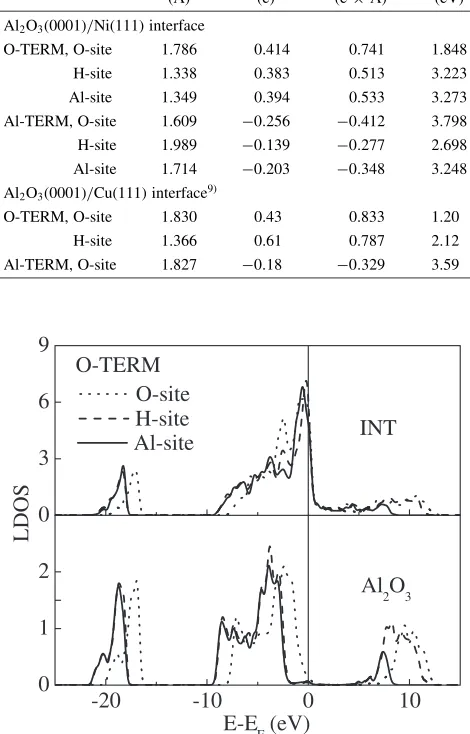
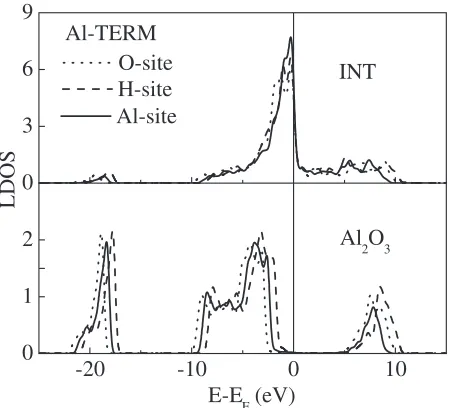
[image:2.595.304.548.144.300.2]Results of the stable configurations and bonding nature are given in Refs. 10) and 11). In this paper, we concentrate on the SBH results. Table 1 lists the interfacial distances, charge transfer and p-type SBH values for all the interfaces. The p-type SBH value is obtained through the analysis of the LDOS’s as shown in Figs. 1 and 2. There is no band bending in the present supercell because of no doping and zero-temperature. Of course, it is desirable that the size of the supercell should be enough large so as to prevent the effects
Table 1 Calculated interface distance (D), charge transfer (n) andp-type Schottky-barrier height (SBH) of each model for the O-terminated and Al-terminated Al2O3(0001)/Ni(111) interfaces.n is positive if electrons are
transferred from the metal to the oxide. The interface dipole is estimated by the charge transfer value times the interface distance so as to analyze the SBH values. Previous results of the Al2O3(0001)/Cu(111) are also
listed.
D (A˚ )
n (e)
nd (eA˚ )
SBH (eV)
Al2O3(0001)/Ni(111) interface
O-TERM, O-site 1.786 0.414 0.741 1.848
H-site 1.338 0.383 0.513 3.223
Al-site 1.349 0.394 0.533 3.273
Al-TERM, O-site 1.609 0:256 0:412 3.798
H-site 1.989 0:139 0:277 2.698
Al-site 1.714 0:203 0:348 3.248
Al2O3(0001)/Cu(111) interface9Þ
O-TERM, O-site 1.830 0.43 0.833 1.20
H-site 1.366 0.61 0.787 2.12
Al-TERM, O-site 1.827 0:18 0:329 3.59
-20
-10
0
10
0
1
2
Al
2O
3INT
E-E
F(eV)
0
3
6
9
O-TERM
Al-site
H-site
O-site
LDOS
Fig. 1 Local densities of states for the three models of the O-terminated Al2O3(0001)/Ni(111) interface. ‘INT’ and ‘Al2O3’ mark the Ni-O
interlayer at the interfacial region and the central Al-O interlayer of the bulk Al2O3region, respectively. The vertical line represents the Fermi
[image:2.595.309.544.163.530.2]of the interface on the bulk Al2O3 region. In Table 1,
dramatically different SBH values for respective interfaces indicate that the SBH does depend on the interface-specific features, in contrast to the conventional models18–21)to deny such dependence. The averaged p-type value of the O-terminated interfaces is lower than that of the Al-O-terminated interfaces, although there is a rather large variation among the three models for each type of interface stoichiometry. The reason of the lower averaged p-type value of the O-terminated interfaces can be understood by quite different charge transfer for the two types of interfaces, namely from Ni to Al2O3for the O-terminated ones and from Al2O3to Ni
for the Al-terminated ones,11) resulting in the opposite
interface dipoles. This tendency is similar to the relation between the C-terminated and Si-terminated SiC/metal interfaces.25–28)
For the O-terminated interfaces, where the bonding nature is explained as strong ionic and Ni-3d/O-2p hybridization interactions,11) the Al-site and H-site models with three-coordinated Ni-O bonds11)have similar SBH values to each other, and the O-site model with Ni-O dimmer bonds11)has
the lowest SBH value. This feature is consistent with the values of the interface charge transfer. More directly, estimated values of the interface dipole listed in Table 1 can well explain the SBH results. The dipole for the O-site model is enlarged by both the largest charge transfer value and the largest interface distance. The larger interface dipole causes the lower p-type SBH value for the O-terminated interface, because the dipole by the electron transfer from Ni to Al2O3lowers the potential in the Ni side relatively. About
the comparison between the H-site and Al-site models, the relation between the dipole and the SBH does not obey the above rule strictly, although the difference between the two models is rather small. For the O-terminated Al2O3/Cu
interfaces,9)the charge transfer is larger for the H-site model,
although the total dipole is larger for the O-site model by the larger interface distance, resulting in the lowest p-type SBH for the O-site model.
For the Al-terminated interfaces, where the bonding is caused by weak image-like electrostatic and Ni-Al hybrid-ization interactions,11)the H-site model has the lowestp-type
value and the O-site model has the highest one. Both the charge transfer and the estimated interface dipole are the largest (in the absolute values) for the O-site model, and the smallest for the H-site model. The larger dipole (in the absolute value) causes the higher p-type SBH value for the Al-terminated interfaces, because the dipole by the electron transfer from Al2O3to Ni11)raises the potential of the Ni side
relatively. Interestingly, Goniakowskiet al.14)reported that, for the non-polar MgO(001)/metal interfaces, the O-site model with the smaller interfacial distance has the higher p-type SBH than the Mg-site model. This agrees with the relation between the p-type SBH and the interfacial distance among the three models of the present Al-terminated interfaces.
About the comparison between the Al2O3/Ni and Al2O3/
Cu interfaces, thep-type SBH value of the former system is higher than that of the latter system for each interface stoichiometry and RBT in Table 1. This relation is in contradiction with the conventional Schottky model, because the work function of Ni(111) is larger than that of Cu(111) as 5.35 eV vs. 4.94 eV experimentally40)and 5.77 eV vs. 5.30 eV theoretically.41) It is quite interesting that the relation between the SBH values of the Al2O3/Ni and Al2O3/Cu
interfaces can be also explained by the estimated interface dipoles in Table 1. For the site and H-site models of the O-terminated Al2O3/Ni and Al2O3/Cu interfaces, the higher
SBH values of the Al2O3/Ni interfaces (1.848 and 3.223 eV)
are consistent with the smaller dipole values (0.741 and 0.513) than those of the Al2O3/Cu interfaces. Similarly, the
higher SBH value of the O-site model of the Al-terminated Al2O3/Ni interface is consistent with the larger (absolute)
dipole value (0:412) than that of the Al2O3/Cu interface
(0:329). About the H-site models of the O-terminated Al2O3/Ni and Al2O3/Cu interfaces, the difference between
the SBH values is fairly large (1.103 eV). This is caused by the quite large interface dipole (0.787) of the Al2O3/Cu
interface associated with large interface charge transfer (0.61 e). In the O-terminated Al2O3/Cu interfaces, the H-site
model has larger charge transfer than that of the O-site model (0.43 e), which is quite different from the O-terminated Al2O3/Ni interfaces.
It is clear that the SBH of the Al2O3/Ni system depends on
both the interface stoichiometry and the configuration. The variation in the O-terminated interfaces is 1.425 eV, that in the Al-terminated interfaces is 1.1 eV, and that among all the models is 1.95 eV. As analyzed above, the relation between the O-terminated and Al-terminated interfaces, and the relation among the three models with each type of interface stoichiometry can be well explained by the interface dipole associated with the interface charge transfer and configu-ration, although the value of the interface dipole is only qualitative in the present analysis. It is quite interesting that the relation between the Al2O3/Ni and Al2O3/Cu interfaces
is also consistent with the relation of the interface dipole. In
-20
-10
0
10
0
1
2
O-site
LDOS
Al
2O
3INT
E-E
F(eV)
0
3
6
9
Al-TERM
Al-site
H-site
Fig. 2 Local densities of states for the three models of the Al-terminated Al2O3(0001)/Ni(111) interface. ‘INT’ and ‘Al2O3’ mark the Ni-Al
interlayer at the interfacial region and the central Al-O interlayer of the bulk Al2O3region, respectively. The vertical line represents the Fermi
[image:3.595.58.284.74.278.2]this way, the present results support our view of the SBH mechanism25–28) dominated by the two factors, first the
interface dipole dependent on the interface structure, and second the intrinsic relation of the band structures of the two materials, as the band discontinuity at semiconductor heterojunctions.42) Our view is consistent with a recent
model43)emphasizing the role of the electric dipole
associ-ated with interface bonds.
However, if we consider the limit of a negligible interface dipole for the O-terminated and Al-terminated Al2O3/Ni
systems, there occurs a problem. From Table 1, the SBH value with a negligible dipole for the O-terminated interface should be larger than 3.273 eV, and that for the Al-terminated one should be less than 2.698 eV. These two limits do not coincide with each other. This indicates that the SBH is determined not only by the above two factors but also by the other factors concerning interface atomic and electronic structure quantitatively.
Experimental studies of the SBH of the Al2O3/Ni or
Al2O3/Cu interfaces are rare. For the interfaces of Ni and Cu
with thin Al2O3 layers by atomic layer chemical vapor
deposition, internal electron photoemission measurements have given then-type SBH of 3.5 and 3.6 eV, respectively.44)
This indicates that the p-type values of the Al2O3/Ni and
Al2O3/Cu interfaces are 2.7 and 2.6 eV, respectively, using
the Al2O3 band gap of 6.2 eV observed for the samples. It
seems that structural disorder or occurrence of -phase greatly reduce the band-gap value of Al2O3.45,46) Using the
same experimental method, DiMaria47) also obtained a similarn-type SBH value of 3.7 eV for the Al2O3/Ni system.
In any case, the calculated p-type values from the above experiments are comparable to the present values of the Al2O3/Ni and Al2O3/Cu interfaces. Recent experiments48,49)
of the work function changes for the epitaxial Al2O3thin-film
growth on NiAl(110) and Cu-9%Al(111) surfaces have also provided valuable information on the SBH. Results indicate that the p-type SBH values of the Al2O3/NiAl and Al2O3/
Cu-Al interfaces are a little smaller than 4 eV. This is also consistent with our theoretical results, although Al2O3 may
be phase and metallic sides are not pure elements. It is instructive to compare our results with those for other insulating oxide/metal interfaces. Inab initiocalculations of the non-polar BaTiO3(001)/transition-metal interfaces,13)
SBH values are in contradiction with the conventional models, similarly to the present results. For the interfaces with several kinds of transition metals, there occurs no Fermi-level pinning, or the SBH values do not vary monotonically as a function of the metal work function. Recentab initiocalculations of the SBH of the ZrO2(001)/Ni
interfaces16) have revealed the effects of the interface
stoichiometry, similarly to the present results. The O-terminated (O-rich) ZrO2(001)/Ni interface has the lowest
p-type value (2.13 eV), the Zr-terminated (Zr-rich or O-deficient) interface has the highest value (3.80 eV), and the O-terminated interface with O vacancies has the intermediate one (2.92 eV), simply according to the interface charge transfer and the interface dipole. This result has been supported by the experimental result that an O-rich interface has a lower p-type value (2.60 eV) than an O-deficient interface (3.36 eV).16) As discussed in Ref. 17), the decay
length of MIGS for insulating oxide/metal interfaces seems to be rather short as compared with semiconductor/metal interfaces. In such systems, the local interface dipole seems to dominate the SBH, as observed in our systems. From this viewpoint, the effects of the insertion of a different metal layer at the ZrO2(001)/Ni interface have been examined
throughab initiocalculations.17)
On the other hand, recentab initiostudies of MgO(100)/ metal interfaces14,15) have revealed the importance of the
detailed analysis of electronic structure such as MIGS, interfacial bonding states or defect states, band distortions by electrostatic fields, charge transfer, interface dipoles and so on. These studies have examined the effects of the interface defects and metal coverage15) and the effects of metallic species,14)although results cannot be simply explained either by the conventional models, or solely by the local interface dipole. In order to understand our present results completely, more detailed analysis of the electronic structure may be important.
4. Conclusion
We have examined the Schottky barrier heights of the Al2O3(0001)/Ni(111) interfaces using first-principles
calcu-lations, and made a comparison with the Al2O3(0001)/
Cu(111) interfaces. For the calculatedp-type SBH values, the average of the O-terminated interfaces is lower than that of the Al-terminated ones, similarly to the relation between the O-terminated and Al-terminated Al2O3/Cu interfaces and
between the C-terminated and Si-terminated SiC/metal interfaces. However, there are substantial variations among the configurations with different RBT in each type of interface stoichimetry, which indicates that the SBH depends on both the interface stoichiometry and the configuration, in contradiction with the conventional models. This can be well explained by the estimated interface dipole associated with the interface charge transfer and configuration of each interface, although the complete understanding might require more detailed analysis of interface electronic structure.
Acknowledgements
The present work was supported by New Energy and Industrial Development Organization (NEDO) as the Nano-Coating Project. The authors would like to thanks Dr. R. Yang, Dr. S. Dmitriev, Prof. W. Zhang, Prof. N. Yoshikawa, Dr. Y. Hangai, Dr. T. Sasaki, Prof. Y. Ikuhara and Prof. Y. Kagawa for fruitful discussions. The authors also thank Dr. M. Yoshitake for the information on recent experimental work of the SBH. All the computations were performed on the HITACHI SR11000 supercomputer at the Tsukuba Advanced Computing Center (TACC), AIST.
REFERENCES
1) T. Sasaki, K. Matsunaga, H. Ohta, H. Hosono, T. Yamamoto and Y. Ikuhara: J. Soc. Mater. Sci. Jpn.52(2003) 555–559.
2) T. Sasaki, K. Matsunaga, H. Ohta, H. Hosono, T. Yamamoto and Y. Ikuhara: Sci. Technol. Adv. Mater.4(2003) 575–584.
4) M. W. Finnis: J. Phys. Condens. Matter8(1996) 5811–5836. 5) W. Zhang, J. R. Smith and A. G. Evans: Acta Mater.50(2002) 3803–
3816.
6) R. Yang, S. Tanaka and M. Kohyama: Phil. Mag. Lett.84(2004) 425– 434.
7) S. Tanaka, R. Yang, M. Kohyama, T. Sasaki, K. Matsunaga and Y. Ikuhara: Mater. Trans.45(2004) 1973–1977.
8) R. Yang, S. Tanaka and M. Kohyama: Phil. Mag.85(2005) 2961– 2976.
9) S. Tanaka, R. Yang and M. Kohyama: Phil. Mag.86(2006) 5123– 5135.
10) S. Q. Shi, S. Tanaka and M. Kohyama: Modelling Simul. Mater. Sci. Eng.14(2006) S21–S28.
11) S. Q. Shi, S. Tanaka and M. Kohyama: to be submitted.
12) W. Mo¨nch:Electronic Properties of Semiconductor Interface, (Spring-er S(Spring-eries in Surface Science 43, Spring(Spring-er, 2004).
13) F. Rao, M. Kim and A. J. Freeman: Phys. Rev. B55(1997) 13953– 13960.
14) J. Goniakowski and C. Noguera: Interface Science12(2004) 93–103. 15) Y. Y. Mi, S. J. Wang, Y. F. Dong, J. W. Chai, J. S. Pan, A. C. H. Huan
and C. K. Ong: Surf. Sci.599(2005) 255–261.
16) Y. F. Dong, S. J. Wang, J. W. Chai, Y. P. Feng and A. C. H. Huan: Appl. Phys. Lett.86(2005) 132103.
17) Y. F. Dong, S. J. Wang, Y. P. Feng and A. C. H. Huan: Phys. Rev. B73 (2006) 045302.
18) W. Schottky: Z. Phys.118(1942) 539–592. 19) V. Heine: Phys. Rev.138(1965) A1689–A1696.
20) S. G. Louie and M. L. Cohen: Phys. Rev. B13(1976) 2461–2469. 21) J. Tersoff: Phys. Rev. Lett.52(1984) 465–468.
22) R. T. Tung: Phys. Rev. Lett.52(1984) 461–464.
23) G. P. Das, P. Blo¨chl, O. K. Anderson, N. E. Christensen and O. Gunnarsson: Phys. Rev. Lett.63(1989) 1168–1171.
24) H. Fujitani and S. Asano: Phys. Rev. B42(1990) 1696–1704. 25) J. Hoekstra and M. Kohyama: Phys. Rev. B57(1998) 2334–2341.
26) M. Kohyama and J. Hoekstra: Phys. Rev. B61(2000) 2672–2679. 27) S. Tanaka and M. Kohyama: Phys. Rev. B64(2001) 235308. 28) S. Tanaka and M. Kohyama: Appl. Surf. Sci.216(2003) 471–477. 29) J. R. Waldrop: J. Appl. Phys.75(1994) 4548–4550.
30) J. P. Perdew and A. Zunger: Phys. Rev. B23(1981) 5048–5079. 31) N. Troullier and J. L. Martins: Phys. Rev. B43(1991) 1993–2006. 32) T. Tamura, G.-H. Lu, R. Yamamoto, M. Kohyama, S. Tanaka and
Y. Tateizumi: Modelling Simul. Mater. Sci. Eng.12(2004) 945–957. 33) G. Kresse and J. Furthmu¨ller: Phys. Rev. B54(1996) 11169–11186. 34) P. Pulay: Chem. Phys. Lett.73(1980) 393–398.
35) P. Pulay: J. Comp. Chem.3(1982) 556–560.
36) S. G. Louie, S. Froyen and M. L. Cohen: Phys. Rev. B26(1982) 1738– 1742.
37) W. Zhang, J. R. Smith, X.-G. Wang and A. G. Evans: Phys. Rev. B67 (2003) 245414.
38) R. H. French: J. Am. Ceram. Soc.73(1990) 477–489.
39) R. Benedek, M. Minkoff and L. H. Yang: Phys. Rev. B54(1996) 7697– 7700.
40) H. B. Michaelson: J. Appl. Phys.48(1977) 4729–4733.
41) H. L. Skriver and N. M. Rosengaard: Phys. Rev. B46(1992) 7157– 7168.
42) N. Binggeli, P. Ferrara and A. Baldereschi: Phys. Rev. B63(2001) 245306.
43) R. T. Tung: Phys. Rev. B64(2001) 205310.
44) V. V. Afanas’ev, M. Houssa, A. Stesmans and M. M. Heyns: J. Appl. Phys.91(2002) 3079–3084.
45) E. Mene´ndez-Proupin and G. Gutie´rrez: Phys. Rev. B 72 (2005) 035116.
46) H. Momida, T. Hamada, Y. Takagi, T. Yamamoto, T. Uda and T. Ohno: Phys. Rev. B73(2006) 054108.
47) D. J. DiMaria: J. Appl. Phys.45(1974) 5454–5456.