N O R M A L
S T A T E I M P L I C A T U R E
Nancy L. Green
Department of Computer and Information Sciences
University of Delaware
Newark, Delaware 19716, USA
Abstract
In the right situation, a speaker can use an unqual- ified indefinite description without being misun-
derstood. This use of language, normal slate im-
plicature, is a kind of conversational implicature, i.e. a non-truth-functional context-dependent in- ference based upon language users' awareness of principles of cooperative conversation. I present a convention for identifying normal state implica- tures which is based upon mutual beliefs of the speaker and hearer about certain properties of the speaker's plan. A key property is the precondition that an entity playing a role in the plan must be in a normal state with respect to the plan.
1
I n t r o d u c t i o n
In the right situation, a speaker can use an unqualified indefinite description without being misunderstood. For example, a typical customer in a typical pet shop who said (la) in response to the clerk's question in (1) would expect to be un- derstood as meaning (lb). The goal of this paper is to formally describe such uses of language. 1
1A s i m i l a r u s e of l a n g u a g e is n o t e d in [McC87]. Mc- C a r t h y (pp. 29-30) d i s c u s s e s t h e p r o b l e m of b r i d ~ n g t h e gap b e t w e e n a " r a t h e r direct [translation] into first order logic" of a s t a t e m e n t of t h e M i s s i o n a r i e s a n d C a n n i b a l s p u z - zle, a n d a r e p r e s e n t a t i o n s u i t a b l e for d e v i s i n g a s o l u t i o n to the puzzle. For e x a m p l e , if t h e p u z z l e s t a t e m e n t m e n t i o n s t h a t '% r o w b o a t t h a t s e a t s two is available" a n d d o e s n ' t say t h a t a n y t h i n g is w r o n g w i t h t h e b o a t , t h e p r o b l e m - s o l v e r
m a y assume that the boat doesn't leak, has oars, etc. Mc- C a r t h y proposes a general-purpose m e t h o d for formalizing c o m m o n sense reasoning, "circumscription", to solve the problem.
Also, a similar use of language is described in [GriT5] (p. 51): "A is standing by an obviously immobilized car and is approached by B; the following exchange takes place: A: I a m out of petrol.
B: There is a garage round the corner.
... [B] implicates that the garage is, or at least m a y be open, [has petrol to sell], etc." T h a t tiffs use of language
8 9
1. (Clerk A:) May I help you?
a. (Customer B:) I'd like to see a parrot.
b. I [the speaker] would like to see a live parrot.
c. 3 p:PARROT REQUEST(B,A,SIIOW(A,B,p)) d. 3 q:[A p : P A R R O T LIVE(p)] REQUEST(B,A,
SHOW(A,B,q)
One problem is that (la) (i.e. its putative representation in (lc)) does not entail (lb) (i.e. its putative representation in (ld)). 2
Another problem
is the context-dependence, both spatio-temporal and linguistic, of the relationship of (lb) to (la). In a different spatic~temporal context, such as in a china shop, a speaker might use (la) to convey (2) rather than (lb).
2. I [the speaker] would like to see a porcelain
parrot.
In a different linguistic context, such as if the cus- tomer had said (3a) following (la), she would not
involves t h e u s e of l a n g u a g e I h a v e i l l u s t r a t e d in (1) c a n b e s e e n b y c o n s i d e r i n g a s i t u a t i o n identical to t h e a b o v e except t h a t t h e dialogue c o n s i s t s of j u s t A ' s s a y i n g "I n e e d a garage." In o t h e r words, Grice's e x a m p l e is of a s i t u a t i o n w h e r e B h a s a n t i c i p a t e d a r e q u e s t f r o m A w h i c h is t h e s a m e
kind of request as (la).
2 T h e customer's use of (la) is an indirect speech act, namely, a request to be s h o w n a parrot; other possible re- alizations of this request include " S h o w m e a parrot" and " C a n you show m e a parrot?". (The derivation of represen- tations of indirect speech acts has been treated elsewhere [PAS0] and is not a concern of this paper.) (Ic) is intended to represent that request by m e a n s of a first order language extended with hlgher-order operators such as R E Q U E S T . Also, indefinite descriptions are represented as in [Web83]. T h e status of the existence of the parrot in the real world or discourse context (and the related question as to the proper scope of the existential quantifier), is not relevazlt to the concerns of this paper. M y point is that the usual treatments employing a one-to-one translation from surface structure to logical form without consideration of other in- formation will not he able to explain the relationship of
normally expect the clerk to think she had meant (lb). A related question is why it would be ap- propriate (non-redundant) for the customer to say (3b) following (la) if the customer believed that the clerk might mistakenly believe that the cus- tomer wanted to see a dead parrot.
2
Scalar I m p l i c a t u r e
tIirschberg proposes the following set of six necessary and sufficient conditions for identifying conversational implicatures (p. 38). 3 A speaker S conversationally implicates Q to a hearer tI by saying U (where U is a realization of a proposition P) in a context C iff:
3.a . . . . a d e a d one b . . . . a l i v e one
A third problem is that in order to derive (lb) from (la) it is necessary to consider the beliefs of speaker (S) and hearer (H): e.g. S's and H's beliefs about why each said what they did, and about the appropriate state of the parrot.
Grice [Gri75] described conversational im- plicature, a kind of non-truth-functional context- dependent inference based upon a speaker's and hearer's awareness of principles of cooperative con- versation. In this paper, I claim that a speaker's use of (la) may conversationally implicate (lb). In order to formally describe this kind of conver- sational implicature, which I have termed 'nor- mal state implicature', I adopt the methodology used by Hirschberg [Hir85] for the identification of another kind of conversational implicature, scalar implicature.
In section 2, I present a brief description of scalar implicatures and Hirschberg's methodol- ogy for identifying them. In section 3, I present a convention for identifying normal state implica- tures. Informally speaking, the convention is that if speaker S makes a request that hearer H per- form an action A on an entity E, and if S and tt mutually believe that S has a plan whose success depends on the E being in a certain state N (which is the normal state for an E with respect to that plan) and that S's request is a step of that plan, then S is implicating a request for S to do A on an E in state N.
In section 4, I clarify the notion of nor- mal state with respect to a plan by distinguish- ing it from the notions of stereotype and plan- independent normal state. Next, in section 5, I show how states can be represented in the lexicon. In section 6, I compare scalar and normal state im- plicature; in section 7, survey related work; and, in section 8, present my conclusions.
1. S intends to convey Q to H via U; and
2. S believes that S and H mutually believe that S is being cooperative; and
.
.
.
.
S and H mutually believe that S's saying U in C, given S's cooperativity, licenses Q; and
Q is cancelable; i.e., it is possible to deny Q without denying P; and
Q is nondetachable; i.e., the choice of a real- ization U of P does not affect S's implicating Q (except in certain situations where Q is li- censed via Grice's Maxim of Manner); and
Q is reinforceable; i.e., it is possible to affirm Q without seeming redundant.
Instead of using these conditions to identify particular scalar implicatures, Hirschberg argues that it is sufficient to provide a means of iden- tifying instances of a class of conversational im- plicature, such as scalar implicatures. Then, she provides a convention for identifying instances of scalar implicat ure.
Informally speaking, scalar implicature is based on the convention that (pp. 1 - 2)"cooper- ative speakers will say as much as they truthfully can that is relevant to a conversational exchange"; and distinguished from other conversational impli- catures by "being dependent upon the identifica- tion of some salient relation that orders a concept referred to in an utterance with other concepts"; e.g. by saying (4a), B has scalar implicated (4b). 4
( 4 ) A: How was the party last night? a. B: Some people left early. b. Not all people left early.
90
The convention for identifying scalar impli- cature proposed by Hirschberg is of the form: if
3Her c o n d i t i o n s are ~ r e v i s i o n of Grice's. Also, I h a v e c h a n g e d t h e n a m e s of h e r v a r i a b l e s to b e c o n s i s t e n t w i t h u s a g e in t h e rest of m y p a p e r .
there exists a partial order O such that S and H mutually believe that O is salient in context C, and utterance U realizes t h e proposition that S af- firms/denies/is ignorant of some value in O, then by saying U to H in C, S licenses the scalar im- plicature that S has a particular belief regarding some other value of O.
In the next section, I will ap-
ply Hirschberg's methodology to the problem of identifying normal state implicatures.
3
N o r m a l S t a t e I m p l i c a t u r e
In this section, I will argue that (lb) is a conversational implicature and propose a conven- tion for identifying instances of that class of impli- cature, which I will call 'normal state implicature'.
First, I claim that a speaker S conversa- tionally implicates (lb) to a hearer H by saying ( l a ) in the context described above; i.e. that (lb) is a conversational implicature according to the six conditions described in section 2. Condition 1 is met since S intends to cause H to believe (lb) by saying (la); condition 2 since S believes that it is a mutual belief of S and H that S is being cooperative; condition 3 will be satisfied by pro- viding a convention for normal state implicature below. The previous discussion about (3a) and (3b) provides evidence for cancelability (condition 4) and reinforceability (condition 6), respectively; and, (lb) is nondetachable (condition 5) since al- ternate ways of saying (la), in the same context, would convey (lb).
Next, in order "to motivate the general convention ((6) below) for identifying normal state implicatures, I'll present the instance of the convention that accounts for the implicature
in (1). Let S, H, U, and C be constants de-
noting speaker, hearer, utterance, and context,
respectively. Let b0, bl, and g be first or-
der variables over parrots ( P A R R O T ) , live par- rots (the lambda expression), and plans (PLAN), respectively. 5 HAS-PLAN(Agent,Plan,Entity) is
5The model of plans used here is that of STRIPS [FN71] with minor extensions. A plan includes preconditions which must hold in order for the plan to succeed, and a sequence of actions to be carried out to achieve some goal. One extension to this model is to add a llst of entities play- ing a r o l e i n t h e plan either as instruments (e.g. a boat
which is to be used to cross a river) or as the goal itself (e.g. a parrot to be acquired for a pet). The second exten-
true if Agent has a plan in which Entity plays a role; PRECOND(Plan,Proposition) is true if Plan has Proposition as a precondition; STEP(Plan,Action) is true if Action is a step
of Plan. Also, BMB(A,B,Proposition) is true
if A believes that A and B mutually believe that Proposition; REALIZE(Utterance, Propo- sition) is true if Utterance expresses Proposi- tion; REQUEST(S,H,Action) is true if S re- quests H to perform Action; and SAY(S,H,U,C) is true if S says U to H in C. 6 SHOW(A,B,C) is true if A shows C to B. IN-STATE(Entity,State) is true if Entity is in the given State; and NORMAL-STATE(State,Plan,Entity) is true if State is the normal state of Entity with re-
spect to Plan. 7 Finally, NORMAL-STATE-
IMP (Speaker, Hearer ,Utterance ,Prop osition ,Context ) is true if by use of Utterance in Context, Speaker conveys Proposition to Hearer.
Now, to paraphrase (5) below, if S and H mutually believe that S has a plan in which a par- rot plays a role and that a precondition of S's plan is that the parrot should be alive, which is its nor- mal state with respect to the plan, and that S's saying U is a step of that plan; and, if U is a re- quest to be shown a parrot, then S normal state
implicates a request to be shown a l i v e parrot.
5. Vb0:PARROT
Vbl : [Ab2: P A R R O T LIVE(b2)] ¥g:PLAN
BMB(S, H, ~HAS-PLAN(S, g, b0) A
PRECOND(g, IN-STATE(b0, LIVE)) A NORMAL-STATE(LIVE, g, b0) A S T E P ( g , SAY(S, H, U, C))) A
REALIZE(U, R E Q U E S T ( S , H, SHOW(H, S, b0)))
NORMAL-STATE-IMP(S, H, U, R E Q U E S T ( S , H,
SHOW(H, S, bl)),C)
It is possible to generalize (5) as follows. Let K, N, and A be higher order variables over classifications (CLASSIF), states (STATE), and actions that may be performed as a step in a plan
sloE, suggested in [Car88], is to distinguish preconditions which can be achieved as subgoais from those which are unreasonable for the agent to try to bring about ("applica- bility conditions" ). In (5) and (6), preconditions are meant in the sense of applicability conditions.
eBMB, REALIZE, REQUEST, and SAY are from [Hir85].
7I will discuss what is meant by state a n d n o r m a l state
in section 4.
(ACT), respectively. Then, (6) is the general con- vention for identifying normal state implicature.
6. V K:CLASSIF V N:STATE V A : A C T Vb0:K
Vbl: [~b2:K N(b~)] V g:PLAN
BMB(S, H, HAS-PLAN(S, g, b0) A
P R E C O N D ( g , IN-STATE(b0, N)) A N O R M A L - S T A T E ( N , g, b0) A S T E P ( g , SAY(S, It, U, C))) A R E A L I Z E ( U , R E Q U E S T ( S , H, A(b0))) ¢~ N O R M A L - S T A T E - I M P ( S , H, U,
R E Q U E S T ( S , I-I, A(bl)),C)
Unfortunately, if (6) is to be of m a x i m u m use, there are two problems to be solved. First, there is the problem of representing all precon- ditions of a plan, s and, second, is the p r o b l e m of plan inference, i.e., how does H come to know what S's plan is (including the p r o b l e m of recognizing that the saying of U is a step in S's plan)? 9 Both problems are outside the scope of this paper.
4
S t a t e s a n d N o r m a l S t a t e s
First, what I mean by a state of an entity
E is, adopted from [Lan87], a history of related events involving E. In Lansky's ontology, events
m a y be causally or temporally related. Tem-
poral precedence is transitive. Causality is not
transitive and does not necessitate occurrence but does imply t e m p o r a l precedence. A strong pre- requisite constraint (--,) can be defined such that "each event of type E~ can be caused by ex- actly one event of type E l , and each event of type E1 can cause at m o s t one event of type E2" ([Lan87],p. 142).
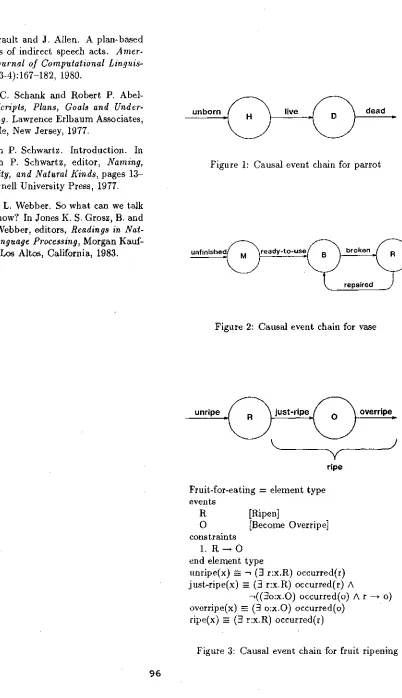
Many classifications expressed as nouns de- note a class of entity whose state varies over the period of existence during which it is aptly char- acterized by the classification. For example, Fig- ure 1 and Figure 2 depict causal event chains l° of parrots and vases, respectively.
(Nodes represent events and directed arcs represent causality.) The state of being dead or
SE.g., see [McC87]. 9E.g., see [Car88].
1°I don't mean 'causal chain' in the sense that philoso- phers have recently used it [Sch77], nor in the sense of [SA77], nor do I mean 'chain' in the mathematical sense of a total order.
broken can be defined in terms of the occurrence of an event type of dying or breaking, respectively. Live is the state of an entity who has been born but has not yet died; ready-to-use is the state of an artifact between its creation or repair and its destruction. 11 Note that, paradoxically, language users would agree that a dead parrot or a vase with a crack in it is still aptly characterized as a parrot or vase, respectively. 12
Next, what I mean by a normal state of E
is a state t h a t E is expected to be in. For example, in the absence of information to the contrary, live or ready-to-use is expected by language users to be a state of parrots or vases, respectively. Note, however, t h a t N O R M A L - S T A T E in (6) represents
a normal state of an entity with respect to some
plan. T h a t is, I am not claiming that, in the ab- sence of information about S's plan, S's use of ( l a ) conversationally implicates (lb).
T h e reason for stipulating that N O R M A L - STATE be relative to S's plan is t h a t use of ( l a ) in the context of a different plan could change what S and H consider to be normal. For example, in a taxidermist's plan, dead could be the normal s t a t e of a parrot. Also, consider 'coffee': a speaker's use of (7) in the context of a coffee f a r m could be used to request coffee beans; in a grocery store, a j a r of instant; and in a restaurant, a hot beverage.
7. I'd like some coffee.
92
Note t h a t more t h a n one precondition of S's plan m a y be relevant to interpreting S's use of an expression. For example, a typical restaurant customer uttering (7) expects to be understood as not only requesting coffee in its hot-beverage state, but also in its safe-to-drink state. Also, more than one of S's plans m a y be relevant, Returning to the pet shop example, suppose t h a t S and H mutually believe t h a t S has plans to acquire a parrot as a pet and also to study its vocalizations; then it would be inappropriate for H to show S a parrot that H believed to be incapable of making vocalizations.
Normal states differ from stereotypes. A stereotype is a generalization a b o u t prototypes of a category, 13 e.g. (8). 14
11Examples of how state predicates can be defined in Lansky's formal language will be given later.
12The cracked vase example is from [Her87].
laThe prototype-stereotype distinction is described in[HH83].
8. Unripe bananas are green.
Qualifying an expression in a way which contradicts a stereotype may have a different ef- fect on H than doing so in a way which specifies a non-normal state. For instance, if S says (9) after saying ( l a ) in the above pet shop scenario, H may doubt S's sincerity or S's knowledge about parrots; while S's use of (3a) after saying (la) may cause tI to have doubts about S's sincerity or It's knowl- edge of S's plan, but not S's knowledge about par- rots.
9 . . . . a 100 pound one
Another difference between stereotypes and normal states is that stereotypes are not affected by S's and H's mutual beliefs about S's plan, whereas I have just demonstrated that what is considered normal may change in the context of S's plan. Finally, another reason for making the
distinction is that I am not claiming that, in the
above pet shop scenario, S's use of (la) licenses (10); i.e., S does not intend to convey (10). 15
10. I [the speaker] would like to see a large, green, talking bird.
5
T h e R o l e of E v e n t s in cer-
tain Lexical R e p r e s e n t a -
t i o n s
Now I will show how the notion of state presented in the previous section can be repre- sented in the lexicon via state predicates based on causal event chains. The purpose of this is to clarify what counts as a state and hence, what is
p r o t o t y p e ; e.g. c o n t r a s t (8) w i t h " R i p e b a n a n a s are yel- low". A s t a t e m e n t of a s t e r e o t y p e in w h i c h t h e state of the
p r o t o t y p e s is u n s p e c i f i e d m a y d e s c r i b e p r o t o t y p e s in the
p l a n - i n d e p e n d e n t n o r m a l s t a t e for t h e c a t e g o r y ; e.g. con- sider " B a n a n a s a r e yellow". Also, n o t e t h a t s t e r e o t y p i c a l p r o p e r t i e s m a y be u s e d to c o n v e y the state; e.g. c o n s i d e r "I w a n t a g r e e n b a n a n a " u s e d to convey "I w a n t a n u n r i p e b a n a n a " .
15I recognize t h a t it is p o s s i b l e for a s p e a k e r to exploit
m u t u a l beliefs a b o u t s t e r e o t y p e s or p l a n - i n d e p e n d e n t nor- real s t a t e s to c o n v e y c o n v e r s a t i o n a l i m p l i c a t u r e s . E.g., con- sider t h e c o n v e r s a t i o n : A s a y s , "Is y o u r n e i g h b o r rich?" B replies, " H e ' s a doctor." However, t h i s k i n d of i m p l i c a t u r e does n o t o c c u r u n d e r t h e s a m e c o n d i t i o n s as t h o s e given for n o r m a l s t a t e i m p l i c a t u r e , a n d is outside of the scope of
tiffs p a p e r .
93
to be identified by the convention for normal state implicature. This way of representing states has benefits in other areas. First, entaihnent relation- ships between states of an entity are thereby rep- resented. Second, certain scalar implicatures may be based on the event ordering of a causal event chain.
For example, Figure 3 contains pictorial and formal representations of a causal event chain for the ripening of fruit. Definitions of states are given as state predicates; e.g. the expression 'un- ripe' is used to denote a state such that no event of ripening (R) has occurred (yet). Note that, as (11) shows, 'ripe' may be used to scalar implicate but not to entail 'not overripe'; the event order- ing of the causal event chain serves as the salient order for the scalar implicature. The expected en- tailments follow from the constraints represented in Figure 3.
l l . a . It's ripe. In fact, it's just right for eating. b. It's ripe. In fact, it's overripe/too ripe.
6
C o m p a r i s o n of Scalar and
N o r m a l S t a t e I m p l i c a t u r e
These two classes of conversational impli- cature have some interesting similarities and dif- ferences.
First, licensing a scalar implicature requires the mention of some specific value in an ordering, while licensing a normal state implicature requires
the absence of the mention of any state. For ex-
ample, consider a situation where S is a restaurant customer; H is a waiter; S and H have mutual be- lief of the salience of an ordering such that warm precedes boiling hot; and, S and H have mutual belief of S's plan to make tea by steeping a tea bag in boiling hot water.
14.a. I'd like a pot of water. b. I'd like a pot of warm water. c. I'd like a pot of boiling hot water. d. I'd like a pot of warm but not boiling
hot water.
(14b) would cancel (14c), as well as be confusing to H due to its inconsistency with H's belief about S's intention to make tea.) Thus, at least in this example, scalar and normal state implicature are mutually exclusive.
Second, saliency and order relations play a role in both. Scalar implicature is based on the salience of a partially ordered set (from any do- main). Normal state implicature is based on the salience of a plan; one of a plan's preconditions may involve a normal state, which can be defined in terms of a causal event chain.
normal state implicature, while the presence of a qualification (the marked case), blocks it (thereby allowing the scalar implicature to be conveyed).
Finally, Herskovits [Her87] addresses the problem that the meaning of a locative expression varies with the context of its use. Her approach is to specify "a set of characteristic constraints - constraints that must hold for the expression to be used truly and appropriately under normal condi- tions. " (p. 20) Her constraints appear to include stereotypes and plan-independent normal states; normal is distinguished from prototypical; and the constraints may include speaker purpose.
7
R e l a t e d W o r k
This work is related to work in several dif- ferent areas.
First, one of the goals of research on non- monotonic reasoning 16 has been the use of default information. The classic example, that if some- thing is a bird then it can fly, appears to in- volve all three notions that I have distinguished here; namely, stereotype, plan-independent nor- mal state, and normal state with respect to a plan. (It is a stereotype that birds are genetically suited for flight; a plan-independent normal state that a bird is alive or uninjured; and a normal state with respect to a plan to send a message via carrier pi- geon that the bird be able to fly.) Also, I have shown that the calculation of normal state impli- cature is based only on the third notion, i:e., that certain "defaults" are context-dependent.
In another area, work has been done on using knowledge of a speaker's plans to fill in missing information to interpret incomplete utter- ances, e.g. sentence fragments [AP80] and ellipsis
[car89].
As for related work on conversational im- plicature, both [iior84] and [ALS1] describe prag- matic inferences where what is conveyed by an utterance is more precise than its literal mean- ing. They claim that such inferences are based on a principle of speaker economy and exploit the speaker's and hearer's shared beliefs about stereo- types. Also, Horn points out that an unmarked ex- pression tends to be associated with the stereotype of an extension and its marked counterpart with the non-stereotype. Roughly, this corresponds to
my observation regarding (14), that the absence
of a qualification (the unmarked case) licenses a
lOFor a survey, see [GinS7].
94
8
C o n c l u s i o n s
This paper has provided a convention for
identifying normal state implicatures. Normal
state implicature permits a speaker to omit certain information from an indefinite description in cer- tain situations without being misunderstood. The convention is that if S makes a request that tt per- form an action A on an E, and if S and H mutually believe that S has a plan whose success depends upon the E being in the normal state N with re- spect to that plan, and that S's request is a step of that plan, then S is implicating a request for S to do A on an E in state N.
In order to specify the convention for nor- mal state implicature, I distinguished the notions of stereotype, plan-independent normal state, and normal state with respect to a plan. This distinc- tion may prove useful in solving other problems in the description of how language is used. Also, a representation for states, in terms of causal event chains, was proposed.
The convention I have provided is impor- tant both in natural language generation and in- terpretation. In generation, a system needs to consider what normal state implicatures would be licensed by its use of an indefinite description. These implicatures determine what qualifications may be omitted (namely, those which would be im- plicated) and what ones are required (those which are needed to block implicatures that the system does not wish to convey), lr In interpretation, a system may need to understand what a user has
implicated in order to provide a cooperative re- sponse. For instance, if during a dialogue a sys- tem has inferred that a user has a plan to make an immediate delivery, and then the user says (15a), then if the system knows that the only truck in terminal A is out of service, it would be uncoop- erative for the system to reply with (15b) alone; (15c) should be added for a more cooperative re- sponse.
15.a. User: Is there a truck in terminal A? b. System: Yes, there is one
c. but it's out of service.
This work may be extended in at least two ways. First, it would be interesting to investigate what plan inference algorithms are necessary in or- der to recognize normal state implicatures in ac- tual dialogue. Another question is whether the notion of normal state implicature can be gener- alized to account for other uses of language.
9
A c k n o w l e d g m e n t s
An earlier version of this work was done at the University of Pennsylvania, partially sup- ported by DARPA grant N00014-85-K0018. My thanks to the people there, particularly Bonnie Webber and Ellen Prince. Thanks to my col- leagues at SAS Institute Inc., Cary, N. C., for their moral support while much of this paper was being written. The final draft was prepared at the Uni- versity of Delaware; thanks to the people there, especially Sandra Carberry and K. Vijayashanker.
R e f e r e n c e s
[AL81] Jay David Atlas and Stephen C. Levin- son. It-clefts, informativeness, and log- ical form: radical pragmatics (revised standard version). In Peter Cole, editor,
Radical Pragmatics, pages 1-62, Aca-
demic Press, N. Y., 1981.
lAP80] James F. Allen and C. Raymond Per- rault. Analyzing intention in utterances.
Artificial Intelligence, 15:143-178, 1980.
[c~881
Sandra Carberry. Modeling the user's plans and goals. Computational Linguis-tics, 14(3):23-37, 1988.
95
[Car80]
[FN71]
[Gin87]
[Gri75]
[Her87]
[HH831
[Hir85]
[Hot84]
[JosS2]
[Lan87]
[McC87]
Sandra Carberry. A pragmatics-based approach to ellipsis resolution. Compu-
tational Linguistics, 15(2):75-96, 1989.
R. E. Fikes and N. J. Nilsson. Strips: a new approach to the application of the- orem proving to problem solving. Artifi-
cial Intelligence, 2:189-208, 1971.
Matthew L. Ginsberg. Readings in Non-
monotonic Reasoning. Morgan Kauf-
mann, Los Altos, California, 1987.
H. Paul Grice. Logic and conversation. In P. Cole and J. L. Morgan, editors,
Syntax and Semantics III: Speech Acts,
pages 41-58, Academic Press, N.Y., 1975.
Annette Herskovits. Language and Spa-
tial Cognition. Cambridge University
Press, Cambridge, England, 1987.
J. Hurford and B. Heasley. Semantics:
A Coursebook. Cambridge University
Press, Cambridge, England, 1983.
Julia Bell Hirschberg. A Theory
of Scalar Implicature. Technical Re-
port MS-CIS-85-56, Department of Computer and Information Science, Uni- versity of Pennsylvania, 1985.
Larry Horn. Toward a new taxonomy for pragmatic inference: q-based and r- based implicature. In D. Schiffrin, ed- itor, GURT '84. Meaning, Form and
Use in Context: Linguistic Applica-
tions, pages 11--42, Georgetown Univer-
sity Press, Washington, D. C., 1984.
Aravind K. Joshi. Mutual beliefs in question-answer systems. In N. Smith, editor, Mutual Beliefs, pages 181-197, Academic Press, New York, 1982.
Amy Lansky. A representation of par- allel activity based on events, struc- ture, and causality. In M. P. Georgeff and A. Lansky, editors, Reasoning about Actions and Plans: Proceedings of the
1986 Workshop, pages 123-160, Morgan
Kaufmann, 1987.
John McCarthy. Circumscription - a form of non-monotonic reasoning. In Matthew L. Ginsberg, editor, Readings
in Nonmonotonic Reasoning, pages 145-
[PASO]
[SA77]
[image:8.612.112.514.43.741.2][Sch77]
[Web83]
R. Perrault and J. Allen. A plan-based analysis of indirect speech acts. Amer- ican Journal of Computational Linguis-
tics, 6(3-4):167-182, 1980.
Roger C. Schank and Robert P. Abel- son. Scripts, Plans, Goals and Under-
standing. Lawrence Erlbaum Associates,
Hinsdale, New Jersey, 1977.
Stephen P. Schwartz. Introduction. In Stephen P. Schwartz, editor, Naming,
Necessity, and Natural Kinds, pages 13-
41, Cornell University Press, 1977.
Bonnie L. Webber. So what can we talk about now? In Jones K. S. Grosz, B. and B. L. Webber, editors, Readings in Nat-
ural Language Processing, Morgan Kauf-
mann, Los Altos, California, 1983.
unborn
, ~ live , ~
deadFigure 1: Causal event chain for parrot
unfinished~ready-to-use~
Figure 2: Causal event chain for vase
\
Y
Y
ripe
Fruit-for-eating = element type eventsR [Ripen]
0 [Become Overripe] constraints
1. R - - . O end element type
unripe(x) = --, (3 r:x.R) occurred(r) just-ripe(x) =- (3 r:x.a) occurred(r) A
-~((5o:x.O) occurred(o) A r --* o) overripe(x) -- (3 o:x.O) occurred(o)
ripe(x) _ (3 r:x.R) occurred(r)
Figure 3: Causal event chain for fruit ripening