C-Feel-It: A Sentiment Analyzer for Micro-blogs
Aditya Joshi
1Balamurali A R
2Pushpak Bhattacharyya
1Rajat Mohanty
31
Dept. of Computer Science and Engineering, IIT Bombay, Mumbai
2
IITB-Monash Research Academy, IIT Bombay, Mumbai
3
AOL India (R&D), Bangalore
India
{
adityaj,balamurali,pb
}
@cse.iitb.ac.in
Abstract
Social networking and micro-blogging sites are stores of opinion-bearing content created by human users. We describeC-Feel-It, a sys-tem which can tap opinion content in posts (called tweets) from the micro-blogging web-site, Twitter. This web-based system catego-rizes tweets pertaining to a search string as positive, negative or objective and gives an ag-gregate sentiment score that represents a senti-ment snapshot for a search string. We present a qualitative evaluation of this system based on a human-annotated tweet corpus.
1
Introduction
A major contribution of Web 2.0 is the explosive rise
of user-generated content. The content has been a
by-product of a class of Internet-based applications
that allow users to interact with each other on the
web. These applications which are highly accessible
and scalable represent a class of media called
social
media. Some of the currently popular social media
sites are Facebook (www.facebook.com), Myspace
(www.myspace.com), Twitter (www.Twitter.com)
etc. User-generated content on the social media
rep-resents the views of the users and hence, may be
opinion-bearing. Sales and marketing arms of
busi-ness organizations can leverage on this information
to know more about their customer base. In
addi-tion, prospective customers of a product/service can
get to know what other users have to say about the
product/service and make an informed decision.
C-Feel-It
is
a
web-based
system
which
predicts
sentiment
in
micro-blogs
on
(called
tweets).
(Screencast
at:
http://www.youtube.com/user/cfeelit/
)
C-Feel-It uses a rule-based system to classify tweets as
positive, negative or objective using inputs from
four sentiment-based knowledge repositories.
A
weighted-majority voting principle is used to predict
sentiment of a tweet. An overall sentiment score for
the search string is assigned based on the results of
predictions for the tweets fetched. This score which
is represented as a percentage value gives a live
snapshot of the sentiment of users about the topic.
The rest of the paper is organized as follows:
Sec-tion 2 gives background study of Twitter and related
work in the context of sentiment analysis for Twitter.
The system architecture is explained in section 3. A
qualitative evaluation of our system based on
anno-tated data is described in section 4. Section 5
sum-marizes the paper and points to future work.
2
Background study
Twitter is a micro-blogging website and ranks
sec-ond among the present social media websites
(Prelo-vac, 2010). A micro-blog
allows users to exchange
small elements of content such as short sentences,
individual pages, or video links
(Kaplan and
Haen-lein, 2010). More about Twitter can be found here
1.
In Twitter, a micro-blogging post is called a
tweet
which can be upto 140 characters in length.
Since the length is constrained, the language used in
tweets is highly unstructured. Misspellings, slangs,
contractions and abbreviations are commonly used
in tweets. The following example highlights these
problems in a typical tweet:
‘Big brother doing sian massey no favours.
Let her ref. She’s good at it you know#lifesapitch’
We choose Twitter as the data source because
of the sheer quantity of data generated and its fast
reachability across masses. Additionally, Twitter
al-lows information to flow freely and instantaneously
unlike FaceBook or MySpace.
These aspects of
1
http://support.twitter.com/groups/31-twitter-basics
Twitter makes it a source for getting a live snapshot
of the things happenings on the web.
In the context of sentiment classification of tweets
Alec et al. (2009a) describes a distant
supervision-based approach for sentiment classification.
The
training data for this purpose is created following a
semi-supervised approach that exploits emoticons in
tweets. In their successive work, Alec et al. (2009b)
additionally use hashtags in tweets to create
train-ing data. Topic-dependent clustertrain-ing is performed
on this data and classifiers corresponding to each are
modeled. This approach is found to perform better
than a single classifier alone.
We believe that the models trained on data
cre-ated using semi-supervised approaches cannot
clas-sify all variants of tweets. Hence, we follow a
rule-based approach for predicting sentiment of a tweet.
An approach like ours provides a generic way of
solving sentiment classification problems in
micro-blogs.
3
Architecture
keyword (s)
Tweet fetcher
Tweet Sentiment
Predictor C-Feel-It
Sentiment score
Tweet Sentiment Collaborator
[image:2.612.84.289.383.513.2]score
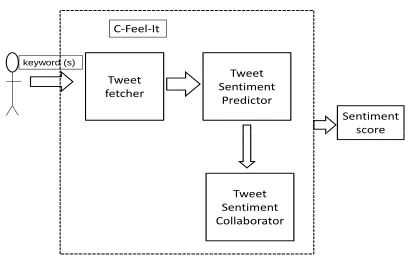
Figure 1: Overall Architecture
The overall architecture of C-Feel-It is shown in
Figure 1. C-Feel-It is divided into three parts:
Tweet
Fetcher
,
Tweet Sentiment Predictor
and
Tweet
Sentiment Collaborator
. All predictions are
pos-itive, negative or objective/neutral. C-Feel-It offers
two implementations of a rule-based sentiment
pre-diction system. We refer to them as version 1 and
2. The two versions differ in the Tweet Sentiment
Predictor module. This section describes different
modules of C-Feel-It and is organized as follows. In
subsections 3.1, 3.2 & 3.3, we describe the three
functional blocks of C-FeeL-It. In subsection 3.4,
we explain how four lexical resources are mapped
to the desired output labels. Finally, subsection 3.5
gives implementation details of C-Feel-It.
Input
to C-Feel-It is a
search string
and a
version
number. The versions are described in detail in
sub-section 3.2.
Output
given by C-Feel-It is two-level: tweet-wise
prediction and overall prediction. For tweet-wise
prediction, sentiment prediction by each of the
re-sources is returned. On the other hand, overall
pre-diction combines sentiment from all tweets to return
the percentage of positive, negative and objective
content retrieved for the search string.
3.1
Tweet Fetcher
Tweet fetcher obtains tweets pertaining to a search
string entered by a user. To do so, we use live feeds
from Twitter using an API
2. The parameters passed
to the API ensure that system receives the latest 50
tweets about the keyword in English. This API
re-turns results in XML format which we parse using a
Java SAX parser.
3.2
Tweet Sentiment Predictor
Tweet sentiment predictor predicts sentiment for
a single tweet.
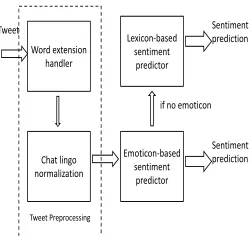
The architecture of Tweet
Senti-ment Predictor is shown in Figure 2 and can be
di-vided into three fundamental blocks:
Preprocessor,
Emoticon-based Sentiment Predictor, Lexicon-based
Sentiment Predictor
(refer Figure 3 & 4). The first
two blocks are same for both the versions of
C-Feel-It. The two versions differ in the working of the
Lexicon-based Sentiment Predictor.
Preprocessor
The noisy nature of tweets is a classical challenge
that any system working on tweets needs to
en-counter. Preprocessor deals with obtaining
clean
tweets. We do not deploy any spelling correction
module. However, the preprocessor handles
exten-sions and contractions found in tweets as follows.
Handling extensions: Extensions like ‘besssssst’
are common in tweets. However, to look up
re-sources, it is essential that these words are
normal-ized to their dictionary equivalent. We replace
con-secutive occurrences of the same letter (if more than
2
Lexicon-based sentiment predictor Word extension
handler Tweet
if no emoticon Sentiment prediction
Chat lingo normalization
Emoticon-based sentiment predictor
Tweet Preprocessing
[image:3.612.125.251.70.188.2]Sentiment prediction
Figure 2: Tweet Sentiment Predictor: Version 1 and 2
three occurrences of the same letter) with a single
letter and replace the word.
An important issue here is that extensions are in fact
strong indicators of sentiment. Hence, we replace an
extended word by two occurences of the contracted
word. This gives a higher weight to the extended
word and retains its contribution to the sentiment of
the tweet.
Chat lingo normalization:
Words used in
chat/Internet language that are common in tweets are
not present in the lexical resources. We use a
dictio-nary downloaded from http://chat.reichards.net/ . A
chat word is replaced by its dictionary equivalent.
Emoticon-based Sentiment Predictor
Emoticons are visual representations of
emo-tions frequently used in the user-generated
con-tent on the Internet.
We observe that in most
cases, emoticons pinpoint the sentiment of a
tweet.
We use an emoticon mapping from
http://chat.reichards.net/smiley.shtml. An emoticon
is mapped to an output label: positive or negative. A
tweet containing one of these emoticons that can be
mapped to the desired output labels directly. While
we understand that this heuristic does not work in
case of sarcastic tweets, it does provide a benefit in
most cases.
Lexicon-based Sentiment Predictor
For a tweet, the Lexicon-based Sentiment
Predic-tor gives a prediction each for four resources. In
addition, it returns one prediction which combines
the four predictions by weighting them on the
ba-Tweet
Lexical Resource Get
sentiment prediction For all words
Return output label corresponding to majority of words
Sentiment Prediction
Figure 3: Lexicon-based Sentiment Predictor: C-Feel-It Version 1
sis of their accuracies. We remove stop words
3from the tweet and stem the words using Lovins
stemmer (Lovins, 1968). Negation in tweets is
han-dled by inverting sentiment of words after a
negat-ing word. The words
‘no’, ‘never’, ‘not’
are
consid-ered negating words and a context window of three
words after a negative words is considered for
in-version. The two versions of C-Feel-It vary in their
Lexicon-based Sentiment Predictor. Figure 3 shows
the Lexicon-based Sentiment Predictor for version
1. For each word in the tweet, it gets the
predic-tion from a lexical resource. We use the intuipredic-tion
that a positive tweet has positive words
outnumber-ing other words, a negative tweet has negative words
outnumbering other words and an objective tweet
has objective words outnumbering other words.
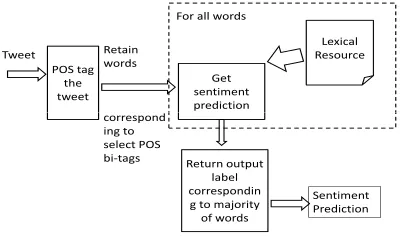
Figure 4 shows the Lexicon-based Sentiment
Predic-tor for version 2. As opposed to the earlier version,
version 2 gets prediction from the lexical resource
for some words in the tweet. This is because certain
parts-of-speech have been found to be better
indi-cators of sentiment (Pang and Lee, 2004). A tweet
is annotated with parts-of-speech tags and the POS
bi-tags (i.e.
a pattern of two consecutive POS) are
marked. The words corresponding to a set of
opti-mal POS bi-tags are retained and only these words
used for lookup. The prediction for a tweet uses
majority vote-based approach as for version 1. The
optimal POS bi-tags have been derived
experimen-tally by using top 10% features on information
gain-based-pruning classifier on polarity dataset by (Pang
and Lee, 2005). We used Stanford POS tagger(Tou,
3
[image:3.612.327.526.79.193.2]2000) for tagging the tweets.
Note
: The dataset we use to find optimal POS
bi-tags consists of movie reviews. We understand
that POS bi-tags hence derived may not be universal
across domains.
Tweet
Lexical Resource
Get sentiment prediction For all words
POS tag the tweet
Retain words
correspond
Return output label correspondin g to majority of words
Sentiment Prediction correspond
[image:4.612.85.285.153.272.2]ing to select POS bi-tags
Figure 4: Lexicon-based Sentiment Predictor: C-Feel-It Version 2
3.3
Tweet Sentiment Collaborator
Based on predictions of individual tweets, the Tweet
Sentiment Collaborator gives overall prediction
with respect to a keyword in form of percentage
of positive, negative and objective content.
This
is on the basis of predictions by each resource by
weighting them according to their accuracies. These
weights have been assigned to each resource based
on experimental results.
For each resource, the
following scores are determined.
posscore[r] =
m
X
i=1 piwpi
negscore[r] =
m
X
i=1 niwni
objscore[r] =
m
X
i=1 oiwoi
where
posscore[r] =Positive score for search string r
negscore[r] =Negative score for search string r
objscore[r] =Objective score for search string r
m=Number of resources used for prediction
pi, ni, oi=Positive,negative & objective count of tweet
predicted respectively using resource i
wpi, wni, ooi=Weights for respective classes derived
for each resource i
We normalize these scores to get the final positive, neg-ative and objective pertaining to search stringr. These scores are represented in form of percentage.
3.4
Resources
Sentiment-based lexical resources annotate words/concepts with polarity. The completeness of these resources individually remains a question. To achieve greater coverage, we use four different sentiment-based lexical resources for C-Feel-It. They are described as follows.
1. SentiWordNet (Esuli and Sebastiani, 2006) assigns three scores to synsets of WordNet: positive score, negative score and objective score. When a word is looked up, the label corresponding to maximum of the three scores is returned. For multiple synsets of a word, the output label returned by majority of the synsets becomes the prediction of the resource.
2. Subjectivity lexicon (Wiebe et al., 2004) is a re-source that annotates words with tags like parts-of-speech, prior polarity, magnitude of prior polarity (weak/strong), etc. The prior polarity can be posi-tive, negative or neutral. For prediction using this resource, we use this prior polarity.
3. Inquirer (Stone et al., 1966) is a list of words marked as positive, negative and neutral. We use these labels to use Inquirer resource for our predic-tion.
4. Taboada (Taboada and Grieve, 2004) is a word-list that gives a count of collocations with positive and negative seed words. A word closer to a positive seed word is predicted to be positive and vice versa.
3.5
Implementation Details
The system is implemented in JSP (JDK 1.6) using Net-Beans IDE 6.9.1. For the purpose of tweet annotation, an internal interface was written in PHP 5 with MySQL 5.0.51a-3ubuntu5.7 for storage.
4
System Analysis
4.1
Evaluation Data
For the purpose of evaluation, a total of 7000 tweets were downloaded by using popular trending topics of 20 domains (like books, movies, electronic gadget, etc.) as keywords for searching tweets. In order to download the tweets, we used the API provided by Twitter4 that crawls latest tweets pertaining to keywords.
Human annotators assigned to a tweet one out of 4 classes: positive, negative, objective and objective-spam.
4
A tweet is assigned to objective-spam category if it con-tains promotional links or incoherent text which was pos-sibly not created by a human user. Apart from these nom-inal class labels, we also assigned the positive/negative tweets scores ranging from +2 to -2 with +2 being the most positive and -2 being the most negative score re-spectively. If the tweet belongs to the objective category, a value of zero is assigned as the score.
The spam category has been included in the annotation as a future goal of modeling a spam detection layer prior to the sentiment detection. However, the current version of C-Feel-It does not have a spam detection module and hence for evaluation purpose, we use only the data be-longing to classes other than objective-spam.
4.2
Qualitative Analysis
In this section, we perform a qualitative evaluation of ac-tual results returned by C-Feel-It. The errors described in this section are in addition to the errors due to mis-spellings and informal language. These erroneous results have been obtained from both version 1 and 2. They have been classified into eleven categories and explained henceforth.
4.2.1
Sarcastic Tweets
Tweet: Hoge, Jaws, and Palantonio are brilliant
to-gether talking X’s and O’s on ESPN right now.
Label by C-Feel-It: Positive
Label by human annotator: Negative
The sarcasm in the above tweet lies in the use of a pos-itive word ’brilliant’ followed by a rather trivial action of
’talking Xs and Os’. The positive word leads to the
pre-diction by C-Feel-It where in fact, it is a negative tweet for the human annotator.
4.2.2
Lack of Sense Understanding
Tweet: If your tooth hurts drink some pain killers and
place a warm/hot tea bag like chamomile on your tooth and hold it. it will relieve the pain
Label by C-Feel-It: Negative
This tweet is objective in nature. The words ’pain’, ’killers’, etc. in the tweet give an indication to C-Feel-It that the tweet is negative. This misguided implication is because of multiple senses of these words (for example, ’pain’ can also be used in the sentence ’symptoms of the
disease are body pain and irritation in the throat’ where
it is non-sentiment-bearing). The lack of understanding of word senses and being unable to distinguish between them leads to this error.
4.2.3
Lack of Entity Specificity
Tweet: Casablanca and a lunch comprising of rice
and fish: a good sunday
Keyword: Casablanca
Label by C-Feel-It: Positive
Label by human annotator: Objective
In the above tweet, the human annotator understood that though the tweet contains the keyword ’Casablanca’, it is not Casablanca about which sentiment is expressed. The system finds a positive word ’good’ and marks the tweet as positive. This error arises because the system cannot find out which sentence/parts of sentence is ex-pressing opinion about the target entity.
4.2.4
Coverage of Resources
Tweet: I’m done with this bullshit. You’re the psycho
not me.
Label by SentiWordNet: Negative
Label by Taboada/Inquirer: Objective
Label by human annotator: Negative
On manual verification, it was observed that an entry for the emotion-bearing word ’bullshit’ is present in Sen-tiWordNet while Inquirer and Taboada resource do not have them. This shows that the coverage of the lexical resource affects the performance of a system and may in-troduce errors.
4.2.5
Absence of Named Entity Recognition
Tweet: @user I don’t think I need to guess, but ok,
close encounters of the third kind? Lol
Entity: Close encounters of the third kind
Label by C-Feel-It: Positive
The words comprising the name of the film ’Close
en-counters of the third kind’ are also looked up. Inability to
identify the named entity leads the system into this trap.
4.2.6
Requirement of World Knowledge
Tweet:The soccer world cup boasts an audience twice
that of the Summer Olympics.
Label by C-Feel-It: Negative
To judge the opinion of this tweet, one requires an un-derstanding of the fact that larger the audience, more fa-vorable it is for a sports tournament. This world knowl-edge is important for a system that aims to handle tweets like these.
4.2.7
Mixed Emotion Tweets
Tweet: oh but that last kiss tells me it’s goodbye, just
like nothing happened last night. but if i had one chance, i’d do it all over again
Label by C-Feel-It: Positive
The tweet contains emotions of positive as well as neg-ative variety and it would in fact be difficult for a human as well to identify the polarity. The mixed nature of the tweet leads to this error by the system.
4.2.8
Lack of Context
Tweet:I’ll have to say it’s a tie between Little Women
Label by C-Feel-It: Negative
Label by human user: Positive
The tweet has a sentiment which will possibly be clear in the context of the conversation. Going by the tweet alone, while one understands that an comparative opinion is being expressed, it is not possible to tag it as positive or negative.
4.2.9
Concatenated Words
Tweet:To Kill a Mockingbird is a #goodbook.
Label by C-Feel-It: Negative
The tweet has a hashtag containing concatenated words ’goodbook’ which get overlooked as out-of-dictionary words and hence, are not used for sentiment prediction. The sentiment of ’good’ is not detected.
4.2.10
Interjections
Tweet:Oooh. Apocalypse Now is on bluray now.
Label by C-Feel-It: Objective
Label by human user: Positive
The extended interjection ’Oooh’ is an indicator of sentiment. Since it does not have a direct prior polar-ity, it is not present in any of the resources. However, this interjection is an important carrier of sentiment.
4.2.11
Comparatives
Tweet:The more years I spend at Colbert Heights..the
more disgusted I get by the people there. I’m soooo ready to graduate.
Label by C-Feel-It: Positive
Label by human user: Negative
The comparatives in the sentence expressed by ’..more
disgusted I get..’ have to be handled as a special case
because ’more’ is an intensification of the negative senti-ment expressed by the word ’disgusted’.
5
Summary & Future Work
In this paper, we described a system which categorizes live tweets related to a keyword as positive, negative and objective based on the predictions of four sentiment-based resources. We also presented a qualitative evalua-tion of our system pointing out the areas of improvement for the current system.
A sentiment analyzer of this kind can be tuned to take in-puts from different sources on the internet (for example, wall posts on facebook). In order to improve the qual-ity of sentiment prediction, we propose two additions. Firstly, while we use simple heuristics to handle exten-sions of words in tweets, a deeper study is required to decipher the pragmatics involved. Secondly, a spam de-tection module that eliminates promotional tweets before performing sentiment detection may be added to the cur-rent system. Our goal with respect to this system is to de-ploy it for predicting share market values of firms based
on sentiment on social networks with respect to related entitites.
Acknowledgement
We thank Akshat Malu and Subhabrata Mukherjee, IIT Bombay for their assistance during generation of evalua-tion data.
References
Go Alec, Huang Lei, and Bhayani Richa. 2009a. Twit-ter sentiment classification using distant supervision. Technical report, Standford University.
Go Alec, Bhayani Richa, Raghunathan Karthik, and Huang Lei. 2009b. May.
Andrea Esuli and Fabrizio Sebastiani. 2006. SentiWord-Net: A publicly available lexical resource for opinion mining. InProceedings of LREC-06, Genova, Italy. Andreas M. Kaplan and Michael Haenlein. 2010. The
early bird catches the news: Nine things you should know about micro-blogging. Business Horizons, 54(2):05 – 113.
Julie B. Lovins. 1968. Development of a Stemming Al-gorithm. June.
Bo Pang and Lillian Lee. 2004. A sentimental edu-cation: sentiment analysis using subjectivity summa-rization based on minimum cuts. In Proceedings of the 42nd Annual Meeting on Association for
Compu-tational Linguistics, ACL ’04, Stroudsburg, PA, USA.
Association for Computational Linguistics.
Bo Pang and Lillian Lee. 2005. Seeing stars: Exploiting class relationships for sentiment categorization with respect to rating scales. InProceedings of ACL-05. Vladimir Prelovac. 2010. Top social media sites. Web,
May.
Philip J. Stone, Dexter C. Dunphy, Marshall S. Smith, and Daniel M. Ogilvie. 1966. The General Inquirer:
A Computer Approach to Content Analysis. MIT
Press.
Maite Taboada and Jack Grieve. 2004. Analyzing Ap-praisal Automatically. In Proceedings of the AAAI Spring Symposium on Exploring Attitude and Affect in
Text: Theories and Applications, pages 158–161,
Stan-ford, US.
2000. Enriching the knowledge sources used in a
maxi-mum entropy part-of-speech tagger, Stroudsburg, PA,
USA. Association for Computational Linguistics. Janyce Wiebe, Theresa Wilson, Rebecca Bruce, Matthew