Word representations:
A simple and general method for semi-supervised learning
Joseph Turian
D´epartement d’Informatique et Recherche Op´erationnelle (DIRO)
Universit´e de Montr´eal Montr´eal, Qu´ebec, Canada, H3T 1J4
Lev Ratinov Department of Computer Science University of Illinois at
Urbana-Champaign Urbana, IL 61801 [email protected]
Yoshua Bengio
D´epartement d’Informatique et Recherche Op´erationnelle (DIRO)
Universit´e de Montr´eal Montr´eal, Qu´ebec, Canada, H3T 1J4
Abstract
If we take an existing supervised NLP sys-tem, a simple and general way to improve accuracy is to use unsupervised word representations as extra word features. We evaluate Brown clusters, Collobert and Weston (2008) embeddings, and HLBL
(Mnih & Hinton, 2009) embeddings
of words on both NER and chunking. We use near state-of-the-art supervised baselines, and find that each of the three word representations improves the accu-racy of these baselines. We find further
improvements by combining different
word representations. You can download
our word features, for off-the-shelf use
in existing NLP systems, as well as our
code, here: http://metaoptimize.
com/projects/wordreprs/
1 Introduction
By using unlabelled data to reduce data sparsity in the labeled training data, semi-supervised
approaches improve generalization accuracy.
Semi-supervised models such as Ando and Zhang (2005), Suzuki and Isozaki (2008), and Suzuki
et al. (2009) achieve state-of-the-art accuracy.
However, these approaches dictate a particular choice of model and training regime. It can be tricky and time-consuming to adapt an existing su-pervised NLP system to use these semi-susu-pervised techniques. It is preferable to use a simple and general method to adapt existing supervised NLP systems to be semi-supervised.
One approach that is becoming popular is to use unsupervised methods to induce word features—or to download word features that have
already been induced—plug these word features into an existing system, and observe a significant increase in accuracy. But which word features are good for what tasks? Should we prefer certain word features? Can we combine them?
Aword representationis a mathematical object associated with each word, often a vector. Each dimension’s value corresponds to a feature and might even have a semantic or grammatical
interpretation, so we call it a word feature.
Conventionally, supervised lexicalized NLP ap-proaches take a word and convert it to a symbolic ID, which is then transformed into a feature vector
using aone-hotrepresentation: The feature vector
has the same length as the size of the vocabulary,
and only one dimension is on. However, the
one-hot representation of a word suffers from data
sparsity: Namely, for words that are rare in the labeled training data, their corresponding model parameters will be poorly estimated. Moreover, at test time, the model cannot handle words that do not appear in the labeled training data. These limitations of one-hot word representations have prompted researchers to investigate unsupervised methods for inducing word representations over
large unlabeled corpora. Word features can be
hand-designed, but our goal is to learn them. One common approach to inducing unsuper-vised word representation is to use clustering, perhaps hierarchical. This technique was used by a variety of researchers (Miller et al., 2004; Liang, 2005; Koo et al., 2008; Ratinov & Roth, 2009; Huang & Yates, 2009). This leads to a one-hot representation over a smaller vocabulary size. Neural language models (Bengio et al., 2001; Schwenk & Gauvain, 2002; Mnih & Hinton, 2007; Collobert & Weston, 2008), on the other hand, induce dense real-valued low-dimensional
word embeddings using unsupervised approaches. (See Bengio (2008) for a more complete list of references on neural language models.)
Unsupervised word representations have
been used in previous NLP work, and have demonstrated improvements in generalization
accuracy on a variety of tasks. But different word
representations have never been systematically compared in a controlled way. In this work, we
compare different techniques for inducing word
representations, evaluating them on the tasks of named entity recognition (NER) and chunking.
We retract former negative results published in Turian et al. (2009) about Collobert and Weston (2008) embeddings, given training improvements that we describe in Section 7.1.
2 Distributional representations
Distributional word representations are based
upon a cooccurrence matrixFof sizeW×C, where
W is the vocabulary size, each rowFwis the
ini-tial representation of wordw, and each columnFc
is some context. Sahlgren (2006) and Turney and Pantel (2010) describe a handful of possible
de-sign decisions in contructing F, including choice
of context types (left window? right window? size of window?) and type of frequency count (raw?
binary? tf-idf?). Fwhas dimensionalityW, which
can be too large to useFwas features for wordwin
a supervised model. One can mapFto matrix f of
sizeW×d, whered C, using some functiong,
where f = g(F). fwrepresents wordwas a vector
withddimensions. The choice ofgis another
de-sign decision, although perhaps not as important
as the statistics used to initially constructF.
The self-organizing semantic map (Ritter & Kohonen, 1989) is a distributional technique that maps words to two dimensions, such that syntactically and semantically related words are nearby (Honkela et al., 1995; Honkela, 1997).
LSA (Dumais et al., 1988; Landauer et al., 1998), LSI, and LDA (Blei et al., 2003) induce
distributional representations over F in which
each column is adocumentcontext. In most of the
other approaches discussed, the columns represent
word contexts. In LSA,gcomputes the SVD ofF.
Hyperspace Analogue to Language (HAL) is another early distributional approach (Lund et al., 1995; Lund & Burgess, 1996) to inducing word
representations. They computeFover a corpus of
160 million word tokens with a vocabulary sizeW
of 70K word types. There are 2·Wtypes of context
(columns): The first or secondWare counted if the
wordcoccurs within a window of 10 to the left or
right of the wordw, respectively. f is chosen by
taking the 200 columns (out of 140K in F) with
the highest variances. ICA is another technique to
transformFinto f. (V¨ayrynen & Honkela, 2004;
V¨ayrynen & Honkela, 2005; V¨ayrynen et al., 2007). ICA is expensive, and the largest vocab-ulary size used in these works was only 10K. As far as we know, ICA methods have not been used
when the size of the vocabWis 100K or more.
Explicitly storing cooccurrence matrixFcan be
memory-intensive, and transforming F to f can
be time-consuming. It is preferable that F never
be computed explicitly, and that f be constructed
incrementally. ˇReh˚uˇrek and Sojka (2010) describe an incremental approach to inducing LSA and LDA topic models over 270 millions word tokens with a vocabulary of 315K word types. This is similar in magnitude to our experiments.
Another incremental approach to constructing f
is using a random projection: Linear mappinggis
multiplying F by a random matrix chosen a
pri-ori. This random indexing method is motivated
by the Johnson-Lindenstrauss lemma, which states
that for certain choices of random matrix, ifd is
sufficiently large, then the original distances
be-tween words inFwill be preserved in f (Sahlgren,
2005). Kaski (1998) uses this technique to pro-duce 100-dimensional representations of docu-ments. Sahlgren (2001) was the first author to use random indexing using narrow context. Sahlgren (2006) does a battery of experiments exploring
different design decisions involved in
construct-ingF, prior to using random indexing. However,
like all the works cited above, Sahlgren (2006) only uses distributional representation to improve existing systems for one-shot classification tasks, such as IR, WSD, semantic knowledge tests, and
text categorization. It is not well-understood
what settings are appropriate to induce distribu-tional word representations for structured predic-tion tasks (like parsing and MT) and sequence la-beling tasks (like chunking and NER). Previous research has achieved repeated successes on these tasks using clustering representations (Section 3) and distributed representations (Section 4), so we focus on these representations in our work.
3 Clustering-based word representations
distributional methods can overlap. For example, Pereira et al. (1993) begin with a cooccurrence matrix and transform this matrix into a clustering.
3.1 Brown clustering
The Brown algorithm is a hierarchical clustering algorithm which clusters words to maximize the mutual information of bigrams (Brown et al.,
1992). So it is a class-based bigram language
model. It runs in timeO(V·K2), whereVis the size
of the vocabulary andKis the number of clusters.
The hierarchical nature of the clustering means that we can choose the word class at several levels in the hierarchy, which can compensate for poor clusters of a small number of words. One downside of Brown clustering is that it is based solely on bigram statistics, and does not consider word usage in a wider context.
Brown clusters have been used successfully in a variety of NLP applications: NER (Miller et al., 2004; Liang, 2005; Ratinov & Roth, 2009), PCFG parsing (Candito & Crabb´e, 2009), dependency parsing (Koo et al., 2008; Suzuki et al., 2009), and semantic dependency parsing (Zhao et al., 2009).
Martin et al. (1998) presents algorithms for
inducing hierarchical clusterings based upon word
bigram and trigram statistics. Ushioda (1996)
presents an extension to the Brown clustering algorithm, and learn hierarchical clusterings of
words as well as phrases, which they apply to
POS tagging.
3.2 Other work on cluster-based word representations
Lin and Wu (2009) present a K-means-like non-hierarchical clustering algorithm for phrases, which uses MapReduce.
HMMs can be used to induce a soft clustering, specifically a multinomial distribution over pos-sible clusters (hidden states). Li and McCallum (2005) use an HMM-LDA model to improve POS tagging and Chinese Word Segmentation. Huang and Yates (2009) induce a fully-connected HMM, which emits a multinomial distribution over possible vocabulary words. They perform hard clustering using the Viterbi algorithm. (Alternately, they could keep the soft clustering, with the representation for a particular word token being the posterior probability distribution over the states.) However, the CRF chunker in Huang and Yates (2009), which uses their HMM word clusters as extra features, achieves F1 lower than
a baseline CRF chunker (Sha & Pereira, 2003). Goldberg et al. (2009) use an HMM to assign POS tags to words, which in turns improves the accuracy of the PCFG-based Hebrew parser. Deschacht and Moens (2009) use a latent-variable language model to improve semantic role labeling.
4 Distributed representations
Another approach to word representation is to
learn a distributed representation. (Not to be
confused with distributional representations.)
A distributed representation is dense,
low-dimensional, and real-valued. Distributed word
representations are calledword embeddings. Each
dimension of the embedding represents a latent feature of the word, hopefully capturing useful syntactic and semantic properties. A distributed representation is compact, in the sense that it can represent an exponential number of clusters in the number of dimensions.
Word embeddings are typically induced us-ing neural language models, which use neural networks as the underlying predictive model (Bengio, 2008). Historically, training and testing of neural language models has been slow, scaling as the size of the vocabulary for each model com-putation (Bengio et al., 2001; Bengio et al., 2003). However, many approaches have been proposed in recent years to eliminate that linear dependency on vocabulary size (Morin & Bengio, 2005; Collobert & Weston, 2008; Mnih & Hinton, 2009) and allow scaling to very large training corpora.
4.1 Collobert and Weston (2008) embeddings
Collobert and Weston (2008) presented a neural language model that could be trained over billions of words, because the gradient of the loss was computed stochastically over a small sample of possible outputs, in a spirit similar to Bengio and S´en´ecal (2003). This neural model of Collobert and Weston (2008) was refined and presented in greater depth in Bengio et al. (2009).
The model is discriminative and
non-probabilistic. For each training update, we
read ann-gramx = (w1, . . . ,wn) from the corpus.
The model concatenates the learned embeddings
of thenwords, givinge(w1)⊕. . .⊕e(wn),where
e is the lookup table and ⊕ is concatenation.
We also create a corrupted or noise n-gram
˜
x = (w1, . . . ,wn−q,w˜n), where ˜wn , wn is chosen
uniformly from the vocabulary.1 For convenience,
we write e(x) to mean e(w1) ⊕ . . .⊕e(wn). We
predict a score s(x) for xby passinge(x) through
a single hidden layer neural network. The training
criterion is that n-grams that are present in the
training corpus like x must have a score at least
some margin higher than corrupted n-grams like
˜
x. Specifically:L(x)=max(0,1−s(x)+s( ˜x)). We
minimize this loss stochastically over then-grams
in the corpus, doing gradient descent
simultane-ously over the neural network parametersandthe
embedding lookup table.
We implemented the approach of Collobert and
Weston (2008), with the following differences:
• We did not achieve as low log-ranks on the
English Wikipedia as the authors reported in Bengio et al. (2009), despite initially attempting to have identical experimental conditions.
•We corrupt thelastword of eachn-gram.
• We had a separate learning rate for the
em-beddings and for the neural network weights. We found that the embeddings should have a learning rate generally 1000–32000 times higher than the neural network weights. Otherwise, the unsupervised training criterion drops slowly.
•Although their sampling technique makes
train-ing fast, testtrain-ing is still expensive when the size of the vocabulary is large. Instead of cross-validating using the log-rank over the validation data as they do, we instead used the moving average of the training loss on training examples before the weight update.
4.2 HLBL embeddings
The log-bilinear model (Mnih & Hinton, 2007) is a probabilistic and linear neural model. Given an
n-gram, the model concatenates the embeddings
of then−1 first words, and learns a linear model
to predict the embedding of the last word. The similarity between the predicted embedding and the current actual embedding is transformed into a probability by exponentiating and then normalizing. Mnih and Hinton (2009) speed up model evaluation during training and testing by using a hierarchy to exponentially filter down the number of computations that are performed. This hierarchical evaluation technique was first
proposed by Morin and Bengio (2005). The
model, combined with this optimization, is called thehierarchical log-bilinear (HLBL)model.
n-gram is corrupted. In Bengio et al. (2009), the last word in then-gram is corrupted.
5 Supervised evaluation tasks
We evaluate the hypothesis that one can take an existing, near state-of-the-art, supervised NLP system, and improve its accuracy by including
word representations as word features. This
technique for turning a supervised approach into a semi-supervised one is general and task-agnostic.
However, we wish to find out if certain word representations are preferable for certain tasks. Lin and Wu (2009) finds that the representations that are good for NER are poor for search query
classification, and vice-versa. We apply
clus-tering and distributed representations to NER and chunking, which allows us to compare our semi-supervised models to those of Ando and Zhang (2005) and Suzuki and Isozaki (2008).
5.1 Chunking
Chunking is a syntactic sequence labeling task. We follow the conditions in the CoNLL-2000 shared task (Sang & Buchholz, 2000).
The linear CRF chunker of Sha and Pereira (2003) is a standard near-state-of-the-art baseline
chunker. In fact, many off-the-shelf CRF
imple-mentations now replicate Sha and Pereira (2003), including their choice of feature set:
• CRF++ by Taku Kudo (http://crfpp.
sourceforge.net/)
• crfsgd by L´eon Bottou (http://leon.
bottou.org/projects/sgd)
• CRFsuite by by Naoaki Okazaki (http://
www.chokkan.org/software/crfsuite/)
We use CRFsuite because it makes it sim-ple to modify the feature generation code,
so one can easily add new features. We
use SGD optimization, and enable negative
state features and negative transition
fea-tures. (“feature.possible transitions=1,
feature.possible states=1”)
Table 1 shows the features in the baseline chun-ker. As you can see, the Brown and embedding features are unigram features, and do not partici-pate in conjunctions like the word features and tag features do. Koo et al. (2008) sees further accu-racy improvements on dependency parsing when using word representations in compound features. The data comes from the Penn Treebank, and is newswire from the Wall Street Journal in 1989. Of the 8936 training sentences, we used 1000 randomly sampled sentences (23615 words) for
• Word features: wi for i in {−2,−1,0,+1,+2}, wi∧wi+1foriin{−1,0}.
• Tag features: wi for i in {−2,−1,0,+1,+2},
ti ∧ti+1 for iin{−2,−1,0,+1}. ti∧ti+1 ∧ti+2
foriin{−2,−1,0}.
• Embedding features [if applicable]: ei[d] for i
in{−2,−1,0,+1,+2}, whered ranges over the
dimensions of the embeddingei.
• Brown features [if applicable]: substr(bi,0,p)
fori in{−2,−1,0,+1,+2}, where substr takes
thep-length prefix of the Brown clusterbi.
Table 1:Features templates used in the CRF chunker.
training partition sentences, and evaluated their F1 on the development set. After choosing hy-perparameters to maximize the dev F1, we would retrain the model using these hyperparameters on the full 8936 sentence training set, and evaluate on test. One hyperparameter was l2-regularization sigma, which for most models was optimal at 2 or 3.2. The word embeddings also required a scaling hyperparameter, as described in Section 7.2.
5.2 Named entity recognition
NER is typically treated as a sequence prediction problem. Following Ratinov and Roth (2009), we use the regularized averaged perceptron model.
Ratinov and Roth (2009) describe different
sequence encoding like BILOU and BIO, and show that the BILOU encoding outperforms BIO, and the greedy inference performs competitively
to Viterbi while being significantly faster.
Ac-cordingly, we use greedy inference and BILOU text chunk representation. We use the publicly available implementation from Ratinov and Roth (2009) (see the end of this paper for the URL). In our baseline experiments, we remove gazetteers and non-local features (Krishnan & Manning, 2006). However, we also run experiments that include these features, to understand if the infor-mation they provide mostly overlaps with that of the word representations.
After each epoch over the training set, we measured the accuracy of the model on the development set. Training was stopped after the accuracy on the development set did not improve for 10 epochs, generally about 50–80 epochs
total. The epoch that performed best on the
development set was chosen as the final model. We use the following baseline set of features
from Zhang and Johnson (2003):
•Previous two predictionsyi−1andyi−2
•Current wordxi
• xi word type information: all-capitalized,
is-capitalized, all-digits, alphanumeric, etc.
•Prefixes and suffixes of xi, if the word contains
hyphens, then the tokens between the hyphens
• Tokens in the window c =
(xi−2,xi−1,xi,xi+1,xi+2)
•Capitalization pattern in the windowc
•Conjunction ofcandyi−1.
Word representation features, if present, are used the same way as in Table 1.
When using the lexical features, we normalize
dates and numbers. For example, 1980becomes
*DDDD* and 212-325-4751 becomes *DDD*-*DDD*-*DDDD*. This allows a degree of abstrac-tion to years, phone numbers, etc. This delexi-calization is performed separately from using the word representation. That is, if we have induced
an embedding for12/3/2008, we will use the
em-bedding of 12/3/2008 , and *DD*/*D*/*DDDD*
in the baseline features listed above.
Unlike in our chunking experiments, after we chose the best model on the development set, we used that model on the test set too. (In chunking, after finding the best hyperparameters on the development set, we would combine the dev and training set and training a model over this combined set, and then evaluate on test.)
The standard evaluation benchmark for NER is the CoNLL03 shared task dataset drawn from the Reuters newswire. The training set contains 204K words (14K sentences, 946 documents), the test set contains 46K words (3.5K sentences, 231 documents), and the development set contains 51K words (3.3K sentences, 216 documents).
We also evaluated on an out-of-domain (OOD) dataset, the MUC7 formal run (59K words).
MUC7 has a different annotation standard than
the CoNLL03 data. It has several NE types that don’t appear in CoNLL03: money, dates, and numeric quantities. CoNLL03 has MISC, which is not present in MUC7. To evaluate on MUC7, we perform the following postprocessing steps prior to evaluation:
1. In the gold-standard MUC7 data, discard (label as ‘O’) all NEs with type
NUM-BER/MONEY/DATE.
These postprocessing steps will adversely affect all NER models across-the-board, nonetheless
allowing us to compare different models in a
controlled manner.
6 Unlabled Data
Unlabeled data is used for inducing the word representations. We used the RCV1 corpus, which contains one year of Reuters English newswire, from August 1996 to August 1997, about 63
millions words in 3.3 million sentences. We
left case intact in the corpus. By comparison,
Collobert and Weston (2008) downcases words and delexicalizes numbers.
We use a preprocessing technique proposed by Liang, (2005, p. 51), which was later used by Koo et al. (2008): Remove all sentences that
are less than 90% lowercase a–z. We assume
that whitespace is not counted, although this
is not specified in Liang’s thesis. We call this
preprocessing stepcleaning.
In Turian et al. (2009), we found that all
word representations performed better on the supervised task when they were induced on the clean unlabeled data, both embeddings and Brown clusters. This is the case even though the cleaning process was very aggressive, and discarded more
than half of the sentences. According to the
evidence and arguments presented in Bengio et al. (2009), the non-convex optimization process for Collobert and Weston (2008) embeddings might
be adversely affected by noise and the statistical
sparsity issues regarding rare words, especially at the beginning of training. For this reason, we hypothesize that learning representations over the most frequent words first and gradually increasing
the vocabulary—a curriculum training strategy
(Elman, 1993; Bengio et al., 2009; Spitkovsky et al., 2010)—would provide better results than cleaning.
After cleaning, there are 37 million words (58% of the original) in 1.3 million sentences (41% of the original). The cleaned RCV1 corpus has 269K word types. This is the vocabulary size, i.e. how many word representations were induced. Note that cleaning is applied only to the unlabeled data, not to the labeled data used in the supervised tasks. RCV1 is a superset of the CoNLL03 corpus. For this reason, NER results that use RCV1 word representations are a form of transductive learning.
7 Experiments and Results
7.1 Details of inducing word representations
The Brown clusters took roughly 3 days to induce, when we induced 1000 clusters, the baseline in prior work (Koo et al., 2008; Ratinov & Roth,
2009). We also induced 100, 320, and 3200
Brown clusters, for comparison. (Because Brown clustering scales quadratically in the number of clusters, inducing 10000 clusters would have
been prohibitive.) Because Brown clusters are
hierarchical, we can use cluster supersets as features. We used clusters at path depth 4, 6, 10, and 20 (Ratinov & Roth, 2009). These are the prefixes used in Table 1.
The Collobert and Weston (2008) (C&W) embeddings were induced over the course of a few weeks, and trained for about 50 epochs. One
of the difficulties in inducing these embeddings is
that there is no stopping criterion defined, and that the quality of the embeddings can keep improving
as training continues. Collobert (p.c.) simply
leaves one computer training his embeddings indefinitely. We induced embeddings with 25, 50, 100, or 200 dimensions over 5-gram windows. In comparison to Turian et al. (2009), we use improved C&W embeddings in this work:
• They were trained for 50 epochs, not just 20
epochs.
• We initialized all embedding dimensions
uni-formly in the range [-0.01, +0.01], not [-1,+1].
For rare words, which are typically updated only
143 times per epoch2, and given that our
embed-ding learning rate was typically 1e-6 or 1e-7, this means that rare word embeddings will be concen-trated around zero, instead of spread out randomly. The HLBL embeddings were trained for 100
epochs (7 days).3 Unlike our Collobert and
We-ston (2008) embeddings, we did not extensively tune the learning rates for HLBL. We used a learn-ing rate of 1e-3 for both model parameters and embedding parameters. We induced embeddings with 100 dimensions over 5-gram windows, and embeddings with 50 dimensions over 5-gram win-dows. Embeddings were induced over one pass
2A rare word will appear 5 (window size) times per epoch as a positive example, and 37M (training examples per epoch)/269K (vocabulary size)=138 times per epoch as a corruption example.
approach using a random tree, not two passes with an updated tree and embeddings re-estimation.
7.2 Scaling of Word Embeddings
Like many NLP systems, the baseline system con-tains only binary features. The word embeddings, however, are real numbers that are not necessarily
in a bounded range. If the range of the word
embeddings is too large, they will exert more influence than the binary features.
We generally found that embeddings had zero
mean. We can scale the embeddings by a
hy-perparameter, to control their standard deviation. Assume that the embeddings are represented by a
matrixE:
E←σ·E/stddev(E) (1)
σis a scaling constant that sets the new standard
deviation after scaling the embeddings.
(a)
93.6 93.8 94 94.2 94.4 94.6 94.8
0.001 0.01 0.1 1
Validation F1
Scaling factor σ C&W, 50-dim
HLBL, 50-dim C&W, 200-dim C&W, 100-dim HLBL, 100-dim C&W, 25-dim baseline
(b)
89 89.5 90 90.5 91 91.5 92 92.5
0.001 0.01 0.1 1
Validation F1
Scaling factor σ C&W, 200-dim
C&W, 100-dim C&W, 25-dim C&W, 50-dim HLBL, 100-dim HLBL, 50-dim baseline
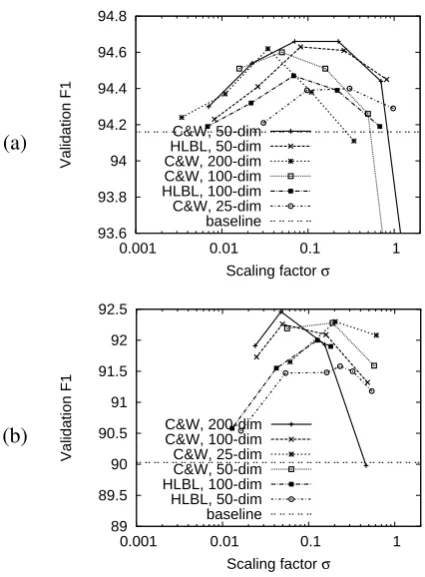
Figure 1: Effect as we vary the scaling factorσ
(Equa-tion 1) on the valida(Equa-tion set F1. We experiment with Collobert and Weston (2008) and HLBL embeddings of var-ious dimensionality. (a) Chunking results. (b) NER results.
Figure 1 shows the effect of scaling factor σ
on both supervised tasks. We were surprised
to find that on both tasks, across Collobert and Weston (2008) and HLBL embeddings of various dimensionality, that all curves had similar shapes
and optima. This is one contributions of our
work. In Turian et al. (2009), we were not
able to prescribe a default value for scaling the embeddings. However, these curves demonstrate that a reasonable choice of scale factor is such that the embeddings have a standard deviation of 0.1.
7.3 Capacity of Word Representations
(a)
94.1 94.2 94.3 94.4 94.5 94.6 94.7
100 320 1000 3200
25 50 100 200
Validation F1
# of Brown clusters # of embedding dimensions
C&W HLBL Brown baseline
(b)
90 90.5 91 91.5 92 92.5
100 320 1000 3200
25 50 100 200
Validation F1
# of Brown clusters # of embedding dimensions
[image:7.595.305.528.162.456.2]C&W Brown HLBL baseline
Figure 2: Effect as we vary the capacity of the word
representations on the validation set F1. (a) Chunking results. (b) NER results.
[image:7.595.71.284.331.620.2]There are capacity controls for the word representations: number of Brown clusters, and number of dimensions of the word embeddings.
Figure 2 shows the effect on the validation F1 as
we vary the capacity of the word representations. In general, it appears that more Brown clusters are better. We would like to induce 10000 Brown clusters, however this would take several months.
In Turian et al. (2009), we hypothesized on the basis of solely the HLBL NER curve that higher-dimensional word embeddings would give
higher accuracy. Figure 2 shows that this
System Dev Test
Baseline 94.16 93.79
[image:8.595.97.268.62.184.2]HLBL, 50-dim 94.63 94.00 C&W, 50-dim 94.66 94.10 Brown, 3200 clusters 94.67 94.11 Brown+HLBL, 37M 94.62 94.13 C&W+HLBL, 37M 94.68 94.25 Brown+C&W+HLBL, 37M 94.72 94.15 Brown+C&W, 37M 94.76 94.35 Ando and Zhang (2005), 15M - 94.39 Suzuki and Isozaki (2008), 15M - 94.67 Suzuki and Isozaki (2008), 1B - 95.15
Table 2: Final chunking F1 results. In the last section, we
show how many unlabeled words were used.
System Dev Test MUC7
Baseline 90.03 84.39 67.48
Baseline+Nonlocal 91.91 86.52 71.80 HLBL 100-dim 92.00 88.13 75.25 Gazetteers 92.09 87.36 77.76 C&W 50-dim 92.27 87.93 75.74 Brown, 1000 clusters 92.32 88.52 78.84 C&W 200-dim 92.46 87.96 75.51 C&W+HLBL 92.52 88.56 78.64 Brown+HLBL 92.56 88.93 77.85 Brown+C&W 92.79 89.31 80.13 HLBL+Gaz 92.91 89.35 79.29 C&W+Gaz 92.98 88.88 81.44 Brown+Gaz 93.25 89.41 82.71 Lin and Wu (2009), 3.4B - 88.44 -Ando and Zhang (2005), 27M 93.15 89.31 -Suzuki and Isozaki (2008), 37M 93.66 89.36 -Suzuki and Isozaki (2008), 1B 94.48 89.92 -All (Brown+C&W+HLBL+Gaz), 37M 93.17 90.04 82.50
All+Nonlocal, 37M 93.95 90.36 84.15 Lin and Wu (2009), 700B - 90.90
-Table 3: Final NER F1 results, showing the cumulative
effect of adding word representations, non-local features, and gazetteers to the baseline. To speed up training, in combined experiments (C&W plus another word representation), we used the 50-dimensional C&W embeddings, not the 200-dimensional ones. In the last section, we show how many unlabeled words were used.
7.4 Final results
Table 2 shows the final chunking results and Ta-ble 3 shows the final NER F1 results. We compare to the state-of-the-art methods of Ando and Zhang (2005), Suzuki and Isozaki (2008), and—for NER—Lin and Wu (2009). Tables 2 and 3 show that accuracy can be increased further by
combin-ing the features from different types of word
rep-resentations. But, if only one word representation is to be used, Brown clusters have the highest ac-curacy. Given the improvements to the C&W beddings since Turian et al. (2009), C&W em-beddings outperform the HLBL emem-beddings. On
chunking, there is only a minute difference
be-tween Brown clusters and the embeddings. Com-(a)
0 50 100 150 200 250
0 1 10 100 1K 10K 100K 1M
# of per-token errors (test set)
Frequency of word in unlabeled data C&W, 50-dim
Brown, 3200 clusters
(b)
0 50 100 150 200 250
0 1 10 100 1K 10K 100K 1M
# of per-token errors (test set)
[image:8.595.305.521.63.352.2]Frequency of word in unlabeled data C&W, 50-dim Brown, 1000 clusters
Figure 3: For word tokens that have different frequency
in the unlabeled data, what is the total number of per-token errors incurred on the test set? (a) Chunking results. (b) NER results.
bining representations leads to small increases in the test F1. In comparison to chunking,
combin-ing different word representations on NER seems
gives larger improvements on the test F1.
On NER, Brown clusters are superior to the word embeddings. Since much of the NER F1 is derived from decisions made over rare words, we suspected that Brown clustering has a superior
representation for rare words. Brown makes
a single hard clustering decision, whereas the embedding for a rare word is close to its initial value since it hasn’t received many training updates (see Footnote 2). Figure 3 shows the total number of per-token errors incurred on the test set, depending upon the frequency of the word token in the unlabeled data. For NER, Figure 3 (b) shows that most errors occur on rare words, and that Brown clusters do indeed incur fewer errors
for rare words. This supports our hypothesis
that, for rare words, Brown clustering produces better representations than word embeddings that
haven’t received sufficient training updates. For
[image:8.595.73.293.233.447.2]words. We hypothesize thatnon-rarewords have good representations, regardless of the choice of word representation technique. For tasks like chunking in which a syntactic decision relies upon looking at several token simultaneously, com-pound features that use the word representations might increase accuracy more (Koo et al., 2008).
Using word representations in NER brought larger gains on the out-of-domain data than on the in-domain data. We were surprised by this result, because the OOD data was not even used during the unsupervised word representation induction,
as was the in-domain data. We are curious to
investigate this phenomenon further.
Ando and Zhang (2005) present a semi-supervised learning algorithm called alternating structure optimization (ASO). They find a low-dimensional projection of the input features that gives good linear classifiers over auxiliary tasks. These auxiliary tasks are sometimes specific to the supervised task, and sometimes general language modeling tasks like “predict the missing word”. Suzuki and Isozaki (2008) present a semi-supervised extension of CRFs. (In Suzuki et al. (2009), they extend their semi-supervised ap-proach to more general conditional models.) One of the advantages of the semi-supervised learning approach that we use is that it is simpler and more general than that of Ando and Zhang (2005) and Suzuki and Isozaki (2008). Their methods dictate a particular choice of model and training regime and could not, for instance, be used with an NLP system based upon an SVM classifier.
Lin and Wu (2009) present a K-means-like non-hierarchical clustering algorithm for phrases,
which uses MapReduce. Since they can scale
to millions of phrases, and they train over 800B unlabeled words, they achieve state-of-the-art accuracy on NER using their phrase clusters. This suggests that extending word representa-tions to phrase representarepresenta-tions is worth further investigation.
8 Conclusions
Word features can be learned in advance in an unsupervised, task-inspecific, and model-agnostic manner. These word features, once learned, are easily disseminated with other researchers, and easily integrated into existing supervised NLP systems. The disadvantage, however, is that ac-curacy might not be as high as a semi-supervised method that includes task-specific information
and that jointly learns the supervised and unsu-pervised tasks (Ando & Zhang, 2005; Suzuki & Isozaki, 2008; Suzuki et al., 2009).
Unsupervised word representations have been used in previous NLP work, and have demon-strated improvements in generalization accuracy on a variety of tasks. Ours is the first work to
systematically compare different word
repre-sentations in a controlled way. We found that
Brown clusters and word embeddings both can improve the accuracy of a near-state-of-the-art supervised NLP system. We also found that
com-bining different word representations can improve
accuracy further. Error analysis indicates that
Brown clustering induces better representations for rare words than C&W embeddings that have not received many training updates.
Another contribution of our work is a default method for setting the scaling parameter for word embeddings. With this contribution, word
embeddings can now be used off-the-shelf as
word features, with no tuning.
Future work should explore methods for inducing phrase representations, as well as tech-niques for increasing in accuracy by using word
representations incompoundfeatures.
Replicating our experiments
You can visit http://metaoptimize.com/
projects/wordreprs/ to find: The word
representations we induced, which you can
download and use in your experiments; The code for inducing the word representations, which you can use to induce word representations on your own data; The NER and chunking system, with code for replicating our experiments.
Acknowledgments
Thank you to Magnus Sahlgren, Bob Carpenter, Percy Liang, Alexander Yates, and the anonymous
reviewers for useful discussion. Thank you to
Andriy Mnih for inducing his embeddings on RCV1 for us. Joseph Turian and Yoshua Bengio acknowledge the following agencies for re-search funding and computing support: NSERC, RQCHP, CIFAR. Lev Ratinov was supported by the Air Force Research Laboratory (AFRL) under
prime contract no. FA8750-09-C-0181. Any
References
Ando, R., & Zhang, T. (2005). A
high-performance semi-supervised learning method
for text chunking.ACL.
Bengio, Y. (2008). Neural net language models.
Scholarpedia,3, 3881.
Bengio, Y., Ducharme, R., & Vincent, P. (2001).
A neural probabilistic language model. NIPS.
Bengio, Y., Ducharme, R., Vincent, P., & Jauvin,
C. (2003). A neural probabilistic language
model. Journal of Machine Learning Research,
3, 1137–1155.
Bengio, Y., Louradour, J., Collobert, R., &
Weston, J. (2009). Curriculum learning. ICML.
Bengio, Y., & S´en´ecal, J.-S. (2003). Quick train-ing of probabilistic neural nets by importance
sampling. AISTATS.
Blei, D. M., Ng, A. Y., & Jordan, M. I. (2003).
Latent dirichlet allocation. Journal of Machine
Learning Research,3, 993–1022.
Brown, P. F., deSouza, P. V., Mercer, R. L., Pietra, V. J. D., & Lai, J. C. (1992). Class-based n-gram
models of natural language. Computational
Linguistics,18, 467–479.
Candito, M., & Crabb´e, B. (2009). Improving gen-erative statistical parsing with semi-supervised
word clustering. IWPT(pp. 138–141).
Collobert, R., & Weston, J. (2008). A unified
architecture for natural language processing: Deep neural networks with multitask learning.
ICML.
Deschacht, K., & Moens, M.-F. (2009).
Semi-supervised semantic role labeling using the
Latent Words Language Model. EMNLP(pp.
21–29).
Dumais, S. T., Furnas, G. W., Landauer, T. K., Deerwester, S., & Harshman, R. (1988). Using latent semantic analysis to improve access to
textual information. SIGCHI Conference on
Human Factors in Computing Systems (pp. 281–285). ACM.
Elman, J. L. (1993). Learning and development in neural networks: The importance of starting
small.Cognition,48, 781–799.
Goldberg, Y., Tsarfaty, R., Adler, M., & Elhadad,
M. (2009). Enhancing unlexicalized parsing
performance using a wide coverage lexicon,
fuzzy tag-set mapping, and EM-HMM-based
lexical probabilities. EACL.
Honkela, T. (1997). Self-organizing maps of
words for natural language processing
applica-tions. Proceedings of the International ICSC
Symposium on Soft Computing.
Honkela, T., Pulkki, V., & Kohonen, T. (1995). Contextual relations of words in grimm tales,
analyzed by self-organizing map. ICANN.
Huang, F., & Yates, A. (2009). Distributional rep-resentations for handling sparsity in supervised
sequence labeling. ACL.
Kaski, S. (1998). Dimensionality reduction by
random mapping: Fast similarity computation
for clustering. IJCNN(pp. 413–418).
Koo, T., Carreras, X., & Collins, M. (2008). Simple semi-supervised dependency parsing.
ACL(pp. 595–603).
Krishnan, V., & Manning, C. D. (2006). An
effective two-stage model for exploiting
non-local dependencies in named entity recognition.
COLING-ACL.
Landauer, T. K., Foltz, P. W., & Laham, D. (1998). An introduction to latent semantic analysis.
Discourse Processes, 259–284.
Li, W., & McCallum, A. (2005). Semi-supervised sequence modeling with syntactic topic models.
AAAI.
Liang, P. (2005). Semi-supervised learning
for natural language. Master’s thesis,
Mas-sachusetts Institute of Technology.
Lin, D., & Wu, X. (2009). Phrase clustering
for discriminative learning. ACL-IJCNLP(pp.
1030–1038).
Lund, K., & Burgess, C. (1996). Producing
highdimensional semantic spaces from lexical
co-occurrence. Behavior Research Methods,
Instrumentation, and Computers,28, 203–208.
Lund, K., Burgess, C., & Atchley, R. A. (1995). Semantic and associative priming in
high-dimensional semantic space. Cognitive Science
Proceedings, LEA(pp. 660–665).
Martin, S., Liermann, J., & Ney, H. (1998). Algo-rithms for bigram and trigram word clustering.
Speech Communication,24, 19–37.
Miller, S., Guinness, J., & Zamanian, A. (2004). Name tagging with word clusters and
Mnih, A., & Hinton, G. E. (2007). Three new graphical models for statistical language
modelling. ICML.
Mnih, A., & Hinton, G. E. (2009). A scalable
hierarchical distributed language model. NIPS
(pp. 1081–1088).
Morin, F., & Bengio, Y. (2005). Hierarchical
probabilistic neural network language model.
AISTATS.
Pereira, F., Tishby, N., & Lee, L. (1993).
Distri-butional clustering of english words. ACL(pp.
183–190).
Ratinov, L., & Roth, D. (2009). Design
chal-lenges and misconceptions in named entity
recognition.CoNLL.
Ritter, H., & Kohonen, T. (1989). Self-organizing
semantic maps. Biological Cybernetics,
241–254.
Sahlgren, M. (2001). Vector-based semantic
analysis: Representing word meanings based
on random labels. Proceedings of the Semantic
Knowledge Acquisition and Categorisation Workshop, ESSLLI.
Sahlgren, M. (2005). An introduction to random
indexing. Methods and Applications of
Seman-tic Indexing Workshop at the 7th International Conference on Terminology and Knowledge Engineering (TKE).
Sahlgren, M. (2006). The word-space model:
Using distributional analysis to represent syn-tagmatic and paradigmatic relations between words in high-dimensional vector spaces. Doctoral dissertation, Stockholm University.
Sang, E. T., & Buchholz, S. (2000). Introduction to the CoNLL-2000 shared task: Chunking.
CoNLL.
Schwenk, H., & Gauvain, J.-L. (2002). Connec-tionist language modeling for large vocabulary
continuous speech recognition. International
Conference on Acoustics, Speech and Signal Processing (ICASSP)(pp. 765–768). Orlando, Florida.
Sha, F., & Pereira, F. C. N. (2003).
Shal-low parsing with conditional random fields.
HLT-NAACL.
Spitkovsky, V., Alshawi, H., & Jurafsky, D. (2010). From baby steps to leapfrog: How “less
is more” in unsupervised dependency parsing.
NAACL-HLT.
Suzuki, J., & Isozaki, H. (2008). Semi-supervised sequential labeling and segmentation using
giga-word scale unlabeled data. ACL-08: HLT
(pp. 665–673).
Suzuki, J., Isozaki, H., Carreras, X., & Collins, M. (2009). An empirical study of semi-supervised structured conditional models for dependency
parsing. EMNLP.
Turian, J., Ratinov, L., Bengio, Y., & Roth, D.
(2009). A preliminary evaluation of word
representations for named-entity recognition.
NIPS Workshop on Grammar Induction, Repre-sentation of Language and Language Learning.
Turney, P. D., & Pantel, P. (2010). From frequency to meaning: Vector space models of semantics.
Journal of Artificial Intelligence Research.
Ushioda, A. (1996). Hierarchical clustering of
words. COLING(pp. 1159–1162).
V¨ayrynen, J., & Honkela, T. (2005).
Compar-ison of independent component analysis and singular value decomposition in word context
analysis. AKRR’05, International and
Interdis-ciplinary Conference on Adaptive Knowledge Representation and Reasoning.
V¨ayrynen, J. J., & Honkela, T. (2004). Word cat-egory maps based on emergent features created
by ICA. Proceedings of the STeP’2004
Cogni-tion + Cybernetics Symposium (pp. 173–185). Finnish Artificial Intelligence Society.
V¨ayrynen, J. J., Honkela, T., & Lindqvist, L.
(2007). Towards explicit semantic features
using independent component analysis.
Pro-ceedings of the Workshop Semantic Content Acquisition and Representation (SCAR). Stock-holm, Sweden: Swedish Institute of Computer Science.
ˇ
Reh˚uˇrek, R., & Sojka, P. (2010). Software frame-work for topic modelling with large corpora.
LREC.
Zhang, T., & Johnson, D. (2003). A robust risk minimization based named entity recognition
system.CoNLL.
Zhao, H., Chen, W., Kit, C., & Zhou, G.
(2009). Multilingual dependency learning: a
huge feature engineering method to semantic