Recognizing Identical Events with Graph Kernels
Goran Glavaˇs and Jan ˇSnajder
University of Zagreb
Faculty of Electrical Engineering and Computing Text Analysis and Knowledge Engineering Lab
Unska 3, 10000 Zagreb, Croatia
{goran.glavas,jan.snajder}@fer.hr
Abstract
Identifying news stories that discuss the same real-world events is important for news tracking and retrieval. Most exist-ing approaches rely on the traditional vec-tor space model. We propose an approach for recognizing identical real-world events based on a structured, event-oriented doc-ument representation. We structure docu-ments as graphs of event mentions and use graph kernels to measure the similarity be-tween document pairs. Our experiments indicate that the proposed graph-based ap-proach can outperform the traditional vec-tor space model, and is especially suitable for distinguishing between topically simi-lar, yet non-identical events.
1 Introduction
News stories typically describe real-world events. Topic detection and tracking (TDT) aims to de-tect stories that discuss identical or directly related events, and track these stories as they evolve over time (Allan, 2002). Being able to identify the sto-ries that describe the same real-world event is es-sential for TDT, and event-based information re-trieval in general.
In TDT, an event is defined as something hap-pening in a certain place at a certain time (Yang et al., 1999), while a topic is defined as a set of news stories related by some seminal real-world event (Allan, 2002). To identify news stories on the same topic, most TDT approaches rely on tra-ditional vector space models (Salton et al., 1975), as more sophisticated natural language processing techniques have not yet proven to be useful for this task. On the other hand, significant advances in sentence-level event extraction have been made over the last decade, in particular as the result of
standardization efforts such as TimeML (Puste-jovsky et al., 2003a) and TimeBank (Puste(Puste-jovsky et al., 2003b), as well as dedicated evaluation tasks (ACE, 2005; Verhagen et al., 2007; Verhagen et al., 2010). However, these two lines of research have largely remained isolated from one another.
In this paper we bridge this gap and address the task of recognizing stories discussing identical events by considering structured representations from sentence-level events. More concretely, we structure news stories intoevent graphsbuilt from individual event mentions extracted from text. To measure event-based similarity of news stories, we compare their event graphs using graph kernels (Borgwardt, 2007). We conduct preliminary ex-periments on two event-oriented tasks and show that the proposed approach can outperform tradi-tional vector space model in recognizing identical real-world events. Moreover, we demonstrate that our approach is especially suitable for distinguish-ing between topically similar, yet non-identical real-world events.
2 Related Work
The traditional vector space model (VSM) (Salton et al., 1975) computes the cosine between bag-of-words representations of documents. The VSM is at the core of most approaches that identify same-topic news stories (Hatzivassiloglou et al., 2000; Brants et al., 2003; Kumaran and Allan, 2005; Atkinson and Van der Goot, 2009). However, it has been observed that some word classes (e.g., named entities, noun phrases, collocations) have more significance than the others. Among them, named entities have been considered as particu-larly important, as they often identify the partici-pants of an event. In view of this, Hatzivassiloglou et al. (2000) restrict the set of words to be used for document representation to words constituting noun phrases and named entities. Makkonen et
al. (2004) divide document terms into four seman-tic categories (locations, temporal expressions, proper names, and general terms) and construct separate vector for each of them. Kumaran and Allan (2004) represent news stories with three dif-ferent vectors, modeling all words, named-entity words, and all non-named-entity words occurring in documents. When available, recognition of identical events can rely on meta-information as-sociated with news stories, such as document cre-ation time (DCT). Atkinson and Van der Goot (2009) combine DCT with VSM, assuming that temporally distant news stories are unlikely to de-scribe the same event.
In research on event extraction, the task of rec-ognizing identical events is known asevent coref-erence resolution (Bejan and Harabagiu, 2010; Lee et al., 2012). There, however, the aim is to identify sentence-level event mentions referring to the same real-world events, and not stories that discuss identical events.
3 Kernels on Event Graphs
To identify the news describing the same real-world event, we (1) structure event-oriented in-formation from text into event graphs and (2) use graph kernels to measure the similarity between a pair of event graphs.
3.1 Event graphs
An event graph is a vertex- and edge-labeled mixed graph in which vertices represent individ-ual event mentions and edges represent temporal relations between event mentions. We adopt a generic representation of event mentions, as pro-posed by Glavaˇs and ˇSnajder (2013): each men-tion consists of an anchor (a word that conveys the core meaning) and four types of arguments (agent, target, time, location). Furthermore, we consider four types of temporal relations between event mentions: before,after, overlap, andequal (Allen, 1983). As relationsoverlapandequalare symmetric, whereas before and after are not, an event graph may contain both directed and undi-rected edges.
Formally, an event graphGis represented as a
tupleG = (V, E, A, m, r), where V is the set of
vertices,Eis the set of undirected edges,Ais the
set of directed edges (arcs), m : V → M is a
bijection mapping the vertices to event mentions, andr :E → R is the edge-labeling function,
as-signing temporal relations to edges (cf. Fig. 1). The construction of an event graph from a news story involves the extraction of event mentions (anchors and arguments) and the extraction of temporal relations between mentions. We use a supervised model (with 80% F1 extraction perfor-mance) based on a rich set of features similar to those proposed by Bethard (2008) to extract event anchors. We then employ a robust, rule-based ap-proach proposed by Glavaˇs and ˇSnajder (2013) to extract generic event arguments. Finally, we em-ploy a supervised model (60% micro-averaged F1 classification performance) with a rich set of fea-tures, similar to those proposed by Bethard (2008), to extract temporal relations between event men-tions. A detailed description of the graph con-struction steps is outside the scope of this paper.
To compute event graph kernels (cf. Section 3.2), we need to determine whether two event mentions co-refer. To resolve cross-document event coreference, we use the model proposed by Glavaˇs and ˇSnajder (2013). The model de-termines coreference by comparing factual event anchors and arguments of four coargrained se-mantic types (agent, target, location, and time), and achieves an F-score of 67% (79% precision and 57% recall) on the cross-document mention pairs from the EventCorefBank dataset (Bejan and Harabagiu, 2008). In what follows, cf(m1, m2) denotes whether event mentions m1 and m2 co-refer (equals1if mentions co-refer,0otherwise).
3.2 Graph kernels
Graph kernels are fast polynomial alternatives to traditional graph comparison techniques (e.g., subgraph isomorphism), which provide an expres-sive measure of similarity between graphs (Borg-wardt, 2007). We employ two different graph ker-nels: product graph kerneland weighted decom-position kernel. We chose these kernels because their general forms have intuitive interpretations for event matching. These particular kernels have shown to perform well on a number of tasks from chemoinformatics (Mah´e et al., 2005; Menchetti et al., 2005).
Product graph kernel. A product graph kernel (PGK) counts the common walks between two in-put graphs (G¨artner et al., 2003). The graph prod-uct of two labeled graphs, G and G0, denoted GP =G×G0, is a graph with the vertex set
where δ(v, v0) is a predicate that holds when vertices v and v0 are identically labeled
(Ham-mack et al., 2011). Given event graphs G = (V, E, A, m, r) andG0 = (V0, E0, A0, m0, r0), we consider the vertices to be identically labeled if the corresponding event mentions co-refer, i.e.,
δ(v, v0) =. cf(m(v), m0(v0)). The edge set of the
graph product depends on the type of the product. We experiment with two different products: ten-sor productandconormal product. In the tensor product, an edge is introduced iff the correspond-ing edges exist in both input graphs and the labels of those edges match (i.e., both edges represent the same temporal relation). In the conormal product, an edge is introduced iff the corresponding edge exists in at least one input graph. Thus, a conor-mal product may compensate for omitted temporal relations in the input graphs.
Let AP be the adjacency matrix of the graph productGP built from input graphsGandG0. The product graph kernel that counts common walks in
GandG0can be computed efficiently as:
KP G(G, G0) =
|VP|
X
i,j=1
[(I−λAP)−1]ij (1)
whenλ < 1/t, wheretis the maximum degree of
a vertex in the graph productGP. In our experi-ments, we setλto 1/(t+ 1).
Weighted decomposition kernel. A weighted decomposition kernel (WDK) compares small graph parts, called selectors, being matched ac-cording to an equality predicate. The importance of the match is weighted by the similarity of the contexts in which the matched selectors occur. For a description of a general form of WDK, see Menchetti et al. (2005).
LetS(G)be the set of all pairs(s, z), wheresis
the selector (subgraph of interest) andzis the
con-text ofs. We decompose event graphs into
individ-ual vertices, i.e., we define selectors to be the indi-vidual vertices. In this case, similarly as above, the equality predicateδ(v, v0)for two verticesv ∈ G
andv0 ∈ G0 holds if and only if the
correspond-ing event mentionsm(v)andm0(v0)co-refer.
Us-ing selectors that consist of more than one vertex would require a more complex and perhaps a less intuitive definition of the equality predicateδ. The
selector contextZvof vertexvis a subgraph ofG that containsvand all its immediate neighbors. In
other words, we consider as context all event
men-tions that are in a direct temporal relation with the selected mention. WDK between event graphsG
andG0is computed as:
KWD(G, G0) =
X
v∈VG,v0∈VG0
cf(m(v), m0(v0))κ(Zv, Zv00)
(2) whereκ(Zv, Zv00)is thecontext kernelmeasuring
the similarity between the contextZv of selector
v ∈ G and the context Zv00 of selector v0 ∈ G0.
We compute the context kernelκas the number of
coreferent mention pairs found between the con-texts, normalized by the context size:
κ(Zv, Zv00) =
P
w∈VZv,w0∈VZ0 v0
cf(m(w), m0(w0))
max(|VZv|,|VZv00|)
The intuition behind this is that a pair of corefer-ent mcorefer-entionsm(v) andm0(v0) should contribute
to the overall event similarity according to the number of pairs of coreferent mentions,m(w)and m0(w0), that are in temporal relation withvandv0,
respectively.
Graph kernels example. As an example, con-sider the following two story snippets describing the same sets of real-world events:
Story 1:A Cezanne masterpiece worth at least$131 million that was the yanked from the wall of a Zurich art gallery in 2008 has been recovered, Serbian po-lice said today. Four arrests were made overnight in connection with the theft, which was one of the biggest art heists in recent history.
Story 2: Serbian police have recovered a painting by French impressionist Paul Cezanne worth an esti-mated 100 million euros (131.7 million U.S. dollars), media reported on Thursday. The painting ”A boy in a red vest” was stolen in 2008 from a Zurich museum by masked perpetrators. Four members of an interna-tional crime ring were arrested Wednesday.
The corresponding event graphs G and G0 are
shown in Fig. 1a and 1b, respectively, while their product is shown in Fig. 1c. There are three pairs of coreferent event mentions between Gand G0:
(yanked,stolen), (recovered,recovered), and (ar-rests, arrested). Accordingly, the product graph
P has three nodes. The dashed edge between
(a) Event graphG(Story 1) (b) Event graphG0(Story 2) (c) Product graphP
Figure 1: Example event graphs and their product
the tensor PGK score as:
KPG =
3 X
i,j=1
I−1 3
0 0 1 0 0 1 1 1 0
!!−1
i,j
≈5.6
Similarly, for the conormal product graph P we
obtain the conormal PGK score ofKPG = 9. By
substitutingGandG0into (2), we obtain the WDK
score as:
KWD =
X
(v,v0)∈VP
κ(Zv, Zv00) = 2
3+
3
4+
2
4 ≈1.9
whereVP contains pairs of coreferent event men-tions: (yanked, stolen), (recovered, recovered), and (arrests,arrested).
4 Experiments
We conducted two preliminary experiments to in-vestigate whether kernels on event graphs can be used to recognize identical events.
4.1 Task 1: Recognizing identical events Dataset. In the first experiment, we classify pairs of news stories as either describing identical real-world events or not. For this we need a collec-tion of stories in which pairs of stories on identi-cal events have been annotated as such. TDT cor-pora (Wayne, 2000) is not directly usable because it has no such annotations. We therefore decided to build a small annotated dataset.1 To this end, we use the news clusters of the EMM NewsBrief service (Steinberger et al., 2009). EMM clusters news stories from different sources using a docu-ment similarity score. We acquired 10 randomly chosen news clusters, manually inspected each of them, and retained in each cluster only the doc-uments that describe the same real-world events. Additionally, we ensured that no documents from
1Datasets for both experiments are available at:
http://takelab.fer.hr/evkernels
Model P R F
Tensor PGK 89.7 82.3 85.8 Conormal PGK 89.3 77.8 83.2
WDK 88.6 73.7 80.5
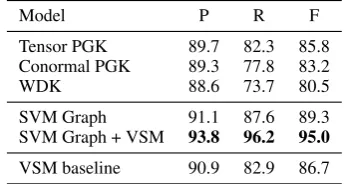
SVM Graph 91.1 87.6 89.3 SVM Graph + VSM 93.8 96.2 95.0 VSM baseline 90.9 82.9 86.7
Table 1: Results for recognition of identical events
different clusters discuss the same event. To ob-tain the gold standard dataset, we build all pairs of documents. The final dataset consists of 64 documents in 10 clusters, with 195 news pairs from the same clusters (positive pairs) and 1821 news pairs from different clusters (negative pairs). We divide the dataset into a train and a test set (7:3 split ratio). Note that, although our dataset has ground-truth annotations, it is incomplete in the sense that some pairs of documents describ-ing the same events, which were not recognized as such by the EMM, are not included. Further-more, because EMM similarity score uses VSM cosine similarity as one of the features, VSM co-sine similarity constitutes a competitive baseline on this dataset.
Original
“Taliban militants have attacked a prison in north-west Pakistan, freeing at least 380 prisoners. . . ”
Event-preserving paraphrase
“Taliban militants in northwest Pakistan attacked the prison, liberated at least 380 prisoners . . . ”
Event-shifting paraphrase
“Taliban militants have been arrested in north-west Pak-istan. At least 380 militants have been arrested. . . ”
Table 2: Event paraphrasing example
individual kernel scores to an SVM model (with RBF kernel), along with additional graph-based features such as the number of nodes and the num-ber of edges (SVM graphmodel). Finally, we com-bined the graph-based features with the VSM co-sine similarity (SVM graph + VSM model). SVM graphmodel significantly (atp < 0.05, student’s 2-tailed t-test) outperforms the individual kernel models and the baseline. The combined model (SVM graph + VSM) significantly (atp < 0.01)
outperforms the baseline and all kernel models. 4.2 Task 2: Event-based similarity ranking Dataset. In the second experiment we focus on the task of distinguishing between news sto-ries that describe topically very similar, yet dis-tinct events. For this purpose, we use a small set of event paraphrases, constructed as fol-lows. We manually selected 10 news stories from EMM NewsBrief and altered each of them to obtain two meaning-preserving (event-preserving) and two meaning-changing (event-shifting) phrases. To obtain the meaning-preserving para-phrases, we use Google translate and round-trip translation via two pairs of arbitrarily chosen lan-guages (Danish/Finnish and Croatian/Hungarian). Annotators manually corrected lexical and syn-tactic errors introduced by the round-trip transla-tion. To obtain meaning-changing paraphrases, we asked human annotators to alter each story so that it topically resembles the original, but describes a different reworld event. The extent of the al-teration was left to the annotators, i.e., no specific transformations were proposed. Paraphrase exam-ples are given in Table 2. The final dataset consists of 60 news pairs: 30 positive and 30 negative. Results. For each method we ranked the pairs based on the assigned similarity scores. An ideal method would rank all positive pairs above all neg-ative pairs. We evaluated the performance using
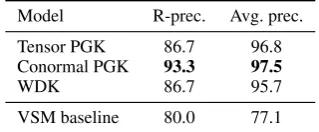
Model R-prec. Avg. prec. Tensor PGK 86.7 96.8 Conormal PGK 93.3 97.5
WDK 86.7 95.7
[image:5.595.336.496.63.129.2]VSM baseline 80.0 77.1
Table 3: Results for event-based similarity ranking
two different rank evaluation metrics: R-precision (precision at rank 30, as there are 30 positive pairs) and average precision. The performance of graph kernel models and the VSM baseline is given in Table 3. We tested the significance of differences using stratified shuffling (Yeh, 2000). When con-sidering average precision, all kernel models sig-nificantly (atp < 0.01) outperform the baseline.
However, when considering R-precision, only the conormal PGK model significantly (atp < 0.05)
outperforms the baseline. There is no statistical significance in performance differences between the considered kernel methods. Inspection of the rankings reveals that graph kernels assign very low scores to negative pairs, i.e., they distinguish well between textual representations of topically simi-lar, but different real-world events.
5 Conclusion
We proposed a novel approach for recognizing identical events that relies on structured, graph-based representations of events described in a document. We use graph kernels as an expres-sive framework for modeling the similarity be-tween structured events. Preliminary results on two event-similarity tasks are encouraging, indi-cating that our approach can outperform tradi-tional vector-space model, and is suitable for dis-tinguishing between topically very similar events. Further improvements could be obtained by in-creasing the accuracy of event coreference resolu-tion, which has a direct influence on graph kernels. The research opens up many interesting direc-tions for further research. Besides a systematic evaluation on larger datasets, we intend to inves-tigate the applications in event tracking and event-oriented information retrieval.
Acknowledgments
References
ACE. 2005. Evaluation of the detection and recogni-tion of ACE: Entities, values, temporal expressions, relations, and events.
James Allan. 2002. Topic Detection and Tracking: Event-based Information Organization, volume 12. Kluwer Academic Pub.
James Allen. 1983. Maintaining knowledge about temporal intervals. Communications of the ACM, 26(11):832–843.
Martin Atkinson and Erik Van der Goot. 2009. Near real time information mining in multilingual news. InProceedings of the 18th International Conference on World Wide Web, pages 1153–1154. ACM.
Cosmin Adrian Bejan and Sanda Harabagiu. 2008. A linguistic resource for discovering event structures and resolving event coreference. InProceedings of the 6th International Conference on Language Re-sources and Evaluation (LREC 2008).
Cosmin Adrian Bejan and Sanda Harabagiu. 2010. Unsupervised event coreference resolution with rich linguistic features. InProceedings of the 48th An-nual Meeting of the Association for Computational Linguistics, pages 1412–1422. Association for Com-putational Linguistics.
Steven Bethard. 2008. Finding Event, Temporal and Causal Structure in Text: A Machine Learning Ap-proach. Ph.D. thesis, University of Colorado at Boulder.
Karsten Michael Borgwardt. 2007. Graph Ker-nels. Ph.D. thesis, Ludwig-Maximilians-Universit¨at M¨unchen.
Thorsten Brants, Francine Chen, and Ayman Farahat. 2003. A system for new event detection. In Pro-ceedings of the 26th Annual International ACM SI-GIR Conference on Research and Development in Information Retrieval, pages 330–337. ACM.
Thomas G¨artner, Peter Flach, and Stefan Wrobel. 2003. On graph kernels: Hardness results and ef-ficient alternatives. InLearning Theory and Kernel Machines, pages 129–143. Springer.
Goran Glavaˇs and Jan ˇSnajder. 2013. Exploring coref-erence uncertainty of generically extracted event mentions. In Proceedings of 14th International Conference on Intelligent Text Processing and Com-putational Linguistics, pages 408–422. Springer.
Richard Hammack, Wilfried Imrich, and Sandi Klavˇzar. 2011. Handbook of Product Graphs. Dis-crete Mathematics and Its Applications. CRC Press.
Vasileios Hatzivassiloglou, Luis Gravano, and Anki-needu Maganti. 2000. An investigation of linguistic
features and clustering algorithms for topical doc-ument clustering. In Proceedings of the 23rd An-nual International ACM SIGIR Conference on Re-search and Development in Information Retrieval, pages 224–231. ACM.
Giridhar Kumaran and James Allan. 2004. Text clas-sification and named entities for new event detec-tion. In Proceedings of the 27th Annual Interna-tional ACM SIGIR Conference on Research and De-velopment in Information Retrieval, pages 297–304. ACM.
Giridhar Kumaran and James Allan. 2005. Using names and topics for new event detection. In Pro-ceedings of the Conference on Human Language Technology and Empirical Methods in Natural Lan-guage Processing, pages 121–128. Association for Computational Linguistics.
Heeyoung Lee, Marta Recasens, Angel Chang, Mihai Surdeanu, and Dan Jurafsky. 2012. Joint entity and event coreference resolution across documents. In Proceedings of the 2012 Joint Conference on Empir-ical Methods in Natural Language Processing and Computational Natural Language Learning, pages 489–500. Association for Computational Linguis-tics.
Pierre Mah´e, Nobuhisa Ueda, Tatsuya Akutsu, Jean-Luc Perret, and Jean-Philippe Vert. 2005. Graph kernels for molecular structure-activity relationship analysis with support vector machines. Journal of Chemical Information and Modeling, 45(4):939– 951.
Juha Makkonen, Helena Ahonen-Myka, and Marko Salmenkivi. 2004. Simple semantics in topic detec-tion and tracking. Information Retrieval, 7(3):347– 368.
Sauro Menchetti, Fabrizio Costa, and Paolo Frasconi. 2005. Weighted decomposition kernels. In Pro-ceedings of the 22nd International Conference on Machine Learning, pages 585–592. ACM.
James Pustejovsky, Jos´e Castano, Robert Ingria, Roser Sauri, Robert Gaizauskas, Andrea Setzer, Graham Katz, and Dragomir Radev. 2003a. Timeml: Robust specification of event and temporal expressions in text. New Directions in Question Answering, 3:28– 34.
James Pustejovsky, Patrick Hanks, Roser Sauri, An-drew See, Robert Gaizauskas, Andrea Setzer, Dragomir Radev, Beth Sundheim, David Day, Lisa Ferro, et al. 2003b. The TimeBank corpus. In Cor-pus Linguistics, volume 2003, page 40.
Ralf Steinberger, Bruno Pouliquen, and Erik Van Der Goot. 2009. An introduction to the euro-pean media monitor family of applications. In Pro-ceedings of the Information Access in a Multilin-gual World-Proceedings of the SIGIR 2009 Work-shop, pages 1–8.
Marc Verhagen, Robert Gaizauskas, Frank Schilder, Mark Hepple, Graham Katz, and James Pustejovsky. 2007. Semeval-2007 Task 15: TempEval tempo-ral relation identification. InProceedings of the 4th International Workshop on Semantic Evaluations, pages 75–80. Association for Computational Lin-guistics.
Marc Verhagen, Roser Sauri, Tommaso Caselli, and James Pustejovsky. 2010. Semeval-2010 Task 13: TempEval-2. In Proceedings of the 5th Interna-tional Workshop on Semantic Evaluation, pages 57– 62. Association for Computational Linguistics.
Charles Wayne. 2000. Multilingual topic detection and tracking: Successful research enabled by cor-pora and evaluation. InProceedings of the Second International Conference on Language Resources and Evaluation Conference (LREC 2000), volume 2000, pages 1487–1494.
Yiming Yang, Jaime G Carbonell, Ralf D Brown, Thomas Pierce, Brian T Archibald, and Xin Liu. 1999. Learning approaches for detecting and track-ing news events. Intelligent Systems and their Ap-plications, IEEE, 14(4):32–43.