Reducing Wrong Labels in Distant Supervision for Relation Extraction
Shingo Takamatsu
System Technologies Laboratories Sony Corporation
5-1-12 Kitashinagawa, Shinagawa-ku, Tokyo
Issei Sato and Hiroshi Nakagawa Information Technology Center
The University of Tokyo 7-3-1 Hongo, Bunkyo-ku, Tokyo {sato@r., n3@}dl.itc.u-tokyo.ac.jp
Abstract
In relation extraction, distant supervision seeks to extract relations between entities from text by using a knowledge base, such as Freebase, as a source of supervision. When a sentence and a knowledge base refer to the same entity pair, this approach heuristically la-bels the sentence with the corresponding re-lation in the knowledge base. However, this heuristic can fail with the result that some sen-tences are labeled wrongly. This noisy labeled data causes poor extraction performance. In this paper, we propose a method to reduce the number of wrong labels. We present a novel generative model that directly models the heuristic labeling process of distant super-vision. The model predicts whether assigned labels are correct or wrong via its hidden vari-ables. Our experimental results show that this model detected wrong labels with higher per-formance than baseline methods. In the ex-periment, we also found that our wrong label reduction boosted the performance of relation extraction.
1 Introduction
Machine learning approaches have been developed to address relation extraction, which is the task of extracting semantic relations between entities ex-pressed in text. Supervised approaches are limited in scalability because labeled data is expensive to pro-duce. A particularly attractive approach, called dis-tant supervision (DS), creates labeled data by heuris-tically aligning entities in text with those in a knowl-edge base, such as Freebase (Mintz et al., 2009).
! " #$%&'()*+,-,. /01 ! " #$%2*3456+*2./01 7
[image:1.612.319.535.251.357.2]89': 4;*6;)- +< = 89': 4;*6;)- +< = >?@A B >@CDE>F GEC H I
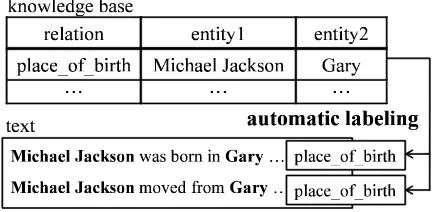
Figure 1: Automatic labeling by distant supervision. Up-per sentence: correct labeling; lower sentence: incorrect labeling.
With DS it is assumed that if a sentence contains an entity pair in a knowledge base, such a sentence actually expresses the corresponding relation in the knowledge base.
However, the DS assumption can fail, which re-sults in noisy labeled data and this causes poor ex-traction performance. An entity pair in a target text generally expresses more than one relation while a knowledge base stores a subset of the relations. The assumption ignores this possibility. For in-stance, consider theplace of birthrelation between Michael JacksonandGary in Figure 1. The upper sentence indeed expresses theplace of birthrelation between the two entities. In DSplace of birthis as-signed to the sentence, and it becomes a useful train-ing example. On the other hand, the lower sentence does not express this relation between the two enti-ties, but the DS heuristic wrongly labels the sentence as expressing it.
Riedel et al. (2010) relax the DS assumption as at least one sentence containing an entity pair
pressing the corresponding relation in the knowl-edge base. They cast the relaxed assumption as multi-instance learning. However, even the relaxed assumption can fail. The relaxation is equivalent to the DS assumption when a labeled pair of entities is mentioned once in a target corpus (Riedel et al., 2010). In fact, 91.7% of entity pairs appear only once in Wikipedia articles (see Section 7).
In this paper, we propose a method to reduce the number of wrong labels generated by DS without using either of these assumptions. Given the labeled corpus created with the DS assumption, we first pre-dict whether eachpattern, which frequently appears in text to express a relation (see Section 4), expresses a target relation. Patterns that are predicted not to ex-press the relation are used to form a negative pattern list for removing wrong labels of the relation.
The main contributions of this paper are as fol-lows:
• To make the pattern prediction, we propose a generative model that directly models the pro-cess of automatic labeling in DS. Without any strong assumptions like Riedel et al. (2010)’s, the model predicts whether each pattern ex-presses each relation via hidden variables (see Section 5).
• Our variational inference for our generative model lets us automatically calibrate parame-ters for each relation, which are sensitive to the performance (see Section 6).
• We applied our method to Wikipedia articles using Freebase as a knowledge base and found that (i) our model identified patterns express-ing a given relation more accurately than base-line methods and (ii) our method led to bet-ter extraction performance than the original DS (Mintz et al., 2009) and MultiR (Hoffmann et al., 2011), which is a state-of-the-art multi-instance learning system for relation extraction (see Section 7).
2 Related Work
The increasingly popular approach, called distant supervision (DS), or weak supervision, utilizes a knowledge base to heuristically label a corpus (Wu and Weld, 2007; Bellare and McCallum, 2007; Pal
et al., 2007). Our work was inspired by Mintz et al. (2009) who used Freebase as a knowledge base by making the DS assumption and trained relation ex-tractors on Wikipedia. Previous works (Hoffmann et al., 2010; Yao et al., 2010) have pointed out that the DS assumption generates noisy labeled data, but did not directly address the problem. Wang et al. (2011) applied a rule-based method to the problem by using popular entity types and keywords for each relation. In (Bellare and McCallum, 2007; Riedel et al., 2010; Hoffmann et al., 2011), they used multi-instance learning, which deals with uncertainty of labels, to relax the DS assumption. However, the re-laxed assumption can fail when a labeled entity pair is mentioned only once in a corpus (Riedel et al., 2010). Our approach relies on neither of these as-sumptions.
Bootstrapping for relation extraction (Riloff and Jones, 1999; Pantel and Pennacchiotti, 2006; Carl-son et al., 2010) is related to our method. In boot-strapping, seed entity pairs of the target relation are given in order to select reliable patterns, which are used to extract new entity pairs. To avoid the selec-tion of unreliable patterns, bootstrapping introduces scoring functions for each pattern candidate. This can be applied to our approach, which seeks to re-duce the number of unreliable patterns by using a set of given entity pairs. However, the bootstrapping-like approach suffers from sensitive parameters that are critical to its performance. Ideally, the parame-ters such as a threshold for scoring function should be determined for each relation, but there are no principled methods (Komachi et al., 2008). In our approach, parameters are calibrated for each rela-tion by maximizing the likelihood of our generative model.
3 Knowledge-based Distant Supervision
In this section, we describe DS for relation extrac-tion. We use the term relationas the relation be-tween two entities. A relation instance is a tuple consisting of two entities and relationr. For exam-ple, place of birth(Michael Jackson, Gary) in Fig-ure 1 is a relation instance.
single sentence. For example, from the upper sen-tence in Figure 1 we extractplace of birth(Michael Jackson, Gary). Since two entities mentioned in a sentence do not always have a relation, we select en-tity pairs from a corpus when: (i) the path of the de-pendency parse tree between the corresponding two named entities in the sentence is no longer than 4 and (ii) the path does not contain a sentence-like boundary, such as a relative clause1 (Banko et al., 2007; Banko and Etzioni, 2008). Banko and Et-zioni (2008) found that a set of eight lexico-syntactic forms covers nearly 95% of relation phrases in their corpus. (Fader et al. (2011) found that this set covers 69% of their corpus). Our rule is designed to cover at least the eight lexico-syntactic forms. We use the entity pairs extracted by this rule.
DS uses a knowledge base to create labeled data for relation extraction by heuristically matching en-tity pairs. A knowledge base is a set of relation instances about predefined relations. For each sen-tence in the corpus, we extract all of its entity pairs. Then, for each entity pair, we try to retrieve the rela-tion instances about the entity pair from the knowl-edge base. If we found such a relation instance, then the set of its relation, the entity pair, and the sentence is stored as a positive example. If not, then the set of the entity pair and the sentence is stored as a nega-tive example. Features of an entity pair are extracted from the sentence containing the entity pair.
As mentioned in Section 1, the assumption of DS can fail, resulting in wrong assignments of a relation to sentences that do not express the relation. We call such assignments wrong labels. An example of a wrong label isplace of birth assigned to the lower sentence in Figure 1.
4 Wrong Label Reduction
We define apatternas the entity types of an entity pair2 as well as the sequence of words on the path of the dependency parse tree from the first entity to the second one. For example, from “Michael Jack-son was born in Gary” in Figure 1, the pattern “[Per-son] born in [Location]” is extracted. We use entity
1We reject sentence-like dependencies such asccomp, com-plmandmark
2
If we use a standard named entity tagger, the entity types are Person, Location, and Organization.
Algorithm 1Wrong Label Reduction labeled data generated by DS:LD
negative patterns for relationr:N egP at(r)
foreach entry (r,P air,Sentence) inLDdo
patternP at←the pattern from (P air,Sentence)
ifP at∈N egP at(r)then
remove (r,P air,Sentence) fromLD
end if end for return LD
types to distinguish the sentences that express differ-ent relations with the same dependency path, such as “ABBA was formed in Stockholm.” and “ABBA was formed in 1970.”
Our aim is to remove wrong labels assigned to frequent patterns, which cause poor precision. In-deed, in our Wikipedia corpus, more than 6% of the sentences containing the pattern “[Person] moved to [Location]”, which does not expressplace of death, are labeled as place of death, and the labels as-signed to these sentences hurt extraction perfor-mance (see Section 7.3.3). We would like to remove place of deathfrom the sentences that contain this pattern.
In our method, we reduce the number of wrong labels as follows: (i) given a labeled corpus with the DS assumption, we first predict whether a pattern expresses a relation and then (ii) remove wrong la-bels using the negative pattern list, which is defined as patterns that are predicted not to express the rela-tion. In the first step, we introduce the novel gener-ative model that directly models DS’s labeling pro-cess and make the prediction (see Section 5). The second step is formally described in Algorithm 1. For relation extraction, we train a classifier for en-tity pairs using the resultant labeled data.
5 Generative Model
We now describe our generative model, which pre-dicts whether a pattern expresses relationr or not via hidden variables. In this section, we consider re-lationrsince parameters are conditionally indepen-dent if relationrand the hyperparameter are given.
JK L M N
O
P Q
R S
TU V
WX Y
Z [
\ ] ^
_
[image:4.612.103.272.61.173.2]` `a
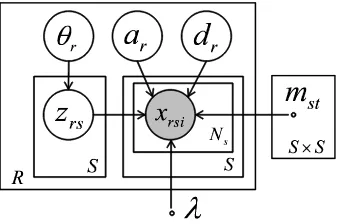
Figure 2: Graphical model representation of our model. Rindicates the number of relations. Sis the number of patterns. Ns is the number of entity pairs that appear
with patterns in the corpus. xrsi is the observed
vari-ables. The circled variables exceptxrsiare parameters
or hidden variables. λis the hyperparameter andmstis
constant. The boxes are “plates” representing replicates.
1, . . . , Ns},3where we defineSto be the number of patterns andNsto be the number of entity pairs ap-pearing with patterns. Note that we count an entity pair for given patternsonce even if the entity pair is mentioned with pattern smore than once in the corpus, because DS assigns the same relation to all mentions of the entity pair.
Given relationr, our model assumes the follow-ing generative process:
1. For each patterns
Choose whethersexpresses relationror not
zrs∼Be(θr)
2. For each entity pairiappearing with patterns
Choose whetheriis labeled or not
xrsi∼P(xrsi|Zr, ar, dr, λ,M),
where Be(θr) is a Bernoulli distribution with pa-rameterθr, zrs is a binary hidden variable that is 1 if patternsexpresses relationrand 0 otherwise, and
Zr = {(zrs)|s = 1, . . . , S}. Given a value ofzrs, we model two kinds of probabilities: one for pat-terns that actually express relationr, i.e.,P(xrsi =
1|zrs = 1), and one for patterns that do not express
r, i.e.,P(xrsi = 1|zrs = 0). The former is simply parameterized as0 ≤ ar ≤ 1. We express the lat-ter asbrs =P(xrsi = 1|Zr, ar, dr, λ,M), which is a function ofZr, ar, dr, λ and M; we explain its modeling in the following two subsections.
3
Since a set of entity pairs appearing with patternsis
differ-ent,ishould be written asis. For simplicity, however, we usei
for each pattern.
b
b b
cdefg hif ijieklkmng lop q cfg hif i ji eklkmnglop q r
s t
t
t
t
t
v x
z { |}~
[image:4.612.344.506.65.162.2]
Figure 3: Venn diagram-like description.E1andE2are sets of entity pairs. E1/E2has 6/4 entity pairs because the 6/4 entity pairs appear with pattern 1/2 in the target corpus. Pattern1expresses relationrand pattern2does not. Elements inE1 are labeled with probabilityar = 3/6 = 0.5. Those inE2 are labeled with probability br2=ar(|E1∩E2|/|E2|) = 0.5(2/4) = 0.25.
The graphical model of our model is shown in Figure 2.
5.1 Example of Wrong Labeling
Using a simple example, we describe how we model
brs, the probability with which DS assigns relationr to patternsvia entity pairs when patternsdoes not express relationr.
Consider two patterns: pattern1that expresses re-lationrand pattern2that does not (i.e.,zr1= 1and zr2 = 0). We also assume that there are entity pairs
that appear with pattern1as well as with pattern2in different places in the corpus (for example,Michael Jackson and Gary in Figure 1). When such entity pairs are labeled, relationr is assigned to pattern1
and at the same time to wrong pattern2. Such entity pairs are observed as elements in the intersection of the two sets of entity pairs,E1 andE2. Here,Esis the set of entity pairs that appear with pattern sin the corpus. This situation is described in Figure 3.
We model probability br2 as follows. In E1, an
entity pair is labeled with probability ar. We as-sume that entity pairs in the intersection,E1∩E2, are also labeled withar. From the viewpoint ofE2,
entity pairs in its subset,E1∩E2, are labeled with
ar. Therefore,br2is modeled as
br2 =ar
|E1∩E2| |E2| ,
We generalize the example in the next subsection.
5.2 Modeling of Probabilitybrs
We modelbrsso that it is proportional to the number of entity pairs that are shared with correct patterns whosezrs = 1, i.e.,
brs=ar
T
{t|zrt=1,t6=s}Et
∩Es
|Es|
, (1)
whereT
indicates set intersections. However, the enumeration in Eq.1 requires O(SN2
s) computa-tional cost and a huge amount of memory to store all of the entity pairs. We approximate the right-hand side of Eq.1 as
brs≈ar
1−
S
Y
t=1,t6=s
1−|Et∩Es| |Es|
zrt
.
This approximation is made, given the sizes of all
Ess and those of all intersections of twoEss. This has a lower computational cost ofO(S)and let us use less memory. We defineS×SmatrixMwhose elements aremst =|Et∩Es|/|Es|.
In reality, factors other than the process described in the previous subsection can cause wrong labeling (for example, errors in the knowledge base). We in-troduce a parameter0 ≤ dr ≤ 1 that covers such factors. Finally, we definebrsas
brs≡ar
λ
1−
S
Y
t=1,t6=s
(1−mst)zrt
+(1−λ)dr
, (2)
where0 ≤ λ ≤ 1is the hyperparameter that con-trols how stronglybrsis affected by the main label-ing process explained in the previous subsection.
5.3 Likelihood
Given observationXr, the likelihood of our model is
P(Xr|θr, ar, dr, λ,M)
= X
Zr
P(Zr|θr)P (Xr|Zr, ar, dr, λ,M),
where
P(Zr|θr) = S
Y
s=1 θzrs
r (1−θr)1−zrs.
For each pattern s, we define nrs as the number of entity pairs to which relationr is assigned (i.e.,
nrs=Pixrsi).
p(Xr|Zr, ar, dr, λ,M) = S
Y
s=1
n
anrs
r (1−ar)Ns−nrs
ozrs
n
bnrs
rs (1−brs)Ns−nrs
o1−zrs , (3)
wherebrsis in Eq.2.
6 Learning
We learn parametersar,θr, anddrand infer hidden variablesZrby maximizing the log likelihood given Xr. EstimatedZr is used to predict which patterns express relationr.
To inferzrs, we would like to calculate the pos-terior probability ofzrs. However, this calculation is intractable because eachzrs depends on the oth-ers,{(zrt)|t 6= s}, as shown in Eqs.2 and 3. This prevents us from using the EM algorithm. Instead, we apply variational approximation to the posterior distribution by using the following trial distribution:
Q(Zr|Φr) = S
Y
s=1 φzrs
rs (1−φrs)1−zrs,
where0 ≤φrs ≤1is a parameter for the trial dis-tribution.
The following functionFris a lower bound of the log likelihood, and maximizing this function with respect toΦris equivalent to minimizing the KL di-vergence between the trial distribution and the pos-terior distribution ofZr.
Fr = EQ[logP(Zr,Xr|θr, ar, dr, λ,M)] − EQ[logQ(Zr|Φr)]. (4)
EQ[•]represents the expectation over trial distribu-tion Q. We maximize function Fr with respect to the parameters instead of the log likelihood.
However, we need further approximation for two terms on expanding Eq.4. Both of the terms are ex-pressed asEQ[log(f(Zr))], wheref(Zr)is a func-tion ofZr. We apply the following approximation (Asuncion et al., 2009).
This is based on the Taylor series of log at
EQ[f(Zr)]. In our problem, since the second deriva-tive is sufficiently small, we use the zeroth-order ap-proximation.4
Our learning algorithm is derived by calculating the stationary condition of the resultant evaluation function with respect to each parameter. We have the exact solution forθr. For eachφrsanddr, we derive a fixed point iteration. We updatear by using the steepest ascent. We update each parameter in turn while keeping the other parameters fixed. Parameter updating proceeds until a termination condition is met.
After learning, we haveφrsfor each pair of rela-tionrand patterns. The greater the value ofφrsis, the more likely it is that patternsexpresses relation
r. We set a threshold and determinezrs = 0when
φrsis less than the threshold.
7 Experiments
We performed two sets of experiments.
Experiment 1aimed to evaluate the performance of our generative model itself, which predicts whether a pattern expresses a relation, given a labeled corpus created with the DS assumption.
Experiment 2 aimed to evaluate how much our wrong label reduction in Section 4 improved the per-formance of relation extraction. In our method, we trained a classifier with a labeled corpus cleaned by Algorithm 1 using the negative pattern list predicted by the generative model.
7.1 Dataset
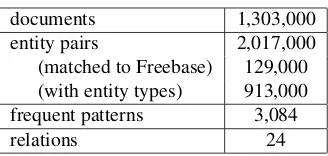
Following Mintz et al. (2009), we carried out our experiments using Wikipedia as the target corpus and Freebase (September, 2009, (Google, 2009)) as the knowledge base. We used more than 1,300,000 Wikipedia articles in the wex dump data (September, 2009, (Metaweb Technologies, 2009)). The proper-ties of our data are shown in Table 1.
In Wikipedia articles, named entities were iden-tified by anchor text linking to another article and starting with a capital letter (Yan et al., 2009). We applied Open NLP POS tagger5 and MaltParser (Nivre et al., 2007) to sentences containing more
4
[image:6.612.344.508.83.161.2]The first-order information becomes zero in this case. 5http://opennlp.sourceforge.net/
Table 1: Properties of Wikipedia dataset
documents 1,303,000
entity pairs 2,017,000
(matched to Freebase) 129,000 (with entity types) 913,000 frequent patterns 3,084
relations 24
than one named entity. We then extracted sentences containing related entity pairs with the method ex-plained in Section 3. To match entity pairs, we used ID mapping between the dump data and Freebase. We used the most frequent 24 relations.
7.2 Experiment 1: Pattern Prediction
We compared our model with baseline methods in terms of ability to predict patterns that express a given relation.
The input of this task wasXrs, which expresses whether or not each entity pair appearing with each pattern is labeled with relation r, as explained in Section 5. In Experiment 1, since we needed entity types for patterns, we restricted ourselves to entities matched with Freebase, which also provides entity types for entities. We used patterns that appear more than 20 times in the corpus.
7.2.1 Evaluation
We split the data into training data and test data. The training data wasXrs for 12 relations and the test data was that for the remaining 12 relations. The training data was used to calibrate parameters (see the following subsection for details). The test data was used for evaluation. We randomly split the data five times and took the average of the following eval-uation values.
We evaluated the performance by precision, re-call, and F value. They were calculated using gold standard data, which was constructed by hand. We manually selected patterns that actually express a target relation as positive patterns for the relation. 6 We averaged the evaluation values in terms of macro average over relations before averaging over the data splits.
6
Table 2: Averages of precision, recall, and F value in Ex-periment 1. The averages of threshold of RS(rank) and RS(value) were 6.2±3.2 and 0.10±0.06, respectively. The averages of hyperparameters of PROP were 0.84±
0.05 forλand 0.85±0.10 for the threshold.
Precision Recall F value Baseline 0.339 1.000 0.458 RS(rank) 0.749 0.549 0.467 RS(value) 0.601 0.647 0.545 PROP 0.782 0.688 0.667
7.2.2 Methods
We compared the following methods:
Baseline: This method assigns relationr to a pat-tern when the patpat-tern is mentioned with at least one entity pair corresponding to relationr in Freebase. This method is based on the DS assumption.
Ratio-based Selection (RS): Given relationr and patterns, this method calculates nrs/Ns, which is the ratio of the number of labeled entity pairs ap-pearing with patternsto the number of entity pairs including unlabeled ones. RS then selects the top
npatterns (RS(rank)). We also tested a version us-ing a real-valued threshold (RS(value)). In train-ing, we selected the threshold that maximized the F value. Some bootstrapping approaches (Carlson et al., 2010) use a rank-based threshold like RS(rank).
Proposed Model (PROP): Using the training data, we determined the two hyperparameters,λ and the threshold to roundφrsto 1 or 0, so that they max-imized the F value. When φrs is greater than the threshold, we select patternsas one expressing re-lationr.
7.2.3 Result and Discussion
The results of Experiment 1 are shown in Table 2. Our model achieved the best precision, recall, and F value. RS(value) had the second best F value, but it completely removed more than one infrequent rela-tion on average in test sets. This is problematic for real situations. RS(rank) achieved the second high-est precision. However, its recall, which is also im-portant in our task, was the lowest and its F value was almost the same as naive Baseline.
The thresholds of RS, which directly affect their performance, should be calibrated for each relation, but it is hard to do this in advance. On the other
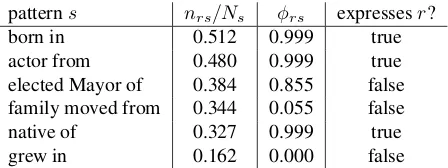
Table 3: Example of estimated φrs for r =
place of birth. Entity types are omitted in patterns. nrs/Nsis the ratio of the number of labeled entity pairs
to the number of entity pairs appearing with patterns.
patterns nrs/Ns φrs expressesr?
born in 0.512 0.999 true
actor from 0.480 0.999 true
elected Mayor of 0.384 0.855 false family moved from 0.344 0.055 false
native of 0.327 0.999 true
grew in 0.162 0.000 false
hand, our model learns parameters such as ar for each relation and thus the hyperparameter of our model does not directly affect its performance. This results in a high prediction performance.
Examples of estimated φrs, the probability with which pattern sexpresses relation r, are shown in Table 3. The pattern, “[Person] family moved from [Location]”, which does not expressplace of birth, had lowφrs in spite of having higher nrs/Ns than the valid pattern “[Person] native of [Location]”. The former pattern had higher brs, the probability with which relation r is wrongly assigned to pat-ternsvia entity pairs, because there were more en-tity pairs that appeared not only with this pattern but also with patterns that was predicted to express place of birth.
7.3 Experiment 2: Relation Extraction
We investigated the performance of relation extrac-tion using our wrong label reducextrac-tion, which uses the results of the pattern prediction.
Following Mintz et al. (2009), we performed an automatic held-out evaluation and a manual evalu-ation. In both cases, we used 400,000 articles for testing and the remaining 903,000 for training.
7.3.1 Configuration of Classifiers
¡ ¢£¤ ¥¦
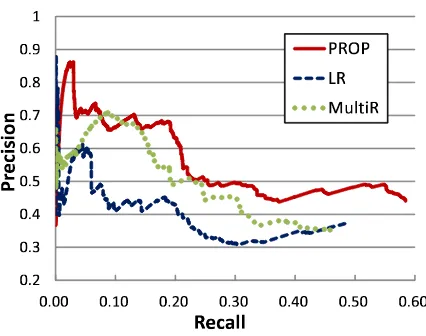
Figure 4: Precision-recall curves in held-out evaluation. Precision is reported at recall levels from 5 to 50,000.
used not only entity pairs matched to Freebase but also ones not matched to Freebase (i.e., entity pairs that do not have entity types). We used syntactic features (i.e., features obtained from the dependency parse tree of a sentence) and lexical features, and en-tity types, which essentially correspond to the ones developed by Mintz et al. (2009).
We compared the following methods: logistic re-gression with the labeled data cleaned by the pro-posed method (PROP), logistic regression with the standard DS labeled data (LR), and MultiR proposed in (Hoffmann et al., 2011) as a state-of-the-art multi-instance learning system.7 For logistic regression, when more than one relation is assigned to a sen-tence, we simply copied the feature vector and cre-ated a training example for each relation. In PROP, we used training articles for pattern prediction.8
7.3.2 Held-out Evaluation
In the held-out evaluation, relation instances dis-covered from testing articles were automatically compared with those in Freebase. This let us calcu-late the precision of each method for the bestn re-lation instances. The precisions are underestimated because this evaluation suffers from false negatives due to the incompleteness of Freebase. We changed
nfrom 5 to 50,000 and measured precision and re-call. Precision-recall curves for the held-out data are
7For MultiR, we used the authors’ implementation from http://www.cs.washington.edu/homes/raphaelh/mr/
[image:8.612.80.293.60.228.2]8In Experiment 2 we setλ= 0.85and the threshold at 0.95.
Table 4: Averages of precisions at 50 for the most fre-quent 15 relations as well as example relations.
PROP MultiR LR
place of birth 1.0 1.0 0.56
place of death 1.0 0.7 0.84 average 0.89±0.14 0.83±0.21 0.82±0.23
shown in Figure 4.
PROP achieved comparable or higher precision at most recall levels compared with LR and MultiR. Its performance atn=50,000 is much higher than that of the others. While our generative model does not use unlabeled examples as negative ones in detecting wrong labels, classifier-based approaches including MultiR do, suffering from false negatives.
7.3.3 Manual Evaluation
For manual evaluation, we picked the top ranked 50 relation instances for the most frequent 15 rela-tions. The manually evaluated precisions averaged over the 15 relations are shown in table 4.
PROP achieved the best average precision. For place of birth, LR wrongly extracted entity pairs with “[Person] played with club [Location]”, which does not express the relation. PROP and MultiR avoided this mistake. For place of death, LR and MultiR wrongly extracted entity pairs with “[Per-son] moved to [Location]”. Multi-instance learning does not work for wrong labels assigned to entity pairs that appear only once in a corpus. In fact, 72% of entity pairs that appeared with this pattern and were wrongly labeled as place of death appeared only once in the corpus. Only PROP avoided mis-takes of this kind because our method works in such situations.
8 Conclusion
References
Arthur Asuncion, Max Welling, Padhraic Smyth, and Yee W. Teh. 2009. On smoothing and inference for topic models. In Proceedings of the 25th Con-ference on Uncertainty in Artificial Intelligence (UAI ’09), pages 27–34.
Michele Banko and Oren Etzioni. 2008. The tradeoffs between open and traditional relation extraction. In
Proceedings of the 46th Annual Meeting of the Asso-ciation for Computational Linguistics: Human Lan-guage Technologies (ACL-HLT ’08), pages 28–36. Michele Banko, Michael J Cafarella, Stephen Soderl,
Matt Broadhead, and Oren Etzioni. 2007. Open in-formation extraction from the web. InProceedings of the International Joint Conferences on Artificial Intel-ligence (IJCAI ’07), pages 2670–2676.
Kedar Bellare and Andrew McCallum. 2007. Learn-ing Extractors from Unlabeled Text usLearn-ing Relevant Databases. InSixth International Workshop on Infor-mation Integration on the Web (IIWeb ’07).
Andrew Carlson, Justin Betteridge, Richard C. Wang, Es-tevam R. Hruschka Jr., and Tom M. Mitchell. 2010. Coupled semi-supervised learning for information ex-traction. InProceedings of the 3rd ACM International Conference on Web Search and Data Mining (WSDM ’10), pages 101–110.
Anthony Fader, Stephen Soderland, and Oren Etzioni. 2011. Identifying relations for open information ex-traction. In Proceedings of the 2011 Conference on Empirical Methods in Natural Language Processing (EMNLP ’11), pages 1535–1545.
Google. 2009. Freebase data dumps. http:// download.freebase.com/datadumps/. Raphael Hoffmann, Congle Zhang, and Daniel S. Weld.
2010. Learning 5000 relational extractors. In Pro-ceedings of the 48th Annual Meeting of the Associa-tion for ComputaAssocia-tional Linguistics (ACL ’10), pages 286–295.
Raphael Hoffmann, Congle Zhang, Xiao Ling, Luke Zettlemoyer, and Daniel S. Weld. 2011. Knowledge-based weak supervision for information extraction of overlapping relations. InProceedings of the 49th An-nual Meeting of the Association for Computational Linguistics: Human Language Technologies (ACL-HLT ’11), pages 541–550.
Mamoru Komachi, Taku Kudo, Masashi Shimbo, and Yuji Matsumoto. 2008. Graph-based analysis of se-mantic drift in Espresso-like bootstrapping algorithms. InProceedings of the 2008 Conference on Empirical Methods in Natural Language Processing (EMNLP ’08), pages 1011–1020.
Metaweb Technologies. 2009. Freebase wikipedia ex-traction (wex). http://download.freebase. com/wex/.
Mike Mintz, Steven Bills, Rion Snow, and Daniel Juraf-sky. 2009. Distant supervision for relation extraction without labeled data. InProceedings of the Joint Con-ference of the 47th Annual Meeting of the ACL and the 4th International Joint Conference on Natural Lan-guage Processing of the AFNLP (ACL-IJCNLP ’09), pages 1003–1011.
Joakim Nivre, Johan Hall, and Jens Nilsson. 2007. Maltparser: A language-independent system for data-driven dependency parsing. Natural Language Engi-neering, 37:95–135.
Chris Pal, Gideon Mann, and Richard Minerich. 2007. Putting semantic information extraction on the map: Noisy label models for fact extraction. InSixth Inter-national Workshop on Information Integration on the Web (IIWeb ’07).
Patrick Pantel and Marco Pennacchiotti. 2006. Espresso: Leveraging generic patterns for automatically harvest-ing semantic relations. In Proceedings of the 21st International Conference on Computational Linguis-tics and 44th Annual Meeting of the Association for Computational Linguistics (COLING-ACL ’06), pages 113–120.
Sebastian Riedel, Limin Yao, and Andrew McCallum. 2010. Modeling relations and their mentions without labeled text. InIn Proceedings of the European Con-ference on Machine Learning and Knowledge Discov-ery in Databases (ECML-PKDD ’10), pages 148–163. Ellen Riloff and Rosie Jones. 1999. Learning dictionar-ies for information extraction by multi-level bootstrap-ping. InAAAI/IAAI, pages 474–479.
Chang Wang, James Fan, Aditya Kalyanpur, and David Gondek. 2011. Relation extraction with relation topics. In Proceedings of the 2011 Conference on Empirical Methods in Natural Language Processing (EMNLP ’11), pages 1426–1436.
Fei Wu and Daniel S. Weld. 2007. Autonomously se-mantifying wikipedia. In Proceedings of the 16th ACM Conference on Conference on Information and Knowledge Management (CIKM ’07), pages 41–50. Yulan Yan, Naoaki Okazaki, Yutaka Matsuo, Zhenglu
Yang, and Mitsuru Ishizuka. 2009. Unsupervised re-lation extraction by mining wikipedia texts using in-formation from the web. InProceedings of the Joint Conference of the 47th Annual Meeting of the ACL and the 4th International Joint Conference on Natu-ral Language Processing of the AFNLP (ACL-IJCNLP ’09), pages 1021–1029.