Morphology-Syntax Interface for Turkish LFG
¨
Ozlem C¸ etino˘glu
Faculty of Engineering and Natural Sciences Sabancı University
34956, Istanbul, Turkey
Kemal Oflazer
Faculty of Engineering and Natural Sciences Sabancı University
34956, Istanbul, Turkey
Abstract
This paper investigates the use of sublexi-cal units as a solution to handling the com-plex morphology with productive deriva-tional processes, in the development of a lexical functional grammar for Turkish. Such sublexical units make it possible to expose the internal structure of words with multiple derivations to the grammar rules in a uniform manner. This in turn leads to more succinct and manageable rules. Fur-ther, the semantics of the derivations can also be systematically reflected in a com-positional way by constructing PRED val-ues on the fly. We illustrate how we use sublexical units for handling simple pro-ductive derivational morphology and more interesting cases such as causativization, etc., which change verb valency. Our pri-ority is to handle several linguistic phe-nomena in order to observe the effects of our approach on both the c-structure and the f-structure representation, and gram-mar writing, leaving the coverage and evaluation issues aside for the moment.
1 Introduction
This paper presents highlights of a large scale lex-ical functional grammar for Turkish that is being developed in the context of the ParGram project1 In order to incorporate in a manageable way, the complex morphology and the syntactic relations mediated by morphological units, and to handle lexical representations of very productive deriva-tions, we have opted to develop the grammar using sublexical units called inflectional groups.
Inflectional groups (IGs hereafter) represent the inflectional properties of segments of a complex
1http://www2.parc.com/istl/groups/nltt/
pargram/
word structure separated by derivational bound-aries. An IG is typically larger than a morpheme but smaller than a word (except when the word has no derivational morphology in which case the IG corresponds to the word). It turns out that it is the IGs that actually define syntactic relations be-tween words. A grammar for Turkish that is based on words as units would have to refer to informa-tion encoded at arbitrary posiinforma-tions in words, mak-ing the task of the grammar writer much harder. On the other hand, treating morphemes as units in the grammar level implies that the grammar will have to know about morphotactics making either the morphological analyzer redundant, or repeat-ing the information in the morphological analyzer at the grammar level which is not very desirable. IGs bring a certain form of normalization to the lexical representation of a language like Turkish, so that units in which the grammar rules refer to are simple enough to allow easy access to the in-formation encoded in complex word structures.
That IGs delineate productive derivational pro-cesses in words necessitates a mechanism that re-flects the effect of the derivations to semantic rep-resentations and valency changes. For instance, English LFG (Kaplan and Bresnan, 1982) repre-sents derivations as a part of the lexicon; both happy and happiness are separately lexicalized. Lexicalized representations of adjectives such as easy and easier are related, so that both lexicalized and phrasal comparatives would have the same feature structure; easier would have the feature structure
(1)
PRED ‘easy’
ADJUNCT
PRED ‘more’
DEG-DIM pos DEGREE comparative
Encoding derivations in the lexicon could be ap-plicable for languages with relatively unproduc-tive derivational phenomena, but it certainly is not
possible to represent in the grammar lexicon,2 all derived forms as lexemes for an agglutinative lan-guage like Turkish. Thus one needs to incorpo-rate such derivational processes in a principled way along with the computation of the effects on derivations on the representation of the semantic information.
Lexical functional grammar (LFG) (Kaplan and Bresnan, 1982) is a theory representing the syn-tax in two parallel levels: Constituent structures (c-structures) have the form of context-free phrase structure trees. Functional structures (f-structures) are sets of pairs of attributes and values; attributes may be features, such as tense and gender, or func-tions, such as subject and object. C-structures de-fine the syntactic representation and f-structures define more semantic representation. Therefore c-structures are more language specific whereas f-structures of the same phrase for different lan-guages are expected to be similar to each other.
The remainder of the paper is organized as fol-lows: Section 2 reviews the related work both on Turkish, and on issues similar to those addressed in this paper. Section 3 motivates and presents IGs while Section 4 explains how they are employed in a LFG setting. Section 5 summarizes the ar-chitecture and the current status of the our system. Finally we give conclusions in Section 6.
2 Related Work
G¨ung¨ord¨u and Oflazer (1995) describes a rather extensive grammar for Turkish using the LFG formalism. Although this grammar had a good coverage and handled phenomena such as free-constituent order, the underlying implementation was based on pseudo-unification. But most cru-cially, it employed a rather standard approach to represent the lexical units: words with multiple nested derivations were represented with complex nested feature structures where linguistically rel-evant information could be embedded at unpre-dictable depths which made access to them in rules extremely complex and unwieldy.
Bozs¸ahin (2002) employed morphemes overtly as lexical units in a CCG framework to account for a variety of linguistic phenomena in a pro-totype implementation. The drawback was that morphotactics was explicitly raised to the level of the sentence grammar, hence the categorial lexi-con accounted for both lexi-constituent order and the morpheme order with no distinction. Oflazer’s de-pendency parser (2003) used IGs as units between which dependency relations were established. An-other parser based on IGs is Eryi˘git and Oflazer’s
2
We use this term to distinguish the lexicon used by the morphological analyzer.
(2006) statistical dependency parser for Turkish. C¸ akıcı (2005), used relations between IG-based representations encoded within the Turkish Tree-bank (Oflazer et al., 2003) to automatically induce a CCG grammar lexicon for Turkish.
In a more general setting, Butt and King (2005) have handled the morphological causative in Urdu as a separate node in c-structure rules using LFG’s restriction operator in semantic construction of causatives. Their approach is quite similar to ours yet differs in an important way: the rules explicitly use morphemes as constituents so it is not clear if this is just for this case, or all morphology is han-dled at the syntax level.
3 Inflectional Groups as Sublexical Units
Turkish is an agglutinative language where a se-quence of inflectional and derivational morphemes get affixed to a root (Oflazer, 1994). At the syntax level, the unmarked constituent order is SOV, but constituent order may vary freely as demanded by the discourse context. Essentially all constituent orders are possible, especially at the main sen-tence level, with very minimal formal constraints. In written text however, the unmarked order is dominant at both the main sentence and embedded clause level.
Turkish morphotactics is quite complicated: a given word form may involve multiple derivations and the number of word forms one can generate from a nominal or verbal root is theoretically in-finite. Turkish words found in typical text aver-age about 3-4 morphemes including the stem, with an average of about 1.23 derivations per word, but given that certain noninflecting function words such as conjuctions, determiners, etc. are rather frequent, this number is rather close to 2 for in-flecting word classes. Statistics from the Turkish Treebank indicate that for sentences ranging be-tween 2 words to 40 words (with an average of about 8 words), the number of IGs range from 2 to 55 IGs (with an average of 10 IGs per sentence) (Eryi˘git and Oflazer, 2006).
The morphological analysis of a word can be represented as a sequence of tags corresponding to the morphemes. In our morphological analyzer output, the tagˆDBdenotes derivation boundaries that we also use to define IGs. If we represent the morphological information in Turkish in the fol-lowing general form:
root+IG DB+IG
DB+ DB+IG .
then eachIG denotes the relevant sequence of in-flectional features including the part-of-speech for the root (in IG½) and for any of the derived forms.
Figure 1: Modifier-head relations in the NP eski kitaplarımdaki hikayeler
word, and by ambiguous interpretations of mor-phemes.
For instance, the morphological analysis of the derived modifiercezalandırılacak (lit-erally, “(the one) that will be given punishment”) would be :3
ceza(punishment)+Noun+A3sg+Pnon+Nom ˆDB+Verb+Acquire
ˆDB+Verb+Caus ˆDB+Verb+Pass+Pos ˆDB+Adj+FutPart+Pnon
The five IGs in this word are:
1.+Noun+A3sg+Pnon+Nom
2.+Verb+Acquire
3.+Verb+Caus
4.+Verb+Pass+Pos
5.+Adj+FutPart+Pnon
The first IG indicates that the root is a singular noun with nominative case marker and no posses-sive marker. The second IG indicates a deriva-tion into a verb whose semantics is “to acquire” the preceding noun. The third IG indicates that a causative verb (equivalent to “to punish” in En-glish), is derived from the previous verb. The fourth IG indicates the derivation of a passive verb with positive polarity from the previous verb. Fi-nally the last IG represents a derivation into future participle which will function as a modifier in the sentence.
The simple phrase eski kitaplarımdaki hikayeler (the stories in my old books) in Figure 1 will help clarify how IGs are involved in syntactic relations: Here, eski (old) modifies kitap (book) and not hikayeler (stories),4 and the locative phrase eski
3
The morphological features other than the obvious part-of-speech features are: +A3sg: 3sg number-person agree-ment,+Pnon: no possesive agreement,+Nom: Nominative case, +Acquire: acquire verb, +Caus: causative verb,
+Pass: passive verb,+FutPart: Derived future participle,
+Pos: Positive Polarity.
4
Though looking at just the last POS of the words one sees an +Adj +Adj +Noun sequence which may imply that both adjectives modify the noun hikayeler
kitaplarımda (in my old books) modifies hikayeler with the help of derivational suffix -ki. Morpheme boundaries are represented by ’+’ sign and mor-phemes in solid boxes actually define one IG. The dashed box around solid boxes is for word bound-ary. As the example indicates, IGs may consist of one or more morphemes.
Example (2) shows the corresponding f-structure for this NP. Supporting the dependency representation in Figure 1, f-structure of adjective eski is placed as the adjunct of kitaplarımda, at the innermost level. The semantics of the relative suffix -ki is shown as ’rel OBJ’ where the
f-structure that represents the NP eski kitaplarımda is the OBJ of the derived adjective. The new f-structure with a PRED constructed on the fly, then modifies the noun hikayeler. The derived adjective behaves essentially like a lexical adjective. The ef-fect of using IGs as the representative units can be explicitly seen in c-structure where each IG cor-responds to a separate node as in Example (3).5 Here, DS stands for derivational suffix.
(2)
PRED ‘hikaye’
ADJUNCT
PRED ‘rel kitap’
OBJ
PRED ‘kitap’
ADJUNCT
PRED ‘eski’ ATYPE attributive
CASE loc, NUM pl
ATYPE attributive
CASENOM, NUMPL
(3) NP
AP
NP
AP
A
eski
NP
N
kitaplarımda DS
ki
NP
N
hikayeler
Figure 2 shows the modifier-head relations for a more complex example given in Example (4) where we observe a chain/hierarchy of relations between IGs
(4) mavi blue
renkli color-WITH elbiselideki
dress-WITH-LOC-REL kitap book
5Note that placing the sublexical units of a word in
[image:3.595.307.533.341.594.2]‘the book on the one with the blue colored dress’
Figure 2: Syntactic Relations in the NP mavi ren-kli elbiselideki kitap
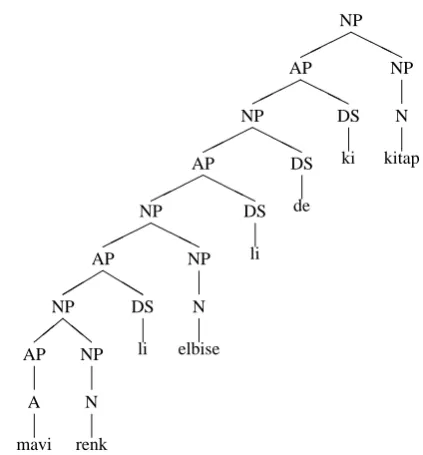
Examples (5) and (6) show respectively the con-stituent structure (c-structure) and the correspond-ing feature structure (f-structure) for this noun phrase. Within the tree representation, each IG corresponds to a separate node. Thus, the LFG grammar rules constructing the c-structures are coded using IGs as units of parsing. If an IG con-tains the root morpheme of a word, then the node corresponding to that IG is named as one of the syntactic category symbols. The rest of the IGs are given the node name DS (to indicate deriva-tional suffix), no matter what the content of the IG is.
The semantic representation of derivational suf-fixes plays an important role in f-structure con-struction. In almost all cases, each derivation that is induced by an overt or a covert affix gets a OBJ feature which is then unified with the f-structure of the preceding stem already constructed, to obtain the feature structure of the derived form, with the PRED of the derived form being constructed on the fly. A PRED feature thus constructed however is not meant to necessarily have a precise lexical semantics. Most derivational suffixes have a con-sistent (lexical) semantics6, but some don’t, that is, the precise additional lexical semantics that the derivational suffix brings in, depends on the stem it is affixed to. Nevertheless, we represent both cases in the same manner, leaving the determina-tion of the precise lexical semantics aside.
If we consider Figure 2 in terms of dependency relations, the adjective mavi (blue) modifies the noun renk (color) and then the derivational suf-fix -li (with) kicks in although the -li is attached to renk only. Therefore, the semantics of the phrase should be with(blue color), not blue
with(color). With the approach we take, this
difference can easily be represented in both the f-structure as in the leftmost branch in Example (5)
6
e.g., the “to acquire” example earlier
and the c-structure as in the middle ADJUNCT f-structure in Example (6). Each DS in c-structure gives rise to an OBJject in c-structure. More pre-cisely, a derived phrase is always represented as a binary tree where the right daughter is always a DS. In structure DS unifies with the mother f-structure and inserts PRED feature which subcat-egorizes for a OBJ. The left daughter of the bi-nary tree is the original form of the phrase that is derived, and it unifies with the OBJ of the mother f-structure.
(5)
NP
AP
NP
AP
NP
AP
NP
AP
A
mavi NP
N
renk DS
li NP
N
elbise DS
li DS
de DS
ki NP
N
kitap
4 Inflectional Groups in Practice
We have already seen how the IGs are used to con-struct on the fly PRED features that reflect the lexical semantics of the derivation. In this section we describe how we handle phenomena where the derivational suffix in question does not explicitly affect the semantic representation in PRED fea-ture but determines the semantic role so as to unify the derived form or its components with the appro-priate external f-structure.
4.1 Sentential Complements and Adjuncts,
and Relative Clauses
In Turkish, sentential complements and adjuncts are marked by productive verbal derivations into nominals (infinitives, participles) or adverbials, while relative clauses with subject and non-subject (object or adjunct) gaps are formed by participles which function as adjectivals modifying a head noun.
(6) PRED ‘kitap’ ADJUNCT
PRED ‘rel zero-deriv’
OBJ
PRED ‘zero-deriv with’
OBJ
PRED ‘with elbise’
OBJ PRED ‘elbise’ ADJUNCT
PRED ‘with renk’
OBJ PRED ‘renk’ ADJUNCT PRED ‘mavi’
CASE nom, NUM sg, PERS 3 ATYPE attributive
CASE nom, NUM sg, PERS 3
ATYPE attributive
CASE loc, NUM sg, PERS 3
ATYPE attributive
CASE NOM,NUM SG,PERS3
(7) Kız Girl-NOM adamı man-ACC aradı. call-PAST ‘The girl called the man’
In (8), we see a past-participle form heading a sentential complement functioning as an object for the verb s¨oyledi (said).
(8) Manav Grocer-NOM kızın girl-GEN adamı man-ACC aradı˘gını call-PASTPART-ACC s¨oyledi. say-PAST
‘The grocer said that the girl called the man’
Once the grammar encounters such a sentential complement, everything up to the participle IG is parsed, as a normal sentence and then the partici-ple IG appends nominal features, e.g., CASE, to the existing f-structure. The final f-structure is for a noun phrase, which now is the object of the ma-trix verb, as shown in Example (9). Since the par-ticiple IG has the right set of syntactic features of a noun, no new rules are needed to incorporate the derived f-structure to the rest of the grammar, that is, the derived phrase can be used as if it is a sim-ple NP within the rules. The same mechanism is used for all kinds of verbal derivations into infini-tives, adverbial adjuncts, including those deriva-tions encoded by lexical reduplicaderiva-tions identified by multi-word construct processors.
(9)
PRED ‘s¨oyle manav, ara’
SUBJ
PRED ‘manav’
CASE nom, NUM sg, PERS 3 OBJ
PRED ‘ara k z, adam’
SUBJ
PRED ‘k z’
CASE gen, NUM sg, PERS 3
OBJ
PRED ‘adam’
CASE acc, NUM sg, PERS 3
CHECK
PART pastpart
CASE acc, NUM sg, PERS 3, VTYPE main CLAUSE-TYPE nom TNS-ASP TENSE past
NUMSG, PERS 3, VTYPEMAIN
Relative clauses also admit to a similar mech-anism. Relative clauses in Turkish are gapped sentences which function as modifiers of nominal heads. Turkish relative clauses have been previ-ously studied (Barker et al., 1990; G¨ung¨ord¨u and Engdahl, 1998) and found to pose interesting is-sues for linguistic and computational modeling. Our aim here is not to address this problem in its generality but show with a simple example, how our treatment of IGs encoding derived forms han-dle the mechanics of generating f-structures for such cases.
Kaplan and Zaenen (1988) have suggested a general approach for handling long distance de-pendencies. They have extended the LFG notation and allowed regular expressions in place of sim-ple attributes within f-structure constraints so that phenomena requiring infinite disjunctive enumer-ation can be described with a finite expression. We basically follow this approach and once we derive the participle phrase we unify it with the appro-priate argument of the verb using rules based on functional uncertainty. Example (10) shows a rel-ative clause where a participle form is used as a modifier of a head noun, adam in this case.
(10) Manavın Grocer-GEN kızın girl-GEN [] obj-gap aradı˘gını call-PASTPART-ACC s¨oyledi˘gi say-PASTPART adam man-NOM ‘The man the grocer said the girl called’
This time, the sentence is parsed with a gap with an appropriate functional uncertainty constraint, and when the participle IG is encountered the sen-tence f-structure is derived into an adjective and the gap in the derived form, the object here, is then unified with the head word as marked with co-indexation in Example (11).
is almost the same as the whole f-structure of Ex-ample (9), differing in TNS-ASP and ADJUNCT-TYPE features. At the grammar level, both the rel-ative clause and the complete sentence is parsed with the same core sentence rule. To understand whether the core sentence is a complete sentence or not, the finite verb requirement is checked. Since the requirement is met by the existence of TENSE feature, Example (8) is parsed as a com-plete sentence. Indeed the relative clause also in-cludes temporal information as ‘pastpart’ value of PART feature, of the ADJUNCT f-structure, de-noting a past event.
(11)
PRED ’adam’½
ADJUNCT
PRED ‘s¨oyle manav, ara’ SUBJ
PRED ‘manav’ CASE gen, NUM sg, PERS 3
OBJ
PRED ‘ara kz, adam’ SUBJ
PRED ‘kz’
CASE gen, NUM sg, PERS 3 OBJ PRED ‘adam’ ½ CHECK PART pastpart
CASE acc, NUM sg, PERS 3, VTYPE main CLAUSE-TYPE nom CHECK PART pastpart
NUM sg, PERS 3, VTYPE main ADJUNCT-TYPE relative
CASENOM, NUMSG, PERS 3
4.2 Causatives
Turkish verbal morphotactics allows the produc-tion multiply causative forms for verbs.7 Such verb formations are also treated as verbal deriva-tions and hence define IGs. For instance, the mor-phological analysis for the verb aradı (s/he called) is
ara+Verb+Pos+Past+A3sg
and for its causative arattı (s/he made (someone else) call) the analysis is
ara+VerbˆDB+Verb+Caus+Pos+Past+A3sg.
In Example (12) we see a sentence and its causative form followed by respective f-structures for these sentences in Examples (13) and (14). The detailed morphological analyses of the verbs are given to emphasize the morphosyntactic relation between the bare and causatived versions of the verb.
(12) a. Kız Girl-NOM
adamı man-ACC
aradı. call-PAST ‘The girl called the man’
b. Manav Grocer-NOM kıza girl-DAT adamı man-ACC arattı. call-CAUS-PAST
‘The grocer made the girl call the man’
7Passive, reflexive, reciprocal/collective verb formations
are also handled in morphology, though the latter two are not productive due to semantic constraints. On the other hand it is possible for a verb to have multiple causative markers, though in practice 2-3 seem to be the maximum observed.
(13)
PRED ‘ara k z, adam’
SUBJ
PRED ‘k z’
CASE nom, NUM sg, PERS 3
OBJ
PRED ‘adam’
CASE acc, NUM sg, PERS 3
TNS-ASP
TENSE past NUMSG, PERS 3,VTYPEMAIN
(14)
PRED ‘caus manav, k z, adam, ara k z , adam’ SUBJ
PRED ‘manav’
OBJ
PRED ‘k z’ ½
OBJTH
PRED ‘adam’ ¾
XCOMP
PRED ‘ara k z , adam’
SUBJ
PRED ‘k z’
CASE dat, NUM sg, PERS 3
½
OBJ
PRED ‘adam’
CASE acc, NUM sg, PERS 3 ¾ VTYPE main TNS-ASP TENSE past NUMSG, PERS 3,VTYPEMAIN
(15) a. adam man-NOM
kadını woman-ACC
aradı. call-PAST ‘the man called the woman’
b. adama man-DAT
kadını woman-ACC
arattı.
call-CAUS-PAST ‘(s/he) made the man call the woman’ (16) a. adam
man-NOM kadına woman-DAT
vurdu. hit-PAST ‘the man hit the woman’
b. adamı man-ACC
kadına woman-DAT
vurdurdu. hit-CAUS-PAST ‘(s/he) made the man hit the woman’
All other derivational phenomena can be solved in a similar way by establishing the appropriate se-mantic representation for the derived IG and its effect on the semantic representation.
5 Current Implementation
The implementation of the Turkish LFG gram-mar is based on the Xerox Linguistic Environ-ment (XLE) (Maxwell III and Kaplan, 1996), a grammar development platform that facilitates the integration of various modules, such as tokeniz-ers, finite-state morphological analyztokeniz-ers, and lex-icons. We have integrated into XLE, a series of finite state transducers for morphological analysis and for multi-word processing for handling lexi-calized, semi-lexicalized collocations and a lim-ited form of non-lexicalized collocations.
The finite state modules provide the rele-vant ambiguous morphological interpretations for words and their split into IGs, but do not provide syntactically relevant semantic and subcategoriza-tion informasubcategoriza-tion for root words. Such informasubcategoriza-tion is encoded in a lexicon of root words on the gram-mar side.
The grammar developed so far addresses many important aspects ranging from free constituent or-der, subject and non-subject extractions, all kinds of subordinate clauses mediated by derivational morphology and has a very wide coverage NP sub-grammar. As we have also emphasized earlier, the actual grammar rules are oblivious to the source of the IGs, so that the same rule handles an adjective - noun phrase regardless of whether the adjective is lexical or a derived one. So all such relations in Figure 28 are handled with the same phrase struc-ture rule.
The grammar is however lacking the treatment of certain interesting features of Turkish such as suspended affixation (Kabak, 2007) in which the inflectional features of the last element in a co-ordination have a phrasal scope, that is, all other
8
Except the last one which requires some additional treat-ment with respect to definiteness.
coordinated constituents have certain default fea-tures which are then “overridden” by the feafea-tures of the last element in the coordination. A very sim-ple case of such suspended affixation is exempli-fied in (17a) and (17b). Note that although this is not due to derivational morphology that we have emphasized in the previous examples, it is due to a more general nature of morphology in which af-fixes may have phrasal scopes.
(17) a. kız girl
adam man-NOM
ve and
kadını woman-ACC aradı.
call-PAST
‘the girl called the man and the woman’ b. kız
girl [adam [man
ve and
kadın]-ı woman]-ACC
aradı. call-PAST ‘the girl called the man and the woman’ Suspended affixation is an example of a phe-nomenon that IGs do not seem directly suitable for. The unification of the coordinated IGs have to be done in a way in which non-default features of the final constituent is percolated to the upper node in the tree as is usually done with phrase struc-ture grammars but unlike coordination is handled in such grammars.
6 Conclusions and Future Work
This paper has described the highlights of our work on developing a LFG grammar for Turkish employing sublexical constituents, that we have called inflectional groups. Such a sublexical con-stituent choice has enabled us to handle the very productive derivational morphology in Turkish in a rather principled way and has made the grammar more or less oblivious to morphological complex-ity.
Our current and future work involves extending the coverage of the grammar and lexicon as we have so far included in the grammar lexicon only a small subset of the root lexicon of the morpho-logical analyzer, annotated with the semantic and subcategorization features relevant to the linguis-tic phenomena that we have handled. We also in-tend to use the Turkish Treebank (Oflazer et al., 2003), as a resource to extract statistical informa-tion along the lines of Frank et al. (2003) and O’Donovan et al. (2005).
Acknowledgement
References
Chris Barker, Jorge Hankamer, and John Moore, 1990.
Grammatical Relations, chapter Wa and Ga in
Turk-ish. CSLI.
Cem Bozs¸ahin. 2002. The combinatory morphemic lexicon. Computational Linguistics, 28(2):145–186.
Miriam Butt and Tracey Holloway King. 2005. Restriction for morphological valency alternations: The Urdu causative. In Proceedings of The 10th
International LFG Conference, Bergen, Norway.
CSLI Publications.
Ruken C¸ akıcı. 2005. Automatic induction of a CCG grammar for Turkish. In Proceedings of the ACL
Student Research Workshop, pages 73–78, Ann
Ar-bor, Michigan, June. Association for Computational Linguistics.
Mary Dalrymple. 2001. Lexical Functional
Gram-mar, volume 34 of Syntax and Semantics. Academic
Press, New York.
G¨uls¸en Eryi˘git and Kemal Oflazer. 2006. Statisti-cal dependency parsing for turkish. In Proceedings
of EACL 2006 - The 11th Conference of the Euro-pean Chapter of the Association for Computational Linguistics, Trento, Italy. Association for
Computa-tional Linguistics.
Anette Frank, Louisa Sadler, Josef van Genabith, and Andy Way. 2003. From treebank resources to LFG f-structures:automatic f-structure annotation of tree-bank trees and CFGs extracted from treetree-banks. In Anne Abeille, editor, Treebanks. Kluwer Academic Publishers, Dordrecht.
Zelal G¨ung¨ord¨u and Elisabeth Engdahl. 1998. A rela-tional approach to relativization in Turkish. In Joint
Conference on Formal Grammar, HPSG and Cate-gorial Grammar, Saarbr¨ucken, Germany, August.
Zelal G¨ung¨ord¨u and Kemal Oflazer. 1995. Parsing Turkish using the Lexical Functional Grammar for-malism. Machine Translation, 10(4):515–544.
Barıs¸ Kabak. 2007. Turkish suspended affixation.
Lin-guistics, 45. (to appear).
Ronald M. Kaplan and Joan Bresnan. 1982. Lexical-functional grammar: A formal system for grammat-ical representation. In Joan Bresnan, editor, The
Mental Representation of Grammatical Relations,
pages 173–281. MIT Press, Cambridge, MA.
Ronald M. Kaplan and Annie Zaenen. 1988. Long-distance dependencies, constituent structure, and functional uncertainty. In M. Baitin and A. Kroch, editors, Alternative Conceptions of Phrase
Struc-ture. University of Chicago Press, Chicago.
John T. Maxwell III and Ronald M. Kaplan. 1996. An efficient parser for LFG. In Miriam Butt and Tracy Holloway King, editors, The Proceedings of
the LFG ’96 Conference, Rank Xerox, Grenoble.
Ruth O’Donovan, Michael Burke, Aoife Cahill, Josef van Genabith, and Andy Way. 2005. Large-scale induction and evaluation of lexical resources from the Penn-II and Penn-III Treebanks. Computational
Linguistics, 31(3):329–365.
Kemal Oflazer, Bilge Say, Dilek Zeynep Hakkani-T¨ur, and G¨okhan T¨ur. 2003. Building a Turkish tree-bank. In Anne Abeille, editor, Building and
Exploit-ing Syntactically-annotated Corpora. Kluwer
Aca-demic Publishers.
Kemal Oflazer. 1994. Two-level description of Turk-ish morphology. Literary and Linguistic
Comput-ing, 9(2):137–148.
Kemal Oflazer. 2003. Dependency parsing with an extended finite-state approach. Computational