An HMM-Based Approach to Automatic Phrasing for Mandarin
Text-to-Speech Synthesis
Jing Zhu
Department of Electronic Engineering Shanghai Jiao Tong University
Jian-Hua Li
Department of Electronic Engineering Shanghai Jiao Tong University
Abstract
Automatic phrasing is essential to Mandarin text-to-speech synthesis. We select word format as target linguistic feature and propose an HMM-based approach to this issue. Then we define four states of prosodic positions for each word when employing a discrete hidden Markov model. The approach achieves high accuracy of roughly 82%, which is very close to that from manual labeling. Our experimental results also demonstrate that this approach has advantages over those part-of-speech-based ones.
1 Introduction
Owing to the limitation of vital capacity and contextual information, breaks or pauses are always an important ingredient of human speech. They play a great role in signaling structural boundaries. Similarly, in the area of text-to-speech (TTS) synthesis, assigning breaks is very
crucial to naturalness and intelligibility,
particularly in long sentences.
The challenge in achieving naturalness mainly results from prosody generation in TTS synthesis. Generally speaking, prosody deals with phrasing, loudness, duration and speech intonation. Among
these prosodic features, phrasing divides
utterances into meaningful chunks of information, called hierarchic breaks. However, there is no unique solution to prosodic phrasing in most cases. Different solution in phrasing can result in different meaning that a listener could perceive. Considering its importance, recent TTS research has focused on automatic prediction of prosodic phrase based on the part-of-speech (POS) feature or syntactic structure(Black and Taylor, 1994; Klatt, 1987; Wightman, 1992; Hirschberg 1996; Wang, 1995; Taylor and Black, 1998).
To our understanding, POS is a grammar-based structure that can be extracted from text. There is no explicit relationship between POS and the prosodic structure. At least, in Mandarin speech synthesis, we cannot derive the prosodic structure from POS sequence directly. By contrast, a word carries rich information related to phonetic feature. For example, in Mandarin, a word can reveal many phonetic features such as pronunciation, syllable number, stress pattern, tone, light tone (if available) and retroflexion (if available) etc. So we begin to explore the role of word in predicting prosodic phrase and propose a word-based statistical method for prosodic-phrase grouping. This method chooses Hidden Markov Model (HMM) as the training and predicting model.
2 Related Work
Automatic prediction of prosodic phrase is a complex task. There are two reasons for this conclusion. One is that there is no explicit relationship between text and phonetic features. The other lies in the ambiguity of word segmentation, POS tagging and parsing in the Chinese natural language processing. As a result, the input information for the prediction of prosodic phrase is quite “noisy”. We can find that most of published methods, including (Chen et al., 1996; Chen et al., 2000; Chou et al., 1996; Chou et al., 1997; Gu et al., 2000; Hu et al., 2000; Lv et al., 2001; Qian et al., 2001; Ying and Shi, 2001) do not make use of high-level syntactic features due to two reasons. Firstly, it is very challenging to parse Chinese sentence because no grammar is formal enough to be applied to
Chinese parsing. In addition, lack of
morphologies also causes many problems in parsing. Secondly, the syntactic structure is not isomorphic to the prosodic phrase structure. Prosodic phrasing remains an open task in the Chinese speech generation. In summary, all the known methods depend on POS features more or less.
3 Word-based Prediction
As noted previously, the prosodic phrasing is associated with words to some extent in Mandarin TTS synthesis. We observe that some
function words (such as “ ”) never occur in
phrase-initial position. Some prepositions seldom act as phrase-finals. These observations lead to investigating the role of words in prediction of prosodic phrase. In addition, large-scale training data is readily available, which enables us to apply data-driven models more conveniently than before.
3.1 The Model
The sentence length in real text can vary significantly. A model with a fixed-dimension input does not fit the issue in prosodic breaking. Alternatively, the breaking prediction can be converted into an optimization problem that allows us to adopt the hidden Markov model (HMM).
An HMM for discrete symbol observations is characterized by the following:
- the state set Q ={qi}, where 1≤i≤N, N is the number of states
- the number of distinct observation symbol per state M
-the state-transition probability distribution
A={aij}, where
aij=P[qt+1=j|qt=i], 1≤i,j≤
N
-the observation symbol probability
distribution B={bj(k)}, where
bj(k)=P[ot =vk |qt = j],
1≤i,j≤ N
- the initial state distribution π={πi}, where πi =P[ot=vk|qt=j], 1≤i,j≤ M .
The complete parameter set of the model is
denoted as a compact notation λ=(A,B,π).
Here, we define our prosodic positions for a word to apply the HMM as follows.
0 phrase-initial 1 phrase-medial 2 phrase-final 3 separate
This means that Q can be represented as
Q={0,1,2,3}, corresponding to the four prosodic
positions. The word itself is defined as a discrete symbol observation.
3.2 The Corpus
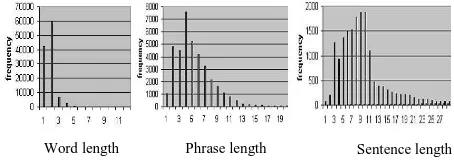
The text corpus is divided into two parts. One serves as training data. This part contains 17,535 sentences, among which, 9,535 sentences have corresponding utterances. The other is a test set, which includes 1,174 sentences selected from the Chinese People’s Daily. The sentence length, namely the number of words in a sentence varies from 1 to 30. The distribution of word length, phrase length and sentence length(all in character number) is shown in Figure 1.
In a real text, there may exist words that are difficult to enumerate in the system lexicon, called “non-standard” words (NSW). Examples of NSW are proper names, digit strings, derivative words by adding prefix or suffix.
Proper names include person name, place name,
institution name and abbreviations, etc.
Alternatively, some characters are usually viewed as prefix and suffix in Chinese text. For
instance, the character (pseudo-) always
serves as a prefix, while another character
(-like) serves as a suffix. There are 130 analogous Chinese characters have been collected roundly. A word segmentation module is designed to identify these non-standard words.
3.3 Parameter estimation
[image:2.595.304.531.354.436.2]Parameter estimation of the model can be treated as an optimization problem. The parametric methods will be optimal if distribution derived from the training data is in the class of distributions being considered. But there is no Figure 1. Statistical results from the corpus
known way so far for maximizing the probability of the observation sequence in a closed form. In
the present approach, a straightforward,
reasonable yet, method to re-estimate parameters of the HMM is applied. Firstly, statistics for the occurring times of word, prosodic position, prosodic-position pair are conducted. Secondly, the simple ratio of occurring times is used to calculate the probability distribution. The following expressions are used to implement calculations,
State probability distribution
, 1≤ i≤ N
Fi is the occurring times of state qi
the state-transition probability
distributionA={aij},
i ij ij F F
a ≈ , 1≤ i, j≤ N , Fij is the occurring
times of state pair (qi,qj).
Observation probability distribution
)} ( {b k
B= j ,
] [ ) , ( ) ( j k j q P v o j q F k
b ∝ = =
where = = = = =
t t k
k F q j o v
v o j q
F( , ) ( , )
is the concurring times of state qj and observation
vk.
With respect to the proper names, all the person names are dealt with identically. This is based on an assumption that the proper names of individual category have the same usage.
3.4 Parameter adjustment
Note that the training corpus is discrete, finite set. The parameter set resulting from the limited samples cannot converge to the “true” values with probability. In particular, some words may not be included in the corpus. In this case, the above expressions for training may result in zero valued observation-probability. This, of course, is unexpected. The parameters should be adjusted after the automatic model training. The way is to
use a sufficiently small positive constant ε to
represent the zero valued
observation-probabilities.
3.5 The search procedure
In this stage, an optimal state sequence that explains the given observations by the model is searched. That is to say, for the input sentence, an optimal prosodic-position sequence is predicted with the HHM. Instead of using the
popular Viterbi algorithm, which is
asymptotically optimal, we apply the Forward-Backward procedure to conduct searching.
Backward and forward search
All the definitions described in (Rabiner, 1999) are followed in the present approach.
The forward procedure
forward variable: αt(i)=P(o1o2 ot,qt=i|λ)
initialization: α1(i)=πibi(o1), 1≤i≤N.
induction: N j 1 1, -T t 1 ), ( ) ( ) ( 1 1
1 = + ≤ ≤ ≤ ≤
=
+ j t
N i
ij t
t j α i a b o
α . termination: = = N i T i O P 1 ) ( ) |
( λ α
where T is the number of observations.
The backward procedure
backward variable: ) , | ( )
( 1 2 λ
βt i =Pot+ot+ oT qt =i
initialization βT(i)=1, 1≤i≤N
induction: N i 1 1, 2, -T 1, -T t ) ( ) ( ) ( 1 1
1 = ≤ ≤
= + = + j o b a i t N j t j j i t β β
The “optimal” state sequence
posteriori probability variable: γt(i), this is
the probability of being in state i at time t given
the observation sequence O and the model λ. It
can be expressed as follows:
= = = = N i t t t t t t i i i i O i q P i 1 ) ( ) ( ) ( ) ( ) , | ( ) ( β α β α λ γ
most likely state *
t
q at time t:
argmax[ ()] 1 t T
N i 1 *= ≤ ≤ ≤ ≤ i
qt γt .
Here comes a question. It is, whether the optimal state sequence means the optimal path. = ≈ N j j i i F F q P 1 ] [ j k j F v o j q F k
Search based on dynamic programming
The preceding search procedure targets the optimal state sequence satisfying one criterion. But it does not reflect the probability of occurrence of sequences of states. This issue is explored based on a dynamic programming (DP) like approach, as described below.
For convenience, we illustrate the problem as shown in Figure 2.
From Figure 2, it can be seen that the transition from state i to state j only occurs in the two consecutive stages, namely time synchronous.
Totally, there are T stages, N2T arcs. Therefore,
the optimal-path issue is a multi-stage
optimization problem, which is similar to the DP problem. The slight difference lies in that a node in the conventional DP problem does not contain any additional attribute, while a node in HMM carries the attribute of observation probability distribution. Considering this difference, we modify the conventional DP approach in the following way.
In the trellis above, we add a virtual node (state), where the start node qs corresponding to
time 0 before time 1. All the transitions from qs
to nodes in the first stage (time 1) equal to 1/N. Furthermore, all the observation probability distributions equal to 1/M. Denoting the optimal
path from qs to the node qi of time t as path(t,i),
path(t,i) is a set of sequential states. Accordingly,
we denote the score of path(t,i) as s(t,i). Then,
s(t,i) is associated with the state-transition
probability distribution and observation
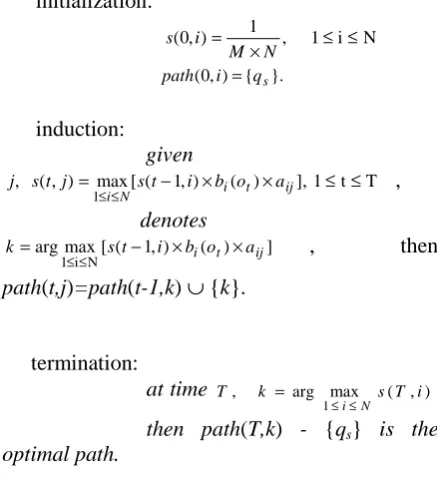
probability distribution. We describe the induction process as follows.
initialization:
(0, ) 1 , 1≤i≤N
× =
N M i s
path(0,i)={qs}.
induction:
given
T t 1 ], ) ( ) , 1 ( [ max ) , ( ,
1 − × × ≤ ≤
= ≤
≤i N i t ij
a o b i t s j
t s
j ,
denotes
] ) ( ) , 1 ( [ max arg
N i
1 i t ij
a o b i t s
k= − × ×
≤
≤ , then
path(t,j)=path(t-1,k) ∪ {k}.
termination:
at time , arg max ( , )
1 s T i
k T
N i≤
≤
= .
then path(T,k) - {qs} is the
optimal path.
Basically, the main idea of our approach lies in that if the final optimal path passes a node j at time t, it passes all the nodes in path(t,j) sequentially. This idea is similar to the forward procedure of DP. We can begin with the termination T and derive an alternative approach. As for time complexity, the above trellis can be viewed as a special DAG. The state transition
from time t to time t+1 requires 2N2 calculations,
resulting in the time complexity O(TN 2).
Intuitively, the optimal path differs from the optimal state sequence generated by the Forward-Backward procedure. The underlying idea of Forward-Backward procedure is that the
target state sequence can explain the
observations optimally. To support our claim,
we can give a simple example (T=2, N=2,π
=[0.5,0.5]T ) as follows:
0.18
0.0 0.82
1.0
0.2 0.8
0.1 0.9
1 2 1
2
Apparently, the optimal state sequence is (1,1), while the optimal path is {1,2}.
4 Experimental Results
[image:4.595.305.524.77.318.2]Before reporting the experimental results, we first define the criterion of evaluation and the related issues.
Figure 2. Illustration of search procedure in trellis (quoted from [Rabiner, 1999])
[image:4.595.72.281.210.330.2]4.1 The evaluation method
After analyzing the existing evaluation methods, we feel that the method proposed in (Taylor and Black, 1998) is appropriate for our application. By employing this method, we can examine each word pair in the test set. If the algorithm generated break fully matches the manually labeled break, it marks correct. Similarly, if there is no labeled break and the algorithm does not place a break, it also marks correct. Otherwise, an error arises. To emphasize the effectiveness of break prediction, we define the adjusted score,
Sa, as follows.
B B S Sa
− − =
1
where
S is the ratio of the number of correct word pairs to the total number of word pairs;
B is the ratio of non-breaks to the number of word-pairs.
4.2 The test corpora
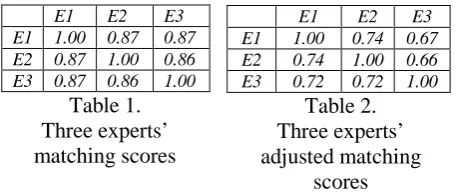
From the perspective of perception, multiple predictions of prosodic phrasing may be acceptable in many cases. At the labeling stage, three experts (E1, E2, E3) were requested to label 1,174 sentences independently. Experts first read the sentences silently. Then, they marked the breaks in sentences independently. Table 1 and 2 show their labeling differences in
terms of S and Sa, respectively.
Table 1 indicates that any two can achieve a consistency of roughly 87% among three experts.
4.3 The results
To evaluate the approaches mentioned above, we conducted a series of experiments. In all our experiments, we assume that no breaking is necessary for those sentences that are shorter than the average phrase length and remove them in the statistic computation. For the approaches
based on HMM path, we further define that the initial and final words of a sentence can only assume two state values, namely, (phrase initial,
separate) and (phrase final, separate),
respectively. With this definition, we modify the
approach HMM-Path to HMM-Path-I.
Alternatively, to investigate acceptance, we also calculate the matching score between the approaches and any expert (We assume the prediction is acceptable if the predicted phrase sequence matches any of three phrase sequences labeled by the experts). By employing the preceding criterion, we achieve the results as shown in Table 3 and 4.
A sentence consumes less than 0.3 ms on average for all the evaluated methods. So they are all computationally efficient. Alternatively, we compared the HMM-based approach base on word format and some POS-based ones on the same training set and test set. Overall,
HMM-path-I can achieve high accuracy by about 10%.
5 Conclusions/Discussions
We described an approach to automatic prosodic phrasing for Mandarin TTS synthesis based on word format and HMM and its variants. We also evaluated these methods through experiments and demonstrated promising results. According to the experimental results, we can conclude that word-based prediction is an effective approach and has advantages over the POS-based ones. It confirms that the syllable number of a word has substantial impact on prosodic phrasing.
References
Black, A.W., Taylor, P., 1994. “Assigning intonational elements and prosodic phrasing for
E1 E2 E3 E1 1.00 0.74 0.67 E2 0.74 1.00 0.66 E3 0.72 0.72 1.00
Table 2. Three experts’ adjusted matching
scores
E1 E2 E3 E1 1.00 0.87 0.87 E2 0.87 1.00 0.86 E3 0.87 0.86 1.00
Table 1. Three experts’ matching scores
E1 E2 E3 Any
HMM 0.78 0.77 0.77 0.85
[image:5.595.306.526.262.390.2]HMM-path 0.79 0.77 0.78 0.85 HMM-path-I 0.82 0.80 0.82 0.88
Table 3. Matching scores of 3 approaches
E1 E2 E3 Any
HMM 0.55 0.53 0.44 0.66
HMM-path 0.52 0.54 0.44 0.67 HMM-path-I 0.62 0.60 0.55 0.74
[image:5.595.64.293.513.610.2]English speech synthesis from high level linguistic input”, Proc. ICSLIP
Chen, S.H., Hwang, S.H., Wang, Y.R., 1998.
“An RNN-based prosodic information
synthesizer for Mandarin text-to-speech”, IEEE
Trans. Speech Audio Processing, 6: 226-239.
Chen, Y.Q., Gao, W., , Zhu, T.S., Ma, J.Y., 2000. “Multi-strategy data mining on Mandarin prosodic patterns”, Proc. ISCLIP
Chou, F.C., Tseng, C.Y., Lee, L.S. 1996. “Automatic generation of prosodic structure for high quality Mandarin speech synthesis”, Proc.
ICSLP
Chou, F.C, Tseng, C.Y, Chen, K.J., Lee, L.S, 1997. “A Chinese text-to-speech system based on part-of-speech analysis, prosodic modeling and non-uniform units”, ICASSP’97
Klatt, D.H., 1987, “Review of text-to-speech conversion for English”, J. Acoust. Soc. Am., 182: 737-79
Gu, Z.L, Mori, H., Kasuya, H. 2000. “Prosodic variation of focused syllables of disyllabic word in Mandarin Chinese”, Proc. ICSLP,
Hirschberg, J., 1996. “Training intonational phrasing rules automatically for English and Spanish text-to-speech”, Speech Communication, 18:281-290
Hu, Y., Liu, Q.F., Wang, R.H., 2000, “Prosody generation in Chinese synthesis using the template of quantified prosodic unit and base intonation contour”, Proc. ICSLIP
Lu, S.N., He, L., Yang, Y.F., Cao, J.F., 2000, “Prosodic control in Chinese TTS system”, Proc.
ICSLP,
Lv, X., Zhao, T.J., Liu, Z.Y., Yang M.Y., 2001,
“Automatic detection of prosody phrase
boundaries for text-to-speech system”, Proc.
IWPT
Qian, Y., Chu, M., Peng, H., 2001, “Segmenting unrestricted Chinese text into prosodic words instead of lexical words”, Proc.
ICASSP.
Rabiner, L., 1999, Fundamentals of Speech
Recognition, pp.336, Prentice-Hall and Tsinghua
Univ. Press, Beijing
Taylor P., Black A.W., 1998, “Assigning phrase
breaks from part-of-speech sequences”,
Computer Speech and Language, 12: 99-117,
Wang, M.Q., Hirschberg, J., 1995, “Automatic classification of intonational phrase boundaries”,
Computer Speech and Language, pp.175-196,
Vol. 6,
Wightman, C.W., 1992, “Segmental durations in the vicinity of prosodic phrase boundaries”, J.
Acoust. Soc. Am., 91:1707-1717