Novel Association Measures Using Web Search with Double Checking
Hsin-Hsi Chen
Ming-Shun Lin
Yu-Chuan Wei
Department of Computer Science and Information Engineering
National Taiwan University
Taipei, Taiwan
[email protected];{mslin,ycwei}@
nlg.csie.ntu.edu.twAbstract
A web search with double checking model is proposed to explore the web as a live corpus. Five association measures including variants of Dice, Overlap Ratio,
Jaccard, and Cosine, as well as Co-Occurrence Double Check (CODC), are presented. In the experiments on Ruben-stein-Goodenough’s benchmark data set, the CODC measure achieves correlation coefficient 0.8492, which competes with the performance (0.8914) of the model using WordNet. The experiments on link detection of named entities using the strategies of direct association, associa-tion matrix and scalar association matrix
verify that the double-check frequencies are reliable. Further study on named en-tity clustering shows that the five meas-ures are quite useful. In particular,
CODC measure is very stable on word-word and name-name experiments. The application of CODC measure to expand community chains for personal name dis-ambiguation achieves 9.65% and 14.22% increase compared to the system without community expansion. All the experi-ments illustrate that the novel model of web search with double checking is fea-sible for mining associations from the web.
1
Introduction
In statistical natural language processing, re-sources used to compute the statistics are indis-pensable. Different kinds of corpora have made available and many language models have been experimented. One major issue behind the cor-pus-based approaches is: if corpora adopted can
reflect the up-to-date usage. As we know, lan-guages are live. New terms and phrases are used in daily life. How to capture the new usages is an important research topic.
The Web is a heterogeneous document collec-tion. Huge-scale and dynamic nature are charac-teristics of the Web. Regarding the Web as a live corpus becomes an active research topic re-cently. How to utilize the huge volume of web data to measure association of information is an important issue. Resnik and Smith (2003) em-ploy the Web as parallel corpora to provide bi-lingual sentences for translation models. Keller and Lapata (2003) show that bigram statistics for English language is correlated between corpus and web counts. Besides, how to get the word counts and the word association counts from the web pages without scanning over the whole col-lections is indispensable. Directly managing the web pages is not an easy task when the Web grows very fast.
Search engine provides some way to return useful information. Page counts for a query de-note how many web pages containing a specific word or a word pair roughly. Page count is dif-ferent from word frequency, which denotes how many occurrences a word appear. Lin and Chen (2004) explore the use of the page counts pro-vided by different search engines to compute the statistics for Chinese segmentation. In addition to the page counts, snippets returned by web search, are another web data for training. A snippet consists of a title, a short summary of a web page and a hyperlink to the web page. Be-cause of the cost to retrieve the full web pages, short summaries are always adopted (Lin, Chen, and Chen, 2005).
Various measures have been proposed to compute the association of objects of different granularity like terms and documents. Rodríguez and Egenhofer (2003) compute the semantic
similarity from WordNet and SDTS ontology by word matching, feature matching and semantic neighborhood matching. Li et al. (2003) investi-gate how information sources could be used ef-fectively, and propose a new similarity measure combining the shortest path length, depth and local density using WordNet. Matsuo et al. (2004) exploit the Jaccard coefficient to build “Web of Trust” on an academic community.
This paper measures the association of terms using snippets returned by web search. A web search with double checking model is proposed to get the statistics for various association meas-ures in Section 2. Common words and personal names are used for the experiments in Sections 3 and 4, respectively. Section 5 demonstrates how to derive communities from the Web using asso-ciation measures, and employ them to disam-biguate personal names. Finally, Section 6 con-cludes the remarks.
2
A Web Search with Double Checking
Model
Instead of simple web page counts and complex web page collection, we propose a novel model, a Web Search with Double Checking (WSDC), to analyze snippets. In WSDC model, two objects X
and Y are postulated to have an association if we can find Y from X (a forward process) and find X
from Y (a backward process) by web search. The forward process counts the total occurrences of Y
in the top N snippets of query X, denoted as
f(Y@X). Similarly, the backward process counts the total occurrences of X in the top N snippets of query Y, denoted as f(X@Y). The forward and the backward processes form a double check op-eration.
Under WSDC model, the association scores between X and Y are defined by various formulas as follows. ⎪ ⎪ ⎩ ⎪ ⎪ ⎨ ⎧ + + = = = Otherwise Y f X f Y X f X Y f Y X f or X Y f if Y X e VariantDic ) ( ) ( ) @ ( ) @ ( 0 ) @ ( 0 ) @ ( 0 ) , ( (1) ) ( ) ( )) @ ( ), @ ( ( , ( Y f X f Y X f X Y f min Y) X ine VariantCos ×
= (2)
)) @ ( ), @ ( ( ) ( ) ( )) @ ( ), @ ( ( Y X f X Y f max Y f X f Y X f X Y f min (X,Y) card VariantJac − +
= (3)
{
}
)} ( ), ( { ) @ ( ), @ ( ) , ( Y f X f min Y X f X Y f min Y X rlapVariantOve = (4)
⎪ ⎪ ⎩ ⎪ ⎪ ⎨ ⎧ = = = ⎟ ⎟ ⎠ ⎞ ⎜ ⎜ ⎝ ⎛ × Otherwise Y X f or X Y f if Y X CODC Y f Y X f X f X Y f log e α ) ( ) @ ( ) ( ) @ ( 0 ) @ ( 0 ) @ ( 0 ) , ( (5)
Where f(X) is the total occurrences of X in the top N snippets of query X, and, similarly, f(Y) is the total occurrences of Y in the top N snippets of query Y. Formulas (1)-(4) are variants of the
Dice, Cosine, Jaccard, and Overlap Ratio asso-ciation measure. Formula (5) is a function
CODC (Co-Occurrence Double-Check), which measures the association in an interval [0,1]. In the extreme cases, when f(Y@X)=0 or f(X@Y)=0,
CODC(X,Y)=0; and when f(Y@X)=f(X) and
f(X@Y)=f(Y), CODC(X,Y)=1. In the first case, X
and Y are of no association. In the second case,
X and Y are of the strongest association.
3
Association of Common Words
We employ Rubenstein-Goodenough’s (1965) benchmark data set to compare the performance of various association measures. The data set consists of 65 word pairs. The similarities be-tween words, called Rubenstein and Goodenough rating (RG rating), were rated on a scale of 0.0 to 4.0 for “semantically unrelated” to “highly syn-onymous” by 51 human subjects. The Pearson product-moment correlation coefficient, rxy,
be-tween the RG ratings X and the association scores Y computed by a model shown as follows measures the performance of the model.
y x i n i i xy s s n y y x x r ) 1 ( ) )( ( 1 − − −
=
∑
= (6)Where x and y are the sample means of xi and yi, and sx and sy are sample standard deviations of xi and yi and n is total samples.
100 200 300 400 500 600 700 800 900
VariantDice 0.5332 0.5169 0.5352 0.5406 0.5306 0.5347 0.5286 0.5421 0.5250
VariantOverlap 0.5517 0.6516 0.6973 0.7173 0.6923 0.7259 0.7473 0.7556 0.7459
VariantJaccard 0.5533 0.6409 0.6993 0.7229 0.6989 0.738 0.7613 0.7599 0.7486
VariantCosine 0.5552 0.6459 0.7063 0.7279 0.6987 0.7398 0.7624 0.7594 0.7501
CODC (α=0.15) 0.5629 0.6951 0.8051 0.8473 0.8438 0.8492 0.8222 0.8291 0.8182
Jaccard Coeff* 0.5847 0.5933
[image:3.595.76.524.77.658.2]0.6099 0.5807 0.5463 0.5202 0.4855 0.4549 0.4622
Table 1. Correlation Coefficients of WSDC Model on Word-Word Experiments
Model Rating RG Resnik (1995) (1998) Lin Li et al (2003)
VariantCosine
(#snippets=700) WSDC
CODC(α=0.15, #snippets=600)
WSDC Correlation Coefficient - 0.7450 0.8224 0.8914 0.7624 0.8492
chord-smile 0.02 1.1762 0.20 0 0 0
rooster-voyage 0.04 0 0 0 0 0
noon-string 0.04 0 0 0 0 0
glass-magician 0.44 1.0105 0.06 0 0 0
monk-slave 0.57 2.9683 0.18 0.350 0 0
coast-forest 0.85 0 0.16 0.170 0.0019 0.1686
monk-oracle 0.91 2.9683 0.14 0.168 0 0
lad-wizard 0.99 2.9683 0.20 0.355 0 0
forest-graveyard 1 0 0 0.132 0 0
food-rooster 1.09 1.0105 0.04 0 0 0
coast-hill 1.26 6.2344 0.58 0.366 0 0
car-journey 1.55 0 0 0 0.0014 0.2049
crane-implement 2.37 2.9683 0.39 0.366 0 0
brother-lad 2.41 2.9355 0.20 0.355 0.0027 0.1811
bird-crane 2.63 9.3139 0.67 0.472 0 0
bird-cock 2.63 9.3139 0.83 0.779 0.0058 0.2295
food-fruit 2.69 5.0076 0.24 0.170 0.0025 0.2355
brother-monk 2.74 2.9683 0.16 0.779 0.0027 0.1956
asylum-madhouse 3.04 15.666 0.97 0.779 0.0015 0.1845 furnace-stove 3.11 1.7135 0.18 0.585 0.0035 0.1982
magician-wizard 3.21 13.666 1 0.999 0.0031 0.2076
journey-voyage 3.58 6.0787 0.89 0.779 0.0086 0.2666
coast-shore 3.6 10.808 0.93 0.779 0.0139 0.2923
implement-tool 3.66 6.0787 0.80 0.778 0.0033 0.2506
boy-lad 3.82 8.424 0.85 0.778 0.0101 0.2828
Automobile-car 3.92 8.0411 1 1 0.0144 0.4229
Midday-noon 3.94 12.393 1 1 0.0097 0.2994
gem-jewel 3.94 14.929 1 1 0.0107 0.3530
Table 2. Comparisons of WSDC with Models in Previous Researches
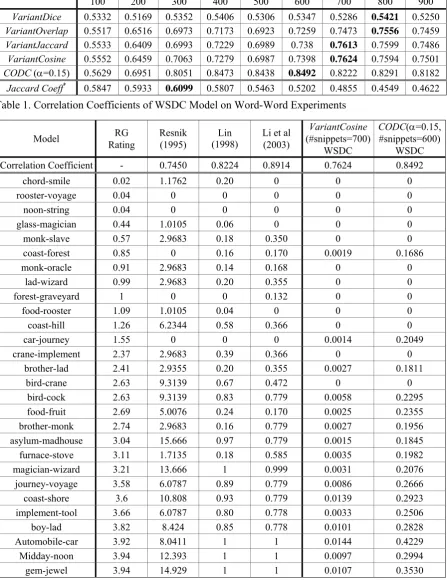
In our experiments on the benchmark data set, we used information from the Web rather than WordNet. Table 1 summarizes the correlation coefficients between the RG rating and the asso-ciation scores computed by our WSDC model. We consider the number of snippets from 100 to 900. The results show that CODC >
) (
) ( ) , (
Y X f
Y X f Y X Coff Jaccard
∪ ∩
= (7)
Where f(X∩Y) is the number of pages including
X’s and Y’s homepages when query “X and Y” is submitted to a search engine; f(X∪Y) is the num-ber of pages including X’s or Y’s homepages when query “X or Y” is submitted to a search en-gine. We revised this formula as follows and evaluated it with Rubenstein-Goodenough’s benchmark.
) (
) ( ) , ( *
Y X f
Y X f Y X Coff Jaccard
s s
∪ ∩
= (8)
Where fs(X∩Y) is the number of snippets in
which X and Y co-occur in the top N snippets of query “X and Y”; fs(X∪Y) is the number of
snip-pets containing X or Y in the top N snippets of query “X or Y”. We test the formula on the same benchmark. The last row of Table 1 shows that
Jaccard Coeff* is worse than other models when
the number of snippets is larger than 100.
Table 2 lists the results of previous researches (Resink, 1995; Lin, 1998; Li et al., 2003) and our
WSDC models using VariantCosine and CODC
measures. The 28 word pairs used in the ex-periments are shown. CODC measure can com-pete with Li et al. (2003). The word pair “car-journey” whose similarity value is 0 in the papers (Resink, 1995; Lin, 1998; Li et al., 2003) is cap-tured by our model. In contrast, our model can-not deal with the two word pairs “crane-implement” and “bird-crane”.
4
Association of Named Entities
Although the correlation coefficient of WSDC
model built on the web is a little worse than that of the model built on WordNet, the Web pro-vides live vocabulary, in particular, named enti-ties. We will demonstrate how to extend our
WSDC method to mine the association of per-sonal names. That will be difficult to resolve with previous approaches. We design two ex-periments – say, link detection test and named entity clustering, to evaluate the association of named entities.
Given a named-entity set L, we define a link detection test to check if any two named entities
NEi and NEj (i≠j) in L have a relationship R using
the following three strategies.
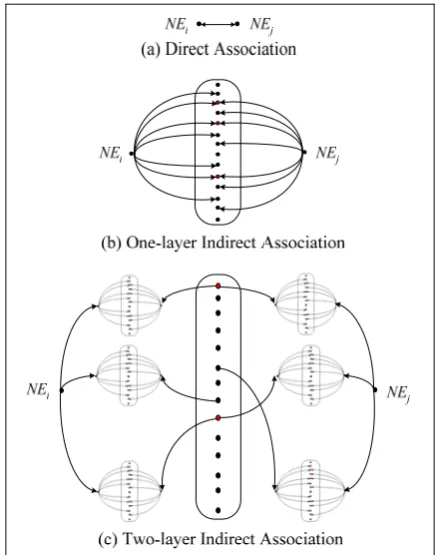
• Direct Association: If the double check
[image:4.595.305.525.69.347.2]frequency of NEi and NEj is larger than 0,
Figure 1. Three Strategies for Link Detection
i.e., f(NEj@NEi)>0 and f(NEi@NEj)>0,
then the link detection test says “yes”, i.e.,
NEi and NEj have direct association.
Oth-erwise, the test says “no”. Figure 1(a) shows the direct association.
• Association Matrix: Compose an n×n
bi-nary matrix M=(mij), where mij=1 if f(NEj@NEi)>0 and f(NEi@NEj)>0; mij=0
if f(NEj@NEi)=0 or f(NEi@NEj)=0; and n
is total number of named entities in L. Let
Mt be a transpose matrix of M. The matrix A=M×Mt is an association matrix. Here the element aij in A means that total aij
common named entities are associated with both NEi and NEj directly. Figure 1(b)
shows a one-layer indirect association. Here, aij=3. We can define NEi and NEj
have an indirect association if aij is larger
than a threshold λ. That is, NEi and NEj
should associate with at least λ common named entities directly. The strategy of association matrix specifies: if aij≥λ, then
the link detection test says “yes”, other-wise it says “no”. In the example shown in Figure 1(b), NEi and NEj are indirectly
associated when 0<λ≤3.
• Scalar Association Matrix: Compose a
binary association matrix B from the asso-ciation matrix A as: bij=1 if aij>0 and bij=0
as-sociation matrix. NEi and NEj may
indi-rectly associate with a common named en-tity NEk. Figure 1(c) shows a two-layer
indirect association. The =
∑
= ×n
k ik kj
ij b b
s 1
denotes how many such an NEk there are.
In the example of Figure 1(c), two named entities indirectly associate NEi and NEj at
the same time. We can define NEi and NEj
have an indirect association if sij is larger
than a threshold δ. In other words, if sij >δ,
then the link detection test says “yes”, otherwise it says “no”.
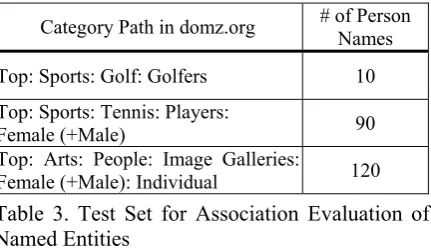
To evaluate the performance of the above three strategies, we prepare a test set extracted from domz web site (http://dmoz.org), the most comprehensive human-edited directory of the Web. The test data consists of three communi-ties: actor, tennis player, and golfer, shown in Table 3. Total 220 named entities are considered. The golden standard of link detection test is: we compose 24,090 (=220×219/2) named entity pairs, and assign “yes” to those pairs belonging to the same community.
Category Path in domz.org # of Person Names
Top: Sports: Golf: Golfers 10 Top: Sports: Tennis: Players:
Female (+Male) 90
Top: Arts: People: Image Galleries:
[image:5.595.74.290.380.504.2]Female (+Male): Individual 120 Table 3. Test Set for Association Evaluation of Named Entities
When collecting the related values for com-puting the double check frequencies for any named entity pair (NEi and NEj), i.e., f(NEj@NEi), f(NEi@NEj), f(NEi), and f(NEj), we consider
naming styles of persons. For example, “Alba, Jessica” have four possible writing: “Alba, Jes-sica”, “Jessica Alba”, “J. Alba” and “Alba, J.” We will get top N snippets for each naming style, and filter out duplicate snippets as well as snip-pets of ULRs including dmoz.org and
google.com. Table 4 lists the experimental re-sults of link detection on the test set. The preci-sions of two baselines are: guessing all “yes” (46.45%) and guessing all “no” (53.55%). All the three strategies are better than the two base-lines and the performance becomes better when the numbers of snippets increase. The strategy of direct association shows that using double checks to measure the association of named enti-ties also gets good effects as the association of common words. For the strategy of association matrix, the best performance 90.14% occurs in the case of 900 snippets and λ=6. When larger number of snippets is used, a larger threshold is necessary to achieve a better performance. Fig-ure 2(a) illustrates the relationship between pre-cision and threshold (λ). The performance de-creases when λ>6. The performance of the strat-egy of scalar association matrix is better than that of the strategy of association matrix in some λ
and δ. Figure 2(b) shows the relationship be-tween precision and threshold δ for some number of snippets and λ.
In link detection test, we only consider the bi-nary operation of double checks, i.e., f(NEj@NEi) > 0 and f(NEi@NEj) > 0, rather than utilizing the
magnitudes of f(NEj@NEi) and f(NEi@NEj).
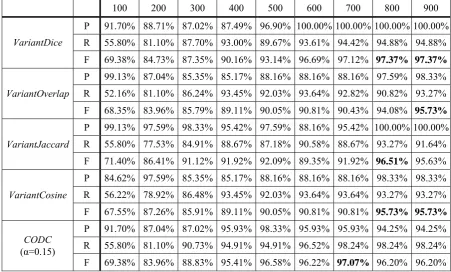
Next we employ the five formulas proposed in Section 2 to cluster named entities. The same data set as link detection test is adopted. An ag-glomerative average-link clustering algorithm is used to partition the given 220 named entities based on Formulas (1)-(5). Four-fold cross-validation is employed and B-CUBED metric (Bagga and Baldwin, 1998) is adopted to evalu-ate the clustering results. Table 5 summarizes the experimental results. CODC (Formula 5), which behaves the best in computing association of common words, still achieves the better per-formance on different numbers of snippets in named entity clustering. The F-scores of the other formulas are larger than 95% when more snippets are considered to compute the double check frequencies.
Strategies 100 200 300 400 500 600 700 800 900 Direct
Association 59.20% 62.86% 65.72% 67.88% 69.83% 71.35% 72.05% 72.46% 72.55% Association
Matrix
71.53% (λ=1)
79.95% (λ=1)
84.00% (λ=2)
86.08% (λ=3)
88.13% (λ=4)
89.67% (λ=5)
89.98% (λ=5)
90.09% (λ=6)
90.14% (λ=6) Scalar
Asso-ciation Matrix
73.93% (λ=1,
δ=6)
82.69% (λ=2,
δ=9)
86.70% (λ=4,
δ=9)
88.61% (λ=5,
δ=10)
90.90% (λ=6,
δ=12)
91.93% (λ=7,
δ=12)
91.90% (λ=7,
δ=18)
92.20% (λ=10,
δ=16)
92.35% (λ=10,
(a) (b)
Figure 2. (a) Performance of association matrix strategy. (b) Performance of scalar association matrix strategy (where λ is fixed and its values reference to scalar association matrix in Table 4)
100 200 300 400 500 600 700 800 900 P 91.70% 88.71% 87.02% 87.49% 96.90% 100.00% 100.00% 100.00% 100.00% R 55.80% 81.10% 87.70% 93.00% 89.67% 93.61% 94.42% 94.88% 94.88%
VariantDice
F 69.38% 84.73% 87.35% 90.16% 93.14% 96.69% 97.12% 97.37% 97.37% P 99.13% 87.04% 85.35% 85.17% 88.16% 88.16% 88.16% 97.59% 98.33% R 52.16% 81.10% 86.24% 93.45% 92.03% 93.64% 92.82% 90.82% 93.27%
VariantOverlap
F 68.35% 83.96% 85.79% 89.11% 90.05% 90.81% 90.43% 94.08% 95.73% P 99.13% 97.59% 98.33% 95.42% 97.59% 88.16% 95.42% 100.00% 100.00% R 55.80% 77.53% 84.91% 88.67% 87.18% 90.58% 88.67% 93.27% 91.64%
VariantJaccard
F 71.40% 86.41% 91.12% 91.92% 92.09% 89.35% 91.92% 96.51% 95.63% P 84.62% 97.59% 85.35% 85.17% 88.16% 88.16% 88.16% 98.33% 98.33% R 56.22% 78.92% 86.48% 93.45% 92.03% 93.64% 93.64% 93.27% 93.27%
VariantCosine
F 67.55% 87.26% 85.91% 89.11% 90.05% 90.81% 90.81% 95.73% 95.73% P 91.70% 87.04% 87.02% 95.93% 98.33% 95.93% 95.93% 94.25% 94.25% R 55.80% 81.10% 90.73% 94.91% 94.91% 96.52% 98.24% 98.24% 98.24%
CODC
(α=0.15)
[image:6.595.73.523.73.255.2]F 69.38% 83.96% 88.83% 95.41% 96.58% 96.22% 97.07% 96.20% 96.20% Table 5. Performance of Various Scoring Formulas on Named Entity Clustering
5
Disambiguation Using Association of
Named Entities
This section demonstrates how to employ asso-ciation mined from the Web to resolve the ambi-guities of named entities. Assume there are n
named entities, NE1, NE2, …, and NEn, to be
dis-ambiguated. A named entity NEj has m
accom-panying names, called cue names later, CNj1,
CNj2, …, CNjm. We have two alternatives to use
the cue names. One is using them directly, i.e.,
NEj is represented as a community of cue names Community(NEj)={CNj1, CNj2, …, CNjm}. The
other is to expand the cue names CNj1, CNj2, …,
CNjm for NEj using the web data as follows. Let CNj1 be an initial seed. Figure 3 sketches the
concept of community expansion.
(1) Collection: We submit a seed to
Google, and select the top N returned snippets. Then, we use suffix trees to extract possible patterns (Lin and Chen, 2006).
(2) Validation: We calculate CODC score
of each extracted pattern (denoted Bi)
with the seed A. If CODC(A,Bi) is
[image:6.595.71.523.293.565.2]threshold θ, we employ Bi as a new
seed and repeat steps (1) and (2). This procedure stops either expected number of nodes is collected or maximum number of layers is reached.
(3) Union: The community initiated by the
seed CNji is denoted by Commu-nity(CNji)={Bji1, Bji2, …, BBjir}, where Bjik
is a new seed. The Cscore score, com-munity score, of BjiB kis the CODC score of Bjik with its parent divided by the layer it is located. We repeat Collec-tion and Validation steps until all the cue names CNji (1≤i≤m) of NEj are
processed. Finally, we have
) ( )
( 1 ji
m i
j CommunityCN
[image:7.595.307.524.403.537.2]NE Community =∪=
Figure 3. A Community for a Seed “王建民” (“Chien-Ming Wang”)
In a cascaded personal name disambiguation system (Wei, 2006), association of named enti-ties is used with other cues such as titles, com-mon terms, and so on. Assume k clusters, c1c2 ...
ck, have been formed using title cue, and we try
to place NE1, NE2, …, and NEl into a suitable
cluster. The cluster c is selected by the similar-ity measure defined below.
) ( )
( 1
) , (
1 i i
s i
q j
pn score C pn count r
c NE score
×
=
∑
= (9)) , ( max
arg ) k q 1 (
cq j q
c NE score c
≤ ≤
= (10)
Where pn1, pn2, …, pns are names which appear
in both Community(NEj) and Community(cq); count(pni) is total occurrences of pni in Commu-nity(cq); r is total occurrences of names in Com-munity(NEj); Cscore(pni) is community score of pni.
If score(NEj, c) is larger than a threshold,
then NEj is placed into cluster c. In other words,
NEj denotes the same person as those in c. We
let the new Community(c) be the old Commu-nity(c)∪{CNj1, CNj2, …, CNjm}. Otherwise, NEj
is left undecided.
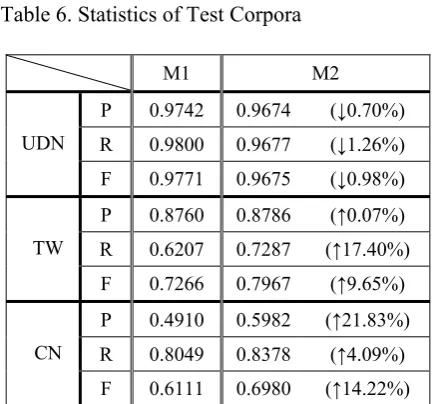
To evaluate the personal name disambiguation, we prepare three corpora for an ambiguous name “王 建 民” (Chien-Ming Wang) from United Daily News Knowledge Base (UDN), Google Taiwan (TW), and Google China (CN). Table 6 summarizes the statistics of the test data sets. In UDN news data set, 37 different persons are mentioned. Of these, 13 different persons occur more than once. The most famous person is a pitcher of New York Yankees, which occupies 94.29% of 2,205 documents. In TW and CN web data sets, there are 24 and 107 different per-sons. The majority in TW data set is still the New York Yankees’s “Chien-Ming Wang”. He appears in 331 web pages, and occupies 88.03%. Comparatively, the majority in CN data set is a research fellow of Chinese Academy of Social Sciences, and he only occupies 18.29% of 421 web pages. Total 36 different “Chien-Ming Wang”s occur more than once. Thus, CN is an unbiased corpus.
UDN TW CN
# of documents 2,205 376 421
# of persons 37 24 107 # of persons of
occurrences>1 13 9 36 Majority 94.29% 88.03% 18.29%
Table 6. Statistics of Test Corpora
M1 M2
P 0.9742 0.9674 (↓0.70%) R 0.9800 0.9677 (↓1.26%) UDN
F 0.9771 0.9675 (↓0.98%) P 0.8760 0.8786 (↑0.07%) R 0.6207 0.7287 (↑17.40%) TW
F 0.7266 0.7967 (↑9.65%) P 0.4910 0.5982 (↑21.83%) R 0.8049 0.8378 (↑4.09%) CN
[image:7.595.306.524.530.732.2]Table 7 shows the performance of a personal name disambiguation system without (M1)/with (M2) community expansion. In the news data set (i.e., UDN), M1 is a little better than M2. Com-pared to M1, M2 decreases 0.98% of F-score. In contrast, in the two web data sets (i.e., TW and CN), M2 is much better than M1. M2 has 9.65% and 14.22% increases compared to M1. It shows that mining association of named entities from the Web is very useful to disambiguate ambigu-ous names. The application also confirms the effectiveness of the proposed association meas-ures indirectly.
6
Concluding Remarks
This paper introduces five novel association measures based on web search with double checking (WSDC) model. In the experiments on association of common words, Co-Occurrence Double Check (CODC) measure competes with the model trained from WordNet. In the experi-ments on the association of named entities, which is hard to deal with using WordNet,
WSDC model demonstrates its usefulness. The strategies of direct association, association ma-trix, and scalar association matrix detect the link between two named entities. The experiments verify that the double-check frequencies are reli-able.
Further study on named entity clustering shows that the five measures – say, VariantDice,
VariantOverlap, ariantJaccard, VariantCosine
and CODC, are quite useful. In particular,
CODC is very stable on word-word and name-name experiments. Finally, WSDC model is used to expand community chains for a specific personal name, and CODC measures the associa-tion of community member and the personal name. The application on personal name disam-biguation shows that 9.65% and 14.22% increase compared to the system without community ex-pansion.
Acknowledgements
Research of this paper was partially supported by National Science Council, Taiwan, under the contracts 94-2752-E-001-001-PAE and 95-2752-E-001-001-PAE.
References
A. Bagga and B. Baldwin. 1998. Entity-Based Cross-Document Coreferencing Using the Vector Space
Model. Proceedings of 36th COLING-ACL
Con-ference, 79-85.
F. Keller and M. Lapata. 2003. Using the Web to Ob-tain Frequencies for Unseen Bigrams. Computa-tional Linguistics, 29(3): 459-484.
Y. Li, Z.A. Bandar and D. McLean. 2003. An Ap-proach for Measuring Semantic Similarity between Words Using Multiple Information Sources. IEEE
Transactions on Knowledge and Data Engineering,
15(4): 871-882.
D. Lin. 1998. An Information-Theoretic Definition of Similarity. Proceedings of the Fifteenth
Interna-tional Conference on Machine Learning, 296-304.
H.C. Lin and H.H. Chen. 2004. Comparing Corpus-based Statistics and Web-Corpus-based Statistics: Chinese Segmentation as an Example. Proceedings of 16th
ROCLING Conference, 89-100.
M.S. Lin, C.P. Chen and H.H. Chen. 2005. An Ap-proach of Using the Web as a Live Corpus for Spoken Transliteration Name Access. Proceedings
of 17th ROCLING Conference, 361-370.
M.S. Lin and H.H. Chen. 2006. Constructing a Named Entity Ontology from Web Corpora.
Pro-ceedings of 5th International Conference on
Lan-guage Resources and Evaluation.
Y. Matsuo, H. Tomobe, K. Hasida, and M. Ishizuka. 2004. Finding Social Network for Trust Calcula-tion. Proceedings of 16th European Conference on
Artificial Intelligence, 510-514.
P. Resnik. 1995. Using Information Content to Evalu-ate Semantic Similarity in a Taxonomy.
Proceed-ings of the 14th International Joint Conference on
Artificial Intelligence,448-453.
P. Resnik and N.A. Smith. 2003. The Web as a Paral-lel Corpus. Computational Linguistics, 29(3): 349-380.
M.A. Rodríguez and M.J. Egenhofer. 2003. Determin-ing Semantic Similarity among Entity Classes from Different Ontologies. IEEE Transactions on
Knowledge and Data Engineering, 15(2): 442-456.
H. Rubenstein and J.B. Goodenough. 1965. Contex-tual Correlates of Synonymy. Communications of
the ACM, 8(10): 627-633.
Y.C. Wei. 2006. A Study of Personal Name
Disam-biguation. Master Thesis, Department of Computer