REES: A Large-Scale Relation and Event Extraction System
Chinatsu Aone SRA International, Inc.
4300 Fair Lakes Court Fairfax, VA 22033 [email protected]
Mila Ramos-Santacruz SRA International, Inc. 4300 Fair Lakes Court
Fairfax, VA 22033 [email protected]
Abstract
This paper reports on a large-scale, end-to- end relation and event extraction system. At present, the system extracts a total of 100 types of relations and events, which represents a much wider coverage than is typical of extraction systems. The system consists of three specialized pattem-based tagging modules, a high-precision co- reference resolution module, and a configurable template generation module. We report quantitative evaluation results, analyze the results in detail, and discuss future directions.
I n t r o d u c t i o n
One major goal of information extraction (IE) technology is to help users quickly identify a variety of relations and events and their key players in a large volume o f documents. In contrast with this goal, state-of-the-art information extraction systems, as shown in the various Message Understanding Conferences (MUCs), extract a small number of relations and events. For instance, the most recent MUC, MUC-7, called for the extraction of 3 relations (person-employer, maker-product, and organization-location) and 1 event (spacecraft launches). Our goal is to develop an IE system which scales up to extract as many types of relations and events as possible with a minimum amount of porting effort combined with high accuracy. Currently, REES handles 100 types of relations and events, and it does so in a modular, configurable, and scalable manner.
Below, Section 1 presents the ontologies of relations and events that we have developed.
Section 2 describes REES' system architecture. Section 3 evaluates the system's performance, and offers a qualitative analysis of system errors. Section 4 discusses future directions.
1 R e l a t i o n a n d E v e n t O n t o l o g i e s
As the first step in building a large-scale relation and event extraction system, we developed ontologies of the relations and events to be extracted. These ontologies represent a wide variety of domains: political, financial, business, military, and life-related events and relations. "Relations" covers what in MUC-7 are called Template Elements (TEs) and Template Relations (TRs). There are 39 types of relations. While MUC TE's only dealt with singular entities, REES extracts both singular and plural entities (e.g., "five executives"). The TR relations are shown in italic in the table below.
Relations
Place Relations 'Artifact Relations Place-Name&Aliases
Place-Type Place-Subtype Place-Descriptor Place-Country
Artifact-Name&Aliases Artifact-Type
Artifact-Subtype Artifact-Descriptor
Artifact-Maker
Artifact-Owner
Organization Relations Person Relations Org-Name&AliasesOrg-Descriptor Org-FoundationDate Org-Nationality Org-TickerSymbol
Org-Location
Org-P arentOrg
Org-Owner
Org-Founder
Org-StockMarket
Person-Name&Aliases Person-Type
Person-Subtype Person-Descriptor Person-Honorific Person-Age
Person-OtherRelative Person-BirthPlace Person-BirthDate Table 1: Relation Ontology
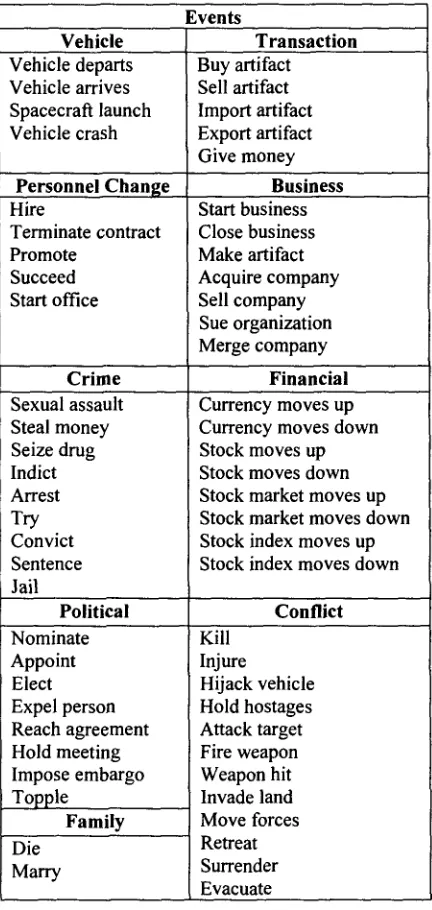
"Events" are extracted along with their event participants, e.g., "who did what to whom when and where?" For example, for a BUYING event, REES extracts the buyer, the artifact, the seller, and the time and location of the BUYING event. REES currently covers 61 types o f events, as shown below.
Events
Vehicle Transaction
Vehicle departs Vehicle arrives Spacecraft launch Vehicle crash
Personnel Change Hire
Terminate contract Promote
Succeed Start office
Buy artifact Sell artifact Import artifact Export artifact Give money
Business Start business Close business Make artifact Acquire company Sell company Sue organization Merge company
Crime Financial
Sexual assault Steal money Seize drug Indict Arrest Try Convict Sentence Jail
Currency moves up Currency moves down Stock moves up Stock moves down Stock market moves up Stock market moves down Stock index moves up Stock index moves down
Political Conflict
Nominate Appoint Elect Expel person Reach agreement Hold meeting Impose embargo Topple
Family Die
Marry
Kill Injure
Hijack vehicle Hold hostages Attack target Fire weapon Weapon hit Invade land Move forces Retreat Surrender Evacuate
Table 2: Event Ontology
Figures 1 and 2 show sample relation and event templates. Figure 1 shows a Person-Affiliation relation template for "Frank Ashley, a spokesman f o r Occidental Petroleum Corp.'"
<PERSON AFFILIATION-AP8802230207-54> := TYPE: PERSON AFFILIATION
PERSON: [TE for"Frank Ashley"]
ORG: [TE for "Occidental Petroleum"]
Figure 1: Example of Relation Template Figure 2 shows an Attack Target event template for the sentence "an Iraqi warplane attacked the frigate Stark with missiles May 17, 1987. "
<ATTACK TARGET-AP8804160078-12>: = i
TYPE: CONFLICT
SUBTYPE: ATTACK TARGET
ATTACKER: [TE for "an Iraqi warplane"] TARGET: [TE for "the frigate Stark"] WEAPON: [TE for "missiles"] TIME: "May 17, 1987" PLACE: [TE for "the gulf'] COMMENT: "attacked"
Figure 2: Example of Event Template
[image:2.612.93.309.241.696.2]2 System A r c h i t e c t u r e and C o m p o n e n t s
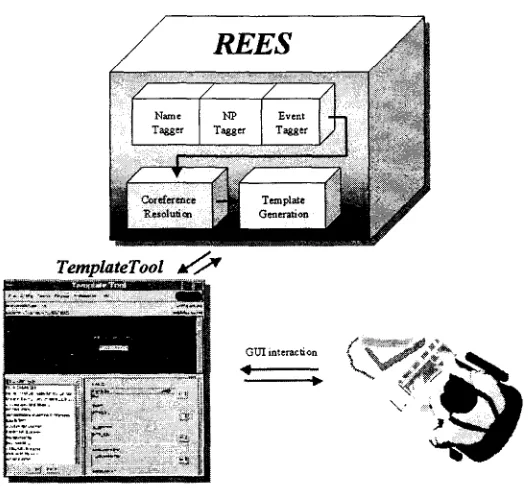
Figure 3 illustrates the REES system architecture. REES consists o f three main components: a tagging component (cf. Section 2.1), a co-reference resolution module (cf. Section 2.2), and a template generation module (cf. Section 2.3). Figure 3 also illustrates that the user may run REES from a Graphical User Interface (GUI) called TemplateTool (cf. Section 2.4).
2.1 Tagging Modules
remplateroot / / v
- ' : . v " . ...
[image:3.612.206.470.99.345.2]GUI interaction ¢
Figure 3: The REES System Architecture
The NPTagger then takes the XML-tagged output of the NameTagger through two phases. First, it recognizes non-recursive Base Noun Phrase (BNP) (our specifications for BNP resemble those in Ramshaw and Marcus 1995). Second, it recognizes complex NPs for only the four main semantic types of NPs, i.e., Person, Organization, Location, and Artifact (vehicle, drug and weapon). It makes post- modifier attachment decisions only for those NPs that are crucial to the extraction at hand. During this second phase, relations which can be recognized locally (e.g., Age, Affiliation, Maker) are also recognized and stored using the XML attributes for the NPs. For instance, the XML tag for
"President of XYZ Corp."
below holds an AFFILIATION attribute with the ID for "XYZ
Corp."
<PNP ID="03"
AFFILIATION="O4">President of
<ENTITY ID="04">XYZ
Corp.</ENTITY>
</PNP>
Building upon the XML output of the
NPTagger, the EventTagger recognizes
events
applying
its
lexicon-driven,
syntactically-based generic patterns. These
patterns tag events in the presence o f at least one o f the arguments specified in the lexical entry for a predicate. Subsequent pattems try to find additional arguments as well as place and time adjunct information for the tagged event. As an example o f the EventTagger's generic patterns, consider the simplified pattern below. This pattem matches on an event-denoting verb that requires a direct object of type weapon (e.g.,
"fire a gun")
(&
{AND $VP {ARG2_SYN=DO} {ARG2_SEM=WEAPON } }
{AND $ARTIFACT {SUBTYPE=WEAPON} })1
The important aspect of REES is its declarative, lexicon-driven approach. This approach requires a lexicon entry for each event-denoting word, which is generally a
verb. The lexicon entry specifies the syntactic and semantic restrictions on the verb's arguments. For instance, the following lexicon entry is for the verb "attack." It indicates that the verb "attack" belongs to the CONFLICT ontology and to the ATTACK_TARGET type. The first argument for the verb "attack" is semantically an organization, location, person, or artifact (ARGI_SEM), and syntactically a subject (ARGI_SYN). The second argument is semantically an organization, location, person or artifact, and syntactically a direct object. The third argument is semantically a weapon and syntactically a prepositional phrase introduced by the preposition "with".
ATTACK { { {CATEGORY VERB} {ONTOLOGY CONFLICT} {TYPE ATTACK_TARGET}
{ARGI_SEM {ORGANIZATION LOCATION PERSON ARTIFACT} } {ARGI_SYN {SUBJECT} }
{ARG2_SEM {ORGANIZATION LOCATION PERSON ARTIFACT} } {ARG2_SYN {DO} }
{ARG3_SEM{WEAPON} } {ARG3_SYN {WITH} } } }
About 50 generic event extraction patterns, supported by lexical information as shown above, allow extraction of events and their arguments in cases like:
An lraqi warplane attacked the frigate Stark with missiles May 17, 1987.
This generic, lexicon-driven event extraction approach makes REES easily portable because new types of events can be extracted by just adding new verb entries to the lexicon. No new patterns are required. Moreover, this approach allows for easy customization capability: a person with no knowledge of the pattern language would be able to configure the system to extract new events.
While the tagging component is similar to other pattern-based IE systems (e.g., Appelt et al. 1995; Aone et al. 1998, Yangarber and Grishman 1998), our EventTagger is more portable through a lexicon-driven approach.
2.2 Co-reference Resolution
After the tagging phase, REES sends the XML output through a rule-based co-reference resolution module that resolves:
• definite noun phrases of Organization, Person, and Location types, and
• singular person pronouns: he and she.
Only "high-precision" rules are currently applied to selected types of anaphora. That is, we resolve only those cases of anaphora whose antecedents the module can identify with high confidence. For example, the pronoun rules look for the antecedents only within 3 sentences, and the definite NP rules rely heavily on the head noun matches. Our high- precision approach results from our observation that unless the module is very accurate (above 80% precision), the co- reference module can hurt the overall extraction results by over-merging templates.
2.3 Template Generation Module
A typical template generation module is a hard-coded post-processing module which has to be written for each type of template. By contrast, our Template Generation module is unique as it uses declarative rules to generate and merge templates automatically so as to achieve portability.
2.3.1 Declarative Template Generation
2.3.2 Event Merging
One of the challenges of event extraction is to be able to recognize and merge those event descriptions which refer to the same event. The Template Generation module uses a set of declarative, customizable rules to merge co- referring events into a single event. Often, the rules reflect pragmatic knowledge of the world. For example, consider the rule below for the DYING event type. This rule establishes that if two die events have the same subject, then they refer to the same event (i.e., a person cannot die more than once).
{merge
{EVENT 1 {AND {SUBTYPE DIE} {PERSON
$foo}}
{EVENT 2 {AND {SUBTYPE DIE} {PERSON
$foo}}}
2.4 Graphical User Interface (GUI)
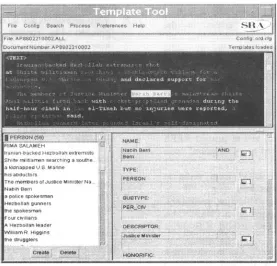
For some applications such as database population, the user may want to validate the system output. REES is provided with a Java- based Graphical User Interface that allows the user to run REES and display, delete, or modify the system output. As illustrated in Figure 4, the tool displays the templates on the bottom half o f the screen, and the user can choose which template to display. The top half o f the screen displays the input document with extracted phrases in different colors. The user can select any slot value, and the tool will highlight the portion o f the input text responsible for the slot value. This feature is very useful in efficiently verifying system output. Once the system's output has been verified, the resulting templates can be saved and used to populate a database.
3 S y s t e m E v a l u a t i o n
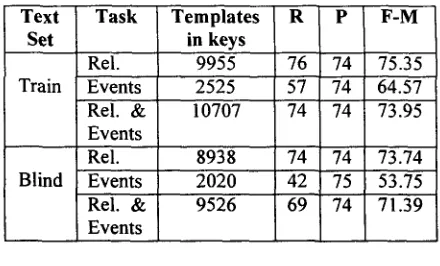
The table below shows the system's recall, precision, and F-Measure scores for the
training set (200 texts) and the blind set (208 texts) from about a dozen news sources. Each set contains at least 3 examples of each type of relations and events. As we mentioned earlier, "relations" includes MUC-style TEs and TRs.
Text Task Templates R P F-M
Set in keys
Rel. 9955 76 74 75.35
Train Events 2525 57 74 64.57 Rel. & 10707 74 74 73.95 Events
Rel. 8938 74 74 73.74
Blind Events 2020 42 75 53.75 Rel. & 9526 69 74 71.39 Events
Table 3: Evaluation Results
The blind set F-Measure for 31 types o f relations (73.95%) exceeded our initial goal o f 70%. While the blind set F-Measure for 61 types o f events was 53.75%, it is significant to note that 26 types o f events achieved an F- Measure over 70%, and 37 types over 60% (cf. Table 4). For reference, though not exactly comparable, the best-performing MUC-7 system achieved 87% in TE, 76% in TR, and 51% in event extraction.
F-M in Event types
blind set
90-100 2 : Buy artifact. Marry
80-89 9 : Succeed, Merge company, Kill, Surrender, Arrest, Convict, Sentence, Nominate, Expel.
[image:5.612.340.560.161.294.2]70-79 15 : Die, Sell artif~/ct, Export Artifact, Hire, Start office, Make artifact, Acquire company, Sue organization, Stock Index moves down, Steal money, Indict, Jail, Vehicle crash, Elect, Hold meeting.
[image:5.612.342.556.451.596.2]Figure 4: TemplateTool
Regarding relation extraction, the difference in the score between the training and blind sets was very small. In fact, the total F-Measure on the blind set is less than 2 points lower than that o f the training set. It is also interesting to note that for 8 of the 12 relation types where the F-Measure dropped more than 10 points, the training set includes less than 20 instances. In other words, there seems to be a natural correlation between low number o f instances in the training set and low performance in the blind set.
There was a significant drop between the training and blind sets in event extraction: 11 points. We believe that the main reason is that the total number o f events in the training set is fairly low: 801 instances o f 61 types o f events (an average o f 13/event), where 35 o f the event types had fewer than 10 instances. In fact, 9 out o f the 14 event types which scored lower than 40% F-Measure had fewer than I0 examples. In comparison, there were 34,000 instances of 39 types o f relations in the training set.
The contribution o f the co-reference module is illustrated in the table below. Co-reference resolution consistently improves F-Measures both in training and blind sets. Its impact is larger in relation than event extraction.
Text set Task Co- No co-
reference reference
rules rules
Relations 75.35 72.54
Training Events 64.57 63.62
Relations 73.95 71.34
& Events
Relations 73.74 72.03
Blind Events 53.75 53.22
71.39 69.86 Relations
& Events
Table 5: Comparative results with and without co-reference rules
[image:6.612.186.463.79.345.2] [image:6.612.340.555.473.616.2]3.1 False Positives (or Precision Errors)
REES produced precision errors following cases:
• Most o f the errors were due
in the
to over- generation o f templates. These are mostly cases o f co-referring noun phrases that the system failed to resolve. For example: "Panama ... the nation ... this country.., his
country"
Rules for the co-reference module are still under development, and at present REES handles only limited types o f plural noun phrase anaphora.
Spurious events resulted from verbs in conditional constructions (e.g., "if ... then...") or from ambiguous predicates. For instance, "appoint" as a POLITICAL event vs. a PERSONNEL CHANGE event.
The subject of a verb was misidentified. This is particularly frequent in reduced relative clauses.
Kabul radio said the latest deaths brought to 38 the number o f people killed in the three car bomb explosions,
(Wrong subject: "the number o f people" as the KILLER instead o f the victim)
3.2
False Negatives (or Recall Errors)
Below, we list the most frequent recall errors in the training set.
• Some event arguments are mentioned with event nouns instead o f event verbs. The current system does not handle noun-based event extraction.
India's acquisition last month o f the nuclear submarine from the Soviet Union...
(SELLER="Soviet Union" and TIME="last month'" come with the noun- based event "acquisition.")
• Pronouns "it" and "they," which carry little semantic information, are currently not resolved by the co-reference module. It also has bought three late-1970s vintage ICilo class Soviet submarines and two West German HDW 209 subs
(Missed BUYER=India because of unresolved it.)
• Verb arguments are a conjunction of noun phrases. The current system does not handle coordination o f verb arguments. Hezbollah killed 21 lsraelis and 43 o f Lahad's soldiers
(The system gets only the first object: 21 Israelis. )
• Ellipsis cases. The current system does not handle ellipsis.
The two were sentenced to five-year prison terms with hard labor by the state security court...
(Missed PERSON_SENTENCED fill because o f unresolved the two.)
• The subject of the event is relatively far from the event-denoting verb:
Vladislav Listyev, 38, who brought television interview shows in the style o f Phil Donahue or Larry King to Russian viewers and pioneered hard-hitting television journalism in the 1980s, was shot in the heart by unknown assailants and died immediately...
(The system missed subject Vladislav Listyev for attack event shot)
• Missed ORG LOCATION relations for locations that are part o f the organization's name.
Larnaca General Hospital
(Missed ORG_LOCATION TR for this and Larnaca. )
We asked a person who is not involved in the development o f REES to review the event extraction output for the blind set. This person reported that:
• In 35% of the cases where the REES system completely missed an event, it was because the lexicon was missing the predicate. REES's event predicate lexicon is rather small at present (a total of 140 verbs for 61 event types) and is mostly based on the examples found in the training set,
• In 25% o f the cases, syntactic/semantic argument structures were missing from existing lexical entries.
It is quite encouraging that simply adding additional predicates and predicate argument structures to the lexicon could significantly increase the blind set performance.
4 Future Directions
We believe that improving co-reference resolution and adding noun-based event extraction capability are critical to achieving our ultimate goal o f at least 80% F-Measure for relations and 70% for events.
4.1 Co-reference Resolution
As discussed in Section 3.1 and 3.2, accurate co-reference resolution is crucial to improving the accuracy o f extraction, both in terms of recall and precision. In particular, we identified two types o f high-payoff co- reference resolution:
• definite noun phrase resolution, especially plural noun phrases
• 3 rd person neutral pronouns "it" and "they."
4.2 Noun-based Event Extraction
REES currently handles only verb-based events. Noun-based event extraction adds more complexity because:
Nouns are often used in a generic, non- referential manner (e.g., "We see a m e r g e r as being in the consumer's interest"), and
When referential, nouns often refer to verb-based events, thus requiring noun- verb co-reference resolution ("An F-14 crashed shortly after takeoff... The crash").
However, noun-based events are crucial because they often introduce additional key information, as the underlined phrases below indicate:
While Bush's meetings with prominent anti- apartheid leaders such as Archbishop
Desmond Tutu and Albertina Sisulu are important...
We plan to develop a generic set o f patterns for noun-based event extraction to complement the set o f generic verb-based extraction patterns.
5 Conclusions
In this paper, we reported on a fast, portable, large-scale event and relation extraction system REES. To the best o f our knowledge, this is the first attempt to develop an IE system which can extract such a wide range o f relations and events with high accuracy. It performs particularly well on relation extraction, and it achieves 70% or higher F-Measure for 26 types o f events already. In addition, the design o f REES is highly portable for future addition o f new relations and events.
Acknowledgements
This project would have not been possible without the contributions o f Arcel Castillo, Lauren Halverson, and Sandy Shinn. Our thanks also to Brandon Kennedy, who prepared the hand-tagged data.
References
Aone, Chinatsu, Lauren Halverson, Tom Hampton, and Mila Ramos-Santacruz. 1998. "SRA: Description of the IE 2 System Used for MUC-7." In Proceedings of the 7thMessage Understanding Conference (MUC-7).
Appelt, Douglas E., Jerry R Hobbs, John Bear, David Israel, Megumi Kameyama, Andy Kehler, David Martin, Karen Myers, and Mabry Tyson. 1995. "SRI International FASTUS System: MUC- 6 Test Results and Analysis." In Proceedings of
the 6 th Message Understanding Conference
(MUC-6).
Ramshaw, Lance A., and Mitchell P. Marcus. 1995. "Text Chunking Using Transformation-Based Learning". In Proceedings of the 3 rd ACL Workshop on Very Large Corpora (WVLC95). Yangarber, Roman and Ralph Grishman. 1998.