Munich Personal RePEc Archive
FDI, Aid, Terrorism: Conditional
Threshold Evidence from Developing
Countries
Asongu, Simplice and Efobi, Uchenna and Beecroft, Ibukun
May 2015
Online at
https://mpra.ub.uni-muenchen.de/67856/
1
AFRICAN GOVERNANCE AND DEVELOPMENT
INSTITUTE
A G D I Working Paper
WP/15/019
FDI, Aid, Terrorism: Conditional Threshold Evidence from Developing
Countries
ASONGU Simplice
African Governance and Development Institute, Cameroon E-mail: [email protected]; [email protected]
EFOBI Uchenna
Covenant University, Nigeria
E-mail: [email protected] ; [email protected]
BEECROFT Ibukun
Covenant University, Nigeria
2 AGDI Working Paper
Research Department
FDI, Aid, Terrorism: Conditional Threshold Evidence from Developing Countries
Simplice ASONGU, Uchenna EFOBI & Ibukun BEECROFT
May 2015
Abstract
We investigate how foreign aid dampens the effects of terrorism on FDI using interactive quantile regressions. The empirical evidence is based on 78 developing countries for the period 1984-2008. Bilateral and multilateral aid variables are used, while terrorism dynamics entail: domestic, unclear, transnational and total number of terrorist attacks. The following findings are established. First, while the effects of multilateral aid are consistently significant with positive threshold evidence, bilateral aid is only positively significant in bottom quantiles. Second, with the slight exception of transnational terrorism in bilateral aid regressions, the impacts of terrorism dynamics are unexpectedly positive, in: (i) bottoms quantiles with domestic terrorism and the 0.25th quantile with total terrorism, for bilateral aid regressions, and (ii) the 0.25th quantile with domestic terrorism and bottom quantiles of transnational terrorism, for multilateral aid regressions. Third, interactions between terrorism and foreign aid dynamics unexpectedly yield negative effects in: (i) bilateral aid and domestic terrorism in bottom quantiles and (ii) multilateral aid and domestic (transnational) terrorism in the 0.25th(bottom) quantile(s). The modifying threshold value of bilateral aid is higher than that of multilateral aid. Fourth, there is positive threshold evidence from GDP growth, infrastructural development and trade openness. Policy implications are discussed.
JEL Classification: C52; D74; F23; F35; O40
Keywords: FDI; Foreign aid; Terrorism; Quantile regression
1. Introduction
off-3
track from the target (World Bank, 2015; Caulderwood, 2015; Asongu & Kodila-Tedika, 2015a).
It is an economic fact that for extreme poverty to be reduced, growth is needed. Whether the growth should be absolute or relative pro-poor is a debate we resist to engage. What is granted is that while growth may increase inequality, there is a wide consensus that it decreases poverty (Mlachila et al., 2014). It is also widely accepted in academic and policy circles that growth essential for poverty reduction can be substantially distorted by political instability, violence and terrorists’ activities (Asongu & Nwachukwu, 2015a). According to the authors, nations that are experiencing a persistent 2011 Arab Spring are also seeing their growth prospects blurring, an outlook that can be associated with substantial poverty externalities. It follows that an economic environment that is unstable due to terrorists’ activities is likely to be linked with less access to individual opportunities and essential services that are important for economic growth.
This tendency is more relevant in post-conflict and fragile states because threats of terrorism are translated to portray an uncertain economic outlook, often characterised with ambiguity from investors (public and private) who for the most part prefer investment strategies that are not clouded with ambiguity (Le Roux & Kelsey, 2015ab). Essentially, the effects of terrorism may endure, with long-lasting negative externalities on economic growth, notably: increasing cost of investment, reducing economic savings and output, infrastructural damages and burgeoning insurance premiums (Singh, 2001, 2007; Efobi et al., 2015).
4
(ISIL) that is gaining territory in Iraq and Syria by the day. The effects of ISIL have been far-reaching, namely the: foiled February 2015 Australian attacks, Sydney-Australian hostage crisis in December 2014, failed Verviers-Belgium attacks of January 2015 and Paris-France ‘Charlie Hebdo’ attacks of January 2015, which have drawn substantial sympathetic mobilisation and global condemnation.
With the above stylized facts, an evolving stream of the literature is increasingly focusing on mechanisms through which various forms of terrorism and political violence can be stemmed. Some of the documented instruments include, inter alia: education through bilingualism (Costa et al., 2008); respect of the rule of law (Choi, 2010) and the corruption-control as the most effective weapon in the fight against conflicts (Asongu & Kodila-Tedika, 2016); internal and external transparency (Bell et al., 2014); publicity and freedom of the press (Hoffman et al., 2013); military instruments (Feridun & Shahbaz, 2010); examination of terrorism behaviour (Gardner, 2007); education (Brockhoff et al., 2014), especially lifelong-learning in the mitigation of political violence and instability (Asongu & Nwachukwu, 2016a), geopolitical fluctuations as primary factors explaining the warfare landscape in SSA (Straus, 2012), and the increase of foreign aid (Bandyopadhyay et al., 2014; Bandyopadhyay & Younas, 2014).
An important reason for desiring to stem the rise of terrorist activities is its devastating effect on global capital flow. There is a nascent body of literature (e.g. Humphreys, 2005; Koh, 2007; Abadie & Gardeazabal, 2008;Meierrieks & Gries, 2013; Bandyopadhyay & Younas, 2014;Choi, 2015)that have paid extensive attention to estimating the economic value of terrorist attacks on foreign investors. It is observed that a terrorist attack will cost an average developing country,whose GDP totalled 70 billion US$,to lose between 324 million US$ and 513 million US$ of FDI, and between 296 million US$and 736 million US$ of FDI, depending on the origin of the attack (Efobi et al., 2015). This amount is significant for developing countries as the inflow of these investors are supposed to augment their resource gap considering the low savings, the declining state of development assistance, and poor integration of the region in the global capital market (Asiedu, 2006).
5
This consensus is motivated by the fact that countries that are afflicted by terrorism are poor and short of vital resources to fight the scourge (Bandyopadhyay & Younas, 2014). They sustain that the principal issue with the statistics is that developing nations have begun tailoring their foreign policy strategies to attract more foreign investment, hence, terrorism is counter-productive to the goal. Against this background, Bandyopadhyay et al. (2014) and Lee (2015) have established that developing assistance can mitigate this potentially counter-productive effect of terrorism in developing nations by providing the much needed finance to fight the scourge.
Efobi et al. (2015) have extended Bandyopadhyay et al. (2014) and Bandyopadhyay and Younas (2014) by conditioning the dampening role of foreign aid in the effect of terrorism on corruption-control levels in recipient countries. They have concluded that: (i) the negative impact of terrorism on FDI is only apparent in estimations with above-average corruption-control levels; (ii) development assistance dampens the negative impact of terrorism on FDI exclusively in countries with above-average corruption-control levels; (iii) the modifying role of bilateral aid on the effect of transnational terrorisms is consistent with Bandyopadhyay et al. (2014), while the stance that only multilateral aid mitigates the adverse consequence of FDI is confirmed principally because it curbs the negative effect of transnational terrorism on FDI. Moreover, the authors also find that the adverse impacts of unclear and total terrorism are mitigated by multilateral aid.
6
second contribution to the literature because it permits us to investigate the determinants of FDI throughout the conditional distributions of FDI.
In light of the above, the line of inquiry adopted by this study is straight forward and simple to follow. It extends Efobi et al. (2015), Bandyopadhyay et al. (2014) and Bandyopadhyay and Younas (2014) by assessing the role of foreign aid in mitigating the potentially negative effect of terrorism on FDI throughout the conditional distributions of FDI. Hence, for the purpose of comparison, we are consistent with the underlying studies in using a panel of 78 developing nations for the period 1984-2008. There are at least two other justifications for restricting the scope to developing countries: (i) the negative effects of terrorists’ activities have been established to be relatively more apparent in developing countries, compared to developed nations which can absorb terrorists’ activities without considerable negative externalities (Gaibulloev & Sandler, 2009) and (ii) development assistance is donated by developed nations to less developed countries.
The empirical evidence is important to the stylized facts enunciated in the first paragraph of this introduction because of current global efforts towards sustaining external flows like FDI in developing countries (Asiedu, 2006; Asiedu & Lien, 2011; Apkan et al., 2014; Boly, et al., 2015; Asongu & Kodila-Tedika, 2015b; Asongu & Nwachukwu, 2015b). In essence: (i) FDI is important in driving the growth needed to mitigate extreme poverty and (ii) it is important to fight terrorism in order to create an enabling environment for growth.
7
The theoretical underpinnings converge with the present paper in the perspective that foreign aid is a policy variable that may be designed to influence conditions articulated by the Social Control theory and Conflict Management Model. Accordingly, development assistance, among others: increases education, improves compliance with the rule of law, increases government expenditure and encourages social responsibility. For instance, Gaibulloev and Sandler (2009) have established that terrorism decreases growth potentials by reducing government expenditure allocated for growth-enhancing investments. For brevity and lack of space, the interested reader can have more insights into other factors (respect for the rule of law, education and social responsibility) from the wealth of studies on political violence and instability (Heyneman, 2002; Beets, 2005; Heyneman, 2008ab; Oreopoulos & Salvanes, 2009; Asongu & Nwachukwu, 2016ab). For example, Asongu and Nwachukwu (2016b) have established that development assistancepositively affects the demand-side of education and lifelong-learning and in a latter study, they have concluded that education and lifelong-learning increase political stability and non-violence (Asongu & Nwachukwu, 2016a). Given the above, the testable hypothesis of the present line of inquiry is simply and straight forward to follow: we examine the role of foreign aid inmitigating a hypothetically negative effect of terrorism on FDI.
The rest of the study is structured as follows. Section 2 covers the data and methodology. The empirical results and policy implications are discussed in Section 3. Section 4 concludes with recommendations for future research.
2. Data and Methodology
2.1 Data
Consistent with Bandyopadhyay et al. (2014) and Efobi et al. (2015), we examine a panel of 781 developing countries with three year non-overlapping intervals data for the period 1984-2008. The choice of sample size and periodicity are based on: (i) availability of foreign aid and terrorism data, (ii) constraints in the availability of other variables in the
1
The panel includes the following developing countries : “Albania, Costa Rica, India, Namibia, Syria, Algeria,
Cote d’Ivoire, Indonesia, Nicaragua, Tanzania, Angola, Dominican Republic, Iran, Niger, Thailand, Argentina,
8
conditioning information set and (iii) the motivation of comparing the findings with resultsofprevious studies that have employed the same sample and periodicity, notably: Bandyopadhyay et al. (2014) and Efobi et al. (2015).
Whereas the dependent variable is net FDI flows as a percentage of GDP, the main independent variable of interest consists of terrorism dynamics, namely: unclear, domestic, transnational and total terrorisms. We employ two development assistance ‘modifying variables’ in the interactive regressions: multilateral and bilateral aid. The adopted control variables are: trade openness, GDP growth, inflation and infrastructural development. The choice of these dependent, independent, modifying and control variables are consistent with the underlying studies motivating this line of inquiry.
We now devote some space to briefly providing further justification for the choice of variables. First, development assistance provides economic resources,much needed for logistical and infrastructural investments in the fight against terrorism. Moreover, it may also create an enabling environment for decreasing political instability and non-violence by providing resources like human capital (Asiedu et al., 2009). Accordingly, foreign aid increases education (Asongu & Nwachukwu, 2016b) and improving education has been recently established to decrease political instability and violence (Asongu & Nwachukwu, 2016a). It follows that education; especially lifelong-learning can reduce the proportion of vulnerable citizens recruited for terrorist activities. The interest of decomposing aggregated foreign aid into its multilateral and bilateral components is to enable more options for policy implications (Asiedu & Nandwa, 2007; Johnson & Quartery, 2009; Asiedu, 2014; Asongu, 2014ab; Efobi et al., 2014)2.
The choice of control variables are also in line with mainstream FDI literature (Asiedu, 2006; Asiedu & Lien, 2011). Drawing from the literature, we expect trade openness, GDP growth and infrastructural development to positively affect FDI while inflation should have a negative effect. Accordingly, GDP growth pulls foreign investment owing to anticipated returns of investment. Trade openness is most likely to be positively associated with FDI because FDI activities entail the importing and exporting of raw materials and finished commodities. Developing countries with better infrastructural development intuitively have an edge in attracting FDI owing to relatively lower transaction and production costs, ceteris paribus. We expect high inflation to reduceforeign investment prospects due to,
2
9
[image:10.595.61.513.148.376.2]inter alia: (i) a negative economic outlook and (ii) reducing purchasing power and domestic consumption.
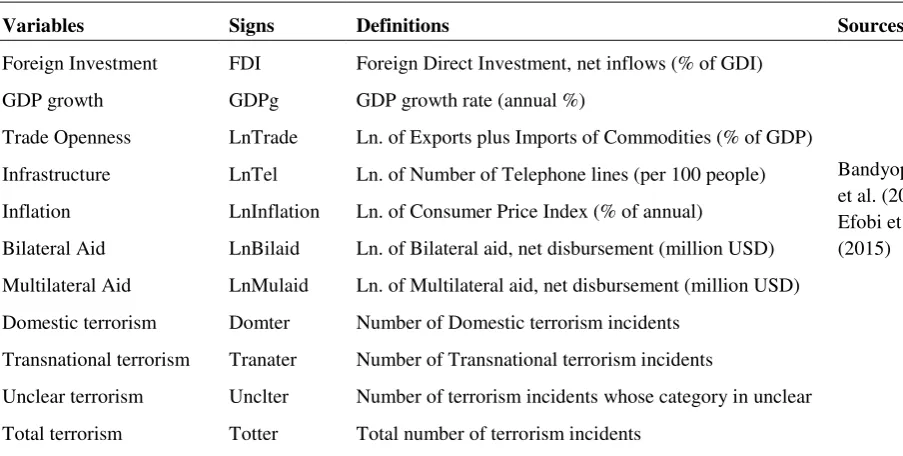
Table 1: Definition and source of variables
Variables Signs Definitions Sources
Foreign Investment FDI Foreign Direct Investment, net inflows (% of GDI)
Bandyopadhyay et al. (2014) and Efobi et al. (2015) GDP growth GDPg GDP growth rate (annual %)
Trade Openness LnTrade Ln. of Exports plus Imports of Commodities (% of GDP)
Infrastructure LnTel Ln. of Number of Telephone lines (per 100 people)
Inflation LnInflation Ln. of Consumer Price Index (% of annual)
Bilateral Aid LnBilaid Ln. of Bilateral aid, net disbursement (million USD)
Multilateral Aid LnMulaid Ln. of Multilateral aid, net disbursement (million USD)
Domestic terrorism Domter Number of Domestic terrorism incidents
Transnational terrorism Tranater Number of Transnational terrorism incidents
Unclear terrorism Unclter Number of terrorism incidents whose category in unclear
Total terrorism Totter Total number of terrorism incidents
GDP: Gross Domestic Product. WDI: World Development Indicators.
[image:10.595.76.531.521.721.2]Table 1 summarises the definition of the variables while Table 2 provides the summary statistics. It can be noticed that some of the variables have been defined in logarithms in the former to enable the comparison of ‘mean values’ in the latter. The substantial variation informs us that reasonable estimated linkages would emerge from the empirical analysis.
Table 2: Summary statistics
Mean S.D Minimum Maximum Obs.
10
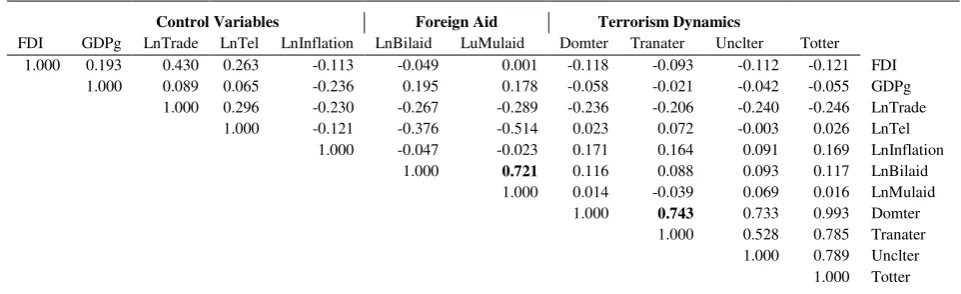
[image:11.595.62.543.330.477.2]The purpose of Table 3 is to decrease potential issues of overparameterization and multicollinearity that are articulated in bold. As expected, terrorism and foreign aid variables are highly correlated. Hence, we avoid employing two foreign aid or terrorism variables in the same specification. We also notice that while the dependent variable is negatively correlated with terrorism variables, it is also negatively (positively) correlated with bilateral (multilateral) aid. Whereas the negative correlation between FDI and bilateral aid is contrary to the intuition motivating the testable hypothesis enunciated in the introduction, two justifications motivate pursuing the line of inquiry. First, it is standard in econometrics that correlations should not be assimilated to causalities. Second, the bilateral aid variable is employed as a modifying policy variable. Hence, it could interact with terrorism to reveal other unexpected dynamics.
Table 3: Correlation Matrix
Control Variables Foreign Aid Terrorism Dynamics
FDI GDPg LnTrade LnTel LnInflation LnBilaid LuMulaid Domter Tranater Unclter Totter 1.000 0.193 0.430 0.263 -0.113 -0.049 0.001 -0.118 -0.093 -0.112 -0.121 FDI
1.000 0.089 0.065 -0.236 0.195 0.178 -0.058 -0.021 -0.042 -0.055 GDPg 1.000 0.296 -0.230 -0.267 -0.289 -0.236 -0.206 -0.240 -0.246 LnTrade
1.000 -0.121 -0.376 -0.514 0.023 0.072 -0.003 0.026 LnTel 1.000 -0.047 -0.023 0.171 0.164 0.091 0.169 LnInflation
1.000 0.721 0.116 0.088 0.093 0.117 LnBilaid 1.000 0.014 -0.039 0.069 0.016 LnMulaid
1.000 0.743 0.733 0.993 Domter 1.000 0.528 0.785 Tranater
1.000 0.789 Unclter 1.000 Totter
FDI: Foreign Direct Investment, net inflows. GDPg: GDP growth rate. LnTrade: Trade Openness. LnTel: Number of Telephone lines. LnBilaid: Bilateral aid. LnMulaid: Multilater aid. Domter: Number of Domestic terrorism incidents. Tranater: Number of Transnational terrorism incidents. Unclter: Number of terrorism incidents whose category in unclear. Totter: Total number of terrorism incidents.
2.2 Methodology
Consistent with the literature on conditional determinants (Billger &Goel, 2009; Asongu, 2013), and in order to examine if existing levels in FDI affect the incidence of terrorism and/or foreign aid on ‘FDI location decisions’in developing countries, we employ a quantile regression (QR) approach. It entailsinvestigating the determinants of FDI throughout the distributions of FDI (Keonker & Hallock, 2001).
11
Ordinary Least Squares (OLS) is based on the assumption that FDI and error terms are distributed normally, the QR approach is not founded on the hypothesis thaterror terms are normally distributed. Hence, the techinque enables us to examine the impact of terrorism on FDI with particular emphasis on best- and worst-performing countries in terms of FDI, among the sampled developing nations. In essence, with QR, parameter estimates are derived at multiple points of the conditional distributions of FDI (Koenker & Bassett, 1978). The employed QR technique is increasingly being adopted in development literature, among others, in: health (Asongu, 2014c) and corruption (Billger &Goel, 2009; Okada & Samreth, 2012) studies
The th quantile estimator of FDI is obtained by solving for the following optimization problem, which is presented without subscripts in Eq. (1) for the purpose of simplicity and ease of presentation.
i i i i i i k x y i i i x y i i i Rx
y
x
y
: :)
1
(
min
(1)Where
0,1 . As opposed to OLS which is fundamentally based on minimizing the sum of squared residuals, with QR, the weighted sum of absolute deviations are minimised. For instance the 25th or 75th quantiles (with =0.25 or 0.75 respectively) by approximately weighing the residuals. The conditional quantile of FDI oryigiven xiis:
i i y x x
Q ( / ) (2)
where unique slope parameters are modelled for each th specific quantile. This formulation is analogous to E(y/x) xi in the OLS slope where parameters are investigated only at
the mean of the conditional distribution of FDI. For the model in Eq. (2), the dependent variable yi is the FDI indicator while xi contains a constant term, trade, inflation,
infrastructure, and GDP growth. The specifications in Eq. (1) are tailored to mitigate the
multicollinearity and overparameterization issues identified in Table 3.
3. Empirical results
3.1 Presentation of results
The empirical findings presented in Table 4 and Table 5 respectively correspond to bilateral aid and multilateral aid regressions. Panel A (B) of both tables presents findings for
12
discussed in the methodological section, an OLS baseline specification is provided to articulate modelling differences between conditional means and median values of FDI. Hence, the interest of adopting the QR technique is justified by differences in significance and magnitude of estimated coefficients between the OLS and QR results. In accordance with Brambor et al. (2006), the overall effect of the modifying development assistance variable on the examined relationship is assessed in terms of marginal effects.
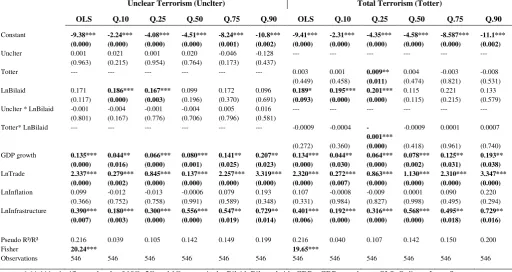
The following can be established for Table 4 on the relationships among FDI, terrorism and bilateral aid. First, in Panel A, the impact of domestic terrorism on FDI is
positive in the 0.10th and 0.25th quantiles of the Left Hand Side (LHS), whereas the effect of
transnational terrorism is negative for the 0.25th quantile in the Right Hand Side (RHS). In Panel B, the effect of unclear terrorism is consistently insignificant on the LHS while the
impact of total terrorism is positively significant in the 0.25thquantile of the RHS. Second, the
effect of foreign aid is consistently positive only in bottom quantiles of the FDI distributions. Third, contrary to the intuition motivating the study, interactions between terrorism and foreign aid do not significantly increase FDI as expected. On the contrary, we find thatthe combined effect on FDI is negative, in: (i) bottom quantiles in the LHS of PanelA for
‘domestic terrorism and bilateral aid’ and (ii) the 0.25th quantile in the RHS of Panel B, for
‘total terrorism and bilateral aid’. Only the modifying threshold for ‘bilateral aid and domestic terrorism’ is within the range (0.765 to 8.362) provided by the summary statistics, notably: 5.5 (0.011/0.002) and 9 (0.009/0.001) respectively for (i) and (ii).
13 Table 4: FDI, Bilateral aid, Terrorism
Dependent Variable: Foreign Direct Investment (FDI) Inflows
Panel A: Domestic Terrorism and Transnational Terrorism
Domestic Terrorism (Domter) Transnational Terrorism (Tranater)
OLS Q.10 Q.25 Q.50 Q.75 Q.90 OLS Q.10 Q.25 Q.50 Q.75 Q.90
Constant -9.43*** -2.50*** -4.38*** -4.58*** -8.68*** -11.3*** -9.43*** -2.23*** -3.94*** -4.57*** -9.041*** -11.4*** (0.000) (0.000) (0.000) (0.000) (0.000) (0.001) (0.000) (0.000) (0.000) (0.000) (0.000) (0.001)
Domter 0.004 0.011*** 0.011*** 0.005 -0.004 -0.008 --- --- --- --- --- ---
(0.343) (0.000) (0.001) (0.471) (0.799) (0.601)
Tranater --- --- --- --- --- --- 0.001 -0.007 -0.064* -0.012 -0.003 0.040
(0.985) (0.835) (0.076) (0.850) (0.983) (0.772) LnBilaid 0.190* 0.222*** 0.202*** 0.116 0.219 0.143 0.181 0.173*** 0.152*** 0.101 0.229 0.146
(0.090) (0.000) (0.000) (0.149) (0.196) (0.562) (0.115) (0.001) (0.000) (0.201) (0.163) (0.551) Domter* LnBilaid -0.001
-0.002*** -0.002***
-0.001 0.0002 0.0006 --- --- --- --- --- ---
(0.202) (0.001) (0.000) (0.414) (0.941) (0.820)
Tranater* LnBilaid --- --- --- --- --- --- -0.003 0.0004 0.009 0.001 -0.004 -0.009
(0.778) (0.936) (0.136) (0.917) (0.880) (0.635) GDP growth 0.133*** 0.055*** 0.064*** 0.077*** 0.127*** 0.190** 0.135*** 0.039** 0.066*** 0.076*** 0.123** 0.184**
(0.000) (0.000) (0.000) (0.003) (0.021) (0.022) (0.000) (0.047) (0.000) (0.000) (0.016) (0.043)
LnTrade 2.322*** 0.284*** 0.871*** 1.129*** 2.327*** 3.376*** 2.332*** 0.295*** 0.829*** 1.138*** 2.400*** 3.437*** (0.000) (0.001) (0.000) (0.000) (0.000) (0.000) (0.000) (0.005) (0.000) (0.000) (0.000) (0.000)
LnInflation 0.107 -0.016 -0.009 0.001 0.096 0.213 0.108 0.002 -0.016 0.011 0.091 0.177 (0.331) (0.662) (0.796) (0.976) (0.444) (0.295) (0.323) (0.956) (0.688) (0.853) (0.451) (0.386) LnInfrastructure 0.401*** 0.213*** 0.313*** 0.569*** 0.500** 0.724** 0.403*** 0.162*** 0.303*** 0.570*** 0.526*** 0.704**
(0.006) (0.000) (0.000) (0.000) (0.013) (0.016) (0.005) (0.008) (0.000) (0.000) (0.006) (0.041)
Pseudo R²/R² 0.216 0.040 0.107 0.142 0.150 0.201 0.216 0.040 0.105 0.142 0.149 0.197
Fisher 19.47*** 18.11***
Observations 546 546 546 546 546 546 546 546 546 546 546 546
Panel B: Unclear Terrorism and Total Terrorism
Unclear Terrorism (Unclter) Total Terrorism (Totter)
OLS Q.10 Q.25 Q.50 Q.75 Q.90 OLS Q.10 Q.25 Q.50 Q.75 Q.90
Constant -9.38*** -2.24*** -4.08*** -4.51*** -8.24*** -10.8*** -9.41*** -2.31*** -4.35*** -4.58*** -8.587*** -11.1*** (0.000) (0.000) (0.000) (0.000) (0.001) (0.002) (0.000) (0.000) (0.000) (0.000) (0.000) (0.002)
Unclter 0.001 0.021 0.001 0.020 -0.046 -0.128 --- --- --- --- --- ---
(0.963) (0.215) (0.954) (0.764) (0.173) (0.437)
Totter --- --- --- --- --- --- 0.003 0.001 0.009** 0.004 -0.003 -0.008
(0.449) (0.458) (0.011) (0.474) (0.821) (0.531) LnBilaid 0.171 0.186*** 0.167*** 0.099 0.172 0.096 0.189* 0.195*** 0.201*** 0.115 0.221 0.133
(0.117) (0.000) (0.003) (0.196) (0.370) (0.691) (0.093) (0.000) (0.000) (0.115) (0.215) (0.579) Unclter * LnBilaid -0.001 -0.004 -0.001 -0.004 0.005 0.016 --- --- --- --- --- ---
(0.801) (0.167) (0.776) (0.706) (0.796) (0.581)
Totter* LnBilaid --- --- --- --- --- --- -0.0009 -0.0004
-0.001***
-0.0009 0.0001 0.0007
(0.272) (0.360) (0.000) (0.418) (0.961) (0.740) GDP growth 0.135*** 0.044** 0.066*** 0.080*** 0.141** 0.207** 0.134*** 0.044** 0.064*** 0.078*** 0.125** 0.193**
(0.000) (0.016) (0.000) (0.001) (0.025) (0.023) (0.000) (0.030) (0.000) (0.002) (0.031) (0.038)
LnTrade 2.337*** 0.279*** 0.845*** 0.137*** 2.257*** 3.319*** 2.320*** 0.272*** 0.863*** 1.130*** 2.310*** 3.347*** (0.000) (0.002) (0.000) (0.000) (0.000) (0.000) (0.000) (0.007) (0.000) (0.000) (0.000) (0.000)
LnInflation 0.099 -0.012 -0.013 -0.0006 0.079 0.193 0.107 -0.0008 -0.009 0.0001 0.090 0.220 (0.366) (0.752) (0.758) (0.991) (0.589) (0.348) (0.331) (0.984) (0.827) (0.998) (0.495) (0.294) LnInfrastructure 0.390*** 0.180*** 0.300*** 0.556*** 0.547** 0.729** 0.401*** 0.192*** 0.316*** 0.568*** 0.495** 0.729**
(0.007) (0.003) (0.000) (0.000) (0.019) (0.014) (0.006) (0.000) (0.000) (0.000) (0.018) (0.016)
Pseudo R²/R² 0.216 0.039 0.105 0.142 0.149 0.199 0.216 0.040 0.107 0.142 0.150 0.200
Fisher 20.24*** 19.65***
Observations 546 546 546 546 546 546 546 546 546 546 546 546
*,**,***: significance levels of 10%, 5% and 1% respectively. Bilaid: Bilateral aid. GDPg: GDP growth rate. OLS: Ordinary Least Squares. R² for OLS and Pseudo R² for quantile regression. Lower quantiles (e.g., Q 0.1) signify nations where FDI is least.
14
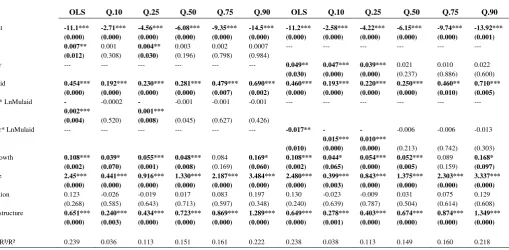
positive in: the 0.25thquantile of the LHS and bottom distributions of the RHSfor transnational terrorism. In Panel B, the effects of unclear and total terrorisms are not significant. Second, the effect of foreign aid is consistently positive with threshold evidence. That is, the impact consistently increases in magnitude from bottom to top quantiles of the FDI distribution. Third, contrary to the intuition motivating the study, the interactions between terrorism and multilateral aid does not significantly increase FDI as expected. On the contrary, we find that the effect on FDI is negative, in: (i) the 0.25th quantile of the LHS of Panel A for ‘domestic terrorism and multilateral aid’ and (ii) bottom quantiles of the RHS of Panel A for ‘transnational terrorism and multilateral aid’.
The modifying thresholds of multilateral aidare within the range (-1.249 and 7.105) provided by the summary statistics, notably: 4.00 (0.004/0.001) for ‘domestic terrorism’ and 3.13 (0.047/0.015) and 3.90 (0.039/0.010)’for the 0.10th and 0.25th quantiles of transnational terrorism respectively.
[image:15.595.49.559.506.756.2]On the control variables, with the exception of GDP growth for which the positive threshold evidence is not very apparent, their significances and magnitudes are broadly consistent with those established in Table 4, notably: (i) the insignificant effect of inflation and (ii) evidence of threshold from the effects of trade openness and infrastructural development.
Table 5: FDI, Multilateral aid, Terrorism
Dependent Variable: Foreign Direct Investment (FDI) Inflows
Panel A: Domestic Terrorism and Transnational Terrorism
Domestic Terrorism (Domter) Transnational Terrorism (Tranater)
OLS Q.10 Q.25 Q.50 Q.75 Q.90 OLS Q.10 Q.25 Q.50 Q.75 Q.90
Constant -11.1*** -2.71*** -4.56*** -6.08*** -9.35*** -14.5*** -11.2*** -2.58*** -4.22*** -6.15*** -9.74*** -13.92*** (0.000) (0.000) (0.000) (0.000) (0.000) (0.000) (0.000) (0.000) (0.000) (0.000) (0.000) (0.001)
Domter 0.007** 0.001 0.004** 0.003 0.002 0.0007 --- --- --- --- --- ---
(0.012) (0.308) (0.030) (0.196) (0.798) (0.984)
Tranater --- --- --- --- --- --- 0.049** 0.047*** 0.039*** 0.021 0.010 0.022
(0.030) (0.000) (0.000) (0.237) (0.886) (0.600) LnMulaid 0.454*** 0.192*** 0.230*** 0.281*** 0.479*** 0.690*** 0.460*** 0.193*** 0.220*** 0.250*** 0.460** 0.710***
(0.000) (0.000) (0.000) (0.000) (0.007) (0.002) (0.000) (0.000) (0.000) (0.000) (0.010) (0.005)
Domter* LnMulaid -0.002***
-0.0002 -0.001***
-0.001 -0.001 -0.001 --- --- --- --- --- ---
(0.004) (0.520) (0.008) (0.045) (0.627) (0.426)
Tranater* LnMulaid --- --- --- --- --- --- -0.017**
-0.015*** -0.010***
-0.006 -0.006 -0.013
(0.010) (0.000) (0.000) (0.213) (0.742) (0.303) GDP growth 0.108*** 0.039* 0.055*** 0.048*** 0.084 0.169* 0.108*** 0.044* 0.054*** 0.052*** 0.089 0.168* (0.002) (0.070) (0.001) (0.008) (0.169) (0.060) (0.002) (0.065) (0.000) (0.005) (0.159) (0.097)
LnTrade 2.45*** 0.441*** 0.916*** 1.330*** 2.187*** 3.484*** 2.480*** 0.399*** 0.843*** 1.375*** 2.303*** 3.337*** (0.000) (0.000) (0.000) (0.000) (0.000) (0.000) (0.000) (0.003) (0.000) (0.000) (0.000) (0.000)
LnInflation 0.123 -0.026 -0.019 0.017 0.083 0.197 0.130 -0.023 -0.009 0.031 0.075 0.129
(0.268) (0.585) (0.643) (0.713) (0.597) (0.348) (0.240) (0.639) (0.787) (0.504) (0.614) (0.608) LnInfrastructure 0.651*** 0.240*** 0.434*** 0.723*** 0.869*** 1.289*** 0.649*** 0.278*** 0.403*** 0.674*** 0.874*** 1.349***
(0.000) (0.003) (0.000) (0.000) (0.000) (0.000) (0.000) (0.001) (0.000) (0.000) (0.000) (0.000)
15
Fisher 19.35*** 18.80***
Observations 543 543 543 543 543 543 543 543 543 543 543 543
Panel B: Unclear Terrorism and Total Terrorism
Unclear Terrorism (Unclter) Total Terrorism (Totter)
OLS Q.10 Q.25 Q.50 Q.75 Q.90 OLS Q.10 Q.25 Q.50 Q.75 Q.90
Constant -11.1*** -13.9*** -4.03*** -5.72*** -8.96*** -14.0*** -11.1*** -2.73*** -4.45*** -6.10*** -9.34*** -14.01*** (0.000) (0.001) (0.000) (0.000) (0.000) (0.000) (0.000) (0.000) (0.000) (0.000) (0.000) (0.000)
Unclter 0.023 0.007 -0.003 0.009 0.008 0.001 --- --- --- --- --- ---
(0.273) (0.676) (0.979) (0.710) (0.899) (0.977)
Totter --- --- --- --- --- --- 0.005** 0.001 0.002 0.002 0.001 0.001
(0.016) (0.306) (0.153) (0.211) (0.828) (0.897) LnMulaid 0.426*** 0.191*** 0.179*** 0.218*** 0.443*** 0.675*** 0.454*** 0.194*** 0.221*** 0.279*** 0.480*** 0.678***
(0.000) (0.000) (0.000) (0.000) (0.005) (0.003) (0.000) (0.000) (0.000) (0.000) (0.008) (0.004)
Unclter * LnMulaid -0.006* -0.001 0.0001 -0.002 -0.004 -0.005 --- --- --- --- --- ---
(0.099) (0.595) (0.949) (0.635) (0.711) (0.705)
Totter* LnMulaid --- --- --- --- --- ---
-0.001***
-0.0002 -0.0007**
-0.001* -0.0008 -0.001
(0.004) (0.504) (0.046) (0.062) (0.637) (0.700) GDP growth 0.110*** 0.036 0.064*** 0.059*** 0.090 0.169* 0.108*** 0.039* .055*** 0.048** 0.084 0.170
(0.002) (0.104) (0.000) (0.003) (0.118) (0.084) (0.002) (0.076) (0.000) (0.010) (0.169) (0.070) LnTrade 2.480*** 0.434*** 0.835*** 1.294*** 2.15*** 3.40*** 2.456*** 0.443*** 0.901*** 1.337*** 2.187*** 3.36***
(0.000) (0.000) (0.000) (0.000) (0.000) (0.000) (0.000) (0.000) (0.000) (0.000) (0.000) (0.000)
LnInflation 0.120 -0.015 -0.012 0.033 0.031 0.159 0.124 -0.023 -0.019 0.016 0.080 0.171
(0.279) (0.748) (0.749) (0.511) (0.821) (0.517) (0.267) (0.628) (0.620) (0.739) (0.596) (0.438) LnInfrastructure 0.634*** 0.244*** 0.381*** 0.681*** 0.866*** 1.267*** 0.650*** 0.239*** 0.422*** 0.721**** 0.867*** 1.300***
(0.000) (0.003) (0.000) (0.000) (0.000) (0.000) (0.000) (0.003) (0.000) (0.000) (0.001) (0.000)
Pseudo R²/R² 0.236 0.036 0.112 0.148 0.160 0.220 0.238 0.036 0.113 0.150 0.161 0.222
Fisher 20.00*** 19.55***
Observations 543 543 543 543 543 543 543 543 543 543 543 543
*,**,***: significance levels of 10%, 5% and 1% respectively. Mulaid: Multilateral aid. GDPg: GDP growth rate. OLS: Ordinary Least Squares. R² for OLS and Pseudo R² for quantile regression. Lower quantiles (e.g., Q 0.1) signify nations where FDI is least.
3.2 Further discussion of results and implication
We set-out to examine how foreign aid can be employed to mitigate the hypothetically negative influence of terrorism on FDI in developing countries. The findings have been mixed with unexpected and unexpected relationships. While we expected development assistance to boost FDI, the positive influence of terrorism on FDI is quite unexpected. With the slight exception of transnational terrorism on the RHS of Panel A in Table 4, we have consistently
observed the latter tendency, notably the positive impact of terrorism dynamics, in: (i) bottoms quantiles with domestic terrorism and the 0.25th quantile with total terrorism, for bilateral aid regressions and (ii) the 0.25th quantile with domestic terrorism and bottom quantiles of transnational terrorism, for multilateral aid regressions.
16
Movement for the Emancipation of the Niger Delta (MEND). This justification is consistent with the stream of literature on China targeting investment projects in less developing countries that are fragile and unstable politically (Tull, 2006; De Grauwe et al., 2012; Asongu & Aminkeng, 2013). Second, another possible elucidation to the unexpected findings may be traceable to the fact that prior to the 2011 Arab Spring; terrorism incidences have not been very alarming. Accordingly, consistent with the 2014 Global Terrorism Index (GTI, 2014, p. 13), global terrorism activities have been soaring substantially in the aftermath of the Spring. Third, there is a wealth of literature on the nexus between terrorism and macroeconomic variables with the consensus that terrorism might not have very significant negative effects on economic development, especially in countries with comparatively higher levels of development (Gaibulloev & Sandler, 2009). The consistently insignificant effects of unclear and total terrorism dynamics in Panel B of Table 5 broadly attest to this position. Moreover, the varying effects of terrorism in terms of signs and insignificance could find explanations in Meierrieks and Gries (2013) if the findings are strongly influenced by Latin American countries because our sample makes no distinction between the ‘Cold war’ and ‘post Cold war’ eras. In analysing the effect of terrorism on economic development, the underlying authors have used two sub-samples (the Cold war and post-Cold war eras) to conclude thatthe nexus varies across space and time. According to the account, in the Cold war époque, growth is established to have swayed terrorists’ activities in nations with intermediate development levels that experienced political instability and terrorism in Latin America. Conversely, in the post-‘Cold war’ era, terrorists’ activities are established to exert more negative economic consequences in Islamic and African nationsexperiencing: (i) growing terrorism and (ii) high rates of political openness and political instability. This third explanation is expositional and should be treated with caution until it is empirically verified.
The immediately preceding narrative has three main implications. (1) The post-2011 impact of terrorism on FDI may be substantially different from the findings established in this study. (2) Low incidences of terrorism have positively affected FDI location decisions. (3) It may be important to also account for the ‘terrorism heterogeneity’from regional perspectives (Africa versus Latin America for instance) in order to understand how regional dynamics play-out in the underlying relationships. In the present line of inquiry, we have only incorporated heterogeneity in terms of types of terrorisms.
17
only positively significant in the bottom quantiles of FDI distributions. The latter tendency is not very surprising because, from a preliminary analysis based on correlation coefficients, we found bilateral aid to be negatively correlated with FDI. Three implications could be derived. (1) Bilateral aid correlations with economic variables should be treated with caution unless backed by some more robust empirical evidence. (2) The instrumentality of bilateral aid in stimulating FDI is more effective in developing countries with lower initial levels of FDI. (3) The relevance of multilateral aid in stimulating FDI grows consistently with increasing levels of initial FDI.
It is important to devote some space to presenting our perspective of why the findings of bilateral aid are substantially different from those of multilateral aid. A possible elucidation for the difference is that, bilateral aid may be accompanied with more ‘political economy’ strings relative to multilateral aid (Efobi and Nnadi, 2015). It makes sense to infer that bilateral aid is associated with more strings because, since it involves only two parties, a consensus on the strings to attach can easily be reached. Conversely, with multilateral aid, multiple donors with potentially very conflicting interests are involved. Whereas a recent literature survey has established no consistent evidence on the effectiveness of bilateral aid vis-à-vis multilateral aid in the development outcomes of recipient countries (Biscaye et al., 2015), what is granted in our explanation is its consistency with common sense and evidence that bilateral aid to former colonies from former colonial powers is strongly tailored in view of preserving colonial legacies and strategic interests. Accordingly, the threshold effect established in our findings may be due to conflicting strategic interests of multilateral donorswhich may indulge them to end-up allocating aid essentially on FDI development outcomes. This interpretation is in accordance with Asongu (2014b), “Aid is the outcome of bargaining in a kind of political market made up of donor aid bureaucracies, multilateral aid
agencies and recipient government officials. Indeed donors pursue multiple goals and these
vary over time. For instance, economic gains seem important in Japanese aid, global welfare
improvement in Nordic aid and political goals in French aid. Hence, few would object to the
inference that our findings may also be explained by a motivation of the French to maintain
their colonial legacies and influence in Africa” (p. 472).
18
Quartey and Afful-Mensah (2014) and Asongu (2014b). In essence, the consistent positive effect: (i) gives credit to the strand of literature clarifying the questionable economics of development assistance (Asongu, 2014a; Efobi et al., 2014) and (ii) confirm the established rewards of development assistance in economic growth (Gyimah-Brempong & Racine, 2014; Kargbo & Sen, 2014), especially when foreign aid is funnelled through educational channels (Asiedu & Nandwa, 2007; Asiedu, 2014). The second point (ii) isvery relevant because, as we have highlighted earlier, Asongu and Nwachukwu (2016b) have shown that foreign aid positively affects education and lifelong-learning and in a latter study, they have established using the same methodology, sample and periodicity that education and lifelong-learning mitigate political violence and instability (Asongu & Nwachukwu, 2016a), which should be positively linked with terrorists’ activities.
A third issue of contention from our findings is that, interactions between terrorism and foreign aid dynamics unexpectedly yield negative effects on FDI. This is visibleexclusivelyin bottom quantiles of FDI distributions. Notably, this tendency is apparent in interactions between: (i) bilateral aid and domestic terrorism in bottom quantiles, (ii) multilateral aid and domestic terrorism in the 0.25th quantile and (iii) multilateral aid and transnational terrorism for the bottom quantiles. Moreover, we also notice that on average, the threshold value for bilateral aid (5.5) is higher than those for multilateral aid (4.00, 3.13 and 3.90). This implies, more bilateral aid is needed to change the positive effect of domestic terrorism on FDI relative to the amount of multilateral aid needed to reverse the positive gains of domestic and transnational terrorisms on FDI.
19
insights into the initial or underlying impact of terrorism on FDI before allocating foreign aid to mitigate a ‘potentially negative effect’ which in real terms, may be ‘positive’.
Given that we have motivated the choice of the data sample and periodicity with the interest of comparing our findings with previous studies which have used the same sample and periodicity, we also devote space to discussing how our findings are different from those established by Efobi et al. (2015) and Bandyopadhyay et al. (2014). While the common element among these strand of studies is that they have investigated the role of foreign aid in mitigating the potentially negative effect of terrorism on FDI, our line of inquiry has steered clear of these previous studies by investigating the underlying nexuses throughout the conditional distributions of the dependent variable. In this light, our findings have improved those of priorexpositions at least in a twofold manner. First, the evidence of a threshold effect present in foreign aid (especially multilateral aid) and some of the control variables (trade, infrastructure and GDP growth) has enriched the literature significantly. Accordingly, the establishment that the benefits of multilateral aid, trade, infrastructural development and GDP growth in stimulating FDI consistently improve with increases in initial levels of FDI is testament to the motivation for our quantile empirical strategy of considering the entire distribution of FDI, contrary to mean values of the dependent variable employed by previous studies. Hence, our findings validate the motivation that blanket FDI location policies may not be effective unless they are contingent on initial FDI levels and tailored differently across high- and low-FDI developing countries. This methodological positioning is being increasingly adopted in the determinants of growth (Asongu, 2015b) and FDI in fast-growing developing countries (Asongu & Kodila-Tedika, 2015).
20
transnational terrorism on FDI. Moreover, the authors also find that the adverse impacts of unclear and total terrorism are mitigated by multilateral aid.
For the sake of remaining succinct and avoiding repetition, our results as discussed above differ substantially in terms of: (i) sign of effect of terrorism dynamics; (ii) thresholds of significant impact of foreign aid variables and (iii) signs, significance and quantiles of marginal effects from the interactive regressions. As a policy implication, applied econometrics should not be limited to the mere acceptance or refutation of existing theories, extending previous studies with the same sample and periodicity is a useful scientific activity that could disclose very relevant policy implications.
4. Conclusion and future research directions
21
The analysis leaves room for the following future lines of inquiry: (i) investigating by what mechanisms terrorism positively affects FDI, (ii) clarifying why development assistance and terrorism interact to have a negative impact on FDI, (iii) examining the underlying nexuses with a post-2011 terrorism sample (iv) decomposing foreign aid into more components and (v) accounting for regional heterogeneity in the examined nexuses.
References
Abadie, A., & Gardeazabal, J., (2008), “Terrorism and the world economy”, European Economic Review, 52(1), pp.1-27.
Akinwale, A. K., (2010). “Integrating the traditional and the modern conflict management strategies in Nigeria”, Department of Sociology, Faculty of Social Sciences, University of Ibadan, Nigeria.
Akpan, U. S., Isihak, S. R., & Asongu, S. A., (2014). “Determinants of Foreign Direct Investment in Fast-Growing Economies: A Study of BRICS and MINT”, African Governance and Development Institute Working Paper No. 14/002, Yaoundé.
Amin, S., (2014). “Aid for Development”, Springer Briefs on Pioneers in Science and Practice, 16, pp. 125-137.
Asiedu, E., (2006), “Foreign Direct Investment in Africa: The Role of Natural
Resources, Market Size, Government Policy, Institutions and Political Stability”. World Economy, 29(1), pp. 63-72.
Asiedu, E. (2014). “Does Foreign Aid in Education Promote Economic Growth? Evidence From Sub-Saharan Africa”, Journal of African Development, 16(1), pp. 37-59.
Asiedu, E., & Lien, D., (2011), “Democracy, Foreign Direct Investment and Natural Resources”, Journal of International Economics, 84, pp. 99-111.
Asiedu, E., & Nandwa, B., (2007), “On the Impact of Foreign Aid in Education on Growth: How relevant is heterogeneity of aid flows and heterogeneity of aid recipients?”, Review of World Economics, 143(4), pp. 631-649.
Asongu, S. A., (2013). “Fighting corruption in Africa: do existing corruption-control levels matter?”, International Journal of Development Issues, 12(1), pp. 36-52.
Asongu, S. A., (2014a). “A Brief Clarification to the Questionable Economics of Foreign Aid for Inclusive Human Development”, African Governance and Development Assistance WP
22
Asongu, S. A., (2014b). “The Questionable Economics of Development Assistance in Africa: Hot-Fresh Evidence, 1996-2010”, The Review of Black Political Economy, 41(4), pp.
455-480.
Asongu, S. A., (2014c). “The impact of health worker migration on development dynamics: evidence of wealth effects from Africa”, The European Journal of Health Economics, 15(2),
pp. 187-201.
Asongu, S. A., (2015a). “On Taxation, Political Accountability and Foreign Aid: Empirics to a Celebrated Literature”, South African Journal of Economics: Forthcoming.
http://onlinelibrary.wiley.com/doi/10.1111/saje.12064/abstract
Asongu, S. A., (2015b). “Drivers of Growth in Fast Emerging Economies: A Dynamic Instrumental Quantile Approach”, African Governance and Development Institute Working Paper No. 15/009, Yaoundé.
Asongu, S. A., & Aminkeng, G. A. A., (2013). “The economic consequences of China-Africa relations: debunking myths in the debate”, Journal of Chinese Economic and Business
Studies, 11(4), pp. 261-277.
Asongu, S. A., & Kodila-Tedika, O., (2015a). “Is Poverty in the African DNA (Gene)?”,
African Governance and Development Institute Working Paper No. 15/011, Yaoundé.
Asongu, S. A., & Kodila-Tedika, O., (2015b). “Conditional determinants of FDI in fast emerging economies: an instrumental quantile regression approach”, African Governance and Development Institute Working Paper No. 15/003, Yaoundé.
Asongu, S. A., & Kodila-Tedika, O., (2016). “Fighting African Conflicts and Crime: Which Governance Tools Matter?”, International Journal of Social Economics: Forthcoming.
Asongu, S. A., & Nwachukwu, J. C., (2015a). “Revolution empirics: predicting the Arab Spring”, Revised and Resubmitted: Empirical Economics.
Asongu, S. A., & Nwachukwu, J. C., (2015b). “Drivers of FDI in Fast Growing Developing Countries: Evidence from Bundling and Unbundling Governance”, African Governance and Development Institute Working Paper No. 15/001, Yaoundé.
Asongu, S. A., & Nwachukwu, J. C., (2016a). “The Role of Lifelong Learning in Political Stability and Non-violence: Evidence from Africa”, Journal of Economic Studies:
Forthcoming.
Asongu, S. A., & Nwachukwu, J. C., (2016b). “Foreign aid volatility and lifelong learning: demand-side empirics to a textual literature”, International Journal of Social Economics:
Forthcoming.
Bandyopadhyay, S., Sandler, T., &Younas, J., (2014). “Foreign direct investment, aid, and terrorism”, Oxford Economic Papers, 66(1), pp. 25-50.
23
Investment”, Doing Business AbroadPolicy Report
https://www.stlouisfed.org/~/media/Files/PDFs/publications/pub_assets/pdf/re/2014/d/terroris m.pdf (Accessed: 29/04/2015).
Banuri, T., (2013). “Sustainable Development is the New Economic Paradigm”,
Development, 56(2), pp. 208-217.
Beets, S. D., (2005). “Understanding the Demand-Side Issues of International Corruption.”
Journal of Business Ethics, 57 (1), pp. 65-81.
Billger, S. M., & Goel, R. K., (2009), “Do existing corruption levels matter in controlling corruption? Cross-country quantile regression estimates”, Journal of Development Economics, 90, pp. 299-305.
Biscaye, P., Harris, K. P., Reynolds, T., & Anderson, C. L., (2015). “Relative Effectiveness of Bilateral and Multilateral Aid on Development and Social Outcomes”, Evans School of Policy Analysis and Research (EPAR) Brief No. 294, Seattle, Washington.
Black, D., (1990). The elementary forms of conflict management. New York, Plenum Press. Boly, A., Coniglio, N., Prota, F., & Seric, A., (2015), “Which Domestic Firms Benefit from FDI? Evidence from Selected African Countries”, Development Policy Review; 33(5):
Forthcoming.
Borg, M. J., (1992). “Conflict management in the modern world-system”. Sociological Forum, 7(2), pp. 261-282.
Brambor, T., Clark, W. M., & Golder, M., (2006), “Understanding Interaction Models: Improving Empirical Analyses”, Political Analysis, 14 (1), pp. 63-82.
Brockhoff, S., Kieger, T., & Meierrieks, D., (2014). “Great Expectations and Hard Times - The (Nontrivial) Impact of Education on Domestic Terrorism”, Journal of Conflict Resolution: doi: 10.1177/0022002713520589.
Caulderwood, K., (2015) “Sub-Saharan Africa Falls Behind In Fight Against Extreme Poverty: World Bank Report”, International Business Times (April 14th 2015).
http://www.ibtimes.com/sub-saharan-africa-falls-behind-fight-against-extreme-poverty-world-bank-report-1881460 (Accessed: 19/04/2015).
Choi, S-W., (2015). “Economic growth and terrorism: domestic, international, and suicide”,
Oxford Economic Papers, 67(1), pp. 157-181.
Choi, S-W., (2010). “Fighting Terrorism through the Rule of Law?”, The Journal of Conflict Resolution, 54(6), pp. 940-966.
24
De Grauwe, P., Houssa, R., & Picillo, G., (2012). “African trade dynamics: is China a different trading partner? ”, Journal of Chinese Economic and Business Studies, 10(1), pp.
15-45.
Efobi, U., Asongu, S., & Beecroft, I., (2015). “Foreign Direct Investment, Aid and Terrorism: Empirical Insight Conditioned on Corruption Control”, African Governance and Development Institute Working Paper No. 15/007, Yaoundé.
Efobi, U., Beecroft, I., & Asongu, S., (2014). “Foreign Aid and Corruption: Clarifying Murky Empirical Conclusions”, African Governance and Development Institute Working Paper No. 14/025, Yaoundé.
Efobi, U., and Nnadi, M., (2015). “How Does Foreign Aid Affect the Relationship between IFRS Adoption and Foreign Direct Investment?” African Governance and Development Institute Working Paper No. 15/014, Yaoundé.
Eubank, N., (2012), “Taxation, Political Accountability and Foreign Aid: Lessons from Somaliland”, Journal of Development Studies, 48(4), pp. 465-480.
Feridun, M., & Shahbaz, M., (2010). “Fighting Terrorism: Are Military Measures Effective? Empirical Evidence from Turkey”, Defence & Peace Economics, 21(2), pp. 193-205.
Gaibulloev, K., & Sandler, T., (2009). “The impact of terrorism and conflicts on growth in Asia”, Economics and Politics, 21(3), pp. 359-383.
Gardner, K. L., (2007). “Fighting Terrorism the FATF Way”. Global Governance: A Review of Multilateralism and International Organisation, 13(3), pp. 325-345.
Ghosh, J., (2013). “Towards a Policy Framework for Reducing Inequalities”, Development,
56(2), pp. 218-222.
GTI (2014). “Global Terrorism Index: Measuring and Understanding the Impact of Terrorism”, Institute for Economics and Peace, pp. 2-90.
http://www.visionofhumanity.org/sites/default/files/Global%20Terrorism%20Index%20Repor t%202014_0.pdf (Accessed: 28/04/2015).
Gyimah-Brempong, K., & Racine, J. S. (2014). “Aid and Economic Growth: A Robust Approach”, Journal of African Development, 16(1), pp. 1-35.
Heyneman, S. P., (2002). “Defining the Influence of Education on Social Cohesion”,
International Journal of Educational Policy, Research and Practice, 3(4), pp. 73-97. Heyneman, S. P., (2008a). “Education, social cohesion and ideology. In Right to Education: Policies and Perspectives,edited by Emin Karip, 89-104. Ankara: Turkish Education Association.
25
Hoffman, A. M., Shelton, C., & Cleven, E., (2013). “Press Freedom, Publicity, and the Cross -National Incidence of Transnational Terrorism”, Political Research Quarterly, 66 (4), pp.
896-909.
Humphreys, M., (2005). “Natural Resources, Conflict, and Conflict Resolution. Uncovering the Mechanisms”, Journal of Conflict Resolution, 49 (4), pp. 508-537.
International Country Risk Guide. (2010) The political risk services group, available at http://www.prsgroup.com/icrg.aspx (Accessed 10 October 2010).
Johnson A., & Quartey P (2009), “Foreign Aid and Human Development Indicators in sub -Saharan Africa”, Journal of Developing Societies, 25(1), pp. 57-83.
Kargbo, P. M., & Sen, K., (2014). “Aid Categories that Foster Pro-Poor Growth: The Case of Sierra Leone”, African Development Review, 26(2), pp. 416-429.
Koenker, R., & Hallock, F.K., (2001), “Quantile regression”, Journal of Economic Perspectives, 15, pp.143-156.
Koh, W. T. H., (2007). “Terrorism and its impact on economic growth and technological innovation”, Technological Forecasting and Social Change, 74(2), pp. 129-138.
Krause, U., (2013). “Innovation: The new Big Push or the Post-Development alternative?”,
Development, 56(2), pp. 223-226.
Lee, C., (2015),“Terrorism, Counterterrorism Aid, and Foreign Direct Investment”. Foreign Policy Analysis, doi: 10.1111/fpa.12087
Le Roux, S., & Kelsey, D., (2015a). “Dragon Slaying with Ambiguity: Theory and Experiments”, Sara le Roux, Department of Economics, Oxford Brookes University.
Le Roux, S., & Kelsey, D., (2015b). “Strategic Substitutes, Complements and Ambiguity: An Experimental Study”, Department of Economics, Oxford Brookes University.
Marglin, S. A., (2013). “Premises for a New Economy”, Development, 56(2), pp. 149-154.
Meierrieks, D., & Gries, T., (2013). “Causality between terrorism and economic growth”,
Journal of Peace Research, 50(1), pp. 91-104.
Mlachila, M., Tapsoba, R., & Tapsoba, S. J. A., (2014). “A Quality of Growth Index for Developing Countries: A Proposal”, IMF Working Paper No. 14/172.
Monni, S., & Spaventa, A., (2013). “Beyond GDP and HDI: Shifting the focus from paradigms to politics”, Development, 56(2), pp. 227-231.
Obeng-Odoom, F. (2013). “Africa’s Failed Economic Development Trajectory: A Critique”,
26
Obi, C. I., (2008). “Enter the Dragon? Chinese Oil Companies & Resistance in the Niger Delta”, Review of African Political Economy, 35(117), pp. 417-434.
Öcal, N., & Yildirim, J., (2010). “Regional effects of terrorism on economic growth in Turkey: A geographically weighted regression approach”, Journal of Peace Research, 47(4),
pp. 477-489.
Okada, K., & Samreth, S.,(2012), “The effect of foreign aid on corruption: A quantile regression approach”, Economic Letters, 115(2), pp. 240-243.
Oreopoulos, P., & Salvanes, K. G., (2009). “How Large are Returns to Schooling? Hint: Money Isn’t Everything.”, NBER Working Paper No. 15339, Massachusetts.
Quartey P., & Afful-Mensah, G., (2014), Foreign Aid to Africa: Flows, Patterns and Impact, in Monga C and Lin J (eds), Oxford Handbook of Africa and Economics, Volume 2: Policies
and Practices, Oxford University Press, Oxford, UK.
Singh, P., (2001). “Punjab Terrorism: Truth Still Uncovered”, Economic and Political Weekly, 36 (40), pp. 3829-3831.
Singh, P., (2007). “The Political Economy of the Cycles of Violence and Non-violence in the Sikh Struggle for Identity and Political Power: implications for Indian federalism”,
Third World Quarterly, 28(3), pp. 555-570.
Straus, S., (2012). “Wars do end. Changing Patterns of Political Violence in Sub-Saharan Africa”, African Affairs, 111(443), pp. 179-201.
Thomas, K.W., (1992). Conflict and negotiation processes in organisations. In: Dunnette, M.D. and L.M. Hough eds. Handbook of industrial and organisational psychology. Palo Alto, CA, Consulting Psychologists Press. pp. 651-717.
Titumir, R. A. M., & Kamal, M. (2013). “Growing Together Sustainably: A zero-poverty post 2015 development framework”, Development, 56(2), pp. 172-184.
Tull, D. M., (2006). “China’s engagement in Africa: scope, significance and consequences”,
The Journal of Modern African Studies, 44(3), pp. 459-479.
Volkema, R. J., & Bergmann, T. J., (1995). “Conflict styles as indicators of behavioural patterns in interpersonal conflicts”. The Journal of Social Psychology, 135 (1), pp. 5-15.
Wamboye, E., Adekola, A., & Sergi, B. S. (2013). “Economic Growth and the Role of Foreign Aid in Selected African Countries”, Development, 56(2), pp. 155-171.