Direct Dry Syntheses and Thermal Analyses of a Series
of Aluminum Complex Hydrides
T. Sato
1, K. Ikeda
1, H.-W. Li
1, H. Yukawa
2, M. Morinaga
2and S. Orimo
1;* 1Institute for Materials Research, Tohoku University, Sendai 980-8577, Japan 2Department of Materials Science and Engineering, Graduate School of Engineering,
Nagoya University, Nagoya 464-8603, Japan
Synthesis of a series of aluminum complex hydrides, namely, LiAlH4, Li3AlH6, NaAlH4, Na3AlH6, Mg(AlH4)2, MgAlH5, Ca(AlH4)2, and
CaAlH5, was attempted by the mechanochemical milling of AlH3 and the other elemental hydrides. Aluminum complex hydrides, except
MgAlH5, were synthesized, and their dehydriding (decomposition) properties were systematically investigated by thermogravimetry. The
dehydridng temperatures possibly showed a correlation with the geometrical distances in space betweenM0(M00) and H in the crystal structures
of the aluminum complex hydrides. [doi:10.2320/matertrans.MER2008251]
(Received August 5, 2008; Accepted October 20, 2008; Published December 3, 2008)
Keywords: aluminum, mechanical milling, thermogravimetric analysis, X-ray diffraction, hydrides
1. Introduction
Aluminum complex hydrides M(AlH4)n (M: typically alkali or alkaline-earth metals; n: valence ofM) have been intensively studied as candidates for hydrogen storage materials because of their high gravimetric hydrogen densities, reversible reactions under moderate conditions (temperatures and hydrogen pressures), and also their release of hydrogen without impurity gases.1–11)It has been reported that M0AlH4 (M0: alkali metals) decomposes into M03AlH6 upon heating and that one molar of hydrogen is released:11)
M0AlH4!1/3M03AlH6þ2/3AlþH2 " ð1Þ
For example, LiAlH4 decomposes into Li3AlH6, which has isolated AlH6-units in the crystal structure.11–13)On the other hand, M00(AlH
4)2 (M00: alkaline-earth metals) has been reported to decompose into the intermediate phase,M00AlH5,
as follows:10,11,14–16)
M00(AlH
4)2!M00AlH5þAlþ3/2H2" ð2Þ
Ca(AlH4)2 decomposes into CaAlH5, which has corner-shared AlH6-units in the crystal structure.14,15)Corner-shared AlH6-units are probably a characteristic of aluminum com-plex hydrides containing alkaline-earth metals (Ex. BaAl-H517)), although the structure of MgAlH5is still unclear.18–20) Systematic studies on aluminum complex hydrides are quite important to obtain further insights on various complex hydrides as candidates for hydrogen storage materials. For example, on the basis of theoretical studies, Løvvik et al. predicted that an interaction betweenM0and H can affect the
thermal stability of M0AlH
4 and M03AlH6.21) These inter-actions were explained given the existence of a geometrical space between M0 and H along with the results of crystal
orbital overlap population (COOP) calculation. Experimental data on crystal structures and thermal analyses of aluminum complex hydrides are indispensable for confirming the results of theoretical studies.
For performing systematic experimental studies, the syn-thesis of solvent-free high-quality samples of aluminum
complex hydrides are required. There are two methods for the synthesis of hydrides: wet synthesis (metathesis and precip-itation reactions in solutions)22)and dry synthesis (solid-solid
and/or solid-gas reactions).11)In the latter case, for example,
LiAlH4 has been synthesized from LiH, Al and TiCl3,23)
Na3AlH6 has been synthesized from NaH, Al and TiF3,24,25)
and Ca(AlH4)2 has been synthesized from CaCl2 and NaAlH4.26)
In the present study, for synthesizing aluminum complex hydrides, we focused on the ‘‘direct’’ dry synthesis method, namely, the mechanochemical milling of elemental hydrides AlH3andM0H orM00H2(M0: Li, Na;M00: Mg, Ca).27,28)The possible advantages of this simple but reliable synthesis method are as follows: (1) elemental hydrides including AlH3 are inductile materials (in contrast to Al) that promote mechanochemical milling and (2) AlH3exhibits an unstable property, the observed formation enthalpy of which is 9– 12 kJ/mol AlH3,29–31) and also promotes the formation of
more stable complex hydrides.11,32)
In the present study, firstly, a series of aluminum complex hydrides was synthesized by the direct dry synthesis method from elemental hydrides. Secondly, the samples were studied to elucidate the thermal properties of the complex hydrides. Finally, the obtained data were used to show a possible correlation between the dehydriding (decomposition) tem-peratures, and the geometrical distances in space betweenM0
(M00) and H in the crystal structures for a series of aluminum
complex hydrides.
2. Experimental Procedures
The starting elemental hydride -AlH3 was prepared in ether according to the chemical reactions of LiAlH4 and AlCl3 as described in Ref. 33), and X-ray diffraction peak positions were identified as -AlH3 (Fig. 1).34)Powders of
elemental hydrides, namely, LiH (CERAC 99.99%), NaH (Aldrich 95%), MgH2 (Alfa Aesar 98%), CaH2 (Aldrich 99.99%), and AlH3, were mixed with chemical compositions of LiAlH4, Li3AlH6, NaAlH4, Na3AlH6, Mg(AlH4)2, MgAlH5, Ca(AlH4)2, and CaAlH5. A mixture of AlH3 and the other elemental hydrides (weighing a total of 200 mg) was
*Corresponding author, E-mail: [email protected]
mechanochemically milled by using Fritsch P7 at 400 rpm at a hydrogen gas pressure of 0.3 MPa for up to 20 h, milling times of 5 min being alternated with 5 min of rest.
All the samples were investigated by using an X-ray diffractometer (PANalytical X’PERT, with Cu-K radia-tion). Simulated X-ray diffraction patterns were generated by PowderCell 1.0.35) To investigate the dehydriding
(decom-position) temperatures and the amounts of released hydrogen, the samples were then studied by thermogravimetry (TG, Rigaku TG-8210, with an Al sample holder) and heated up to 673 K at 5 K/min in a He gas flow of 150 ml/min. All the
samples were handled in an Ar- or He-gas-filled glove box with a dew point below 183 K and with less than 1 ppm of O2 in order to avoid (hydro-)oxidation.
3. Results and Discussion
Mechanochemical milling of only-AlH3 accelerates the dehydriding (decomposition) reaction and forms elemental Al in less than 1 h, especially at the beginning stage of the milling.30) Interestingly, the successful milling of -AlH3
together with the other elemental hydrides, however, results in the synthesis of aluminum complex hydrides, as explained below. It is assumed that the other elemental hydrides that are attached to the surface of -AlH3 prevent the dehydriding (decomposition) reaction of -AlH3, although the detailed mechanism is still under investigation.
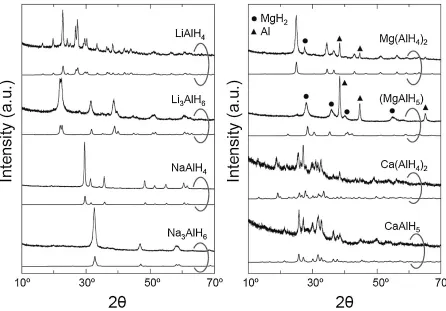
LiAlH4 and Li3AlH6 were synthesized by the mechano-chemical milling of LiH and -AlH3 for 5 h. The X-ray diffraction patterns in Fig. 2 are in good agreement with the simulated patterns. By the same synthesis procedures (the milling time was optimized for each hydride), NaAlH4 (milling time: 5 h), Na3AlH6 (10 h), Mg(AlH4)2 (10 h), Ca(AlH4)2 (10 h), and CaAlH5 (5.5 h) were also identified from X-ray diffraction patterns (Fig. 2). Although MgAlH5 has been reported to be formed from Mg(AlH4)2 as an intermediate phase,18,19) no evidence of its formation was obtained under the present synthesis conditions. The X-ray diffraction patterns of the samples (5 and 20 h) corresponded to Mg(AlH4)2, MgH2,-AlH3, and Al peaks (Fig. 2). Fig. 1 X-ray diffraction patterns of observed (top) and simulated (bottom)
-AlH3.33)
Fig. 2 Observed X-ray diffraction patterns of LiAlH4, Li3AlH6, NaAlH4, Na3AlH6, Mg(AlH4)2, Ca(AlH4)2and CaAlH5(MgAlH5was
not actually formed under the present syntheses condition). Simulated X-ray diffraction patterns of LiAlH4,36)Li3AlH6,13)NaAlH4,37)
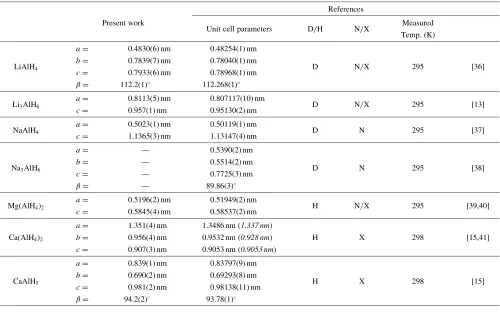
[image:2.595.54.282.68.244.2] [image:2.595.72.518.439.750.2]The unit cell parameters of all the aluminum complex hydrides, except MgAlH5, were calculated by TREOR42)and PIRUM43)and are summarized in Table 1.
Dehydriding properties of thus synthesized M0AlH
4,
M03AlH6, M00(AlH4)2 and M00AlH5 were systematically
investigated by thermogravimetry (TG), as shown in Fig. 3. Upon heating, LiAlH4has been reported to decompose and release hydrogen according to the following reactions:11,12)
LiAlH4
!1/3Li3AlH6þ2/3AlþH2" (5:3mass%) ð3aÞ !LiHþAlþ1/2H2" (2:7mass%) ð3bÞ
!LiAlþ1/2H2 " (2:7mass%) ð3cÞ
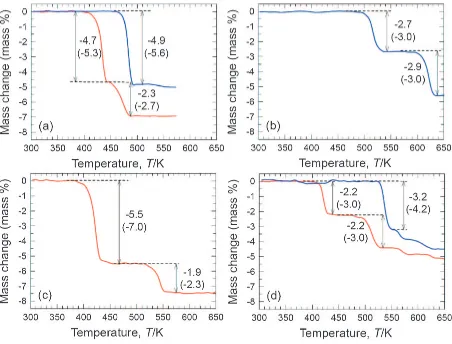
As shown in Fig. 3(a), LiAlH4 exhibited two-step mass changes from hydrogen release with amounts of 4.7 mass% (onset temperature of 426 K) and 2.3 mass% (459 K) that correspond to eqs. (3a) and (3b), respectively. Furthermore, Li3AlH6 is also assumed to obey the following reactions:
Li3AlH6!3LiHþAlþ3/2H2" (5:6mass%) ð3dÞ !Li-Al alloyþ3/2H2" (5:6mass%) ð3eÞ
In fact, we can confirm that 4.9 mass% of hydrogen was released from Li3AlH6 (476 K), corresponding to eq. (3d) (also shown in Fig. 3(a)).
Next, NaAlH4has been reported to decompose and release hydrogen according to the following reactions:1–3,5–7,11,32)
NaAlH4
!1/3Na3AlH6þ2/3AlþH2" (3:7mass%) ð4aÞ
!NaHþAlþ1/2H2" (1:9mass%) ð4bÞ
!NaþAlþ1/2H2" (1:9mass%) ð4cÞ
In the case of Na3AlH6, the reactions are as follows:
Na3AlH6!3NaHþAlþ3/2H2" (3:0mass%) ð4dÞ
!3NaþAlþ3/2H2" (3:0mass%) ð4eÞ
Na3AlH6 exhibited two-step hydrogen release with amounts of 2.7 mass% (507 K) and 2.9 mass% (610 K) that correspond to eqs. (4d) and (4e), respectively (Fig. 3(b)).
Furthermore, Mg(AlH4)2has been reported to decompose and release hydrogen according to the following reac-tions:10,11,16)
Mg(AlH4)2!MgH2þ2Alþ3H2" (7:0mass%) ð5aÞ
!Mgþ2AlþH2" (2:3mass%) ð5bÞ
As shown in Fig. 3(c), Mg(AlH4)2 exhibited two-step hy-drogen releases with amounts of 5.5 mass% (410 K) and 1.9 mass% (534 K) that correspond to eqs. (5a) and (5b), respectively.
Finally, the reactions for Ca(AlH4)2are suggested to be as follows:14,15)
Ca(AlH4)2
!CaAlH5þAlþ3/2H2" (3:0mass%) ð6aÞ !CaH2þ2Alþ3/2H2" (3:0mass%) ð6bÞ !Ca-Al alloyþH2" (2:0mass%) ð6cÞ
[image:3.595.49.549.113.429.2]According to Fig. 3(d), Ca(AlH4)2 released 2.2 mass% (415 K) and 2.2 mass% (499 K) of hydrogen by a two-step Table 1 Calculated unit cell parameters. The reported unit cell parameters were obtained from deuterided (D)/hydrided (H) samples with
structural determination (Rietveld refinement) results by powder neutron (N)/X-ray (X) diffraction. Ca(AlH4)2has not been examined by
Rietveld refinement, but calculated unit cell parameters by computational study are given in italics in parentheses. Unit cell parameters of Na3AlH6could not be obtained because of the small number of observed X-ray diffraction peaks.
References
Present work
Unit cell parameters D/H N/X Measured Temp. (K)
a¼ 0.4830(6) nm 0.48254(1) nm
LiAlH4
b¼ 0.7839(7) nm 0.78040(1) nm
D N/X 295 [36]
c¼ 0.7933(6) nm 0.78968(1) nm
¼ 112.2(1) 112.268(1)
Li3AlH6
a¼ 0.8113(5) nm 0.807117(10) nm
D N/X 295 [13]
c¼ 0.957(1) nm 0.95130(2) nm
NaAlH4
a¼ 0.5023(1) nm 0.50119(1) nm
D N 295 [37]
c¼ 1.1365(3) nm 1.13147(4) nm
a¼ — 0.5390(2) nm
Na3AlH6
b¼ — 0.5514(2) nm
D N 295 [38]
c¼ — 0.7725(3) nm
¼ — 89.86(3)
Mg(AlH4)2
a¼ 0.5196(2) nm 0.51949(2) nm
H N/X 295 [39,40]
c¼ 0.5845(4) nm 0.58537(2) nm
a¼ 1.351(4) nm 1.3486 nm (1.337 nm)
Ca(AlH4)2 b¼ 0.956(4) nm 0.9532 nm (0.928 nm) H X 298 [15,41]
c¼ 0.907(3) nm 0.9053 nm (0.9053 nm)
a¼ 0.839(1) nm 0.83797(9) nm
CaAlH5
b¼ 0.690(2) nm 0.69293(8) nm
H X 298 [15]
c¼ 0.981(2) nm 0.98138(11) nm
reaction, which correspond to eqs. (6a) and (6b). On the other hand, compared to the reported one-step reaction of (6c), hydrogen was released by a two-step reaction,i.e., 0.4 mass% (561 K) and 0.2 mass% (618 K). A similar phenomenon also appears in the dehydriding reaction of the synthesized CaAlH5, although it is predicted to release hydrogen according to the following reactions:
CaAlH5!CaH2þAlþ3/2H2" (4:2mass%) ð6dÞ
!Ca-Al alloyþH2" (2:8mass%) ð6eÞ
The dehydriding temperatures and the amounts of hydro-gen release for all the samples are basically comparable to the previously reported dehydriding reactions. The results indicate that the direct solid reaction ofMHn and AlH3 by using mechanochemical milling is a new and reliable synthesis process of the aluminum complex hydrides. The optimization of the synthesis condition is under investigation to obtain higher quality aluminum complex hydrides with different thermodynamic stabilities.
It is generally known that in the aluminum complex hydrides, hydrogen covalently bonds to Al in complex anions, [AlH4] or [AlH6]3, which form an ionic bonding
with Mnþ. On the other hand, a recent theoretical study
proposed that there is a possible weak M-H bonding, the strength of which depends on the distance in space betweenMand H.21)In other words, a shorterM-H distance
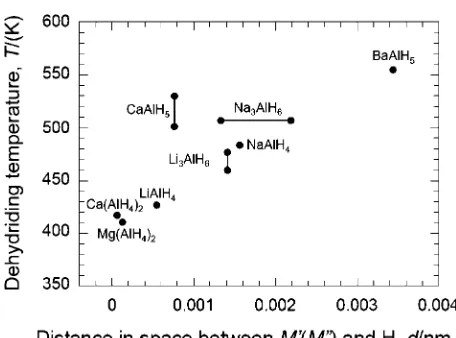
weakens the Al-H bonding and leads to a lower dehydriding temperature. Therefore, the onset temperatures of the dehydriding reaction of aluminum complex hydrides are plotted as a function of the distances in space between M0
(M00) and H.13,15,36–41)In this study, in order to estimate the
distances, averaged M0 (M00)-H distances were subtracted
from total distances of the ionic radius of H (0.110 nm21)) and that of M0 (M00). The result, shown in Fig. 4, roughly
indicates that the shorter the distance in space between
M0 (M00) and H, the stronger the interaction between them. This induces breakage of the Al-H bonds and lowers the dehydriding (decomposition) temperatures of the aluminum complex hydrides.
Detailed studies on the dehydriding reactions of the aluminum complex hydrides including Ca(AlH4)2 and CaAlH5, and on the correlation between dehydriding (de-composition) temperature and distance are required to obtain further insights on various complex hydrides for potential use as hydrogen storage materials.
4. Conclusions
The direct dry synthesis method was employed to obtain the aluminum complex hydrides from elemental hydrides. The hydrides, except MgAlH5, were successfully synthesized and characterized by using a powder X-ray diffractometer. Fig. 3 Thermogravimetry (TG) curve of (a) LiAlH4(red) and Li3AlH6(blue), (b) Na3AlH6, (c) Mg(AlH4)2, and (d) Ca(AlH4)2(red) and
CaAlH5(blue). Numbers indicate the mass reductions that the theoretical mass reductions are given in parentheses. In order to avoid any
reactions between the samples and the sample holder, the measurements of LiAlH4and Li3AlH6were terminated at 573 K. NaAlH4could
[image:4.595.72.524.70.414.2]Moreover, the dehydriding (decomposition) temperatures and the amounts of released hydrogen upon heating were investigated by TG. By the comparison study, the possible existence of a correlation between the dehydriding temper-atures and geometrical distances in space between M0(M00)
and H in the crystal structures of a series of aluminum complex hydrides was indicated.
Acknowledgements
This work was partially supported by Grant-Aid for Science Research (17106008) from the Ministry of Educa-tion, Culture, Sports, Science and Technology of Japan, by the Japan Society for the Promotion of Science; and by the Global COE Program ‘‘Materials Integration, Tohoku Uni-versity,’’ MEXT, Japan. Synthesis of AlH3 was done in collaboration with Dr. K. Hashi, Dr. H. Ito, and Dr. T. Kabutomori at Japan Steel Works, Ltd., and Prof. C.M. Jensen at the University of Hawaii.
REFERENCES
1) B. Bogdanovic´ and M. Schwickardi: J. Alloy. Compd.253–254(1997) 1–9.
2) C. M. Jensen and K. J. Gross: Appl. Phys. A72(2001) 213–219. 3) B. Bogdanovic´ and M. Schwickardi: Appl. Phys. A72(2001) 221–223. 4) J. Chen, N. Kuriyama, Q. Xu, H. T. Takeshita and T. Sakai: J. Phys.
Chem. B105(2001) 11214–11220.
5) D. Sun, T. Kiyobayashi, H. T. Takeshita, N. Kuriyama and C. M. Jensen: J. Alloy. Compd.337(2002) L8–11.
6) S. S. Srinivasan, H. W. Brinks, B. C. Hauback, D. Sun and C. M. Jensen: J. Alloy. Compd.377(2004) 283–289.
7) B. Bogdanovic´, U. Eberle, M. Felderhoff and F. Schu¨th: Scr. Mater.56 (2007) 813–816.
8) J. Graetz and J. Reilly: Scr. Mater.56(2007) 835–839.
9) N. Eigen, C. Keller, M. Dornheim, T. Klassen and R. Bormann: Scr. Mater.56(2007) 847–851.
10) K. Komiya, N. Morisaku, Y. Shinzato, K. Ikeda, S. Orimo, Y. Ohki, K. Tatsumi, H. Yukawa and M. Morinaga: J. Alloy. Compd.446–447 (2007) 237–241.
11) S. Orimo, Y. Nakamori, J. R. Eliseo, A. Zu¨ttel and C. M. Jensen: Chem. Rev.107(2007) 4111–4132.
12) H. W. Brinks, B. C. Hauback, P. Norby and H. Fjellva˚g: J. Alloy. Compd.351(2003) 222–227.
13) H. W. Brinks and B. C. Hauback: J. Alloy. Compd.354(2003) 143– 147.
14) M. Mamatha, C. Weidenthaler, A. Pommerin, M. Felderhoff and F. Schu¨th: J. Alloy. Compd.416(2006) 303–314.
15) C. Weidenthaler, T. J. Frankcombe and M. Felderhoff: Inorg. Chem.45 (2006) 3849–3851.
16) M. Fichtner, O. Fuhr and O. Kircher: J. Alloy. Compd.356–357(2003) 418–422.
17) Q. A. Zhang, Y. Nakamura, K. Oikawa, T. Kamiyama and E. Akiba: Inorg. Chem.41(2002) 6941–6943.
18) P. Claudy, B. Bonnetot and J. M. Letoffe: J. Thermal. Anal.15(1979) 119–128.
19) T. N. Dymova, N. N. Mal’tseva, V. N. Konoplev, A. I. Golovanova, D. P. Aleksandrov and A. S. Sizareva: Russ. J. Coord. Chem.29(2003) 385–389.
20) A. Klaveness, P. Vajeeston, P. Ravindran, H. Fjellva˚g and A. Kjekshus: Phys. Rev. B73(2006) 094112.
21) O. M. Løvvik, O. Swang and S. M. Opalka: J. Mater. Res.20(2005) 3199–3213.
22) R. H. Pawelke, M. Felderhoff, C. Weidenthaler and F. Schu¨th: Scr. Mater.59(2008) 515–517.
23) Y. Kojima, Y. Kawai, T. Haga, M. Matsumoto and A. Koiwai: J. Alloy. Compd.441(2007) 189–191.
24) P. Wang and C. M. Jensen: J. Phys. Chem. B108(2004) 15827–15829. 25) P. Wang, D. X. Kang and H. M. Cheng: Appl. Phys. Lett.87(2005)
071911.
26) M. Mamatha, B. Bogdanovic´, M. Felderhoff, A. Pommerin, W. Schmidt, F. Schu¨th and C. Weidenthaler: J. Alloy. Compd.407(2006) 78–86.
27) S. Chaudhuri, J. Graetz, A. Ignatov, J. J. Reilly and J. T. Mucherman: J. Am. Chem. Soc.128(2006) 11404–11415.
28) H. Kabbour, C. C. Ahn, S. J. Hwang, R. C. Bowman Jr. and J. Greatz: J. Alloy. Compd.446–447(2007) 264–266.
29) G. C. Sinke, L. C. Walker, F. L. Oetting and D. R. Stull: J. Chem. Phys. 47(1967) 2759–2761.
30) S. Orimo, Y. Nakamori, T. Kato, C. Brown and C. M. Jensen: Appl. Phys. A83(2006) 5–8.
31) J. Graetz and J. Reilly: J. Alloy. Compd.424(2006) 262–265. 32) W. Grochala and P. P. Edwards: Chem. Rev.104(2004) 1283–1316. 33) F. M. Brower, N. E. Matzek, P. F. Reigler, H. W. Rinn, C. B. Roberts,
D. L. Schmidt, J. A. Snover and K. Terada: J. Am. Chem. Soc.98 (1976) 2450–2453.
34) J. W. Turley and H. W. Rinn: Inorg. Chem.8(1969) 18–22. 35) W. Kraus and G. Nolze: J. Appl. Cryst.29(1996) 301–303. 36) B. C. Hauback, H. W. Brinks and H. Fjellva˚g: J. Alloy. Compd.346
(2002) 184–189.
37) B. C. Hauback, H. W. Brinks, C. M. Jensen, K. Murphy and A. J. Maeland: J. Alloy. Compd.358(2003) 142–145.
38) E. Ro¨nnebro, D. Nore´us, K. Kadir, A. Reiser and B. Bogdanovic´: J. Alloy. Compd.299(2000) 101–106.
39) A. Fossdal, H. W. Brinks, M. Fichtner and B. C. Hauback: J. Alloy. Compd.387(2005) 47–51.
40) M. Fichtner, J. Engel, O. Fuhr, A. Glo¨ss, O. Rubner and R. Ahlrichs: Inorg. Chem.42(2003) 7060–7066.
41) O. M. Løvvik: Phys. Rev. B71(2005) 144111.
42) P. E. Werner, L. Eriksson and W. Westdahl: J. Appl. Cryst.18(1985) 367–370.
43) P. E. Werner: Ark. Kemi.31(1969) 513–516.
44) M. P. Balogh, G. G. Tibbetts, F. E. Pinkerton, G. P. Meisner and C. H. Olk: J. Alloy. Compd.350(2003) 136–144.
45) Q. A. Zhang, Y. Nakamura, K. Oikawa, T. Kamiyama and E. Akiba: J. Alloy. Compd.361(2003) 180–186.
Fig. 4 Correlation between dehydrding temperature compared with the distances in space betweenM0(M00) and H. A six-coordinated ionic radius
of Li was used for LiAlH4because five-coordinated ionic radius has not
been reported. The dehydriding temperature of NaAlH4 (483 K) was
obtained from Ref. 44). Na3AlH6has two atomic positions for Na where
one Na atom has eight-coordinations (0.219 nm on distance in space between Na and H) and the other has six-coordinations (0.133 nm). Li3AlH6 and CaAlH5 each have two plots that are Li3AlH6 (459 K)/
CaAlH5 (499 K) decomposed from LiAlH4/Ca(AlH4)2, and directly
synthesized Li3AlH6 (476 K)/CaAlH5(530 K). BaAlH5 was plotted on
[image:5.595.53.281.66.235.2]