PSO OPTIMIZED CONTROLLER DESIGN FOR CARDIAC PACEMAKERS
1
Jeyanth Fedal Castro
1
Research Scholar, Department of EIE, Annamalai University, Chidambaram, Tamil Nadu
2
Professor, Department of EIE, Annamalai University, Chidambaram, Tamil Nadu
ARTICLE INFO ABSTRACT
With the current advancements quality
development of advanced techniques for health care related modules and particularly to recover from cardiac abnormalities. A PSO
the desired performance specifications by using PSO optimization algorithm. The gain parameters of the PID controller are designed and applied to the controller system. The closed loop response of the controller is obse
performance PID tuned with BF
determine a pacing rate in order to achieve a closer match between actual heart rate and a desired profile. Simulation results confirm that the proposed advanced design is effective for heartbeat recovery. It is hope
for improving the performance of implantable medical devices.
Copyright©2016, Jeyanth Fedal Castro and Malathi.
unrestricted use, distribution, and reproduction in any medium, provided the original work is properly cited.
INTRODUCTION
In order to prevent the sudden death of a patient, early and accurate diagnosis and medical treatment of heart diseases are very important. Electrocardiogram (ECG) is a very popular and simple and non invasive tool (also well recommended by WHO) for diagnosizing the cardiac abnormalities. The contractions of heart muscles give rise to the familiar ECG waveform. Normally rhythm of heart is synchronized by natural pacemaker of heart, Sino Atrial node. If there is any problem in conduction system of heart, a pacemaker is used. It is a medical device that applies an electrical impulse, delivered by electrodes contacting the heart muscles if any ambiguity in the heart rate which may occur due to changes in electrical activity of the heart. There are several researchers who have developed the control system to bring working of heart to normal condition, i.e. nomal rhythmic condition in
few years. A first cardiovascular system with transfer function
model was proposed by Biswas et al., (2006
Integral controller (PI) had been designed and demonstrated through simulation for closed loop pacemaker model by Inbar
et al., for regulating the mixing venous oxygen saturation level
(Gideon et al., 1988). In continuation of above control
algorithm Sugiura et al., (1991) developed a fuzzy approach to
control HR using an artificial cardiac pacemaker regulated by
*Corresponding author: Malathi, R.
Professor, Department of EIE, Annamalai University, Chidambaram, Tamil Nadu, India.
ISSN: 0975-833X
Article History: Received xxxxx, 2016 Received in revised form xxxxxxxx, 2016 Accepted xxxxxxx, 2016
Published online xxxxxx,2016
Key words:
Cardiac Pacemakers, PID Controller, Neuro Controller, PSO algorithm, Adaptive Controller.
Citation: Jeyanth Fedal Castro,V. and Malathi, R. Research, 8, (11), 42647-42651.
Article History:
Received 09th August, 2016
Received in revised form 03rd September, 2016
Accepted 25th October, 2016
Published online 30th November,2016
RESEARCH ARTICLE
PSO OPTIMIZED CONTROLLER DESIGN FOR CARDIAC PACEMAKERS
Jeyanth Fedal Castro,
V. and
*,2Malathi, R.
Research Scholar, Department of EIE, Annamalai University, Chidambaram, Tamil Nadu
Professor, Department of EIE, Annamalai University, Chidambaram, Tamil Nadu
ABSTRACT
With the current advancements quality-of-life of individuals has become a focal theme in the development of advanced techniques for health care related modules and particularly to recover from cardiac abnormalities. A PSO-PID controller is designed for the dual
the desired performance specifications by using PSO optimization algorithm. The gain parameters of the PID controller are designed and applied to the controller system. The closed loop response of the controller is observed for ISE, IAE, IATE and MSE error criteria.
performance observed for all four criteria. Comparison with the conventional PID control algorithm, PID tuned with BF-PSO based optimization techniques provide a more suitable control s
determine a pacing rate in order to achieve a closer match between actual heart rate and a desired profile. Simulation results confirm that the proposed advanced design is effective for heartbeat recovery. It is hoped that this study will be helpful not only for treatment of cardiac diseases but also for improving the performance of implantable medical devices.
This is an open access article distributed under the Creative Commons Att use, distribution, and reproduction in any medium, provided the original work is properly cited.
In order to prevent the sudden death of a patient, early and accurate diagnosis and medical treatment of heart diseases are very important. Electrocardiogram (ECG) is a very popular and (also well recommended by cardiac abnormalities. The contractions of heart muscles give rise to the familiar ECG of heart is synchronized by natural pacemaker of heart, Sino Atrial node. If there is any problem in conduction system of heart, a pacemaker is used. It is a medical device that applies an electrical impulse, delivered scles if any ambiguity in the heart rate which may occur due to changes in electrical activity of the heart. There are several researchers who have developed the control system to bring working of heart to normal condition, i.e. nomal rhythmic condition in the recent with transfer function 2006). The Propotional had been designed and demonstrated through simulation for closed loop pacemaker model by Inbar for regulating the mixing venous oxygen saturation level
In continuation of above control loped a fuzzy approach to control HR using an artificial cardiac pacemaker regulated by
Professor, Department of EIE, Annamalai University, Chidambaram, Tamil
respiratory rate and temperature
results that the fuzzy method is well suited for the application
(Sugiura et al., 1991). One more control algorithm designed
using fuzzy logic controller for rate
and proposed by Wojtasik, et al.
authors have designed a family of fuzzy logic controllers for rate-adaptive cardiac pacemakers. Shin
fuzzy controller to study the rate adaptive pacemaker by motion and respiration. It is observed that the neuro inferred HR is more accurate than the one using normal fuzzy
table look-up method (Shin et al
algorithm offers good adaptation to the change in HR according to physiological needs of the patient and easy personalization. It is also noted that other researchers have also reported different algorithms for cardiac pacing
1999; Jaworski et al., 2000; Dipali Bansal
et al., 1999). Recently, Neogi
aspect of an artificial pacemaker. The authors have designed and analysed a control system for regulating the HR using pacemaker in an efficient way. The design emphasizes on the optimality of the developed system
From the literatures, it is noted that the need for improved performance of the pacemaker has led to the development of
model based controllers. Well
Proportional, Integral and Derivative (PID) controllers are the most widely used controller in the chemical process industries because of their simplicity, robustness and successful practical
International Journal of Current Research Vol. 8, Issue, 11, pp.42647-42651, November, 2016
INTERNATIONAL
V. and Malathi, R. 2016.“PSO optimized controller design for cardiac pacemaker
PSO OPTIMIZED CONTROLLER DESIGN FOR CARDIAC PACEMAKERS
Research Scholar, Department of EIE, Annamalai University, Chidambaram, Tamil Nadu, India
Professor, Department of EIE, Annamalai University, Chidambaram, Tamil Nadu, India
life of individuals has become a focal theme in the development of advanced techniques for health care related modules and particularly to recover from dual-sensor based pacemaker to meet the desired performance specifications by using PSO optimization algorithm. The gain parameters of the PID controller are designed and applied to the controller system. The closed loop response of the ISE, IAE, IATE and MSE error criteria. A comparison of system with the conventional PID control algorithm, PSO based optimization techniques provide a more suitable control strategy to determine a pacing rate in order to achieve a closer match between actual heart rate and a desired profile. Simulation results confirm that the proposed advanced design is effective for heartbeat pful not only for treatment of cardiac diseases but also
is an open access article distributed under the Creative Commons Attribution License, which permits
respiratory rate and temperature and it is concluded from the results that the fuzzy method is well suited for the application One more control algorithm designed using fuzzy logic controller for rate-adaptive heart pacemaker
et al., (2000). Further several other
authors have designed a family of fuzzy logic controllers for
adaptive cardiac pacemakers. Shin et al. proposed a
neuro-fuzzy controller to study the rate adaptive pacemaker by motion and respiration. It is observed that the neuro-fuzzy inferred HR is more accurate than the one using normal fuzzy
et al., 2000). The implemented
algorithm offers good adaptation to the change in HR according to physiological needs of the patient and easy so noted that other researchers have also
reported different algorithms for cardiac pacing (Alt et al.,
Dipali Bansal et al., 2009; Werner
. Recently, Neogi et al. worked on simulation
aspect of an artificial pacemaker. The authors have designed and analysed a control system for regulating the HR using pacemaker in an efficient way. The design emphasizes on the
optimality of the developed system (Neogi et al., 2010).
From the literatures, it is noted that the need for improved performance of the pacemaker has led to the development of
model based controllers. Well-designed conventional
Proportional, Integral and Derivative (PID) controllers are the ontroller in the chemical process industries because of their simplicity, robustness and successful practical
INTERNATIONAL JOURNAL OF CURRENT RESEARCH
applications. Many tuning methods have been proposed for PID controllers. Many tuning methods have been proposed for obtaining better PID controller parameter settings. The comparison of various tuning methods for cardiac pacemaker is analysed using simulation software. Also efficiency of various PID controller are investigated for different performance metrics such as Integral Square Error (ISE), Integral Absolute Error (IAE), Integral Time absolute Error (ITAE), and Mean square Error (MSE) is presented and simulation is carried out. Work in this paper explores basic concepts, mathematics, and design aspect of PID controller. Comparison between the PID controller and PSO optimization based control techniques will have been carried out to determine the best controller for the cardiac system is concerned.
PID controller
The controller consists of Proportional, Integral and Derivative gains and the PID feedback control system is illustrated in Fig. 1 where r, e, y are respectively the reference, error and
controlled variables. Where Kp is proportional gain, Ki is
[image:2.595.310.554.183.342.2]integral gain and Kd is derivative gain.
Figure 1. Feedback PID Controller
In the diagram of Fig.1, G(s) is the plant transfer function and C(s) is the PID controller transfer function that is given as:
( ) = + + --- (1)
Where Kp ,Ki, Kd are theparameters of the PID controllers that
are going to be tuned using PSO algorithm.
Neural network based PID control
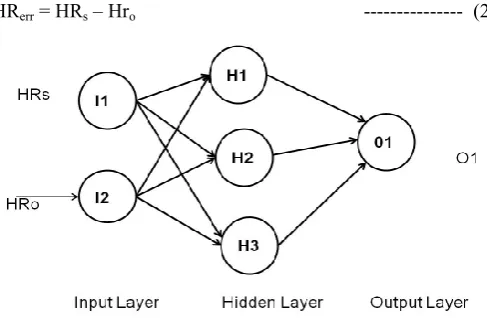
[image:2.595.61.273.333.438.2]Neural network could be used to regulate the parameters of the PID controller. The PID control system based on Back Propagation (BP) neural network was composed by the conventional PID controller and BP neural network and its structure is shown in Figure 2, are regulated by the neural network.
Figure 2. Structure of Neuro Controller
The BP neural network can contain different hidden layers. But it is theoretically proved that three layered network with
unlimited nodes can fit any non linear mapping. The number of
input layer neurons is two namely I1 and I2 that is Heart rate
set point (HRs), Heart rate output (HRo). The output of the
neural network is PID controller output O1
and t
herefore thenumber of neurons in the output layer is one. The hidden layer
has three neurons and they represented as H1 (P-neuron), H2
(I-neuron) and H3 (D-neuron). According to the structure of
neural net diagram in Figure. 3, the actuating error HRerr can
be expressed as,
HRerr = HRs – Hro --- (2)
Figure 3. Architecture of Neural controller
In the conventional BP multi-layered neural network, the learning algorithm is the gradient descent algorithm in which the gradient is calculated by back propagation method, according to the rules of windrow-Hoff. BP algorithm is used for weighting coefficients. The aim of the algorithm is to minimize the error in order to recover the system quickly from the effects of the external disturbance by tuning of PID parameter. BP neural network learning algorithm is described as follow:
= 0.5 ∗ ( − ) (3)
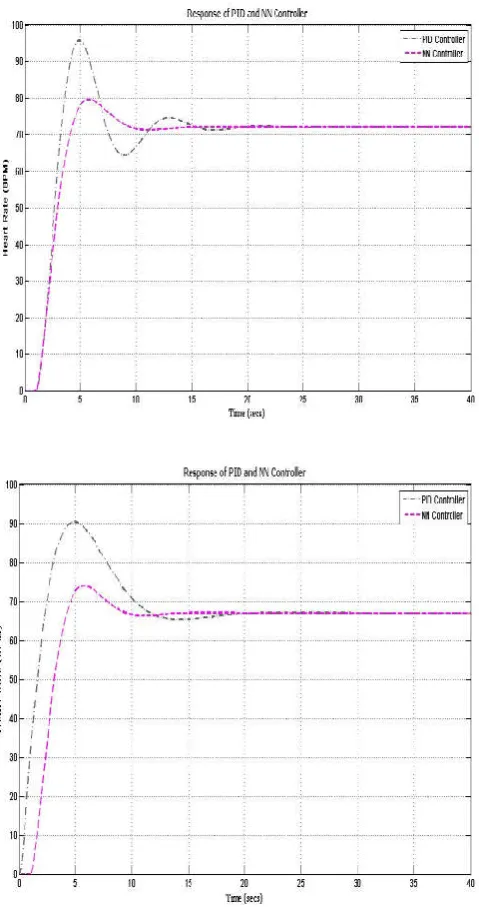
The weights of hidden nodes are adjusted by BPNN algorithm based on steepest descent online training process. It is done in terms of adjusted weights of hidden layer to output layer and input layer to hidden layer. The increments of weight in hidden to output connection are updated by gradient descent method. The responses of both the controllers are given in Figure 4. It is observed from the response that the performance criteria such as peak over shoot, settling time are too high. In order to bring the performance indices within the stipulated limit, the following performance criteria also considered. Also, the two more controllers are designed to minimize the performance criteria.
Performance evaluation criteria
[image:2.595.39.286.676.741.2]settling time, steady state error and reference tracking error for all proposed controllers. For a PID- controlled system, there are often four indices to depict the system performance ISE, IAE, IATE and MSE.
Figure 4. Response of PID and NN controller for 67 and 72 bpm
They are defined as follows:
ISE Index:
= ∫∝ ( ) --- (4) IAE Index:
= ∫ | ( )| ∞ --- (5) IATE Index:
= ∫∞ | ( )| --- (6)
MSE Index:
= ∫∞ ( ) --- (7)
Overview of pso algorithm
PSO is optimization algorithm based on evolutionary computation technique. A new parameter called inertia weight
is added. This is a commonly used PSO where inertia weight is linearly decreasing during iteration in addition to another common type of PSO which is reported by Clerc. The later is the one used in this paper. In PSO, instead of using genetic operators, individuals called as particles are “evolved” by cooperation and competition among themselves through generations. A particle represents a potential solution to a problem. Each particle adjusts its flying according to its own flying experience and its companion flying experience. Each
particle is treated as a point in a D-dimensional space. The ith
particle is represented as XI=(xi1,xi2,…,xiD). The best previous position (giving the minimum fitness value) of any particle is recorded and represented as PI=(pi1,pi2,…,piD), this
is called pbest. The index of the best particle among all particles
in the population is represented by the symbol g, called as gbest.
The velocity for the particle i is represented as VI= (vi1,
vi2,…,viD). The particles are updated according to set of
equations given in (Nasri et al., 2007; Popov et al., 2005;
Lieslehto, 2001; Fisher, 1938; Janzen, 1998).
The ith particle in the swarm is represented as
Xi = ( xi1 , xi2, xi3,...xid) in the d-dimensional space.
The best previous positions of the ith particle is represented as: Pbest = (Pbesti, 1, Pbesti, 2, Pbesti, 3...Pbesti, d)
The index of the best particle among the group is Gbestd. Velocity of the ith particle is represented as Vi = (Vi, 1 Vi,2 Vi,3... Vi,d).
The updated velocity and the distance from Pbesti,d to Gbesti,d is given as ;
Vi,m t+1 = W*Vi,m t +C1*rand()*(Pbesti,m – Xi,m t) +
C2*rand()*(Gbestm – Xi,m t)
- Xi,m (t+1) = Xi,m (t) +Vi,m (t+1)
For i=1,2,3...n. m = 1,2,3...d.
where,
n:- Number of particles in the group.
d:- dimension index.
t:- Pointer of iteration.
Vi,m(t) :- Velocity of particle at iteration i.
W:- Inertia weight factor.
C1 , C2 :- Acceleration Constant.
rand() :- Random number between 0 and 1.
Xi,d (t) :- Current position of the particle ‘i’ at iteration. Pbesti :- Best previous position of the ith particle.
Gbest:- Best particle among all the particle in the swarming population.
Figure 5. Flowchart for PSO algorithm
[image:4.595.54.544.354.755.2]It can be a positive constant or even positive linear or nonlinear function of time. A guaranteed convergence of PSO proposed by Clerc set w=0.9. It has been also shown that PSO with different number of particles (swarm size) has reasonably similar performance. Swarm size of 10-50 is usually selected. Now the PID parameters are tuned for above reduced order system by using PSO algorithm. Fitness Functions are used for designing PID controller ISE, IAE, ITAE and ITSE.
PSO-PID controller tuning
The PSO-PID algorithm is applied to tune the parameters Kp, Ki and Kd to meet the system performance criteria and the PSO-PID controller is implemented as detailed in the flowchart. The PSO_PID algorithm was simulated and tested by tuning various parameters like population size, etc.
RESULTS DISCUSSION
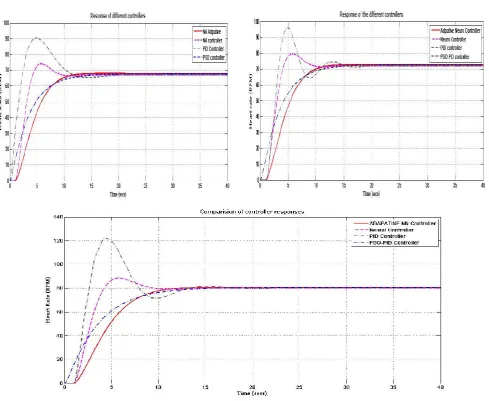
The intelligent PSO technique gives highly trace over of the conventional PID controller. The response of PSO-PID controller comparing with the response of PID conventional Controller, NN controller, Adaptive neuro controller are as shown in Figure 6. The output responses of PID controller have high peak overshoot, which is not acceptable for the physiology, heart rate. Also it is observed that small change in disturbance the response is highly not satisfactory. Compared to conventional controller, NN controller has better response in view of settling time and sudden disturbance; however the peak overshoot was still high. The adaptive NN controller is well better, but still a peak overshoot of 3.4% is observed. The PSO-PID controller has high tracking between input and output for any simulation time response and the output follows the input, that is the reference. It implies that the response has not any distortion or tracking error.
CONCLUSION
Heart Rate signals are used as a reliable indicator of heart diseases. These HR signals form the basis of functioning of a pacemaker. Pacemaker performance depends not only on sensors and the pacemaker circuitry but also on the performance of the controller. In the present work a ZN tuned PID controller was designed and the performance criteria are not satisfactory. Then the PID controller system using PSO algorithm is designed to control to improve the performance of the system. It is observed from the response of PSO based controller that all the parameters (rise time, settling time, maximum overshoot are within the limits and a smooth and satisfactory response is obtained. Therefore it is concluded that the overall performance of Bio inspired tuned PID is better as compared to the PID controller.
REFERENCES
Adam Wojtasik, 2000, Fuzzy logic controller for rate-adaptive
heart pacemaker, Journal of applied soft computing, 4, 3,
(Aug.2000), 259-270.
Alt E, Barold S. S, Stangl K. K (eds.), 1999, Rate adaptive cardiac pacing Berlin, Germany, Springer-Verlag, 83-169. Biswas, S. C., A. Das, P. Guha, 2006. Mathematical Model of
Cardiovascular System by Transfer function Method,
Calcutta Medical Journal, 4, (July-Aug 2006), 15-17.
Dipali Bansal, Munna Khan, Ashok K. Salhan, 2009, A computer based wireless system for online acquisition, monitoring and digital processing of ECG waveforms,
Computers in Biology and Medicine, 39, 361 – 367.
Fisher R.A. 1938. The Statistical Utilization of Multiple
Measurements, Annals of Eugenics 8, 376–386.
Gideon F. Inbar , R. Heize klass, N. Hoekstein liess, K. Stangl and A. Wirtzfeld, 1988. Development of closed loop pacemaker controller regulating mixing venous oxygen
saturation level, IEEE transactions on biomedical
Engineering, 35, 9, (Sep.).
Janzen J., 1998, Tuning of Fuzzy controllers, Technical university of Denmark, Department of Automation (Sep. 1998)
Jaworski, Z., W. Kuzmicz, M. Sadowski, D. Sama, A. Walkanis, A. Wielgus and A. Wojtasik, 2000. VLSI implementations of fuzzy logic controllers for rate-adaptive pacemakers, Annual Intemational IEEE-EMBS Special Topic Conference on Microtechnologies in Medicine and Biology, Annual International Conference, (Oct 2000), 475 – 478.
Lieslehto J., "PID Controller Tuning Using Evolutionary Programming", American Control Conference, VA June 25-27, 2001.
Nasri, M., H. Nezamabadi and M. Maghfoori, "A PSO-Based Optimum Design of PID Controller for A Linear Brushless DC Motor", World Academy of Science, Engineering and Technology, 2007.
Neogi, B., Ghosh, R., Tarafdar U. and Das A. 2010,
Simulation aspect of an artificial pacemaker, Int. J. Inf.
Tech. Kno. Mgt. 3 (July-Dec. 2010) 723-727.
Popov A., Farag A., Werner H. 2005. "Tuning of a PID Controller Using a MultiObjective Optimization Technique Applied to A Neutralization Plant", 44th IEEE Conference on Decision and Control, and the European Control Conference.
Shin, J. W., J. H. Yoon and. R. Yoon, 2000. A Study on the Rate-Adaptive Pacemaker by Motion and Respiration using Neuro-Fuzzy, Annual EMBS International Conference, (July 2000).
Sugiura, T., N. Sugiura, T. Kazui and Y. Harada, 1991. A fuzzy approach to the rate control in an artificial cardiac pacemaker regulated by respiratory rate and temperature,
Journal of Medical Engineering and Technology, 15, 3,
107-110.
Werner J., Hexamer M., Meine M., and Lemke, B. 1999. Restoration of cardio-circulatory regulation by rate- adaptive pacemaker systems: the bioengineering view of a
clinical problem, IEEE Transactions on Biomedical
Engineering, 46(9) (Sep. 1999) 1057-1064.