RbCuFe(PO
4)
2Abdessalem Badri, Mourad Hidouri* and Mongi Ben Amara
Faculty of Science, University of Monastir, 5019 Monastir, Tunisia Correspondence e-mail: [email protected]
Received 8 May 2013; accepted 15 July 2013
Key indicators: single-crystal X-ray study;T= 293 K; mean(P–O) = 0.006 A˚; Rfactor = 0.046;wRfactor = 0.126; data-to-parameter ratio = 26.6.
A new iron phosphate, rubidium copper(II) iron(III) bis-(phosphate), RbCuFe(PO4)2, has been synthesized as single crystals by the flux method. This compound is isostructural with KCuFe(PO4)2 [Badriet al. (2011), J. Solid State Chem.
184, 937–944]. Its structure is built up from Cu2O8 units of edge-sharing CuO5polyhedra, interconnected by FeO6 octa-hedra through common corners to form undulating chains that extend infinitely along the [011] and [011] directions. The linkage of such chains is ensured by the PO4tetraedra and the resulting three-dimensional framework forms quasi-elliptic tunnels parallel to the [101] direction in which the Rb+cations are located.
Related literature
For the physical properties of iron phosphates, see: Elbouaa-nani et al.(2002). For the structural chemistry of iron phos-phates, see: Moore (1970); Gleitzer (1991). For rubidium iron phosphates, see: Hidouri et al.(2010). The title compound is isostructural with KCuFe(PO4)2 (Badri et al., 2011) and K(Fe,Mg)(PO4)2(Yatskinet al., 2012). For P—O distances in monophosphate groups, see: Baur (1974). For ionic radii, see: Shannon (1976).
Experimental
Crystal data
RbCuFe(PO4)2
Mr= 394.80 Monoclinic,P21=n a= 8.054 (1) A˚
b= 9.906 (3) A˚
c= 9.140 (1) A˚
= 115.47 (1)
V= 658.3 (2) A˚3
Z= 4
MoKradiation
= 13.28 mm 1
T= 293 K
0.250.210.14 mm
Data collection
Enraf–Nonius CAD4 diffractometer
Absorption correction: part of the refinement model (F) (SHELXLA; Sheldrick 2008)
Tmin= 0.060,Tmax= 0.119 1939 measured reflections
1437 independent reflections 1236 reflections withI> \2(I)
Rint= 0.046 2 standard reflections
every 120 min intensity decay: 1%
Refinement
R[F2> 2(F2)] = 0.046
wR(F2) = 0.126
S= 1.08 1437 reflections
54 parameters max= 3.25 e A˚ 3 min= 2.25 e A˚ 3
Data collection: CAD-4 EXPRESS (Enraf–Nonius, 1994); cell refinement:CAD-4 EXPRESS; data reduction:XCAD4(Harms & Wocadlo, 1995); program(s) used to solve structure:SIR92(Altomare et al., 1993); program(s) used to refine structure:SHELXL97 (Shel-drick, 2008); molecular graphics:DIAMOND(Brandenburg, 1999); software used to prepare material for publication:SHELXL97.
Supplementary data and figures for this paper are available from the IUCr electronic archives (Reference: BR2226).
References
Altomare, A., Cascarano, G., Giacovazzo, C. & Guagliardi, A. (1993).J. Appl. Cryst.26, 343–350.
Badri, A., Hidouri, M., Lopez, M. L., Pico, C., Wattiaux, A. & Amara, M. B. (2011).J. Solid State Chem.184, 937–944.
Baur, W. H. (1974).Acta Cryst.B30, 1195–1215.
Brandenburg, K. (1999).DIAMOND. University of Bonn, Germany. Elbouaanani, L. K., Malaman, B., Gerardin, R. & Ijjaali, M. (2002).J. Solid
State Chem.163, 412–944.
Enraf–Nonius (1994).CAD-4 EXPRESS. Enraf–Nonuis, Delft, The Nether-lands.
Gleitzer, C. (1991).Eur. J. Solid State Inorg. Chem.28, 77–91.
Harms, K. & Wacadlo, S. (1995).XCAD-4. University of Marburg, Germany. Hidouri, M., Wattiaux, A., Lopez, M. L., Pico, C. & Amara, M. B. (2010).J.
Alloys Compd.560, 569–574.
Moore, P. B. (1970).Am. Mineral.55, 135–169. Shannon, R. D. (1976).Acta Cryst.A32, 751–767. Sheldrick, G. M. (2008).Acta Cryst.A64, 112–122.
Yatskin, M. M., Zatovsky, I. V., Baumer, V. N., Ogorodnyk, I. V. & Slobodyanik, N. S. (2012).Acta Cryst.E68, i51.
Structure Reports
Online
supporting information
Acta Cryst. (2013). E69, i52 [doi:10.1107/S1600536813019569]
RbCuFe(PO
4)
2Abdessalem Badri, Mourad Hidouri and Mongi Ben Amara
S1. Comment
Iron phosphates are the subject of growing interest because of their attractive physical properties (Elbouaanani et al.,
2002) as well as for their structural diversity (Moore, 1970; Gleitzer, 1991). Among the variety of iron monophosphates
synthesized and characterized over the past three decades, only one rubidium-containing compound has been reported,
namely Rb9Fe7(PO4)10 (Hidouri et al., 2010). In this paper, we report the structure of a new rubidium iron monophosphate
RbCuFe(PO4)2 synthesized during our investigation of the Rb3PO4—Cu3(PO4)2-FePO4 quasi system.
Due to the poor quality of the crystal, anisotropic structure refinement systematically led to non-positive definite
thermal parameters. For this reason, all the atoms were refined istropically.
This compound is isostructural with KCuFe(PO4)2 (Badri et al., 2011) and K(Fe,Mg)(PO4)2 (Yatskin et al., 2012). The
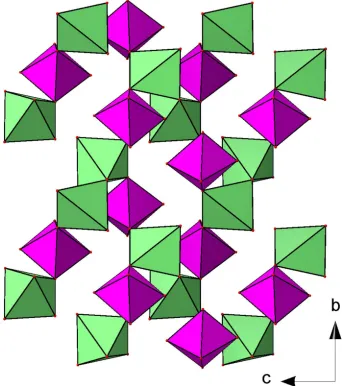
structure consists of a three-dimensional assemblage of Cu2O8 units of edge-sharing CuO5 trigonal bipyramids, linked to
each other by FeO6 octahedra through common corners to form crossing zigzag chains that run parallel to the [011] and
[011] directions (Fig. 1). These chains are linked by the PO4 tetrahedra, giving rise to a three-dimensional framework.
The environments of the different coordination polyhehdra are shown in Fig. 2. Each CuO5 polyhedron is linked to four
PO4 tetrahedra, by sharing three corners with three tetrahedra and one edge with the fourth, the two O atoms forming the
shared edge being also shared by two FeO6 octahedra (Fig. 2a). Each FeO6 octahedron is corner-linked to six PO4
tetrahedra, two of its corners being also shared with two CuO5 polyhedra (Fig. 2b). Each P1O4 tetrahedron shares one
edge with one CuO5 polyhedron and four corners, one with a CuO5 polyhedron and three with three FeO6 octahedra (Fig.
2c). Each P2O4 tetrahdron shares three corners with three FeO6 octahedra,the remaining corner being doubly shared with
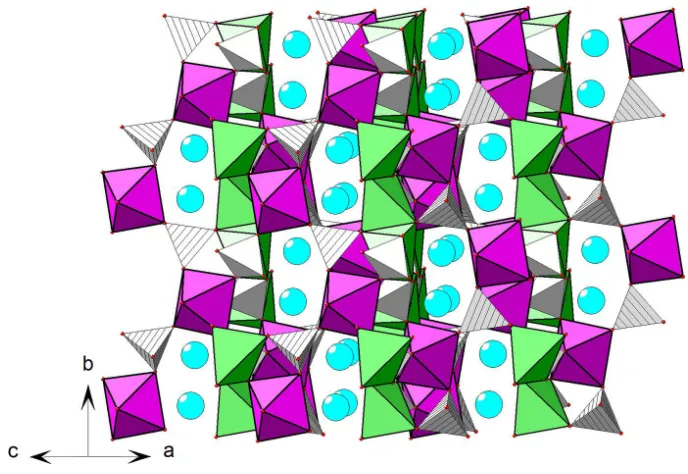
two CuO5 polyhedra (Fig. 2d). The anionic framework induced by this mode of connectivity forms quasi-elliptic tunnels
along the [101] direction (Fig. 3).
From an examination of the cation–oxygen distances, the CuO5 polyhedron is highly deformed, with one longer Cu—O
distance of 2.174 (3) Å compared to the four others [from 1.916 (3) to 2.030 (3) Å]. Such deformation has already been
observed in KCuFe(PO4)2 and it can be attributed to the Jahn–Teller effect accentuated for the Cu2+ ions with d9
configuration. The FeO6 octahedron is also highly distorted, whith Fe—O distances varying between 1.937 (4) and
2.187 (3) Å. Corresponding mean <Fe—O> distance of 2.018 Å is close to 2.03 Å predicted by Shannon for octahedral
Fe3+ ions (Shannon, 1976). The P—O distances within the PO
4 tetrahedra are in the range 1.518 (3) and 1.576 (3) Å, with
an overall distances of 1.540 (3) Å consistent with 1.537 Å calculated by Baur for the monophosphate groups (Baur,
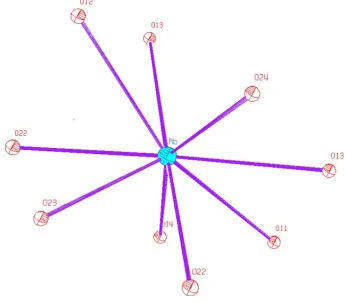
1974). The Rb+ ions occupy a single distinct site. Their environment was determined assuming all cation–oxygen
distances shorter than the shortest distance between Rb+ and its nearest cation. This environment (Fig. 4) is then
Single crystals of RbCuFe(PO4)2 were grown in a flux of rubidium dimolybdate, Rb2Mo2O7, in an atomic ratio P:Mo =
4:1. Appropriate amounts of Rb2CO3 (Fluka, 99%), Cu(NO3)2.6H2O (Acros, 99%), Fe(NO3)3.9H2O (Fisher, 98.6%),
(NH4)2HPO4 (Merck, 99%) and MoO3 (Acros, 99%) were dissolved in aqueous nitric acid and the obtained solution was
evaporated to dryness. The obtained residue was homogenized by grinding and then gradually heated up to 873 K in a
platinum crucible. After being reground, the mixture was melted for 1 h at 1173 K and subsequently cooled at a rate of 10
K h-1 down to 673 K, after which the furnace was turned off. The crystals extracted from the flux by washing with warm
water, are essentially composed by dark-green plate crystals of RbCuFe(PO4)2.
S3. Refinement
Due to the poor quality of the crystal, anisotropic structure refinement led to non-positive definite thermal parameters for
the Fe, P1, P2, O11, O13, O21 and O23 atoms. Then, all the atoms were refined istropically. The obtained largest positive
[image:3.610.133.475.272.658.2]and negative difference electron densities are closest to the Rb atoms.
Figure 1
The crossing chains of the alternating Cu2O8 units and FeO6 octahedra. The FeO6 octahedra and the CuO5 trigonal
Figure 2
[image:4.610.132.476.398.635.2]The environments of the CuO5 (a), FeO6 (b), P1O4 (c) and P2O4 (d) polyhedra.
Figure 3
A projection along the [101] direction of the structure showing the large tunnels occupied by the Rb+ cations. FeO
6, CuO5,
P1O4 and P2O4 are represented by purple, green, solid grey and hatched grey polyhedra, respectively. The Rb atoms are
Figure 4
The environment of the Rb cations showing the thermal ellipsoids drawn at the 50% probability level.
Rubidium copper iron bis(phosphate)
Crystal data RbCuFe(PO4)2
Mr = 394.80 Monoclinic, P21/n
Hall symbol: -P 2yn a = 8.054 (1) Å b = 9.906 (3) Å c = 9.140 (1) Å β = 115.47 (1)° V = 658.3 (2) Å3
Z = 4
F(000) = 744 Dx = 3.983 Mg m−3
Mo Kα radiation, λ = 0.71073 Å Cell parameters from 25 reflections θ = 2.8–26.9°
µ = 13.28 mm−1
T = 293 K Plate, green
0.25 × 0.21 × 0.14 mm
Data collection Enraf–Nonius CAD4
diffractometer
Radiation source: fine-focus sealed tube Graphite monochromator
ω/2θ scans
Absorption correction: part of the refinement model (ΔF)
(SHELXL97; Sheldrick 2008) Tmin = 0.060, Tmax = 0.119
1939 measured reflections
1437 independent reflections 1236 reflections with I > \2(I) Rint = 0.046
θmax = 26.9°, θmin = 2.8°
h = −1→10 k = −1→12 l = −11→10
Refinement Refinement on F2
Least-squares matrix: full R[F2 > 2σ(F2)] = 0.046
wR(F2) = 0.126
S = 1.08 1437 reflections 54 parameters 0 restraints
Primary atom site location: structure-invariant direct methods
Secondary atom site location: difference Fourier map
w = 1/[σ2(F
o2) + (0.0642P)2 + 8.1747P]
where P = (Fo2 + 2Fc2)/3
(Δ/σ)max = 0.001
Δρmax = 3.25 e Å−3
Δρmin = −2.25 e Å−3
Extinction correction: SHELXL97 (Sheldrick, 2008), Fc*=kFc[1+0.001xFc2λ3/sin(2θ)]-1/4
Extinction coefficient: 0.056 (3)
Special details
Geometry. All e.s.d.'s (except the e.s.d. in the dihedral angle between two l.s. planes) are estimated using the full covariance matrix. The cell e.s.d.'s are taken into account individually in the estimation of e.s.d.'s in distances, angles and torsion angles; correlations between e.s.d.'s in cell parameters are only used when they are defined by crystal symmetry. An approximate (isotropic) treatment of cell e.s.d.'s is used for estimating e.s.d.'s involving l.s. planes.
Refinement. Refinement of F2 against ALL reflections. The weighted R-factor wR and goodness of fit S are based on F2,
conventional R-factors R are based on F, with F set to zero for negative F2. The threshold expression of F2 > σ(F2) is used
only for calculating R-factors(gt) etc. and is not relevant to the choice of reflections for refinement. R-factors based on F2
are statistically about twice as large as those based on F, and R-factors based on ALL data will be even larger.
Fractional atomic coordinates and isotropic or equivalent isotropic displacement parameters (Å2)
x y z Uiso*/Ueq
Rb 0.08146 (10) −0.36746 (7) 0.92434 (9) 0.0187 (3)* Cu 0.36913 (11) −0.11858 (8) 0.94182 (10) 0.0103 (3)* Fe 0.98385 (13) 0.12391 (9) 0.75520 (11) 0.0084 (3)* P1 1.2630 (2) 0.08995 (18) 0.1423 (2) 0.0082 (4)* O11 0.4087 (7) 0.0231 (5) 0.0958 (6) 0.0116 (10)* O12 0.2147 (7) −0.0101 (5) 0.2460 (6) 0.0116 (10)* O13 0.8515 (7) 0.2895 (5) 0.7505 (6) 0.0123 (10)* O14 0.0942 (7) 0.1317 (5) 0.9900 (6) 0.0115 (10)* P2 0.1321 (2) −0.15855 (18) 0.6387 (2) 0.0087 (4)* O21 0.4575 (7) −0.2610 (5) 0.1010 (6) 0.0138 (10)* O22 0.1462 (7) −0.1108 (5) 0.4869 (6) 0.0119 (10)* O23 0.3040 (7) −0.2436 (5) 0.7543 (6) 0.0118 (10)* O24 0.1483 (7) −0.0378 (5) 0.7545 (6) 0.0112 (10)*
Geometric parameters (Å, º)
Rb—O13i 2.888 (5) Fe—O14vii 1.940 (5)
Rb—O21ii 2.947 (5) Fe—O13 1.946 (5)
Rb—O12iii 2.952 (5) Fe—O12vi 1.952 (5)
Rb—O21iii 2.969 (5) Fe—O22vi 2.005 (5)
Rb—O14iv 3.003 (5) Fe—O24vii 2.081 (5)
Rb—O12v 3.085 (5) Fe—O23viii 2.185 (5)
Rb—O23 3.087 (5) P1—O13ix 1.519 (5)
Rb—O11iii 3.120 (5) P1—O14x 1.526 (5)
Cu—O21ii 1.930 (5) P2—O22 1.515 (5)
Cu—O23 1.993 (5) P2—O21iii 1.521 (5)
Cu—O24 2.028 (5) P2—O24 1.565 (5)
Cu—O11vi 2.178 (5) P2—O23 1.576 (5)
O13i—Rb—O21ii 69.35 (14) O11ii—Cu—O23 170.6 (2)
O13i—Rb—O12iii 112.20 (14) O21ii—Cu—O23 94.0 (2)
O21ii—Rb—O12iii 176.53 (14) O11ii—Cu—O24 98.0 (2)
O13i—Rb—O21iii 138.05 (14) O21ii—Cu—O24 146.1 (2)
O21ii—Rb—O21iii 102.61 (12) O23—Cu—O24 73.0 (2)
O12iii—Rb—O21iii 78.36 (14) O11ii—Cu—O11vi 84.8 (2)
O13i—Rb—O14iv 54.85 (14) O21ii—Cu—O11vi 112.0 (2)
O21ii—Rb—O14iv 93.87 (14) O23—Cu—O11vi 93.67 (19)
O12iii—Rb—O14iv 89.52 (14) O24—Cu—O11vi 100.20 (19)
O21iii—Rb—O14iv 86.08 (14) O14vii—Fe—O13 88.7 (2)
O13i—Rb—O12v 48.09 (13) O14vii—Fe—O12vi 90.8 (2)
O21ii—Rb—O12v 68.83 (13) O13—Fe—O12vi 92.7 (2)
O12iii—Rb—O12v 109.70 (11) O14vii—Fe—O22vi 176.0 (2)
O21iii—Rb—O12v 168.12 (14) O13—Fe—O22vi 90.5 (2)
O14iv—Rb—O12v 102.37 (13) O12vi—Fe—O22vi 85.3 (2)
O13i—Rb—O23 121.31 (14) O14vii—Fe—O24vii 92.6 (2)
O21ii—Rb—O23 56.71 (14) O13—Fe—O24vii 172.8 (2)
O12iii—Rb—O23 123.04 (13) O12vi—Fe—O24vii 94.4 (2)
O21iii—Rb—O23 49.30 (14) O22vi—Fe—O24vii 88.73 (19)
O14iv—Rb—O23 105.24 (13) O14vii—Fe—O23viii 91.5 (2)
O12v—Rb—O23 119.56 (13) O13—Fe—O23viii 85.59 (19)
O13i—Rb—O11iii 158.60 (14) O12vi—Fe—O23viii 177.11 (19)
O21ii—Rb—O11iii 129.19 (14) O22vi—Fe—O23viii 92.38 (19)
O12iii—Rb—O11iii 48.65 (13) O24vii—Fe—O23viii 87.29 (19)
O21iii—Rb—O11iii 55.53 (14) O13ix—P1—O14x 111.4 (3)
O14iv—Rb—O11iii 124.74 (13) O13ix—P1—O12vii 106.2 (3)
O12v—Rb—O11iii 122.91 (13) O14x—P1—O12vii 112.1 (3)
O23—Rb—O11iii 80.05 (13) O13ix—P1—O11vii 108.3 (3)
O13i—Rb—O22v 98.03 (14) O14x—P1—O11vii 110.3 (3)
O21ii—Rb—O22v 72.07 (14) O12vii—P1—O11vii 108.4 (3)
O12iii—Rb—O22v 104.52 (14) O22—P2—O21iii 112.5 (3)
O21iii—Rb—O22v 119.17 (14) O22—P2—O24 111.3 (3)
O14iv—Rb—O22v 152.82 (13) O21iii—P2—O24 110.7 (3)
O12v—Rb—O22v 51.19 (13) O22—P2—O23 113.0 (3)
O23—Rb—O22v 86.70 (13) O21iii—P2—O23 109.4 (3)
O11iii—Rb—O22v 80.87 (13) O24—P2—O23 99.3 (3)
O11ii—Cu—O21ii 95.2 (2)