
2-Phenoxyethyl benzoate
Mousa Al-Noaimi,a* Ismail Warad,bSalim F. Haddad,c Ahmad Huseinband Rami Shareiahd
a
Department of Chemistry, Hashemite University, Zarqa 13115, Jordan,bDepartment of Chemistry, AN-Najah National University, Nablus, Palestinian Territories,
cDepartment of Chemistry, The University of Jordan, Amman 11942, Jordan, and dDepartment of Basic Science, Allied Medical Science College, Applied Science
Private University, PO Box 166, Amman 11931, Jordan Correspondence e-mail: [email protected]
Received 9 April 2013; accepted 22 April 2013
Key indicators: single-crystal X-ray study;T= 293 K; mean(C–C) = 0.003 A˚; Rfactor = 0.044;wRfactor = 0.130; data-to-parameter ratio = 13.8.
In the title compound, C15H14O3, the dihedral angle between the benzene rings is 75.85 (7). In the crystal,
centrosymme-trically related molecules are weakly associated through pairs of interactions between a benzene ring and an O atom of the ester group [ring centroid O = 3.952 (7) A˚ ], and through pairs of interactions between the other benzene ring and an O atom of the phenoxy group [ring centroid O = 3.912 (7) A˚ ], giving chains extending along [110].
Related literature
For background information and related structures, see: Gandhiet al.(1995); Huanget al.(1996); Litera et al.(2006); Ruzickaet al.(2002); Sheehan & Umezaw (1973).
Crystal data
C15H14O3 Mr= 242.26
Monoclinic,P21=c a= 9.4675 (10) A˚
b= 10.1411 (10) A˚
c= 13.7792 (12) A˚
= 103.895 (10)
V= 1284.2 (2) A˚3 Z= 4
MoKradiation
= 0.09 mm 1 T= 293 K
0.320.260.18 mm
Data collection
Oxford Diffraction Xcalibur Eos CCD-detector diffractometer Absorption correction: analytical
(CrysAlis PRO; Agilent, 2011)
Tmin= 0.995,Tmax= 0.997
5089 measured reflections 2269 independent reflections 1479 reflections withI> 2(I)
Rint= 0.029
Refinement
R[F2> 2(F2)] = 0.044 wR(F2) = 0.130 S= 1.02 2269 reflections
164 parameters
H-atom parameters constrained max= 0.11 e A˚ 3
min= 0.11 e A˚ 3
Data collection: CrysAlis PRO(Agilent, 2011); cell refinement:
CrysAlis PRO; data reduction: CrysAlis PRO; program(s) used to solve structure: SHELXS97(Sheldrick, 2008); program(s) used to refine structure:SHELXL97(Sheldrick, 2008); molecular graphics:
ORTEPIII (Burnett & Johnson, 1996); software used to prepare material for publication:SHELXL97.
The project was supported by AN-Najah National Univer-sity and the Hashemite UniverUniver-sity (Jordan). The X-ray structural work was performed at Hamdi Mango Center for Scientific Research at The University of Jordan, Amman 11942, Jordan.
Supplementary data and figures for this paper are available from the IUCr electronic archives (Reference: ZS2256).
References
Agilent (2011).CrysAlis PRO. Agilent Technologies, Yarnton, England. Burnett, M. N. & Johnson, C. K. (1996).ORTEPIII. Report ORNL-6895. Oak
Ridge National Laboratory, Tennessee, USA.
Gandhi, S. S., Bell, K. L. & Gibson, M. S. (1995).Tetrahedron,51, 13301– 13308.
Huang, W., Pian, J., Chen, B., Pei, W. & Ye, X. (1996).Tetrahedron,52, 10131– 10136.
Litera, J. K., Loya, A. D. & Klan, P. (2006).J. Org. Chem.71, 713–723. Ruzicka, R., Zabadal, M. & Klan, P. (2002).Synth. Commun.32, 2581–2590. Sheehan, J. C. & Umezaw, K. (1973).J. Org. Chem.58, 3771–3773. Sheldrick, G. M. (2008).Acta Cryst.A64, 112–122.
Structure Reports Online
supporting information
Acta Cryst. (2013). E69, o789 [https://doi.org/10.1107/S1600536813010878]
2-Phenoxyethyl benzoate
Mousa Al-Noaimi, Ismail Warad, Salim F. Haddad, Ahmad Husein and Rami Shareiah
S1. Comment
Phenoxyethyl benzoate has applications in the synthesis of e.g. oxazoles, imidazoles and benzoxazepines (Huang et al.,
1996; Gandhi et al., 1995). Esters are also useful as photo-removable protecting groups for carboxylic acids in organic
synthesis and biochemistry (Ruzicka et al., 2002; Litera et al., 2006; Sheehan & Umezaw, 1973). Keeping this in view,
the title compound, C15H14O3, was synthesized and its crystal structure is repored herein.
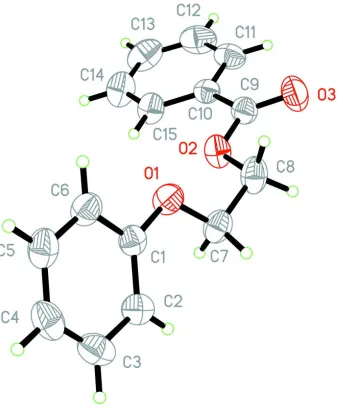
In the title compound (Fig. 1), the dihedral angle between the benzene rings is 75.85 (7)°. In the crystal, two
centrosymmetrically related molecules are weakly associated through a pair of intermolecular interactions between a
benzene ring [C1–C6] and an oxygen of the phenoxy group (O1A) [ring centroid(Cg)···O1A separation, 3.912 (7) Å] [for
symmetry code (A): -x, -y + 1, -z]. In addition, the molecules are weakly associated through a similar pair of
intermolecular interactions between the second benzene ring [C10–C15] and a carboxyl oxygen of the ester group (O2B)
[ring centroid (Cg)···O2B separation, 3.952 (7) Å] [for symmetry code (B): -x + 1, -y, -z] (Fig. 2). The result is a chain
structure extending across [110].
S2. Experimental
Benzoic acid (10.0 g, 0.08 mol) was mixed directly without solvent with 2-phenoxyethanol (11.0 g, 0.08 mol) and
refluxed for 3 hours. The reaction was left at room temperature for 24 hours. The product was collected as crystals in
52% yield. The crystals were purified by washing several times with cold ethanol.
S3. Refinement
Hydrogen atoms were positioned geometrically with C—H = 0.93 Å (aromatic) or 0.98 Å (methylene) and allowed to
Figure 1
Molecular conformation and atom numbering scheme for the title compound. Displacement ellipsoids are drawn at the
Figure 2
The chain structure showing the ring centroid···O associations [for symmetry code (A): -x, -y + 1, -z]; (B): -x + 1, -y, -z].
2-Phenoxyethyl benzoate
Crystal data
C15H14O3 Mr = 242.26 Monoclinic, P21/c
Hall symbol: -P 2ybc
a = 9.4675 (10) Å
b = 10.1411 (10) Å
c = 13.7792 (12) Å
β = 103.895 (10)°
V = 1284.2 (2) Å3
Z = 4
F(000) = 512
Dx = 1.253 Mg m−3
Mo Kα radiation, λ = 0.71073 Å Cell parameters from 1664 reflections
θ = 3.0–29.3°
µ = 0.09 mm−1 T = 293 K Wedge, colourless 0.32 × 0.26 × 0.18 mm
Data collection
Oxford Diffraction Xcalibur Eos CCD-detector diffractometer
Radiation source: Enhance (Mo) X-ray Source Graphite monochromator
Detector resolution: 16.0534 pixels mm-1 ω scans
Absorption correction: analytical
(CrysAlis PRO; Agilent, 2011)
Tmin = 0.995, Tmax = 0.997
5089 measured reflections 2269 independent reflections 1479 reflections with I > 2σ(I)
Rint = 0.029
θmax = 25.0°, θmin = 3.0°
h = −11→10
k = −9→12
l = −12→16
Refinement
Refinement on F2
Least-squares matrix: full
R[F2 > 2σ(F2)] = 0.044 wR(F2) = 0.130 S = 1.02
164 parameters 0 restraints
Primary atom site location: structure-invariant direct methods
neighbouring sites
H-atom parameters constrained
w = 1/[σ2(Fo2) + (0.0531P)2 + 0.042P]
where P = (Fo2 + 2Fc2)/3
(Δ/σ)max < 0.001
Δρmin = −0.11 e Å−3
Extinction correction: SHELXL97 (Sheldrick, 2008), Fc*=kFc[1+0.001xFc2λ3/sin(2θ)]-1/4
Extinction coefficient: 0.035 (3)
Special details
Geometry. All esds (except the esd in the dihedral angle between two l.s. planes) are estimated using the full covariance matrix. The cell esds are taken into account individually in the estimation of esds in distances, angles and torsion angles; correlations between esds in cell parameters are only used when they are defined by crystal symmetry. An approximate (isotropic) treatment of cell esds is used for estimating esds involving l.s. planes.
Refinement. Refinement of F2 against ALL reflections. The weighted R-factor wR and goodness of fit S are based on F2,
conventional R-factors R are based on F, with F set to zero for negative F2. The threshold expression of F2 > 2sigma(F2) is
used only for calculating R-factors(gt) etc. and is not relevant to the choice of reflections for refinement. R-factors based on F2 are statistically about twice as large as those based on F, and R- factors based on ALL data will be even larger.
Fractional atomic coordinates and isotropic or equivalent isotropic displacement parameters (Å2)
x y z Uiso*/Ueq
H14A 0.3603 −0.2471 −0.1534 0.113* C12 0.5261 (3) −0.3035 (3) 0.0747 (2) 0.1039 (9) H12A 0.5904 −0.3628 0.1138 0.125*
Atomic displacement parameters (Å2)
U11 U22 U33 U12 U13 U23
O2 0.0937 (10) 0.0559 (9) 0.0580 (7) 0.0144 (8) 0.0151 (7) 0.0017 (7) O1 0.0707 (8) 0.0666 (9) 0.0747 (8) 0.0111 (7) 0.0255 (7) 0.0141 (7) C1 0.0673 (12) 0.0505 (12) 0.0551 (10) 0.0079 (10) 0.0163 (9) −0.0068 (9) C10 0.0561 (11) 0.0540 (12) 0.0664 (12) −0.0040 (10) 0.0146 (9) 0.0108 (10) C9 0.0665 (12) 0.0659 (14) 0.0601 (11) −0.0028 (11) 0.0139 (9) 0.0091 (11) C7 0.0862 (14) 0.0593 (14) 0.0730 (12) 0.0087 (12) 0.0342 (10) 0.0017 (11) C8 0.1139 (17) 0.0638 (14) 0.0627 (11) 0.0174 (13) 0.0303 (12) 0.0018 (11) O3 0.1082 (12) 0.1176 (15) 0.0581 (8) 0.0162 (10) 0.0073 (8) −0.0040 (9) C2 0.0685 (13) 0.0602 (14) 0.0758 (12) 0.0002 (11) 0.0164 (10) −0.0068 (11) C5 0.1058 (18) 0.0711 (16) 0.0663 (12) 0.0138 (14) 0.0312 (12) 0.0101 (12) C6 0.0747 (13) 0.0719 (15) 0.0716 (12) 0.0103 (12) 0.0284 (10) 0.0065 (12) C11 0.0631 (13) 0.0809 (17) 0.0913 (15) 0.0054 (12) 0.0036 (11) 0.0145 (14) C15 0.0933 (15) 0.0593 (14) 0.0717 (13) 0.0159 (12) 0.0262 (11) 0.0103 (11) C3 0.0709 (13) 0.0768 (17) 0.0855 (14) 0.0073 (13) 0.0003 (12) −0.0152 (14) C4 0.1031 (18) 0.0686 (16) 0.0614 (12) 0.0196 (14) 0.0018 (12) −0.0062 (11) C13 0.107 (2) 0.0694 (17) 0.148 (2) 0.0217 (16) 0.0600 (19) 0.0079 (19) C14 0.126 (2) 0.0727 (17) 0.0922 (15) 0.0136 (16) 0.0415 (14) 0.0034 (14) C12 0.0790 (16) 0.089 (2) 0.139 (2) 0.0257 (15) 0.0167 (16) 0.0231 (19)
Geometric parameters (Å, º)
O2—C9 1.339 (2) C5—C4 1.364 (3) O2—C8 1.445 (2) C5—C6 1.374 (3) O1—C1 1.373 (2) C5—H5A 0.9300 O1—C7 1.415 (2) C6—H6A 0.9300 C1—C2 1.379 (2) C11—C12 1.364 (3) C1—C6 1.384 (3) C11—H11A 0.9300 C10—C15 1.376 (2) C15—C14 1.381 (3) C10—C11 1.381 (3) C15—H15A 0.9300 C10—C9 1.474 (3) C3—C4 1.370 (3) C9—O3 1.203 (2) C3—H3A 0.9300 C7—C8 1.491 (3) C4—H4A 0.9300 C7—H7A 0.9700 C13—C12 1.367 (3) C7—H7B 0.9700 C13—C14 1.369 (3) C8—H8A 0.9700 C13—H13A 0.9300 C8—H8B 0.9700 C14—H14A 0.9300 C2—C3 1.384 (3) C12—H12A 0.9300 C2—H2A 0.9300
O1—C1—C6 115.68 (17) C5—C6—H6A 119.9 C2—C1—C6 119.39 (18) C1—C6—H6A 119.9 C15—C10—C11 119.3 (2) C12—C11—C10 120.0 (2) C15—C10—C9 122.27 (17) C12—C11—H11A 120.0 C11—C10—C9 118.41 (18) C10—C11—H11A 120.0 O3—C9—O2 122.7 (2) C10—C15—C14 120.2 (2) O3—C9—C10 124.74 (18) C10—C15—H15A 119.9 O2—C9—C10 112.59 (16) C14—C15—H15A 119.9 O1—C7—C8 109.06 (16) C4—C3—C2 121.1 (2) O1—C7—H7A 109.9 C4—C3—H3A 119.5 C8—C7—H7A 109.9 C2—C3—H3A 119.5 O1—C7—H7B 109.9 C5—C4—C3 119.3 (2) C8—C7—H7B 109.9 C5—C4—H4A 120.3 H7A—C7—H7B 108.3 C3—C4—H4A 120.3 O2—C8—C7 108.78 (15) C12—C13—C14 120.0 (3) O2—C8—H8A 109.9 C12—C13—H13A 120.0 C7—C8—H8A 109.9 C14—C13—H13A 120.0 O2—C8—H8B 109.9 C13—C14—C15 119.7 (2) C7—C8—H8B 109.9 C13—C14—H14A 120.1 H8A—C8—H8B 108.3 C15—C14—H14A 120.1 C1—C2—C3 119.3 (2) C11—C12—C13 120.7 (2) C1—C2—H2A 120.3 C11—C12—H12A 119.7 C3—C2—H2A 120.3 C13—C12—H12A 119.7 C4—C5—C6 120.7 (2)
![Figure 2The chain structure showing the ring centroid···O associations [for symmetry code (A): -x, -y + 1, -z]; (B): -x + 1, -y, -z]](https://thumb-us.123doks.com/thumbv2/123dok_us/507542.549348/4.610.134.477.73.299/figure-chain-structure-showing-ring-centroid-associations-symmetry.webp)