JOURNAL OF FOREST SCIENCE, 56, 2010 (3): 112–120
In the Czech forest typology and geobiocoenology, the term vegetation tier has been introduced as an analogue of more general terms altitudinal vegeta-tion zone or vegetavegeta-tion belt (see Zlatník 1976a). Al-titudinal zonation of vegetation has been known for a long time (Huggett, Cheesman 2002). Altitudinal vegetation zones (or belts) have been recognized and studied in many regions in the world (Ellenberg 1986; Hegazy et al. 1998; Hemp 2006; Zhang et al. 2006). Vegetation tiers represent superstructural units in both typological systems for forest and land-scape classification in the Czech Republic. The first one, the typological system of Forest Management Institute (FMI) (Randuška et al. 1986; Viewegh et al. 2003), finds its use mainly in forestry. The second one is the system of geobiocoenological typology (Buček, Lacina 2007) which is used to classify the whole landscape. Both systems characterize poten-tial vegetation rather than the actual one.
Zlatník (1976a) defined vegetation tiers as “the connection of the sequence of differences in vegeta-tion with the sequence of differences in the climate of different altitude and exposure climate”. Ten vegetation tiers were distinguished in the former Czechoslovakia (Zlatník 1976b). The first eight tiers (1–8) were named after main woody species growing naturally in particular tiers under normal soil water content (oak, beech-oak, oak-beech, beech, fir-beech, spruce-fir-beech, spruce and dwarf mountain pine vegetation tier). Vegetation tiers are mapped based on the occurrence of plant bioindi-cators, site altitude, slope orientation, and terrain relief. The characteristics of vegetation tiers used in geobiocoenological typology were described by Buček et al. (2005), Buček and Lacina (2007). Differences in the typological system of FMI were described by Randuška et al. (1986). Holuša and Holuša (2008) described the detailed
character-Supported by the Higher Education Development Fund, Project No. 1130/2008/G4, and by the Ministry of Education, Youth and Sports of the Czech Republic, Project No. MSM 6215648902.
Application of digital elevation model for mapping
vegetation tiers
D. Volařík
Department of Forest Botany, Dendrology and Geobiocoenology, Faculty of Forestry
and Wood Technology, Mendel University in Brno, Brno, Czech Republic
ABSTRACT: The aim of this paper is to explore possibilities of application of digital elevation model for mapping vegetation tiers (altitudinal vegetation zones). Linear models were used to investigate the relationship between vegeta-tion tiers and variables derived from a digital elevavegeta-tion model – elevavegeta-tion and potential global radiavegeta-tion. The model was based on a sample of 138 plots located from the 2nd to the 5th vegetation tier. Potential global radiation was
com-puted in r.sun module in geographic information system GRASS. The final model explained 84% of data variability and employed variables were found to be sufficient for modelling vegetation tiers in the study area. Applied methodology could be used to increase the accuracy and efficiency of mapping vegetation tiers, especially in areas where such task is considered difficult (e.g. agricultural landscape).
istics of the 3rd and the 4th vegetation tiers of the north-eastern Moravia and Silesia. Air and soil tem-perature, precipitation amount and its distribution are considered to be the main direct factors influ-encing the altitudinal vegetation zonation (Zlatník 1976b; Randuška et al. 1986).
Digital Elevation Model (DEM) contains infor-mation both on altitude and topography. DEM is considered to be the main prerequisite map for spatial modelling in ecology (Guisan, Zimmer-mann 2000). It determines the spatial resolution of all derived maps, such as a map of slope, aspect, and curvatures. DEM has been used as a source of variables in numerous vegetation studies (e.g. Del Barrio et al. 1997; Gottfried et al. 1998; Guisan et al. 1998).
Three types of environmental variables or gradi-ents can be recognized: indirect gradigradi-ents, direct gradients, and resource gradients (Austin 1980). Elevation, slope, and aspect represent indirect en-vironmental gradients. The derivation of variables which have a more obvious influence on vegetation may help to elucidate the relations studied (Austin et al. 2006). The aspect is a typical example which is inapplicable to some analyses in its original ex-pression (359° and 1° are far outlying values albeit the real difference in exposure is only slight). The aspect can be substituted by radiation which has a more obvious impact on vegetation, and in addi-tion, it includes the influence of slope steepness and possibly other variables (terrain shading, latitude). Relatively simple formulae for radiation have been introduced e.g. by McCune and Keon (2002). More sophisticated models are incorporated in geographic information systems (Šúri, Hofierka 2004; Pierce Jr. et al. 2005).
The aim of presented paper is to explore possibili-ties of using DEM for mapping vegetation tiers. DEM is considered to be a useful tool for transferring the knowledge of vegetation tiers from easily classifi-able sites to the sites that are not easily classificlassifi-able (e.g. large areas of non-native spruce monocultures, agricultural land).
MATERIAL AND METHODS
Study area
The study area is located in the Zlín Region, around the towns of Valašské Klobouky and Bru-mov-Bylnice, and between the towns of Uherský Brod, Luhačovice, and Bojkovice. Both sites cover an area of approximately 10,000 ha in total. The area lies within the Natural Forest Area Bílé Karpaty and
Vizovické vrchy (Plíva, Žlábek 1986). The altitude ranges from 250 to 835 m a.s.l., with Průklesy being the highest point. The soil parent material is sand-stone and claysand-stone of flysch layers (Chlupáč 2002). The main soil type is Cambisol (Czech Geological Survey 2003). Mean annual temperature (for the period 1961–2000) ranges from 6 to 9°C, depending on the altitude; mean annual precipitation varies from 650 to 1,000 mm (Tolasz 2007).
Data collection
Phytosociological relevés were recorded in 2007 to 2008 using standard methods. Relevés were record-ed in square geobiocoenological plots (20 × 20 m), located in 2007 in various forest stands so as to cap-ture the variability of vegetation. In 2008, the plots were supplemented by plots selected by a stratified random sampling design, in which altitude, aspect, predominant tree species, and historical land-use were considered. Trees were classified into several vertical strata using Zlatník’s adjusted scale; the cover for each species in the layer was determined using the abundance-dominance scale (Zlatník 1976b). A total of 200 relevés were recorded. All relevés were classified into the system of geobio-coenological typology (Buček, Lacina 2007). The relevés from the nutrient-poor soils were excluded (trophic range A and AB according to Buček, Lacina 2007), as well as the relevés from the tufa mounds and waterlogged sites.
The locations of phytosociological relevés were determined by GPS. In 2007, GPS receiver Garmin GPSMAP 76S was used; recorded data were trans-ferred to GRASS GIS (GRASS Development Team 2009). In 2008, Trimble Juno ST GPS receiver with ArcPad 7.1.1 (ESRI) software and Trimble GPSCor-rect 2.40 (Trimble) extension was employed. Data were transferred to ArcGIS 9.2 (ESRI) with Trimble GPS Analyst 2.10 (Trimble) extension. Phytoso-ciological relevés were stored in TURBOVEG 2.75 program (Hennekens, Schaminee 2001).
Determining vegetation tiers
re-corded, therefore 7 supplementary plots were estab-lished. Supplementary plots were similarly classified into vegetation tiers although no phytosociological relevés were performed.
Digital elevation model and derived maps
DEM was interpolated from contour lines using the RST (regularized spline with tension) method. Contour line data were obtained from the Fundamen-tal Base of Geographic Data of the Czech Republic (ZABAGED) provided by the Czech Office for Sur-veying, Mapping and Cadastre. Klimánek (2006) found ZABAGED as the best generally available source of elevation data in the Czech Republic. Maps of slope, aspect, and annual sum of potential global radiation (hereinafter referred to as potential global radiation) were derived. All the above-mentioned calculations were processed within GRASS GIS en-vironment. Potential global radiation was calculated in r.sun module. This module can be used to compute direct, diffuse and reflected solar radiation for a par-ticular day in the year, based on latitude, type of sur-face and atmospheric conditions (Hofierka, Šúri 2002; Neteler, Mitasova 2008). For the purposes of analysis, global radiation was calculated as the sum of direct and diffuse radiation; impact of atmospheric conditions was omitted from the calculation, while the effect of terrain shading was included. The resolu-tion of raster maps was 5 m, except for the maps of potential global radiation (10 m resolution).
Data analyses
The influence of the variables on the herb layer spe-cies composition was evaluated by indirect ordina-tion method – non-metric multidimensional scaling (NMDS; using 2 dimensions) and by fitting the vari-ables as vectors to the ordination plot. The influence of DEM-derived variables (elevation, potential global radiation, and slope steepness), vegetation tiers and percent tree canopy cover was assessed. The smooth surface for vegetation tiers was also fitted to the ordination plot (using generalized additive models – GAM). Before the analyses, data were edited using the JUICE 6.5 (Tichý 2002) program – the nomen-clature was unified and the data set was divided into 3 subsets for analyses. The first subset contained all relevés in which at least 2 species per plot occurred in the herb layer (188 relevés), the second subset consisted of all records with at least 8 herb-layer species (170 relevés), and the third subset included all records with at least 14 herb-layer species (131 re- levés). The species cover values were transformed
using square root transformation; data were stan-dardized; Jaccard index of dissimilarity was used for the purposes of NMDS. Statistical significance of the impact of each variable was tested by permutation tests; the impact of variables was compared using the coefficient of determination (R2).
A linear model for vegetation tiers was developed, using vegetation tiers determined by a field survey as dependent variables, and elevation and potential global radiation as independent variables. The model was based on data from geobiocoenological plots in which more than 14 herb layer species were found and from supplementary plots (in total 138 plots). The cross-correlation between elevation and poten-tial global radiation was weak (R = –0.1471). Vegeta-tion tiers represent an ordinal variable (values 2, 3, 4 and 5 in model area). However, when developing the model they were considered as a continuous variable. Model values are therefore continuous and the limits between vegetation tiers had to be set for them. The limits were set so as to achieve the minimum number of plots differently classified by the model.
Comparison of model vegetation tiers and vegetation tiers obtained from the Regional
Plans of Forest Development (RPFD)
The map of model vegetation tiers was compared with the map of vegetation tiers classified by the typological system of FMI obtained from the Re-gional Plans of Forest Development (RPFD, Forest Management Institute in Brandýs nad Labem 2003). The comparison was carried out only for forest land within the boundaries of the study area. Error matrix and the percentage of correctly classified pixels were calculated in the GRASS GIS environment (about error matrix e.g. in Campbell 2002).
RESULTS
Classification of plots into vegetation tiers based on a field survey
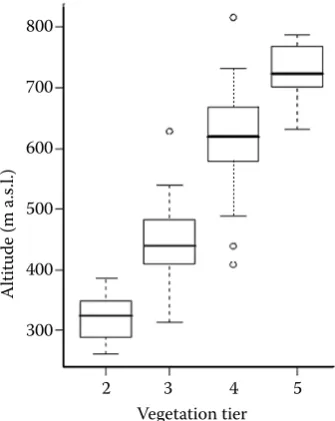
tier have mainly shady aspect with lower potential global radiation, while plots in the second tier have mainly sunny aspect (with higher potential global radiation) (Fig. 2).
Variability of vegetation
Phytosociological relevés were classified into 9 groups of geobiocoene types after removing those from the nutrient-poor soils, tufa mounds and waterlogged sites. In the 2nd vegetation tier
there were Fagi-querceta typica, Fagi-querceta aceris, Fagi-querceta tiliae, in the 3rd vegetation tier Querci-fageta typica, Querci-fageta aceris, Querci-fageta tiliae, in the 4th ve-getation tier Fageta typica, Fageta aceris and in the 5th ve- getation tier Abieti-fageta typica and Abieti-fageta ace- ris inferiora. Phytosociological relevés were
re-Vegetation tier
2 3 4 5
Altit
ude (m a
.s.l.)
800
700
600
500
400
300
Vegetation tier
2 3 4 5
Pot
en
tial g
lob
al radi
ation (MWh.m
–2 p
er ye
ar)
2.0
1.6
1.2
Table 1. Coefficients of determination (R2) and significances based on permutation tests (1,000 permutations) for
variables fitted as vectors to the NMDS ordination. (The analysis was performed for 3 subsets of data: subset I included all phytosociological relevés in which at least 2 species per plot occurred in the herb layer, subset II (at least 8 herb-layer species per plot) and subset III (at least 14 herb-layer species per plot))
Variable R2 (significance)
subset I (≥ 2 species) subset II (≥ 8 species) subset III (≥ 14 species) Cover of tree layer 0.0898 (***) 0.2210 (***) 0.3335 (***) Elevation 0.2457 (***) 0.3247 (***) 0.4062 (***)
Slope 0.0638 (**) 0.0551 (**) 0.0391 (.)
Radiation 0.1706 (***) 0.1487 (***) 0.1486 (***) Vegetation tiers 0.2380 (***) 0.3168 (***) 0.4670 (***)
[image:4.595.319.525.56.309.2]Significance levels: ***α = 0.001. **α = 0.01. *α = 0.05. (.) α = 0.1
[image:4.595.67.235.59.270.2]Fig. 2. Box-and-whisker plots showing the distribution of po-tential global radiation in vegetation tiers determined through field survey. Center line and outside edge (hinges) of each box represent the median and range of inner quartile around the median; vertical lines on the two sides of the box (whiskers) represent values falling within 1.5 times the absolute value of the difference between the values of the two hinges; circle represents outside values
[image:4.595.64.537.615.733.2]NMDS1
–1.0 –0.5 0.0 0.5
NMD
S2
0.6
0.4
0.2
0.0
–0.2
–0.4
–0.6
–0.8
2nd vegetation tier 3rd vegetation tier 4th vegetation tier 5th vegetation tier
4
3.5
3
[image:5.595.63.373.56.318.2]2.5
Fig. 3. NMDS ordination plot for subset of phytosociological relevés with more than 14 species. Only species from herb layer are used for ordination. Environmental variables (rad – potential global radiation, elev – elevation), cover of tree layer (cover_trees) and vegetation tiers (VS) are fitted as vectors on the ordination. Vegetation tiers are fitted also as surface using GAM (grey isolines)
Fig. 4. Box-and-whisker plots showing the distribution of model values of vegetation tiers in vegetation tiers determined through field survey. Center line and outside edge (hinges) of each box represent the median and range of inner quartile around the median; vertical lines on the two sides of the box (whiskers) represent values falling within 1.5 times the absolute value of the difference between the values of the two hinges; circle represents outside values
Vegetation tier
2 3 4 5
M
ode
l v
alue
s
5.0
4.5
4.0
3.5
3.0
2.5
2.0
corded in forest stands with the near natural tree species composition (mainly with Quercus petraea, Fagus sylvatica, Carpinus betulus and Abies alba) as well as in forest stands hardly influenced by human activities (Picea abies and Pinus sylvestris monocultures).
Influence of variables on vegetation
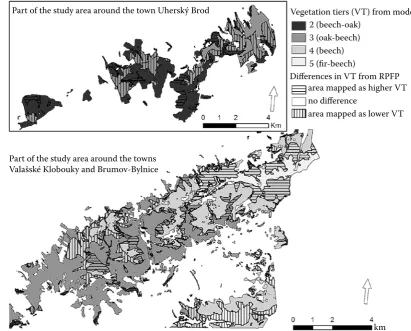
[image:5.595.64.263.394.648.2]Fig. 5. Map of vegetation tiers derived from the model and its comparison with vegetation tiers from RPFD. Vegetation tiers from model are based on the system of geobiocoenological typology, vegetation tiers from RPFD (Regional Plans of Forest Development) are based on the typological system of FMI. From the map it is possible to see different concept of the 5th vegetation tier in the mapping from RPFD and insufficient incorporation of vegetation inversion by the model especially in lower vegetation tiers
Part of the study area around the town Uherský Brod
Part of the study area around the towns Valašské Klobouky and Brumov-Bylnice
Vegetation tiers (VT) from model 2 (beech-oak)
3 (oak-beech) 4 (beech) 5 (fir-beech)
area mapped as higher VT no difference
area mapped as lower VT Differences in VT from RPFP
[image:6.595.88.500.369.700.2]km
Table 2. Error matrix for the classification of plots into vegetation tiers determined by the model and vegetation tiers determined by a field survey. The number of plots within different categories is shown
Vegetation tiers determined by the model Vegetation tiers determined by a field survey
2nd 3rd 4th 5th row sum
2nd 10 2 0 0 12
3rd 1 46 3 0 50
4th 0 4 55 3 62
5th 0 0 0 14 14
Column sum 11 52 58 17 138
Vegetation tiers themselves, fitted as vectors, have similar R2 and similar direction as elevation (Table 1, Fig. 3). They represent the most significant variable (R2 = 0.46) in the subset of records with at least 14 herb layer species per plot. Parameters of the generalized additive model by which the smooth surface of vegetation tiers is fitted are statistically significant; the deviation explained by the model (D2) is 0.49.
Model for vegetation tiers
The model for vegetation tiers in which elevation was included as the independent variable explains 78% of variability (R2
adj = 0.7759, telev = 21.805, df = 136, Pelev < 0.001). The model with potential global radiation explains much less variability (R2
ex-plains 84% of variability, both variables are significant (R2
adj = 0.8366, trad = –7.172, df = 135, Prad < 0.001, telev = 24.068, df = 135, Pelev < 0.001).
Limits between vegetation tiers were set for model values at 2.55, 3.5 and 4.5. Model values slightly over-lap with vegetation tiers determined by a field survey (Fig. 4). In total 13 plots were classified differently by the model (9% plots). In other words, 91% of plots were classified equally (Table 2).
Comparison of model vegetation tiers and vegetation tiers obtained from RPFD
The resulting map of model vegetation tiers cor-responds to the map of vegetation tiers from RPFD in 64%. The lowest difference was found for the 3rd ve- getation tier, the highest for the 5th and for the 2nd ve- getation tier (Table 3, Fig. 5).
DISCUSSION
Elevation is an important variable affecting the herb layer species composition. Its importance increases as we select the subset of plots with a higher number of species recorded in the plot (Table 1). This may be explained by the higher probability of occurrence of indicator species. However, using only the herb layer species composition is not sufficient for accurate determination of vegetation tiers in the study area (Fig. 3). The herb layer species composition is affected by a number of other variables (e.g. by canopy cover in performed analyses). The effect of some of these variables was excluded in this paper by excluding phytosociological relevés from the nutrient-poor soils (trophic range A and AB according to Buček, Lacina 2007), relevés from the tufa mounds and waterlogged sites where the determination of vegetation tier is less obvious and the impact of vegetation tiers on vegeta-tion composivegeta-tion is overlaid by the impact of these variables (Buček, Lacina 2007). Problems related to
the determination of vegetation tiers and the use of bioindication were discussed by Grulich and Culek (2005). Vegetation tiers are often determined in forest stands affected by forest management practices which e.g. alter the tree species composition. These influ-ences can be obvious (such as spruce monocultures at a low altitude) while others may be rather elusive (e.g. former use of the forest as wood pasture allowing more light to reach the forest floor).
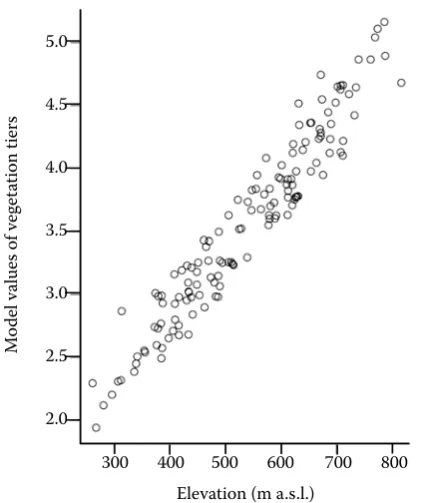
[image:7.595.64.532.77.211.2]The linear model developed for classifying vegeta-tion tiers based on DEM-derived variables (eleva-tion and potential global radia(eleva-tion) was found to be satisfactory, explaining 84% of data variability. The effect of both variables is linear (see Fig. 6 for eleva-tion) in the study area. However, this could not be necessarily valid in the whole gradient of vegetation
[image:7.595.310.521.461.713.2]Fig. 6. Scatter plot of model values of vegetation tiers against altitude. Figure shows positive linear relationship of these variables
Table 3. Error matrix for vegetation tiers determined by the model and vegetation tiers classified by RPFD
Vegetation tiers determined by the model (area in ha) Vegetation tiers by RPFD (area in ha)
1st 2nd 3rd 4th 5th row sum
1st 0 5 4 0 0 9
2nd 0 1,043 698 0 0 1,741
3rd 0 292 2,110 508 4 2,914
4th 0 0 341 1,247 204 1,792
5th 0 0 13 507 241 761
Column sum 0 1,340 3,166 2,262 449 7,217
Elevation (m a.s.l.)
300 400 500 600 700 800
M
ode
l v
alue
s of ve
ge
ta
tion tiers
5.0
4.5
4.0
3.5
3.0
2.5
tiers in the Czech Republic. Only 9% of plots (in total 13 plots) were classified differently by the model than by the field survey, out of them 5 were close to the border of the vegetation tier (less than 20 m), 3 were on the bases of valleys perhaps influenced by vegeta-tion inversion. The classificavegeta-tion of the other 5 plots is problematic, 2 plots are in oak stands at higher elevation where probably more light available to the herb layer influences the occurrence of species from lower vegetation tiers, 2 plots are on the south facing slopes of the 5th vegetation tier where only few plots are established and 1 is close to the forest edge.
The model was used to obtain a smooth trend of vegetation tiers, based on variables relevant to the definition of vegetation tiers by Zlatník (1976a). Plots which do not fit into this trend were reclassi-fied into another vegetation tier. Based on the com-bination of selected variables, the model has further extended the knowledge of vegetation tiers from sample plots to the whole study area. It represents an analogical approach to the site classification which is based on similarity of the site being classified to the analogous easily classifiable site (e.g. with the species composition closer to that of natural conditions). This approach is commonly known and used in mapping not only vegetation tiers but also groups of geobio-coene types (Buček, Lacina 2007). However, the approach presented here allowed us to obtain more accurate and precise results more efficiently.
Elevation and global potential radiation are suf-ficient variables for the study area. Areas with steep valley slopes would probably require additional vari-ables to characterize inversion areas (slightly miss-ing also in the study area). The effect of vegetation inversion is more important in the lower vegetation tiers (from 1st to 4th vegetation tier) (Buček, Lacina 2007). In future, the model could be improved by a variable derived from DEM that expresses the effect of inversion. For example Antonic et al. (2001) used GIS based depth in sink to estimate the distribution of 6 dominant tree species in karst regions. Simi-larly to model vegetation tiers in larger areas, more variables would probably be needed (e.g. to express varying amounts of precipitation).
Two thirds of the map of model-determined veg-etation tiers are equivalent to the map obtained from RPFD (Table 3, Fig. 5). This result can be considered as satisfactory taking into account differences be-tween vegetation tiers defined by the system of geo-biocoenological typology and vegetation tiers defined by the typological system of FMI. The typological system of FMI classifies azonal forest types into lower or higher vege-tation tiers than the surrounding area (Mikeska 2000). Mikeska (2000) proposed
geographically zonal vegetation tiers which are more similar to vegetation tiers in geobiocoenological ty-pology. But these are not included in RPFD. This is for example the cause of determination of the 1st ve- getation tier in the study area by RPFD. Other dif-ferences may be explained by a slightly different approach to the definition of individual vegetation tiers in both systems. The most important differ-ences are in the 5th and in the 2nd vegetation tiers in the study area. Differences in the mapping of the 5th vegetation tier can be explained by a different concept of determination of this vegetation tier. In the mapping for RPFD this tier is mapped from lower altitudes in the north-eastern part of the study area (Fig. 5). Differences in the mapping of the 2nd ve- getation tier revealed insufficient incorporation of the effect of vegetation inversion by the model.
CONCLUSION
Vegetation tiers were successfully modelled in the study area using elevation and potential global radiation as independent variables. Both variables have a similar influence on the herb layer species composition. The presented model explains 84% of data variability. Only relatively few plots (9%) were classified differently by the model than by the field survey. The possibilities of using a digital elevation model for the more accurate and efficient mapping of vegetation tiers were explored. The findings may be used e.g. for transferring the knowledge of veg-etation tiers from natural forest fragments to the whole landscape in a particular region.
References
Ambros Z., Štykar J. (2001): Geobiocoenology I. Brno, MZLU v Brně. (in Czech)
Antonic O., Hatic D., Pernar R. (2001): DEM-based depth in sink as an environmental estimator. Ecological Model-ling, 138: 247–254.
Austin M.P. (1980): Searching for a model for use in vegeta-tion analysis. Vegetatio, 42: 11–21.
Austin M.P., Belbin L., Meyers J., Doherty M., Luoto M. (2006): Evaluation of statistical models used for predicting plant species distributions: Role of artificial data and theory. Ecological Modelling, 199: 197–216.
Buček A., Lacina J. (2007): Geobiocoenology II. Geobio-coenological Typology of the Czech Republic Landscape. Brno, MZLU v Brně: 251. (in Czech)
Campbell J.B. (2002): Introduction to Remote Sensing. New York, Guilford Press: 621.
Czech Geological Survey (2003): GEOČR50, geoscience GIS layers geodatabase of geological maps at a scale of 1:50,000) Available at http://nts5.cgu.cz/website/geoinfo (accessed September 10, 2007)
Del Barrio G., Alvera B., Puigdefabregas J., Diez C. (1997): Response of high mountain landscape to topographic vari-ables: Central Pyrenees. Landscape Ecology, 12: 95–115. Ellenberg H. (1986): Vegetation Ecology of Central Europe.
Cambridge, Cambridge University Press.
Forest Management Institute Brandýs nad Labem (2003): Re-gional Plans of Forest Development. Available at http://www. uhul.cz/en/oprl/index.php (wms server: http://geoportal2.uhul. cz/wms_oprl?SERVICE=WMS) (accessed October 6, 2009) Gottfried M., Pauli H., Grabherr G. (1998): Prediction
of vegetation patterns at the limits of plant life: a new view of the Alpine-nival ecotone. Arctic and Alpine Research, 30: 207–221.
GRASS Development Team (2009): Geographic Resources Analy-sis Support System (GRASS GIS) Software ITC-irst, Trento, Italy. Available at http://grass.itc.it (accessed May 5, 2009) Grulich V., Culek M. (2005): Remarks to vegetation tiers.
In: Culek M. (ed.): Biogeographic Division of the Czech Republic, Volume 2. Praha, Agentura ochrany přírody a krajiny ČR: 21. (in Czech)
Guisan A., Zimmermann N.E. (2000): Predictive habitat distribution models in ecology. Ecological Modelling, 135: 147–186.
Guisan A., Theurillat J.P., Kienast F. (1998): Predicting the potential distribution of plant species in an alpine envi-ronment. Journal of Vegetation Science, 9: 65–74. Hegazy A.K., El-Demerdash M.A., Hosni H.A. (1998):
Vegetation, species diversity and floristic relations along an altitudinal gradient in south-west Saudi Arabia. Journal of Arid Environments, 38: 3–13.
Hemp A. (2006): Continuum or zonation? Altitudinal gra-dients in the forest vegetation of Mt. Kilimanjaro. Plant Ecology, 184: 27–42.
Hennekens S.M., Schaminee J.H.J. (2001): TURBOVEG, a comprehensive database management system for vegeta-tion data. Journal of Vegetavegeta-tion Science, 12: 589–591. Hofierka J., Šúri M. (2002): The solar radiation model for Open
Source GIS: implementation and applications. In: Ciolli M., Zatelli P. (eds): Proceedings of the Open Source GIS – GRASS Users Conference 2002. Trento, Italy, 2002, 11–13 September 2002. Available at http://www.ing.unitn.it/~grass/conferences/ GRASS2002/home.html (accessed March 20, 2009)
Holuša O., Holuša J. (2008): Characteristics of 3rd (
Querci-fageta s. lat.) and 4th (Fageta (abietis) s. lat.) vegetation tiers of north-eastern Moravia and Silesia (Czech Republic). Journal of Forest Science, 54: 439–451.
Huggett R., Cheesman J. (2002): Topography and the En-vironment. Prentice Hall, Pearson Education: 274. Chlupáč I. (2002): Geological History of the Czech Republic.
Praha, Academia. (in Czech)
Klimánek M. (2006): Optimization of digital terrain model for its application in forestry. Journal of Forest Science, 52: 233–241.
McCune B., Keon D. (2002): Equations for potential annual direct incident radiation and heat load. Journal of Vegeta-tion Science, 13: 603–606.
Mikeska M. (2000): Proposal of formation and classifica-tion of outlines of geographically zonal vegetaclassifica-tion tiers. In: Viewegh J. (ed.): The Questions of Forest Typology II. Kostelec nad Černými lesy, 11.–12. 1. 2000. Praha, ČZU, FLE: 19–21. (in Czech)
Neteler M., Mitasova H. (2008): Open Source GIS: A GRASS GIS Approach. 3rd Ed. New York, Springer: 406.
Pierce K.B. Jr., Lookingbill T., Urban D. (2005): A simple method for estimating potential relative radiation (PRR) for landscape-scale vegetation analysis. Landscape Eco-logy, 20: 137–147.
Plíva K., Žlábek I. (1986): Natural Forest Areas in Czecho-slovakia. Praha, Státní pedagogické nakladatelství: 313. (in Czech)
Randuška D., Vorel J., Plíva K. (1986): Phytosociology and Forest Typology. Bratislava, Príroda: 339. (in Slovak)
Šúri M., Hofierka J. (2004): A new GIS-based solar radia-tion model and its applicaradia-tion to photovoltaic assessments. Transactions in GIS, 8: 175–190.
Tichý L. (2002): JUICE, software for vegetation classification. Journal of Vegetation Science, 13: 451–453.
Tolasz R. (2007): Climate Atlas of Czechia. Praha, Olomouc, Český hydrometeorologický ústav, Univerzita Palackého v Olomouci: 255. (in Czech)
Viewegh J., Kusbach A., Mikeska M. (2003): Czech forest eco-system classification. Journal of Forest Science, 49: 85–93. Zhang B.P., Wu H.Z., Xiao F., Xu J., Zhu Y.H. (2006):
Integration of data on Chinese Mountains into a digital altitudinal belt system. Mountain Research and Develop-ment, 26: 163–171.
Zlatník A. (1963): Die Vegetationstufen und deren Indika-tion durch Pflanzenarten am Beispiel der Wälder der ČSSR. Preslia, 35: 31–51.
Zlatník A. (1976a): Overview of groups of geobiocoene types originally wooded or shrubed. Zprávy Geografického ústavu ČSAV v Brně, 13: 55–56. (in Czech)
Zlatník A. (1976b): Forest Phytosociology. Praha, Státní zemědělské nakladatelství: 495. (in Czech)
Received for publication June 22, 2009 Accepted after corrections October 12, 2009
Corresponding author:
Ing. Daniel Volařík, Mendelova univerzita v Brně, Lesnická a dřevařská fakulta, Zemědělská 3, 613 00 Brno, Česká republika