JOURNAL OF FOREST SCIENCE, 56, 2010 (10): 461–473
Supported by the Ministry of Agriculture of the Czech Republic, Project No. MZE 0002070203, and by the project of the Czech Science Foundation, Grant No. 526/08/P587.
Th
e eff ect of diff erent stand density on diameter growth
response in Scots pine stands in relation to climate
situations
J. Novák, M. Slodiák, D. Kacálek, D. Dušek
Opočno Research Station, Forestry and Game Management Research Institute Strnady,
Opočno, Czech Republic
ABSTRACT: The effect of stand density on the resistance of Scots pine (Pinus sylvestris L.) to climatic stress and subsequent response of diameter increment were investigated using data gathered from six long-term experimental series located in the typical pine regions of the Czech Republic (sandy nutrient-poor soils on the Pineto-Quercetum oligotrophicum-arenosum). Diameter growth of dominant individuals (with the largest diameter at the age before the first thinning) was measured in all variants of experimental series (control and thinned). Monthly average temperature and total precipitation were taken from the nearest climatological stations and, additionally, three climatic factors (precipitation and temperature ratio in different periods) were calculated. Diameter growth responses were analyzed in connection with long-term deviations of climatic characteristics. The effect of different stand density on diameter growth response in relation to climate situations was evaluated by cluster analysis and the variability of diameter growth response to climate situations was interpreted by the variance of correlation coefficients in groups of sample trees. The investigation confirmed the significant negative effect of meteorological drought on diameter increment of studied pine stands in the period of the last 30 years. At the same time, we observed a significant positive influence of higher spring (February, March) air temperatures on the annual diameter growth of dominant trees. The effect of stand density (in thinned stands) on the relation between diameter growth and climatic characteristic was not significant.
Keywords: diameter growth; Pinus sylvestris; precipitation; temperature; thinning
Th e Fourth Assessment Report of the Intergov-ernmental Panel on Climate Change (IPCC) re-ferred to the strong infl uence of climate change and other global changes on forest ecosystems in Eu-rope (Alcamo et al. 2007). Annual mean tempera-tures in Europe are likely to increase more than the global mean (Christensen et al. 2007). Annual precipitation is very likely to increase in most of northern Europe and decrease in most of the Medi-terranean area. In central Europe, precipitation is likely to increase in winter but decrease in summer. Th e risk of summer drought is likely to occur in central Europe and in the Mediterranean area.
Th erefore, the question “How will forest tree spe-cies respond to these rapid changes?” is essential
for current forestry management. Th e greatest risk will supposedly be in the lowlands where current precipitation is low and air temperatures are high. Additionally, forest stands under these conditions are located on sandy nutrient-poor sites mainly. Not only in central Europe, Scots pine (Pinus syl-vestris L.) even-aged monocultures often occur in these localities.
1974; Tessier 1986; Hill 1993; Barsch et al. 1994; Beker 1996; Cech, Tomiczek 1996; Augustaitis 1998; Irvine et al. 1998; Makkonen, Helmisaari 1998; Linderholm, Molin 2005; Ozolincius et al. 2005; Davi et al. 2006; Eilmann et al. 2006; We-ber et al. 2007). On the other hand, pine seemed to be more drought-tolerant than other common species (e.g. Vitas, Bitvinskas 1998; Cienciala et al. 1999). Consequently, the historical growth re-sponse of current pine stands to drought stress can contribute to prediction of future development of these stands.
However, information from common dendro-chronology studies is mostly aff ected by the un-known complete history of investigated stand. But silvicultural measures performed in the stands can strongly infl uence observed growth responses (Sa-baté et al. 2002).
Th erefore, the objective of the present study was to fi nd out answers to the following questions: (1) What was the diameter growth response of
cur-rent Scots pine stands to mentioned climate situations with respect to drought cases char-acterised by the interaction of precipitation de-fi ciency and high temperature?
(2) Did the thinning regime have any eff ect on the diameter growth response of Scots pine stands to climate situations?
(3) What is the eff ect of thinning on variability of diameter growth response in pine stands?
In the Czech Republic, where pine stands take up 18% of the forest area, a relatively wide collection of long-term thinning experiments is available for this research. Some of the experiments are located on sandy nutrient-poor sites where possibilities of pine monocultures conversion are limited (we have no choice of favourable tree species). Despite lim-ited conversion possibilities, we consider silvicul-tural management used to increase drought resist-ance of these pine stands as appropriate measures.
MATERIALS AND METHODS
Experimental stands design and site
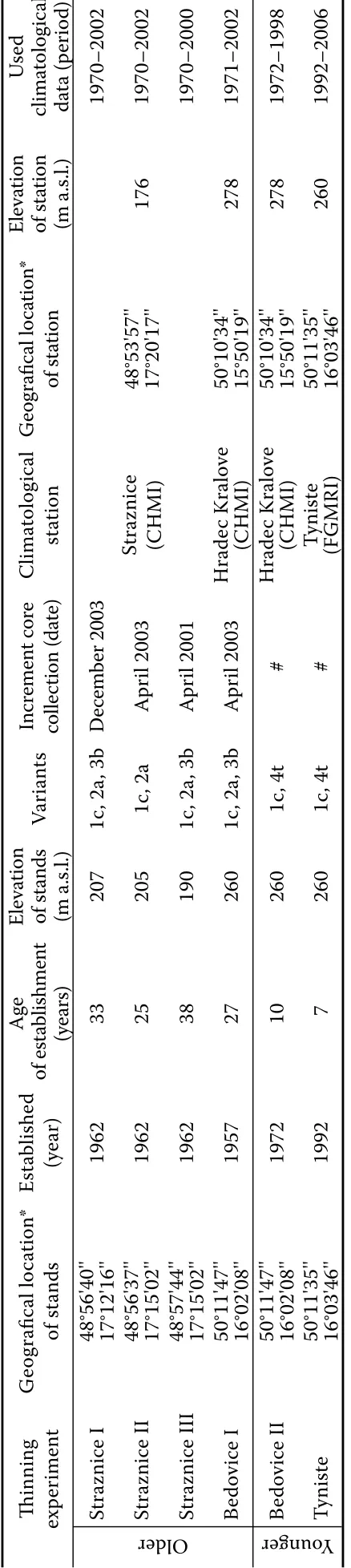
In the present study, we used six long-term thin-ning Scots pine (Pinus sylvestris L.) experiments es-tablished in 1957–1992 by the Forestry and Game Management Research Institute (Table 1). Th e el-evation of stands varied from 190 m to 260 m a.s.l. All stands are located on sandy nutrient-poor soils (arenic Podzol). Th e forest type was classifi ed as
Pineto-Quercetum oligotrophicum (arenosum) –
Musci on experiments Bedovice I and II and Tyniste
and as (Carpineto-)Quercetum oligo-mesotrophi-cum – Calamagrostis epigeios) on experiments Straznice I, II and III. According to data from the Czech Hydrometeorological Institute for the period 1961–2000, mean annual precipitation varies from 550 mm (experiments Straznice I, II and III) to 600 mm (experiments Bedovice I and II and Tyniste) and mean annual temperature from 8.5°C (experiments Bedovice I and II and Tyniste) to 9.0°C (experiments Straznice I, II and III).
Experimental stands were planted with the ini-tial density of 6–15 thousand trees per ha with the exception of Bedovice I experiment, which was re-generated naturally, i.e. with the unknown initial density (Table 2).
According to the age of the fi rst thinning, ex-periments are divided into two groups (Table 1): older (i.e. experiments with thinning that started at the age of 25–38 years) and younger (i.e. experi-ments with thinning that started at the age of 7–10 years). Prior to the fi rst thinning, the stand charac-teristics were comparable on included variants (Ta-ble 2) without statistically signifi cant diff erences. In “older” stands, density varied from 2,600 to 3,800 trees per ha before thinning, with the exception of naturally regenerated Bedovice I experiment, where a higher density was found (ca 9,000 trees·ha–1).
In younger experiments, stands were relative-ly similar in density before the fi rst thinning (9,300–10,300 trees·ha–1).
Experiments consist of two to three treatments, which in total comprised three thinning variants (2a, 3b, 4t) and unthinned control (1c). Variant 2a represents high thinning, i.e. positive selection from above and variant 3b represents low thinning. Th e intensity of thinning was set to account for 15–10% of the basal area during the fi rst half of the rotation period (up to the age of 50 years) and for 10–6% of the basal area in the second half of rota-tion period. Full stocking and a fi ve-year thinning interval were assumed. Where stocking was not full, the thinning intensity decreased to 30–50% of the original amount.
re-T
able 1. B
a sic da ta a b out e x p er imen ts and da ta c olle c tion Th inning ex p e rimen t G e og rafi c al lo c ation* of st ands E st ablishe d (ye ar) Age of e st ablishmen t (ye ars) Ele v ation of st ands (m a .s .l.) Va ri a n ts Incr emen t c o re colle ction ( d at e) Clima tolog ic a l st ation G eog rafi c al lo ca tion* of st ation Ele v ation of st ation (m a .s .l.) Us e d clima tolog ic al da ta (p er io d) Older Stra z nic e I 48°56'40'' 17°12'16'' 1962 33 207 1 c , 2a , 3b D ec em b er 2 0 0 3 Stra z nic e (C HMI) 48°53'57'' 17°20'17'' 176 1970–2002 Stra z nic e II 48°56'37'' 17°15'02'' 1962 25 205 1 c , 2a A p ril 2003 1970–2002 Stra z nic e III 48°57'44'' 17°15'02'' 1962 38 190 1 c , 2a , 3b A p ril 2001 1970–2000 B e dov ic e I 50°11'47'' 16°02'08'' 1957 27 260 1 c , 2a , 3b A p ril 2003 Hrade c Kralove (C HMI) 50°10'34'' 15°50'19'' 278 1971–2002 Younger B e dov ic e II 50°11'47'' 16°02'08'' 1972 10 260 1 c , 4t # Hrade c Kralove (C HMI) 50°10'34'' 15°50'19'' 278 1972–1998 T y nist e 50°11'35'' 16°03'46'' 1992 7 2 60 1c , 4t # T y nist e (FGMR I) 50°11'35'' 16°03'46'' 260 1992–2006
*in WGS 84 s
y st em, #w it hout c o re
s – diame
ter incr emen t w a s de te c te d f rom t he ann ual me a sur emen t (s e e me th o d s), C
HMI – Cze
ch H y d ro me te or olog ic al Instit ut e, FGMR
I – F
o re str y and G ame Managemen t Re se ar ch Instit ut e, V a ri an ts
: 1c – c
o n tr ol un thinne d plot
, 2a – plot w
it h p o sitive s ele c tion f rom a b ove, 3b
– plot w
it
h
low t
hinning
, 4t – plot w
it h c ombina tion of ge ome tr ic t
hinning and indiv
idual s
ele
c
tion
T
able 2. Summar
y of t
he st and charac te ri stic s Older Y o unger Th inning e x p er imen t S tra z nic e I S tra z nic e II Stra z nic e III B e dov ic e I B e dov ic e II T y nist e Va ri a n t 1c 2a 3b 1c 2a 1c 2a 3b 1c 2a 3b 1c 4t 1c 4t Ar e a (ha) 0.25 0 .25 0.25 0.25 0.25 0.25 0.25 0.25 0.10 0.10 0.10 0.12 0.12 0.09 0.09 Or ig
inal density plan
te
d (p
er 1 ha)
6,000 6,000 6,000 9,000 9,000 9,000 9 ,000 9,000 c a 12,000–15,000* 1 5,000 15,000 10,000 10,000 Initial b e fo re t hinning (ye
ar – age)
1962 – 33 ye
ars
1962 – 25 ye
ars
1962 – 38 ye
ars
1957 – 27 ye
ars
1972 – 10 ye
ars
1992 – 7 ye
ars
N
u
mb
er of tr
e
e
s (p
er 1 ha)
3,384 3,528 3,508 3,744 3,840 2,724 2 ,696 2,600 8,770 8,794 9,334 10,340 9,720 9 ,289 9,889 B a sal ar e a (m 2 ·ha –1 ) 3 7.6 3 8.3 37.4 27.3 28.4 37.9 3 9.9 38.6 29.6 27.7 29.0 6.6 6 .7 6.4 6 .3 F inal (ye
ar – age)
2002 – 73 ye
ars
2002 – 65 ye
ars
2002 – 78 ye
ars
2000 – 70 ye
ars
1998 – 36 ye
ars
2006 – 21 ye
ars
N
u
mb
er of tr
e
e
s (p
er 1 ha)
788 744 852 8 00 760 6 96 588 620 1,210 1,320 8 40 3,017 2 ,025 5,211 3 ,600 B a sal ar e a (m 2 ·ha –1 ) 3 6.8 3 5.8 37.7 33.3 36.8 39.2 3 7.0 37.4 37.0 42.3 37.1 45.6 39.4 34.6 29.4 *na tural r e genera
tion, – unk
now n density . F o r e x p lana
tion of v
[image:3.842.113.332.93.1071.2]moved) and individual negative selection in the left rows (totally 50% reduction). Th e schedule was followed by individual positive selection in the 10-year period.
At the end of the observation period used for this study, the experimental stand showed the follow-ing characteristics (Table 2): in older stands, den-sity varied from 620 to 1,320 trees per hectare. It represents basal area from 33.3 to 42.3 m2·ha–1. In
younger experiments, the stands density varied from 2,025 to 5,211 trees·ha–1 with basal area from
29.4 to 45.6 m2·ha–1.
Data collection
Diameter increment data
Th e experimental stands were measured annually (younger stands) or every fi ve years (older stands). Among others, diameter at breast height was meas-ured to the nearest millimetre on all trees using a calliper. For further investigation we selected from 18 to 24 dominant individuals with the largest di-ameter before thinning from each variant of exper-iments (Table 3). Diameter increment data for the analyses were taken using two methods:
In older stands, one core sample was extract-ed with an increment Pressler borer at 1.3 m from identical direction of each tree from selected group, mounted on a wooden holder and the surface was prepared with belt sander. Ring widths were meas-ured to the nearest 0.01 mm using a DIGI-MET (Bohrkernmeßgerät) which was made in Preisser Messtechnik, Grube KG Forstgerätestelle, Germa-ny. Th e dating of tree ring series was checked again by existing chronologies from the regular measure-ment of diameter at breast height.
In younger stands, where stem cores were un-acceptable because of smaller diameter (< 15 cm), diameter increment data were calculated from the annual measurement of diameter at breast height.
Age-related trends in diameter increment series of individual trees can be evaluated by diff erent methods. For example, the method of moving aver-ages was successfully used for oak stands (Petráš et al. 2007). In our study, we used the recommend-ed growth function (Smelko, Dursky 1999) – the equation by Korf (1939, 1972) in the increment form:
. (1)
where:
A, k, n – coeffi cients (k ≠ 0, n> 1).
Th e outputs of analysis were residual chronolo-gies (calculated from measured and modelled data) of all individual trees.
Climate data
Mean monthly temperatures (measured at a height of 2 m above the ground) and total monthly precipitation were available from nearby meteoro-logical stations (two stations in total) operated by the Czech Hydrometeorological Institute (Table 1). Additionally, climatic data from a NOEL auto-matic station were used. Th is station is situated di-rectly in Tyniste experimental stand and operated by the Forestry and Game Management Research Institute.
We calculated the long-term mean of monthly average temperatures and total monthly precipi-tation in accordance with the period of observa-tion (Table 1). Addiobserva-tionally, average temperature and total precipitation from the vegetation period (April–September) and total monthly precipita-tion and average temperature from the spring pe-riod March–August were computed. Furthermore, long-term means of three climatic factors were de-termined using the following equations:
. (2)
Precipitation from several months before the growing season (February, March) can contribute to suffi cient soil moisture when growth begins. Th e precipitation amount from the second half-year was not included. Temperatures characterised al-most the whole vegetation period.
. (3)
Th e sum of precipitation in the fi rst half-year is in-creased via the amount of precipitation in the last two months of the previous year (accumulation of win-ter precipitation). Temperatures characwin-terised the whole vegetation period.
. (4)
Th is factor characterised the ratio of precipita-tion and temperature in the spring season only. Di-ameter increment of forest tree species is maximal in this period.
Finally, for each year from the period of observa-tion we calculated deviaobserva-tions between mean values and measured values of presented climatic
vari-( )
⎥⎥⎦⎤ ⎢
⎢ ⎣ ⎡
⋅ − ⋅
⋅
= n 1 n tn−1 k e
t k A Y
September to
April from re temperatu average
June o November t from
ion precipitat total
2=
F
June to April from re
temperatu average
June to April from ion precipitat total
3=
F
August to
April from re
temperatu average
June o February t from
ion precipitat total
1=
F
August to
April from re
temperatu average
June o February t from
ion precipitat total
average temperature from April to August total precipitation from February to June
Augus to
April from re temperatu average
June o February t from
ion precipitat total
average temperature from April to June total precipitation from April to June
August to
April from re
temperatu average
June o February t from
ion precipitat total
T
able 3. Charac
te ri stic ( d iame ter d 1.3
) of g
roup of ob
se rv e d tr e e s f or p a rtic ular v a ri an ts and e x p er imen ts Older Y ounger Th inning e x p er imen t S tra z nic e I Stra z nic e II Stra z nic e III B e dov ic e I B e dov ic e II T y nist e Va ri a n t 1c 2a 3b 1c 2a 1c 2a 3b 1c 2a 3b 1c 4t 1c 4t N umb
er of tr
e e s ( N )2 0 2 0 2 0 2 0 2 0 2 0 2 0 2 0 2 0 2 0 2 0 2 4 2 4 1 8 1 8 Initial (ye
ar – age)
1962 – 33 ye
ars
1962 – 25 ye
ars
1962 – 38 ye
ars
1971 – 41 ye
ars
1972 – 10 ye
ars
1992 – 7 ye
ars d 1.3 ( c m) Me an 18.8 18.3 18.9 14.9 14.3 19.8 19.6 20.5 18.4 18.3 18.6 8.1 8.5 5.1 4.8 SD 1.32 1.16 1.44 1.35 0.68 0.59 1.74 1.35 1.44 1.75 1.18 1.13 0.92 0.47 0.33 F inal (ye
ar – age)
2002 – 73 ye
ars
2002 – 65 ye
ars
2002 – 78 ye
ars
2000 – 70 ye
ars
1998 – 36 ye
ars
2006 – 21 ye
ars d 1.3 ( c m) Me an 29.1 31.6 31.3 26.5 30.2 32.5 32.7 32.7 25.3 25.8 24.9 23.1 20.5 14.1 14.3 SD 1.81 2.44 2.12 3.35 2.51 2.91 3.72 4.88 3.18 3.20 1.65 2.08 3.21 2.30 2.29
SD – st
andar d de v ia tion. F or e x plana
tion of v
a ri an ts s e e T able 1
ables (monthly values, vegetation period, spring season and factors F1, F2 and F3).
Th e construction of climatic factor equations was supported by some studies. Fritts (1976) report-ed that growth–climate relationships must also be computed between ring indices and climate vari-ables for several months before the growing season, because the width of the annual ring is an integra-tion of climatically infl uenced processes taking place over a longer period. Diameter growth of co-niferous trees started usually in April and subsid-ed in the period of August–September. Th erefore, temperatures in the period of April–June and pre-cipitation in the period of June–August are of great signifi cance in the driving diameter growth process in the stands (Smelko et al. 1992, Riemer , Slobo-da 1991). A shorter but similar period (July–Au-gust) in relation to the negative drought eff ect on diameter increment was reported by Cienciala et al. (1997) in the 50-year-old pine stand. On the other hand, no eff ect of climate variables at the end of growing season on diameter growth of current year was found (Graumlich 1991). However, cli-mate characteristics of the last months can infl u-ence growth of trees in the following year.
Data analyses
Data analyses were performed using the statisti-cal software package UNISTAT®(version 5.1) and 3
steps included in total:
(1) Diameter growth response was determined using correlation coeffi cients characterising the long-term relationship between diameter growth (data from residual chronologies) and climate (long-term deviations between mean values and measured values of climatic vari-ables). All sample trees were described using coeffi cients calculated and determined at the 95% confi dence level. If 25% of trees within a group showed a signifi cant correlation coef-fi cient at the 95% concoef-fi dence level (evaluated by summary statistics – lower and upper quar-tile), the growth response of the tree group was considered important.
ex-periments) were determined. Th e Hierarchical Cluster Analysis method was used with distance measure as Euclid and linking method as Aver-age Between Groups. We calculated the propor-tion of individuals by thinning variants for each cluster. Th is approach was used in order to sup-port or disprove the hypothesis that a group of dominant trees from individual variants of thin-ning had the identical growth response to cli-mate variation, i.e. diff erences between thinning variants in diameter growth response of domi-nant trees to climate variation signifi cantly exist. (3) Evaluation of growth response variability with-in the group of trees with-in the experiments was the last step of data analyses. Variability was deter-mined by variance of correlation coeffi cients for detected signifi cant relationships (see the fi rst step of data analyses). We compared the variability of growth response in control un-thinned variants against un-thinned variants.
RESULTS
Th e eff ect of drought on diameter increment of pine stands
In our study, drought is predominantly repre-sented by three climatic factors F1, F2 and F3, which were calculated as the ratio of precipitation and
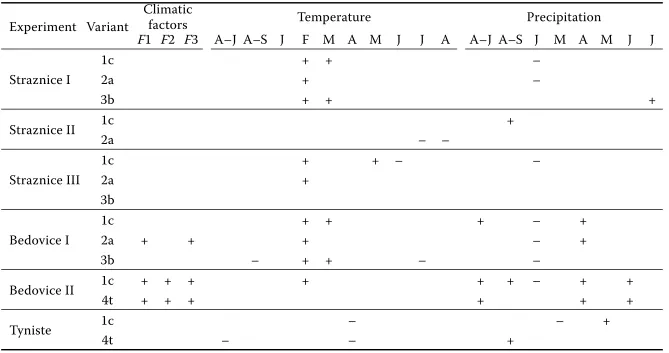
temperatures in selected periods (for more details see the Method). It means that lower values of these factors showed a possibility of drought in the period of the last ca 30 years. Dominant pine trees showed positive diameter growth responses to higher values of climatic factors (Table 4). However, a signifi cant relationship was observed for neighbouring experi-ments Bedovice I and II only.
Th ere is a possibility that drought might also be caused over a long period with low precipitation or higher temperatures. Th is is important mainly during the growing season. In the observed experi-ments, climate variations in the spring season from April to June (A–J) and in the vegetation period from April to September (A–S) were important for diameter growth of pine stands (Table 4). A nega-tive eff ect of higher temperature in spring (A–J) and in vegetation period (A–S) on annual diameter increment was observed on experiment Tyniste and Bedovice I, respectively. On the other hand, we found a positive eff ect of the higher sum of precipi-tation in the spring season (experiments Bedovice I and II) and in the growing season (experiments Straznice II, Bedovice II and Tyniste) on diameter growth of dominant trees.
[image:6.842.89.758.673.1026.2]At the same time, we observed a signifi cant posi-tive infl uence of higher air temperatures in early spring (February, March) on annual diameter growth of dominant trees on four experiments (Straznice
Table 4. Signifi cance (for explanation see Methods) of growth response to climate variables according to experiments and variants
Experiment Variant
Climatic
factors Temperature Precipitation
F1 F2 F3 A–J A–S J F M A M J J A A–J A–S J M A M J J
Straznice I
1c + + –
2a + –
3b + + +
Straznice II 1c +
2a – –
Straznice III
1c + + – –
2a +
3b
Bedovice I
1c + + + – + 2a + + + – + 3b – + + – –
Bedovice II 1c + + + + + + – + + 4t + + + + + +
Tyniste 1c – – +
4t – – +
I and II, Bedovice I and II). Mean temperatures in May also had a positive eff ect on diameter growth on Straznice III experiment. For the other months (April, June, July and August), a negative infl uence of higher air temperatures on diameter growth was found on some experiments (Table 4).
Mainly positive eff ects of higher sums of precipi-tation in the particular months on annual diameter growth were detected (for April, May, June and July). On the other hand, the higher sum of precipitation in January (four experiments) and in March (one experi-ment) had a negative infl uence on annual diameter growth. Th is result (negative infl uence of higher sum of precipitation on growth) might be surprising. We can fi nd an explanation within the climate series: the sum of precipitation in January correlated negatively (at the 95% confi dence level) with the sum of precipi-tation in April and mean temperature in March (Hra-dec Kralove station) and/or with mean temperature in February and March (Straznice station).
Finally, for the relationship between climate and diameter growth, the most important (statistically
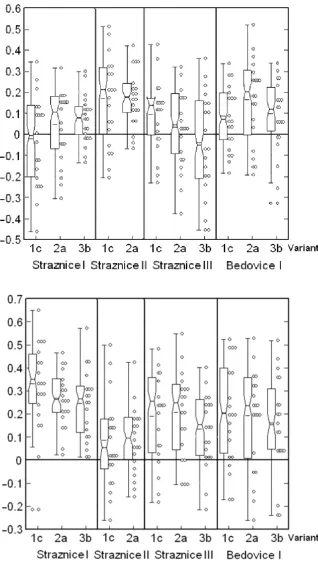
signifi cant) climate variables were: (a) in “older” stands mean temperature in February (Straznice I, Straznice III and Bedovice I) and sum of precipi-tation in the vegeprecipi-tation period from April to Sep-tember (Straznice II); (b) in younger stands climate factor F1 (Bedovice experiment) and mean tem-perature in April (Tyniste). Th e eff ect of these vari-ables on diameter growth of dominant pine trees was positive in three cases (factor F1, temperatures in February and precipitation in the vegetation period) and negative in one case (temperatures in April) (Figs. 1 and 2).
Eff ect of stand density (thinning) on pine re-sistance to drought stress
All variables that showed signifi cant (positive or negative) eff ects on diameter growth (Table 4) were subjected to Principal Components Analysis (PCA). During the procedure, the number of variables was reduced (according to Scree plot results) to 2–4. In Straznice I experiment, three variables were separat-ed via the analysis: sum of precipitation in July and mean temperature in January and February. Only two important variables – sum of precipitation in the vegetation period (from April to September) and mean temperature in July – were found in Straznice II experiment. For Straznice III experiment we sepa-rated three variables using the PCA analysis: mean temperature in February, May and June.
Four variables in total were found for neighbour-ing experiments Bedovice I (climatic factor F1, sum of precipitation in April and mean temperature in February and in the vegetation period from April to September) and Bedovice II (climatic factors F1 and
F2, sum of precipitation in the vegetation period from April to September and mean temperature in Febru-ary). Finally, for Tyniste experiment four variables were chosen: sum of precipitation in March, May and in the vegetation period (April–September) and mean temperature in the spring season from April to June.
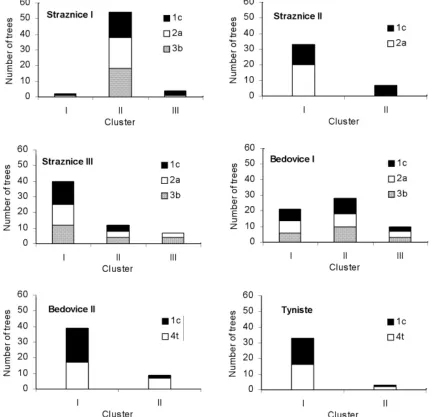
[image:7.842.91.409.509.1073.2]Two or three clusters (in accordance with the number of variants in individual experiments) were determined subsequently and we calculated the pro-portion of individuals by thinning variants within
each cluster (Fig. 3). Th e results showed that groups of dominant trees from the particular variants of thinning did not have the identical growth response to climate variation. Each cluster included trees mostly from all variants that were observed in the particular experiments. Straznice III experiment is the only exception. Small proportions of trees (15% in variant 2a with positive selection from above and 20% in variant 3b with low thinning) responded sim-ilarly and no individuals from the control unthinned plot belonged to their cluster. In all the remaining
experiments, trees from thinned variants (2a, 3b, 4t) were included in the clusters together with trees from unthinned control plots 1c.
Variability of growth response of pine stands to climate characteristic in relation to thinning
[image:8.842.93.522.83.375.2]Variability of growth response was determined by the variance of correlation coeffi cients for vari-ables detected using PCA during the previous steps. Th e eff ect of thinning on the variability of diameter Fig. 2. Comparison of growth re-sponse to climate variables (climate factor F1 – left, mean temperature in April – right) in younger experi-ments Bedovice II and Tyniste. Vari-ants: 1c – control unthinned plot, 4t – plot with combination of geometric thinning and individual selection
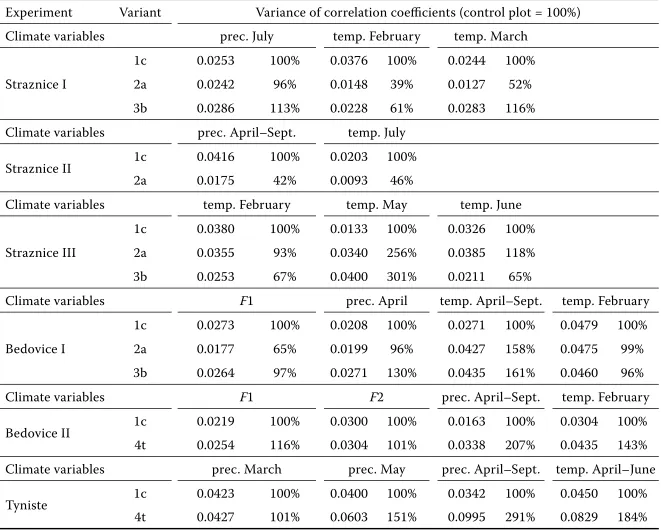
[image:8.842.95.530.652.1069.2]growth response to climate situations was not uni-form (Table 5). When we labelled the variance of correlation coeffi cients on the control unthinned plot as 100%, the results showed that dominant trees from thinned stands demonstrated in some cases higher (> 105%), comparable (95–105%) and lower (< 95%) variability of diameter growth response in comparison with those from control stands.
However, some trends are obvious. In two experi-ments (Straznice I and II), dominant trees from vari-ants 2a with positive selection from above had either lower or comparable (in one case in Straznice I ex-periment) variability of growth response in compari-son with relevant control stands. On the other hand, in Straznice III experiment, trees from this variant of thinning (2a) showed either higher or compara-ble (in one case) variability. In the younger stands (Bedovice II and Tyniste experiments) the results were quite uncomplicated. Nearly in all cases,
domi-nant trees from thinned stands (variant 4t) showed the higher variability of diameter growth response in comparison with those from control stands.
DISCUSSION
Th e response of Scots pine to climatic conditions has been extensively discussed over the last few decades. Pine is considered a species that is highly tolerant to climate change (Vitas, Bitvinskas 1998; Barbéro et al. 1998), and has been grown under a variety of environmental conditions across Europe and Asia (Richardson, Rundel 1998). Nowadays, forestry science faces the problem of tree species behaviour under conditions of climate extremes suggesting possible climate changes. Th e Scots pine response to a predicted shift in climate seems to be dependent upon particular site
condi-Table 5. Variability of growth response – determined by variance of correlation coeffi cients for detected signifi cant relationship (see Methods for detailed explanation)
Experiment Variant Variance of correlation coeffi cients (control plot = 100%)
Climate variables prec. July temp. February temp. March
Straznice I
1c 0.0253 100% 0.0376 100% 0.0244 100%
2a 0.0242 96% 0.0148 39% 0.0127 52%
3b 0.0286 113% 0.0228 61% 0.0283 116%
Climate variables prec. April–Sept. temp. July
Straznice II 1c 0.0416 100% 0.0203 100% 2a 0.0175 42% 0.0093 46%
Climate variables temp. February temp. May temp. June
Straznice III
1c 0.0380 100% 0.0133 100% 0.0326 100%
2a 0.0355 93% 0.0340 256% 0.0385 118%
3b 0.0253 67% 0.0400 301% 0.0211 65%
Climate variables F1 prec. April temp. April–Sept. temp. February
Bedovice I
1c 0.0273 100% 0.0208 100% 0.0271 100% 0.0479 100%
2a 0.0177 65% 0.0199 96% 0.0427 158% 0.0475 99%
3b 0.0264 97% 0.0271 130% 0.0435 161% 0.0460 96%
Climate variables F1 F2 prec. April–Sept. temp. February
Bedovice II 1c 0.0219 100% 0.0300 100% 0.0163 100% 0.0304 100% 4t 0.0254 116% 0.0304 101% 0.0338 207% 0.0435 143%
Climate variables prec. March prec. May prec. April–Sept. temp. April–June
Tyniste 1c 0.0423 100% 0.0400 100% 0.0342 100% 0.0450 100% 4t 0.0427 101% 0.0603 151% 0.0995 291% 0.0829 184%
[image:9.842.93.754.498.1030.2]tions as noted by Dursky and Pavlickova (1998), when they reported a positive growth response to the expected change. Th e only negatively respond-ing trees were found at the poorest sites (acidic oak wood with pine). However, the question is which climatic variable is the driving variable for the re-lationship between pines and growth conditions. Grace and Norton (1990) reported tempera-ture more important than rainfall in infl uencing growth; a signifi cantly positive correlation between the ring width and both late winter (January–Feb-ruary) and summer (July–August) temperatures was found. Th e importance of late winter/early spring temperatures was confi rmed in the study from Poland (Feliksik, Wilczyski 2000) where a positive relationship between January–March temperatures and wide rings was found. In addi-tion to warm spring (February, March), the autumn temperatures are also considered to be positively aff ecting the radial growth of pine (Rundel, Yo-der 1998; Vitas 2004). Consistently with reported information on the positive eff ect of higher spring temperatures, we found the positively infl uenced radial growth of dominant trees in relation to Feb-ruary–March temperatures on four experimental plots (Straznice I and II, Bedovice I and II). On the other hand, summer droughts infl uence the radial growth of pines rather adversely (Tessier 1986; Riek et al. 1995; Feliksik, Wilczyski 2000; Rigling et al. 2002; Pichler, Oberhuber 2007; Vitas 2004). In accordance with these results, the spring/late spring and summer temperatures were found to negatively infl uence the diameter growth in our experiments.
Besides early spring temperatures, a positive ef-fect of the higher sum of spring precipitation on the radial growth was found in Bedovice I and II experiments; a similar response was observed for vegetation season precipitation in experiments Straznice II, Bedovice II and Tyniste. Some stud-ies also pointed out the current early spring (Lin-derholm 2001) and vegetation period (Riemer, Sloboda 1991) precipitation as an important cli-matic factor infl uencing Scots pine. Feliksik and Wilczyski (2000) also reported the high summer rainfall as related to wide growth rings. From the season aspect, our results confi rm the positive ef-fect of precipitation on annual diameter increment detected in April, May, June (Miller et al. 1977; Oberhuber et al. 1998; Oberhuber 2001) and July. In contrast with Rigling et al. (2002), January (four experiments) and March (one experiment) temperatures proved a negative infl uence upon an-nual radial growth.
Based on the results of our study, no signifi cant eff ects of thinning (stand density management) on the relation between diameter growth and climatic characteristics were detected. Using the methods of increment evaluation (growth function) can be a reason for our ambiguous results. A diff erent method (moving averages) was applied in other similar studies (e.g. Petráš et al. 2007).
On the other hand, Biryukova et al. (1989) reported similar results that thinning did not in-crease the resistance of pine stands to drought. Th e dependence of drought resistance on the geograph-ical location of pine provenances was not found in Poland (Przybylski, Malecki 1993). Th e eff ect of thinning on dominant trees seems to be negligible from the production aspect (Varmola, Salminen 2004). However, increased variability in the young thinned stands (Bedovice II and Tyniste experi-ments) confi rmed higher growth response variabil-ity of pine stands in relation to precipitation (Dur-sky, Pavlickova 1998; Palmroth et al. 1999). Th e eff ect of thinning on growth characteristics is obviously greater in the early thinned pine stands compared to older ones (Eder 1999; Hartig 1999; Huss 1999).
Th e growth response of thinned young stands is likely to be related to increased availability of water (lower interception) and generally better growth conditions (temperature, radiation). Chroust (1977) confi rmed the importance of early thinning of pine stands as highly favourable at sandy and permeable sites in low-precipitation areas.
Consequently, our results support the hypothesis that silvicultural management is likely to result in an increase in drought resistance only in the young pine stands. Subsequently our study suggests that the thinning of older pine stands leads to an insig-nifi cant change in drought resistance.
CONCLUSION
On the basis of the study aimed at the eff ect of stand density on Scots pine resistance to drought stress and subsequent response of diameter incre-ment, carried out in six long-term experimental series with thinning located in the Czech Republic, we conclude:
Dominant trees from the particular variants of thinning did not show the identical growth re-sponses to climate variation, except for one experi-ment (Straznice III), where a small proportion of trees (15–20%) from thinned variants responded similarly and both were diff erent from unthinned individuals on the control plot. Trees from thinned variants in all the other experiments responded similarly together with trees from unthinned con-trol plots.
In the younger pine stands (Bedovice II and Tyniste experiments) dominant trees from thinned stands (variant 4t) showed higher variability of di-ameter growth response in comparison with those from control stands. In the older stands this result was not signifi cant.
Acknowledgements
Results were evaluated with respect to the conver-sion of coniferous monocultures which is the topic of international collaboration in the project centrum ConForest (http://www.conforest.uni-freiburg.de/) under supervision of the European Forest Institute EFI. We are grateful to Stuart Dedrick for his use-ful suggestions and assistance with English.
R e f e r e n c e s
Alcamo J., Moreno J.M., Nováky B., Bindi M., Corobov R., Devoy R.J.N., Giannakopoulos C., Martin E., Olesen J.E., Shvidenko A. (2007): Europe. Climate Change 2007: Im-pacts, Adaptation and Vulnerability. In: Parry M.L., Canzi-ani O.F., Palutikof J.P., van der Linden P.J., Hanson C.E. (eds): Contribution of Working Group II to the Fourth As-sessment Report of the Intergovernmental Panel on Climate Change. Cambridge, Cambridge University Press: 541–580. Augustaitis A. (1998): Regeneration of Scots pine trees
damaged by pests according to the retrospective analysis of tree ring time series. In: Stravinskiene V., Juknys R. (eds): Proceedings Dendrochronology and Environmental Trends. Kaunas, Lithuania: 151–159.
Barbéro M., Loisel R., Quezel P., Richardson D.M., Romane F. (1998): Pines of the Mediterranean basin. In: Richardson D.M. (ed.): Ecology and Biogeography of Pinus. Cambridge, Cambridge University Press: 153–170. Barsch H., Steinhardt U., Söllner R. (1994): Th e de-velopment of forest damage – control and prognosis on the basis of remote sensing data. Geojournal, 32: 39–46. Beker C. (1996): Th e diameter-at-breast-height increment in
pine stands of older age classes. Sylwan, 140: 81–91. (in Polish) Biryukova Z.P., Verzunov A.I., Mekhedova L.G., Sho-morokhova G.I. (1989): Th e water regime and resistance
of Scots pine stands in northern Kazakhstan. Lesovedenie,
1: 9–18. (in Russian)
Cech T., Tomiczek C. (1996): Zum Kiefernsterben in Nie-derösterreich. Forstschutz Aktuell,17/18: 12–14.
Christensen J.H., Hewitson B., Busuioc A., Chen A., Gao X., Held R., Jones R., Kolli R.K., Kwon W. K., Laprise R., Magana Rueda V., Mearns L., Menén-dez C.G., Räisänen J., Rinke A., Sarr A., Whetton P. (2007): Regional Climate Projections. In: Solomon S., Qin D., Manning M., Chen Z., Marquis M., Averyt K.B., Tignor M., Miller H.L. (eds): Climate Change 2007: Th e Physical Science Basis. Contribution of Working Group I to the Fourth Assessment Report of the Intergovernmental Panel on Climate Change. Cambridge, New York, Cam-bridge University Press, Chapter 11: 847–940.
Chroust L. (1977): Th e ecological importance of thinning in pine stands. Práce VÚLHM, 51: 53–66. (in Czech)
Cienciala E., Kuera J., Lindroth A., Čermák J., Grelle A., Halldin S. (1997): Canopy transpiration from a boreal forest in Sweden during a dry year. Agricultural and Forest Meteorology,86: 157–167.
Cienciala E., Kuera J., Lindroth A. (1999): Long-term measurements of stand water uptake in Swedish boreal for-est. Agricultural and Forest Meteorology,98–99: 547–554. Davi H., Dufrêne E., Francois C., Maire G., le Loustau
D., Bosc A.,Rambal S., Granier A., Moors E. (2006): Sensitivity of water and carbon fl uxes to climate changes from 1960 to 2100 in European forest ecosystems. Agri-cultural and Forest Meteorology, 141: 35–56.
Dursky J., Pavlickova A. (1998): Dendroclimatic model of Scotch pine in Zahorska Nizina. Acta Facultatis Forestalis Zvolen,40: 85–97. (in Slovak)
Eder W. (1999): Grundlagen und Uberlegungen zu neuen Konzeptionen für die Kiefernwirtschaft in Rheinland-Pfalz. Forst und Holz,54: 209–212.
Eilmann B., Weber P., Rigling A., Eckstein D. (2006): Growth reactions of Pinus sylvestris L. and Quercus pu-bescens Willd. to drought years at a xeric site in Valais, Switzerland. Dendrochronologia,23: 121–132.
Feliksik E., Wilczyski S. (2000): Th e infl uence and pluvial conditions on the radial increment of the Scots pine (Pinus sylvestris L.) from the area of Dolny Ślask. Folia Forestalia Polonica, Seria A, Leśnictwo,42: 55–66.
Fritts H.C. (1976): Tree ring and Climate. London, New York, San Francisco, Academic Press: 567.
Grace J., Norton D.A. (1990): Climate and growth of Pinus sylvestris at its upper altitudinal limit in Scotland: evidence from tree-growth rings. Journal of Ecology,78: 601–610. Graumlich L.J. (1991): Subalpine tree growth, climate, and
increasing CO2: An assessment of recent growth trends. Ecology,72: 1–11.
Hartig M. (1999): Erste Reaktionen von Kiefernjungbe-standen auf unterschiedliche Freistellung. Forst und Holz,
Hill G. (1993): Untersuchungen uber den Einfl uss des Wit-terungsverlaufes auf Absterbevorgange in alteren Kiefern-bestanden (Pinus sylvestris L.). Forstarchiv,64: 3–9. Huss J. (1999): Auswirkungen unterschiedlicher
Ausgangsp-fl anzendichten und fruhzeitiger PAusgangsp-fl egeeingriff e bei jungen Kiefern. Forst und Holz, 54: 335–341.
Irvine J, Perks M.P., Magnani F., Grace J. (1998): Th e response of Pinus sylvestris to drought: Stomatal control of transpiration and hydraulic conductance. Tree Physiol-ogy, 18: 393–402.
Koch H.G. 1956): Durchmesserzuwachserhebungen an Waldbaumen zum Nachweis von Gelandeklimaeinfl ussen. Archive Forstwirtschaft,5: 673–689.
Korf V. 1939): Contribution to mathematical defi nition of the forest stand volume growth. Lesnická práce, 18: 339–379. (in Czech.)
Korf V. (1972): Dendrometry. Praha, SZN: 371. (in Czech.) Krecmer V. (1952): Eff ect of the 1947 drought, in particular
on the height increment of forest trees. Sbornik CAZV, 25: 243–260. (in Czech)
Landa M. (1959): Climatic fl uctuations and their eff ect on annual growth rings and on growing stock. Scottish For-estry,13: 154–162.
Linderholm H.W. (2001): Climatic infl uence on Scots pine growth on dry and wet soils in the Central Scandinavian Mountains, interpreted from tree-ring widths. Silva Fen-nica,35: 415–424.
Linderholm H.W., Molin T. (2005): Early nineteenth century drought in east central Sweden inferred from dendrochronological and historical archives. Climate Research,29: 63–72.
Makkonen K., Helmisaari H.S. (1998): Seasonal and yearly variations of fi ne-root biomass and necromass in a Scots pine (Pinus sylvestris L.) stand. Forest Ecology and Management,102: 283–290.
Meloun M., Militky J. (2002): Compendium of the statis-tical data processing. Praha, Academia: 764. (in Czech.) Memelink G. (1951): Th e infl uence of the dry year, 1947, on
growth of Larch, Douglas Fir and Scots Pine. Tijdschrift der Nederlandse Heidemaatschappij, Arnhem, 62: 299–302. (in Dutch)
Miller H. G., Miller J. D., Binns W. O. (1977): Growth of Scots pine under nutritional and climatic stress. Plant and Soil,48: 103–114.
Oberhuber W. 2001): Th e role of climate in the mortality of Scots pine (Pinus sylvestris L.) exposed to soil dryness. Dendrochronologia,19: 45–55.
Oberhuber W., Stumböck M., Kofler W. (1998): Climate-tree-growth relationships of Scots pine stands (Pinus sylvestris L.) exposed to soil dryness. Trees: Structure and Function, 13: 19–27.
Orlov A. Ya., Abaturov Yu. D., Matveeva A.A. 1974: Th e condition of Scots Pine after the 1972 drought in young plan-tations in the SE of the Moscow region. Lesovedenie, 1: 35–45.
Ozolincius R., Miksys V., Stakenas V. 2005: Growth-independent mortality of Lithuanian forest tree species. Scandinavian Journal of Forest Research,20 (Supplement 6): 153–160.
Palmroth S., Berninger F., Nikinmaa E., Lloyd J., Pulk-kinen P., Hari P. (1999): Structural adaptation rather than water conservation was observed in Scots pine over a range of wet to dry climates. Oecologia,121: 302–309.
Petráš R., Brezina L., Mecko J. 2007: Dynamics of radial increments of oak due to climatic factors eff ect. Ekológia,
26: 295–304.
Pichler P., Oberhuber W. 2007): Radial growth response of coniferous forest trees in an inner Alpine environment to heat-wave in 2003. Forest Ecology and Management,
242: 688–699.
Przybylski J., Malecki G. 1993): Eff ect of drought in 1992 in the area of the experiment forest district of Zielonka near Poznań on a provenance trial of Scots pine (Pinus sylvestris
L.). Sylwan,137: 35–44. (in Polish)
Riek W., Wessolek G., Lührte A. (1995): Wasserhaushalt und Dickenwachstum von Kiefern (Pinus sylvestris) im Raum Berlin. Allgemeine Forst- und Jagdzeitung, 166: 138–144.
Riemer T., Sloboda B. (1991): Analyse von Zuwächsen bei Kiefern mit zeitreihenorientierten Regressionsmodellen unter Berücksichtigung von Serien langfristiger Klimames-sungen. Allgemeine Forst- und Jagdzeitung, 162: 185–195. Rigling A., Bräker O., Schneiter G., Schweingruber
F. (2002): Intra-annual tree-ring parameters indicating diff erences in drought stress of Pinus sylvestris forests within the Erico-Pinion in the Valais (Switzerland). Plant Ecology,163: 105–121.
Richardson D. M., Rundel P. W. (1998): Ecology and biogeography of Pinus: an introducton. In: Richardson D.M. (ed.): Ecology and Biogeography of Pinus. Cambridge, Cambridge University Press: 3–46.
Rundel P.W., Yoder B.J. 1998): Ecophysiology of Pinus. In: Richardson D.M. (ed.): Ecology and Biogeography of
Pinus. Cambridge, Cambridge University Press: 296–323. Sabaté S., Gracia C. A., Sánchez A. (2002): Likely eff ects
of climate change on growth of Quercus ilex, Pinus ha-lepensis, Pinus pinaster, Pinus sylvestris and Fagus sylvatica
forests in the Mediterranean region. Forest Ecology and Management,162: 23–37.
Smelko S., Wenk G., Antanaitis V. 1992): Growth, struc-ture and production of the forest. Príroda: 342. (in Slovak.) Smelko S., Dursky J. (1999: Quantifi cation of growth and
increment changes in forest stands due to Gabcikovo dam in the Hrusovska Zdrz area. Lesnicky Casopis – Forestry Journal,45: 123–136.
Varmola M., Salminen H. 2004: Timing and intensity of precommercial thinning in Pinus sylvestris stands. Scandi-navian Journal of Forest Research, 19: 142–151.
Vitas A. 2004: Dendroclimatological research of Scots pine (Pinus sylvestris L.) in the Baltic coastal zone of Lithuania. Baltic Forestry, 10: 65–71.
Vitas A., Bitvinskas T. 1998: Dendroclimatological simi-larities of Picea abies (L.) Karsten and Pinus sylvestris (L.). Baltic Forestry,4: 24–28.
Weber P., Bugmann H., Rigling A. (2007): Radial growth responses to drought of Pinus sylvestris and Quercus pu-bescens in an inner-Alpine dry valley. Journal of Vegetation Science,18: 777–792.
Recieved for publication January 18, 2010 Accepted after corrections May 31, 2010
Corresponding author:
Ing. Jií Novák, PhD., Výzkumný ústav lesního hospodářství a myslivosti, Výzkumná stanice Opočno, 517 73 Opočno, Česká republika