JOURNAL OF FOREST SCIENCE, 57, 2011 (4): 178–184
Importance of logging technologies for economic
eff ectiveness of tending Norway spruce stands
P. Z, J. R, K. P
Faculty of Forestry and Wood Sciences, Czech University of Life Sciences Prague, Prague, Czech Republic
ABSTRACT: This article examines the impact of modern harvesting and hauling technologies on the economic ef-fectiveness of tending Norway spruce stands. The analysis of more than 70 tending treatments showed how funda-mental the choice of technology is with respect to the impact of tending treatments. The introduction of harvesters and forwarders, compared with traditional technologies, conclusively demonstrated a higher gross profit per unit area (CZK·ha–1) as well as per unit volume of harvested timber (CZK·m–3). In addition, the paper demonstrated economic effectiveness even in the first thinning operations in relatively young stands (30 years old).
Keywords: economic effectiveness; harvesting technologies; spruce stands; stand tending
Supported by Ministry of Agriculture of the Czech Republic, Projects No. QI102A085, and No. QI92A197. Th e tending of forest stands is an important
sil-vicultural measure that can be used to aff ect the development of forest stands in terms of both the productive and non-productive functions of ests. In Central Europe, the policies of spruce for-est tending were formulated soon after the intro-duction of rational management (H 1814; C 1835; B 1917). Since the very beginning of the systematic tending of forest stands the fundamental question has been whether these silvicultural measures could be used to increase the volume of wood production of the stands (V 1962; A 1968; K 1988; S-V 1986; C 1997; P 2005).
Purposeful tending measures can also be used to infl uence the tree species composition of the stand, its quality, and some constituents of the stand en-vironment that are important in terms of ecologi-cal, environmental and even aesthetic functions (C 1997). One of the basic tasks of spruce stand tending is their stabilization and increased re-sistance to harmful abiotic agents (S 1983, 1987; S, N 2006). Th e high percent-age of spruce in the form of unmixed monocultural stands in the Czech Republic at various sites makes the diff erentiation of tending an indispensable
conclusions thereof in the current legislation and the governmental subsidization policy”.
Th is issue has also been highlighted by a considera-ble change in technologies used in tending treatments (M, D 2007) with a substantial impact on the yield of intermediate harvests in recent years. For the reasons specifi ed above, this paper tries to evalu-ate the economic eff ectiveness of tending treatments in spruce stands for diff erent harvesting technologies.
MATERIAL AND METHODS
As input data required for determining the eco-nomic eff ectiveness of spruce stand tending, we used data published in the monograph of S and N (2007). Th eir paper analysed and evaluated the long-term eff orts of spruce tending introduced as early as in the 1950s. For economic analyses, the paper used the basic data published for the specifi c years from 12 experimental areas, which referred to the number of trees (N – trees·ha–1), basal area
(G ‒ m2·ha–1), mid diameter over bark (d o.b. ‒ cm),
and mid height (h ‒ m) of stands before thinning, as well as thinned trees and stands after thinning. Ob-viously, the input data included absolute and rela-tive data on intermediate harvests performed each year (T – trees·ha–1, m2·ha–1). Th ese parameters
were used to calculate log volume, volume of har-vested timber over bark or under bark (V o.b. – m3
and V u.b. – m3), and total volume stock of the
stand over bark and under bark (Vtotal o.b. – m3 and
Vtotal u.b.– m3).
In order to perform the exact calculation of tree volume, volume equations derived from the paper by K (1961), P and P (1991) were used. Th e equations were as follows:
To calculate the volume of large timber (with a minimum top diameter of 7 cm) of spruce over bark (V l.t.o.b – m3):
V l.t.o.b. = [(0.00004013841 × d(d+1)1.821816 × × h1.132062) – (0.00928540767 ×
× (d+1)–1.02037409 × h0.896100664)]
To calculate the volume of large timber (with a minimum top diameter of 7 cm) of spruce under bark (V l.t.u.b – m3):
V l.t.u.b. = [(0.000031989 × (d+1)1.8465 × h1.1474) – – (0.00829054252 × (d+1)-1.02037409 × × h0.896100664)]
where:
d – mean diameter over bark (cm),
h – mean tree height (m).
Th e above calculations were used to calculate the log volume of each tending measure, which was subsequently used to calculate the total volume of the stand. To show the harvest volume in each tending measure, the log volume was multiplied by the number of trees removed during the har-vest. Consequently, the result showed the harvest volume and the total volume of the stand (i.e. the sum of the harvest volume and the main stand vol-ume). For each experimental area, initial standing volume, harvest volume at each tending treatment and fi nal standing volume are shown.
For each tending treatment (harvest), assortment was performed according to the assortment growth tables (P et al. 1996) based on harvest vol-ume (m3·ha–1 u.b.), average log volume and
aver-age diameter d (cm u.b.).As such tables show as-sortments for stem diameters over bark, diameters over bark had to be recalculated to diameters under bark. Th e actual conversion used the reduction co-effi cient of 0.9598 for spruce (Š 2000).
Th us, the proportion of quality classes of assort-ments (%, m3) was determined for each tending
treatment. Th e proportions of quality classes of as-sortments were then multiplied by the selling price according to the available data of the Czech Statis-tical Offi ce (ČSÚ 2008).Th e result of the calcula-tion provided the potential yields of each tending treatment in Czech crowns.
In this way, the data from 12 sites were acquired for economic evaluations of 73 tending treatments. To determine the costs of logging technologies, the current costs typical of contract prices (servic-es) in Central Bohemia for three options (technolo-gies) were used:
– harvester technology (HT);
– traditional method using draught horse with maximum 0.29 (CMlv) log volume;
– traditional method without draught horse (CM). Th erefore the calculation of costs was based on the options indicated above.
Harvesters – Th e contract price was determined according to the average log volume arising from the average skidding distance of 300 m and the delivery of timber to the roadside landing (RL), i.e. harvest-ing usharvest-ing HT, includharvest-ing manipulation into specifi ed assortments and forwarding using the forwarder (F).
Traditional Method without Draught Horse ‒ Th e contract price was determined according to the average log volume arising from the average skidding distance of 300 m and delivery of timber to the roadside landing (RL), i.e. harvesting using a hand-operated chainsaw (OCS), manipulation at RL using OCS, P-RL GWT.
To assess the economic eff ectiveness of tending treatments, the calculation of gross profi t (GP) in Czech crowns (CZK) was used, with an absolute for-mulation per tending treatment per hectare of stand area (CZK·ha–1), as well as per unit volume of
har-vested timber (m3) in a single tending treatment:
GP = P – TC
where: P – profi t TC – total cost
Th is was performed for each of the three tech-nologies used:
– Calculation of gross profi t in CZK for harvester technology;
– Calculation of gross profi t in CZK for the tradi-tional method of draught horse at log volume up to 0.29 only; and
– Calculation of gross profi t in CZK for the tradi-tional method without draught horse.
Th e calculation above applies to economically stable units with regular repetition of tending treat-ments, making the consideration of the time factor (P et al. 2008) unnecessary. Th e statistical comparison of the economic eff ectiveness of the technologies used was performed by the analysis of variance, and S-PLUS software was used.
RESULTS
In total, parameters of the economic eff ective-ness of 73 tending treatments were calculated. Th e
results show a noticeable diff erentiation in the re-sulting values varying between –538 CZK·ha–1 and
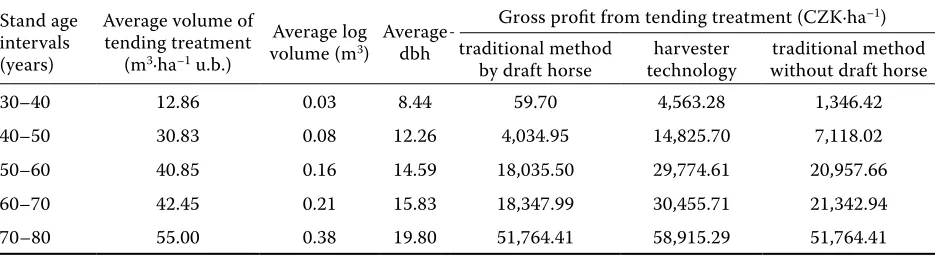
112,233 CZK·ha–1 per tending treatment. Table 1
shows a summary of the average economic eff ec-tiveness of tending treatments in ten-year intervals of stand age. Th e table also clearly shows that, apart from the technologies used, the key parameters that determine the eff ectiveness of tending treatments in-cluded age of the stand, volume of the harvesting op-eration and the average log volume of harvested trees. With regard to the selected logging technology, the total working costs (costs of logging of 1 m3
wood volume) were the primary parameter that fundamentally infl uenced the economic eff ective-ness of tending. Th e per unit production costs are defi nitely the lowest in the harvester technology (Table 2). Th is diff erence was greater in a lower log volume of the stand (up to 0.29), where the dif-ference from the traditional method was the most distinct (350 CZK·m–3). Th e comparison of
har-vester technology and traditional method without draught horse showed a diff erence of 250 CZK·m–3.
In log volumes over 0.29, the diff erences in unit production costs between individual technologies were less distinct, varying between 130 CZK·m–3
and 150 CZK·m–3 (see Table 2). Th ese unit costs
were substantially refl ected in the amount of gross profi t of the tending treatments. Th e tending treat-ment performed by harvester technology was al-ways accompanied by the highest profi t, with the diff erences from the other technologies being sta-tistically relevant (0.05 signifi cance level).
Th e signifi cance of unit costs is also shown in the amount of gross profi t recalculated to the unit volume of harvested timber, which, in 73 evaluated tending treatments, varied between –30 CZK·m–3 and 1,130
CZK·m–3. A comparison of the economic eff
[image:3.595.64.532.611.739.2]ective-ness of the assessed harvesting technologies in rela-tion to stand age (Fig. 1) was also interesting. Th e re-sult shows that the application of traditional method
Table 1. Economic eff ectiveness (CZK·ha–1) of tending treatments by harvesting technology and depending on stand age
Stand age intervals (years)
Average volume of tending treatment
(m3·ha–1 u.b.)
Average log volume (m3)
Average dbh
Gross profi t from tending treatment (CZK·ha–1)
traditional method by draft horse
harvester technology
traditional method without draft horse
30–40 12.86 0.03 8.44 59.70 4,563.28 1,346.42
40–50 30.83 0.08 12.26 4,034.95 14,825.70 7,118.02
50–60 40.85 0.16 14.59 18,035.50 29,774.61 20,957.66
60–70 42.45 0.21 15.83 18,347.99 30,455.71 21,342.94
70–80 55.00 0.38 19.80 51,764.41 58,915.29 51,764.41
in stands of the age between 20 and 30 years brought about the worst economic results. Th e average
eco-nomic loss in this period amounted to 6.79 CZK·m–3.
Th e subsequent age brackets provided economic profi t, while the application of harvester technology brought about the best results. However, the diff er-ence between the technologies being used decreases with the increasing age of the stand.
Th ere are two ways in which the average log vol-ume or changes thereof are refl ected in the cal-culation of the economic eff ectiveness of tending treatments. A positive correlation can be inferred between an increase in the average log volume and the selling price of harvested wood mass, which is primarily related to its assortment. On the con-trary, a negative correlation exists between an in-crease in the average log volume and a dein-crease of unit costs of harvesting as well as skidding.
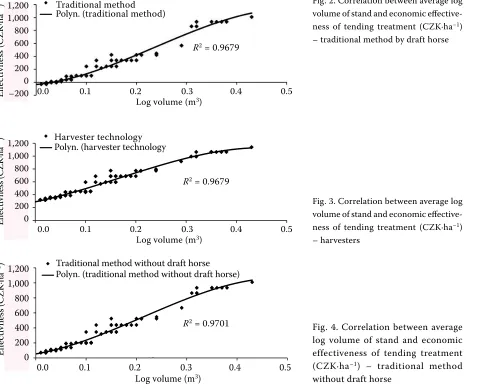
Th e resulting dependence between the average log volume of stand and economic eff ectiveness of tending is very tight (determination coeffi cient between 0.96 and 0.97) and applies to all the tech-nologies evaluated (Figs. 2–4).
A comparison of balanced values between the technologies used shows a decrease in the diff er-ences in the attained gross profi t per tending treat-ment with an increase in the average log volume of harvested trees, similarly like with the stand age.
[image:4.595.64.539.74.350.2]Th e volume of harvested timber is a very impor-tant parameter aff ecting the economic eff ectiveness of tending. It is closely related to the stand age and to the applied silvicultural procedure. For all the tech-nologies, the analyses performed have confi rmed a tight positive correlation (determination coeffi cient between 0.65 and 0.83) between the harvested volume and the economic eff ectiveness of tending, expressed
Table 2. Production costs on log volume by harvesting technology and labor operation in CZK·m–3
Harvester Traditional method
by draft horse
Traditional method
without draft horse Remarks
< 0.29 0.30–1.00 1 > < 0.29 0.30–1.00 1 > < 0.29 0.30–1.00 1 >
400 180 140 400 180 140 OCS harvesting
100 0 0 0 0 0 S-HR horse
115 110 100 130 110 100 GWT HR-RL
185 175 160 185 175 160 OCS manipulation
440 355 235
harvester
429 340 258
460 325 250
428 305 268
539 320 270
560 236 248
230 230
348 249
319 278
357
476 313.5 254 800 465 400 715 465 400 arithmetical mean
450 340 250 800 470 400 700 470 400 suggested mean
OCS – one-man chainsaw, S-HR – from stump to hauling road, GWT HR-RL – general-purpose wheeled tractor from hauling road to roadside landing
Fig. 1. Economic eff ectiveness of
tending treatments (CZK·m–3) by
harvesting technology and depend-ing on stand age
E
ff
ec
ti
v
n
es
s
(C
Z
K
·m
–
3)
Stand age interval 400
600 800 1,000 1,200
-200 0 200 400 600 800 1,000 1,200
30-40 40-50 50-60 60-70 70-80
30–40 40–50 50–60 60–70 70–80
1,200
1,000
800
600
400
200
0
[image:4.595.66.404.630.758.2]by gross profi t from a single tending treatment from
the area of one hectare (Figs. 5–7). However, the search for a relationship between the volume of the harvesting (tending) operation and gross profi t per m3 shows that
this correlation is still positive, but the relationship is
less conclusive (determination coeffi cient of 0.29).
DISCUSION
Tending treatments have a signifi cant impact on further growth and development of forest stands, af-fecting their production, their diameter and height structure, and their stability. Generally, the tending of forest stands is triggered by the economic require-ments for maximizing and securing the volume and value of production (P et al. 2009). Th e eco-nomic eff ectiveness of tending is based on an in-creased volume or value of production of the main stand, and therefore the tending of stands is often seen, in economic terms, as an investment. Th e pos-sibility of increasing the volume of production of for-est stands through tending has been discussed for
a long time, and was virtually the fi rst fundamental goal of tending (W 2007). However, today researchers see this contribution either as relatively minor (P 2005) or even entirely insignifi cant (S-V 1986; K 1988; C 1997). Even so, the resulting changes in the stand structure brought about by tending have an indisput-able impact on the production value of the stands. While accepting insignifi cant positive changes in the production volume of the main stand, the value of production and economic eff ectiveness of each tending treatment are essential for the general eco-nomic profi tability of stand tending. Its fundamental requirement is the existence of a market with thinner timber (W 2007). However, such a market is subjected to changes over time caused by fl uctua-tions of price as well as demand. Th e performed anal-yses, which confi rmed the considerable economic ef-fectiveness of tending treatments, were based on the assumption that such a market exists, and enables the sale of the entire wood mass harvested by thinning. However, while largely holding true at present (2010), this assumption need not always be fulfi lled. In
ad-Fig. 2. Correlation between average log volume of stand and economic eff ective-ness of tending treatment (CZK·ha–1) – traditional method by draft horse
Fig. 3. Correlation between average log volume of stand and economic eff ective-ness of tending treatment (CZK·ha–1) – harvesters
Fig. 4. Correlation between average log volume of stand and economic effectiveness of tending treatment (CZK·ha–1) – traditional method
without draft horse
1,200 1,000 800 600 400 200 0 –200 E ff ec ti v n es s (C Z K ·h a – 1)
0.1 0.2 0.3 0.4 0.5
Log volume (m3) 0.0
R² = 0.9679 400 600 800 1,000 1,200 Harvester Technology
Polyg. (Harvester Technology) R² = 0.9679
0 200 400 600 800 1,000 1,200 Harvester Technology
Polyg. (Harvester Technology) 1,200 1,000 800 600 400 200 0 E ff ec ti vn es s (C Z K ·h a – 1)
0.1 0.2 0.3 0.4 0.5
Log volume (m3) 0.0
R² = 0.9701
400 600 800 1,000 1,200
R² = 0.9701
0 200 400 600 800 1,000 1,200
Traditional method without draft horse Polyg. (Traditional method without draft horse) 1,200 1,000 800 600 400 200 0 E ff ec ti v n es s (C Z K ·h a – 1)
0.1 0.2 0.3 0.4 0.5
Log volume (m3)
0.0
R2 = 0.9701
R2 = 0.9679
R2 = 0.9679
Traditional method without draft horse
Polyg. (Traditional method without draft horse) Harvester technology
Polyn. (harvester technology
Traditional method without draft horse Polyn. (traditional method without draft horse) Traditional method
Polyn. (traditional method)
Traditional method without draft horse
Polyg. (Traditional method without draft horse) Traditional method without draft horse
[image:5.595.69.547.60.451.2]dition, economic calculations have unambiguously proved that the main factor that has had a
fundamen-tal impact on the economic eff ectiveness of forest stands is the introduction of harvester technologies. Th eir undisputed superiority over the “traditional” technologies is caused by signifi cantly lower produc-tion costs based on their much higher productivity. While this development is quite new in the Czech Republic, Scandinavia saw such economic results as early as 20 years ago (W 2007).
Even so, the “traditional” technologies have yielded a positive gross profi t in each analysed case, except for some tending treatments of young stands from 30 to 40 years of age using a combination of horse and tractor skidding. Th e economic eff ectiveness of tending treatments was positively aff ected by the increase of the stand age and the related higher log volume of harvested trees. Th e total volume of wood
harvested in a single treatment was also an important factor. Still, it can be observed that, under the condi-tions considered in this model calculation, the tend-ing treatments in spruce stands are already profi table from 30 years of age. Generally, this fi nding corre-sponds to the results of economic analyses from Ger-many (M, R 2008).
CONCLUSION
Th e paper provides a model evaluation of the economic eff ectiveness of tending treatments in spruce stands. Th is eff ectiveness is determined by the amount of gross profi t from individual tend-ing harvests, both per square and volume unit. Th e results of the performed economic calculations have confi rmed how fundamentally important the
140,000 120,000 100,000 80,000 60,000 40,000 20,000 0
–20,000 0 20 40 60 80 100 120
20 40 60 80 100 120
0
20 40 60 80 100 120
0 120,000
100,000
80,000
60,000
40,000
20,000
0
–20,000
120,000
100,000
80,000
60,000
40,000
20,000
0
–20,000
E
ff
ec
ti
v
n
es
s
(C
Z
K
·h
a
–
1)
Volume of tending treatment (m3·ha–1)
E
ff
ec
ti
v
n
es
s
(C
Z
K
·h
a
–
1)
Volume of tending treatment (m3·ha–1)
E
ff
ec
ti
v
n
es
s
(C
Z
K
·h
a
–
1)
Volume of tending treatment (m3·ha–1)
Harvester technology Polyn. (harvester technology
Traditional method Polyn. (traditional method) Traditional method without draft horse
Polyg. (Traditional method without draft horse)
Traditional method without draft horse Polyn. (traditional method without draft horse) Traditional method without draft horse
Polyg. (Traditional method without draft horse)
Traditional method without draft horse
Polyg. (Traditional method without draft horse)
R2 = 0.8314
R2 = 0.7127
R2 = 0.6495
Fig. 5. Dependence of economic ef-fectiveness of tending (CZK·ha–1) on volume of timber harvested in one tending treatment – harvesters
Fig. 6. Dependence of economic eff ectiveness of tending (CZK·ha–1) on volume of timber harvested in one tending treatment – traditional method without draft horse
[image:6.595.70.495.51.508.2]used harvesting technologies are for the economic
profi tability of spruce stand tending. Th e greatest positive impact of harvester technologies was seen in young stands that yielded over double the gross profi t from “traditional” harvesting and hauling technologies. Th e economic profi tability of tending treatments, even in relatively young stands, com-pels us to change the rooted schemes of thinking that see such treatments as imperative in terms of silviculture, but unprofi table in terms of economy.
R e f e r e n c e s
A E. (1968): Th eory of Forest Production. Bratislava, Príroda: 485. (in Slovak).
B J. (1917): Cultivation of spruce stands accord-ing to the method of Josef Bohdanecký. Manuscript 1917, Depositum Bohdanecký, sign. A-1-20 (in Czech). ČSÚ (2008): Timber prices according to the Czech
Statisti-cal Offi ce (average for 2008). Lesnická práce. (in Czech). C H. (1835): Anweisung zum Waldbau.
Dresden-Leipzig, Arnold: 393.
Czech Government (2008): Resolution of the Government of the Czech Republic on 1 October 2008 No. 1221 on the National Forestry Programme for the period until 2013 (in Czech).
H G.L. (1814): Lehrbuch für Förster und die es werden wollen. Wien, Kaulfuss, Armbruster: 316.
C L. (1997): Ecology of Forest Stand Tending, Norway Spruce, Scotch Pine, Pedunculate Oak, Stand Environment – Tree Growth – Stand Production. Opočno, VÚLHM: 277. (in Czech).
K F. (1961): Volume table for spruce. Lesnictví-Forestry, 7: 275–304. (in Czech).
K H. (1988): Waldwachstumslehre. Hamburg, Berlin, Verlag Paul Parey: 374.
M V., D J. (2007): Harvesting Technology and the Impact on Forests. Praha, ČZU: 84. (in Czech).
M B., R U. (2008): A concept for the calculation of fi nancial losses when changing the forest management strategy. Forest Policy and Economics, 10: 98–117.
P J. (1956): Economic Evaluation of Th inning. Strnady, VÚLH: 110. (in Czech).
P J., C L. (1988): Models of Forest tending. Lesnický průvodce 4. Strnady, VÚLHM: 82. (in Czech).
P R., P J. (1991): Czech-Slovak system of volume tables of trees. Lesnický Časopis, 37: 49–56. (in Slovak).
P R., H J., M J. (1996): Assortments Tables of Trees. Bratislava, Slovak Academic Press: 249. (in Slovak). P Z., V S., P V., R J., Š
I., M M., K J., K I., M V., T M., D J., Z V., B L., B M., S J. (2009): Silviculture III. – Practical Methods of Silviculture. Kostelec nad Černými lesy, Lesnická práce: 860. (in Czech).
P H. (2005): Stand density and growth of Norway spruce (Picea abies (L.) Karst.) and European beech (Fagus
sylvatica L.): evidence from long-term experimental plots.
European Journal of Forest Research, 124: 193–205.
P K. (2006): Ecomonic eff ectiveness of sustainable forest management. Journal of Forest Science, 52: 427–437.
P K., S M., Š L. (2010): Methodology for Determining the Optimal Number and Intensity of Th in-ning Interventions. Praha, ČZU: 28. (in Czech).
P K., Š L., B J. (2008): Evaluation of the eff ectiveness in forest management. Lesnická práce,
87: 131. (in Czech).
S-V H. (1986): Die Fichte. Band II/1. Wachstum, Züchtung, Boden, Umwelt, Holz. Hamburg, Berlin, Verlag Paul Parey.
S M. (1983): Th e occurrence of snow and wind dam-age in diff erently thinned spruce stands. Práce VÚLHM,
62: 151–178. (in Czech).
S M. (1987): Resistance of young spruce stands to snow and wind damage in dependence on thinning. Com-munications Institute Forestalis Čechosloveniae, 15: 75–86.
S M., N J. (2006): Silvicultural measures to increase the mechanical stability of pure secondary Nor-way spruce stands before conversion. Forest Ecology and Management, 224: 252–257.
S M., N J. (2007): Growth, structure and static stability of spruce stands with diff erent tending regime. In: Proceeding of the Original Scientifi c Papers and Mono-graphs. Forestalia 3, Kostelec nad Černými lesy, Lesnická práce: 144. (in Czech).
Š Š. (2000): Dendrometry. [Textbook.] Zvolen, Tech-nická univerzita ve Zvoleně: 399. (in Slovak).
V M. (1962): Th inning. Praha, Státní zemědělské na-kladatelství: 301. (in Czech).
W C. (2007): Th inning of Norway spruce. [PhD. Th esis.] Acta Universitatis Agriculturae Sueciae, 29: 116.
Received for publication October 11, 2010 Accepted after corrections March 1, 2011
Corresponding author:
Ing. P Z, Czech University of Life Sciences in Prague, Faculty of Forestry and Wood Sciences, Kamýcka 1176, 165 21 Praha 6, Czech Republic