
1150
http://dx.doi.org/10.1107/S2056989016010641 Acta Cryst.(2016). E72, 1150–1152research communications
Received 4 June 2016 Accepted 30 June 2016
Edited by G. Smith, Queensland University of Technology, Australia
Keywords:crystal structure; isoxazolidine; hydrogen bonding.
CCDC reference:1489217
Supporting information:this article has supporting information at journals.iucr.org/e
Crystal structure of 2-isopropyl-5,7
000-dimethyl-1
000,3
000,3a’,6
000,8a’,8b’-hexahydrospiro[cyclohexane-1,6
000-furo[3,4-
d
]imidazo[1,5-
b
]isoxazol]-8
000(7
000H
)-one
Heithem Abda,a* Khaireddine Ezzayani,bKaiss Aouadi,aTaha Guerfel,cSebastien Vidald and Moncef Msaddeka
aUniversity of Monastir, Heterocyclic Chemistry Laboratory, Products, Natural and Reactivity, Faculty of Sciences of
Monastir, Avenue of the Environment, 5000 Monastir, Tunisia,bUniversity of Monastir, Laboratory of Physical Chemistry
of Materials, Faculty of Sciences of Monastir, Avenue of the Environment, 5019 Monastir, Tunisia,cLaboratory of
Electrochemistry, Materials and Environment, Kairouan University, 3100 Kairouan, Tunisia, anddUniversity of Lyon
CNRS, Institute of Chemistry and Biochemistry and Molecular Supramolecular, UMR 5246, Laboratoire de Chimie Organique 2-Glycochemistry, Curien Building, 43 Boulevard du 11 Novembre 1918, F-69622 Villeurbanne, France. *Correspondence e-mail: [email protected]
In the title compound, C17H28N2O3, the isoxazolidine ring adopts an envelope
conformation with the O atom deviating from the mean plane of the other four ring atoms by 0.617 (1) A˚ . In the crystal, molecules are linkedvia weak C— H O hydrogen bonds, forming chains which extend along theb-axis direction.
1. Chemical context
The 1,3-dipolar cycloaddition of nitrones to alkenes has been applied to produce substituted isoxazolidines (Gothelf & Jørgensen, 1998). These compounds can be converted into
-amino alcohols (Padwaet al., 2002),-lactams (Hanselmann
et al., 2003) and -amino acids (Aouadi et al., 2006), by reductive cleavage of the N—O bond. Consequently, isoxazolidines have been used as key intermediates for the synthesis of various natural products or antifungal, inflammatory, mycobacterial, tuberculosis and anti-viral agents. The previously mentioned importance of the isoxazolidine substructure led us to investigate the cyclo-addition of chiral nitrone [(5(S),6(S),9(R )-6-isopropyl-4,9-dimethyl-3-oxo-1,4-diazaspiro[4.5]dec-1-ene-1-oxide] with 2,5-dihydrofuran. The present work reports the synthesis and the X-ray crystallographic study of this substituted isoxazol-idine, the title compound, C17H28N2O3, (I).
2. Structural commentary
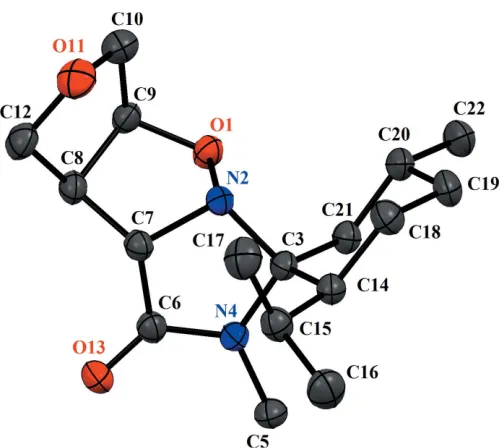
In the title compound (I), the asymmetric unit comprises a single molecule (Fig. 1). Each molecule has six stereogenic centres (Abdaet al., 2014) although the absolute configuration
for the molecule was not determined definitively in this analysis. The isoxazolidine ring (O1/N2/C7–C9) adopts an envelope conformation with atom O1 displaced by 0.617 (1) A˚ from the mean plane through atoms N2/C7–C9. The N—O bond lengths of the isoxazolidine rings O1—N2 = 1.482 (2) A˚ , close to values reported for related compounds (Lohet al., 2010; Molanderet al., 2013).
3. Supramolecular features
In the crystal, the molecules are linkedvianon-classical weak C5—H52 O13i hydrogen bonds, forming zigzag chains, which extend along theb-axis direction (Table 1 and Fig. 2).
4. Synthesis and crystallization
In a Biotage Initiator 10 ml vial, nitrone [(5(S),6(S),9(R )-6- isopropyl-4,9-dimethyl-3-oxo-1,4-diazaspiro[4.5]dec-1-ene-1-oxide] (1 eq.) in anhydrous toluene (4 ml) was introduced.
research communications
Acta Cryst.(2016). E72, 1150–1152 Abdaet al. C
17H28N2O3
1151
Figure 1 [image:2.610.46.298.66.290.2]The molecular conformation in the molecules of (I), showing the atom labelling. Displacement ellipsoids are drawn at the 35% probability level. H atoms have been omitted for clarity.
Table 1
Hydrogen-bond geometry (A˚ ,).
D—H A D—H H A D A D—H A
C5—H52 O13i 0.97 2.57 3.536 (3) 172
Symmetry code: (i)xþ1;y1 2;zþ
[image:2.610.112.496.428.727.2]1 2.
Figure 2
The vial was flushed with argon and 2,5-dihydrofuran (3 eq,) was added. The vial was sealed with a septum cap and was irradiated with microwaves (temperature: 373 K) (Fig. 3). TLC monitoring (EtOAc/PE 5/5) showed full conversion after 2 h. After the crude mixture was concentrated and purified by flash column chromatography (silica gel, EtOAc/PE 5/5), the desired isoxazolidine (I) was obtained (m.p. = 410–411 K).
5. Refinement
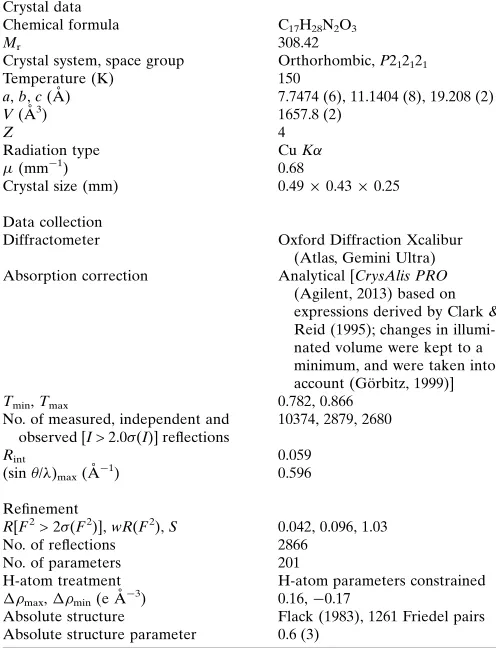
Crystal data, data collection and structure refinement details are summarized in Table 2. The H atoms were located in a difference map, but these were repositioned geometrically and were initially refined with soft restraints on the bond lengths and angles to regularize their geometry (C—H in the range 0.93–0.98 A˚ ) andUiso(H) (in the range 1.2–1.5 timesUeqof the
parent atom). These were subsequently refined with riding constraints (Cooperet al., 2010). Although not definitive for this chiral structure, the Flack (1983) absolute structure parameter obtained [0.60 (3) for 1261 Friedel pairs] gave C3(S), C7(S), C8(S), C9(S), C14(S), C20(R) assignments for the six arbitrarily named chiral centres in the molecule. The inverted structure gave a similarly high Flack factor .
Acknowledgements
The authors are grateful to the Ministry of Higher Education and Scientific Research of Tunisia for financial support.
References
Abda, H., Aouadi, K., Perrin, L., Msaddek, M., Praly, J.-P. & Vidal, S. (2014).Eur. J. Org. Chem.pp. 6017–6024.
Agilent (2013). CrysAlis PRO. Agilent Technologies, Yarnton, England.
Altomare, A., Burla, M. C., Camalli, M., Cascarano, G. L., Giacovazzo, C., Guagliardi, A., Moliterni, A. G. G., Polidori, G. & Spagna, R. (1999).J. Appl. Cryst.32, 115–119.
Aouadi, K., Vidal, S., Msaddek, M. & Praly, J.-P. (2006).Synlett,2006, 3299–3303.
Betteridge, P. W., Carruthers, J. R., Cooper, R. I., Prout, K. & Watkin, D. J. (2003).J. Appl. Cryst.36, 1487.
Clark, R. C. & Reid, J. S. (1995).Acta Cryst.A51, 887–897.
Cooper, R. I., Thompson, A. L. & Watkin, D. J. (2010).J. Appl. Cryst.
43, 1100–1107.
Flack, H. D. (1983).Acta Cryst.A39, 876–881. Go¨rbitz, C. H. (1999).Acta Cryst.B55, 1090–1098.
Gothelf, K. V. & Jørgensen, K. A. (1998).Chem. Rev.98, 863–910. Hanselmann, R., Zhou, J., Ma, P. & Confalone, P. N. (2003).J. Org.
Chem.68, 8739–8741.
Larson, A. C. (1970).Crystallographic Computing, edited by F. R. Ahmed, pp. 291–294. Copenhagen: Munksgaard.
Loh, B., Vozzolo, L., Mok, B. J., Lee, C. C., Fitzmaurice, R. J., Caddick, S. & Fassati, A. (2010).Chem. Biol. Drug Des.75, 461–474. Molander, G. A., Cavalcanti, L. N. & Garcı´a-Garcı´a, C. (2013).J. Org.
Chem.78, 6427–6439.
Padwa, A. & Pearson, W. H. (2002). Editors.Synthetic Applications of 1,3-Dipolar Cycloaddition Chemistry Toward Heterocycles and Natural Products, Vol. 59, pp. 1–81. Chichester: Wiley.
Prince, E. (1982). InMathematical Techniques in Crystallography and Materials Science. New York: Springer-Verlag.
Watkin, D. (1994).Acta Cryst.A50, 411–437.
Watkin, D. J., Prout, C. K. & Pearce, L. J. (1996). CAMERON. Chemical Crystallography Laboratory, Oxford, England.
1152
Abdaet al. C17H28N2O3 Acta Cryst.(2016). E72, 1150–1152
[image:3.610.46.297.73.166.2]research communications
Table 2
Experimental details.
Crystal data
Chemical formula C17H28N2O3
Mr 308.42
Crystal system, space group Orthorhombic,P212121
Temperature (K) 150
a,b,c(A˚ ) 7.7474 (6), 11.1404 (8), 19.208 (2)
V(A˚3) 1657.8 (2)
Z 4
Radiation type CuK
(mm1) 0.68
Crystal size (mm) 0.490.430.25
Data collection
Diffractometer Oxford Diffraction Xcalibur
(Atlas, Gemini Ultra) Absorption correction Analytical [CrysAlis PRO
(Agilent, 2013) based on expressions derived by Clark & Reid (1995); changes in illumi-nated volume were kept to a minimum, and were taken into account (Go¨rbitz, 1999)]
Tmin,Tmax 0.782, 0.866
No. of measured, independent and observed [I> 2.0(I)] reflections
10374, 2879, 2680
Rint 0.059
(sin/)max(A˚
1) 0.596
Refinement R[F2> 2(F2
)],wR(F2),S 0.042, 0.096, 1.03
No. of reflections 2866
No. of parameters 201
H-atom treatment H-atom parameters constrained
max,min(e A˚
3
) 0.16,0.17
Absolute structure Flack (1983), 1261 Friedel pairs Absolute structure parameter 0.6 (3)
Computer programs:CrysAlis PRO (Agilent, 2013),SIR97 (Altomareet al., 1999),
CRYSTALS(Betteridgeet al., 2003),CAMERON(Watkinet al., 1996), Larson (1970), Prince (1982) and Watkin (1994).
Figure 3
[image:3.610.313.561.97.421.2]supporting information
sup-1
Acta Cryst. (2016). E72, 1150-1152
supporting information
Acta Cryst. (2016). E72, 1150-1152 [https://doi.org/10.1107/S2056989016010641]
Crystal structure of 2-isopropyl-5,7
′
-dimethyl-1
′
,3
′
,3a
′
,6
′
,8a
′
,8b
′
-hexahydro-spiro[cyclohexane-1,6
′
-furo[3,4-
d
]imidazo[1,5-
b
]isoxazol]-8
′
(7
′
H
)-one
Heithem Abda, Khaireddine Ezzayani, Kaiss Aouadi, Taha Guerfel, Sebastien Vidal and Moncef
Msaddek
Computing details
Data collection: CrysAlis PRO (Agilent, 2013); cell refinement: CrysAlis PRO (Agilent, 2013); data reduction: CrysAlis
PRO (Agilent, 2013); program(s) used to solve structure: SIR97 (Altomare et al., 1999); program(s) used to refine
structure: CRYSTALS (Betteridge et al., 2003); molecular graphics: CAMERON (Watkin et al., 1996); software used to
prepare material for publication: CRYSTALS (Betteridge et al., 2003).
(I)
Crystal data
C17H28N2O3
Mr = 308.42
Orthorhombic, P212121 Hall symbol: P 2ac 2ab a = 7.7474 (6) Å b = 11.1404 (8) Å c = 19.208 (2) Å V = 1657.8 (2) Å3
Z = 4
F(000) = 672 Dx = 1.236 Mg m−3
Cu Kα radiation, λ = 1.5418 Å Cell parameters from 5548 reflections θ = 4.5–66.7°
µ = 0.68 mm−1
T = 150 K Block, colorless 0.49 × 0.43 × 0.25 mm
Data collection
Oxford Diffraction Xcalibur (Atlas, Gemini Ultra)
diffractometer
Radiation source: Enhance Ultra (Cu) X-ray source
Mirror monochromator
Detector resolution: 10.4678 pixels mm-1
ω scans
Absorption correction: analytical
[CrysAlis PRO (Agilent, 2013) based on expressions derived by Clark & Reid (1995); changes in illuminated volume were kept to a minimum, and were taken into account (Görbitz, 1999)]
Tmin = 0.782, Tmax = 0.866 10374 measured reflections 2879 independent reflections 2680 reflections with I > 2.0σ(I) Rint = 0.059
θmax = 66.8°, θmin = 11°
supporting information
sup-2
Acta Cryst. (2016). E72, 1150-1152
Refinement
Refinement on F2 Least-squares matrix: full R[F2 > 2σ(F2)] = 0.042
wR(F2) = 0.096
S = 1.03 2866 reflections 201 parameters 0 restraints
Primary atom site location: structure-invariant direct methods
Hydrogen site location: difference Fourier map H-atom parameters constrained
Method, part 1, Chebychev polynomial, (Watkin, 1994: Prince, 1982) [weight] = 1.0/[A0*T0(x) + A1*T1(x) ··· + An-1]*Tn-1(x)] where Ai are the Chebychev coefficients listed below and x = F /Fmax Method = Robust Weighting (Prince, 1982) W = [weight] * [1-(deltaF/6*sigmaF)2]2 A
i are: 0.124E + 04 0.195E + 04 0.105E + 04 304.
(Δ/σ)max = 0.0002 Δρmax = 0.16 e Å−3 Δρmin = −0.17 e Å−3
Extinction correction: Larson (1970), Equation 22
Extinction coefficient: 74 (4)
Absolute structure: Flack (1983), 1261 Friedel pairs
Absolute structure parameter: 0.6 (3)
Special details
Experimental. The crystal was placed in the cold stream of an Oxford Cryosystems open-flow nitrogen cryostat with a
nominal stability of 0.1K.
Refinement. The analytical numeric absorption correction using a multi-faceted crystal model is based on expressions
derived by Clark & Reid (1995). The relatively large ratio of minimum to maximum corrections applied in the multi-scan process (1:nnn) reflect changes in the illuminated volume of the crystal. Changes in illuminated volume were kept to a minimum, and were taken into account (Görbitz, 1999).
Fractional atomic coordinates and isotropic or equivalent isotropic displacement parameters (Å2)
x y z Uiso*/Ueq
supporting information
sup-3
Acta Cryst. (2016). E72, 1150-1152
H71 0.1551 0.6415 0.3518 0.0307* O13 0.4052 (2) 0.63710 (15) 0.24780 (8) 0.0357 C14 0.0307 (3) 0.3616 (2) 0.32135 (11) 0.0274 C15 −0.0806 (3) 0.4686 (2) 0.29604 (12) 0.0310 C16 −0.2129 (4) 0.4250 (3) 0.24307 (14) 0.0435 H162 −0.2845 0.4937 0.2288 0.0654* H163 −0.1594 0.3903 0.2017 0.0653* H161 −0.2850 0.3629 0.2652 0.0658* C17 −0.1731 (4) 0.5369 (2) 0.35403 (14) 0.0406 H171 −0.2186 0.6122 0.3336 0.0606* H173 −0.2672 0.4908 0.3721 0.0604* H172 −0.0979 0.5542 0.3931 0.0602* H151 −0.0031 0.5263 0.2711 0.0372* C18 −0.0536 (3) 0.2924 (2) 0.38122 (13) 0.0346 C19 0.0460 (4) 0.1795 (2) 0.40142 (14) 0.0379 C20 0.2339 (3) 0.2100 (2) 0.41916 (12) 0.0327 C21 0.3154 (3) 0.27553 (19) 0.35817 (12) 0.0288 H211 0.3096 0.2212 0.3171 0.0339* H212 0.4342 0.2949 0.3684 0.0350* C22 0.3387 (4) 0.0976 (2) 0.43654 (13) 0.0429 H222 0.4583 0.1173 0.4469 0.0645* H221 0.3358 0.0416 0.3963 0.0629* H223 0.2912 0.0549 0.4787 0.0629* H201 0.2358 0.2644 0.4599 0.0385* H192 0.0469 0.1237 0.3607 0.0463* H191 −0.0113 0.1390 0.4418 0.0451* H182 −0.1724 0.2721 0.3658 0.0423* H181 −0.0606 0.3469 0.4217 0.0410* H141 0.0390 0.3055 0.2810 0.0325*
Atomic displacement parameters (Å2)
U11 U22 U33 U12 U13 U23
supporting information
sup-4
Acta Cryst. (2016). E72, 1150-1152
C16 0.0430 (14) 0.0423 (14) 0.0453 (14) −0.0056 (13) −0.0109 (13) 0.0027 (12) C17 0.0370 (13) 0.0368 (13) 0.0481 (15) 0.0038 (12) 0.0041 (12) −0.0022 (11) C18 0.0371 (13) 0.0322 (13) 0.0344 (12) −0.0047 (11) 0.0039 (11) 0.0025 (10) C19 0.0533 (16) 0.0238 (12) 0.0365 (13) −0.0085 (11) 0.0037 (12) 0.0039 (10) C20 0.0495 (15) 0.0209 (11) 0.0278 (11) −0.0015 (11) −0.0011 (11) −0.0001 (9) C21 0.0360 (12) 0.0211 (11) 0.0292 (11) 0.0013 (10) 0.0009 (10) −0.0008 (9) C22 0.0680 (19) 0.0239 (12) 0.0369 (13) 0.0025 (12) −0.0068 (13) 0.0040 (10)
Geometric parameters (Å, º)
O1—N2 1.482 (2) C14—C15 1.550 (3) O1—C9 1.424 (3) C14—C18 1.531 (3) N2—C3 1.493 (3) C14—H141 0.997 N2—C7 1.489 (3) C15—C16 1.524 (3) C3—N4 1.472 (3) C15—C17 1.527 (3) C3—C14 1.552 (3) C15—H151 1.001 C3—C21 1.531 (3) C16—H162 0.983 N4—C5 1.448 (3) C16—H163 0.977 N4—C6 1.349 (3) C16—H161 0.986 C5—H51 0.969 C17—H171 0.991 C5—H53 0.956 C17—H173 0.957 C5—H52 0.974 C17—H172 0.970 C6—C7 1.509 (3) C18—C19 1.526 (4) C6—O13 1.226 (3) C18—H182 0.992 C7—C8 1.523 (3) C18—H181 0.988 C7—H71 0.959 C19—C20 1.533 (4) C8—C9 1.536 (3) C19—H192 0.999 C8—C12 1.513 (3) C19—H191 1.001 C8—H81 0.957 C20—C21 1.518 (3) C9—C10 1.521 (3) C20—C22 1.529 (3) C9—H91 0.980 C20—H201 0.990 C10—O11 1.433 (3) C21—H211 0.996 C10—H102 0.989 C21—H212 0.966 C10—H101 0.983 C22—H222 0.972 O11—C12 1.423 (3) C22—H221 0.995 C12—H122 0.985 C22—H223 1.009 C12—H121 0.981
supporting information
sup-5
Acta Cryst. (2016). E72, 1150-1152
C3—N4—C5 123.70 (17) C17—C15—H151 108.1 C3—N4—C6 113.29 (17) C15—C16—H162 108.5 C5—N4—C6 122.47 (19) C15—C16—H163 112.6 N4—C5—H51 109.8 H162—C16—H163 108.7 N4—C5—H53 110.8 C15—C16—H161 108.4 H51—C5—H53 106.1 H162—C16—H161 110.3 N4—C5—H52 110.4 H163—C16—H161 108.3 H51—C5—H52 109.2 C15—C17—H171 107.4 H53—C5—H52 110.4 C15—C17—H173 110.8 N4—C6—C7 107.39 (18) H171—C17—H173 109.1 N4—C6—O13 126.4 (2) C15—C17—H172 112.4 C7—C6—O13 126.2 (2) H171—C17—H172 110.5 C6—C7—N2 105.48 (16) H173—C17—H172 106.5 C6—C7—C8 116.15 (19) C14—C18—C19 113.0 (2) N2—C7—C8 106.89 (17) C14—C18—H182 106.7 C6—C7—H71 108.3 C19—C18—H182 110.9 N2—C7—H71 108.7 C14—C18—H181 107.8 C8—C7—H71 111.0 C19—C18—H181 109.5 C7—C8—C9 101.88 (16) H182—C18—H181 108.9 C7—C8—C12 114.2 (2) C18—C19—C20 110.74 (19) C9—C8—C12 102.57 (18) C18—C19—H192 108.4 C7—C8—H81 109.3 C20—C19—H192 107.8 C9—C8—H81 114.4 C18—C19—H191 110.1 C12—C8—H81 113.9 C20—C19—H191 110.4 C8—C9—O1 105.88 (16) H192—C19—H191 109.2 C8—C9—C10 104.18 (18) C19—C20—C21 109.3 (2) O1—C9—C10 114.75 (19) C19—C20—C22 111.8 (2) C8—C9—H91 111.5 C21—C20—C22 110.0 (2) O1—C9—H91 109.5 C19—C20—H201 109.0 C10—C9—H91 110.8 C21—C20—H201 108.1 C9—C10—O11 106.84 (18) C22—C20—H201 108.7 C9—C10—H102 110.7 C3—C21—C20 113.52 (19) O11—C10—H102 110.6 C3—C21—H211 107.3 C9—C10—H101 111.5 C20—C21—H211 107.5 O11—C10—H101 108.3 C3—C21—H212 108.2 H102—C10—H101 108.9 C20—C21—H212 110.3 C10—O11—C12 105.74 (19) H211—C21—H212 109.9 C8—C12—O11 104.57 (19) C20—C22—H222 111.5 C8—C12—H122 111.7 C20—C22—H221 109.4 O11—C12—H122 112.4 H222—C22—H221 108.8 C8—C12—H121 111.6 C20—C22—H223 111.6 O11—C12—H121 109.7 H222—C22—H223 106.8 H122—C12—H121 107.0 H221—C22—H223 108.7 C3—C14—C15 115.54 (18)
supporting information
sup-6
Acta Cryst. (2016). E72, 1150-1152
N2—O1—C9—C10 73.5 (2) C14—C3—C21—C20 −57.7 (2) C12—O11—C10—C9 −30.4 (2) O13—C6—C7—N2 −169.1 (2) C10—O11—C12—C8 41.4 (2) O13—C6—C7—C8 −51.0 (3) O1—N2—C3—N4 −88.72 (18) N4—C6—C7—N2 13.2 (2) O1—N2—C3—C14 152.15 (15) N4—C6—C7—C8 131.3 (2) O1—N2—C3—C21 30.7 (2) N2—C7—C8—C9 9.3 (2) C7—N2—C3—N4 18.2 (2) N2—C7—C8—C12 −100.5 (2) C7—N2—C3—C14 −100.94 (18) C6—C7—C8—C9 −108.1 (2) C7—N2—C3—C21 137.64 (18) C6—C7—C8—C12 142.1 (2) O1—N2—C7—C6 91.23 (18) C7—C8—C9—O1 19.2 (2) O1—N2—C7—C8 −32.94 (19) C7—C8—C9—C10 −102.2 (2) C3—N2—C7—C6 −19.4 (2) C12—C8—C9—O1 137.68 (18) C3—N2—C7—C8 −143.56 (17) C12—C8—C9—C10 16.3 (2) C5—N4—C3—N2 177.7 (2) C7—C8—C12—O11 74.2 (2) C5—N4—C3—C14 −64.6 (3) C9—C8—C12—O11 −35.1 (2) C5—N4—C3—C21 56.2 (3) O1—C9—C10—O11 −107.8 (2) C6—N4—C3—N2 −10.6 (3) C8—C9—C10—O11 7.6 (2) C6—N4—C3—C14 107.2 (2) C3—C14—C15—C16 146.3 (2) C6—N4—C3—C21 −132.0 (2) C3—C14—C15—C17 −90.4 (2) C3—N4—C6—O13 −179.3 (2) C18—C14—C15—C16 −84.9 (2) C3—N4—C6—C7 −1.6 (3) C18—C14—C15—C17 38.4 (3) C5—N4—C6—O13 −7.4 (4) C3—C14—C18—C19 −54.8 (3) C5—N4—C6—C7 170.3 (2) C15—C14—C18—C19 174.06 (19) N2—C3—C14—C15 59.5 (2) C14—C18—C19—C20 55.5 (3) N2—C3—C14—C18 −70.2 (2) C18—C19—C20—C21 −55.6 (3) N4—C3—C14—C15 −54.8 (2) C18—C19—C20—C22 −177.5 (2) N4—C3—C14—C18 175.48 (17) C19—C20—C21—C3 58.7 (2) C21—C3—C14—C15 −176.47 (18) C22—C20—C21—C3 −178.24 (19)
Hydrogen-bond geometry (Å, º)
D—H···A D—H H···A D···A D—H···A
C5—H52···O13i 0.97 2.57 3.536 (3) 172
![Crystal structure of 5′′ (4 chlorobenzylidene) 4′ (4 chlorophenyl) 1′ methyltrispiro[acenapthylene 1,2′ pyrrolidine 3′,1′′ cyclohexane 3′′,2′′′ [1,3]dioxane] 2(1H),6′′ dione](data:image/gif;base64,R0lGODlhAQABAIAAAP///wAAACH5BAEAAAAALAAAAAABAAEAAAICRAEAOw==)