Abstract
Aim:Counselling for Depression (CfD) is a person-centred experiential therapy developed for implementation in the Improving Access to Psychological Therapies (IAPT)
programme. Training in this model has been available across England since 2011. This study aims to investigate counselling practitioners’ experiences of learning the CfD model and implementing CfD in practice settings.Method:Participants were recruited by an email sent to the British Association for Counselling and Psychotherapy’s (BACP) CfD Practice Research Network (PRN). Out of the 53 CfD practitioners belonging to BACP’s CfD PRN, 18 participated in this mixed-methods’ piece of research. All 18 participants completed an online questionnaire, and a one-hour follow-up, and semi-structured
interviews were conducted with six of the participants.Results:Descriptive analyses from the online questionnaire indicated a positive experience of CfD training, with practitioners indicating a positive impact on sense of self, practice and skill set. Although a degree of challenge was encountered when training in the CfD model, thematic analyses from the six semi-structured interviews revealed factors contributing to the positives and challenges experienced on the course. Themes also revealed a predominately negative experience of CfD in practice and service settings, although this was service dependent.Conclusions and implications for practice:The findings can inform future recruitment of trainees to CfD training programmes and the training programme itself. They can also be used to achieve greater congruence between training in CfD and the delivery of the model. Future research may need to focus on the service level factors influencing practitioners’ experiences, and whether this experience is specific to the CfD modality in IAPT.
Introduction
Within the Improving Access to Psychological Therapies (IAPT) service and in line with the new revision of the National Institute for Health and Care Excellence guidelines for depression in adults (NICE, 2017), Cognitive Behaviour Therapy (CBT) is
recommended as the front-line psychological therapy for people experiencing mild to moderate depression (NICE 2017 guidelines currently in consultation at time of writing, August 2017). However, four other psychological therapies are approvedby NICE:
Interpersonal Therapy (IPT), Brief Dynamic Interpersonal Therapy (DIT), Couple Therapy for Depression, and Counselling for Depression (CfD) (Department for Health, n.d).
CfD is a form of person-centred experiential therapy (Murphy, 2017). This manualised form of counselling is derived in part from the competences for humanistic psychological therapies (Roth, Hill, & Pilling, 2009) and evidence from person-centred and emotion-focused therapies. CfD aims to target the emotional problems underlying
depression, along with the intrapersonal processes (such as criticism and self-discrepancies), which often maintain depressed mood (Hill, 2011). It is particularly appropriate for people with persistent sub-threshold depressive symptoms or mild to moderate depression where 6 to 10 sessions are recommended over an 8 to 12 week period, and also for more complex or severe presentations with up to 20 sessions recommended as a high intensity therapy (Hill, 2011).
and finally a set of meta-competences. A detailed map and description of the competences as they relate to CfD can be found in Sanders and Hill (2014, pp. 25-27). Training has been delivered since 2011, and the number of funded CfD training places has increased annually (Pearce et al., 2013). Whilst in the period 2012 to 2015 there was a 184% increase in the number of practitioners delivering CfD employed in IAPT (from 123 to 349), CfD practitioners account for only 6% of the high intensity therapist workforce (IAPT, 2016). Although this is the highest representation of non-CBT therapists, it is a low representation in comparison to CBT therapists, which constitute 42% of the IAPT workforce (IAPT, 2016). Furthermore, despite counselling being recommended as a second line treatment for depression by NICE, a recent IAPT report has indicated ‘recovery rates’ for the treatment of depression by CfD and CBT interventions to be comparable (NHS Digital, 2016).
With CfD being a relatively newly named psychological therapy, and considering that most practitioners working within IAPT are CBT therapists, there is, understandably, little research exploring the experiences of CfD trainees and practitioners working in IAPT. To date there has been just one evaluation, which indicated CfD practitioners who
completed the first wave of training felt they did not have equal status to CBT colleagues (Pearce et al., 2013). Pearce and colleagues hypothesised that as more counsellors were trained in CfD and practising in IAPT services, then it might give all high-intensity interventions equality of esteem. To date there has been no further evaluation to test this hypothesis.
difficulties in relation to training included the following: a view by trainees that the five-day training involved insufficient time to integrate the training material; including practical issues around confidentiality and data handling of recorded sessions. CfD supervision on the course received critical feedback, with some CfD supervisors deemed to be unfamiliar with the CfD framework, and teaching input on Emotion-Focused Therapy was seen as limited in terms of theory and practice. However, 60% of participants in Pearce and colleagues’ (2013) evaluation stated that attending CfD training had positively changed their practice by deepening their understanding of working with clients. They went on to explore the impact of confidence in this evaluation, with 60% of participants indicating they felt more confident working with depressed clients.
From 2015, 349 individuals have trained in CfD and are employed by IAPT services (IAPT, 2016). IAPT is the largest provider of psychological therapies in the UK and the primary provider of NHS-based psychological therapy. As well as outcome data from the available IAPT therapies, it is important to gauge counsellors’ experiences. A robust evidence base for CfD as an effective psychological therapy can therefore be built, since within IAPT this person-centred experiential therapy is defined by clearly stated competencies. However, as the CfD workforce continues to grow, it is important to ensure the training and practice issues reported by Pearce et al. (2013) have been addressed. The current study aims to explore CfD practitioners’ views about whether CfD training prepares them for working within IAPT services, and what their experiences are of being supported in IAPT services.
Method
A mixed-methods’ design was adopted incorporating both quantitative and qualitative research approaches, to explore practitioners’ experiences of learning and implementing CfD in routine practice settings. The quantitative method involved the use of an online questionnaire to measure the practitioners’ attitudes towards CfD. The qualitative aspect of the study comprised semi-structured interviews (Braun and Clarke, 2006) via telephone to investigate experiences of training, implementing CfD in practice, and working in a service setting.
Information on the participants
In January 2016, all members (n=53) of the British Association for Counselling and Psychotherapy (BACP) Counselling for Depression Practice Research Network (CfD PRN) were contacted via email and invited to participate in this study. A total of 23 individuals responded, representing a 43% response rate, exceeding the average (33%) response rate for online surveys (Nulty, 2008). However, five participants were withdrawn due to being CfD trainees rather than fully qualified practitioners. Hence, the final sample comprised 18 CfD practitioners drawn from six BACP approved CfD courses across England and two BACP training programmes. The two BACP training programmes were precursors to the subsequent BACP approved CfD courses and were equivalent to the approved training.
Fourteen participants had undertaken their core professional training in the humanistic approach and the majority (n=13) were qualified in this one modality only. Since completing core professional training, the average years of experience working as a counsellor was 12.6 (SD= 6.1), with a range of four to 25 years. The sample represents those who qualified in the first wave of training through to those qualifying in 2015, with a range of three to 400 clients seen since qualifying as a CfD practitioner. All participants (n=18) attended BACP approved training courses at a wide range of institutes, including; Metanoia (n=4), Nottingham (n=4), Colchester Institute (n=3), York St John (n=2), University of Central Lancashire (n=2), and Keele University (n=1). The two remaining participants completed their training at Warwick and Manchester on BACP approved training programmes prior to the establishment of CfD course programmes. Interviewees also represented five training programmes comprising: Metanoia (n=2), Keele University (n=1), York St John (n=1), University of Central Lancashire (n=1), and a BACP training programme (n=1) rolled out prior to the approved CfD courses.
Twelve participants indicated willingness to participate in a follow-up interview. Due to resourcing limitations, a 50% sampling density was employed, yielding six
interviews. Due to the possible variation in CfD training, which may impact on the ease of uptake to the CfD model and the degree of theoretical consistency between their initial training and CfD competencies, the selection of the six interviewees was stratified
according to the statement they chose to best represent their experiences of working in the CfD model. This was operationalised in their response to the final question in the
philosophy, values and the way I work with clients’,or participants could select‘neither statement’and leave a written response). To adhere to the 50% density sample of six interviewees, it was deemed necessary to have two participants from each answer option to accurately reflect the variation of experience of using the CfD model.
Of the 12 participants willing to participate in the follow-up interview, eight selected the statement ‘The CfD model fits very well with my philosophy, values and the way I work with clients’.Two of the eight participants who chose this statement were selected at random to participate in a follow-up interview. Randomly selected participants were chosen via computer-generated codes in Microsoft Excel. Out of the remaining four participants, two selected the statement ‘I find the CfD model restricts the range of skills and approaches I would normally use with clients’and two stated that neither statement reflects their experience of using the CfD model. Therefore, all four were selected for interview to increase the variation of experiences and explore reasons for this difference.
Measures
A survey was developed comprising 24 items using a series of Likert-scale (Likert, 1932) questions as a means to explore practitioners’ experiences of learning and
implementing CfD in practice settings. Questions focused on the overall experience of training (including‘How would you describe your experience of training to become a CfD practitioner?’scored on a five-point scale ranging from ‘very negative’ to ‘very positive’); the degree of challenge (including. ‘How challenging was the experience of training in CfD?’scored on a three-point scale ranging from ‘not challenging at all’ to ‘very
training in CfD affected your sense of self as a professional therapist?’scored on a five-point scale ranging from ‘made me feel far less confident’ to ‘made me feel far more confident’); and skill set (including‘To what extent has training in CfD impacted on your set of skills as a professional therapist?’scored on a four-point scale ranging from ‘did not change skill set’ to ‘greatly increased skill set’).
Additionally, data pertaining to demographic information, professional
qualification, theoretical orientation, counselling experience, CfD training information, motivating factor for undertaking the course and current job role were also collected. The electronic survey was piloted in-house at BACP by five members of the research team (including one qualified counsellor and BACP member) and, following minor amendments, was emailed to participants.
The interview schedule comprised eight questions which covered six areas in relation to experience of CfD in training and service settings;general experience of CfD training; degree and types of challenges experienced; experience of being assessed; impact of training on work with clients; experience of managerial and clinical supervision; and
practising CfD in a service setting.
Procedure
To capture CfD practitioners’ experiences of training in CfD as well as adapting to and implementing the model, survey and interview questions were developed with
their contact details for a follow-up interview. Participants were given 10 working days to complete and return the questionnaire. To encourage CfD practitioners to participate, a reminder email was sent after five working days. Each interview was conducted within two weeks of completing the questionnaire. All interviews were conducted via telephone and were recorded (with consent; please see informed consent and ethical considerations) and transcribed verbatim by the lead researcher. Once all interview recordings were transcribed, each transcript was listened to again by another colleague in order to enhance reliability.
Informed consent and ethical considerations
The study was conducted in line with BACP’s Ethical guidelines for researching counselling and psychotherapy (Bond, 2004) alongside the NHS Health Research Authority (HRA) recommendations. Participants were all members of BACP’s Counselling for
Depression Practice Research Network (CfD PRN) which is a network BACP members can voluntarily sign up to be contacted about research being undertaken by BACP, with the understanding that there is no obligation to participate and that they may withdraw their participation at any time. The survey did not request personally identifiable information from participants, nor did it require them to submit such data about their clients, nor require participants to be randomised to different groups nor change their treatment from accepted standards. For the sub-sample selected for interview, copies of the interview schedule and the informed consent sheet were sent via email, detailing information on audio-recording, confidentiality and participants’ rights throughout the research. All interviewees
Following each interview, participants were debriefed with information regarding the nature of the research to complete their understanding of the research aims; and monitor any misconceptions as outlined in the Code of Human Research Ethics (The British
Psychological Society, 2009). Subsequently, data were stored in a password protected computer file and anonymity was ensured by the lead researcher blind coding each transcript in line with the Data Protection Act (1998).
Analysis
Quantitative data from questionnaires were analysed with descriptive statistics (mean, mode and range) and inferential statistics (one-way paired-samples t-test). A t-test was conducted to explore whether there was a significant difference between the number of commissioned CfD therapy hours in NHS IAPT and non-NHS IAPT services.
Qualitative data were analysed using Braun and Clarke’s (2006) thematic analysis -a process for identifying, -an-alysing -and reporting themes within the d-at-a. This six-step procedure of analysis provided clarity on how themes emerged and enhanced ease of synthesis for future related research on this topic. It also helped identify patterns of meaning across a dataset to provide an understanding of the research question being addressed. Braun and Clarke specify that decisions regarding how the data are analysed need to be explicitly considered before thematic analysis is undertaken, to shape the type of analysis and generate a consistent approach. Consequently, a ‘bottom-up’ inductive
discourses operating in society. From this, data was themed into superordinate (broader, overarching themes capturing all data related to the theme) and subordinate themes (sub-themes, ‘themes-within-a-theme’).
of what each theme captured was determined, making it clear what each theme contributed individually to the research question. Within this stage, two colleagues from the BACP research team independently reviewed the data and themes to determine if the themes identified were compatible with the data set and to build reliability and validity of the analysis (Miles and Huberman, 1994). Three verbatim interview transcripts were sent to each reviewer (totalling the whole interview data set), and each reviewer was asked to identify themes for each interview question. This procedure ensured the consistency and validity of the superordinate and subordinate themes identified by the lead researcher.
Results
In this section, the quantitative results from the questionnaire are presented first, followed by the qualitative results from the interviews.
Why did participants undertake the CfD training and how long did it take to complete?
The main motivating factor for undertaking the CfD training course for half of participants was to remain employed by the NHS (n=9). Other motivating factors included; developing professional and personal practice (n=7), a mandatory requirement (n=1) and a wish to return to a core modality (n=1). The average duration from commencing to completing the CfD training course was nine months (SD=4.1) with a range of three to 19 months.
What are the job profiles and work settings of qualified CfD practitioners?
Participants indicated their main job role was either an IAPT high-intensity
job role across the third sector, NHS non-IAPT and private practice (n=1). The average number of CfD therapy hours in these job roles was 13.8 hours with a range from two to 25 hours per week. Two participants were working as CfD supervisors and three participants were undertaking the CfD supervision training. Table 1 provides a breakdown of CfD therapy hours by workplace provider (NHS/non-NHS). There was no significant difference between CfD therapy hours in NHS and non-NHS settings (t(16)=1.048, p = .310).
[Table 1 inserted here]
Experience and impact of the CfD training course
Experience of CfD training:All but one participant had either a very positive (n=11) or positive (n=6) experience of becoming a CfD practitioner, with one participant stating it was neither positive nor negative (n=1). There were no reports of a negative or very negative experience.
Degree of challenge experienced on the CfD course:Two participants stated the training was very challenging while half experienced some challenges during their training (n=9). Seven participants stated that the training was not challenging at all.
Impact on therapeutic practice:Sixteen of the participants reported that the CfD training course had an impact on their practice with clients. For the remaining two participants, the CfD training course did not change their practice with clients.
practitioner, two participants said the training made them feel more confident and the remaining seven participants stated they felt no change.
Impact on skill set:An increase in skill set whether minimal (n=6), moderate (n=8) or great (n=2) was indicated by all but two participants, who reported no change in skill set.
Experience of using the CfD model
Finally, participants were asked to indicate which statement best fitted with their individual experience of using the CfD model. Thirteen participants indicated that ‘the CfD model fits very well with my philosophy, values and the way I work with clients’whereas three participants felt that‘the CfD model restricts the range of skills and approaches I would normally use with clients’.The remaining two participants indicated both statements applied to their experience. Specifically, they noted that occasionally clients require other interventions that can be implemented whilst adhering to the philosophy and values of the CfD approach.
Qualitative
Challenging experiences of CfD training
The challenges experienced on the CfD training course were prominent. The
‘my core model is [model specified] so obviously I had to set that to one side and that was quite a challenge, you know to stop thinking in those terms.’
Another participant also described this challenge like learning a new intervention ‘with one hand tied behind my back’.The subordinate themeunrealistic time constraints and expectationswas a recurring challenge for most participants. This theme incorporates fitting the course around everyday life and working as well as unrealistic expectations of qualifying in the specified time frame of three months. Finally, within this theme
re-anchoring to core theoretical approachwas a challenge described by practitioners, noticing how much their practice had drifted due to working in IAPT and re-grounding themselves back in the person-centred/experiential approach.
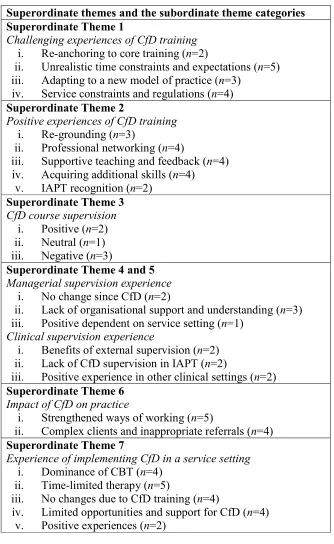
[Table two inserted here]
Positive experiences of CfD training
Although a challenge,re-groundingandre-anchoring back into core theoretical approachwas a key positive experience reported by half the participants. One participant described the training as‘it felt like going home’and another described the course as ‘re-visiting a place of security’. The majority of participants statedprofessional networking
with colleagues and‘like-minded’individuals was a key positive experience of the course.
CfD course supervision
Supervision whether on the course, clinical or managerial in a service setting generated opposing views from participants interviewed. Consequently, a theme was created for each supervision type to capture all the data and provide a representation of conflicting experiences. Half the interviewees had apositiveexperience of CfD course supervision. One participant felt they had aneutralCfD supervision on the course. Two interviewees described anegativeexperience, with the CfD course supervision being deemed‘problematic’and‘more of a hindrance than a help’– resulting in one interviewee paying for their own CfD supervision to get the support they required.
Managerial and clinical supervision
Alack of organisational support and understandingwas experienced in workplace managerial supervision by half of interviewees, as evidenced by the following quote:‘I would say that you know with my supervisor being very hostile to CfD, it undermines its credibility in the organisation.’However, two interviewees describedno change since CfD for managerial supervision.
Positive managerial and clinical supervisionwere described by interviewees. These interviewees worked in different workplace settings that added to the richness of the data. The following quote highlights the different experience of managerial supervision in these settings:
Managerial supervision, I have from the clinical psychologist who is the head of the team who is enormously and I mean really supportive so this kind of feels almost
about the client – a rounded whole holistic person, physical, psychological, spiritual, everything.
The two remaining subthemes for clinical supervision in service settings encompass contrasting experiences of thebenefits of external supervision,that is, CfD supervision being funded externally by the NHS (n=2) and adistinct lack of clinical supervision in IAPT settings(n=2). For the latter, it was commented that‘it’s kind of difficult enough really to find someone who can supervise within a team of 10 people you know because of the small numbers so never mind someone who does CfD supervision’.
Impact of CfD on practice
Within this theme, interviewees spoke about how the CfD training hasstrengthened ways of workingand how practice has been‘retuned’and‘refocused’to explore and stay with a client’s feelings. It is the emotion-focused aspect of the course that is used
frequently in practice. However, most participants stated that this strengthening of skills is limited due tocomplex clients and inappropriate referrals. This is evidenced by one
interviewee describing counsellors as being ‘like the bin into which referrals go who people don’t know what to do with’and another stating where they work they simply do not
receive referrals for mild to moderate depression:
I guess what the CfD model talks about is working with mild to moderate people with depression and where I work it is quite rare that we have – I had somebody last
week with mild depression – it is sort of unrecognisable really!
Experience of implementing CfD in a service setting
practitioners, which were incorporated to make up the themedominance of CBT. One quote out of many captures this subtheme:
We aren’t regarded as high-intensity therapists yet we are surrounded by other approaches which are given more kudos and credibility, it just serves to devalue. It
sort of brings home how your approach isn’t seen as valuable as these other approaches, which is quite demoralising.
Further to this, interviewees described the CfD model being limited in services due totime-limited therapy. Interviewees went on to say that there is a constant pressure from services to keep the number of sessions down which impacts the efficacy of the CfD model with clients:
because of the limited number of sessions we are just getting going with people then
they have to leave so we are not meeting the recovery targets that they are hoping to so there is always that feeling of knowing this model could work for people but we just haven’t got enough time.
There beingno changes due to CfD trainingwas also identified as a theme as interviewees focused on the experience of no change to pay or status since the CfD training. This is evidenced by interviewees stating: ‘as far as the organisation is concerned we’re all doing the same thing’and that‘even though I have done the CfD training, it hasn’t really made any difference’.
for CfD supervision training, increased working hours and CfD supervision. In the NHS non-IAPT service there is opportunity to have 20 sessions with clients, as well as feeling respected and supported within the team.
Discussion
As the CfD IAPT workforce continues to grow, this study sought to explore CfD practitioners’ experiences of training and of working in the IAPT service. Overall, CfD practitioners indicated a predominately positive CfD training experience, encountering a degree of challenge but an overall positive impact on sense of self, practice and skill set. The interviews revealed challenges and positive components in equal measure in terms of how the courses were experienced, with course, managerial and clinical supervision receiving a mixed response. The data from interviews suggest that experience of
implementing CfD is service dependent; often perceived as problematic in IAPT settings with CfD practitioners regularly faced with a lack of support, a constant pressure to limit the number of sessions and an inequity in relation to other high-intensity interventions; and in terms of attitude, status and pay.
Experience of training
Following Pearce et al.’s (2013) evaluation there has been little or no change in the experience of training in the CfD modality. Of note, challenging themes resemble
difficulties experienced in Pearce et al.’s study. More specifically, it appears time
However, it was also found that some participants might have found it challenging to re-anchor practice back into the person-centred approach due to their practice having drifted from their core training. Also, CfD is a form of person-centred experiential therapy and some more classically oriented therapists might fear they are being too directive if they engage more actively with the client’s experiential processing and especially if they then focus on supporting the specificity of emotions. Half of interviewees stated it was challenging to adapt to a new model of practice, and this was especially relevant for individuals who had completed training in modalities additional to the person-centred approach. The challenges experienced by the participants raise pertinent questions about training. This might be explained to some extent by the wide range of approaches that have been deemed suitable for access to CfD training. Entry criteria require only ‘humanistic’ training to access the course. Humanistic training with a low level of person-centred theory included could make it difficult to implement CfD following training.
Previous research has reported that some practitioners found adhering to the competencies difficult and it was proposed that this might be due to a gap between core theory/orientation of training and practice (Pearce et al., 2013). The findings presented here provide further support that this is the case and that practitioners not currently practising in the person-centred approach may find a CfD training course a more challenging process. However, it is interesting to note that this did not impact on practitioners’ overall
Whilst the findings share some similarities with previous research, there are various trends in the data that have not been found or explored previously. The average time for practitioners to complete the course and qualify as a CfD practitioner was nine months, which substantially exceeds the 12-week course guidelines. However, this guideline was developed on the assumption of practitioners training on a full-time basis. A clear majority of CfD trainees undertake training on a part-time basis, which would account for a longer period for training. This finding was compounded by interviewees commenting that this was for two reasons;1)that practitioners struggled to adhere to the course requirements whilst working and maintaining a work-life balance, and2)that some practitioners experienced a lack of support from their services in permitting sessions to be recorded.
One explanation for this finding might be that whilst CfD trainees are required to select, record, and submit suitable recordings of cases for assessment, a lack of support in the workplace and the pressures of working in IAPT may make completing the
qualification a highly demanding process. As teaching and feedback on the course was experienced to be positive, it is felt this finding has greater implications for services. It is recommended that services recognise that because the assessment period exceeds the five-day taught training course, practical support is required to ensure practitioners can submit assessment material efficiently. Furthermore, services can factor in that after the CfD taught course completion of the practice component it typically takes nine to 12 months to qualify as opposed to the previous 12-week guideline.
Experience of practice
This led to the anticipation that, because of this finding and as a consequence of CfD being a relatively new therapy, over time CfD would reduce such perceived inequity and
counsellors be placed on a more equal footing to CBT therapists. The current research identified that unfortunately this is not the case. More importantly, this study identified contributing factors, including a lack of impact on practice due to service constraints, a lack of support from management, limited clinical supervision and often no CfD supervision, as well as an overwhelming dominance of CBT.
Whilst it was clear that most interviewees had a negative experience since qualifying, it appears that experience is service dependent. Individuals working in NHS non-IAPT or within a trial-supported environment raised positive experiences. Individuals from these services identified that although number of sessions was strictly adhered to, the factors that contributed to a positive experience comprised respect from management, supervisors and colleagues, and the correct amount of supervision required for the hours worked. Thus, whilst there are many factors that services need to address for CfD to be placed on an equal footing with CBT, it appears that recognition and respect from all professionals for CfD and CfD practitioners and allocated supervision are key factors which could alleviate some of the perceived inequity in service settings.
Caveats
There are several caveats to be made regarding this study. First, the sample comprised members of BACP’s CfD PRN, a network specifically designed for CfD
representation of training in CfD as a whole. To make these findings more generalisable and to draw comparisons, further research with practitioners who dropped out of the CfD training, failed to qualify, or who had a negative experience is required. Further, the participant sample had considerable life experience, which signifies a different practitioner base from that of a younger cohort training more immediately post-university. This
suggests that those training in CfD are likely to be bringing with them significant life experiences and perhaps more established ways of working therapeutically.
Second, although all training courses were represented in the sample for the quantitative analysis, this was not the case for the qualitative analysis. So, whilst the vast majority of participants reported a positive or very positive training experience, the course attended may impact on the overall training experience of participants and further influence the themes identified for positives and challenges of CfD training and CfD course
supervision. Consequently, further research is necessary with more participants from the same training institutes to determine a more consistent representation of experience.
Third, the average time since qualifying as a CfD practitioner was two years five months. As there is a substantial average time lapse between time of qualifying and participating in the research, it is highly likely that participants’ memory recall of their experience of training may have modified over this time. This may mean that the information gained from the survey and interviews did not fully capture the learning
process and challenges experienced at the time on the course. This is evidenced by a wealth of data arising out of the questions relating to experience of CfD in service settings, in comparison to experience of training in CfD.
Conclusion
Findings highlighted that CfD practitioners find training in the CfD model had a positive impact on their sense of self, practice and skill set. They also encountered a degree of challenge on the course. Most practitioners agreed that CfD fits well with their
philosophy, values and the way they work with clients. In-depth, semi-structured interviews provided rich information on the factors contributing to the positives and challenges
experienced on the course. However, the experience of CfD in practice and in service settings was predominately negative, with practitioners reporting a lack of management support, limited supervision and a dominance of CBT. However, those working outside of IAPT services had more positive experiences of CfD in practice. These findings suggest further research is required to understand the service level factors that may be influencing practitioners’ experience and whether CfD practitioners’ experience of IAPT differs to that of other psychological therapists, specifically CBT as the dominant model within IAPT.
References
Bond, T. (2004).Ethical guidelines for researching counselling and psychotherapy.Rugby, United Kingdom: British Association for Counselling and Psychotherapy.
Braun, V., & Clarke, V. (2006). Using thematic analysis in psychology.Qualitative Research in Psychology, 3, 77 – 101.
Department of Health. (n.d). WHICH talking therapy for depression? National IAPT programme, 1 – 16.
http://www.content.digital.nhs.uk/catalogue/PUB22110/psyc-ther-ann-rep-2015-16_v2.pdf
Hill, A. (2011). Curriculum for counselling for depression. Improving access to
psychological therapies. Retrieved from: http://www.iapt.nhs.uk/silo/files/curriculum-for-counselling-for-depression.pdf
IAPT (2016). 2015 adult IAPT workforce census report. NHS England. Retrieved from:
https://www.england.nhs.uk/mentalhealth/wp-content/uploads/sites/29/2016/09/adult-iapt-workforce-census-report-15.pdf
Likert, R. (1932) A technique for the measurement of attitudes.Archives of Psychology, 140(1), 44-53.
Miles, M.B. and Huberman, A.M. 1994.Qualitative data analysis: An expanded sourcebook. London, United Kingdom: Sage.
Murphy, D. (2017). Person-centred experiential counselling psychology. In, D. Murphy (Ed.)Counselling psychology: A textbook for study and practice(pp. 72-87). Chichester, United Kingdom: Wiley.
National Institute for Health and Care Excellence (2017). Depression in adults: Recognition and management: Draft guidance consultation.
https://www.nice.org.uk/guidance/indevelopment/gid-cgwave0725/consultation/html-content
Pearce, P., Sewell, R., Hill, A., Coles, H., Pybis, J., Hunt, J.… & Hobday, T. (2013). Counselling for depression: The perceptions of trainees.Healthcare Counselling and Psychotherapy Journal, 13(1),8-13.
Roth, A.D., Hill, A., & Pilling, S. (2009). The competences required to deliver effective humanistic psychological therapies. Retrieved from:
https://www.ucl.ac.uk/pals/research/cehp/research-groups/core/pdfs/Humanistic_Therapy/Humanistic_clinicians_guide.pdf
Sanders, P., & Hill, A. (2014).Counselling for depression. A person-centred and experiential approach to practice.London, United Kingdom: Sage.
Table 1. The number of CfD therapy hours in one working week split by work place provider (NHS/non-NHS).
CfD therapy hours in NHS setting
CfD therapy hours in non-NHS setting
Average 14.69 11.50
Table 2. Seven superordinate themes and the subordinate themes identified from the thematic analysis.
Superordinate themes and the subordinate theme categories Superordinate Theme 1
Challenging experiences of CfD training i. Re-anchoring to core training (n=2)
ii. Unrealistic time constraints and expectations (n=5) iii. Adapting to a new model of practice (n=3)
iv. Service constraints and regulations (n=4) Superordinate Theme 2
Positive experiences of CfD training i. Re-grounding (n=3)
ii. Professional networking (n=4)
iii. Supportive teaching and feedback (n=4) iv. Acquiring additional skills (n=4)
v. IAPT recognition (n=2) Superordinate Theme 3 CfD course supervision
i. Positive (n=2) ii. Neutral (n=1) iii. Negative (n=3)
Superordinate Theme 4 and 5 Managerial supervision experience
i. No change since CfD (n=2)
ii. Lack of organisational support and understanding (n=3) iii. Positive dependent on service setting (n=1)
Clinical supervision experience
i. Benefits of external supervision (n=2) ii. Lack of CfD supervision in IAPT (n=2)
iii. Positive experience in other clinical settings (n=2) Superordinate Theme 6
Impact of CfD on practice
i. Strengthened ways of working (n=5)
ii. Complex clients and inappropriate referrals (n=4) Superordinate Theme 7
Experience of implementing CfD in a service setting i. Dominance of CBT (n=4)
ii. Time-limited therapy (n=5)
iii. No changes due to CfD training (n=4)