sustainable
development
commission
The role of nuclear power in a
low carbon economy
Paper 6:
Safety and security
An evidence-based report by the
Sustainable Development Commission
with contributions from Large & Associates
and AMEC NNC
Safety and security www.sd-commission.org.uk
1
Table of contents
1 EXECUTIVE SUMMARY ... 3
1.1 Introduction... 3
1.2 Accident risk... 3
1.3 Security issues – vulnerability to terrorism ... 3
1.4 Implications for nuclear proliferation ... 4
1.5 Health impacts from background radiation... 4
2 INTRODUCTION... 5
3 ACCIDENT RISK ... 7
3.1 UK regulatory position ... 7
3.2 Review of accidents in the nuclear industry ... 8
3.3 Summary ... 10
4 SECURITY ISSUEs... 11
4.1.1 Motivation and nature of terrorist threats ... 11
4.2 Nuclear security ... 11
4.3 Design of plant... 13
4.4 Shipments of radioactive materials and wastes ... 15
4.5 Summary ... 16
5 IMPLICATIONS FOR NUCLEAR PROLIFERATION... 18
5.1 International treaty obligations ... 18
5.1.1 General ... 18
5.1.2 The NPT... 18
5.1.3 The Euratom Treaty... 19
5.2 Application of safeguards at UK nuclear power stations... 19
5.3 Proliferation – a summary of more ‘critical’ perspectives... 20
5.4 Safeguards activities... 21
5.4.1 Declaration of basic technical characteristics ... 21
5.4.2 Materials accountancy ... 21
5.4.3 Containment and surveillance ... 22
5.5 Disincentives to diverting PWR fuel... 22
5.5.1 Difficulty of processing the fuel ... 22
5.5.2 Unsuitability of spent fuel ... 23
5.5.3 Inaccessibility of fuel when loaded in the reactor... 23
5.5.4 Unfavourable economics ... 24
5.5.5 Conflict with declared intentions ... 24
5.6 Summary ... 24
6 HEALTH IMPACTS... 26
6.1 Potential health impacts of low effective dose exposures ... 26
6.1.1 Cancers in general ... 26
6.1.2 Leukaemia... 26
6.2 Policy context... 27
6.3 Regulatory framework... 28
6.4 Worker doses ... 29
6.4.1 Collective radiation exposure... 29
6.4.2 Individual radiation exposure... 29
6.5 Doses to members of the public... 30
6.5.1 Radioactivity in the environment: Marina II study in the OSPAR region ... 30
Safety and security www.sd-commission.org.uk
2
7 CONCLUSIONS ... 34
7.1 Conclusion on accident risk ... 34
7.2 Conclusion on security issues... 34
7.3 Conclusion on nuclear proliferation ... 34
7.4 Conclusion on health impacts ... 35
8 GLOSSARY ... 36
9 TABLES AND FIGURES... 37
10 APPENDIX A - SUMMARY DESCRIPTION OF MAJOR NUCLEAR ACCIDENTS ... 49
10.1 Chernobyl (INES 7)... 49
10.2 Three Mile Island (INES 5) ... 50
10.3 The Windscale fire (INES 5) ... 51
10.4 Saint-Laurent A2 (INES 4)... 52
10.5 Tokai criticality accident (INES 4)... 52
Safety and security www.sd-commission.org.uk
3
1 EXECUTIVE SUMMARY
1.1 Introduction
This report has been prepared as part of the Sustainable Development Commission’s work on examining the role of nuclear power in the low carbon economy. It covers matters relating to safety and security, under four main topic headings. It has examined relevant material in the public domain, and has reached the following conclusions for the topics under review:
1.2 Accident
risk
• Nuclear power stations in the UK are designed to stringent standards with emergency arrangements to avoid on-site and off-on-site effects, and which ensure that all reasonably practicable steps are taken to avoid accidents, and to mitigate the consequences of any that might occur.
• Nuclear power stations are designed so that safety equipment is duplicated and segregated resulting in a robust
approach and practice of the engineered system response to abnormal operation and fault conditions. The current safety assessment principles state that safety equipment should be actuated
automatically, and that no human action should be necessary for at least 30 minutes.
• UK civil nuclear power stations have an excellent safety record (although this is on the basis of relatively few reactor years of operating experience) , and there have been no events recorded either with off-site consequences or where all safety measures had been exhausted (the 1957 Windscale accident occurred at a military reactor).
• Modern reactor designs are expected to reduce the very small accident risks still further. Wherever possible, passive safety systems are used in preference to engineered ones.
1.3 Security issues – vulnerability
to terrorism
• There are high levels of security at nuclear power stations, which are regularly reviewed against current intelligence about the intents and capabilities of terrorist groups.
• While modern reactor designs have substantial containment buildings which are considered unlikely to be breached even by a crashing airliner, and the reactor fuel is protected against impact and fire by other structures, no current operating reactor design has been specifically designed to resist commercial aircraft impact – the
Generation III EPR and AP series reactors have yet to have anti-terrorist measures specifically designed in
• Attempts at damaging the plant, either by external attack or sabotage, will probably cause the reactor to shut down safely once a fault is detected.
However, it remains difficult to fully account for future changes in the modus operandi of terrorist groups and their capacity to exploit weaknesses in the design, operation or security of nuclear power stations and associated
infrastructure.
• Reactor fuel cannot be easily processed to produce weapons-grade material – but a ‘dirty-bomb’ can be made from reactor-grade material. The ceramic pellets are not easily fragmented, but could be used in a ‘dirty’ bomb.
Safety and security www.sd-commission.org.uk
4 realistic. By their nature, these
containers would be difficult to steal as they are heavy and cannot be moved quickly. Opening the containers without specialist equipment would expose the terrorists to life-threatening radiation, but this in itself could comprise a ‘dirty bomb’.
1.4 Implications
for
nuclear
proliferation
• The UK is a signatory to and therefore bound by the Non-Proliferation Treaty and the Euratom Treaty, and has agreed not to divert civilian nuclear materials to military use.
• Any attempt by a future government to withdraw from its treaty obligations would raise suspicions about the intention, and cause an international response.
• Independent international safeguards measures are in place at fuel
manufacturing facilities, power stations and reprocessing facilities, to account for all nuclear material within the civil sector. These measures have proved effective over many years, and will be applied to any new-build stations.
• However, terrorist organisations almost by definition operate outside of national or international laws and treaties. Concerns remain about the wider uptake of nuclear power based on the emphasis on equity and
non-discrimination in the UNFCCC, and the governance arrangements within and between sovereign states to ensure the separation of civil and military
applications or that radioactive materials do not fall into the ‘wrong hands’
• Pressurised water reactor fuel is unsuitable for weapons use – but if reprocessed, the plutonium extracted from light water reactor fuel is suitably fissile for nuclear warhead use .
1.5 Health impacts from
background radiation
• Radiological protection of employeesand the general public in the UK is covered by a strict legal framework. Permitted dose levels to the public, as a result of nuclear industry operations, are only a small fraction of natural
background radiation. The average dose to a member of the public, due to radioactive discharges, is 0.015% of the annual average dose from all sources.
• 83% of the EU collective dose
attributable to the nuclear industry is due to discharges from fuel
reprocessing. Spent fuel from new nuclear stations may not be reprocessed.
• Dose levels to the public are expected to reduce from already low levels with modern reactor designs. The associated risk of developing a fatal cancer is extremely small, below the 1 in one million level considered ‘broadly acceptable’ by the HSE.
Safety and security www.sd-commission.org.uk
5
2 INTRODUCTION
This report has been prepared as part of a study commissioned by the Sustainable Development Commission (SDC) into the role of nuclear power in the low carbon
economy. The Government is conducting a fresh review of energy policy, and the SDC has therefore decided to conduct its own review of nuclear power, enabling it to update its position on the subject in advance of a formal consultation.
The study covers five areas, each being the subject of a separate contract. This document covers matters relating to Safety and
Security (Contract 3), and other studies (not necessarily by AMEC NNC) deal with
Economics, Waste and Decommissioning, Public Perceptions and Community Issues, and Resource Availability. Some of the matters covered in this report may impinge on these other topics.
For the purpose of the study, it is assumed that any new reactor will be an ‘advanced’i
pressurised water reactor (PWR) or similar advanced reactor, in line with industry expectations. Candidate designs include the Westinghouse AP-1000 and the Framatome-ANP EPR (European Pressurised [water] Reactor). This study makes no assumptions about possible locations for any new-build nuclear power station, although it is recognised that the site location may be relevant when considering some safety and security issues.
For instance, the vulnerability to terrorist attack may depend on the site location and the source of any perceived threat, which could change over time. In the 1970s and afterwards, the possibility of Irish Republican
i i.e. designs that differ from existing plants in
the extent of the reliability on passive
containment and close down systems, although the reactor and containment systems overall and in detail are not that ’advanced’ on existing designs
terrorist strikes on sites at Heysham and Wylfa were assessed because of their proximity to ferry ports – but the threat was considered to be low because the Republican movement was confined and restrained by its own constituents (resident in Ireland, locally in the UK and as fund raising in the United States) who would have been subject to any radiation detriment arising from a terrorist action on a UK nuclear power plant. New terrorism threats require a full re-evaluation of the risk to nuclear power installations, which has been ongoing since ‘9/11’.
Other considerations include the extent to which coastal locations could be
compromised by the effects of changes in the climate that are already in the pipeline, including vulnerability of plant to sea level rise, storm damage and coastal erosion for several decades or hundreds of years hence. Site selection criteria should be ‘climate change-proofed’ – this is discussed further in Paper 2 – Landscape, environment and community impacts.
At this stage, it is not known whether or not the spent fuel will be reprocessed. It is also not certain whether the reactor fuel will be uranium dioxide or mixed oxide (which comprises depleted uranium and fissile plutonium oxides, MOX). Where appropriate, both options will be considered, with
appropriate caveats.
This report covers four main topics:
• Accident risk - record in the United Kingdom (UK) and in major overseas countries
• Security issues (vulnerability to terrorism)
• Implications for nuclear proliferation
Safety and security www.sd-commission.org.uk
Safety and security www.sd-commission.org.uk
7
l f
3 ACCIDENT RISK
3.1 UK
regulatory
position
Within the UK, the operators of nuclear plants must conform to the general health and safety standards laid down in the Health and Safety at Work etc. Act 1974 (HSW Act). The HSW Act applies to all employment situations, but nuclear plant operators must also comply with the Nuclear Installations Act 1965 (as amended) and related legislation. Under the Nuclear Installations Act, no site may be used for the purposes of installing or operating any nuclear
installation unless a licence has been granted by the Health and Safety Executive (HSE). The HSE exercises this responsibility through the Nuclear Installations
Inspectorate (NII), which is the nuclear safety regulator for the UK nuclear industry. Radioactive discharges are regulated separately, by the Environment Agency in England and Wales and the Scottish Environment Protection Agency (SEPA) in Scotland.
The NI Act requires that no health harm shall arise from the operation of the nuclear facility. The NII interprets this in terms of the
Acceptabi ity of the Risk of Accident and the Tolerability o its Consequences, and, acting on behalf of the HSE, sets out the general safety requirements to deal with the risks on a nuclear site. This determines the general standards required which are set out in a number of documents discussed below including the Site Licence (Site Licence Conditions - SLCs), Basic Safety Limits, Basic Safety Objectives and dose limits. Guidance on complying with NII requirements is set out in the Safety Assessment Principles (SAPs)1, which have been produced by the
NII and reflect its approach to the regulation of risks. There are five fundamental
principles, and over three hundred detailed principles which are derived from them. Two of the fundamental principles relate directly to accidents:
• P4: All reasonably practicable steps shall be taken to prevent accidents
• P5: All reasonably practicable steps shall be taken to minimise the radiological consequences of any accident
Nuclear plants are designed to cope with a wide range of potential accidents (Design Basis Accidents - DBAs), for which it must be shown that off-site doses will not exceed specified limits. The predicted frequency of accidents that would result in doses to the public must also remain within limits. These limits become more onerous as the
predicted off-site dose increases, so that an accident which would result in a large off-site dose must have a very low probability of occurring. The limits are specified as Basic Safety Limits (BSLs) and Basic Safety Objectives (BSOs). BSLs are absolute
minimum requirements, while BSOs must be met (or even exceeded) if it is reasonably practicable to do soii.
Nuclear power plants are therefore designed to minimise the potential for accidents, and to minimise the consequences to both workers and the general population in the event that they do occur. This is reflected in the international nuclear event statistics discussed below, which record very few instances of significant off-site risk or major plant damage.
ii Reasonably practicable means that ‘measures
necessary to avert risk must be taken until or unless the cost ... whether in money, time or trouble, is grossly disproportionate to the risk that would be thereby averted’ (1, paragraph 1).
Safety and security www.sd-commission.org.uk
8
3.2 Review of accidents in the
nuclear industry
The industry view is that accidents are extremely rare, and,when they have
occurred, the significance of what happened (or did not happen) has not always been well-understood outside the industry. For instance, the Three Mile Island accident resulted in an almost-new reactor being written off, with major financial
consequences for the plant operator.
Although there were no off-site health effects, the primary containment was breached: the Kemeney Commission Report gives a radioactive release from the
secondary containment with an estimated collective dose of 2000 man Rem. The dose exposure to workers over the reactor clean up program may have been sufficient to result in on-site detrimental effects..
The International Nuclear Event Scale (INES 2)
has been developed by the International Atomic Energy Agency (IAEA), and was introduced in 1990. It is a scale to put nuclear and radiological events into
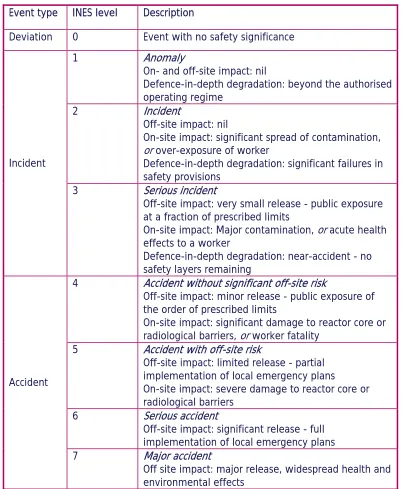
perspective, explaining in simple terms their significance and relative importance to the public. The INES is now used by over 60 countries, including the UK. Events are graded on a scale 0 to 7, and are assessed against up to three criteria: off-site impact, on-site impact and impact on defence-in-depthiii (the extent to which safety
protection has been degraded), as shown in Table 1.
The scale is designed for prompt use following an event, but on occasions it may be necessary to give a provisional rating only. The level will then be confirmed, or
iiiDefence-in-depth can be considered as
providing multiple physical barriers between the source of radioactivity and the environment, or a structured ‘series’ safety argument (‘if this happens, then that will happen, but if that fails, then this will take place...’ and so on), or a ‘parallel’ or ‘multi-leg’ safety argument which demonstrates that the outcome can be achieved in several different ways. See also section 4.3.
possibly revised, once the event has been fully assessed. However, critics argue that the INES serves more of a PR function than a meaningful index, pointing out that, like the Beaufort wind force scale, the INES has little meaning because the graduations are not at all linear and noting that the IAEA
recommends3 that it should not be used for
international comparisons. Some of the classifications are disputed, as discussed below for the Windscale incident in 1957.
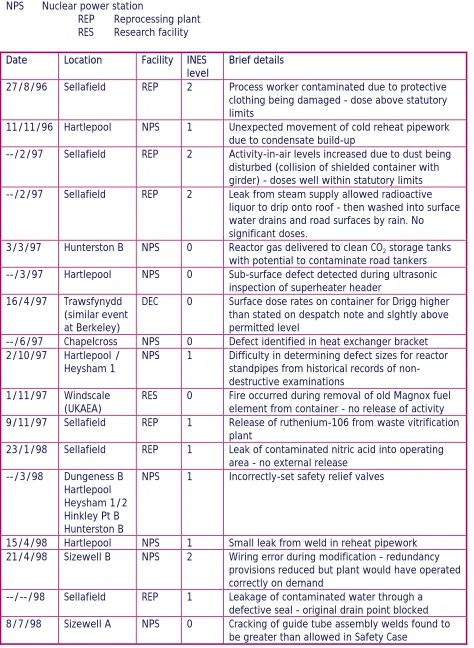
The vast majority of events that have been reported against INES criteria have been level 0, 1, or 2, and there have never been any events above level 2 at a UK civil nuclear power plant. The Windscale fire and release (at a military reactor) is given as INES level 5 (Table 2) although others consider it to have been INES scale 7 (the maximum level, and equivalent to Chernobyl) – these differences may result from the non-linear nature of the scale, inviting subjective interpretation of event characteristics. At level 2, there would be ‘significant failure in safety provisions but with sufficient defence-in-depth remaining to cope with additional failures’. Examples of higher-level classifications are given in Table 2, and summary descriptions of some of these incidents are given in 10. Table 3 lists the incidents at INES levels 0 to 3 that have been reported to the UK Government since the last quarter of 1996. These have been extracted from the HSE web-site, excluding those incidents which met the HSE criteria for reporting to Government but did not receive an INES rating. The reporting requirements were initiated in the late 1970s by the then Secretary of State for Energy, Anthony Wedgwood Benn.
Similar arrangements do not always exist in other countries, and where they do the reporting criteria may differ significantly from those applying in the UK. This will particularly affect the numbers of low-level incidents reported, although the treatment of more serious (Level 2 and above) incidents should be consistent across
Safety and security www.sd-commission.org.uk
9
Autorité de Sûreté Nucléaire (ASN) were modified in 2002, and include environmental protection events such as releases of
chlorofluorocarbons and high temperatures of discharged cooling wateriv. Although such
events do not necessarily attract an INES rating, nevertheless one Level 2, 148 Level 1 and 522 Level 0 incidents were declared in 20034. The ASN annual reports do not cover
all the Level 0 and Level 1 incidents in any detail, though individual incidents may be discussed, hence it is difficult to determine the reasons for the apparent discrepancy between the UK and France regarding these levels.v It can be seen that, while there are
many more Level 0 and 1 incidents recorded in France than in the UK, the number of Level 2 incidents is of a similar order of magnitude.
The nuclear industry in Japan has suffered adverse publicity due to a sodium leak at the Monju fast reactor, two incidents at Tokai (including the criticality incident described in 10) and a scandal relating to falsification of inspection records. The latter involved a lapse of management controls at
Sellafield and a BNFL MOX fuel shipment to Japan which had to be sent back to the UK. Industry sources state that the inspection
iv This is a particular issue in France, where inland
power stations discharge their coolant into large rivers such as the Seine and the Loire: all operating UK stations discharge cooling water into the sea.
v The total of Level 1 incidents in France, at
operating power stations only, was 116 in 1999, 134 in 2000, 88 in 2001, 99 in 2002, 148 in 2003 and 92 in 2004. The corresponding figures for Level 2 incidents were 3, 2, 2, 1, 1 and 1 for the same six years. There were no incidents rated at Level 3 or above. Over the same period, Table 3 shows that two Level 0, seven Level 1 and one Level 2 incidents were reported to Parliament. It should be noted that France has 59 operating reactors, compared to the UK’s 23 in late 2005. The ASN report for 2003 identifies that about 60% of the incidents (levels 0, 1 and 2) were attributable to organisational and human causes, and 21.3% were caused by equipment faults. Just 1.2% of the incidents involved an accidental release of activity, but in all cases the releases were contained within the plant.
issues were not safety-related5 – but others
point out that the fuel pellets and cladding gap were not to specification., In any event, a significant loss of public confidence
resulted. It has not proved possible to obtain comprehensive data on INES-rated incidents.
Five of the accidents/incidents listed in Table 2 occurred at power stations. Of the reactors involved, two (Saint-Laurent and Vandellos) were to a design no longer built (the French UNGG, not dissimilar to the UK Magnox design), one (Bohunice A1) occurred on an experimental reactor of a type since abandoned, and one (Chernobyl) was to a design long considered unlicensable (Amec-NCC) in the UK (Reactor Bolshoy
Moshchnosty Kanalny - RBMK - or high-power channel reactor). Apart from
Chernobyl, no nuclear workers or members of the public have died as a result of exposure to radiation due to a commercial nuclear reactor incident6. Most of the serious
radiological injuries and deaths that occur each year are the result of large uncontrolled radiation sources, such as abandoned
medical or industrial equipment.
There have also been a number of accidents in experimental reactors and in one military plutonium-producing pile (Windscale, 1957), but, according to industry sources, none of these resulted in loss of life outside the actual plant or long-term environmental contamination6 - although this is disputed. A
fatality was recorded at the Idaho SL-1 reactor in January 1961.
Particularly following the Three Mile Island (PWR) accident, which was rated as INES level 5, reactor designers have striven to limit the potential for core damage under accident conditions. Increasingly, PWR designs rely on passive features (which use natural forces such as gravity, natural circulation and compressed gas) rather than engineered features to assure safety
functions. Where engineered systems cannot be avoided, the standard engineered system design principles of diversity and redundancy
Safety and security www.sd-commission.org.uk
10 most hazardous plants including the UK AGR reactors designed in the 1960s), so that:
• there are at least two ways of dealing with any identified fault, that do not rely on each other for any part of their operation
• there are multiple, segregated sets of safety equipment, each one with the capability of dealing with the fault on its own.
As a result, the manufacturers’ claims for their products suggest that the risk of core damage is very much less than for current designs. For instance, the Westinghouse AP1000 is claimed to have a core damage frequency (corresponding to a level 4 event) nearly 100 times below that for current plants, and 250 times lower than the
frequency required by the United States (US) regulator7.
Although fuel from Sizewell B - the UK’s first, and so far only, PWR used for electricity production (the Royal Navy has operated PWR powered propulsion systems for its submarine flotillas since 1965) - is currently not reprocessed, this remains as an option for new-build power stations. Many (though not all) of the incidents recorded in Table 3 for reprocessing plant relate to the old Magnox facilities that are due for closure around 2012, and are therefore of less relevant to plant built to modern standards (i.e. in accordance with the requirement of the Nuclear Installations Act to reduce the risk to a low as reasonably practicable). Inspection of Table 3 (page 53) shows that none of the incidents listed there resulted in the release of activity off site, and in most cases the release was contained within the building in question.
3.3 Summary
While it may not be possible to eliminate all risk, the regulatory requirement is that risks have be shown to be acceptable and the consequences have to be tolerable, and that any accident with potentially large off-site
consequences must be shown to have a very low frequency of occurrence.
Modern nuclear power stations are built to a high standard, with multiple layers of protection to guard against faults and passive safety features which will come into play automatically when a fault condition occurs. As will be apparent from Table 2, some of the more serious accidents were due, in part, to human error – notably, Chernobyl which resulted when workers were under pressure to perform an experiment even though the load requirements of the plant were changed (Annex A). Current practice is to remove the need for prompt operator action and, with it, the potential for the wrong action to be taken. Ref 1, Safety Assessment Principle 77
Safety and security www.sd-commission.org.uk
11
4 SECURITY ISSUES
4.1.1 Motivation and nature of terrorist
threats
Some of the risks of terrorist attacks on nuclear facilities are discussed in8. There
could be several possible motives for a possible terrorist attack on a nuclear power station. They will depend on the group or groups involved, and on their political aims. It could take up to ten years, following a public enquiry, eventual approval and the construction phase, before a new nuclear station will be ready to operate, and it could then be running for 40-60 years. Over that period, both the motives for and the nature of a terrorist threat could change. Currently, the perceived threat is generally linked to events in the Middle East, from terrorists with a desire to cause widespread death and destruction of ‘Western’ interests, and with a total disregard for their own lives. The situation in thirty years’ time may be different yet again.
Although the detail of the threat will depend on the circumstances pertaining at the time, a number of general motives can be
identified:
• to cause widespread death and destruction by direct action
• to acquire nuclear material which could then be used in an explosive device
• to cause economic damage to the UK
• to gain publicity for the group in question.
Nuclear plants might be considered
‘attractive’ targets for a number of reasons, including:
• the potential to cause wide scale economic and social disruption
• playing on the public fear and anxiety of radioactivity
• the possibility of causing a ‘spectacular’ event.
Various counter-measures are in place to combat these threats. Some of these are institutional (e.g. site security) and others are related to plant and equipment design. Section 3.3 presents two opposing views. The first is an industry view wherein nuclear plant is robust, and the containment
buildings are able to withstand external impacts from, in the worst case, a civil airliner. Attempts at causing a major release of activity from commando-style operations are considered likely to be frustrated by the fail-safe nature of the plant where, if a fault is detected, several systems are available to shut the reactor down safely. Nuclear fuel (fresh or spent) is considered technically unattractive for use in a classical fission weapon, and difficult to fragment in the way that would be intended in a ‘dirty’ bomb. The problem is perceived to be mainly one of publicity, even though the more sinister motives are unlikely to be realised. The second is more critical, challenging the industry view on almost every count.
4.2 Nuclear
security
It is important to distinguish the probabilistic risk analysis (PRA) undertaken for accidents (that is unintelligent, random and
unfocussed events) compared to terrorist actions which are intelligently driven, intentional events that seek out the vulnerabilities of the plant (and may also strive to disrupt or disable the emergency response actions to maximise the impact)9.
Safety and security www.sd-commission.org.uk
12
r
Regulations (2003) and associated legislation. It reports each year to the Secretary of State for Trade and Industry, most recently in10.
The Nuclear Industry Security Regulations require civil nuclear operators to have site security plans in place, dealing with the measures for protection of sites and the nuclear material on them. The OCNS is responsible for approving these security arrangements, which include the
deployment of armed police at designated power stations10 – a consequence of which is
that not all nuclear plants have armed UKAEA police in attendance all of the time.
In line with international best practice11,
security measures are regularly reviewed against the Design Basis Threat, which is based on the best available intelligence about terror groups, their motives and capabilities – although the tragic events in London on July 7 illustrate the difficulties of designing a system to cover all eventualities especially unknown future modus ope andi. For obvious reasons, the Design Basis Threat is classified as Secret, and no further details can be published. However, different countries have different approaches to Design Basis Threat – for example in the US and France specific actions are taken into account whereas in the UK it is considered sufficient to have intelligence about the motives and intention of the terrorist. This could lead to different perceptions and assessments of threats.
Access to nuclear power stations is tightly controlled. Measures to prevent or at least delay unauthorised access include:
• double lines of fencing with razor wire, high intensity lighting and CCTV linked to a permanently-manned security building
• turnstiles at personnel access points where entry and exit is only possible with a site-specific electronic pass
• random searches of personnel and vehicles
• double barriers at vehicle access points and chicanes to prevent the barriers from being rammed at high speed
• additional barriers within the station to protect sensitive areas such as the reactor building, to which only certain personnel will have access.
These measures may not always deter the determined intruder, but will delay access to sensitive areas, to buy enough time to both shut down the reactor and limit any possible release, and to mobilise off-site counter-terrorist measures.
There have been instances of intrusions by groups protesting about nuclear power (e.g. Greenpeace), who have used such events to highlight supposed breaches in nuclear security. The activities of groups such as
Fathers for Justice, though so far not directed at the nuclear industry, also pose security concerns. Some of the Greenpeace incursions at Sizewell in 2002-3 were conducted with a large number of activists, and OCNS claims that they were different in character and scale from a possible terrorist attack, which would be conducted with far fewer
participants who would seek to avoid detection for as long as possible. The second Greenpeace incursion into Sizewell B was by a group of 11 campaigners in the early hours of the morning without the glare of publicity – Greenpeace’s intrusion was modelled on the NRC Design Basis Threat scenario for an armed insurgency group. Although the Sizewell incidents were identified as a demonstration, and the authorities reacted accordingly, attempts by terrorists to
infiltrate protest groups cannot be ruled out, and armed police could be faced with the dilemma of whether or not to use extreme force if the nature of the incident was not immediately obvious8. As a result, OCNS is
pressing for legislation to make unauthorised entry into licensed nuclear sites a specific offence10.
Safety and security www.sd-commission.org.uk
13 stations being infiltrated by untrustworthy
individuals. This was extended in January 2005 to encompass all personnel working within the perimeter fence of a nuclear power station (including secretarial, administrative and cleaning staff amongst others), not just those requiring access to a radiologically-controlled area or inner security barrier. Personnel without such clearance are not permitted unescorted access to site.
4.3 Design
of
plant
A full discussion of this subject should consider existing plants, both nuclear power and the front and back-end fuel plants, and the so-called Generation III nuclear power plants.
Areas where nuclear fuel is present (the reactor itself and spent fuel stores) are mostly protected by heavily-reinforced concrete buildings. The main exception is with the existing Magnox steel reactor pressure vessel designs (Sizewell A, Dungeness A etc) in which the reactor primary circuit extends outside the concrete biological shield (which vents to atmosphere and is not a pressure vessel) and this part of the primary circuit is entirely unprotected against aircraft impact. A typical PWR containment building is cylindrical, with a domed roof, and has walls some 1 to 1.5 m thick, with an internal steel liner. The buildings are designed to withstand
earthquakes, forces generated by postulated internal explosions and, in some parts of the world, hurricane force winds. Before 9/11, they were only specifically designed against the impact of a light aircraft – i.e. aircraft up to 2.7 tonnes gross weight and with the assumption that the pilot will endeavour to steer clear of hazardous parts of the plant12 -
However, in meeting the requirements mentioned above, the buildings could withstand much larger aircraft impacts – although no current operating reactor design has been specifically designed to resist commercial aircraft impact and the Generation III EPR and AP series reactors have yet to have anti-terrorist measures
specifically designed in13. A report by the
mainly industry-funded Electricity Power Research Institute (EPRI) in the USA,
summarised in14, showed that a Boeing
767-400, impacting at 350 mph, would not breach the containment structure. Any future reactor to be constructed in the UK will be specifically assessed against the possibility of impact by a large commercial aircraft – although concerns remain about the existing nuclear power and fuel plants.
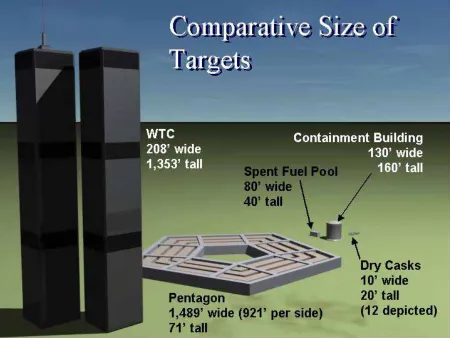
Assuming that the modus operandi of future terrorist attacks is similar to that of ‘9/11’, then the potential threat to nuclear plant may be small. Compared with either the World Trade Center or the Pentagon building, a containment building is a relatively small target, close to the ground (Figure 1). It would be difficult for a trained commercial pilot to control a large airliner at 350 mph near to ground level14, so it is less likely that
a terrorist, possibly with only basic training and minimal experience, would be able to impact the building at the most onerous impact site. Furthermore, although it is not shown in Figure 1, the containment building is surrounded by other buildings, making a direct hit on the containment even more difficult to achieve.
The OCNS has been working with operating companies and the NII on measures to counter the risk of a deliberate large aircraft crash15, though details may not be disclosed
for security reasons. While these measures relate to existing nuclear plant, they can be expected to apply to any new-build power station.
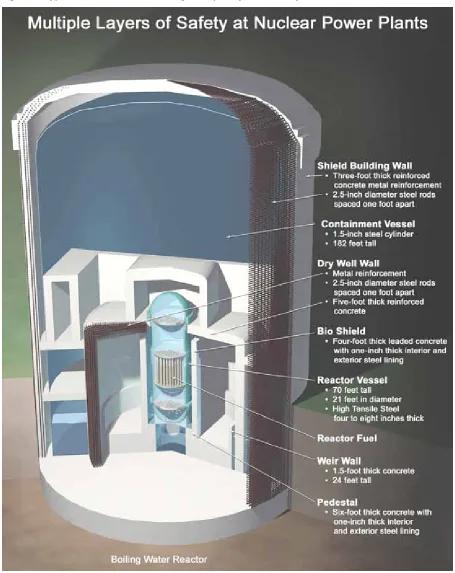
Figure 2, also taken from Ref14, shows a
Safety and security www.sd-commission.org.uk
14
It can be seen, therefore, that if a crashing airliner did penetrate the containment building14 suggests would be most unlikely),
there are still substantial barriers to prevent an uncontrolled release of radioactivity. Most of the energy would be used up in the initial impact, leaving the contents of the
containment building largely undamaged.vi16
However, this line of reasoning is not comprehensive for the following main reasons:
• it fails to explore and understand the way that the civil engineering structures react to and dissipate impact;
• it doesn’t take into account the penetration capacity of hard missiles from the aircraft, such as turbine shafts, undercarriage spars, which may
themselves be able to penetrate the reactor and fuel storage pond containments; and,
• it incorrectly assumes that the terrorists’
modus operandi would be the same as the ‘9/11’ attacks, rather than targeting a specific vulnerability in, for example, plant design, operation or security – the ‘9/11’ attack was targeted at buildings which were successfully demolished, thus Al queada correctly identified the vulnerability of the World Trade Towers
vi In an appraisal for Greenpeace of the EPR to be
built at Okliluoto, Finland, Large states that the original EPR containment was not specifically designed to withstand any impact greater than a light aircraft crash16. While this is technically
correct, in practice the conditions that the containment was designed to meet were more severe than the specific hazard of an accidental light aircraft impact. Although details of the EPR containment design have not been released, drawing adverse comment from Large, the analysis summarised in14 strongly suggests that
pre-9/11 designs are strong enough to withstand the deliberate crash of a large commercial aircraft. Any specific
assessments in the light of 9/11 can be expected to confirm this. It should be no surprise that the design authorities refused to release sensitive design details on security grounds.
and obviously had a good
understanding of the structure to identify the optimum impact zone.
As noted in section 2.1, UK nuclear power stations have to meet NII requirements as expressed in the SAPs. One of the most important principles on which modern nuclear plants are based is ‘defence-in-depth’, whereby several different systems perform the same function, so that the plant safety does not rely on any single feature. This involves three concepts:
• redundancy (multiple ways of shutting a reactor down, providing fuel cooling, or multiple barriers to contain any release)
• diversity (ensuring that systems with the same function are not designed in the same way or do not rely on common features, so that a particular fault on one system does not affect other systems)
• segregation (reducing the possibility of a common hazard, such as fire,
damaging more than one system).
The SAPs were not designed to assess security threats, but many of the measures taken to enhance safety also provide defence against terrorist attack8.
‘Defence-in-depth’ means that terrorists would have to damage several systems or components to cause a significant release of activity, with the possibility that an
Safety and security www.sd-commission.org.uk
15
established employee acting as an
undetected sleeper in the plant.
4.4 Shipments
of
radioactive
materials and wastes
Both fresh and spent fuel are transported to and from power stations under appropriate security arrangements. Fresh fuel presents no particular radiation hazards and is delivered by road, whereas spent fuel is highly radioactive and has to be transported in heavily-shielded flasks, by road to the nearest railhead and then by rail to
Sellafield. At present, it is uncertain whether or not spent fuel from any new build nuclear station will be reprocessed. If it is not, it will remain at the power station until such times as a national repository is available. In the meantime consideration may need to be given to the management of spent fuel accumulating in the station fuel ponds to avoid the possibility of it becoming a large, effectively uncontained, radioactive source.
Fresh fuel has no attractions for the terrorist (but see next paragraph for a discussion on unirradiated MOX fuel). It is only enriched to 4% uranium-235 (the isotope of uranium that takes part in fission reactions), whereas weapons-grade material has to be extremely pure, in excess of 90% uranium-235.
Furthermore, the fuel is in the form of ceramic pellets, which are extremely hard, and difficult to process (they can only be dissolved in very strong acid).
Compared with uranium ores or metal, they are unattractive as a starting-point for producing weapons-grade material. Because fresh fuel is only weakly radioactive, it would have little value in a ‘dirty bomb’, and the ceramic pellets are resistant to
fragmentation – although the use of such materials could nonetheless be used to play on public fears and anxieties over
radioactive materials.
However, unirradiated MOX fuel contains significant quantities of plutonium-239 which is the highly fissile material capable of providing the fissile pit of a nuclear
warhead. The United States Department of Energy considers MOX fuel to be ‘Stored Weapons Standard’ and thus requires the utmost standards of security during transportvii.
If it is decided that spent fuel should be reprocessed, it is possible that a shipment from the station to the reprocessing plant could be attacked en route, either to spread contamination over a wide area or to steal the material for future use in a nuclear weapon. Spent fuel containers are robust and undergo stringent testing, including dropping onto rigid surfaces (the equivalent of a 30 mph impact) and steel spikes, immersion in deep water, and an 800°C fire (in accordance with IAEA TS-R-1). One-off tests have also been carried out, such as crashing a train travelling at 100 mph into a Magnox flask - although some consider this to be neither particularly demanding or realistic. The industry argues that the pellets themselves are not easily dispersed even under severe impact and fire, and any intention to contaminate the surrounding area is unlikely to be achieved.
However, the IAEA Transport Safety
Standards Advisory Committee (TRANSACC) has yet to accept MOX to be within this transport category, so Type B(M)
transportation flasks are a prerequisite for its transport in order to minimise its release and
vii See NRC Hearing Disposition of Surplus
Weapons Plutonium Using Mixed Oxide Fuel, US Nuclear Regulatory Commission Hearing, 2004:
• Comments on Opinion on the Applicability and Sufficiency of the Safety, Security and Environmental Requirements and Measures as these Apply to the Transatlantic Shipment, European Waters and France
• The Role of PNTL Ships in the Atlantic Transit Phases, United States of America Nuclear Regulatory Commission, 26 November 2003,
• Summary of the Findings of the French-sourced Plutonium Dioxide
Transportation, 23 March 2004,
Safety and security www.sd-commission.org.uk
16
airborne dispersion upon failure of the flask containmentviii.
A container for spent PWR fuel weighs around 100 tonnes and is several metres long, which makes theft and subsequent concealment extremely difficult. Anyone opening the container to extract the fuel would subject themselves to life-threatening radiation doses before they could carry out any operations on the fuel itself – although this is unlikely to deter a fanatic especially if death were not immediate. Even then, the fuel could not easily be processed. However, the container could in itself make for a dirty or radiological bomb (NRPB study).
The IAEA itself recognises the transportation stage of nuclear and radioactive materials to be particularly vulnerable to terrorist attack, calling for special arrangements, especially for Category 1 materials17.
Analysis and tests have demonstrated that the transportation flasks are vulnerable to terrorist actions, both from shaped or propelled explosive charge18 from fire being
deliberately set when the flask(s) are trapped within a confined space19 such as a
tunnel or ship hold, generally with the security arrangements overall for the
transportation of new, unirradiated MOX fuel and spent fuel20 and acts of sabotage21.
viii The substance qualifies as LDM if, during and
following the tests, does not release an amount of activity greater than 100 times the A2 index in gaseous and particulate forms of up to 100 microns in diameter - Requirements for Very Low Dispersible Material (VLDM), TC-946, F Lange, F Nitsche, F-W Collin and M Cosack, Working Paper No 11, IAEA Technical Committee Meeting, Vienna, 15-19 May 1995 5
Large J H, Review of the Sea Transportation of Mixed Oxide Fuel: i) Transportation Risks and Hazards , ii) Physical and Dispersion
Characteristics of MOX Fuel, iii) MOX Fuel, a UK Perspective, Evidence to the New Zealand Government Foreign Affairs, Defence and Trade Select Committee, May 2001
http://www.largeassociates.com/MOX1.pdf . . ./ MOX2.pdf . . . / R3063-MOX3.pdf
The risk posed by nuclear reactor spent fuel in transit is not so much absconding with it, but more a terrorist action that might entrap the flask(s), for example in a siding where an explosive charge might breach the containment22, or within a tunnel where the
flask might be subject to fierce fire. Modelled by the National Radiological Protection Board (NRPB), a hypothetical terrorist attack on a PWR spent fuel flask standing at Willesden Junction in London, gave one airborne dispersion condition prediction of 1,300 fatalities over the interim and longer terms23.
4.5 Summary
Security at nuclear power stations has been under constant review since 9/11 and provisions have been strengthened as deemed necessary. Modern designs of nuclear power station are resistant to external attack, and the duplication of safety systems makes it likely that the reactor will be shut down safely even if some safety systems are disabled. However, it remains difficult to fully account for future changes in the modus operandi of terrorist groups and their capacity to exploit weaknesses in the design, operation or security of nuclear power stations and associated infrastructure.
Security measures are reviewed against a Design Basis Threat, which is based on intelligence about the terror groups, their motives and capabilities – but different approaches to DBT may create different perceptions and evaluations of risk.
Intelligence cannot be comprehensive, and it is possible that some threats can be
underestimated or even overlooked
altogether, as may have been the case with the London tube and bus bombers on 7 July 2005.
The possibility that a power station might be infiltrated by terrorists, who could then use knowledge gained in their work to disable critical safety systems, cannot be ruled out. Although it might, take several years for such people to achieve the required
Safety and security www.sd-commission.org.uk
Safety and security www.sd-commission.org.uk
18
5 IMPLICATIONS FOR NUCLEAR PROLIFERATION
5.1 International
treaty
obligations
5.1.1 General
The materials used for both nuclear power generation and nuclear weapons
manufacture are both ultimately derived from natural uranium – including sources such as MOX or plutonium which are derived from spent fuel. There are long-standing concerns that material and technologies intended for power generation could be diverted to weapons use, and several international treaties have been concluded to ensure either that this does not take place or that any attempts to do so are detected. Some of these treaties are regional in nature (e.g. the Treaty of Tlatelolco, covering South American states) while others concern the supply of uranium ores by non-nuclear weapons states such as Australia and Canada to other states. The two principal treaties that concern the UK are the 1970 Treaty on the Non-Proliferation of Nuclear Weapons (NPT)24 and the Euratom Treaty25, to which
the UK became a partner on joining the European Community in 1973.
These are discussed below, but it should be noted that these obligations relate to the compliance of signatory states and not to the activities of terrorist groups (which, almost by definition, act outside of national or international laws). The view below represents an ‘industry’ view. A further section is added below as a commentary on proliferation concerns from a more critical perspective.
5.1.2 The
NPT
The only states that have not signed the NPT are India, Pakistan and Israel, all of which are known to have nuclear weapons, while North Korea has chosen to withdraw from the treaty. Out of the 188 states that have signed the NPT, the UK is one of five
declared Nuclear Weapons States (NWS), the others being France, the USA, the USSR and China. Along with the other four declared NWS, the UK has signed voluntary
agreements with the IAEA26,27 which allow
the Agency to apply safeguards to its civil nuclear activities, to verify that civilian nuclear material is not being diverted to military use. The Non-nuclear Weapons States (NNWS), who have agreed to use nuclear energy for exclusively peaceful purposes, also allow inspections of their civil facilities to confirm that there are no
clandestine military programmes.
The nature of the safeguards agreements has been refined over the years. Before the NPT came into force, the IAEA’s safeguards regime was defined in INFCIRC/6628.
Following the NPT, comprehensive safeguards agreements have been made with many of the signatories, with voluntary offer agreements26 applying to the five
NWS. These agreements cover the application of safeguards at declared facilities, with the onus being placed on the NNWS (via the treaty itself) to declare all nuclear activities (the NWS may choose not to declare certain facilities on the grounds of national security).
The weakness of the comprehensive safeguards agreements was that, if a state chose not to comply with its treaty
obligations, and failed to declare certain nuclear facilities (as did Iraq in the 1990s), detecting the non-compliance was not straightforward.ix Accordingly, a system of
additional protocols was developed, which gives IAEA inspectors greater rights of access and requires administrative procedures to be streamlined so that, for instance, states
ix Iraq probably had access to indigenous sources
Safety and security www.sd-commission.org.uk
19
cannot delay the issuing of visas as a means of delaying an unwanted inspection. The states also have to provide significantly more information, including details of nuclear-related imports and exports, which the IAEA is then able to verify. The five NWS have signed modified additional protocols
27which reflect their particular status.
Individual states can terminate their NPT agreement, as North Korea has done. Given that almost all states have signed the NPT (and those that have not done so have agreed to limited safeguards28), any
withdrawal from the treaty would
immediately raise suspicions of clandestine activities.x There have been a few failures to
detect undeclared nuclear activities. For instance, South Korea had conducted some experiments into the separation of uranium and plutonium in the 1980s, which were not declared at the time and only came to light in 200429. However, the IAEA has concluded
that, without the NPT, there might be perhaps 30 to 40 NWS, and points out that more states have abandoned nuclear weapons programmes than started them30.
It is also worth noting that all five of the declared NWS had developed nuclear weapons before beginning electricity generation from nuclear power. In India and Pakistan the development of nuclear
weapons and nuclear power appears to have been concurrent, and in both cases the emergence of weapons programmes led to a cessation of overseas assistance with nuclear power development, at least by countries that had by then signed the NPT. Israel does not generate electricity using nuclear power.
5.1.3 The
Euratom
Treaty
The Euratom Treaty and its supporting regulations, specifically Commission
Regulation (Euratom) 3227/7631, empowers
the European Commission to verify that nuclear materials are not being diverted
x For North Korea, the reverse was actually the
case. Non-compliances were detected and the state decided to withdraw from the NPT, rather than put matters right.
from their intended uses. This responsibility is exercised by the Euratom Safeguards Office (often known simply as ‘Euratom’), part of the Directorate-General for Energy and Transport. It is also required to ensure that member states comply with their international treaty obligations.
Consequently, there is a degree of overlap between Euratom and the IAEA.
There is no provision for a EU member state to withdraw from the Euratom Treaty. This could only be achieved by a general renegotiation of the treaty, which would then have to be ratified by all (currently 25) member states. Consequently, unless a major upheaval took place in the European political system, safeguards would be maintained in the event that a future UK government was minded to withdraw from the NPT.
5.2 Application of safeguards at
UK nuclear power stations
Euratom applies a range of safeguards at both power stations and fuel fabrication and reprocessing plants, to ensure that civil nuclear material is not diverted to military use. These measures include materials accountancy, analysis, surveillance and inspections. The precise level of safeguards applied to each plant will depend on the activities taking place there. For instance, a power station with on-site spent fuel storage (interim or long-term) will be subject to accountancy audit, containment and surveillance measures (closed circuit television - CCTV, seals) and, if practicable, occasional re-verification (checking that identified fuel assemblies are still present). To avoid unnecessary duplication of effort, IAEA will generally only apply its own safeguards to verify that Euratom’s
conclusions are correct. Discrepancies have emerged, for instance the European Commission identified shortfalls in accounting procedures at Sizewell32, the
absence of an irradiated fuel element at Wylfa (believed to have been dispatched to Sellafield in error) and discrepancies
Safety and security www.sd-commission.org.uk
20 Sellafield. Any new-build nuclear power
station will be subject to Euratom and IAEA safeguards requirements. The plant operator is required to supply Euratom with the plant’s technical characteristics, from which Euratom will determine how safeguards will be implemented. This is likely to include CCTV surveillance of fuel storage areas, with tamper-proof seals that can only be broken with the approval (and presence) of the inspectors. The inspectors will monitor refuelling operations which, on a modern PWR, will take place at 12-18 month intervals. This will confirm that fuel
movements and disposals are in accordance with a predetermined plan and that there are no unexplained aspects (e.g. early removal of a fuel assembly) that could indicate an attempt at diverting material.
5.3 Proliferation – a summary of
more ‘critical’ perspectives
A chief concern with reprocessing is that the plutonium could be diverted to develop nuclear weapons. Several industrial countries have, in the past, provided reprocessing as well as enrichment technology and services to other countries, raising concerns about increasing the opportunities for theft or transfer of technology, equipment, or products. (ref. Chicago study). Reprocessing is carried out in Belgium, China, France, Germany, India, Japan, Russia, Switzerland, and the UK. These countries engage in reprocessing to separate plutonium and uranium from fission products for further use as fuel for reactors (see Waste and
Decommissioning). Direct disposal without reprocessing is carried out in the United States, Canada, Finland, South Korea, Spain, and Sweden.
Although, as discussed above, the UK is itself not likely to directly aggravate proliferation issues as a result of replacement or
enhancement of nuclear power, this remains an important issue for any UK decision because of the international implications of such a decision. These implications arise from the United Nations Framework Convention on Climate Change which
indicates that if nuclear power is part of the solution to climate change for the UK, then it is a suitable solution for all countries based on the emphasis on equity and
non-discrimination in the Convention. For
example, Article 4 – Commitments include:
• “1c) Promote and cooperate in the development, application and diffusion, including transfer, of technologies, practices and processes that control, reduce or prevent anthropogenic emissions of greenhouse gases… in all relevant sectors, including the
energy…”; and,
• “5. The developed country Parties and other developed Parties included in Annex II shall take all practicable steps to promote, facilitate and finance, as appropriate, the transfer of, or access to, environmentally sound technologies and know-how to other Parties,
particularly developing country Parties, to enable them to implement the provisions of the Convention.”
The use of a nuclear reactor to produce military products is mainly a management choice depending on the duration and frequency of reactor shut-down that can be tolerated to extract the relevant feedstocks (see sections 4.4.2 and 4.4.3). While transparency and scrutiny by a variety of stakeholders may preclude the use of commercial civil reactors for clandestine plutonium production in the UK, this cannot be guaranteed in all countries.
In 1977 the USA decided not to reprocess spent fuel, largely due to concerns over nuclear proliferation because of the separation of pure plutonium by PUREX reprocessing. Although more proliferation-resistant reprocessing techniques have since been developed, the USA continues to use a ‘once-through’ fuel cycle in which spent fuel is treated and stored, or sent for
reprocessing in other countries.
Safety and security www.sd-commission.org.uk
21 continue to cause concern among many
commentators33, including:
• the difficulties of enforcing international treaty obligations;
• proliferation risks associated with the widespread use of nuclear technologies in countries with very diverse systems of governance;
• the resources available to enforce international obligations in a potentially growing number of states with a nuclear capacity; and,
• how to deal with states that withdraw from treaties (e.g. North Korea) or develop nuclear capability outside of them, such as India, Pakistan and Israel, and the suspected development of a nuclear military capability in Iran.
All of these lead to a general concern about making clear distinctions between civil and military uses of nuclear power especially where reprocessing is used.
5.4 Safeguards
activities
This section discusses some of the processes designed to account for the amounts of radioactive materials entering and leaving various key stages in the fuel cycle.
5.4.1 Declaration
of basic technical
characteristics
The operator of any nuclear plant is required to submit design information to Euratom and the IAEA. These Basic Technical
Characteristics include a description of the plant and the processes that take place within it, details of the arrangements for handling nuclear material, and a description of the materials accountancy system to be employed. From an understanding of the plant, the safeguards agency (Euratom or IAEA, as appropriate) will be able to determine the nature and extent of
safeguards to be applied. It will also enable the agency to identify locations where material diversion or process interference could take place, and to apply appropriate measures.
5.4.2 Materials
accountancy
It is desirable that knowledge of the quantity and whereabouts of nuclear material should be maintained as long as the material poses a potential threat to society. Nuclear
material enters the safeguards system when it is separated from the naturally-occurring ores, and leaves only when the agency can determine that it has either been consumed, been diluted in such a way that it is no longer usable for weapons purposes, or become practically irrecoverable34. However,
Barnaby (2005)35 argues that safeguarding
plutonium and highly enriched uranium in a commercial reprocessing plant dealing with up to 10 tonnes a year is problematic: with acceptable measurement errors of 0.5-1%, 50-100kg could be unaccounted for (as discussed further below). He further notes that about 13kg of reactor grade plutonium would be sufficient to make a crude nuclear device.
Certificates are generated at all stages of the fuel cycle, and accompany the material through all stages from mining to final disposal. Essentially, they indicate the origin of the material, any particular safeguards
obligations (restrictions placed on its use by the supplying state), quantity, chemical and isotopic composition, state of enrichment, storage location and date of transfer. As the material moves through the fuel cycle, the certification ‘bundle’ is added to, and completed fuel assemblies are marked with unique numbers that can be read and correlated with the certification.
Safety and security www.sd-commission.org.uk
22
turn, carry out audits of the accounting system, including (where appropriate and practicable) inspections to confirm the correctness of declared records.
Materials accounting is less straightforward in the fuel manufacture and reprocessing sector, as indicated above. At power stations, keeping inventories is relatively simple, because the fuel exists in discrete assemblies. It is delivered, used, stored after use and (where appropriate) sent for
reprocessing in fixed amounts. In fuel manufacture, materials accounting requires that, for instance, estimates are made of the amount of uranium that can be extracted from a given quantity of ore. The amount recovered never precisely matches the amount estimated in the ore. Similarly, quantities of uranium and plutonium reprocessed from spent fuel may not match the estimated amounts. Furthermore, there are uncertainties associated with measuring materials passing through a continuous process, since it is usually not possible to ‘freeze’ operations to get a snapshot of what is present at any one time.
For these reasons, materials accounting will include a proportion of Materials
Unaccounted For (MUF). The MUF figures may indicate an apparent gain of material in some years, and a loss in others. The IAEA standard on uncertainties is 1% of the total throughput. The latest figures produced by BNFL (2005) represent 0.5% of throughput and have been accepted by Euratom as satisfactory36.
5.4.3 Containment and surveillance
Containmentxi and surveillance operations
are performed to ensure that there is continuity of knowledge about nuclear material, in particular that it has not been removed or tampered with since it was last verified. These measures may include:
xi In this context, ‘containment’ refers to the
requirement to contain nuclear materials in specified locations, to which access for adding, inspecting or removing materials is controlled.
• tamper-resistant seals at storage locations, which cannot be removed without the agency being notified and an inspector witnessing any movement of material
• the presence of inspectors on site to identify any suspicious operations
• continuous surveillance of storage locations using CCTV or other electronic techniques
• fitting monitors on potential exit routes, including those which would not
normally be used (e.g. ventilation ducts) but might be employed for clandestine activities.
Any indications of tampering (e.g. seal damage, cameras being turned off) would trigger investigations and, potentially, full inventory checks.
5.5 Disincentives to diverting
PWR fuel
It is likely that any attempt to divert nuclear material to military use would be detected by the safeguards agencies. However, there are several reasons why such action would be unattractive, and these are discussed below.
5.5.1 Difficulty of processing the fuel
Irradiated PWR fuel consists of a matrix of fuel pins, composed of uranium dioxide (or occasionally MOX – although at present, no thermal reactors in the UK are licensed to burn MOX fuel) formed into hard, physically and chemically stable ceramic pellets, and then encased in a Zircaloy cladding. The pellets are difficult to fragment and have to be dissolved in strong nitric acid when undergoing reprocessing. Compared with uranium ores or metal, they are unattractive as a source material for producing weapons-grade materials, although they could be used in crude reactor-grade devices as indicated below. However, should any diversion of material occur, it would
Safety and security www.sd-commission.org.uk
23 less complicated. There is little point in
fabricating fuel pellets and then reversing the process, at great expense and difficulty. However, others (e.g. Barnaby, see Footnote 15) argue that the pellets themselves could be used for a crude device based on reactor-grade material, and unirradiated MOX could be used to procure its plutonium content. Further, short burn fuel illicitly removed from the reactor core during an unscheduled outage would have a high Pu-239 yield that might be diverted to the unsafeguarded stockpile once reprocessed or chemically separated. Whilst unlikely in the UK, such matters do require consideration in the case of widespread uptake of nuclear power as discussed in Section 4.
5.5.2 Unsuitability of spent fuel
Uranium consists of two principal isotopes
(atoms with the same atomic number - and therefore the same chemical behaviour - but different atomic weights), uranium-235 and uranium-238. As stated in section 4.4, only uranium-235 is of use for fission reactions, whether for producing power or explosions. As the fuel is burnt up in the reactor, the proportion of uranium-235 progressively reduces, making spent fuel even less attractive for producing weapons-grade material than fresh fuel at 4% enrichment.
Although the majority uranium-238 content is not fissile, it is able to capture neutrons while in-reactor and eventually produce isotopes of plutonium. Plutonium-239 is fissile and has military applications, but weapons-grade plutonium is over 93% plutonium-239, whereas the plutonium in spent fuel is a lower grade as well as being intimately mixed with uranium and
contaminated with other radioactive species. In some cases extraction of plutonium-239 from spent fuel is only possible if the fuel removed from the reactor within a short time, and reprocessed promptly. This principle was used on the Windscale plutonium piles and the Magnox reactors at Calder Hall and Chapelcross, but this is less likely with PWR fuel, as discussed in section 5.5.3. However, THORP has extracted
quantities of Pu-239 from spent light water reactor (PWR and BWR) fuels.
5.5.3 Inaccessibility of fuel when
loaded in the reactor
Once PWR fuel is loaded into the reactor, it cannot be removed while the reactor is operating. Unlike the UK gas-cooled reactors, which were designed to be refuelled on-load and have machines to remove individual assemblies or elements, the PWRs have to be shut down for refuelling. The vessel head (a substantial steel component weighing up to 100 tons) has to be unbolted and
removed, and part of the reactor building must be flooded with water to provide personnel shielding. Only then can the spent fuel be removed. PWR refuelling outages take place every 12 to 18 months, and require significant planning, as well as extra personnel on site. Generally, one-quarter to one-third of the assemblies are removed, and the rest are repositioned (along with the new fuel) to optimise fuel burn-up.
As noted in section 5.5.2, it is suggested that extracting plutonium from spent fuel for weapons use is only possible if the fuel is removed from the reactor after a few months of being loaded, before