STEPPING PATTERNS IN ANTS
III. INFLUENCE OF LOAD
CHRISTOPH P. E. ZOLLIKOFER*
Zoologisches Institut der Universität Zürich-Irchel, Winterthurerstrasse 190, CH-8057 Zürich, Switzerland
Accepted 9 March 1994
Summary
Stepping pattern geometry and walking kinematics of individual foragers of
Cataglyphis fortis (Formicidae: Hymenoptera) were recorded during outward and
homeward trips to and from a food source. While returning homewards, the animals were supplied with food items of defined mass (load ratio from 1.3 to 6.4) and volume. Under the influence of load, the temporal interleg coordination pattern was maintained (alternating tripod gait), but the spatial tripod pattern was modified. Tripod deformation was found to be proportional to the displacement of the centre of mass induced by the load. Stride length and stride frequency were not altered at any speed when animals carried loads compared with trips without a load. However, in order to maintain stability, mean stride length, mean speed and mean stride frequency were reduced while carrying loads.
Introduction
Walking arthropods change their gait patterns in response to internal and external constraints that alter stability and loading conditions. Experimental evidence for this hypothesis has been obtained for several arthropods. In Carausius morosus, the interleg coordination pattern was found to be highly susceptible to shifts in the centre of mass (Jander, 1985) as well as to load alterations in single legs (Dean, 1991). In Crustacea (Grote, 1981), differences between terrestrial and aquatic stepping patterns can be traced back to differences in body weight caused by the surrounding medium. Measurements of the energetic cost of load-carriage in Crustacea (Herreid and Full, 1986), ants (Nielsen and Baroni-Urbani, 1990; Lighton et al. 1993) and humans (Maloiy et al. 1986) indicate that, under certain circumstances, animals and humans are able to carry a unit of load at less metabolic cost than a unit of body mass. Although the causes of efficient load-carriage are not known, there is evidence that they are related to the kinematics of the centre of mass during walking (Maloiy et al. 1986; Lighton et al. 1993).
*Address for correspondence: Institut für Informatik, MultiMedia Laboratorium, Universität Zürich-Irchel, Winterthurerstrasse 190, CH-8057 Zürich, Switzerland.
The aim of this paper is to investigate the effects of load on stepping patterns and walking kinematics in ants. During foraging runs, worker ants carry food items weighing far more than their own body mass. This natural habit provides an excellent basis for the investigation of locomotory performance under different mechanical conditions. The prevailing interleg coordination pattern found in ant workers is the alternating tripod gait. The spatial arrangement of the legs, i.e. the tripod geometry, is closely related to leg morphology, but otherwise remains constant over a wide range of speeds and curvatures (Zollikofer, 1994a,b). The analyses presented here are based on these findings; they test the effect of load on tripod geometry as well as on walking kinematics.
Materials and methods
A colony of Cataglyphis fortis was held in the laboratory under constant conditions (30 ˚C, 50 % relative humidity, 14 h:10 h light:dark cycle). Foragers were trained to visit a food source (dried fruit flies) situated at the end of a 20 cm3450 cm running channel, lined with 20 cm330 cm smoked-glass plates. A video camera was placed above the channel and could film a distance of 70 cm. Individuals exhibiting regular foraging behaviour were marked and used for tests. Tarsal imprints from one foraging run (to and from the food) were sampled on one set of glass plates. In consecutive tests, the mass, volume and position of the food items relative to the centre of mass of the body were systematically varied. Standard food items consisted of a dried fruit fly glued to a bit of copper wire. The mass and volume of these items ranged from 3 to 40 mg and from 2.0 to 4.5 mm3, respectively. Furthermore, some ants were tested with a low-density item of
extensive area (3 mg paper item, volume approximately 27 mm3). The effects of changing
the position of the food item relative to the centre of mass of the body were tested in ants carrying loads glued onto their metathorax.
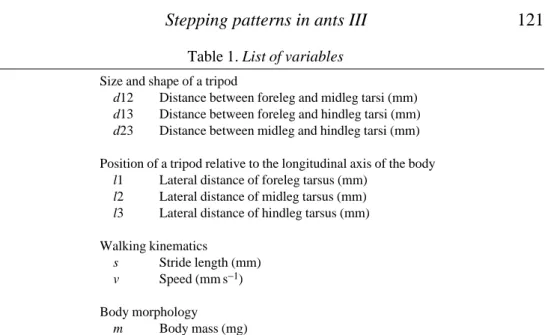
Data acquisition followed the procedures described previously (Zollikofer, 1994a). Stepping pattern geometry, walking kinematics and body morphology were described by a set of variables (Table 1). Data analysis and statistical tests were performed with the Statistical Analysis Software package SAS. The effects of load-carrying on stepping patterns were tested by comparing the locomotory performance under different loading conditions. To this end, mean values of the variables for each loading level were submitted to an analysis of variance (SAS procedure GLM). The effect of load-carrying on walking kinematics was tested by comparing loaded and unloaded trips with respect to the curvilinear regressions of stride length (s) versus speed (v) (SAS procedure REG, analysis of covariance).
Results
As described previously (Zollikofer, 1994a), in the absence of load, the spatial tripod arrangement of the workers’ legs of Cataglyphis fortis is held constant, irrespective of the running speed.
were calculated for every loading level. The analyses show that, with increasing load, the tripods undergo increased distortion. Data from two indivduals of different body size are presented in Fig. 1i and Fig. 1ii, respectively. In Fig. 1Ai and Fig. 1Aii, undistorted tripods (i.e. in the absence of load) are compared with tripods exhibiting maximum distortion. In distorted tripods, the hindleg and the midleg are placed more laterally, whereas the foreleg is positioned closer to the longitudinal axis of the body. The distances between midleg and hindleg tarsi are increased, while the foreleg-to-midleg distance remains approximately constant. In general, these effects increase with increasing load (Fig. 1Bi).
However, the effects of increasing the volume of the food item must be discriminated from the effects of increasing its mass. A bulky food item may restrain the movements of the legs and cause tripod distortion. To test this hypothesis, the effects of loading the ants with a low-density item of extensive area (3 mg, 27 mm3) were compared with the effects
of a small high-density item (40 mg, 5 mm3). The changes in the leg arrangement
(Fig. 1Bii) suggest that tripod distortion is due to the mass rather than to the volume of the food item.
Food items held between the mandibles may affect the mechanics of locomotion in two ways: first, by increasing the load acting upon the legs and, second, by causing the centre of mass to shift forwards. Under natural conditions, workers of C. fortis always hold food items between their mandibles. Thus, the shift of the centre of mass induced by the load is directly proportional to the mass of that load (Fig. 1Bi). To separate these two effects, ants were tested while carrying a load glued onto their metathorax. Calculations carried out on one individual (Fig. 1Bii) show that the 30 mg load held between the mandibles
Table 1. List of variables
Size and shape of a tripod
d12 Distance between foreleg and midleg tarsi (mm)
d13 Distance between foreleg and hindleg tarsi (mm)
d23 Distance between midleg and hindleg tarsi (mm)
Position of a tripod relative to the longitudinal axis of the body
l1 Lateral distance of foreleg tarsus (mm)
l2 Lateral distance of midleg tarsus (mm)
l3 Lateral distance of hindleg tarsus (mm)
Walking kinematics
s Stride length (mm)
v Speed (mm s−1)
Body morphology
m Body mass (mg)
4.5 5.0 5.5 2.0 2.2 2.4 2.6 1.8 2.0 2.2 2.4 2.6 1.8 4.5 5.0 3 20 30 40 40 30 0 0 Log speed
Mandibular load (mg) Mandibular load (mg) Load glued onto thorax (mg)
Ci Cii
Log stride length
No load No load L1 R2 L3 5mm Maximum distortion
Without load Without load Maximum distortion
Tripod L1R2L3 Tripod L1R2L3
Walking direction Ai Aii l1 l2 l3 d12 d13 d23 0 2 4 6 8 10 12 14
0 1 2 3
2 4 6 8 10 12 14 16
–1 0 1 2 3
Shift of centre of mass (mm) Load (mg)
40 30 20
3 40 30
0 0
Tripod geometry (mm)
causes the centre of mass to be shifted 3 mm in the anterior (positive) direction, whereas the 40 mg thoracic load elicits a 1 mm shift in the posterior (negative) direction. Accordingly, tripod distortion proved to be positive in the former and negative in the latter situation. This suggests that distortion is proportional to the shift of the centre of mass elicited by the load, even under artificial conditions.
4.8 mm
5.3 mm
3.0 mm
A B
Fig. 2. Shortening of stride length in Cataglyphis fortis carrying loads (same individual as in Fig. 1i). Both figures show the ant putting down the tripod R1L2R3 (right foreleg, left midleg and right hindleg, respectively; solid lines) as its centre of mass leaves the previous tripod L1R2L3 (left foreleg, right midleg and left hindleg; dotted tripod). When walking without a load (A), the centre of mass of the body (black triangle) lies in the posterior part of the thorax and foreleg extension is 4.8 mm. Carrying a 40 mg load (B) causes a 3 mm forward shift of the centre of mass. Despite maximum leg extension (5.3 mm), step length (tripod distance; 3.0 mm) has to be shortened in order to maintain equilibrium.
Fig. 1. Effects of load on the locomotory performance in Cataglyphis fortis. Data from two individuals (i, body mass 5.5 mg; ii, 10.2 mg). (A) Geometric representation of tripod deformation. Shape and position during outward trips (without load) and during homeward trips with a load causing maximum distortion; L1, R2 and L3, footfall positions of left foreleg, right midleg and left hindleg, respectively; the variables measuring tripod geometry are indicated in the leftmost graph and explained in Table 1. (B) Deformation of tripod shape versus loading. Vertical axis: variables measuring tripod geometry (d12, d13, d23, l1, l2, l3, see A and Table 1). Horizontal axis: shift of the centre of mass elicited by different loads; the masses of the loads are indicated on top of the graph; load items had a volume of 4±2 mm3, except for one item (3 mg, 27 mm3, large symbols in Bi); negative shift of the centre of mass
was induced by gluing a load to the metathorax (Bii, marked with an arrow). (C) Log–linear plot of mean values and standard deviations of stride length (s in mm) versus speed (v in mm s21). Although both s
and v are reduced with increasing load, the log–linear regression remains constant. Regressions (with standard errors) for pooled data are: (dotted lines) (Ci) logs = (0.554±0.057) + (0.341±0.012)logv;
N=1388, r=0.38, P<0.01; (Cii) logs = (1.118±0.074) + (0.221±0.015)logv; N=582, r=0.26, P<0.01. The
Both mean stride length (s) and mean speed (v) are reduced in ants carrying a load (Fig. 1C). Reduction of stride length is a direct consequence of the forward shift of the centre of mass, which will leave the boundaries of a tripod earlier in the stepping cycle, forcing the animal to put down the next tripod nearer to the previous one. This effect is compensated for, to a certain extent, by putting down the legs in the anteriormost position relative to the body. A numerical analysis carried out on one individual shows that the average foreleg extension in normal walking is 4.8 mm (Fig. 2A). When carrying a 40 mg load, leg extension increases to 5.3 mm, a figure corresponding to the anatomical limits set by the leg length (Fig. 2B).
While carrying a 30 mg load held between the mandibles, stride length was shorter than during carrying a 40 mg load glued onto the metathorax (Fig. 1Cii). This indicates that the reduction of stride length is proportional to the forward shift of the centre of mass rather than to the mass itself. However, stride length during trips with a thoracic load is shorter than during unloaded trips. Following the above arguments, one would expect longer strides in the former situation due to the backward shift of the centre of mass. This point will be discussed below.
As has been shown earlier (Zollikofer, 1994b), the relationship between stride length (s) and speed (v) can be characterized by the following log–linear equation:
logs = a + blogv,
where a and b are the intercept and the slope of the regression line, respectively. A comparison of the s/v relationships of unloaded (outward) and loaded (homeward) trips shows that there are no statistically significant differences in a and b between the functions (analysis of covariance, P>0.20). This shows that the walking kinematics remain essentially the same. Although tripod geometry is changed during load-carrying, stride length and stride frequency are not altered at any speed when carrying a load compared with trips without a load (Fig. 1Ci,ii).
Discussion
The alternating tripods of a walking insect may be compared to the footfalls of a bipedal animal (Full et al. 1991). The main difference is that the tripod arrangement provides a larger area of support in an insect, leading to greater stability. For static equilibrium to be maintained during walking, the centre of mass should not pass over the boundaries of one tripod before the following tripod is laid down. As has been shown in running ants (Zollikofer, 1994b), static equilibrium is lost in favour of extending stride length and introducing aerial phases. In ants carrying loads, however, aerial phases are no longer possible and the maintenance of static equilibrium becomes increasingly important. As the centre of mass is shifted forwards, ants preserve equilibrium conditions by putting down tripods closer to each other (Fig. 2A). To avoid excessive shortening of stride length, ants extend the legs further forward when loaded compared with unloaded trips (Fig. 2B). Reduction of stride length was shown to be proportional to the shift of the centre of mass elicited by the load rather than to the mass of the load (Fig. 1C).
reduction of stride length necessary to compensate for the forward shift of the centre of mass. However, this argument cannot explain the observed reduction of stride length during a backward shift of the centre of mass (Fig. 1Bii,Cii). Considering the high load ratio (total mass/mass of the body=50.5 mg/10.5 mg=4.8) in this situation, the reduction of stride length and speed may be due to physiological limits of muscle force generation. Reduction of speed during load-carrying has been reported in several ant species (Veromessor pergandei: Rissing, 1982; Atta colombica: Lighton et al. 1987; Eciton
hamatum: Bartholomew et al. 1988; Pogonomyrmex rugosus: Lighton et al. 1993) and
may reflect constraints that are similar to those found in Cataglyphis fortis.
Tripod deformation during load-carrying turned out to be proportional to the shift of the centre of mass elicited by the load rather than to its mass or its volume. Artificially induced negative (backward) shifts caused ‘negative’ deformations of the tripods (Fig. 1Bii). Only a minor part of the tripod distortions, the increase in lateral extension of the mid- and hindlegs, can be interpreted as an improvement of static equilibrium conditions. As an alternative, tripod modification may be regarded as a readjustment of tarsal positions in order to maintain optimal conditions for force generation. As force measurements in ants are not available, there is no way of evaluating the significance of the observed distortions. However, evidence from other arthropods supports this view. For instance, Dean (1991) showed that experimental alterations in load applied to single legs of Carausius morosus elicited changes in the interleg coordination pattern. In another study on crayfish (Grote, 1981), marked differences between terrestrial and aquatic stepping patterns were observed because, during terrestrial locomotion, the force required to propel the body was substantially higher than under aquatic conditions.
remain unchanged in laden ants and this is probably a prerequisite for keeping low the cost of carrying a load.
It has been shown that the most important factor influencing walking kinematics and tripod geometry is the forward shift of the centre of mass elicited by the load. A shift of the centre of mass modifies the relative loadings of the legs. Thus, tripod distortion observed in ants carrying loads may be interpreted as an adaptation of posture and of muscle force generation patterns to keep constant the temporal profile of acceleration of the centre of mass. Following this argument, load carriage would be most efficient if the horizontal shift of the centre of mass induced by the load were minimized, i.e. if the load were carried as close as possible to a vertical line through the centre of mass. For humans, this implies that the load should be supported by the head; evidence for efficient load carriage resulting from this strategy is given by Maloiy et al. (1986).
In Cataglyphis fortis, overhead carriage could be simulated by gluing a load onto the thorax, near the centre of mass of the body. An item of considerable mass fixed at this position had little effect on the locomotor behaviour compared with an item of smaller mass carried between the mandibles (Fig. 1Bii,Cii). Overhead load carriage as a natural habit has been analyzed in the leaf-cutter ant Atta colombica (Lighton et al. 1987). Workers of this species carry relatively heavy vegetable items containing a relatively small specific amount of usable energy. The desert harvester ants Cataglyphis fortis (Wehner, 1987) and Pogonomyrmex rugosus (Lighton et al. 1993) and the army ant
Eciton hamatum (Bartholomew et al. 1988) rely on a different strategy. They are feeding
on lightweight animal or vegetable foodstuff containing large amounts of energy. Holding the food items between the mandibles and hung between the legs seems to be adequate under normal conditions. However, as has been observed by the author, workers of Cataglyphis fortis transporting a food item weighing more than three times their body mass tend to drag it on the ground while walking backwards.
References
BARTHOLOMEW, G. A., LIGHTON, J. R. B. ANDFEENER, D. H. (1988). Energetics of trail running, load carriage and emigration in the column-raiding army ant Eciton hamatum. Physiol. Zool. 61, 57–68. DEAN, J. (1991). Effects of load on leg movements and step coordination of the stick insect Carausius
morosus. J. exp. Biol. 156, 449–472.
FULL, R. J., BLICKHAN, R. ANDTING, L. H. (1991). Leg design in hexapedal runners. J. exp. Biol. 156, 369–390.
GROTE, J. R. (1981). The effect of load on locomotion in crayfish. J. exp. Biol. 92, 277–288.
HERREID, C. F. ANDFULL, R. J. (1986). Energetics of hermit crabs during locomotion: the cost of
carrying a shell. J. exp. Biol. 120, 401–408.
JANDER, J. P. (1985). Mechanical stability of stick insects when walking around curves. In Insect
Locomotion (ed. M. Gewecke and G. Wendler), pp. 33–42. Berlin, Hamburg: Paul Parey.
LIGHTON, J. R. B., BARTHOLOMEW, G. A. ANDFEENER, D. H. (1987). Energetics of locomotion and load
carriage and a model of the ecergy cost of foraging in the leaf-cutting ant Atta colombica. Physiol.
Zool. 60, 524–537.
LIGHTON, J. R. B., WEIER, J. A. ANDFEENER, D. H. (1993). The energetics of locomotion and load carriage in the desert harvester ant Pogonomyrmex rugosus. J. exp. Biol. 181, 49–61.
MALOIY, G. M., HEGLUND, N. C., PRAGER, L. M., CAVAGNA, G. S. ANDTAYLOR, R. C. (1986). Energetic
harvesting ant Messor capitatus. I. Respiratory metabolism and energy consumption of unloaded and loaded workers during locomotion. Physiol. Ent. 15, 441–448.
RISSING, S. W. (1982). Foraging velocity of seed-harvester ants, Veromessor pergandei (Hymenoptera, Formicidae). Env. Ent. 11, 905–907.
TAYLOR, C. R., HEGLUND, N. C., MCMAHON, T. A. ANDLOONEY, T. R. (1980). Energy cost of generating muscle force during running: a comparison of large and small animals. J. exp. Biol. 86, 9–18. WEHNER, R. (1987). Spatial organization of foraging behavior in individually searching ants,
Cataglyphis (Sahara desert) and Ocymyrmex (Namib desert). In Behavior in Social Insects, Experientia, Supplement, vol. 54 (ed. J. M. Pasteels and J.-L. Deneubourg), pp. 15–42. Basel, Boston:
Birkhäuser.
ZOLLIKOFER, C. P. E. (1994a). Stepping patterns in ants. I. Influence of speed and curvature. J. exp. Biol. 192, 95–106.