Evaluation of Shared-View Acquisition Using Repeated Echoes
(SHARE): A Dual-Echo Fast Spin-Echo MR Technique
Blake A. Johnson, Evan K. Fram, Burton P. Drayer, Bruce L. Dean, Paul J. Keller, and Ronald Jacobowitz
PURPOSE: To compare the clinical efficacy of a dual-echo fast spin-echo imaging technique,
SHARE (shared-view acquisition using repeated echoes), with conventional long-repetition-time spin-echo imaging. METHODS: Conventional spin-echo and SHARE fast spin-echo MR images of the brain were acquired in 50 randomized patients and interpreted separately in conjunction with the T1-weighted images. All images were reviewed independently by two neuroradiologists who were blinded to the clinical history and previous interpretations. RESULTS: The diagnoses rendered for the spin-echo and SHARE images were concordant in 48 of the 50 subjects (96%) by the first reader and in all 50 cases ( 1 00%) by the second reader. SHARE images were acquired in one-fourth of the imaging time yet image contrast, quality, and sensitivity to long T2 lesions were comparable. The SHARE technique was less sensitive to hemorrhagic residua. CONCLUSIONS: SHARE is a viable time-saving alternative to the conventional long-repetition-time pulse sequence. Although SHARE images are not as sensitive to magnetic susceptibility effects, the time saved using this technique could be used to perform a gradient-echo sequence when indicated.
Index terms: Magnetic resonance, comparative studies; Magnetic resonance, technique; Brain,
magnetic resonance; Efficacy studies
AJNR Am J Neuroradio/15:667-673, Apr 1994
Several variations of the rapid acquisition with relaxation enhancement technique (1, 2) have been investigated as potential time-saving re-placements for long repetition time (TR) spin-echo images (3, 4). In this trial, we compared conventional long-TR dual-echo spin-echo imag-ing with the SHARE technique (shared view ac-quisition using repeated echoes), a variation of the RARE pulse sequence. SHARE images are generated by using a fast spin-echo train consist-ing of 6 echoes. The 40- and 80-msec echoes encode the middle of k space to generate two
images at these effective echo delay times. In
Received December 28, 1992; accepted pending revision April 26,
1993; revision received June 28.
Presented at the 30th Annual Meeting of the ASNR, St. Louis, Missouri, May 31-June 5, 1992.
From the Department of Neuroradiology, Barrow Neurological Insti
-tute, St. Joseph Medical Center, Phoenix, Arizona (B.A.J., E.K.F., B.P.D., B.L.D., P.J.K.) and the Department of Mathematics, Arizona State Uni -versity, Tempe, Arizona (R.J.).
Address reprint requests to Evan K. Fram, MD, Department of Neuroradiology, Barrow Neurological Institute, 350 W. Thomas Road, Phoenix, AZ 85258.
AJNR 15:667-673, Apr 1994 0195-6108/94/1504-0667 © American Society of Neuroradiology
667
clinical practice this technique results in a 25% improvement in speed over conventional fast spin-echo techniques when the acquisition time
is TR limited. SHARE provides two "effective
echoes" with intermediate and T2-weighted con-trast characteristics, similar to the spin-echo se-ries.
Methods
A prospective comparison between SHARE and long-TR spin-echo imaging was performed on 50 randomized patients. The images were obtained over a 3-month period from November 1991 to January 1992. A prospective blinded comparison of conventional spin-echo and SHARE fast spin-echo imaging was effected by supplementing the conventional spin-echo magnetic resonance (MR) se
668 JOHNSON
SHARE Technique
This modification of the RARE technique uses the ac -quisition of multiple spin echoes after each 90° pulse (Fig
1). With a TR of 2600 msec, spin echoes are formed every 20 msec from 20 to 120 msec. The first echo is formed but not sampled. The SHARE scheme for Fourier space mapping has already been described (E.K. Fram, P.J. Keller, and B.P. Drayer, Rapid Spin Echo Imaging (RARE) Producing Two Effective Echo Times by Sharing Views, presented at the Society of Magnetic Resonance in Medi-cine, 1991 ). The center of k space is sampled at both 40 and 80 msec. Because the central views in Fourier space determine image contrast, the resultant SHARE images have effective echo times (TEeff) of 40 and 80 msec, respectively (2600/40,80/1). The higher-order phase-en-coding steps (mapped to the periphery of k space) are sampled with echoes at 60, 100, and 120 msec. These views are shared by both (40 and 80 msec TEeff) images, which allows data for the short and long-TE images to be acquired simultaneously. The SHARE method of k space mapping maintains symmetry and provides relatively smooth transitions through k space. Five millimeter-thick axial images are obtained with a 20-cm field of view, 16-kHz bandwidth, 256 X 192 matrix using a single excitation per view. This technique provides 18 axiallong-TR images of the brain in a 2: 10 acquisition time.
Image Analysis
All spin-echo and SHARE images were reviewed inde-pendently by two of three neuroradiologists (E.K.F., B.P.D., B.L.D.) who were blinded to the clinical history and previous interpretations. The long-TR spin-echo and SHARE images were interpreted separately in conjunction with the spin-echo T1-weighted images and evaluated for the presence and identity of focal signal abnormalities, which were indi-vidually marked on each image. A diagnosis was independ-ently derived for each study. After the spin-echo and SHARE images were evaluated separately by each of two readers, the images and interpretations were compared by a third reader (B.A.J.). This comparison included assess-ment of the number of focal signal abnormalities recognized using each of the techniques via a point-by-point compar-ison on the SHARE and spin-echo images. The diagnosis assigned to each set of images was also assessed for concordance between the SHARE and spin-echo readings. The relative amount of image degradation caused by mo-tion and flow-induced artifacts was then compared.
Statistical Analysis
The sensitivities demonstrated by each technique for the detection of hyperintense and hypointense foci (< 3 mm) were compared separately as follows. The probabili-ties that the readers would recognize a focus were estimated for each technique and then compared by a formal hy-pothesis test. Each estimate was obtained as the proportion of foci recognized with one technique (spin-echo or SHARE)
AJNR: 15, April 1994
out of the total number recognized with both methods. The test consisted of comparing these two probabilities using the normal approximation to the binomial with a 2-tailed alternative.
Results
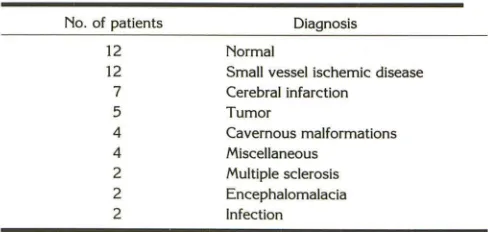
A wide cross-section of disease was encoun-tered in our cohort of patients (Table 1). Subjects ranged in age from 2 months to 89 years (mean, 49 years). The geographic and signal character-istics of mass lesions such as neoplasms corre-lated closely on conventional spin-echo and SHARE fast spin-echo images (Fig 2). Descrip-tions of all neoplasms were concordant, and side-by-side comparisons of the two techniques re-vealed no discrepancies.
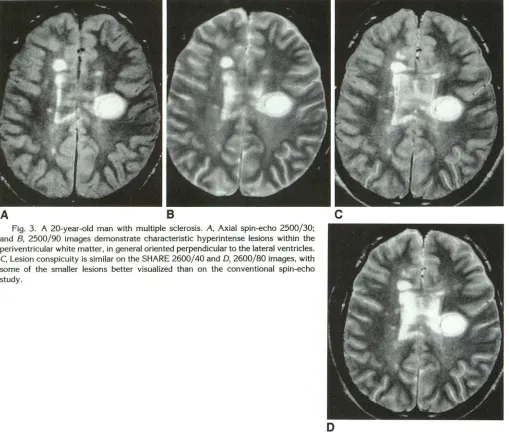
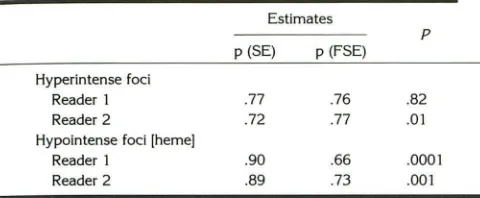
Focal high-signal white-matter lesions were demonstrated equally well on both techniques; in some cases, these small foci were better depicted on the SHARE images (Fig 3). Statistical analyses of the detection of hyperintense periventricular and subcortical white-matter lesions using the spin-echo and SHARE techniques are presented
IMAGE
VIEW NUMBER
PHASE ENCODE
ECHO
FIRST BOTH SECOND BOTH BOTH
49· 72 25·48 1·24 73·120 121·144 73•120 145·168 169-192
Fig. 1. Pulse sequence timing diagram for SHARE technique. The multiecho train consists of 6 echoes, formed at 20-msec intervals. The first echo is not sampled, but its formation is an important feature of SHARE.
TABLE 1: Categories of disease
No. of patients
12 12 7 5 4 4 2 2 2 Diagnosis Normal
Small vessel ischemic disease Cerebral infarction
Tumor
Cavernous malformations Miscellaneous
[image:2.612.318.562.385.562.2] [image:2.612.317.561.629.745.2]AJNR: 15, April 1994
A
Bc
D
in Table 2. These data show that the sensitivities for the detection of hyperintense white-matter foci for the two methods were equal by the first observer, but SHARE was slightly more sensitive than spin-echo according to the second
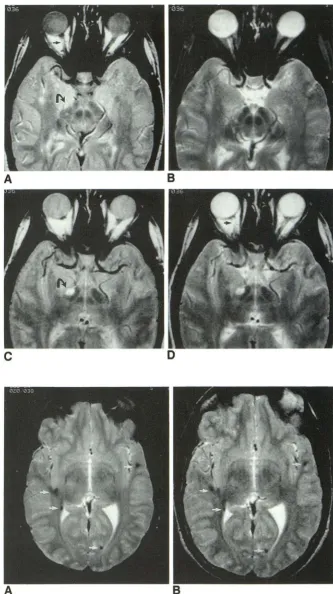
observ-er's results (Table 2). In one patient with multiple sclerosis, optic nerve lesions were identified pro-spectively only on the SHARE images (Fig 4).
The signal characteristics of hemorrhage were similar on the two techniques, although the hy-pointense components were not as conspicuous on the SHARE images. Thus, SHARE was less sensitive to small deposits of hemosiderin, which manifest as subtle hypointense foci (Fig 5). Al-though hemorrhagic foci and blood degradation
SHARE EVALUATION 669
Fig. 2. A 69-year-old man with a left thalamic glioma. A, axial spin-echo 2500/
30 and B, 2500/90 images show a hyperin
-tense left thalamic mass partially effacing the third ventricle. The geographic and con
-trast characteristics of the lesion correlate
closely on the SHARE images, C, 2600/40;
D, 2600/80.
products greater than 3 to 4 mm in diameter were detected with equal accuracy, conventional spin-echo allowed recognition of a greater num-ber of smaller lesions (Table 2). However, because there were multiple foci in most patients with hemorrhagic lesions, this only affected the final impression in one patient by one of the observers (see below).
[image:3.614.53.381.76.538.2]670 JOHNSON AJNR: 15, April 1994
A
Bc
Fig. 3. A 20-year-old man with multiple sclerosis. A, Axial spin-echo 2500/30;
and B, 2500/90 images demonstrate characteristic hyperintense lesions within the
periventricular white matter, in general oriented perpendicular to the lateral ventricles.
C, Lesion conspicuity is similar on the SHARE 2600/40 and D, 2600/80 images, with
some of the smaller lesions better visualized than on the conventional spin-echo
study.
subtle focus of residual hemosiderin subjacent to a craniotomy site was not detected on the SHARE images; the history of craniotomy was not avail-able to the readers in this blinded study. Although the final impressions on the SHARE and spin-echo studies were not identical for these two cases, clinical management would not have been affected by these discrepancies. There was con-cordance of the final impressions in all 50 cases in the second readers who were blind to the first set of interpretations.
Side-by-side comparison of SHARE and spin-echo images for the relative degree of flow-related artifacts revealed no difference in 19 cases (38% ). SHARE was superior to spin-echo in 19 (38%) and the SHARE images showed more image deg-radation caused by blood or cerebrospinal fluid motion than the spin-echo images in 12 cases
D
(24% ). Artifacts caused by J'>atient motion were less conspicuous on the SHARE images in 7 (14%) patients and more conspicuous in 7 (14%) patients. There was no appreciable difference in 36 (72%).
Discussion
SHARE images provide similar contrast char-acteristics to conventional spin-echo long-TR im-ages and are obtained in one-fourth of the acqui-sition time. The interpretations rendered for the two techniques were identical in 98 of 100 blinded readings.
[image:4.612.53.562.81.521.2]hyper-AJNR: 15, April 1994
TABLE 2: Statistical analysis: probabilities of detecting hyper- or hypointense foci using spin-echo (SE) or SHARE (FSE) techniques
Estimates
p
p (SE) p (FSE)
Hyperintense foci
Reader 1 .77 .76 .82
Reader 2 .72 .77 .01
Hypointense foci [heme]
Reader 1 .90 .66 .0001
Reader 2 .89 .73 .001
intense white matter foci. The second readings
showed a statistically significant difference,
al-though the difference may not be clinically sig-nificant. Possible explanations for the higher sen-sitivity demonstrated by the SHARE images in-clude a more heavily T2-weighted first echo
image in this sequence (TE = 40 msec vs 30
msec for the spin-echo sequence). In addition, edge-enhancement effects, demonstrated by multiple-echo acquisition Iong-TE images (5), may contribute to improved detection of small,
high-signal lesions. The inclusion of higher-order
echo samples (at 100 and 120 msec) may also contribute to the sensitivity of the SHARE tech-nique to small hyperintense foci because of the
heavier T2 weighting of the long-TE data. Al
-though all of these factors might also contribute to the hyperintense appearance of perivascular spaces on intermediate-weighted images, Vir-chow-Robin spaces were rarely mistaken for punctate white matter lesions in this trial. The location and configuration of the spaces and the use of the T1-weighted images likely played a role in preventing such mistakes. In addition, the intermediate-weighted SHARE images were not compromised by blurring, as reported with other techniques (4, 6).
Our results show that SHARE is less sensitive than spin-echo imaging to magnetic susceptibility effects (Table 2), a characteristic demonstrated by other fast spin-echo techniques (4, 6). One consequence is decreased sensitivity for the de-tection of small hemorrhagic foci. This is clearly disadvantageous in certain cases. Conversely, the lower sensitivity to focal field inhomogeneities can be exploited for imaging postoperative pa-tients with indwelling metallic hardware or other
sources of ferromagnetic artifacts (5). In our
ex-perience, SHARE images are less severely com-promised by magnetic susceptibility artifacts in patients with surgical hardware and other metallic devices because of the decreased sensitivity to field inhomogeneity.
SHARE EVALUATION 671
Many "fast spin-echo" techniques have been
evaluated in the recent literature (3, 4, 7-9).
Conclusions regarding these techniques are not universal by virtue of a common label, as varia-tions of the multiple sequence parameters signif-icantly affect image characteristics. Interecho de-lay (between successive echoes) and echo train length affect such image qualities as sharpness, contrast, and sensitivity to magnetic susceptibil-ity effects (7 -1 0). Thus the specific pulse
se-quence used to obtain the data in a fast
spin-echo technique will have a significant impact on
image characteristics. The phase-encoding order
is another parameter that varies with technique (8) and has a significant impact on image contrast characteristics. Not all authors are in agreement
regarding the contrast mechanisms in fast spin
-echo imaging (9, 11). However, the following
factors probably contribute to the contrast char-acteristics: 1) decreased J modulation of spin echoes, 2) stimulated echoes, 3) magnetization transfer effects, and 4) lack of diffusion-induced losses across susceptibility gradients.
Other workers have reported greater image degradation caused by flow or motion artifacts on fast spin-echo images than on spin-echo im-aging (6, 8). We did not encounter these
difficul-ties and, in some cases, the SHARE images
showed less degradation caused by motion and flow artifacts than the corresponding velocity-compensated spin-echo images, despite the fact that no flow compensation gradients were used
in the SHARE technique. Instead, SHARE is aided
by even-echo rephasing because of the
unsam-pled first echo at 20 msec, which renders the
echoes at 40 and 80 msec even echoes. The 40- and 80-msec views are thus inherently flow compensated, and SHARE images (with 40- and 80-msec effective TE) are comparable to flow-compensated spin-echo images. This apparent insensitivity to motion occurs regardless of the fact that stimulated echo components of the 40-and 80-msec signals do not benefit from
even-echo rephasing.
Clinical Application
The decrease in acquisition time provided by SHARE may be used to augment image resolution
or signal-to-noise ratio via an increase in matrix
size or number of signal averages, respectively.
Alternatively, an additional sequence may be
[image:5.612.55.295.106.205.2]672 JOHNSON
Fig. 4. A 28-year-old woman with mul-tiple sclerosis. A, Axial spin-echo 2500/30 and B, 2500/90 images do not show the hyperintense optic nerve lesions as well as
the SHARE fast spin-echo technique seen on C, 2600/40 and D, 2600/80 (arrows).
The lesions were noted prospectively on the SHARE study only. The right cerebral pe-duncle lesion is also better visualized on the
SHARE images (curved arrows). Patient had
subclinical optic neuritis with abnormal vis-ual evoked potentials bilaterally.
Fig. 5. A 16-year-old boy with multiple cavernous malformations. A, 2500/90
im-age demonstrates multiple punctate hypoin-tense foci consistent with hemosiderin dep-osition. B, The SHARE axial 2600/80 image does not demonstrate the same degree of hypointensity at these locations, resulting in less contrast with the adjacent normal brain.
A
c
A
For example, to screen for small hemorrhagic
foci, as in closed head injury patients, or to rule out multiple vascular malformations, a gradient-echo sequence can be performed in addition to
AJNR: 15, April1994
D
8
the SHARE sequence. These two sequences can
be accomplished in less time than a long-TR
spin-echo sequence, and the combination provides
[image:6.615.230.563.75.669.2]AJNR: 15, April 1994
gradient-echo exam is more sensitive for the
detection of small hemorrhagic foci than
spin-echo, and the SHARE images provide comparable
sensitivity to high-signal lesions. In other patients,
Tl-weighted spin-echo sagittal and SHARE axial sequences could be performed for a screening MR exam of the brain which can be accomplished
in less than 5 minutes. In many clinical situations,
the SHARE technique saves significant time
with-out significantly sacrificing image quality or
ac-curacy and thus should be considered as a
re-placement for long-TR spin-echo images.
Acknowledgment
We thank the St. Joseph's Medical center MR techni-cians for their energetic contribution to this project.
References
1. Henning J, Nauerth A, Friedburg H. RARE Imaging: a fast imaging method for clinical MR. Magn Reson Med 1986;3:823-833 2. Henning J, Friedburg H. Clinical applications and methodological
developments of the RARE technique. Magn Reson Imaging
1988;6:391-395
SHARE EVALUATION 673
3. Haacke EM, Bearden FH, Clayton JR, Linga NR. Reduction of MR
imaging time by the hybrid fast-scan technique. Radiology
1986; 158:521-529
4. Melki PS, Mulkern RV, Panych LP, Jolesz FA. Comparing the FAispin -echo method with conventional dual-echo sequences. J Magn Reson Imaging 1991 ;1319-1326
5. Jones KM, Mulkern RV, Schwartz RB, Oshio K, Barnes PD, Jolesz FA. Fast spin-echo MR imaging of the brain and spine: current concepts. AJR Am J Roentgenol 1992; 158:1313-1320
6. Jones KM, Mulkern RV, Mantello MT, et al. Brain hemorrhage: evaluation with fast spin-echo and conventional dual spin-echo im
-ages. Radiology 1992; 182:53-58
7. Constable RT, Smith RC, Gore JC. Signal-to-noise ratio and contrast in fast spin echo (fast spin-echo) and inversion recovery fast
spin-echo imaging. J Comput Assist Tomogr 1992;16:41-47
8. Tien RD, Felsberg GJ, MacFall J. Practical choices of fast spin echo pulse sequence parameters: clinically useful proton density and T2
-weighted contrasts. Neuroradiology 1992;35:38-41
9. Constable RT, Anderson AW, Zhong J, Gore JC. Factors influencing
contrast in fast spin-echo MR imaging. Magn Reson Imaging
1992;10:497-511
10. Mulkern RV, Wong STS, Winalski C, Jolesz FA. Contrast manipula-tion and artifact assessment of 2D and 3D RARE sequences. Magn Reson Imaging 1990;8:557-566
11. Henkelman RM, Hardy PA, Bishop JE, Poon CS, Peiwes DB. Why fat is bright in RARE and fast spin-echo imaging. J Magn Reson Imaging