
ISSN Online: 2158-7086 ISSN Print: 2158-706X
Synthesis and Characterization of a
[Li
0+x
Mg
2−2x
Al
1+x
(OH)
6
][Cl∙mH
2
O]
Solid Solution with X = 0 - 1 at
Different Temperatures
A. Niksch, H. Pöllmann
Mineralogy/Geochemistry, Institute for Geosciences and Geography, University of Halle, Halle, Germany Email: [email protected]
Abstract
The synthesis of a novel Li+ /Mg2+ /Al3+ containing layered double hydroxide
(LDH) by using a hydrothermal synthesis route is represented in this work. The autoclaves were heated up to 100˚C, 120˚C, 140˚C and 160˚C for 10 h and 48 h with a water to solid ratio (W/S) of 15:1. The physicochemical prop-erties of the synthesized LDHs were investigated by X-ray powder diffraction (PXRD), fourier transform infrared spectroscopy (FTIR), thermo gravimetric and differential thermal analysis (TG-DTA), inductively coupled plasma op-tical emission spectroscopy (ICP-OES) and scanning electron microscopy (SEM). The formation of a solid solution phase depends strongly on the composition of the reactants and the synthesis temperature. Using an exact stoichiometric ratio of Li+/Mg2+/Al3+ resulted in the synthesis of amorphous
phases without producing plenty of crystalline amounts of the expected solid solutions while using higher temperatures than 140˚C resulted in a formation of AlO(OH). To avoid the formation of an Al containing amorphous phase or an AlO(OH) crystalline phase, the stoichiometric ratio of Li+ was changed.
The results show solid solutions with the formula [Li0+xMg2−2xAl1+x(OH)6]
[Cl·mH2O] with X ≥ 0.9. The lattice parameters and chemical compositions
for solid solutions with different compositions were determined and the pure solid solution with the highest amount of Mg (x = 0.9) is [Li0.9Mg0.2Al1.9(OH)6]
[Cl∙0.50H2O] with the lattice parameters a = 5.1004(4) Å, c = 15.3512(1) Å, V
= 345.844(9) ų. For X < 0.9 two separate phases, a Mg2+ and a Li+ dominated
solid solution, are coexistent.
Keywords
Lithium LDH, Magnesium LDH, Solid Solution, X-Ray Powder Diffraction How to cite this paper: Niksch, A.
Pöllmann, H. (2017) Synthesis and Cha-racterization of a
[Li0+xMg2−2xAl1+x(OH)6][Cl∙mH2O] Solid So- lution with X = 0 - 1 at Different Tempera-tures. Natural Resources, 8, 445-459. https://doi.org/10.4236/nr.2017.86029
Received: March 16, 2017 Accepted: June 25, 2017 Published: June 28, 2017
Copyright © 2017 by authors and Scientific Research Publishing Inc. This work is licensed under the Creative Commons Attribution International License (CC BY 4.0).
1. Introduction
Layered double hydroxides (LDHs) consist of alternate positively charged mixed metal hydroxide layers and negative charged interlayer anions. The stoichiome-try of these materials can be formulated as [Mz+
1−xM3+x(OH)2]p+[(An−)p/n·mH2O]
with z = 2, M = bi- and trivalent metallic elements, A = organic or inorganic anions and m = amount of interlayer H2O depending on the temperature,
rela-tive humidity and hydration level [1]. A special case is Mz+ = Li+(z = 1) and M3+
= Al3+. The ratio between Li and Al is always 1:2 [2] while the ratio between Mz+
and M3+ (z = 2) can vary strongly [3] depending on which M2+ ion or synthesis
parameters are used. These layered materials are able to intercalate negatively charged and neutral molecules or exchange the interlayer anion with organic [4] [5] [6] [7] [8] or inorganic [3] [9] anions of different sizes or charges. The [Mz+
1−xM3+x(OH)2]p+ main layer remains stable and is not capable of ion
ex-change once it is formed.
Two well-known and described LDHs are [LiAl2(OH)6] [Cl∙mH2O] [2] [9] [10] and [Mg2Al(OH)6] [Cl∙mH2O] [11]. Both compounds are generally
synthe-sized by a direct reaction of a LiXor MgX2(X = Cl−, OH−, NO3−, etc) with
Al(OH)3[2/4]or by a hydrothermal reaction with higher temperatures and
pres-sures [1].
The structure of Al(OH)3is built up of double layered sheets of hexagonally
packed O atoms. Two thirds of the octahedral holes are occupied by Al atoms. Using LiX as the reaction partner leads to the formation of [LiAl2(OH)6]
[X·mH2O] with Li+ cations entering the vacancies in the aluminum hydroxide
layers and A entering the interlayer space [1] [9]. The structure of the resulting Li-LDH depends directly on the structure of the used aluminium hydroxide. Syntheses using gibbsite as starting material leads to Li-LDHs with hexagonal symmetry, while reactions with bayerite or nordstrandite produce LDHs with rhombohedra symmetry [1] [10] [12]. In the brucite-like structure of [Mg2Al(OH)6][X·mH2O], Mg2+ is octahedrally coordinated to six OH− anions.
These octahedrons share edges and form thereby a layer. Substituting Mg2+ with
a trivalent ion like Al3+ leads to a positive charge which can be compensate by
interlayer anions [11]. [Mg2Al(OH)6][X·mH2O] can also be rhombohedra or
hexagonal [13] [14]. The pure [Mg2Al(OH)6] [X·mH2O] phase produced within
this work was hexagonal (P6/m).
Almost all publications concerning the interlayer anion exchange or the syn-thesis and physicochemical properties use a combination of Mz+ (z = 1 or 2) +
M3+ in the main layer with a variation of two different elements [3] [5] [15]-[20].
The aim of this research is to invent a novel solid solution by adding a Me2+
ca-tion (Mg2+) into the structure of a Li-LDH. The distance between Li+ and O2−
ions in a [LiAl2(OH)6] [Cl·mH2O] LDH is 2.129Å and between Al3+ and O2−
1.926Å [2]. In a [Mg2Al(OH)6][Cl·mH2O] LDH, Mg2+ and Al3+ ions occupy the
2.
Experimental
2.1. Reagents
The starting materials for this work were LiCl (ROTH, purity ≥ 99%), MgCl2·6H2O
(AppliChem ≥ 99%), AlCl3·6H2O (Serva ≥ 98%) and NaOH (Fluka ≥ 97%). XRD
investigations and loss of ignition (LOI) were done with all chemicals to exclude contaminations and determine the amount of crystal water.
2.2.
Measurements
APAN anlytical X’PERT³ Powder diffractometer with Pixcel detector and a Cu radiation (45 kV/40 mA) was used for the X-ray powder diffraction (XRD). The samples were prepared with back loading procedure and recorded from 5˚ - 70˚2θ with a step width of 0.017˚2θ and a irradiation time per step of 19.685 s. Thermogravimetric analysis and differential thermal analysis (TGA/DTA) for the dried samples (relative humidity (RH) 35%) were done simultaneously by the 320U from Seiko Instruments under nitrogen flow and a 2.5 K/min heating rate between 25˚C - 1000˚C. Fourier transform infrared spectra (FTIR) were recorded by an IFS 55 Equinox FTIR spectrometer from Bruker (400 - 4000 cm−1). The scanning electron microscope (SEM) pictures were taken by a JOEL
640 SEM and the chemical compositions of the samples were proven by a Horiba Ultima2 inductively coupled plasma optical emission spectroscopy (ICP-OES).
2.3. Synthesis
All mixtures of the initial components were prepared in a glove box with nitro-gen atmosphere to avoid carbonatization. The synthesis were carried out in 35 ml PTFE-lined stainless-stealautoclaves [1] by adding solutions of LiCl, MgCl2∙6H2O
and AlCl3·6H2Owith a W/S of 15: 1(a total of 1 g salts with 15 ml deionized/
decarbonized water) and 5M NaOH until an alkaline pH (8.5) was reached and heating it up 10 h and 48 h. A series of experiments with different temperatures, synthesis times and pH were carried out to achieve the best result for a pure sol-id solution. The synthesis temperature was varied between 100˚C, 120˚C, 140˚C and 160˚C and two different synthesis times (10 h and 48 h) and pH (8.5/9.5) were tested. To synthesize pure [Mg2Al(OH)6][Cl·mH2O] an exact ratio of 2 mol
Mg2+: 1 mol Al3+was chosen andthe pure [LiAl
2(OH)6][Cl·mH2O] was prepared
by adding the Li+ and Al3+ salts in an exact 1 mol : 2 mol ratio. While the Mg
containing LDH was prepared without problems, the Li LDH showed a high proportion of an amorphous phase. ICP-OES investigations stated that only 20% of Li+ was incorporated in the LDH structure leaving 80% of Li+ in the solution
and the so remaining excess of Al3+ as an amorphous phase. A five times higher
concentration of Li+ [10], as required by stoichiometry for the preparation of the
pure [LiAl2(OH)6][Cl·mH2O] LDH, was necessary to compensate the 80 % lack
of Li+ in the solid state.
After the synthesis of pure [Mg2Al(OH)6][Cl·mH2O], the amount of Li+ was
100 mol% Li ([LiAl2(OH)6][Cl·mH2O]) was reached. The products were filtered,
washed with 30 ml deionized water and dried (RH 35%) until a constant mass was reached.
The mineralogical phases were determined by X-ray powder diffraction, the chemical compositions of the products by ICP-OES using the filtrate and the synthesis products dissolved in HNO3[11] [16].
3. Results and Discussion
3.1.
Stoichiometric Composition
First experiments were carried out at 100˚C, pH 8.5, 10 h synthesis time and a W/S ratio of 15:1. Using an exact stoichiometric ratio of Li+/Mg2+/Al3+ resulted
in the synthesis of a high proportion of an amorphous phase with a small amount of a crystalline solid solution. After drying at 80˚C, XRD analysis showed a recrystallized Al(OH)3 phase next to the LDH main phase.
Investigations of the filtered solutions and the dissolved products with ICP-OES stated that, independent from the Mg reactant amount, 99% - 100% of Mg2+ but only 20% of Li+ were build-in into a LDH phase. The other 80% of Li+
remained in the solution. Due to the stoichiometric reactant ratio the leftover Li+
ions in the solution are leading to leftover Al3+. These Al3+ ions formed Al(OH) 3
in the basic environment. Using higher temperatures (up to 160˚C) or synthesis times (48 h) showed no positive effect for the crystallization of a pure LDH phase. Increasing pH from 8.5 to 9.5 resulted in a slightly higher amount of a crystalline phase.
3.2.
Composition with
Increased Li
+Content
After a five times increasement of the stoichiometric amount of Li+ (equal to the
pure Li-LDH synthesis), with a resulting ratio of Li: Mg: Al = 5: 1: 1, a pure crystalline LDH phase could be achieved. ICP-OES studies stated that >99% of Mg2+ and Al3+ and the needed 20 % of the five times higher Li+ concentration
were build-in into the crystalline phase.
3.2.1. PXRD Analysis
By increasing X from 0 to 1 in 0.1 mol steps in [Li0+xMg2−2xAl1+x(OH)6][Cl∙mH2O],
the amount of Mg2+is decreased and replaced by Al3+ and Li+. This leads to a
change of the lattice parameter a and the cell volume. Comparing the ion radii of Mg2+ (0.65 Å) with Li+ (0.60 Å) and Al3+ (0.50 Å) it is to be expected that the
lat-tice parameter a starts to decrease with higher Li+/Al3+content [7]. A dependent
change in the lattice parameter c or the basal reflections (00l) is not visible. By means of the (110)/(112) and (300)/(302) peaks, it is easily possible to distin-guish the two different phases [Mg2Al(OH)6][Cl·mH2O] (P6/m) and
[Li-Al2(OH)6][Cl·mH2O] (P63/m). Starting with X = 0 (pure [Mg2Al(OH)6][Cl·mH2O]
Figure 1. XRD pattern of the test series with X for[Li0+xMg2−2xAl1+x(OH)6][Cl·mH2O] (120˚C/10 h) showing no visible phase separation at the (002)/(004) main peaks but two coexisting phases at higher ˚2Θ angle (60 - 65).
Figure 2. XRD pattern in the range of 60˚ to 65 ˚2Θ of the test series with X for [Li0+xMg2−2xAl1+x(OH)6][Cl·mH2O]. The pattern for x = 0.1 until x = 0.8 show two differ-ent phases.
phase (Figure 2 and Figure 3) which is also visible in the lattice parameter (Table 1). This shift increases with higher Li+ reactant amounts, which indicates
Mg dominated solid solutions with different Li+/Mg2+ ratios.
While the (110)/(112) peaks are completely erased for X = 0.9, the (300)/(302) peaks shifted and the solid solution hasa different lattice parameter compared to [LiAl2(OH)6][Cl·mH2O] at X = 1 [2] (Figure 2 and Figure 3, Table 1). The
[image:5.595.233.507.330.527.2]Figure 3. Lattice parameter a of two different phases with X for [Li0+xMg2−2xAl1+x(OH)6]
[Cl·mH2O]. The black dashed line shows the theoretical lattice parameter of the solid
so-lutions.
Table 1. Pawley fitted lattice parameter a/c for [Mg2Al(OH)6][Cl·mH2O] (X = 0),
[Li-Al2(OH)6][Cl·mH2O] (X = 1) and the split Li and Mg dominated solid solutions.
X
lattice parameter a [Å] lattice parameter c [Å]
phase 1
(Mg dominated) (Li dominated) phase 2 (Mg dominated) phase 1 (Li dominated) phase 2
0 5.2862 (1) - 15.4231 (3)
0.1 5.2784 (1) 5.0966 (1) 15.3655 (2) 15.3650 (4)
0.2 5.2795 (9) 5.0976 (7) 15.3591 (9) 15.3582 (3)
0.3 5.2790 (3) 5.0978 (2) 15.3589 (4) 15.3593 (1)
0.4 5.2782 (5) 5.0978 (3) 15.3599 (2) 15.3596 (6)
0.5 5.2773 (8) 5.0978 (2) 15.3581 (5) 15.3584 (4)
0.6 5.2772 (3) 5.0977 (4) 15.3612 (1) 15.3609 (1)
0.7 5.2750 (3) 5.0970 (6) 15.3644 (1) 15.3647 (9)
0.8 5.2701 (6) 5.0978 (2) 15.3608 (3) 15.3602 (2)
0.9 - 5.0978 (9) - 15.3601 (8)
1 - 5.0766 (2) - 15.3425 (3)
Mg2+ independent from the Mg2+ reactant amount. The miscibility gap for X =
0.1 - 0.8 was observed at all tested synthesis temperatures (100˚C - 160˚C) and times (10 h/48 h).
[image:6.595.210.540.364.633.2]Figure 4. XRD pattern of the test series with X = 0.9 - 1 for[Li0+xMg2−2xAl1+x(OH)6]
[Cl·mH2O]. X was increased in 0.02 mol steps (120˚C/10 h). Due to a preferred
orienta-tion of 00l, the (100) and (105) peak is no longer visible for X = 0.96; 0.98; 1.
Figure 5. XRD pattern in the range of 60˚ to 65 ˚2Θ of the test series with series with X = 0.9 - 1 for [Li0+xMg2−2xAl1+x(OH)6][Cl·mH2O] with marked peaks. A shift for the (300) and (302) peaks is visible.
calculated shifts for the solid solutions (Figure 6). These experiments were also done at four different temperatures (100˚C, 120˚C, 140˚C, 160˚C). Although there is a shift difference depending on the temperature (Figure 6), no phase separation was observed for all investigated solid solutions (Figure 5).
The optimal results for a pure solid solution phase were achieved at 120˚C/10 h synthesis time/pH 9.5 and W/S ratio 15:1 (Figure 6/Table 2). The measured lattice parameters a differ only slightly from the calculated and the lattice para-meters c are nearly constant (Table 2).
The products were fitted by Pawley fit and the space group was determined as P63/m for all pure solid solutions up to X = 0.9. Investigations of the lattice
(a) (b)
[image:8.595.65.533.70.472.2](c) (d)
Figure 6. Theoretical and measured lattice parameter a for the solid solutions with X = 0.1, 0.8, 0.9 - 0.98 for
[Li0+xMg2−2xAl1+x(OH)6] [Cl·mH2O]and the pure Mg/Li LDH at (a) 100˚C; (b) 120˚C; (c) 140˚C; (d) 160˚C. For X = 0.1/0.8 two
separated LDH phases are visible.
Table 2. Theoretical and measured/fitted lattice parameter (a) and (c) for the solid
solu-tions with X = 0.9 - 0.98 and [LiAl2(OH)6][Cl·0.51H2O] at X = 1 (120˚C/10 h/pH 9.5/W/S
15: 1).
X theoretical lattice parameter a [Å] measured lattice parameter a [Å] measured lattice parameter c [Å] cellvolume [Å]³ spacegroup Measured
0.9 5.0962 5.1004 (4) 15.3512 (1) 345.844 (9) P63/m
0.92 5.0922 5.0978 (3) 15.3602 (3) 345.694 (9) P63/m
0.94 5.0881 5.0975 (1) 15.3563 (7) 345.566 (5) P63/m
0.96 5.0840 5.0906 (9) 15.3497 (1) 344.483 (5) P63/m
0.98 5.0799 5.0886 (8) 15.3550 (3) 344.331 (7) P63/m
[image:8.595.208.540.575.732.2]3.2.2. ICP-OES Analysis
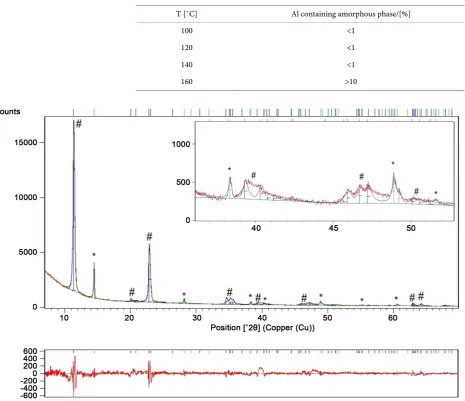
To determine the chemical formula, all products were completely dissolved in-suprapur 65% nitric acid and investigated with ICP-OES [11] [16]. The results were used to calculatethe LDH formulas (Table 4). These calculations also stated a maximum content of an amorphous phase of <1%. Recrystallization tests showed no Al containing phases. Synthesis temperatures higher than 140˚C led to a destabilization of the LDH phase and the formation of AlO(OH) (Figure 7). The test series with 160˚C were repeated several times producing always AlO(OH) next to the LDH. Calculations showed an Al containing amorphous phase and crystalline AlO(OH) proportion of 10 % to 90 % (Table 3). The re-sulting lack of Al3+ in the solid solution leads to LDH phases with a higher
Mg/Al ratio than 2:1 and therefore to the formation of a LDH with higher Mg2+
[image:9.595.73.539.302.703.2]amounts next to the AlO(OH) phase (Figure 6(d)).
Table 3. Proportion of the amorphous phase/AlO(OH) depending on the synthesis tem-perature.
T [˚C] Al containing amorphous phase/[%]
100 <1
120 <1
140 <1
160 >10
3.2.3. Thermal Analysis
The amount of interlayer water was determined by TG/DTA for [LiAl2(OH)6]
[Cl·0.50H2O], [Mg2Al(OH)6][Cl·0.55H2O]and all pure solid solutions (Table 4).
An example for the Li-LDH, Mg-LDH and the solid solution with the highest Mg2+ amount [Li
0.9Mg0.2Al1.90(OH)6][Cl·0.51H2O] is shown in Figure 8.
Com-paring the solid solution with the pure Li- and Mg-LDH, there is a high similar-ity in mass loss and exothermal reaction. The mass loss at 75˚C - 100˚C is caused by the removal of intercalated interlayer water [2] [6]. With 4.5% for the pure Li-LDH, 4.2% for the solid solution and 4.7% for the pure Mg-LDH it corres-ponds with the loss of 0.50 to 0.55 water per formula unit of the LDHs. While the differential thermal analysis of the pure Li- and Mg-LDH show a single en-dothermic reaction at 275˚C - 325˚C, the solid solution shows two (260˚C and 320˚C). At this temperature, the LDH starts to dehydroxylate which results in the destruction of the metal hydroxide main layer [2] [6] [7] [11]. Combining Li+
and Mg2+ with Al3+ in the main layer leads to a two-step dehydroxylation.
(a)
[image:10.595.64.531.303.690.2]
(b) (c)
Figure 8. Thermogravimetric and differential thermal analysis of (a) [LiAl2(OH)6] [Cl·0.51H2O]; (b) [Li0.9Mg0.2Al1.90(OH)6]
[Cl·0.50H2O]; (c) [Mg2Al(OH)6][Cl·0.55H2O] (120˚C/10 h/pH 9.5/W/S 15: 1) show the loss of interlayer water at 75˚C - 100˚C).
Table 4. Calculated chemical formulas based on ICP-OES results and interlayer water of the solid solutions X for [Li0+xMg2−2xAl1+x(OH)6][Cl∙mH2O] (120°C/10h/pH 9.5/W/S 15: 1).
X chemical formula interlayer water [mol]
0 [Mg2Al(OH)6]Cl 0.55
0.9 [Li0.9Mg0.2Al1.90(OH)6]Cl 0.50 0.92 [Li0.92Mg0.16Al1.92(OH)6]Cl 0.52 0.94 [Li0.94Mg0.12Al1.94(OH)6]Cl 0.50 0.96 [Li0.96Mg0.08Al1.96(OH)6]Cl 0.51 0.98 [Li0.98Mg0.04Al1.98(OH)6]Cl 0.50
1 [LiAl2(OH)6]Cl 0.51
3.2.4. FTIR Spectroscopy
To prove purity of the products, all samples were investigated by FTIR spec-troscopy (Figure 9). Although there are 10 mol% Mg2+ in the solid solution,
there is only a slight difference to a pure [LiAl2(OH)6][Cl·0.51H2O] FTIR
spec-trum visible. All three spectra show the typical H2O/OH− absorption at ~3500
cm−1 and 1630 cm−1[5] [18] [22] and only the spectra of [Li
0.9Mg0.2Al1.90(OH)6]
[Cl·0.50H2O] and [Mg2Al(OH)6][Cl·0.55H2O] show an insignificant amount of
carbonatization with the absorption at 1380 cm−1[5] [18] [23]. The absorption of
Al (980/720/520 cm−1) related groups is very good visible for the pure Li-LDH
but not as distinct for the solid solution [11] [24]. Mg related absorptions at 415 cm−1 are only visible in the pure Mg-LDH (Table 5). The amount of Mg2+ is high
enough to influence the absorption spectra but not to show a clear Mg related absorption.
3.2.5. SEM Analysis
SEM pictures (Figure 10) show flat, (pseudo-) hexagonal particles with different sizes, starting at 2 - 3 µm until nearly nanosize. These particles form cluster in the size of 200 - 600 µm.
3.2.6. Structure of the Solid Solution
Based on the assumption that Mg2+ ions can occupy the positions of Li+ and Al3+
because of the fitting bonding length [2] [21], the ion radii [7] and the deter-mined hexagonal P63/m space group, the structure of the pure phased solid
solu-tion should be identical with the Li-LDH (Figure 11). This is also indicated by the chemical composition with the formula [Li0.9Mg0.2Al1.90(OH)6][Cl·0.50H2O].
If Mg2+ ions could not enter one of the two octahedral positions, there would be
two possibilities: they would exchange with Li+ ions only, which would reduce
the amount of Li+ in the solid solution while the amount of Al3+ would not
change, or they would exchange only with Al3+ ions with the opposite result. The
results of this work show, that in fact Mg2+ has to be statistically distributed with
5 mol% on the Li+ and 5 mol% on the Al3+ position to provide the measured
Figure 9. FTIR spectrum of (a) [[LiAl2(OH)6][Cl·0.51H2O]; (b) [Li0.9Mg0.2Al1.90(OH)6]
[Cl·0.50H2O]; (c) [Mg2Al(OH)6][Cl·0.55H2O] with the typical absorbed water (~3500
cm−1 and 1620 cm−1) and the metal-O and metal-OH vibrations (>1000 cm−1). Absorption
[image:12.595.86.540.425.716.2]at 2400 cm−1 is device related.
Table 5. Observed wavenumbers and the assignment bending.
wavenumber [cm−1] assignment
3600 - 3400 ν1, ν3 (H2O)
1630 ν(H2O)
1380 va(C-O)
980 δ(Me-OH)
720 δ(Me-OH)
520 δ(Al-O)
415 δ(Mg-O)
Figure 11. View of the unit cell of [Li0.9Mg0.2Al1.90(OH)6]Cl·0.5H2O (based on Li-LDH
structure [2]—interlayer water excluded) with the octahedral positions of Li+ and Al3+.
Both positions are occupied with 5mol% by Mg2+.
4. Conclusion
It is possible to synthesise a pure [Li0+xMg2−2xAl1+x(OH)6][Cl·mH2O] solid
solu-tion using autoclaves with temperatures of 100˚C, 120˚C and 140˚C with a maxi- mum amount of 10 mol% Mg2+ (X = 0.9). Using more Mg2+ in the reactant leads
to a parallel formation of an Mg2+ dominated and a Li+ dominated solid solution.
Optimal results for a pure solid solution can be achieved at 120˚C, pH 9.5, W/S15: 1, 10 h synthesis time. Changing the temperature to 160˚C provides the formation of an AlO(OH) phase. The pure solid solution with the highest Mg content is [Li0.9Mg0.2Al1.9(OH)6][Cl·0.50H2O].
References
[1] Williams, G.R., Morrhouse, S.J., Prior, T.J., Fogg, A.M., Rees, N.H. and O’Hare, D.
(2011) New Insights into the Intercalation Chemistry of Al(OH)3. Dalton
Transac-tions, 40, 6012. https://doi.org/10.1039/c0dt01790f
[2] Besserguenev, A.V., Fogg, A.M., Francis, R.J., Price, S.J. and O’Hare, D. (1997)
Synthesis and Structure of the Gibbsite Intercalation Compounds [LiAl2(OH)6]X
{X=Cl, Br, NO3} and [LiAl2(OH)6]Cl·H2O Using Synchrotron X-Ray and Neutron
Powder Diffracion. Chemistry of Materials, 9, 241-247.
https://doi.org/10.1021/cm960316z
[3] Khan, A.I. and O’Hare, D. (2002) Intercalation Chemistry of Layered Double
Hy-droxides: Recent Developments and Applications. Journal of Materials Chemistry,
12, 3191-3198. https://doi.org/10.1039/B204076J
[4] Lei, L., Millange, F., Walton, R.I. and O’Hare, D. (2000) Efficient Separation of Pyridinedicarboxylates by Preferential Anion Exchange Intercalation in [Li-Al2(OH)6]Cl·H2O. Journal of Materials Chemistry, 10, 1881-1886.
[5] Williams, G.R., Dunbar, T.G., Beer, A.J., Fogg, A.M. and O’Hare, D. (2006) Interca-lation Chemistry of the Novel Layered Double Hydroxides [MAl4(OH)12](NO3)2·yH2O (M=Zn, Cu, Ni and Co). 1: New Organic Intercalates and Reaction Mechanisms.
Journal of Materials Chemistry, 16, 1222-1230. https://doi.org/10.1039/b514874j
[6] Lei, L., Vijayan, R.P. and O’Hare, D. (2001) Preferential Anion Exchange
Intercala-tion of Pyridinecarboxylate and Toluate Isomers in the Layered Double Hydroxide [LiAl2(OH)6]Cl·H2O. Journal of Materials Chemistry, 11, 3276-3280.
https://doi.org/10.1039/b102754a
[7] Newman, S.P. and Jones, W. (1998) Synthesis, Characterization and Applications of
Layered Double Hydroxides Containing Organic Guests. New Journal of Chemistry,
105-115. https://doi.org/10.1039/a708319j
[8] Ragavan, A., Williams, G.R. and O’Hare, D. (2009) A Thermodynamically Stable
Layered Double Hydroxide Heterostructure. Journal of Materials Chemistry, 19,
4211-4216. https://doi.org/10.1039/b822390d
[9] Isupov, V.P., Chupakhina, L.E., Mitrofanova, R.P. and Tarasov, K.A. (2000)
Synthe-sis, Structure, Properties, and Application of Aluminium Hydroxide Intercalation
Compounds. Chemistry for Sustainable Development, 8, 121-127.
[10] Williams, G.R., Fogg, A.M., Sloan, J., Taviot-Gueho, C. and O’Hare, D. (2007)
Staging during Anion-Exchange Intercalation into [LiAl2(OH)6]Cl·yH2O: Structural
and Mechanistic Insights. Dalton Transactions, 3499-3506.
https://doi.org/10.1039/b705753a
[11] Constantino, V.R.L. and Pinnavaia, T.J. (1995) Basic Properties of 2 3
1
Mg Alx x
+ +
−
Layered Double Hydroxides Intercalated by Carbonate, Hydroxide, Chloride, and Sulfate Anions. Inorganic Chemistry, 34, 883-892.
https://doi.org/10.1021/ic00108a020
[12] Fogg, A.M., Freij, A.J. and Parkinson, G.M. (2002) Synthesis and Anion Exchange
Chemistry of Rhombohedral Li/Al Layered Double Hydroxides. Chemistry of
Ma-terials, 14, 232-234. https://doi.org/10.1021/cm0105099
[13] Mitchell, S., Biswick, T., Jones, W., Williams, G. and O’Hare, D. (2007) A
Synchto-tron Radiation Study of the Hydrothermal Synthesis of Layerd Double Hydroxides from MgO and Al2O3 Slurries. Green Chemistry, 9, 373-378.
https://doi.org/10.1039/b613795d
[14] Hu, G., Wang, N., O’Hare, D. and Davis, J. (2007) Synthesis of Magnesium Layered
Double Hydroxides in Reverse Microemulsions. Journal of Materials Chemistry, 17,
2257-2266. https://doi.org/10.1039/b700305f
[15] Fogg, A.M., Williams, G.R., Chester, R. and O’Hare, D. (2004) A Novel Family of
Layered Double Hydroxides—[MAl4(OH)12](NO3)2∙xH2O (M = Co, Ni, Cu, Zn).
Journal of Materials Chemistry, 14, 2369-2371. https://doi.org/10.1039/B409027F
[16] Aimoz, L., Taviot-Gueho, C., Churakov, S.V., Chukalina, M., Dähn, R., Curti, E.,
Bordet, P. and Vespa, M. (2012) Anion and Cation Order in Iodide-Bearing Mg/Zn-
Al Layered Double Hydroxides. The Journal of Physical Chemistry C, 116, 5460-
5475. https://doi.org/10.1021/jp2119636
[17] Taviot-Gueho, C., Feng, Y., Faour, A. and Leroux, F. (2010) Intercalation Chemistry
in a LDH System: Anion Exchange Process and Staging Phenomenon Investigated
by Means of Time-Resolved, in Situ X-Ray Diffraction. Dalton Transactions, 39,
5994-6005. https://doi.org/10.1039/c001678k
[18] Boclair, J.W., Braterman, P.S., Jiang, J., Lou, S. and Yarberry, F. (1999) Layered Double Hydroxides Stability. 2. Formation of Cr(III)-Containing Layered Double
https://doi.org/10.1021/cm980524m
[19] Williams, G.R., Dunbar, T.G., Beer, A.J., Fogg, A.M. and O’Hare, D. (2005)
Interca-lation Chemistry of the Novel Layered Double Hydroxides [MAl4(OH)12](NO3)2∙yH2O
(M = Zn, Cu, Ni and Co). 2: Selective Intercalation Chemistry. Journal of Materials
Chemistry, 16, 1231-1237. https://doi.org/10.1039/b514875h
[20] Williams, G.R. and O’Hare, D. (2006) Towards Understanding, Control and
Appli-cation of Layered Double Hydroxide Chemistry. Journal of Materials Chemistry, 16,
3065-3074. https://doi.org/10.1039/b604895a
[21] Bellotto, M., Rebours, B., Clause, O., Lynch, J., Bazin, D. and Elkaim, E. (1996) A
Reexamination of Hydrotalcite Crystal Chemistry. The Journal of Physical
Chemi-stry, 100, 8527-8534. https://doi.org/10.1021/jp960039j
[22] Pöllmann, H., Stöber, S. and Stern, E. (2006) Synthesis, Characterizaion and
Reac-tion Behaviour of Lamellar AFm Phases with Aliphatic Sulfonate-Anions. Cement
and Concrete Research, 36, 2039-2048. https://doi.org/10.1016/j.cemconres.2006.06.008
[23] Cavani, F., Trifiro, F. and Vaccari, A. (1991) Hydrotalcite-Type Anionic Clays:
Preparation, Properties and Applications. Catalysis Today, 11, 173-301.
https://doi.org/10.1016/0920-5861(91)80068-K
[24] Dutta, P.K. and Puri, M. (1989) Anion Exchange in Lithium Aluminate Hydroxides.
The Journal of Physical Chemistry, 93, 376-381. https://doi.org/10.1021/j100338a072
Submit or recommend next manuscript to SCIRP and we will provide best service for you:
Accepting pre-submission inquiries through Email, Facebook, LinkedIn, Twitter, etc. A wide selection of journals (inclusive of 9 subjects, more than 200 journals)
Providing 24-hour high-quality service User-friendly online submission system Fair and swift peer-review system
Efficient typesetting and proofreading procedure
Display of the result of downloads and visits, as well as the number of cited articles Maximum dissemination of your research work
Submit your manuscript at: http://papersubmission.scirp.org/
![Figure 1. XRD pattern of the test series with X for[Li0+xMg2−2xAl1+x(OH)6][Cl·mH2O] (120˚C/10 h) showing no visible phase separation at the (002)/(004) main peaks but two coexisting phases at higher ˚2Θ angle (60 - 65)](https://thumb-us.123doks.com/thumbv2/123dok_us/7746936.709137/5.595.233.507.330.527/figure-pattern-series-showing-visible-separation-coexisting-phases.webp)
![Figure 3. Lattice parameter a of two different phases with X for [Li0+xMg2−2xAl1+x(OH)6] [Cl·mH2O]](https://thumb-us.123doks.com/thumbv2/123dok_us/7746936.709137/6.595.210.540.364.633/figure-lattice-parameter-different-phases-li-xmg-xal.webp)
![Table 2. Theoretical and measured/fitted lattice parameter (a) and (c) for the solid solu-tions with X = 0.9 - 0.98 and [LiAl2(OH)6][Cl·0.51H2O] at X = 1 (120˚C/10 h/pH 9.5/W/S 15: 1)](https://thumb-us.123doks.com/thumbv2/123dok_us/7746936.709137/8.595.65.533.70.472/table-theoretical-measured-fitted-lattice-parameter-tions-lial.webp)
![Figure 8. Thermogravimetric and differential thermal analysis of (a) [LiAl[Cl·0.50H2(OH)6] [Cl·0.51H2O]; (b) [Li0.9Mg0.2Al1.90(OH)6] 2O]; (c) [Mg2Al(OH)6][Cl·0.55H2O] (120˚C/10 h/pH 9.5/W/S 15: 1) show the loss of interlayer water at 75˚C - 100˚C)](https://thumb-us.123doks.com/thumbv2/123dok_us/7746936.709137/10.595.64.531.303.690/figure-thermogravimetric-differential-thermal-analysis-lial-interlayer-water.webp)
![Table 4. Calculated chemical formulas based on ICP-OES results and interlayer water of the solid solutions X for [Li0+xMg2−2xAl1+x(OH)6][Cl∙mH2O] (120°C/10h/pH 9.5/W/S 15: 1)](https://thumb-us.123doks.com/thumbv2/123dok_us/7746936.709137/11.595.209.539.113.251/table-calculated-chemical-formulas-based-results-interlayer-solutions.webp)
![Figure 9. FTIR spectrum of (a) [[LiAlat 2400 cm[Cl·0.50H2(OH)6][Cl·0.51H2O]; (b) [Li0.9Mg0.2Al1.90(OH)6] 2O]; (c) [Mg2Al(OH)6][Cl·0.55H2O] with the typical absorbed water (~3500 cm−1 and 1620 cm−1) and the metal-O and metal-OH vibrations (>1000 cm−1)](https://thumb-us.123doks.com/thumbv2/123dok_us/7746936.709137/12.595.282.465.71.338/figure-ftir-spectrum-lialat-typical-absorbed-metal-vibrations.webp)
![Figure 11. View of the unit cell of [Listructure0.9Mg0.2Al1.90(OH)6]Cl·0.5H2O (based on Li-LDH [2]—interlayer water excluded) with the octahedral positions of Li+ and Al3+](https://thumb-us.123doks.com/thumbv2/123dok_us/7746936.709137/13.595.237.534.72.306/figure-view-listructure-interlayer-water-excluded-octahedral-positions.webp)
