Predictors of Complete Early Virological Response to
Pegylated Interferon and Ribavirin in Egyptian Patients
with Chronic Hepatitis C Genotype 4
Gamal El Din Esmat Gamil1, Maissa El Said El Raziky1, Rabab Maamoun Salama1, Wafaa Ahmed El Akel1, Waleed Fouad Fathalah1*, Dina Ismail Attia2
1Endemic Medicine and Hepatology Department, Faculty of Medicine, Cairo University, Cairo, Egypt; 2Endemic Medicine and
Hepatology Department, Faculty of Medicine, Beni-Suef University,Beni Suef, Egypt. Email: *[email protected]
Received March 1st,2013; revised April 9th, 2013; accepted May 9th, 2013
Copyright © 2013 Gamal El Din Esmat Gamil et al. This is an open access article distributed under the Creative Commons Attribu-tion License, which permits unrestricted use, distribuAttribu-tion, and reproducAttribu-tion in any medium, provided the original work is properly cited.
ABSTRACT
We aim to determine the baseline factors associated with partial and cEVR by analyzing the data of 1861 Egyptian pa-tients treated for 12 weeks with a course of Peg-IFN plus RBV. Base line data of 1861 Egyptian papa-tients with chronic hepatitis C coming at Cairo-Fatemic Hospital for HCV treatment were studied including full clinical, Ultrasonographic examination, laboratory evaluation and liver biopsy. The most significant variables in relation to complete early vi-rological response were low Hb level (<13 gm/dl) with p < 0.01, the stage of fibrosis p value < 0.05 and the grades of inflammation p value < 0.05 were associated with less achievement of c EVR. We conclude that identifying the most significant predictors of response such as Hb, stage of fibrosis F, at baseline before initiating treatment is mandatory to predict which patient will be more expected to achieve a cEVR and thus reducing the side-effects and healthcare costs associated with interferon therapies.
Keywords: Predictors of Response; cEVR; HCV Treatment; Peg IFN/Ribavirin
1. Introduction
Chronic hepatitis C is endemic in most regions of the world though prevalence rates vary widely. Over 170 million people are infected with HCV worldwide (about 3% of the global population). Egypt is among the world’s highest prevalence rates of HCV (10% - 15% having HCV antibodies in rural area) [1]. HCV is a major cause of chronic hepatitis, liver cirrhosis and hepatocellular car- cinoma and represents the most common cause of liver transplantation in the US and Europe [2].
The current and future burden of disease caused by vi- ral hepatitis in Egypt is significant: it is not an exaggera- tion to say that viral hepatitis (particularly HCV) is cur- rently and will remain for some time Egypt’s most press- ing public health issue [3].
PEG-IFN has become the cornerstone of therapy as it extends the duration of therapy and reduces adverse ef- fects and when combined with Ribavirin, the rate of sus- tained virological response (SVR) has dramatically im-
proved even in patients with high HCV RNA level [4,5]. Egyptians being treated for HCV receive 48 weekly subcutaneous doses of pegylated interferon with twice daily doses of Ribavirin. Several specificities of the Egyptian epidemic are to be noted. First, nearly all Egyp- tian HCV infections (upwards of 95%) are genotype 4. While HCV genotype has no impact on the course of the disease, different genotypes do react differently to treat- ment; genotype 4 has an intermediate resistance to treat- ment. For this reason, Egyptian patients must undergo longer courses of treatment: 48 weeks instead of the 24 weeks recommended [1].
Given the significant side-effects and healthcare costs associated with interferon therapies, identifying patients who are less likely to respond is highly desirable to pre- dict the rate of achieving SVR in the individual patient, before initiating treatment. Patients who failed to achieve a complete early virologic response (cEVR) (defined as undetectable HCV RNA after 12 weeks of treatment) or a partial EVR (p EVR, defined as a ≥ 2-log10 decrease
from baseline in HCV RNA after 12 weeks of treatment) had a lower likelihood of achieving SVR with an addi- tional 36 weeks of treatment [5-7].
Both virus and host-related elements have been re- ported as factors correlated to therapeutic effects of com- bination therapy. A particular focus has been placed on age, gender, Body mass index (BMI), degree of inflam- matory activity and fibrosis of the liver and HCV RNA level, HCV genotype and hematological parameters [8- 10]. However many other factors need to be studied.
Identifying these factors may provide information to optimize and/or individualize the treatment of HCV genotype 4 infected patients, thus improving antiviral response. This is of particular importance because these difficult to treat populations have a high prevalence of HCV infection and comprise a large proportion of the HCV-infected population in Egypt.
The aim of this study is to analyze the data of 1861 Egyptian patients treated for 12 weeks with a course of Peg-IFN plus RBV, to examine the baseline factors asso- ciated with partial and cEVR.
2. Patients and Methods
We studied retrospectively the data of 1861 Egyptian patients with chronic hepatitis C who received antiviral therapy (pegylated-interferon alpha plus Ribavirin) at Cairo-Fatemic Hospital, Ministry of Health and Popula- tion, Cairo, Egypt from 2007-2010. Data were retrieved from their medical records after obtaining patient’s in- formed consent and the approval of IRB of the MOH, Patients had code numbers to respect privacy policy. Pa- tients received either pegylated interferon alpha 2a (180 ug once weekly) or pegylated interferon alpha 2b (1.5 ug/kg weekly) SC in addition to Ribavirin dose (13 - 15 mg/kg/day). Early virologic response (EVR) was as- sessed after 12 weeks of therapy and patients were cate- gorized into complete EVR, partial EVR or non-EVR (<2-log10 decrease from baseline in HCV RNA after 12
weeks of treatment).
Data studied included full clinical examination, ultra- sonographic examination and laboratory evaluation (haematological tests, Liver function tests and PCR for detection of HCV viraemia); liver biopsy was done for all patients prior to treatment to assess the grade of in- flammation and the stage of fibrosis and to decide whether included or excluded from treatment.
Patients were included according to the national guide- lines of National Committee, being adult, naïve, non obese(BMI LESS < 35) of both sexes with no co-morbid conditions and -ve HBsAg, having no contraindications for IFN/RBV therapy and with elevated liver enzymes or normal liver enzymes but with METAVIR score ≥ A2 and F≥F2.
APRI was done and was calculated at a cut off value < 0.8 [11].
Statistical Analysis
The SPSS software version 11 was used for data man- agement and analysis. Quantitative data were presented as mean + SD. Qualitative data were presented as fre- quencies and percentages. For comparison of 3 group’s means, Post Hoc test was used. To study the relationship between two variables Spearman’s correlation coefficient was calculated. All tests were two tailed and considered statistically significant when (p value < 0.05).
3. Results
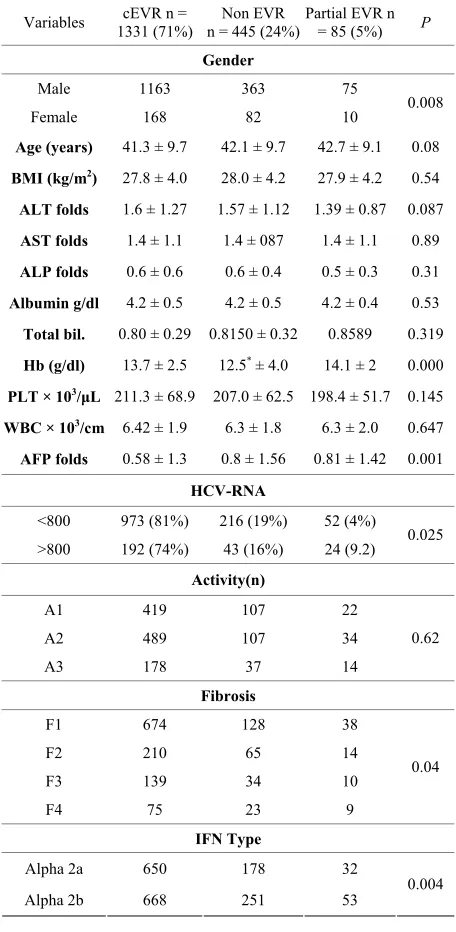
Among the studied 1861 patients, 860 received peg in- terferon alpha2-a while, 972 received peg interferon al- pha 2-b in addition to Ribavirin for a period of 12 weeks. They were evaluated for EVR, Partial and non virologi- cal response by quantitative testing their HCV RNA by PCR techniques. At 12 weeks, among 1861 patients, 1331 (71.5%) achieved c EVR, 85 (4.6%) achieved par- tial EVR however 445 (23.9%) were non responders. On analyzing the demographic features shown in (Table 1); of 1861 patients, 1601 were males, 260 were females. Among males 1163 achieved c EVR, and among females 168 achieved c EVR, with a statistically significant dif- ference <0.05 between males and females denoting that gender plays a role as a predicting factor for EVR in chronic hepatitis C patients, however this statistical dif- ference may be due to the larger number of males in- cluded in the study compared to females, on doing Uni- variate analysis of predictors of cEVR, male gender was associated with failure of cEVR with a statistically sig- nificant difference. Regarding the base line characteris- tics, biochemical and hematological findings of our pa- tients, as the age, BMI, the albumin, the AST, ALT & ALP, the total and direct bilirubin, these parameters were of no significant impact on cEVR, however the Hb level was higher (mean 13.7 and 14.1gm/dl) in patients who achieved a cEVR and partial EVR compared to non re- sponders who have lower Hb level (mean 12.5 gm/dl) with a highly statistical significant difference <0.001. The alpha feto-protein was significantly higher in non responders than in patients with cEVR with a statistical significance <0.05, denoting that the higher the alpha fetoprotein level the lesser the chance to achieve a cEVR.
Table 1. The baseline variables in relation to the achieve- ment of EVR.
Variables 1331 (71%) cEVR n = n = 445 (24%) Non EVR Partial EVR n= 85 (5%) P
Gender
Male 1163 363 75
Female 168 82 10 0.008
Age (years) 41.3 ± 9.7 42.1 ± 9.7 42.7 ± 9.1 0.08
BMI (kg/m2) 27.8 ± 4.0 28.0 ± 4.2 27.9 ± 4.2 0.54
ALT folds 1.6 ± 1.27 1.57 ± 1.12 1.39 ± 0.87 0.087
AST folds 1.4 ± 1.1 1.4 ± 087 1.4 ± 1.1 0.89
ALP folds 0.6 ± 0.6 0.6 ± 0.4 0.5 ± 0.3 0.31
Albumin g/dl 4.2 ± 0.5 4.2 ± 0.5 4.2 ± 0.4 0.53
Total bil. 0.80 ± 0.29 0.8150 ± 0.32 0.8589 0.319
Hb (g/dl) 13.7 ± 2.5 12.5* ± 4.0 14.1 ± 2 0.000
PLT × 103/μL 211.3 ± 68.9 207.0 ± 62.5 198.4 ± 51.7 0.145
WBC × 103/cm 6.42 ± 1.9 6.3 ± 1.8 6.3 ± 2.0 0.647
AFP folds 0.58 ± 1.3 0.8 ± 1.56 0.81 ± 1.42 0.001
HCV-RNA
<800 973 (81%) 216 (19%) 52 (4%)
>800 192 (74%) 43 (16%) 24 (9.2) 0.025
Activity(n)
A1 419 107 22 A2 489 107 34
A3 178 37 14 0.62
Fibrosis
F1 674 128 38 F2 210 65 14
F3 139 34 10 F4 75 23 9 0.04
IFN Type
Alpha 2a 650 178 32
Alpha 2b 668 251 53 0.004
674 patients out of 1331 of c EV responders were F1 compared to only 75 with F4 who achieved c EVR, with a statistical significant difference of <0.05. Univariate and multivariate analysis of stages of fibrosis (F2, F3 and F4) with achievement of cEVR shows these stages are associated with failure of cEVR with a statistical signifi- cance of <0.05 and the higher the stage of fibrosis the greater the failure of cEVR. Regarding the grades of in- flammation A, on Univariate analysis, A1, A2 and A3 were associated with cEVR with a statistical significance for A2 and A3 < 0.05 on Univariate and multivariate analysis and for A3 on multivariate analysis < 0.05, so A1
[image:3.595.310.538.677.736.2]and A2 and A3 are predictors of achievement of cEVR. 650 patients received PEG IFN alpha 2 a and achieved c EVR compared to 178 who did not respond and 32 with partial response with a statistically significant difference <0.05, however 668 patients achieved cEVR were on PEG IFN alpha 2 b compared to 251 who did not respond and 53 partial responders with no statistical significant difference.
Table 2 shows the relation between APRI cutoff at 0.8 and the achievement of EVR in chronic HCV patients.
893 (69.2%) patients with APRI < 0.8 achieved cEVR compared to 398 (30.8%) patients with APRI > 0.8 how- ever there was no statistical significant difference and among patients with APRI < 0.8, 893 out of 1225 achieved c EVR compared to 276 with no EVR and 56 with partial response with no statistical significant dif- ference, in univariate analysis APRI at 0.8 cutoff value was associated with failure of cEVR but with no statisti- cal significance.
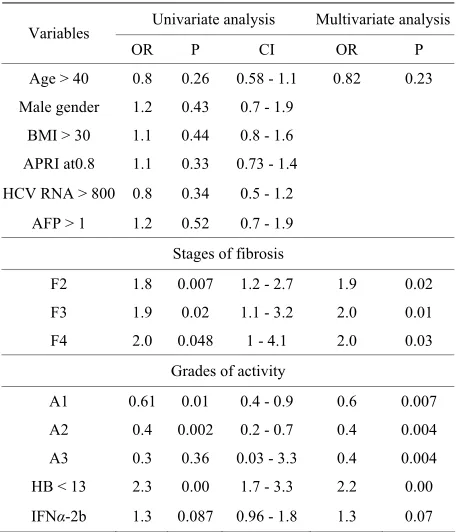
As a conclusion, in logistic regression analysis (Table 3), Univariate analysis was done among all variables and then multivariate analysis was done among the most sig- nificant variables in relation to complete early virological response; by univariate analysis achievement of cEVR was related to higher stages of fibrosis, grades A2 and A3 of inflammation and Hb < 13 mg/dl.
By multivariate analysis, cEVR showed significant association with higher fibrosis stages (F2, F3 and F4) and grades of inflammation (A2 and A3), low Hb level (<13 gm/dl) with a p value < 0.05, denoting that these are the most significant predictors of response useful to be known at the baseline before initiating treatment to pre-dict which patient will be more expected to achieve a complete early virological response and thus reducing the side-effects and healthcare costs associated with inter- feron therapies.
4. Discussion
HCV is a major cause of chronic hepatitis, liver cirrhosis and hepatocellular carcinoma. Given the significant side- effects and healthcare costs associated with interferon therapies, this retrospective study was conducted, on evaluating the predictors of early virological response at the base line before initiating treatment, among 1861 patients with chronic hepatitis C of genotype 4, we demon-
Table 2. Relation between APRI cutoff at 0.8 and the achievement of EVR in chronic HCV patients.
EVR groups APRI
cEVR n(%) Non-EVR n(%) p EVR n(%) <0.8 (n = 1225) 893 (69.2%) 276 (63.6%) 56 (69.1%)
Table 3. The logistic regression analysis of variables in rela-tion to EVR.
Univariate analysis Multivariate analysis Variables
OR P CI OR P
Age > 40 0.8 0.26 0.58 - 1.1 0.82 0.23 Male gender 1.2 0.43 0.7 - 1.9
BMI > 30 1.1 0.44 0.8 - 1.6 APRI at0.8 1.1 0.33 0.73 - 1.4
HCV RNA > 800 0.8 0.34 0.5 - 1.2
AFP > 1 1.2 0.52 0.7 - 1.9
Stages of fibrosis
F2 1.8 0.007 1.2 - 2.7 1.9 0.02
F3 1.9 0.02 1.1 - 3.2 2.0 0.01
F4 2.0 0.048 1 - 4.1 2.0 0.03
Grades of activity
A1 0.61 0.01 0.4 - 0.9 0.6 0.007 A2 0.4 0.002 0.2 - 0.7 0.4 0.004 A3 0.3 0.36 0.03 - 3.3 0.4 0.004
HB < 13 2.3 0.00 1.7 - 3.3 2.2 0.00
IFNα-2b 1.3 0.087 0.96 - 1.8 1.3 0.07
OR: odds ratio; CI: confidence interval.
strated that at 12 weeks of treatment with Pegasys and Ribavirin or Peg IFN and Ribavirin, 1331 (71.5%) achieved complete EVR, 85(4.6%) were partial respond- ers and 445(23.9%) didn’t respond to treatment. Our re- sults were comparable with Torres and colleagues [12] who evaluated factors associated with rapid and early virologic response to peg interferon alfa-2a/Ribavirin treatment in HCV genotype 1 patients representative of the general chronic hepatitis C population and found that out of the 1550 patients treated with peg interferon alfa2a plus Ribavirin, 242 (15.6%) patients achieved RVR and 837 (54.0%) which was lower than our results. Several predictive factors play a significant role in the achieve- ment of EVR. In our study the response in males was significantly higher than females, Martinot-Pegnoux and co-workers [13] reported that females respond better than males but this difference in our study may be due the larger number of males included compared to females as well as the difference in the type of interferon received as treatment.
Regarding the Hb level in our study and its impact on EVR, it was higher (mean 13.7 and 14.1gm/dl) in pa- tients who have achieved a cEVR and p EVR compared to non responders who have lower Hb level (mean 12.5 gm/dl) with a highly statistical significant difference < 0.001, showing that the Hb level is one of the important predictive factor of EVR response and thus of SVR, this
may be explained by the fact that these patients with a higher HB might need less frequent dose reduction of INF and/or RBV than those with lower base line HB and maintenance of higher doses of both is related to better response. In the study conducted by Torres et al., [12] the decrease of Hb from baseline to week 12 in the cEVR group was greater than that in the non-cEVR group (p = 0.0160).
The alpha feto protein was also found to be one of the predictors of response being significantly higher in non responders than in those with C EVR with a statistical significance <0.05, denoting that the higher the alpha fetoprotein level the lesser the chance to achieve a C EVR. Abdo and Sanai [14] cited that a higher AFP level is associated with a negative treatment outcome in chronic hepatitis C patients of genotype 4. Similar find- ings have been found in genotype 1 patients [8].
The HCV RNA level was a good predictor of response in our study as patients with an HCV RNA level <600 IU/ml prior to treatment achieved a complete EVR with a statistical significant difference compared to patients with partial response and non responders, however it is therefore difficult to predict the virological response solely from the amount of HCVRNA before starting the treatment [15].
In our study, the type of interferon plays a statistically significant role in patients with Non EVR and with par- tial EVR as the early response to treatment is signifi- cantly lower with PEG-INT compared to PEGASYS (p < 0.004). This finding was similar to two studies (including 100 and 38 patients, respectively) using the alfa 2a form of pegylated interferon in genotype 4 patients and sug- gested that the response rates may be higher with Pegasys [16,17], as well as, In a study of Ribavirin in combination with either PEG-IFN alfa-2b or PEG-IFN alfa-2a for the treatment of chronic HCV infection, As- cione et al. [18] reported a higher SVR rate with PEG- IFN alfa-2a than with PEG-IFN alfa-2b (68% versus 54.4%). However, any attempt at comparing treatment success between the two forms of pegylated interferons among this particular genotype would be unfair and pre- mature, due to the lack of large, prospectively conducted studies using the Alfa 2a form of pegylated interferon [14].
degree of response to treatment decreases with the in- crease of stage of fibrosis.
Although not statistically significant, we found that the lower the APRI the better the achievement of a C EVR, however Mata-Marin et al.; [20] found no association when APRI was more than 1.2 and early virological re- sponse when stratifying between genotype 1 and geno- type other than 1 to evaluate APRI as predictor of EVR.
Previous studies have not explored the utility of non- invasive tests to assess liver fibrosis for the prediction of viral response in hepatitis C naive patients. In our study, we believe that our results show that APRI is a predictor of early viral response in HCV naive patients.
From our study we can conclude that proper evalua- tion of the predictors of c EVR such as Hb level, stage of fibrosis and grade of inflammation, PCR , Alpha feto- protein, APRI and the type of interferon better to be used at the base line before initiating treatment is important in determining the possibility of achievement of c EVR and hence SVR and also in reducing the burden of cost and the side effects of chronic HCV treatment for patients who are not likely to achieve neither c EVR nor SVR.
5. Acknowledgements
Special thanks to Cairo Fatemic Hospital and the minis- try of Health, for their active participation in the practical part of this work and their active cooperation in giving the permission for the collection of data of chronic HCV patients who were subjected to proper evaluation and treatment of HCV.
REFERENCES
[1] Egyptian National Control Strategy for Viral Hepatitis, 2008-2012.
[2] G. M. Lauer and B. D. Walke, “Hepatitis C Virus Infec- tion,” The New England Journal of Medicine, Vol. 345, 2001, pp. 41-52. doi:10.1056/NEJM200107053450107 [3] K. W. Ray, “Global Epidemiology and Burden of Hepati-
tis C,” Microbes and Infection, Vol. 4, No. 12, 2002, pp. 1219-1225. doi:10.1016/S1286-4579(02)01649-0
[4] J. Stephanos, S. Hoel Jr., R. Timothy, D. Vijayan, et al., “Peginterferon-α2a and Ribavirin Combination Therapy in Chronic Hepatitis C: A Randomized Study of Treat- ment Duration and Ribavirin Dose,” Annals of Internal Medicine, Vol. 140, No. 5, 2004, pp. 346-355.
doi:10.7326/0003-4819-140-5-200403020-00010
[5] M. P. Manns, J. G. McHutchison, S. C. Gordon, V. K. Rustgi,
et al., “Peginterferon Alfa-2b plus Ribavirin Compared with Interferon Alfa-2b plus Ribavirin for Initial Treat- ment of Chronic Hepatitis C: A Randomised Trial,” Lan- cet, Vol. 358, No. 9286, 2001, pp. 958-965.
doi:10.1016/S0140-6736(01)06102-5
[6] S. S. Lee, E. J. Heathcote, K. R. Reddy, S. Zeuzem, et al.,
“Prognostic Factors and Early Predictability of Sustained Viral Response with Peginterferon Alfa-2a (40KD),” Jour- nal of Hepatology, Vol. 37, No. 4, 2002, pp. 500-506. doi:10.1016/S0168-8278(02)00211-8
[7] G. L. Davis, J. B. Wong, J. G. McHutchison, M. P. Manns,
et al., “Early Virologic Response to Treatment With Pegin- terferon Alfa-2b plus Ribavirin in Patients with Chronic Hepatitis C,” Hepatology, Vol. 38, No. 3, 2003, pp. 645- 652. doi:10.1053/jhep.2003.50364
[8] N. Akuta, F. Suzuki, Y. Kawamura, H. Yatsuji, et al., “Predictive Factors of Early and Sustained Responses to Peginterferon plus Ribavirin Combination Therapy in Japanese Patients Infected with Hepatitis C Virus Geno- type 1b: Amino Acid Substitutions in the Core Region and Low-Density Lipoprotein Cholesterol Levels,” Jour- nal of Hepatology, Vol. 46, No. 3, 2007, pp. 403-410. doi:10.1016/j.jhep.2006.09.019
[9] M. W. Fried, M. L. Shiffman, K. R. Reddy, et al., “Peg- interferon Alfa-2a plus Ribavirin for Chronic Hepatitis C Virus Infection,” The New England Journal of Medicine, Vol. 347, No. 13, 2002, pp. 975-982.
doi:10.1056/NEJMoa020047
[10] K. L. Lindsay, C. Morishima, E. C. Wright, J. L. Dienstag,
et al., “Blunted Cytopenias and Weight Loss: New Cor- relates of Virologic Null Response to Re-Treatment of Chronic Hepatitis C,” Clinical Gastroenterology and He- patology, Vol. 6, No. 2, 2008, pp. 234-241.
doi:10.1016/j.cgh.2007.11.020
[11] C.-T. Wai, J. K. Greenson, R. J. Fontana, J. D. Kalbfleisch,
et al., “A Simple Noninvasive Index Can Predict Both Significant Fibrosis and Cirrhosis in Patients with Chro- nic Hepatitis C,” Hepatology, Vol. 38, No. 2, 2003, pp. 518-526. doi:10.1053/jhep.2003.50346
[12] M. Rodriguez-Torres, M. S. Sulkowski, R. T. Chung, F. M. Hamzeh and D. M. Jensen, “Factors Associated with Rapid and Early Virologic Response to Peginterferon Alfa- 2a/Ribavirin Treatment in HCV Genotype 1 Patient’s Re- presentative of the General Chronic Hepatitis C Popula- tion,” Journal of Viral Hepatitis, Vol. 17, No. 2, 2010, pp. 139-147. doi:10.1111/j.1365-2893.2009.01157.x
[13] M. Martinot-Peignoux, N. Boyer, M. Pouteau, C. Castelnau,
et al., “Predictors of Sustained Response to Alpha Inter- feron Therapy in Chronic Hepatitis C,” Journal of Hepa- tology, Vol. 29, No. 2, 1998, pp. 214-223.
doi:10.1016/S0168-8278(98)80006-8
[14] A. A. Abdo and F. M. Sanai, “Predictors of Sustained Virologic Response in Hepatitis C Genotype 4: Beyond the Usual Suspects,” Annals of Saudi Medicine, Vol. 29, 1, 2009, pp. 1-3. doi:10.4103/0256-4947.51810
[15] I. Namiki, A. Yasuhiro and K. Masayuki, “Predictors of Virological Response to a Combination Therapy with Pegylated Interferon plus Ribavirin Including Virus and Host Factors,” Hepatitis Research and Treatment, Vol. 2010, 2010, 7 Pages.
[17] M. F. Derbala, S. R. Al Kaabi, N. Z. El Dweik and F. Passic, “Treatment of Hepatitis C Virus Genotype 4 with Peginterferon Alfa-2a: Impact of Bilharziasis and Fibrosis Stage,” World Journal of Gastroenterology, Vol. 12, No. 35, 2006, pp. 5692-5698.
[18] A. Ascione, M. De Luca, M. T. Tartaglione, F. Lampasi,
et al., “Peginterferon Alfa-2a plus Ribavirin Is More Ef- fective than Peginterferon Alfa-2b plus Ribavirin for Treating Chronic Hepatitis C Virus Infection,” Gastroen- terology, Vol. 138, No. 1, 2010, pp. 116-122.
doi:10.1053/j.gastro.2009.10.005
[19] B. O. De Careaga, “Predictive Factors for Response to Treat- ment of Chronic Hepatitis C,” Annals of Hepatology, Vol. 5, Suppl. 1, 2006, pp. s24-s28.