2013. Vol.4, No.6A, 9-14
Published Online June 2013 in SciRes (http://www.scirp.org/journal/ce) http://dx.doi.org/10.4236/ce.2013.46A002
OSCE Feedback: A Randomized Trial of Effectiveness,
Cost-Effectiveness and Student Satisfaction
Celia A. Taylor, Kathryn E. Green
School of Clinical and Experimental Medicine, University of Birmingham, Birmingham, UK Email: [email protected]
Received February 21st, 2013; revised March 24th, 2013; accepted April 1st, 2013
Copyright © 2013 Celia A. Taylor, Kathryn E. Green. This is an open access article distributed under the Crea-tive Commons Attribution License, which permits unrestricted use, distribution, and reproduction in any me-dium, provided the original work is properly cited.
Purpose: To develop two new types of clinical feedback for final year medical students using OSCE
mark sheets and to evaluate their effectiveness, cost-effectiveness and student satisfaction in a random-ized trial. Methods: A randomized trial was conducted with two groups (Cohort A and B) of students (n = 350) at the University of Birmingham (UK) participating in a two stage Objective Structured Clinical Examination (OSCE) (November 2011 and April 2012). Students were randomly assigned to receive one of three feedback interventions (skills-based, station-based, or both) after the November OSCE. Multi-variate regression analysis was used to test if feedback intervention was a significant predictor of April OSCE score, while controlling for November OSCE score. Secondary outcomes were cost-effectiveness and student satisfaction. Results: Feedback group was not a significant predictor of April scores for Co-hort B.In Cohort A, the station-based group did better than the group who received both types of feed-back (2.8%, 95% CI 0.4% to 5.2%, p = 0.022). There was no difference between the skills-based and
sta-tion-based groups. The cost of providing the stasta-tion-based feedback was double of that for the skills- based. Questionnaires were received from 245 students (70%). Students who received both types of feed-back were the most satisfied, followed by those in the station-based group. Conclusion: There was no
consistent difference in effectiveness across the three trial groups. Students tended to prefer station-based feedback over skills-based feedback, but students found elements of the standard feedback more helpful than the feedback evaluated in this trial.
Keywords: Assessment; Medical Students; Objective Structured Clinical Examination; Feedback;
Randomized Trial
Introduction
Feedback is an important part of medical education and is necessary for students to improve as clinicians and learners (Ende, 1983; Brown & Cooke, 2009; Chowdhury & Kalu, 2004; Brukner, Altkorn, Cook, Quinn, & Mcnabb, 1999). Contrary to reports from educators who feel feedback is abundant, students often report a lack of and/or dissatisfaction with feedback (Ende, 1983; De, Henke, Ailawadi, Dimick, & Colletti, 2004; Gil, Heins, & Jones, 1984). Feedback should be specific, timely and steer future learning, while reinforcing appropriate behav-iors and competency levels (Ende, 1983; Brown & Cooke, 2009; Chowdhury & Kalu, 2004; Brukner et al., 1999; Gigante, Dell, & Sharkey, 2011; Van De Ridder, Stokking, McGaghie, & Ten Cate, 2008). In contrast, feedback not perceived to come from a credible source or that does not conform to the examinees’ own self-perception may not be taken seriously (Sargeant, Mann, Van der Vleuten, & Metsemakers, 2009; Bing-You, Paterson, & Levine, 1997; Veloski, Boex, Grasberger, Evans, & Wolfson, 2006; Watling & Lingard, 2012). To aid student receptivity, feedback should also be evaluative, focusing on the task and not the person (Kluger & DeNisi, 1996).
The Objective Structured Clinical Exam (OSCE) is used
an excellent opportunity to provide students with formal feed-back on their clinical skills prior to entering postgraduate train-ing. Some research has explored the use of the OSCE as a way of providing immediate feedback to students by allowing an additional time for examiners to speak with examinees (Black & Harden, 1986; Hodder, Rivington, Calcutt, & Hart, 1989; Hollingsworth, Richards, & Frye, 1994). Though this proved beneficial, time constraints and testing policies do not allow for immediate feedback in many exams. The nearest alternative would be to show students their mark sheets which list the tasks they are expected to complete (e.g. palpate, communicate clearly) and include examiners’ comments on each task. The tasks vary by station, but many of the tasks are assessed over multiple stations in different OSCE settings. The logistical difficulties in providing mark sheets are exacerbated by test security restrictions, which would not usually allow students to view mark sheets (University of Washington, 2004). Alterna-tive methods of providing more feedback than marks alone should however be explored, as examiners have a unique op-portunity to view students’ clinical skills in a controlled setting.
satis-students rated complementary feedback better than constructive criticism. However, in follow-up the group that received the constructive criticism did significantly better on a subsequent knot-tying task (Boehler et al., 2006). This reiterates the im-portance of going beyond “happy sheets” and evaluating the real effectiveness of an intervention in terms of knowledge, performance, and behaviors (Hodder et al., 1989; Boet, Sharma, Goldman, & Reeves, 2012). As in the knot-tying study, such evaluations should use random allocation, which helps to re-duce bias and enables any causal relationship to be identified. However we were unable to find any studies evaluating feed-back provided after OSCEs which fulfilled either of these crite-ria (random allocation or performance outcomes).
This study considers two methods of using the data on OSCE mark sheets while maintaining test security, by extracting only the data on student performance without giving away the re-stricted information. We evaluated the effectiveness of feed-back derived from the mark sheets in this randomized trial. The research questions we addressed were:
1) Does receiving examiners’ comments help students to per-form better on a subsequent OSCE? (station-based feedback)
2) Does receiving a grading (good, fair, etc) for important skills, derived from OSCE tasks assessed in multiple stations, help students to perform better on a subsequent OSCE? (skills- based feedback)
3) What is the cost effectiveness of developing and deliver-ing the two types of feedback?
4) Do students prefer one type of feedback over the other?
Methods
OSCE Structure and Standard Feedback
Students in the final year of medical school at The University of Birmingham (UB) participate in a two stage OSCE. The OSCE consists of 18, 10 minute stations. Nine stations are tak-en in November and the remaining nine in April.Students must achieve an overall mean score ≥ 50% to pass the OSCE and are required to pass 12 of the 18 stations with a score ≥ 50% after calibration using the Borderline Group method of standard setting (Livingston & Zieky, 1982).
At the start of the academic year, students are randomly as-signed to a cohort (Cohort A or Cohort B). Each cohort em-barks on one of two rotation blocks and nine OSCE stations correspond to each block. Cohort A begins with Part 1 subjects (Medicine, Surgery, and the specialities). Cohort B begins with Part 2 subjects (Pediatrics, Obstetrics/Gynaecology, and Com-munity-Based Medicine). After completing their first rotation block, students switch and take the other rotations and OSCE stations. Specific skills are assessed in each station and a num-ber of generic skills are assessed in multiple stations (e.g. communication with patients, history taking).
The standard feedback provided to students after the No-vember OSCE comprises (I) individual station scores, (II) his-togram depicting the spread of total scores, and (III) generic station-based feedback for the cohort.
Trial Design
The authors consulted the CONSORT statement at the plan-ning and reporting phases of this trial (Moher et al., 2010; Schulz et al., 2010). This was a three-arm trial with balanced stratified randomization and colleagues who were not part of
this project determined the allocation to the feedback groups. The allocation was stratified by cohort to ensure a balanced design.One of the authors (KG) collated these allocations and managed the process of delivering the feedback to students. Another author (CT) was blinded from the allocation of the feedback group and conducted the analyses. She was not aware of group allocations until after analyses were complete. Stu-dents were aware of their group allocation when they received their feedback, but the examiners for the April OSCE were blinded as to which type of feedback each student had received. A true control group was not used because of the ethical con-siderations of depriving one group of students of additional feedback. Instead, a three-arm design was used to evaluate if differences exist between the two new types of feedback (skills-based and station-based) and also if receiving both types of feedback would be beneficial.
Outcomes
The primary outcome of this trial was April OSCE perform-ance. The secondary outcomes were cost-effectiveness and student satisfaction with feedback.
Participants and Setting
All final year medical students at UB in October 2011 were eligible for participation (n = 351). An opt-out method was used so that students who may have forgotten to “opt-in” would not be deprived of the additional feedback. One student who was only required to take nine stations was excluded.We un-dertook a power analysis to determine the effect size that could be detected in each regression model. Assuming 10% of stu-dents opted-out of the study or did not complete both parts of the OSCE, we estimated the likely sample size of each cohort to be 157. At alpha = 0.05 and 80% power, this would enable us to detect an effect size of f2 = 0.05 (between Cohen’s standards for a “small” and “medium” effect), where f2 is the proportion of variance explained by a predictor (Faul et al., 2009; Cohen, 1988).
The trial took place at UB between November 2011 and May 2012. The OSCEs took place in six different National Health Service (NHS) sites in the Birmingham area.
Feedback Interventions
Skills-Based Feedback: The skills-based feedback was
Table 1.
Skills-based feedback categories.
Range of number of stations/9 included in each skill categorya Skill Category
Cohort A Cohort B
Taking a patient history 3 - 4 5 - 6
Communicating with
patient/role player 6 - 7 6 Conducting a physical or
mental examination 5 - 7 3 - 4
Planning investigations 4 - 7 N/A (<3 common stations) Interpreting history,
examination and investigations and/or making
a (differential) diagnosis
8 - 9 5 - 7
Treatment and management, including prescribing skills and providing immediate care
in an emergency
4 - 5 6
Communicating scientific and/or critical knowledge to a
professional
5 - 6 4 - 6
Note: aDifferent scenarios are used within some stations in each half-day OSCE session; there is some variation in the skills assessed across the different scenarios.
performance in each skill was excellent (85%+), very good (75% - 84.9%), good (65% - 74.9%), fair (55% - 64.9%), or needs improvement (<55%). Students were also given a rank ordering of their relative performance in each skill.
Station-Based Feedback:In addition to the tasks on the mark
sheets, there are boxes where examiners can comment on how a student performed on each task. For the station-based feedback students were given verbatim transcriptions of the examiners’ comments. Examiners were trained prior to the OSCE and were made aware that their comments might be transcribed for stu-dents.If there were no comments on a mark sheet, “No com-ments” was listed as the feedback for that station.
On December 16, 2011 all students received an email with their personalized feedback. This was the earliest possible date, as all OSCE marks had to be approved by an exam board before the feedback could be generated.
Analysis of the Primary Outcome
Multiple linear regression was performed separately for Co-hort A and CoCo-hort B using STATA v. 12 to examine the effect of feedback group on April performance. In addition to a dummy coded variable for feedback group, the mean percent-age score for the November OSCE was included in the model in order to control for regression to the mean. The outcome variable was the mean percentage score for the April OSCE stations. To account for the use of two regression models,
p-values < 0.025 would be considered statistically significant.
Cost-Effectiveness
The authors kept track of the time they spent developing and executing each type of feedback so that cost-effectiveness could be assessed. The total hours were extrapolated to the time re-quired to provide each type of feedback to the entire cohort.We
an administrator, while the skills-based feedback would require academic input. The time commitment was then costed using 2011/12 UK Higher Education pay scales, at the bottom end of administrative band 500 and academic grade 7, uplifted for employer National Insurance and pension contributions, as-suming a working week of 37.5 hours and 46 working weeks per year.
Student Satisfaction
A short questionnaire was emailed to students via Survey Monkey on January 11, 2012. The survey was designed to as-certain student opinion on the helpfulness of the feedback pro-vided as part of this trial and the standard feedback they re-ceived (in regards to future OSCE performance and clinical practice) using a 4-point rating scale. The percentage of stu-dents rating each type of feedback as somewhat or very helpful was calculated by trial group using SPSS v. 18.
Results
Participation
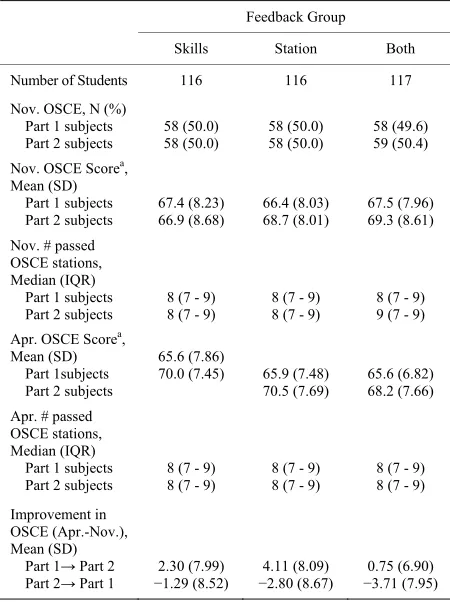
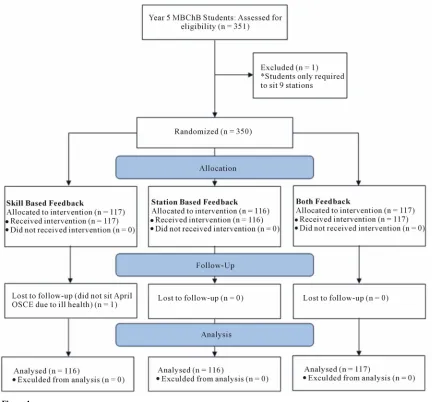
[image:3.595.57.285.109.335.2]No students opted-out of the study. A flow diagram of the trial is shown in Figure 1. One student did not take the April stations due to ill health and was excluded from the analysis. Summary statistics for each feedback group are shown in Table 2.
Table 2. Summary Statistics.
Feedback Group
Skills Station Both
Number of Students 116 116 117
Nov. OSCE, N (%) Part 1 subjects Part 2 subjects
58 (50.0) 58 (50.0) 58 (50.0) 58 (50.0) 58 (49.6) 59 (50.4) Nov. OSCE Scorea,
Mean (SD) Part 1 subjects Part 2 subjects
67.4 (8.23) 66.9 (8.68) 66.4 (8.03) 68.7 (8.01) 67.5 (7.96) 69.3 (8.61) Nov. # passed
OSCE stations, Median (IQR) Part 1 subjects Part 2 subjects
8 (7 - 9) 8 (7 - 9)
8 (7 - 9) 8 (7 - 9)
8 (7 - 9) 9 (7 - 9) Apr. OSCE Scorea,
Mean (SD) Part 1subjects Part 2 subjects
65.6 (7.86)
70.0 (7.45) 65.9 (7.48) 70.5 (7.69)
65.6 (6.82) 68.2 (7.66) Apr. # passed
OSCE stations, Median (IQR) Part 1 subjects Part 2 subjects
8 (7 - 9) 8 (7 - 9)
8 (7 - 9) 8 (7 - 9)
8 (7 - 9) 8 (7 - 9)
Improvement in OSCE (Apr.-Nov.), Mean (SD) Part 1→ Part 2 Part 2→ Part 1
2.30 (7.99)
−1.29 (8.52)
4.11 (8.09)
−2.80 (8.67)
0.75 (6.90)
−3.71 (7.95)
[image:3.595.310.535.393.694.2]
Figure 1. Trial flow diagram.
OSCE Performance
entire cohort. There are no economies of scale in providing both feedback interventions, so the total time spent providing both for the whole cohort would have been approximately 100 hours.The total cost of providing the feedback would be ap-proximately £500 ($790) for the skills-based and £1050 ($1660) for the station-based.This amounts to around £1.40 ($2.20) per student for the skills-based feedback and £3.00 ($4.75) per student for the station-based feedback.No further analysis of cost-effectiveness was undertaken because there was no differ-ence in effectiveness between the station- and skills- based groups in either cohort.The internal consistency of the 18 station-level scores in the OSCE (calculated using Cronbach’s alpha) was 0.72 for Cohort A and 0.71 for Cohort B. The coefficients for the regression models predicting April OSCE performance are shown in
Ta-ble 3. Feedback group was not a statistically significant
predic-tor of April OSCE score for Cohort B.For Cohort A, students who received station-based feedback had higher April scores than the group that received both types (mean difference 2.8%, 95% CI 0.4 to 5.2, p = 0.022). There was no statistically
sig-nificant difference between the April scores of the station- and skills-based groups. The effect sizes (f2) of the skills-only and station-only feedback groups compared to the group receiving both types were 0.014 and 0.032 (Cohort A); and 0.004 and 0.001 (Cohort B), respectively.
Student Satisfaction
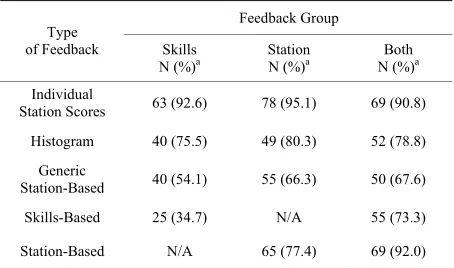
Questionnaires were received from 245 students (70%).
Ta-ble 4 shows the percentage of students rating each type of
feedback as somewhat or very helpful, by feedback group.Only 35% of students in the skills-based only feedback rated this as somewhat or very helpful, compared to 73% of students who received both interventions.The “both” group were also more positive about the station-based feedback, with 92% rating this
Cost-Effectiveness
[image:4.595.83.515.85.487.2]Table 3.
Predictors of April OSCE performance.
Cohort A Cohort B Variables in
Re-gression Model
Coef. (95%CI), p-value Coef. (95%CI), p-value
Constant 35.1 (26.7 - 43.5), <0.001 38.5 (30.1 - 46.9), <0.001
Nov. OSCE Score 0.49 (0.37 - 0.61), <0.001 0.39 (0.27 - 0.51), <0.001
Feedback group (cf Both)
Skills-based
Station-based 1.83 (2.80 (0.41 - 5.18), 0.022 −0.55 - 4.22), 0.131 0.90 (0.52 (-1.90 - 2.95), 0.671−1.54 - 3.34), 0.467
n 174 175
R² 0.28 0.20
Table 4.
Questionnaire resultsa by feedback group.
Feedback Group Type
of Feedback Skills
N (%)a Station N (%)a N (%)Both a Individual
Station Scores 63 (92.6) 78 (95.1) 69 (90.8)
Histogram 40 (75.5) 49 (80.3) 52 (78.8)
Generic
Station-Based 40 (54.1) 55 (66.3) 50 (67.6)
Skills-Based 25 (34.7) N/A 55 (73.3)
Station-Based N/A 65 (77.4) 69 (92.0)
Note: aPercent of students who rated each mode of feedback somewhat helpful or very helpful by Feedback Group (4-point rating scale).
as somewhat or very helpful compared to 77% of students who only received this type of feedback.At least 90% of students in all three groups rated their individual station scores as some-what or very helpful.
Discussion
This randomized trial evaluated the effectiveness of using OSCE mark sheets to deliver two new types of feedback to students on their clinical performance.The group that received both skills- and station-based feedback were the most satisfied with the additional feedback they received. However, they did not perform better on their subsequent OSCE and actually those in Cohort A did not do as well as the station-only group. This divergence between satisfaction and effectiveness has been noted previously (Boehler et al., 2006). While the average cost per student of providing either type of additional feedback is low, the resources required still have an opportunity cost and may be more productively employed elsewhere at the medical school.
The effect sizes were very low and differences amongst trial groups in the regression models lacked educational significance. Furthermore, only one cohort saw a statistically significant result for trial group. Receiving station feedback alone was better than receiving both for Cohort A, but not for Cohort B.
jects, or vice versa. The examiners in Cohort A and B are dif-ferent, but if the comments of the November Cohort A examin-ers negatively affected the students, we would also have ex-pected to see the station-based group do worse than the skills- based group. Cohort A also received feedback on one more skill (planning investigations) compared to Cohort B (Table 1),
but it seems unlikely this would negatively impact scores for only those students receiving both types of feedback.
Our findings suggest that the additional feedback derived from OSCE mark sheets was not effective in improving per-formance. One of the reasons for this could be weaknesses in both types of additional feedback: feedback should be specific, non-evaluative, timely, and provide guidance on current and future behaviour (Ende, 1983; Brown & Cooke, 2009; Chowd-hury & Kalu, 2004; Brukner et al., 1999; Kluger & DeNisi, 1996). Despite our best efforts to map OSCE tasks to important clinical skills, deriving those skills from tasks on OSCE mark sheets may not have produced specific enough areas for stu-dents to improve upon.Likewise, examiner comments may not have been specific enough to be useful, or perhaps were too evaluative (about the student instead of the task).Examiners could instead be asked to provide specific information about each student’s strengths and areas in which they could improve.
The lag time between the November OSCE and provision of the feedback (5 weeks) could have been one reason for its inef-fectiveness (Gigante et al., 2011).This delay was the result of having to wait until all marks had been processed and ratified by the exam board to begin transcribing the station-based feed-back and calculating skills-based scores. Other methods of delivering feedback as immediately as possible should be ex-plored.For example, digitised voice recordings or comments typed electronically by examiners could be sent to students much sooner than transcriptions of paper mark sheets.
While this was a randomized trial, it was not possible to blind students to which feedback intervention they had received and this may have affected their study behavior for the April OSCE. However both April examiners and the statistician were blinded as to students’ group allocations and it is unlikely that students receiving both types of feedback would have relied on this to ensure they passed this high-stakes exam.Ethical con-siderations prevented us from having a “no additional feedback” group, although it does not appear that either type of additional feedback was effective in improving OSCE performance. Stu-dents are inevitably concerned with passing their examinations, but from a patient perspective, the most important outcome— for which April OSCE performance is a surrogate of unknown quality—is whether the feedback helps students perform better in clinical practice.
[image:5.595.58.288.108.266.2] [image:5.595.59.286.300.434.2]used effectively by students.
Acknowledgements
We thank Professor Carole Torgerson for providing guidance on design, Beverley Merricks for providing guidance on the OSCE and Alan Girling & Amanda Chapman for assistance with randomization.
REFERENCES
Bing-You, R. G., Paterson, J., & Levine, M. A. (1997). Feedback fal-ling on deaf ears: Residents’ receptivity to feedback tempered by sender credibility. Medical Teacher, 19, 40-44.
doi:10.3109/01421599709019346
Black, N. M. I., & Harden, R. M. (1986). Providing feedback to stu-dents on clinical skills by using the objective structured clinical ex-amination. Medical Education, 20, 48-52.
doi:10.1111/j.1365-2923.1986.tb01041.x
Boehler, M. L., Rogers, D. A., Schwind, C. J., Mayforth, R., Quin, J., Williams, R. G., et al. (2006). An investigation of medical student reactions to feedback: A randomised controlled trial. Medical Educa-tion, 40, 746-749. doi:10.1111/j.1365-2929.2006.02503.x
Boet, S., Sharma, S., Goldman, J., & Reeves, S. (2012). Review article: Medical education research: An overview of methods. Canadian Journal of Anesthesia, 59, 159-170. doi:10.1007/s12630-011-9635-y Brown, N., & Cooke, L. (2009). Giving effective feedback to
psychiat-ric trainees. Advances in Psychiatpsychiat-ric Treatment, 15, 123-128. doi:10.1192/apt.bp.106.003293
Brukner, H., Altkorn, D. L., Cook, S., Quinn, M. T., & Mcnabb, W. L. (1999). Giving effective feedback to medical students: A workshop for faculty and house staff. Medical Teacher, 21, 161-165.
doi:10.1080/01421599979798
Chowdhury, R. R., & Kalu, G. (2004). Learning to give feedback in medical education. The Obstetrician & Gynaecologist, 6, 243-247. doi:10.1576/toag.6.4.243.27023
Cohen, J. (1988). Statistical power analysis for the behavioral sciences (2nd ed.). Hillsdale, NJ: Earlbaum.
De, S. K., Henke, P. K., Ailawadi, G., Dimick, J. B., & Colletti, L. M. (2004). Attending, house officer, and medical student perceptions about teaching in the third-year medical school general surgery clerkship. Journal of the American College of Surgeons, 199, 932- 942. doi:10.1016/j.jamcollsurg.2004.08.025
Ende, J. (1983). Feedback in clinical medical education. Journal of the American Medical Association, 250, 777-781.
doi:10.1001/jama.1983.03340060055026
Faul, F., Erdfelder, E., Buchner, A., & Lang, A. G. (2009). Statistical power analyses using G*Power 3.1: Tests for correlation and regres-sion analyses. Behavior Research Methods, 41, 1149-1160. doi:10.3758/BRM.41.4.1149
General Medical Council (2009). Tomorrow’s doctors. London:
Gen-eral Medical Council.
Gigante, J., Dell, M., & Sharkey, A. (2011). Getting beyond “good job”: How to give effective feedback. Pediatrics, 127, 205-207.
doi:10.1542/peds.2010-3351
Gil, D. H., Heins, M., & Jones, P. B. (1984). Perceptions of medical school faculty members and students on clinical clerkship feedback. Academic Medicine, 59, 856-864.
doi:10.1097/00001888-198411000-00003
Hodder, R. V., Rivington, R. N., Calcutt, L. E., & Hart, I. R. (1989). The effectiveness of immediate feedback during the Objective Struc- tured Clinical Examination. Medical Education, 23, 184-188. doi:10.1111/j.1365-2923.1989.tb00884.x
Hollingsworth, M., Richards, B. F., & Frye, A. W. (1994). Description of observer feedback in an objective structured clinical examination and effects on examinees. Teaching and Learning in Medicine, 6, 49-53. doi:10.1080/10401339409539643
Kluger, A., & DeNisi, A. (1996). The effects of feedback interventions on performance: A historical review, a meta-analysis, and a prelimi-nary feedback intervention theory. Psychological Bulletin, 119, 254- 284. doi:10.1037/0033-2909.119.2.254
Livingston, S., & Zieky, M. (1982). Passing scores: A manual for setting standards of performance on educational and occupational tests. Princeton, NJ: Educational Testing Service.
Moher, D., Hopewell, S., Schulz, K. F., Montori, V., Gøtzsche, P. C., Devereaux, P. J., et al. (2010). CONSORT 2010 Explanation and Elaboration: Updated guidelines for reporting parallel group ran-domised trials. British Medical Journal, 340, c.869.
doi:10.1136/bmj.c869
Sargeant, J. M., Mann, K. V., Van der Vleuten, C. P., & Metsemakers, J. F. (2009). Reflection: A link between receiving and using assess-ment feedback. Advances in Health Science Education, 14, 399-410. doi:10.1007/s10459-008-9124-4
Schulz, K. F., Altman, D. G., & Moher, D. for the CONSORT Group (2010). CONSORT 2010 statement: Updated guidelines for reporting parallel group randomised trials. PLoS Medicine, 7, e1000251. doi:10.1371/journal.pmed.1000251
University of Washington (2004). Second year OSCEs: Preparing for the second year OSCEs. URL (last checked 14 September 2012). http://www.uwmedicine.org/Education/MD-Program/Current-Studen ts/Curriculum/OSCE/Pages/Second-Year-OSCEs.aspx
Van De Ridder, J. M. M., Stokking, K. M., McGaghie, W. C., & Ten Cate, O. T. (2008). What is feedback in clinical education? Medical Education, 42, 189-197. doi:10.1111/j.1365-2923.2007.02973.x Veloski, J., Boex, J. R., Grasberger, M. J., Evans, A., & Wolfson, D. B.
(2006). Systematic review of the literature on assessment, feedback and physicians’ clinical performance: BEME Guide No. 7. Medical Teacher, 28, 117-128. doi:10.1080/01421590600622665