Computing the Distribution Function of the
Number of Renewals
Mohan L. Chaudhry, Xiaofeng Yang, Boon Ong
Department of Mathematics and Computer Science, Royal Military College of Canada, Kingston, Canada Email: [email protected], [email protected], [email protected]
Received April 20, 2013; revised May 25, 2013; accepted June 15, 2013
Copyright © 2013 Mohan L. Chaudhry etal. This is an open access article distributed under the Creative Commons Attribution Li-cense, which permits unrestricted use, distribution, and reproduction in any medium, provided the original work is properly cited.
ABSTRACT
The method of Laplace transforms is used to find the distribution function, mean, and variance of the number of renew- als of a renewal process whose inter-arrival time distribution has a rational Laplace transform. Where the Laplace transform is not rational, we use the Padé approximation method. We apply our method to certain examples and the results are compared to those reported by other researchers.
Keywords: Number of Renewals; Rational Approximation; Padé
1. Introduction
Renewal and reliability theories are powerful modeling tools in many applications, considering, for example, a series of renewals during a time interval
0,t
with the inter-renewal times having certain distributions. The in- terest, usually, is to find the distribution or the moments of the number of renewals during the interval
0,t
, ,
X X
.Although the theoretical aspects of renewal theory have been discussed in various books such as Cox [1] and Feller [2,3], not much seem to have been done in apply- ing the theoretical results to practice for lack of availabil- ity of easily computable results. Using the cubic splining algorithm to compute the recursively-defined convolu- tion integrals that appear in renewal theory, Baxter et al. [4] is able to construct some tables for the mean and vari-ance of the number of renewals for different inter-re- newal time distributions with varying parameters. A straightforward method to compute the convolution inte-gral is to use the Laplace transform (LT) method. Using the root-finding method, Chaudhry [5] develops a unified method to compute the mean and variance of the number of renewals. Though the means and variances are useful for many applications, this paper goes a step further and deals with computing the distribution of the number of renewals from which one can get more information than from the mean and variance.
There are several methods that can be used for the numerical inversion of generating functions (GFs); see the excellent reviews on the numerical inversion (of GFs
as well as of LTs) by Abate et al. [6-9]. Some researchers have been critical of using the method of roots, see, e.g. Cox and Smith [10] and Kleinrock [11]. In view of this, this paper serves another useful purpose and shows that with the availability of high precision in current software packages, the roots can be found successfully and used to invert the transforms. Further, using the roots method, the results can be first given in an analytically explicit form and then used to find the final results.
2. Theory
2.1. Problem Description and Method of Laplace Transforms
Let 1 2 be a governing sequence of independ-ently identically distributed (i.i.d.) inter-renewal times for the renewal process
N t t
, 0
, where N t
denotes the number of renewals in 0,t
. Let X rep-resent the generic inter-renewal time with cumulative distribution function (CDF)
, 00, 0
P X t t
F t
t
f t . and probability density function (pdf)Define the probability mass function (pmf)
, 0,1, 2,n
P t P N t n n
, 1, 0
n
S X n S
. Let
0 1
n
i i . For n0, Sn representsthe time when the n-th renewal occurs. Define
n n
f s
Is Not a Rational Function
n
n
F t F t ,n0,1, 2,
is the n-fold convolution of F t
with itself, and (see Chaudhry and Templeton [12])
1
n n n
P t F t F t , t0,n0
(1) Let f s
and n
p s be the Laplace-Stieltjes trans-form (LST) of F t
and P tn
0
, respectively, defined b y f s
e dst
0 e d
st
n
P tn
1
n
f s f s F t p s
a n d .
Taking the LST on both sides of Equation (1), we get
n
n1
n
p s f s f s (2) and hence
1
1
n n
n
f s p s
P t 1 f s .
s s
f s
(3)
2.2. Inversion of Laplace Transforms
2.2.1. Is a Rational Function
The inverse LT Equation (3) can be obtained analytically using partial fractions. Let
N s f s D s where D s
and N s
kk
are polynomials of degree and at most , respectively. Then by Equation (2), we have
1
n
D s N s s
n
n N s
p s s sD (4)
which is a rational function.
Without loss of generality, we assume that the equa-tion D s
0 has distinct roots k s s1, , ,2 sk. Since
0 1f , N s
and D s
n 1
n 1s s
have the same constant terms, 1
s
s s1 2
k
1
n
s s
n
D . And
Equation (4) can be expressed in partial fractions as
1 , 1 1 k n j i i j i j A n p ss s s
, j i A where the constant coefficient is given by
ij
p s
A s s
1
, 1
1 d
1 ! d
i n
j i i si s
The final inversion can be written as
11 1
k n
, 1e
1 ! j
s t
j i i
A t i
n j iP t
(5)The case when
2.2.2.
We use the Padé approximation method. Assume
0D s has repeated roots can be dealt with similarly.
0 1 1 ! n n n n
f s M s
n
0 d n n whereM
x F x
is the n-th moment of the inter-renewal time. We can find a rational approximation function
0 0 ˆ K n n n L n n n b s N s f s
D s a s
N s and D s are polynomials of degree
where K
and L, respectively with undetermined coefficients and n, such that the first
n
b
a K L moments of f s
are equal to those of f s
. We denote the above Padé approximation as
K L
a
(Baker et al. [13]). In practice,
0 is set to one and K and L are chosen by trial and
error. Equating the moments and formulating the simul-taneous equations, the coefficients bn and an are uniquely
determined (Baker et al. [13], Harris [14]).
Use of continued fractions is another way to obtain an approximate rational function f s
. The method is, in fact, a special case of the Padé method (Baker et al. [13]).
There are times when using Padé method directly is not possible or does not give the desired results. For ex-ample, the Pareto distribution has an infinite second mo-ment, and directly equating the moments cannot be done. For the lognormal distribution, the waveform of the Padé approximated distribution function shows quite large errors. The solution is to have a two-step approximation. The first step is to use line segments to approximate the distribution function. In the second step, the Padé method is used to generate a rational LT. By adjusting the pa-rameters in these two steps, f s
can be obtained with the desired properties. We will illustrate this technique in the examples.
2.3. Verification of the Distribution
N t in The expected number of renewals of 0,1
0 n
n
E N t nP t
2
20 n
n
V N t n P t E N t
is given by
and its variance by
In all our examples, the P tn
obtained in Equation
V N
, and E N t and
are checked against the results obtained by (Chaudhry [5]) using
1E N t
1 f s s f s
and
1
1 f s
V N t 1 f s2 .
s f s
In addition, we also match the resulting mean and vari-ance with those of Baxter et al. [4].
3. Examples
3.1. Erlang Distribution
We first consider the simple case where f t
follows the Erlang distribution with the shape parameter equal to 2, and we can get exact analytical results.
The pdf and CDF of f t
2e tare given, respectively, by f t t
and
1 e t
1
F t t
Thus, 2 2. s f s We get
2 2 2 2 n 2 1 2 2 2 n n n n s s s s p s
t
2n1 ,
2
e 2 1 !
n t n t P t n 2 1 2 2
1 1 1
e ,
4 2 4
2
t
E N t t
s s
and
2 2 2
1 2 2 2 4 2 2 2
1 1 1e 1e .
16 4 2 16
t t
s s
V N t
s s
t t
It may be remarked that the analytic expression for the mean has been incorrectly reported by Parzen [15, p. 177].
3.2. Mixed Generalized Erlang Distribution
The pdf and LST of a Mixed Generalized Erlang (MGE) distribution are given, respectively, by
1
1
e , 0
1 !
j j t
k
j j
t
f t c t
j
and j 1 . k j jf s c
s
1 1. k j jcwith
0.25, 0.5,
c c c
We consider the case of MGE with
n
P
1 5 10 and 1. The t
t
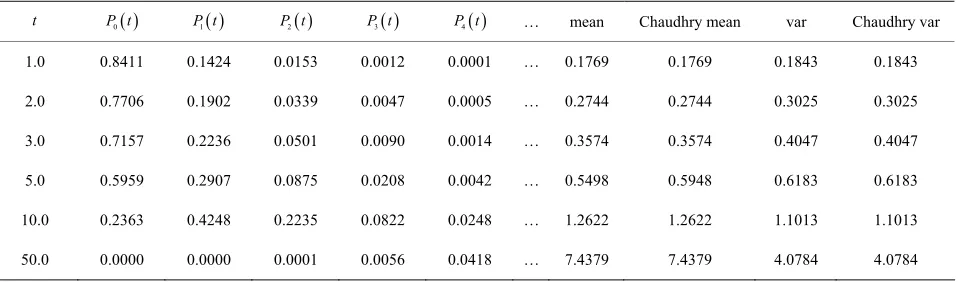
, mean and variance are obtained by the LT method discussed in Section 2.2. Table 1 shows the results for several values of . They are checked against the known results obtain- ed without using roots by Chaudhry [5].
The graph in Figure 1 shows that the E N t
cal-culated from the obtained distribution functions asymp-totically converges to the line
2 2 1 2 1 1 2 1 1 2 M Mt t o
M M 1 (6) M
M and
derived in [16], where M2 are the first and
[image:3.595.62.239.117.224.2] [image:3.595.61.540.592.733.2]n P t
Table 1. for MGE distribution with c1c50.25,c100.5, and 1.
t t t t t … mean Chaudhry mean var Chaudhry var
t P0 P1 P2 P3 P4
1.0 0.8411 0.1424 0.0153 0.0012 0.0001 … 0.1769 0.1769 0.1843 0.1843
2.0 0.7706 0.1902 0.0339 0.0047 0.0005 … 0.2744 0.2744 0.3025 0.3025
3.0 0.7157 0.2236 0.0501 0.0090 0.0014 … 0.3574 0.3574 0.4047 0.4047
5.0 0.5959 0.2907 0.0875 0.0208 0.0042 … 0.5498 0.5948 0.6183 0.6183
10.0 0.2363 0.4248 0.2235 0.0822 0.0248 … 1.2622 1.2622 1.1013 1.1013
Figure 1. E N t
asymptotically converges to the line
M t .
second moments of f t
. As expected, one can see from this graph that the results given in Equation (6) are good only for large t.
3.3. Matrix Exponential Distribution
Consider the matrix exponential and non-phase-type dis-
tribution (see Bladt [17]) given below. The pdf and its LT are, respectively,
2
1
1 1 cos 2π e
4π
t
f t t
and
2
2 2
4π 1
1 1 4π
f s
s s
Using partial fractions for transform inversion, we
ob-tain P tn
t
for some selected values. The results are listed in Table 2.
3.4. Gamma Distribution
The pdf and LST of the Gamma distribution are given, respectively, by
1e
Γ
t
t f t
and
1 1 f s
s
where and are the shape and scale parameters, respectively. In this example, we set 1
and α = 0.55. The Padé [4/5] approximation of f s
is given by
2 3 4
2 3 4 5
1 1.97778 1.27938 0.29852 0.01804 ˆ
1 2.52778 2.24340 0.81724 0.10556 0.00232
s s s s
f s
s s s s s
The P tn
are obtained and some selected pmf's, means, and variances are tabulated together with those fromBax-ter et al. [4] in Table 3.
3.5. Weibull Distribution
The pdf
1
e
, 0
t
t
f t t
and the CDF1 e , 0
t
F t t
3
of the Weibull distribution do not have the closed-form LT. However, the moments of the Weibull distribution can be obtained from its CDF to use in the Padé method. For and 1, we equate moments up to the 8-th moment in the Padé [2/6] approximation, and get
2 3 24 5 61 0.0834 0.01200
1 0.88464 0.35058 0.08043 0.01141 0.00097 0.00004
s s
ˆ f s
s s s s s s
Table 2. Pn t for the non-phase-type distribution discussed in Section 3.3.
t P t0 P t1 P t2 P3 t P t4 … mean var
1.0 0.3679 0.3915 0.2154 0.0242 0.0009 … 0.8988 0.6785
2.0 0.1353 0.2881 0.3035 0.1693 0.0832 … 1.8411 1.5077
3.0 0.0498 0.1590 0.2475 0.2322 0.1779 … 2.7919 2.3400
5.0 0.0067 0.0359 0.0919 0.1523 0.1963 … 4.6973 3.9929
10.0 0.0001 0.0005 0.0025 0.0084 0.0215 … 9.4619 8.1164
[image:5.595.56.542.227.285.2]
Table 3. Pn t for the Gamma distribution with 0.55 and 1.
t P t0 P t1 P t2 P3 t P t4 … mean Baxter mean var Baxter var
0.10 0.6871 0.2385 0.0602 0.0119 0.0019 … 0.4040 0.3933 0.4623 0.4485
0.40 0.4071 0.3088 0.1677 0.0743 0.0284 … 1.0545 1.0550 1.3970 1.3901
1.25 0.1291 0.1951 0.2050 0.1730 0.1249 … 2.6663 2.6653 4.0487 4.0441
Some selected results are listed in Table 4 together with Baxter’s (see Baxter et al. [4]). It is noted that when t becomes large, our resulting means and variances match those of Chaudhry [5].
3.6. Truncated Normal Distribution
The pdf of the truncated normal distribution is given by
2
2
2
1
e , 0
2π
t
f t t
a
where a 1 Φ
, with Φ
being the standard normal distribution function. By the Padé [5/6] approxi-mation
2 2 3 3 4 4 5 5 61 0.77069 0.31300 0.07039 0.00886 0.00048 .56875 1.06454 0.40145 0.08908 0.01108 0.00061
s s s s s
ˆ
1 1 f s
s s s s s s
n
P
we are able to obtain t . Some results and compari-sons are shown in Table 5.
3.7. Inverse Gaussian Distribution
The pdf for the inverse Guassian distribution is
2
0.75
2 2
3e , 0.
2π
t t
f t t
t
Setting and 0.5625
0.75 0.75 1 2 0.5e s
f s
, its LST is given by
and can also be expressed in terms of the where
2
shape and scale parameters and
, re- spectively, (see Baxter et al. [4]). By the Padé [4/7] ap-proximation, we get
2 3 4
2 3 4 5 6 7
1 4.95748 9.70859 6.32864 1.57069
1 5.70748 12.33295 12.55938 6.10460 1.27288 0.09280 0.00385
s s s s
ˆ f s
s s s s s s s
Some results are shown in Table 6 along with the re-sults of Baxter et al. [4].
3.8. Lognormal Distribution
The pdf
2
2 log
2
e , 0
π
t
f t t
1 2 t and CDF
ln
Φ t , 0
F t t
of the lognormal distribution have no closed-form LT. Using the Padé approximation method directly on the lognormal distribution does not lead to the desired results. Our solution is a two-step approximation. In the first step, we sample uniformly N points of F t
N
Table 4. Pn t for the Weibull distribution with 3 and 1.
t P t0 P t1 P t2 P3 t P4 t … mean Baxter mean var Baxter var
0.25 0.9841 0.0159 0.0000 … 0.0159 0.0156 0.0156 0.0154
0.60 0.8070 0.1908 0.0022 0.0000 … 0.1953 0.1965 0.1616 0.1624
1.00 0.3664 0.5939 0.0391 0.0005 0.0000 … 0.6738 0.6724 0.3012 0.3018
[image:6.595.58.550.199.257.2]
Table 5. Pn t for the Truncated Normal distribution with 0 and 1.
t P t0 P t1 P t2 P3 t P4 t … mean Baxter mean var Baxter var
0.15 0.8807 0.1121 0.0068 0.0003 0.0000 … 0.1267 0.1267 0.1261 0.1261
0.45 0.6527 0.2849 0.0548 0.0068 0.0006 … 0.4178 0.4179 0.4023 0.4024
1.25 0.2113 0.4002 0.2567 0.0981 0.0268 … 1.3507 1.3508 1.0997 1.1007
[image:6.595.53.546.290.348.2]
Table 6. Pn t for the Inverse Gaussian distribution with 0.5625 and 0.75.
t P t0 P t1 P t2 P3 t P4 t … mean Baxter mean var Baxter var
0.25 0.7445 0.2442 0.0112 0.0001 0.0000 … 0.2669 0.2715 0.2188 0.2200
0.70 0.3390 0.4042 0.2062 0.0457 0.0046 … 0.9736 0.9739 0.7732 0.7718
1.25 0.1623 0.2869 0.2867 0.1762 0.0683 … 1.7635 1.7638 1.5294 1.5293
[image:6.595.57.542.381.439.2]
Table 7. Pn t for the Lognormal distribution with 0 and 1.
t P t0 P t1 P t2 P3 t P4 t … mean Baxter mean var Baxter var
0.10 0.9855 0.0145 0.0000 … 0.0145 0.0107 0.0143 0.0106
0.40 0.8226 0.1698 0.0074 0.0001 0.0000 … 0.1851 0.1867 0.1664 0.1658
1.25 0.4113 0.4052 0.1532 0.0274 0.0027 … 0.8056 0.8043 0.6636 0.6616
uniform sampling step size used is h tN
N
, where tN is chosen arbitrarily such that F
tN is close to 1. In addition,the last line segment is modified to reach 1 at tN. The resulting first approximation function can be written as
1
1 1
1
N
i i
i i
i
F t F t
t t F t u t t
h
i1
u t ti
,
where
, i1, 2, , N 2i
u t t are unit step functions. In this example, is set to 0 and to 1. Accordingly, we set N100 and tN 10.
In the second step, the LST of the first approximation function is obtained and expanded as a Taylor series. Using the Padé [7/8] method, we have the second approximation of f s
to be
2 2 3 3 4 4 5 5 6 61 2.7966 4.7293 7
7 8
0493 2.8807 0.9596 0.3004 0.0036 ˆ
1 4.3795 8.9689 11.2718 9.5600 5.6388 2.2756 0.5795 0.0721
s s s s s s
f s s 4.
s s s s s s s s
n
P
Table 7 lists selected t , means and variances a- long with the results of Baxter et al. [4].
4. Conclusions
Using Laplace transforms, it is shown that computing the distribution of the number of renewals is straightforward when the LT of the inter-renewal time distribution is ra- tional. For inter-renewal time distributions having non- rational LTs, the Padé method provides good approxima-
tions. For the case where the inter-renewal time distribu- tions do not have Laplace transforms, we provide the line segment approximation for the distribution function and apply the Padé method thereafter.
are used to solve such problems. Further, the method discussed here can be applied to more complex models such as bulk-renewal processes both in discrete- and con- tinuous-times once the analytic results are known.
5. Acknowledgements
The first author acknowledges with thanks for the partial support he received through NSERC #17287 for carrying out this research.
REFERENCES
[1] D. R. Cox, “Renewal Theory,” John Wiley & Sons Inc., New York, 1962.
[2] W. Feller, “Probability Theory and Its Applications Vol. II,” Wiley, New York, 1966.
[3] W. Feller, “An Introduction to Probability Theory and Its Applications,” Wiley, New York, 1967.
[4] L. A. Baxter, E. M. Scheuer, D. J. McConalogue and W. R. Blischke, “On the Tabulation of the Renewal Func- tions,” Technometrics, Vol. 24, No. 2, 1982, pp. 151-156.
doi:10.1080/00401706.1982.10487739
[5] M. L. Chaudhry, “On Computations of the Mean and Va- riance of the Number of Renewals: A United Approach,” TheJournaloftheOperationsResearchSociety, Vol. 46, 1995, pp. 1352-1364.
[6] J. Abate, G. L. Choudhury and W. Whitt, “A Unified Framework for Numerically Inverting Laplace Trans- forms,” InformsJournal onComputing, Vol. 18, No. 4, 2006, pp. 408-421. doi:10.1287/ijoc.1050.0137
[7] J. Abate, G. L. Choudhury and W. Whitt, “An Introduc- tion to Numerical Transform Inversion and Its Applica- tion to Probability Models,” In: W. Grassman, Ed., Com-
putational Probability, Kluwer, Boston, 1999, pp. 257- 323.
[8] J. Abate and W. Whitt, “Numerical Inversion of Laplace Transforms of Probability Distributions,” ORSAJournal onComputing, Vol. 7, No. 1, 1995, pp. 36-43.
doi:10.1287/ijoc.7.1.36
[9] J. Abate and W. Whitt, “The Fourier-Series Method for Inverting Transforms of Probability Distributions,” Queue- ingSystems, Vol. 10, No. 1-2, 1992, pp. 5-88.
doi:10.1007/BF01158520
[10] D. R. Cox and W. L. Smith, “Queues,” Methuen and CO Ltd., London, 1967.
[11] L. Kleinrock, “Queueing Systems Volume I: Theory,” John Wilery & Sons, New York, 1975, pp. 212-312. [12] M. L. Chaudhry and J. G. C. Templeton, “A First Course
on Bulk Queues,” John Wiley & Sons Inc., New York, 1983.
[13] G. A. Baker and P. Graves-Morris Jr., “Padé Approxi- mants (Encyclopedia of Mathematics and Its Applica- tions),” 2nd Edition, Cambridge University Press, Cam- bridge, 1996.
[14] C. M. Harris and W. G. Marchal, “Distribution Estima- tion Using Laplace Transform,” INFORMS Journal on Computing, Vol. 10, No. 4, 1998, pp. 448-458.
doi:10.1287/ijoc.10.4.448
[15] E. Parzen, “Stochastic Processes,” Holden-Day Inc., San Francisco, 1962.
[16] M. L. Chaudhry and B. Fisher, “Simple and Elegantderi-vations for Some Asymptotic Results in the Discrete- Time Renewal Process,” StatisticsandProbabilityLetters, Vol. 83, No. 1, 2012, pp. 408-421.