Munich Personal RePEc Archive
Behavior in Contests
Sheremeta, Roman
1 July 2014
Behavior in Contests
Roman M. Sheremeta
Weatherhead School of Management, Case Western Reserve University and the Economic Science Institute, Chapman University
11119 Bellflower Road, Cleveland, OH 44106, U.S.A.
July 1, 2014
Abstract
Standard theoretical prediction is that rational economic agents participating in rent-seeking contests should engage in socially inefficient behavior by exerting costly efforts. Experimental studies find that the actual efforts of participants are significantly higher than predicted and that over-dissipation of rents (or overbidding or over-expenditure of resources) can occur. Although the standard theory cannot explain over-dissipation, this phenomenon can be explained by incorporating behavioral dimensions into the rent-seeking contest, such as (1) the utility of winning, (2) relative payoff maximization, (3) bounded rationality, and (4) judgmental biases. These explanations are not exhaustive, but they provide a coherent picture of important behavioral dimensions that should be considered when studying rent-seeking behavior in theory and in practice.
JEL Classifications: C72, C91, C92, D72, D74
Keywords: rent-seeking, contests, experiments, overbidding, over-dissipation
* Corresponding author: Roman Sheremeta, [email protected] and [email protected]
1. Introduction
Costly and unproductive competitions between economic agents are often portrayed as
rent-seeking contests. Examples range from litigation and lobbying, to wars and violent global
conflicts (Tullock, 1964; Krueger, 1974). The variety of economic and political situations that
can be described as rent-seeking contests has attracted enormous attention from economic
theorists. For a recent review of the theoretical literature see Konrad (2009).
The main idea of rent-seeking is very simple and it is used to describe socially inefficient
but personally profitable behavior. People can engage in productive behavior (such as creating
resources) and unproductive behavior (such as contesting for already existing resources). The
unproductive behavior is known as rent seeking. The two most commonly used models to
describe rent-seeking behavior are the rent-seeking contest model of Tullock (1980) and the
all-pay auction (Dasgupta, 1986; Hillman and Riley, 1989). Both models assume that individuals
exert costly irreversible efforts while competing for a prize. The individual probability of
winning the prize depends on efforts exerted by all contestants. In the all-pay auction, the
individual exerting the highest effort wins the prize with certainty. In the rent-seeking contest,
the probability of winning the prize equals the ratio of an individual’s effort to the sum of efforts
exerted by all contestants. Both models provide many important theoretical results and
comparative statics predictions. One of such theoretical results is that rational economic agents
should always engage in unproductive behavior and that dissipation of rents is inevitable in
equilibrium.
Theoretical models of rent-seeking have been extensively tested in controlled laboratory
settings. For a comprehensive review of this literature see Dechenaux et al. (2014). Most
However, these studies also uncover a number of important behavioral phenomena which are not
predicted by the theory. One of such phenomena is over-dissipation of rents (Sheremeta, 2013).
This phenomenon is also known as overbidding or over-expenditures of resources, i.e.,
participants in laboratory experiments exert efforts which are significantly higher than predicted
by the standard Nash equilibrium.
The standard rent-seeking contest model, based on the assumption of rational economic
agents, cannot explain over-dissipation. Nevertheless, the over-dissipation phenomenon can be
explained by incorporating behavioral dimensions into the standard model, such as (1) the utility
of winning, (2) relative payoff maximization, (3) bounded rationality, and (4) judgmental biases.
In this chapter, we discuss these behavioral dimensions of contests in detail. We restrict our
attention mostly to rent-seeking contests of Tullock (1980), since such contests have attracted
most attention from experimental researchers (Dechenaux et al., 2014) and the over-dissipation
phenomenon has been extensively explored (Sheremeta, 2013).
We begin by introducing a standard theoretical contest model. Then, we provide a short
overview of experimental literature on rent-seeking contests and discuss the over-dissipation
phenomenon. Then, in order to explain over-dissipation, we extend the theory of contests to
behavioral dimensions, such as the utility of winning, relative payoff maximization, bounded
rationality, and judgmental biases. Finally, we conclude by suggesting directions for future
research and discussing potential mechanisms that can reduce over-dissipation.
2. Standard Theoretical Contest Model
Perhaps the simplest model of rent-seeking is a lottery contest model proposed by
prize value of . The probability that individual wins the prize depends on individual ’s effort
and the efforts of all other individuals. Specifically, individual ’s probability of winning the
prize is defined by a contest success function (Skaperdas, 1996):
∑
. (1)
Given (1), the expected payoff for individual is equal to the expected benefit, i.e., the
probability of winning the prize times the prize value , minus the cost of effort, i.e.,
. That is
. (2)
Differentiating (2) with respect to and accounting for the symmetric Nash equilibrium leads to
an equilibrium effort:
. (3)
There are no asymmetric equilibria in the lottery contest and the symmetric equilibrium (3) is
unique (Szidarovszky and Okuguchi, 1997).1 Therefore, each individual has an equal probability
of winning in equilibrium, i.e., . The equilibrium expected payoff can be calculated
by plugging (3) into (2), which gives
. (4)
The dissipation rate, measured as a ratio of the total expenditures to the value of the prize ,
is
. (5)
Economic intuition behind this model is straightforward. Higher value of prize implies
higher equilibrium effort , i.e., , and higher payoff , i.e. . On
1
the other hand, higher number of competitors implies lower equilibrium effort , i.e.,
(due to so-called “discouragement effect”), and lower payoff , i.e.,
.2
The classic formulation of a Tullock contest demonstrates the tension between the
socially optimal and the individually rational behavior. The socially optimal level of effort is
zero. In such a case, no effort is wasted, i.e., 0, and all individuals have equal probability of
winning, i.e., . The expected payoff is and the dissipation rate is
0. However, in equilibrium, the rational economic agent should engage in an unproductive
competition by exerting costly efforts, i.e., , thus causing rent dissipation, i.e.,
. Each individual earns positive expected payoff, i.e., , and, as
in the socially optimal case of no effort, all individuals have equal probability of winning, i.e.,
.
3. Experimental Findings on Contests
Millner and Pratt (1989) were the first to examine a lottery contest using a laboratory
experiment. In their experiment, participants were placed in groups of two, i.e., 2, and group
composition changed from period to period. Each period, participants could submit their bids
(efforts) in order to win a prize of $8, i.e., 8. Given these parameters, the unique equilibrium
effort is $2, i.e., 2, the expected payoff is $2, i.e., 2, and
the dissipation rate is 0.5, i.e., = 0.5. The results of the experiment showed
2
Theoretically, the “discouragement effect” arises because, when facing a stronger individual (or more individuals), a weaker individual cuts back on his costly expenditures (Baik, 1994; Gradstein, 1995; Stein, 2002). The
that the actual average effort of $2.24 and the dissipation rate of 0.56 are significantly higher
[image:7.612.143.475.143.425.2]than predicted. The magnitude of over-dissipation is about 12%.
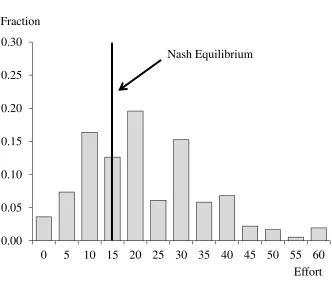
Figure 1: Distribution of Efforts.
Note: The data are taken from Sheremeta (2011).
Since Millner and Pratt (1989), many other experiments have replicated the phenomenon
of over-dissipation (Sheremeta, 2013; Dechenaux et al., 2014). Based on a sample of 30 contest
experiments examined by Sheremeta (2013), the median over-dissipation rate is 72%. The
magnitude of over-dissipation in some studies is so high that on average participants receive
negative payoffs (Abbink et al., 2010; Sheremeta and Zhang, 2010; Price and Sheremeta, 2011,
2014; Morgan et al., 2012; Chowdhury et al., 2014; Lim et al., 2014; Mago et al., 2014). Figure 1
displays a typical distribution of effort in lottery contests. The data are taken from Sheremeta
(2011), where 2 individuals compete for a prize of = 60. According to the theoretical 0.00
0.05 0.10 0.15 0.20 0.25 0.30
0 5 10 15 20 25 30 35 40 45 50 55 60 Fraction
prediction, the equilibrium effort is 15. Nevertheless, most participants exert efforts that are
significantly higher than predicted, with an average over-dissipation of about 31%.
Why do participants over-dissipate relative to the standard Nash equilibrium prediction?
In the next section, we extend the theory of contests to behavioral dimensions, such as the utility
of winning, relative payoff maximization, bounded rationality, and judgmental biases in order to
explain the phenomenon of over-dissipation.
4. Behavioral Dimensions of Contests
4.1. Utility of Winning
The standard theoretical contest model is based on the assumption that individuals care
only about the monetary value of the prize, i.e., . However, participants in actual contests also
may care about winning itself. One way to incorporate the utility of winning into a contest
model, is to assume that in addition to the prize value , individuals also have an additive
non-monetary utility of winning (Sheremeta, 2010). Therefore, the updated expected payoff of
individual can be written as
. (6)
Differentiating (6) with respect to and accounting for the symmetric Nash equilibrium gives a
new equilibrium effort, which is a function of both a monetary value and a non-monetary value
:
. (7)
The corresponding dissipation rate is
It is easy to verify that the new equilibrium effort (7) increases in the non-monetary
utility of winning , i.e., . Moreover, for any , the dissipation rate
described by (8) is higher than the standard dissipation rate described by (5). Therefore, if
in addition to the prize value , individuals indeed have the non-monetary utility of winning ,
we should observe over-dissipation in rent-seeking contests.
Although the utility of winning is an appealing behavioral explanation for the
over-dissipation phenomenon, it is not trivial to test whether economic agents indeed have such a
utility. Sheremeta (2010) designed a method to elicit the utility of winning by having individuals
participate in the contest with a monetary prize and then in the contest with no prize. The results
of the experiment showed that individuals who exert significant efforts just to be recognized as
winners also behave overly competitive in the contest with the monetary prize. In the
experiment, students participated in 30 periods of play in a four-individual contest, i.e., 4,
with a prize value of 120, i.e., 120. At the end of the experiment, participants were asked to
submit their efforts for a prize value of 0, i.e., 0. Participants were explicitly told that they
would have to pay for their efforts and that they would not receive any monetary benefit in case
they won. If participants value only monetary payoffs, they should not exert any effort when the
monetary prize value is zero. However, if participants derive utility from winning, they may
choose to exert positive efforts even when there is no monetary prize.
Sheremeta (2010) found that more than 40% of economically motivated participants
exert positive efforts in the contest with a prize value of zero. Moreover, efforts in a contest with
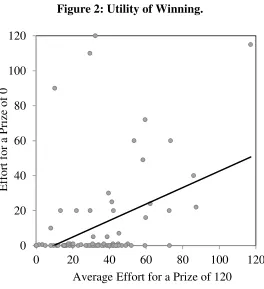
a zero prize are correlated with efforts in contests with a strictly positive prize. Figure 2 displays
the correlation between an effort for a prize of = 0 and an average (over 30 periods of play)
22.5 when the prize is 120 and 0 when the prize is 0. Figure 2 shows that there is substantial
heterogeneity in efforts, and participants who exert higher efforts for the prize of 0 also exert
higher efforts for the prize of 120 (Spearman’s correlation coefficient is 0.31, p-value < 0.01).
Therefore, it appears that in addition to monetary utility, many participants derive non-monetary
utility of winning and such a utility can partially explain over-dissipation in rent-seeking
[image:10.612.176.440.236.525.2]contests.
Figure 2: Utility of Winning.
Note: The data are taken from Sheremeta (2010).
The findings of Sheremeta (2010) have been replicated by other studies (Price and
Sheremeta, 2011, 2014; Cason et al., 2013; Brookins and Ryvkin, 2014; Mago et al., 2014). This
suggests that the utility of winning is a robust behavioral regularity that should be incorporated
into theoretical models of rent-seeking. However, the exact specification of the utility of winning
is still an open question. For example, it is possible that the utility of winning is not additive and
is not invariant to the value of the monetary prize , in which case, the correct specification of 0
20 40 60 80 100 120
0 20 40 60 80 100 120
Ef
for
t
for
a
P
riz
e
of
0
the utility of winning would be . It is also possible that the utility of winning may
depend on the number of contestants , in which case, the correct specification of the utility of
winning would be . Disregarding the exact functional form, the utility of winning is an
important behavioral factor which can help explaining over-dissipation.
4.2. Relative Payoff Maximization
Related to the utility of winning, studies show that over-dissipation may be driven by
spiteful preferences and relative payoff maximization (Fonseca, 2009; Cason et al., 2013;
Eisenkopf and Teyssier, 2013; Mago et al., 2014). Mago et al. (2014) propose a theoretical
model in which individuals care not only about the utility of winning but also about the
weighted average payoff of other group members. In such a case, the expected utility of
individual can be written as
∑ ( ), (9)
where is a relative payoff parameter representing a measure of how individuals weight their
payoffs relative to others: reflects preferences of pro-social individuals seeking to increase
the payoff of others, while reflects preferences of status-seeking individuals striving to
obtain a higher relative payoff than others. The exact origin of the relative payoff plarameter is
ambiguous. First, it may be the case that individuals simply have other-regarding preferences
(Fehr and Schmidt, 1999). Second, evolutionary game theory would argue that individuals care
about their “survival” payoff (Leininger, 2003; Hehenkamp et al., 2004; Riechmann, 2007).
Finally, the quest to seek higher expected payoff than others is also consistent with the ‘spite
substantial amount of research indicating that individuals care about their payoff relative to
others in the group (Frey and Stutzer, 2002)
Differentiating (9) with respect to and accounting for the symmetric Nash equilibrium
gives the equilibrium effort
. (10)
The corresponding dissipation rate is
. (11)
It is easy to verify that the equilibrium effort (10) increases in the utility of winning ,
i.e., , and increases in the relative payoff parameter , i.e., .
Moreover, for and 0, the dissipation rate described by (11) is higher than the
standard dissipation rate described by (5).
In their experiment, Mago et al. (2014) find that 51% of participants indicate positive
utility of winning, i.e., 0, replicating the findings of Sheremeta (2010). Moreover, Mago et
al. find that 67% of participants behave as status-seekers, i.e., 0. These findings suggest that
over-dissipation in contests can be explained by a combination of a utility of winning and
relative payoff maximization.
4.3. Bounded Rationality
The two explanations that we have discussed so far are based on the behavioral facts that
individuals participating in contests care about winning itself ( ) and their relative payoffs ( ).
Another well document behavioral fact is that people are prone to mistakes and instead of
One way to introduce bounded rationality into a contest model is to assume that
participants make mistakes, which add noise to the Nash equilibrium solution. McKelvey and
Palfrey (1995) suggested an elegant method of incorporating mistakes into strategic
environments, naming the corresponding solution a quantal response equilibrium (QRE). In the
Nash equilibrium (3), each individual plays a pure strategy , given that others are playing the
equilibrium strategy . In the QRE, each individual plays a mixed strategy in which the
probability of playing a pure strategy is increasing in the expected payoff of that
strategy, given that others are playing the equilibrium mixed strategy . The most commonly
used specification of the QRE is the logistic QRE, where the equilibrium probability of choosing
is given by:
∫ , (12)
where 0 is an error parameter describing the level of noise in the decision making process. If
0, then the Nash equilibrium effort is chosen with probability one, i.e., 1. If
, then each effort between 0 and the maximum allowed effort level is equally likely to be
chosen.
One implication of the QRE is that if individuals are unconstrained and are allowed to
exert any effort between 0 and the value of the prize , then any level of mistakes, i.e., 0,
will lead to over-dissipation (Sheremeta, 2011; Chowdhury et al., 2014; Lim et al., 2014). The
intuition is simple. Consider an individual who is completely confused and does not understand
the rules of the game, i.e., . According to the QRE, such an individual will make his
decision by randomly choosing any effort level between 0 and the value of the prize .
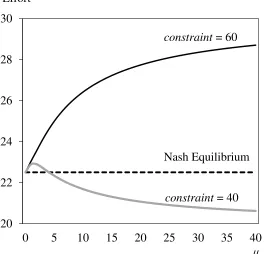
Figure 3: Expected Average Effort at the QRE.
Sheremeta (2011) explicitly tests the predictions of the QRE model by conducting two
experimental treatments. In each treatment, four participants, i.e., = 4, compete in a lottery
contest for a prize value of = 120. In one treatment, participants are constrained to choose their
efforts between 0 and 60 and in the other treatment participants are constrained to choose their
efforts between 0 and 40. Constraining participants to choose their efforts not higher than either
60 or 40 is not binding relative to the Nash equilibrium of 22.5, i.e., 22.5.
Figure 3 displays the expected average effort at the QRE as a function of and constraint. When
, the behavior is consistent with the Nash equilibrium. When , individuals move
closer to a random play, and thus the average effort approaches 30 (over-dissipation) for the
constraint of 60 and it approaches 20 (under-dissipation) for the constraint of 40. Therefore, if
participants make substantial level of mistakes, then the average effort should be significantly
higher in the treatment with the constraint of 60. Sheremeta (2011) finds that the actual average 20
22 24 26 28 30
0 5 10 15 20 25 30 35 40 Effort
μ
constraint = 60
effort is 29.3 when the constraint is 60 and it is 21.0 when the constraint is 40, consistent with
the predictions of the QRE.
The findings of Sheremeta (2011) suggest that participants indeed make mistakes when
participating in rent-seeking contests and such mistakes can explain over-dissipation. There are
two potential explanations as to why participants make mistakes. First, it is possible that
participants hold incorrect beliefs about the actions chosen by their opponents. Second,
participants may simply make errors in their own actions. The first explanation is less likely to
be true. The main reason is that the best-response functions in lottery contests are structured in
such a way that if a participant believes that the opponent is going to either make higher or lower
than the equilibrium effort, his best response is to always exert lower than the equilibrium effort.
4.4. Judgmental Biases
It is well documented in behavioral economics literature that people not only make
random mistakes (as in the case of the QRE), but they also exhibit systematic “judgmental
biases” (Camerer et al., 2011) which can explain behavior in rent-seeking contests (Baharad and
Nitzan, 2008; Sheremeta and Zhang, 2010; Chowdhury et al., 2013, 2014; Price and Sheremeta,
2014).
Baharad and Nitzan (2008) apply an idea of distorted probability weighting function from
“prospect theory” of Kahneman and Tversky (1979) to prove that over-dissipation of rents is
theoretically possible. Following Tversky and Kahneman (1992), they assume that individuals
assign a distorted (biased) inverse S-shaped probability weighting function to the objective
probability . Thus, instead of contest success function (1), individual’s perceived probability of
. (13)
Given the distortion function (13), the expected payoff for an individual can be written as
( ) . (14)
Differentiating (14) with respect to and accounting for the symmetric Nash equilibrium gives
the equilibrium effort
( ) (
) . (15)
The corresponding dissipation rate is
( ) (
). (16)
When comparing the dissipation rate described by (16) to the standard dissipation
rate described by (5), we find that for certain configurations of parameters it is possible to
observe over-dissipation, i.e., . For example, with 15 and 0.61, the
dissipation rate described by (16) is 1.05, while the standard dissipation rate described
by (5) is 0.9. The magnitude of over-dissipation is about 16%, which is close to the
magnitude of over-dissipation observed in many experimental studies (Sheremeta, 2013;
Dechenaux et al., 2014).
Although there is substantial evidence for the distorted probability weighting function
both in the laboratory and in the field (Wu and Gonzalez, 1996; Bruhin et al., 2010), there are
currently no experimental studies directly relating the phenomenon of over-dissipation to the
distorted probability weighting.3 Closely related studies have examined how the behavior of
participants in rent-seeking contests changes when the contest success function (1) is replaced by
3
a share function (Cason et al., 2010, 2013; Fallucchi et al., 2013; Shupp et al., 2013; Chowdhury
et al., 2014). Chowdhury et al. (2014), for example, design a two-by-two experiment, by varying
whether the prize is assigned probabilistically (i.e., efforts determine the probabilities of winning
the prize) or proportionally (i.e., efforts determine the shares of the prize) and whether the cost
function is linear or convex. Although in all treatments the risk-neutral Nash equilibrium effort
level is constant, Chowdhury et al. find that compared to the probabilistic contest success
function, the proportional rule results in effort levels that are closer to the risk-neutral prediction
(with almost no over-dissipation).4 Combining the proportional rule with a convex cost function
further strengthens these results. Therefore, it appears that even though there is no direct
evidence as to whether distorted probability weighting causes over-dissipation in rent-seeking
contests, related studies show that even a slight modification to the contest success function
plays a major role in determining individual behavior.
Price and Sheremeta (2014) apply another idea from prospect theory of Kahneman and
Tversky (1979) to explain over-dissipation in contest experiments. They design an experiment in
which some participants have to earn their income before participating in a laboratory
rent-seeking contest experiment. Price and Sheremeta find that participants who earn their income
exert lower efforts in subsequent contests than participants who receive their income directly
from the experimenter. The main reason for this result is that participants who earn their income
and participants who receive their income for free have difference reference points. Participants
who earn their income operate in the domain of losses, while participants who receive free
income operate in the domain of gains.
4
Sheremeta and Zhang (2010) and Chowdhury et al. (2013) discuss yet another
judgmental bias that may partially explain over-dissipation in repeated contests. Specifically,
they find that, participants who win in period t-1 are more likely to make higher efforts in period
t. Sheremeta and Zhang (2010) point out the similarities of correlation between winning in
period t-1 and higher efforts in period t to a “hot hand” phenomenon found in the gambling
literature – belief in a positive autocorrelation of a non-autocorrelated random sequence
(Gilovich et al., 1985; Chau and Phillips, 1995; Croson and Sundali, 2005). Therefore, it appears
that hot hand response by participants may help explaining over-dissipation in repeated contest
settings.5
5. Discussion and Conclusion
Many economic and political environments can be characterized as rent-seeking contests
in which economic agents choose to engage in unproductive competition in order to obtain a
scarce resource. Such rent-seeking contests have been extensively studied by economic theorists
(Konrad, 2009). In recent years, theoretical rent-seeking models have been extensively tested in
controlled laboratory settings (Dechenaux et al., 2014). One of the main findings from these
studies is that participants exert efforts which are significantly higher than predicted by the
standard Nash equilibrium (Sheremeta, 2013). This phenomena is commonly referred to as
over-dissipation of rents, overbidding, or over-expenditure of resources.
The standard rent-seeking contest model, based on the assumption of rational economic
agents, cannot explain over-dissipation. Nevertheless, the over-dissipation phenomenon can be
explained by incorporating behavioral dimensions into a standard contest model, such as (1) the
utility of winning, (2) relative payoff maximization, (3) bounded rationality, and (4) judgmental
5
biases. Although these explanations are not exhaustive, they provide a coherent picture of
important behavioral dimensions that should be considered when studying rent-seeking behavior
in theory and in practice.6
There are several fruitful avenues for future research. First, it is still an open question as
to what behavioral dimensions are the most important in explaining individual behavior in
rent-seeking contests. For example, it is possible that some of the factors explaining over-dissipation
are correlated, e.g., the relative payoff maximization may be driven by the utility of winning, or
judgmental biases may be driven by systematic mistakes. The relative impact of these factors on
individual behavior remains unknown.
Second, given the prevalence of over-dissipation in laboratory experiments it is important
to know whether over-dissipation occurs in field settings with real-effort and high stakes. Do
field experiments offer insights on whether over-dissipation is a robust phenomenon? If so, then
are the explanations for dissipation in the field similar to the explanations for
over-dissipation in the laboratory? These questions are very important and answering them would
significantly advance our understanding of over-dissipation phenomenon.
Finally, given that rent-seeking behavior is unproductive and very costly (even more so
than predicted by the theory), it is important to develop and investigate mechanisms aimed at
avoiding unproductive competitions.7 Since the seminal book by Schelling (1960), a number of
mechanisms for avoiding conflicts have been proposed, ranging from deterrence via extensive
6
One may add to this list other candidates such as regret, overconfidence, and risk aversion. It is important to emphasize, however, that risk aversion cannot explain over-dissipation in contests (Dechenaux et al., 2014). Although theoretically it is possible for risk aversion to cause over-dissipation (Treichm, 2010; Cornes and Hartley, 2012), experimental contest studies show that more risk-averse subjects choose lower efforts than less risk-averse subjects (Millner and Pratt, 1991; Anderson and Freeborn, 2010; Sheremeta and Zhang, 2010; Sheremeta, 2011; Mago et al., 2013; Shupp et al., 2013).
7
armament to contractually binding side-payments. Recent experimental studies have examined
different conflict resolution mechanisms including side-payments (Kimbrough and Sheremeta,
2013, 2014), random devices (Kimbrough et al., 2013, 2014), communication (Cason et al.,
2012, 2014), cooperative spillovers (Savikhin and Sheremeta, 2013), and social identification
(Mago et al., 2014). Whether these mechanisms are effective in the field remains an open
References
Abbink, Klaus, Jordi Brandts, Benedikt Herrmann, and Henrik Orzen (2010), "Intergroup conflict and intra-group punishment in an experimental contest game," American Economic Review, 100, 420-447.
Amaldoss, Wilfred, and Amnon Rapoport (2009), "Excessive expenditure in two-stage contests: Theory and experimental evidence," in F. Columbus (ed.), Game Theory: Strategies, Equilibria, and Theorems, Hauppauge, NY: Nova Science Publishers.
Anderson, Lisa R., and Beth A. Freeborn (2010), "Varying the intensity of competition in a multiple prize rent seeking experiment," Public Choice, 143 (1-2), 237-254.
Anderson, Lisa R., and Sarah L. Stafford (2003), "An experimental analysis of rent seeking under varying competitive conditions," Public Choice, 115 (1-2), 199-216.
Baharad, Eyal, and Shmuel Nitzan (2008), "Contest efforts in light of behavioural considerations," Economic Journal, 118 (533), 2047-2059.
Baik, Kyung Hwan (1994), "Effort levels in contests with two asymmetric players." Southern Economic Journal, 367-378.
Brookins, Philip, and Dmitry Ryvkin (2014), "An experimental study of bidding in contests of incomplete information," Experimental Economics, 17 (2), 245-261.
Bruhin, Adrian, Helga Fehr‐Duda, and Thomas Epper (2010), "Risk and rationality: Uncovering heterogeneity in probability distortion," Econometrica, 78 (4), 1375-1412.
Camerer, Colin (2003), Behavioral Game Theory: Experiments in Strategic Interaction, Princeton University Press.
Camerer, Colin F., George Loewenstein, and Matthew Rabin (2011), Advances in behavioral economics, Princeton University Press.
Cason, Timothy N., William A. Masters, and Roman M. Sheremeta (2010), "Entry into winner-take-all and proportional-prize contests: An experimental study," Journal of Public Economics, 94 (9), 604-611.
Cason, Timothy N., William A. Masters, and Roman M. Sheremeta (2013), “Winner-take-all and proportional-prize contests: theory and experimental results,” Economic Science Institute, Working Paper.
Cason, Timothy N., Roman M. Sheremeta, and Jingjing Zhang (2012), "Communication and efficiency in competitive coordination games," Games and Economic Behavior, 76 (1), 26-43.
Cason, Timothy N., Roman M. Sheremeta, and Jingjing Zhang (2014), “Asymmetric and endogenous communication in competition between groups,” Economic Science Institute, Working Paper.
Chau, Albert W., and James G. Phillips (1995), "Effects of perceived control upon wagering and attributions in computer blackjack," Journal of General Psychology, 122 (3), 253-269.
Chowdhury, Subhasish M., and Roman M. Sheremeta (2011a), "A generalized Tullock contest," Public Choice, 147 (3-4), 413-420.
Chowdhury, Subhasish M., and Roman M. Sheremeta (2011b), “Multiple equilibria in Tullock contests,” Economics Letters, 112, 216-219.
Chowdhury, Subhasish M., and Roman M. Sheremeta (2014), “Strategically equivalent contests,” Theory and Decision, forthcoming.
Chowdhury, Subhasish M., Theodore L. Turocy, and Roman M. Sheremeta (20 4), ‘Overbidding and overspreading in rent-seeking experiments: Cost structure and prize allocation rules,’ Games and Economic Behavior, 87, 224-238.
Cornes, Richard, and Roger Hartley (2012), "Risk aversion in symmetric and asymmetric contests," Economic Theory, 51 (2), 247-275.
Croson, Rachel, and James Sundali (2005), "The gambler’s fallacy and the hot hand: Empirical data from casinos," Journal of Risk and Uncertainty, 30 (3), 195-209.
Dasgupta, Partha (1986), “The theory of technological competition,” in J. E. Stiglitz and G. F. Mathewson, (eds.), New Developments in the Analysis of Market Structure, Cambridge, MIT Press.
Dechenaux, Emmanuel, Dan Kovenock, and Roman M. Sheremeta (2014), “A survey of experimental research on contests, all-pay auctions and tournaments,” Experimental Economics, forthcoming.
Deck, Cary, and Roman M. Sheremeta (2012), "Fight or flight? Defending against sequential attacks in the game of Siege," Journal of Conflict Resolution, 56 (6), 1069-1088.
Eisenkopf, Gerald, and Sabrina Teyssier (2013), "Envy and loss aversion in tournaments," Journal of Economic Psychology, 34, 240-255.
Fallucchi, Francesco, Elke Renner, and Martin Sefton (2013), "Information feedback and contest structure in rent-seeking games," European Economic Review, 64, 223-240.
Fehr, Ernst, and Klaus M. Schmidt (1999), "A theory of fairness, competition, and cooperation," Quarterly Journal of Economics, 114, 817-868.
Fonseca, Miguel A. (2009), "An experimental investigation of asymmetric contests," International Journal of Industrial Organization, 27 (5), 582-591.
Frey, Bruno S., and Alois Stutzer (2002), "What can economists learn from happiness research?" Journal of Economic literature, 40, 402-435.
Gilovich, Thomas, Robert Vallone, and Amos Tversky (1985), "The hot hand in basketball: On the misperception of random sequences," Cognitive Psychology, 17 (3), 295-314.
Gradstein, Mark (1995), "Intensity of competition, entry and entry deterrence in rent seeking contests," Economics and Politics, 7 (1), 79-91.
Hamilton, William D. (1970), "Selfish and spiteful behaviour in an evolutionary model," Nature, 228, 1218-1220.
Hehenkamp, Burkhard, Wolfgang Leininger, and Alexandre Possajennikov (2004), "Evolutionary equilibrium in Tullock contests: spite and overdissipation," European Journal of Political Economy, 20 (4), 1045-1057.
Hillman, Arye L., and John G. Riley (1989), "Politically contestable rents and transfers," Economics and Politics, 1 (1), 17-39.
Kahneman, Daniel, and Amos Tversky (1979), "Prospect theory: An analysis of decision under risk," Econometrica, 47, 263-291.
Kimbrough, Erik, Jared Rubin, Roman Sheremeta, and Timothy Shields (2013), "Commitment problems in conflict resolution," Economic Science Institute, Working Paper.
Kimbrough, Erik O., and Roman M. Sheremeta (2013), "Side-payments and the costs of conflict," International Journal of Industrial Organization, 31 (3), 278-286.
Kimbrough, Erik O., Roman M. Sheremeta, and Timothy W. Shields (2014), "When parity promotes peace: Resolving conflict between asymmetric agents," Journal of Economic Behavior and Organization, 99, 96-108.
Konrad, Kai A. (2009), Strategy and Dynamics in Contests, New York, NY: Oxford University Press.
Krueger, Anne O. (1974), "The political economy of the rent-seeking society," American Economic Review, 64, 291-303.
Leininger, Wolfgang (2003), "On evolutionarily stable behavior in contests," Economics of Governance, 4 (3), 177-186.
Lim, Wooyoung, Alexander Matros, and Theodore L. Turocy (2014), "Bounded rationality and group size in Tullock contests: Experimental evidence," Journal of Economic Behavior and Organization, 99, 155-167.
Mago, Shakun, Anya Samak, and Roman Sheremeta (2013), "Facing your opponents: Social identification and information feedback in contests," Journal of Conflict Resolution, forthcoming.
Mago, Shakun D., Roman M. Sheremeta, and Andrew Yates (2013), "Best-of-three contest experiments: Strategic versus psychological momentum," International Journal of Industrial Organization, 31 (3), 287-296.
McKelvey, Richard D., and Thomas R. Palfrey (1995), "Quantal response equilibria for normal form games," Games and Economic Behavior, 10 (1), 6-38.
Millner, Edward L., and Michael D. Pratt (1989), "An experimental investigation of efficient rent-seeking," Public Choice, 62 (2), 139-151.
Millner, Edward L., and Michael D. Pratt (1991), “Risk aversion and rent-seeking: An extension and some experimental evidence,” Public Choice, 69, 81-92.
Morgan, John, Henrik Orzen, and Martin Sefton (2012), "Endogenous entry in contests," Economic Theory, 51 (2), 435-463.
Parco, James E., Amnon Rapoport, and Wilfred Amaldoss (2005), "Two-stage contests with budget constraints: An experimental study," Journal of Mathematical Psychology, 49 (4), 320-338.
Price, Curtis R., and Roman M. Sheremeta (2011), "Endowment effects in contests," Economics Letters, 111 (3), 217-219.
Price, Curtis R., and Roman M. Sheremeta (2014), “Endowment origin, demographic effects and individual preferences in contests,” Journal of Economics and Management Strategy, forthcoming.
Riechmann, Thomas (2007), "An analysis of rent-seeking games with relative-payoff maximizers," Public Choice, 133 (1-2), 147-155.
Savikhin, Anya C., and Roman M. Sheremeta (2013), "Simultaneous decision‐making in competitive and cooperative environments," Economic Inquiry, 51 (2), 1311-1323.
Schelling, Thomas C. (1960), The Strategy of Conflict, Cambridge, MA: Harvard University Press.
Sheremeta, Roman M., and Jingjing Zhang (2010), "Can groups solve the problem of over-bidding in contests?" Social Choice and Welfare, 35 (2), 175-197.
Sheremeta, Roman M. (2010), "Experimental comparison of multi-stage and one-stage contests," Games and Economic Behavior, 68 (2), 731-747.
Sheremeta, Roman M. (2013), “Overbidding and heterogeneous behavior in contest experiments,” Journal of Economic Surveys, 27, 491-514.
Shupp, Robert, Roman M. Sheremeta, David Schmidt, and James Walker (2013), "Resource allocation contests: Experimental evidence," Journal of Economic Psychology, 39, 257-267. Skaperdas, Stergios (1996), "Contest success functions," Economic Theory, 7 (2), 283-290. Stein, William E. (2002), "Asymmetric rent-seeking with more than two contestants," Public
Choice, 113 (3-4), 325-336.
Szidarovszky, Ferenc, and Koji Okuguchi (1997), "On the existence and uniqueness of pure Nash equilibrium in rent-seeking games," Games and Economic Behavior, 18 (1), 135-140. Treich, Nicolas (2010), "Risk-aversion and prudence in rent-seeking games," Public Choice, 145
(3-4), 339-349.
Tullock, Gordon ( 967), ‘The welfare costs of tariffs, monopolies, and theft’, Western Economic Journal, 5(3), 224-232.
Tullock, Gordon (1980), “Efficient rent seeking,” in James M. Buchanan, Robert D. Tollison and Gordon Tullock (eds), Towards a Theory of the Rent-Seeking Society, College Station, TX: Texas A&M University Press, pp. 97-112.
Tversky, Amos, and Daniel Kahneman (1992), "Advances in prospect theory: Cumulative representation of uncertainty," Journal of Risk and Uncertainty, 5 (4), 297-323.