Communities of practice, knowledge acquisition and
innovation: a case study of science-based small firms.
PATTINSON, Steven <http://orcid.org/0000-0003-3352-5738> and PREECE, DavidAvailable from Sheffield Hallam University Research Archive (SHURA) at: http://shura.shu.ac.uk/12594/
This document is the author deposited version. You are advised to consult the publisher's version if you wish to cite from it.
Published version
PATTINSON, Steven and PREECE, David (2014). Communities of practice, knowledge acquisition and innovation: a case study of science-based small firms. Journal of Knowledge Management, 18 (1), 107-120.
Copyright and re-use policy
See http://shura.shu.ac.uk/information.html
1
Communities of practice, knowledge acquisition and innovation: a case
study of science-based SMEs
Steven Pattinson
Teesside University Business School, Teesside University, Middlesbrough, UK
David Preece
2 ABSTRACT
Purpose – Recent research into communities of practice (CoPs) has focused on large
organizations, suggesting they can be constructed for the purposes of knowledge acquisition and innovation. The study provides evidence that for small science-based firms CoPs are more likely to emerge unplanned to support incremental innovation in the form of problem solving activities.
Design/methodology/approach – Thematic template analysis was used to analyze 25 in- depth interviews conducted with a range of employees in science-based SMEs.
Findings – Analysis of the interview data from a case study of seven science-based SMEs provides evidence that both intra and inter-organizational CoPs were leveraged for a variety
of purposes, including the acquisition of knowledge and improving firm’s ability to generate innovative solutions.
Research limitations/implications - Whilst there cannot be any claim of ‘representativeness’
of the sample in relation to the wider population of science-based firms, the authors do
maintain that the new empirical material has made a contribution to a research area which has been dominated, especially in recent years, by a focus upon large organizations that have adopted a managerialist orientation.
Originality/value - The challenges of understanding the role of CoPs in science-based SMEs
and the factors that influence their success, or otherwise, have not been sufficiently
investigated and have received little attention in the extant literature. Hence, this paper makes an original contribution to this body of knowledge.
Key words - Communities of practice, innovation, knowledge acquisition, template analysis.
3
1. INTRODUCTION
The research project upon which this paper is based is concerned to understand whether, and
if so, how, science-based SMEs engage with CoPs in order to acquire new knowledge and
whether any innovations are generated through such engagement. The project addresses a
number of specific questions relating to CoPs in science-based SMEs:
1. Are CoPs to be found such organizations?
2. If so, how and why do they emerge and/or are they constructed?
3. How is knowledge acquired?
4. What innovations, if any, are generated thereby?
The study extends our understanding of CoPs in science-based SMEs through the new
empirical material the authors have gathered and the development of a framework for
constructing CoPs in science-based SMEs.
2. COMMUNITIES OF PRACTICE
In knowledge management (KM) terms, a community of practice is a group of people
informally bound together by shared expertise and a passion for a joint enterprise (Wenger
and Snyder, 2000). The initial theoretical formulation of CoPs (Lave and Wenger, 1991)
focused on the way in which individuals learn, and argued that learning is socially situated,
that is, it arises from and within the context, activity, and culture in which it is developed and
used. CoP theory has been adapted by knowledge management theorists and used to highlight
its value in relation to increasing firms’ absorptive capacity, i.e. the ability to recognize the
value of new, external information, assimilate it, and apply it to commercial advantage
(Cohen and Levinthal, 1990), improve learning (Autio, et al., 2008) and innovation
4
The emergent and self-selecting membership features of CoPs can contribute to strategy and
innovation, help start new lines of business, solve problems on the spot, transfer best practice,
develop professional skills and help the recruitment and retention of talent (Wenger and
Snyder, 2000). Through the sharing of practice participants learn together, focusing on
problems directly related to their work (Wenger and Snyder, 2000). This has some affinity
with Orr’s (1996) ethnographic study of photocopy repairmen, although Orr used the term
‘occupational communities’ (Van Maanen and Barley, 1984) rather than CoPs.
Lave and Wenger’s (1991) and Wenger’s (1998) earlier CoP research failed to acknowledge
that a lot of research and technological development work is now done between
organizations-these early formulations being rather amorphous, group-centric and inward
looking (Assimakopoulos, 2007). CoP theory has often ignored the inter-organizational
networks and relationships that are required in complex, technology-rich, innovation-driven
organizations, where research and development is organized and conducted at distributed
locations (Assimakopoulos, 2007). Moingeon et al. (2006) argue for the support and
development of inter- organizational communities of practice (IOCoPs), noting that such
CoPs can bring together professionals belonging to different organizations and that ‘for the
organization, IOCoPs indirectly represent a powerful monitoring and innovation force,
making both knowledge production and distribution easier’ (Moingeon et al., 2006, p.13).
Similarly, Allee (2000) comments that if CoPs emerge in the social space between project
teams and knowledge networks they could be beneficial in supporting learning communities
that extend both inside and outside organizational boundaries.
For science-based SMEs wishing to innovate, there are two clear imperatives: support the
development and circulation of knowledge within and pursue alignments across CoPs.
5
research laboratories, suppliers and buyers (Moingeon et al., 2006). ‘Open innovation’ in
particular involves searching outside the firm’s boundaries for mutually beneficial
relationships (Chesbrough, 2003), and focuses upon how firms manage their network of
internal and external relationships (Dahlander and Gann, 2010). Open innovation has
increasingly emphasized the role of communities in creating, shaping and disseminating
innovations (Fichter, 2009). Autio et al. (2008) argue that firms involved in collaborative
innovation should purposely foster the development of CoPs. There are clear links between
open innovation and absorptive capacity, particularly with reference to the sourcing and
exchange of externally developed knowledge (Vanhaverbeke et al., 2008). CoPs may provide
an introductory vehicle for SME knowledge management (Du Plessis, 2008), a means to
boost technological learning, and a means to commercially exploit new innovations (Autio et
al., 2008).
Notwithstanding the above, the authors and others have found that, for science-based SMEs
at least, the construction of CoPs can be problematic. It is unlikely, for example, that SMEs
can spare the resources required for constructing CoPs (Roberts, 2006). These resources can
include time for CoP participation, training for CoP leaders, and IT tools to facilitate
participation in CoPs (McDermott and Archibald, 2010). Given that they have access to
fewer resources than larger organizations, Tödtling (2001) suggests, however, that they might
compensate precisely by engaging in CoPs to support innovation and knowledge
management (see also Partanen et al., 2008). Probst and Borzillo (2008) advocate the use of
‘governance committees’ to assess the activities of CoPs and management sponsors to guide
them, but such practices might be seen by SMEs to divert resources away from core business
6
In the next section the authors briefly outline the research methodology and case study
organizations.
3. METHODOLOGY
The research project used the critical case sampling technique to identify and select cases
relevant to the research questions (Patton, 2002). This helped to generate the four
science-based SMEs, access to which was negotiated and agreed between key gatekeepers in these
organizations and one of the authors. Semi-structured interviews were conducted with 21
individuals employed in technical (i.e. scientists and engineers) and commercial roles (i.e.
operations, finance and purchasing). The interviews lasted for between 40 and 80 minutes
and were audio- recorded with the permission of the interviewee, and subsequently
transcribed verbatim. The names of the organizations and interviewees have been
anonymized for confidentiality reasons. Template analysis (see Crabtree and Miller, 1999;
King, 2004) was used to thematically analyze the resultant data. This deploys hierarchical
coding, beginning with broad a priori themes, moving to sequentially narrower, more defined
themes as the analysis progresses. This method was chosen because it is in sympathy with the
adopted social constructionist epistemology, and was used, inter alia, to explore
relationships, the meanings attributed to actions, and the various perspectives and orientations
of the interviewees.
Nvivo qualitative data analysis software was used to code the data and create the final
thematic template. Nvivo was helpful in organizing and storing the data as well as generating
a hierarchical structure. It also supported an iterative process, allowing for codes to be added,
deleted or changed more readily than a ‘cut and glue’ paper-based approach; it did not,
however, replace the iterative process of generating codes, which is where Template Analysis
7
systematic yet reflexive approach to data analysis. Appendix 1 lists the themes which
emerged during coding. Whilst the authors’ sample is not claimed to be representative of the
wider population of SME science-based firms, it does present new empirical material on
CoPs, knowledge acquisition and innovation in such organizations, an area where there has
been only a limited amount of research to date. The six organizations are now briefly
outlined.
Company A is a contract chemical processing company providing bespoke outsourcing
solutions to the process industry, such as agrochemicals, biocides and herbicides. It is the
largest and longest established of the six firms. Company B manufactures a range of in-vitro
diagnostic products for use in the detection, prevention, and monitoring of medical conditions
related to haemostasis and platelet function. Company C is a university spin- out,
manufacturing semi-conductor materials in the cadmium telluride family, which have a
variety of applications in medical imaging, security screening, industrial inspection and space
exploration. Company D specialises in the design and manufacture of gas sensors and
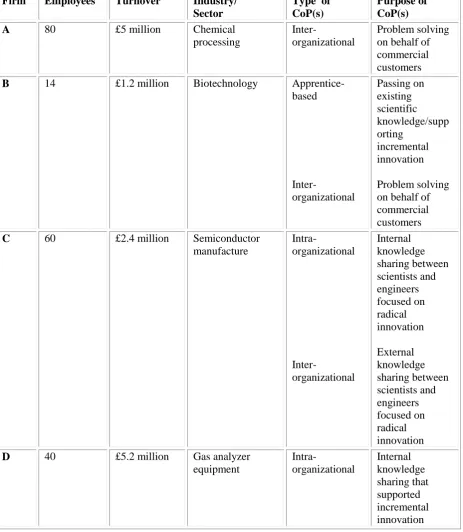
analyzers and provides solutions to gas monitoring in a variety of environments. See Table 1.
Table 1 about here
8
4. FINDINGS AND DISCUSSION
The findings are presented and discussed below in relation to the four research questions.
4.1 Are CoPs to be found in science-based SMEs?
Wenger (1998) claims that CoPs exist in all organizations, but most research into CoPs and
innovation have focused on large businesses, which prompted this first research question. The
data reveals three types of CoPs present in these science-based SMEs – apprentice-based
CoPs, intra-organizational CoPs and inter-organizational CoPs.
In Company B there was evidence of apprentice-based, which emerged to support individual
learning and internal knowledge-sharing related to individuals’ domain of scientific
knowledge. Junior scientists moved from ‘novice’ to ‘master’ and, through their participation
as CoP members, in the process gaining the firm-specific scientific knowledge that they
needed to participate in innovation activities:
[Name omitted], our R&D Manager, he, and our other less experienced scientists,
through [the MD’s] mentoring really, is getting in touch with this and that group of
people and the knowledge is transferring to [R&D Manager] so he is getting more
confident in passing this on to colleagues. (Technical Manager, Company B).
Intra-organizational CoPs were leveraged for a variety of purposes including individual
learning, internal knowledge-sharing, and for supporting noncanonical practices. Scientists
and engineers pooled their expertise in problem- solving activities. These CoPs emerged
through such mechanisms as ‘corridor meetings’, and shared many similarities with Orr’s
(1991) study of a community of photocopy repairmen. As one participant commented:
‘people work in teams generally, but often the most productive solutions happen by accident,
9
intra-organizational CoPs were constructed through the use of a boundary object, the
‘Imagineering Wall’, which was used to encourage informal collaboration and stimulate
innovation. This is not dissimilar to the CoP cultivation approach adopted by the
organizations in Probst and Borzillo’s (2008) study. The ‘Imagineering Wall’ was a large
tri-divided whiteboard mounted on an office wall, where employees posted ideas for new
products or improvements to existing products. Employees were encouraged to post ideas on
the wall, no matter how bizarre they might appear, in order to encourage sharing and
creativity and an open approach to innovation:
It was the idea of open sharing of ideas within the company, sort of, that anybody,
wherever they work in the company, can submit any idea they have, and it can go on
the wall… and everyone else can see it… and everyone else can contribute. (Design
Engineer, Company D).
The company did not keep records of each employee’s informal ‘wall activities’ until these
became designated as formal projects. This meant that an employee could move from one
project to another without informing anyone and, therefore, he/she might be engaged in
multiple CoPs at any one time.
Inter-organizational CoPs (cf. Moingeon et al., 2006) emerged between SMEs and two
distinct sets of customers: commercial organizations, focused on developing new products
and processes, and R&D organizations represented by universities and other research
organizations seeking to commercialize their inventions. These CoPs were particularly
evident in Companies B, D and E. One interviewee commented on the importance of regular
contact for building and maintaining strong relationships with customers through informal
contact: ‘We very much have to work with these customers and build relationships, and that
10
interaction with customers produced a sense of shared understanding. By working together
towards a mutual goal and engaging in a joint enterprise, inter-organizational CoPs emerged,
where the participants sought to develop innovative solutions in partnership with customers:
We work together with the customer to provide solutions in a way we both
understand. Someone may call, a chemist or engineer for example, or someone else...
call to discuss progress, and that's significant in terms of maintaining good relations
and meeting their demands for a solution. (Operations Director, Company A).
The leveraging of personal relationships helped bring people together, including customers,
competitors and suppliers. In Company B, the MD had built an extensive inter-organizational
CoP consisting of diverse members, including hospital doctors, nurses, GPs, practice
managers, hospital technicians and academics. It appeared that an important ingredient in the
success of such inter-organizational CoPs was the strength of the (bridging) social presence
of a particular individual or individuals, in this case the MD of Company B. Social presence
has been found to be associated with successful community building (Rovai, 2002), and has
some resonance with Coakes and Smith’s (2007) notion of ‘innovation champions’ who
transcend organizational boundaries and support collaboration with other communities and
organizations. Company B had been particularly successful at building external connections
and, as the R&D scientist acknowledged: ‘Well I suppose it’s ‘who you know’ - especially
who [the MD] knows as he's worked in the industry a long time’. The MD in this instance
exhibited a particularly high level of saliency in both his networking and relationship-
building. An example of CoPs emerging between SMEs and their suppliers can be taken from
the interviews in Company A, which held occasional events for their suppliers in order to
11
… we invite major suppliers here … and we will give them, if you like, seminars on
different sort of process techniques, which sort of can help them go and find more
businesses… and has a reciprocal effect in that they put us in touch with businesses
who want help… sort of knowledge [sharing] (Managing Director, Company A).
There were a number of references in the authors’ case study interviews to mutual
engagement, shared repertoires, and joint enterprises between these SMEs and their
customers and suppliers.
In the next section the authors explore how and why these CoPs were constructed.
4.2 How and why are CoPs constructed in science-based SMEs?
CoPs in science-based SMEs in this study were found to be an essentially emergent
phenomenon. There was also some evidence of attempts to cultivate CoPs. The use of
boundary objects (such as the ‘Imagineering Wall’ in Company D) stimulated the cultivation
of multiple intra-organizational CoPs. The ‘Imagineering Wall’, for example, brought
together scientists and engineers who, through the building of shared repertoires, mutual
engagement and joint enterprise, formed a variety of CoPs focused on both incremental
(improving existing products) and radical innovation (developing ‘new to the world’
products). There were implementation problems, however. For example, some employees felt
that they could not always use the 10% time allocated to become involved in projects that
interested them. Others highlighted the fact that, once they had posted their initial ideas on
the wall, they struggled to generate new ideas:
It’s agood idea… when it was first developed because everyone had been sitting for a
few years saying “why didn’t we do this”, “why didn’t we do that”… and when the
12
bashed out… and then, after the novelty is worn off everybody’s sort of got rid of
their ideas and it is now sort of sat… we don’t really have enough external stimulation
to keep it going… (R&D Engineer, Company D).
The wall initially acted as a boundary object, encouraging practice-based creativity, but in
order to maintain momentum and help generate new innovative ‘big ideas’, the organization
perhaps needed to move beyond capturing the skills, expertise and creativity of its employees
and seek to create or join external, inter-organizational, CoPs. Other efforts to cultivate CoPs
included building and maintaining trust-based relationships and credibility with customers -
closely linked to developing reciprocal relationships. Building trust was essential in order to
facilitate effective knowledge sharing and to help SMEs to better understand their customers’
needs - as Field (2008) has observed, ‘relationships matter’. Through mutual engagement,
sharing expertise internally with colleagues and externally with customers and suppliers,
SMEs were able to build effective trust-based inter-organizational CoPs, thus generating
social capital, developing their capabilities and improving their ability to problem solve on
behalf of their customers. This finding is in contradistinction to Hamburg and Marin (2010),
who argue that SMEs are unreceptive to knowledge sharing due to a lack of trust.
Trust was found to be an essential ingredient for building social capital in inter-organizational
CoPs, and the SMEs employed a variety of trust- building activities to engage customers and
suppliers. For example, Company A held free seminars to which they invited their customers
and suppliers, whereas Company B provided free specialist advice to a university. These
companies used such events to build trust and stimulate informal networking. The
inter-organizational CoPs that developed in the aftermath of such events frequently led to more
formal partnerships being established between firms, often based on a mutual need for
expertise not possessed internally. These organizations, by offering on-going advice and
13
members of different cognate organizations, which sometimes formed the basis of
inter-organizational CoPs. The establishment of trust between members of the different firms was
linked to building credibility with customers. Some larger SMEs, notably Companies A and
E, encountered similar difficulties when engaging in trust- building activities, and on
occasion adopted a pragmatic approach in order to source external expertise. For example, for
Company C, which was engaged in radical innovation in developing new products, trust-
building could be a secondary consideration after identifying someone with the necessary
expertise, particularly if the person was not within their existing external network. However,
overall, the study found that SMEs were able to build external trust-based collaborative
relationships and, CoPs sometimes developed through regular mutual engagement with
customers. This helped them to better understand their customers’ needs and provide
appropriate solutions.
Reciprocity was an important part of the trust- building process and was often achieved
through offering free advice or additional services. Companies A, B and D all offered their
services free to both commercial and R&D customers. Company A provided free services to
commercial customers in order to maintain regular, informal contact, build collaborative
relationships and generate future business. For non-commercial customers, e.g. universities,
these reciprocal arrangements often led to informal knowledge exchanges and the emergence
of inter-organizational CoPs. As the MD of Company B commented:
… in the past [N] university’s got a grant to do this research, then we say ‘well, we’ll
do this’, but then that’s how we got the contacts, so ‘cause we’ve done this, or that for
them, if we want something to be externally validated, we can say, you, ‘Do you mind
14
The relationship here was cultivated by the MD of the company. Entrepreneurs such as these,
who displayed high levels of social presence, were able to build strong, long-lasting,
trust-based relationships. The ability to ‘beout there’ making connections was an essential factor
in building successful inter-organizational CoPs, based on trust and reciprocity. Thus, the
knowledge exchanges that occur in CoPs are an essential part of the innovation process in
science-based SMEs; in the next section the authors discuss how this knowledge is acquired.
4.3 How is knowledge acquired in science-based CoPs?
As has already been seen, internal and external knowledge acquisition is a key part of the
innovation process for science-based SMEs. Individual learning was often informal and both
apprentice-based and intra-organizational CoPs emerged in response to the need to support
the sharing and dissemination of knowledge. Apprentice-based CoPs emerged to support
members’ needs to expand their existing scientific knowledge and they thus often supported
informal ‘on the job’ training and development. Although individual learning was recognized
as being important for innovation, the view of managers was that it had to be aligned with the
firm’s commercial goals. This could inhibit the emergence or cultivation of CoPs by
restricting the knowledge domain:
We might have to do bits of research, but the learning for learning’s sake… or
because of what’s interesting, isn’t really what we do. We are a commercial company
and we need to make products, we need to make money. That’s what we’re in it for.
We’re not in to widen everyone’s understandings… (New Technology Manager,
Company C).
The individual learning that occurred in the apprentice-based CoPs in Company B was more
aligned to notions of incremental innovation, where there is a high level of reliance on
15
internally between CoP members. Conversely, for the SMEs involved in radical or disruptive
innovation, such as Company E, the emergence and/or cultivation of apprentice-based CoPs
was inhibited by the absence of a shared repertoire, which in turn was related to a lack of a
shared domain of knowledge in a particular field of scientific research where there was a high
level of novelty or uniqueness associated with the innovation. As one interviewee observed:
‘We’re not doing projects that are digging ditches or building walls’.
Both the emergent and cultivated CoPs which focused on specific domains of scientific
knowledge were seen to support knowledge sharing between various professional groups,
such as scientists and engineers. Members of these CoPs participated in a range of
knowledge- sharing activities, including what one interviewee called ‘the obvious stuff’, as
well as things they ‘didn’t yet understand’. The impetus for this was often a wish or need to
support members in problem- solving activities conducted on behalf of customers. This is
illustrated by an interviewee’s reference to informal ‘corridor meetings’ with colleagues in
Company C, where internal knowledge exchanges often occurred. CoP members pooled their
expertise, participating in problem solving activities, a kind of incremental innovation, on
behalf of customers:
Internally, there is a network, which is probably the four people who I talked about,
you know, the IT guy, the detector guy, myself and Ben, and that’s an informal
network, you know, but we’re… we tend to do corridor meetings, you know: ‘how’s
that?’ … our Venn diagrams of influence cross over so regularly.. (Materials
Manager, Company C).
It is important to note, however, that the construction of CoPs could be inhibited. In
Company C, for example, the Chief Technical Officer commented that for senior scientists
16
due to a lack of ‘band width’ inhibiting their capacity to build CoPs relationships and
leverage the social capital necessary for innovation. CoP participation became more difficult
because they could not maintain regular contact with their network of scientific colleagues.
Additionally, conflict frequently emerged between scientists and engineers, the former
viewing innovation as a ‘journey’ whilst the latter saw it more in terms of a ‘destination’.
This sometimes restricted the emergence of intra-organizational CoPs. In general, scientists
were considered to be less commercially aware than engineers, who were more focused on
developing an end product:
An engineer wants to get somewhere. In fact an engineer’s happy if something never
happens again, you know I think that’s the thing that… a scientist likes to do a thing
over and over and over, you know, ‘we’ll try that’, ‘I’ll do that experiment’. An
engineer’s target, I would say, is to make it to have nothing to do in a day. (Technical
Manager, Company C).
In SMEs focused on radical innovation, i.e. Company E, this conflict inhibited knowledge-
sharing activities generated through the emergence or cultivation of CoPs, thereby restricting
their ability to turn innovations into commercial products. The literature suggests that in
networks people might fear losing their expert status, whereas organizations might fear
disclosure of their competitive knowledge, thus questioning whether organizations are willing
to initiate innovation projects with new partners (Wohlfart et al., 2006). SMEs in particular
might refrain from participating in such innovation networks because of the perceived
increased risk to their competitiveness (Meeus and Oerlemans, 2000). However, Meeus and
Oerlemans (2000) observe that the limited resource base usually available to small firms does
not negatively impact on innovativeness as they are able to develop the adaptive behaviour
17
The present study found that collaboration was an essential part of the commercialization of
innovation for all the SMEs for a variety reasons, including sourcing external scientific
expertise from other firms and universities, seeking commercial expertise to help them
exploit their innovations, as a route to market through licensing agreements, and as a source
of funding. At the same time, customers often sought collaboration with SMEs to acquire
external knowledge. Companies A, B and G in particular used this approach to bind
customers to them, in effect cultivating an inter-organizational CoP by building a shared
repertoire through regular, informal contact. There was much evidence of the internal pooling
of expertise and exchanges of tacit knowledge through collaborative activities, often resulting
in or from the emergence of CoPs. SMEs acted as ‘key experts’, solving problems on behalf
of their customers, and there was evidence of enhanced absorptive capacity based on SMEs’
collaborative activities with customers.
The capability to access internal and external pools of knowledge suggests that although
these SMEs may have no formal strategy for knowledge acquisition, they did possess some
absorptive capacity based upon the collaborative relationships that develop through emergent
CoPs (see also Beijerse, 2000):
Right at the outset they’ll [customers] come to us and say, ‘Look, we’ve got a
particular problem. Do you think you can solve it?’ And, coming back then to the
pool of knowledge and experience we have within the business, then we can apply
ourselves and we can usually come up with solutions, or recommend alternative
solutions… but, you know, we can either develop... bring in outside expertise or pass
perhaps potential enquiries on to other people that we know or source solutions from
18
The SMEs which were collaborating predominantly with R&D customers tended to value
collaborative trust-based relationships more than those mainly working in partnership with
commercial organizations. For the former, collaboration with universities was an important
source of external scientific knowledge, as well as providing access to research and
development funding and specialist scientific equipment and facilities. The latter tended not
to consider themselves innovative; although they engaged in collaboration with customers,
they were generally suspicious of, or failed to see the value in, collaboration with other
external organizations. This suggests that those SMEs who see themselves as engaged in
innovative activities tend to be more aware of the importance of collaboration and are also
more likely to actively seek collaborative relationships, engaging in the CoPs that emerge
through shared repertoire and joint enterprise, focused on their specific scientific domain of
knowledge.
In summary, the findings illustrate how science-based SMEs acquire internal and external
knowledge through the construction of, and participation in, CoPs. CoPs support individual
knowledge acquisition and improve absorptive capacity, both of which are necessary for
successful innovation. In the next section the authors discuss the impact this participation has
on their innovation activities.
4.4 What innovation is generated from collaborative activities in CoPs?
The findings of this research suggest that in relation to radical innovation, the construction of
CoPs is inhibited by a lack of shared repertoire, especially for those science-based SMEs at
the forefront of their respective scientific field. The literature indicates that participation in
intra-firm knowledge sharing activities is often difficult because it is dependent on CoP
members’ willingness to voluntarily share their knowledge and expertise (Hildreth and
19 et al., 2002). The findings support the view that CoPs are more likely to support incremental
innovation in science-based SMEs.
For SMEs working with R&D organizations, innovation was often described in terms of
novelty or uniqueness, i.e. aligned with ideas of radical or disruptive innovation and verified
by ‘new to the world’ products and processes. The SMEs working with commercial
customers considered innovation more in terms of ‘problem solving’ activities, i.e. aligned
with views of incremental innovation, evidenced by collaborative activities as
problem-solvers for their customers. The SMEs involved in producing novel innovations sometimes
found it difficult to engage with external organizations because the uniqueness of the
knowledge base associated with their innovation resulted in the lack of a shared repertoire. In
effect, the SMEs were frequently the ‘knowledge leaders’ in their particular field. Although
novelty provided capability advantages, some interviewees considered it a barrier to
collaboration: ‘We are the only people in the world doing this… innovation is quite difficult
‘cause it can only come from ourselves’ (Material Manager, Company C).
This finding suggests that for SMEs generating novel innovations, their status as ‘knowledge
leaders’ restricts their ability to engage in inter organizational CoPs because of a lack of
shared repertoire. However, some interviewees in Company E, generating novel innovations,
were aware that further incremental innovation, often generated through collaborative
activities, was required in order to successfully commercialize their inventions. A lack of
shared repertoire restricted their ability to engage in informal networks, or in the informal
collaborative relationships that often result from CoP participation. Nevertheless, there was
collaborative relationship- building and the emergence of shared repertoires through mutual
engagement with a range of external organizations, including customers, suppliers and
20
Tension was noted between scientists and engineers regarding their views of innovation. At
one extreme, there were scientists who said they sought to discover entirely new processes
and knowledge. At the other extreme, there were engineers who used their knowledge to
build useful devices. In general, scientists viewed innovation as a ‘journey’ and appeared to
be less commercially aware than engineers, who were more focused on developing an end
product. In those SMEs focused on radical innovation, the level of conflict between scientists
and engineers was often more pronounced because of the absence of a shared repertoire. This
was related partly to a lack of common existing knowledge, but also because of the
uniqueness or ‘novelty’ associated with radical innovation. This aspect sometimes inhibited
the internal knowledge- sharing activities associated with the emergence or cultivation of
intra-organizational CoPs. On the other hand, these same SMEs, in particular Company C,
generally found it easier to collaborate with R&D customers, such as universities, and there
was evidence of both resource sharing and knowledge sharing through inter-organizational
CoPs.
We still collaborate with the university… in fact we built a system… one of the four
systems is at the university, you know, so we have a fairly strong collaboration with
[D] University. We work with their scientists on a variety of crystal growth
development... issues... we can dip in and out of each other’s research quite often,
almost by accident. (Technical Manager, Company C).
The interviewees expressed a range of views about innovation per se. Those who saw their
firm’s innovation activity as being towards the radical end of the spectrum generally
considered their firm’s products and processes to be unique. Others saw the innovation
activity in more incremental terms, e.g. offering ‘better’ solutions by making a product
simpler in order that customers find new uses for it. Uniqueness was considered a source of
21
interviewees also recognized the importance of engaging in incremental innovation in order
to develop new products based on their initial science-based innovation, or when they were
commercializing their innovations. Although novelty or uniqueness was considered a
capability advantage, the lack of shared repertoire (which, as we have seen, is usually
generated through mutual engagement) restricted the community- building activities
associated with inter-organizational CoPs.
Interviewees in Company A did not consider their organization to be innovative because it
did not manufacture its own products; those in Company D expressed a similar view because
they created new products by integrating existing technology rather than through their own
R&D activity. However, the Imagineering Wall had been successful in generating a number
of small incremental innovations to existing products; the CoPs that emerged from the
associated activity had produced 6 new versions of products that were on the market, and a
further 4 projects were in the early stages of development (as at July 2013). Given these
organization’s incremental approaches to innovation and their problem- solving activities on
behalf of or in partnership with customers, one can see many similarities with the sort of
‘user-led’ innovation communities discussed by Heiskanen et al., (2010) and Von Hippel and
Finkelstein (1979), which, the authors would argue, are in essence a form of
inter-organizational CoP.
Problem solving requires in-depth collaboration and, as these examples show, SMEs share
knowledge with their customers in order to develop complex innovative solutions. They use a
variety of methods to engage with customers, including hosting events to showcase their
expertise and visiting customers to offer advice and training related to their products. Thus
customers were sometimes reliant on the sharing of scientific expertise with the SMEs, and
22
problem solving activities and generating the mutual engagement and building of shared
repertoires necessary for inter-organizational CoPs to emerge.
5. CONCLUSIONS
5.1 F indings
The empirical findings of this research project confirm the existence of CoPs in
science-based SMEs and show how they emerge or are cultivated for a variety of purposes, including
knowledge acquisition and innovation. This confirms the widely held view in the extant
literature that CoPs exist in most organizations (Brown and Duguid, 1991; Hildreth et al.,
2000; Lesser and Prusak, 1999; Wenger, 1998; Wenger et al., 2002). Three types of CoPs
were identified: apprentice-based CoPs that support individual learning; intra-organizational
CoPs that facilitate internal knowledge sharing (particularly between different professional
groups, e.g. scientists and engineers); and inter-organizational CoPs that emerge between
SMEs and external organizations (e.g. customers, universities), and were leveraged to support
a range of collaborative innovative activities. However, the SMEs did not always recognize
either the presence of CoPs or the benefits they might gain from explicitly engaging in their
construction. The findings also identified instances where, although the conditions for
constructing CoPs were present (there was mutual engagement, shared repertoire and joint
venture), CoPs did not emerge. This suggests that science-based SMEs could do more to
develop and support the cultivation of CoPs.
5.2 Limitations
Although template analysis is a useful tool for analyzing qualitative data, issues arose in
relation to its use in this research project. Deciding on the extent of the initial template and
the number of codes was a necessarily subjective process, potentially leading to accusations
of researcher bias. In order to mitigate such bias, the data was coded, discussed and reviewed
23
applying the template method, it did not allow for the inclusion of multiple perspectives.
Involving a wider range of reviewers, or even involving the interviewees themselves, might
have generated some insights when developing the template. Sampling bias: these
science-based SMEs represented a heterogeneous group of firms from a range of scientific
disciplines. However, they had science at the core of their business and, therefore, could be
argued to represent a variety of typical, although not necessarily representative, cases that
were useful in generating data and making comparisons and contrasts.
Whilst the authors cannot make any claim for the representativeness of the sample in relation
to the wider population of science-based firms, they do maintain that this new empirical
material and theorizing on CoPs and innovation in science-based SMEs makes a contribution
to a research domain which has been dominated, especially in recent years, by a focus upon
large organizations and (where publications have drawn upon new empirical material) there
has been an over-reliance upon the voice of senior managers (as against, for example,
scientists and engineers). In the next section the authors present a contextualized framework
for the construction of CoPs in science-based SMEs.
5.3 Implications
The contextualized framework for constructing CoPs (Figure 1) shows how science-based
SMEs can promote CoP construction. The framework captures how intra-organizational CoPs
can be promoted by SMEs by first identifying existing and potential CoPs and then
encouraging their construction by allocating time and resource to their cultivation.
Inter-organizational CoPs can be promoted by SMEs by encouraging employees to mobilize their
personal networks and by firms taking part in, as well as organizing, networking events.
SMEs should also encourage individuals who display high levels of ‘social presence’ to act as
24
organization, and thus enhancing their firm’s absorptive capacity. SMEs which pursue these
sorts of activities and take these sorts of initiatives can thereby encourage and support CoP
cultivation, and thus build trust and reciprocity, leading to enhanced social capital.
Participation in intra-organizational CoPs increases firms’ absorptive capacity; participation
in inter-organizational CoPs stimulates open innovation (see also Chesbrough, 2003). This
helps SMEs to build new networks and facilitates more effective knowledge transfer, thus
helping to generate more focused innovation in science-based SMEs.
Figure 1 about here
5.4 Suggestions for future research
The findings provide a number of insights and pointers for future areas of research. Firstly,
whilst it was not possible, given the time constraints of the current research, to conduct a
longitudinal study, this would be helpful for examining in more detail, inter alia, the types of
CoP activities taking place and how they change over time, along with the (changing)
membership of the CoP. Secondly, future research would benefit from a larger sample size to
establish a better understanding of CoPs in science-based SMEs. Thirdly, this research
focused on the views and experiences of managers, scientists and engineers- it would be
valuable to gather the views and experiences of a wider range of people, both internal and
25 References
Allee, V. (2000), “Knowledge networks and communities of practice”, OD Practitioner
Online, Vol. 32, pp. 4-13.
Assmakopoulos, D. (2007), Technological Communities and Networks, Triggers and Drivers
for Innovation, London, Routledge.
Autio, E., Kanninen, S. and Gustafsson, R. (2008), “First- and second-order additionality and
learning outcomes in collaborative R&D programs”, Research Policy, Vol.37, No.1, pp.
59-76.
Beijerse, R.P. (2000), “Knowledge management in small and medium-sized companies:
knowledge management for entrepreneurs”, Journal of Knowledge Management, Vol. 4, No.
2, pp. 162-177.
Brown, J.S. and Duguid, P. (1991), “Organizational Learning and Communities of Practice”,
Organization Science, Vol.2, No.1, pp. 40-57.
Chesbrough, H. (2003), Open Innovation: The New Imperative for creating and profiting
from technology. Boston, MA: Harvard Business School Press.
Coakes, E. and Smith, P. (2007), “Developing communities of innovation by identifying
innovation champions”, Learning Organization, Vol. 14, No. 1, pp. 74-85.
Cohen, W.M. and Levinthal, D.A. (1990), “Absorptive capacity, A new perspective on
learning and innovation”, Administrative Science Quarterly, Vol.35, No.1, pp. 128-152.
Crabtree, B.F. and Miller, W.L. (1999), “Using codes and code manuals: a template
organizing style of interpretation”, in Crabtree, B.F. and Miller, W.L. (eds.), Doing
26
Dahlander, L. and Gann, D. (2008), “How open is innovation?”, in Bessant, J. and Venables,
T. (eds), Creating wealth from knowledge and learning: Meeting the innovation challenge,
Cheltenham: Edward Elgar.
Du Plesssis, M. (2008), “The strategic drivers and objectives of communities of practice as
vehicles for knowledge management in small and medium enterprises”, International Journal
of Information Management, Vol. 28, No. 1, pp. 61-67.
Fichter, K. (2009), “Innovation communities: the role of networks of promoters in open
innovation”, R&D Management, Vol. 39, No. 4, pp. 357-370.
Field, J. (2008), Social Capital. London: Routledge.
Hamburg, I. and Marin, M. (2010), “Innovation through Knowledge Transfer”, Smart
Innovation, Systems and Technologies, Vol.5, No. pp.167-177.
Heiskanen, E., Johnson, M., Robinson, S., Vadovics, E. and Saastamoinen, M. (2010), “
Low-carbon communities as a context for individual behavioural change”, Energy Policy, Vol. 38,
pp. 7586-7595.
Hildreth, P.M. and Kimble, C. (2002), “The duality of knowledge”, Information Research,
Vo.8, No.142. Online, http,//InformationR.net/ir/8-1/paper142.html.
King, N. (2004), Using templates in the thematic analysis of text. In Cassell, C. and Symon,
G. (eds.), Essential Guide to Qualitative Methods in Organizational Research. London: Sage.
King, N. (2006), Template analysis. University of Huddersfield website.
http://www.hud.ac.uk/hhs/research/template_analysis, viewed July 2013.
Kogut, B. and Zander, U. (1996), “What firms do? Coordination, identity, and learning”,
27
Lave, J. and Wenger, E. (1991), Situated Learning. Legitimate Peripheral Participation,
Cambridge, Cambridge University Press.
Lesser, E. and Prusak, L. (1999), “Communities of practice, social capital and organizational
knowledge”, in Cortada, J.W. and Woods, J. A. (eds), Knowledge Management Year Book
2000 – 2001. Woburn: Butterworth Heinemann.
McDermott, R. and Archibald, D. (2010), “Harnessing your staff’s informal networks”,
Harvard Business Review, Vol.88, No.3, pp. 82-89.
Meeus, M. and Oerlemans, L. (2000), “Firm behaviour and innovative performance. An
empirical exploration of the selection-adaptation debate”, Research Policy, Vol. 29, No. 1,
pp. 41-59.
Moingeon, B., Quélin, B., Dalsace, F. and Lumineau, F. (2006), “Inter-organizational
communities of practice, specificities and stakes”, Les Cahiers de Recherche 857, HEC Paris.
Online,http,//www.hec.fr/var/fre/storage/original/application/cf1ffa47b2611bb7e196ca06bf3e
0bf7.pdf.
Orr, J. (1996), Talking About Machines: An Ethnography of a Modern Job. New York:
Cornell University Press.
Partanen, J., Möller, K., Westerlund, M., Rajala, R. and Rajala, A. (2008), “Social capital in
the growth of science-and-technology-based SMEs”, Industrial Marketing Management, Vol.
37, No. 5, pp. 513-522.
Pattinson, S., Preece, D. and Scott J.M. (2011), “Cultivating communities of practice for
innovation: What about SMEs?”, paper presented at 27th EGOS Colloquium, Gothenburg,
July, 2011, available at: http://tees.openrepository.com/tees/handle/10149/155850. Viewed
28
Patton, M. Q. (2002), Qualitative research and evaluation methods. Thousand Oaks, CA:
Sage.
Probst, G. and Borzillo, S. (2008), “Why communities of practice succeed and why they fail”,
European Management Journal, Vol.26, No.5, pp. 335-347.
Probst, G. and Borzillo, S. (2008), “Why communities of practice succeed and why they fail”,
European Management Journal, Vol. 26, No. 3, pp. 335-347.
Roberts, J. (2006), “Limits to communities of practice”, Journal of Management Studies, Vol.
43, No. 3, pp. 623 -39.
Rovai, A. (2002), “Building sense of community at a distance”, International Review of
Research in Open and Distance Learning, Vol. 3, No.2.
http://www.irrodl.org/index.php/irrodl/article/view/79/152. Viewed July 2013.
Scarbrough, H., Swan, J., Laurent, S., Bresnen, M., Edelman, L. and Newell, S. (2004),
“Project-based learning and the role of learning boundaries”, Organization Studies, Vol.25,
No.9, pp. 1579-1600.
Tödtling, F. (2001), “The Role of the Region for Innovation Activities of SMEs”, European
Urban and Regional Studies, Vol. 8, No. 3, pp. 203-215.
Van Manen, M. (1998), Researching live experience: Human science for an action sensitive
pedagogy (2nd ed.), London, Ontario: The Althouse Press.
Vanhaverbeke, W., Cloodt, M. and Van de Vrande, V. (2008), “Connecting absorptive
capacity and open innovation”, in proceedings of The XX ISPIM Conference, Huizinga
K.R.E., Conn S., Torkkeli M. and Bitran I. (eds), Proceedings of The R&D Management
29
Von Hippel (1998), “Economics of Product Development by Users: The Impact of "Sticky"
Local Information”, Management Science, Vol. 44, No. 5, pp. 629-644.
Von Hippel, E. and S. N. Finkelstein (1979), “Analysis of Innovation in Automated Clinical
Chemistry Analyzers,” Science & Public Policy, Vol. 6, No. 1, pp. 24-37.
Von Krogh, G., Ichijo, K. and Nonaka, I. (2000), Enabling Knowledge Creation: Unlocking
the Mystery of Tacit Knowledge and Unleashing the Power of Innovation. Oxford: Oxford
University Press.
Wenger and Snyder (2000), “Communities of Practice, The Organizational Frontier”,
Harvard Business Review, Vol.78, No.1, pp. 139-145.
Wenger, E, McDermott, R. and Snyder, W. (2002), Cultivating Communities of Practice,
Boston, Harvard Business School Press.
Wenger, E. (1998), Communities of Practice, Learning, Meaning and Identity, Cambridge,
Cambridge University Press.
Wohlfart, L., Sturm, F., Wolf, P., Slagter, R. and Emshanova, T. (2006), “Setting up
Communities of Practice for Innovative Russian SME”, in Cunningham, P.and Cunningham,
M. (eds), Exploiting the Knowledge Economy: Issues, Applications, Case Studies.
30 Table 1 The science-based SMEs
Firm Employees Turnover Industry/
Sector
Type of CoP(s)
Purpose of CoP(s) A 80 £5 million Chemical
processing
Inter-organizational
Problem solving on behalf of commercial customers
B 14 £1.2 million Biotechnology Apprentice-based Inter-organizational Passing on existing scientific knowledge/supp orting incremental innovation Problem solving on behalf of commercial customers
C 60 £2.4 million Semiconductor manufacture Intra-organizational Inter-organizational Internal knowledge sharing between scientists and engineers focused on radical innovation External knowledge sharing between scientists and engineers focused on radical innovation