The transition of the self through the Arab Spring in Egypt
and Libya.
AL-ABDIN, Ahmed, DEAN, Diane and NICHOLSON, John
Available from Sheffield Hallam University Research Archive (SHURA) at:
http://shura.shu.ac.uk/12678/
This document is the author deposited version. You are advised to consult the publisher's version if you wish to cite from it.
Published version
AL-ABDIN, Ahmed, DEAN, Diane and NICHOLSON, John (2016). The transition of the self through the Arab Spring in Egypt and Libya. Journal of Business Research, 69 (1), 45-56.
Copyright and re-use policy
See http://shura.shu.ac.uk/information.html
Sheffield Hallam University Research Archive
1 The transition of the self through the Arab Spring in Egypt and Libya
Abstract
This paper builds on Belk’s notions of the extended, social, family and dialogic selves in an attempt to explore the transformation of the self during the phenomena which has been referred to popularly as the Arab Spring. From the perspective of respondents in Egypt and Libya, this paper provides a reading of how images of self are related to artifacts of consumption, rituals, and symbols and how consumer values are navigated through this difficult landscape. The paper uses a three phase − history, happening and hopes narrative to show that the self in a liminal period of flux is referent to history and hopes and proposes a notion of a transitional self that incorporates this observation of reference to past and future. In particular, findings suggest the importance of considering the sacred and profane of religiosity in dialogue with consumption in the Middle East, although findings also suggest that consumption, particularly of Western consumption can be transcendental during a liminal period of flux. The paper also argues that revelatory incidents such as the Arab Spring allow for consumer candidness and offer an unbounded opportunity to access the unconstrained thoughts of consumers and citizens before a wheel of re-volution completes a rotation and the opportunity is lost.
1.0: Introduction
This paper offers a challenge to the underlying assumptions of much of the discourse
surrounding consumption whose foundations seem to lie in conditions of societal stability.
Instead, we seek to provide a reading of images of self and consumption practices in
conditions of flux, or revolution. Consumption choices are often based on the utility of
products, symbolic meanings, rituals, while artifacts are also important for creating and
sustaining a sense of self and locating one’s place in society (Wattanasuwan, 2005). Hence,
images of self and consumption practices can be considered to be intrinsically related. The
choice of a particular consumption object or objects can signify how we choose to present
ourselves, how we ground ourselves in a community, and how we make a “positive
contribution to our identities” (Belk, 1988: p.160). The inter-relationship between the self and
the extended self is complex and carries a multiplicity of images of how people feel about
themselves and how they are perceived by others (Arnould, et al., 2004). We ask here, what
can be learned about the self by studying consumption practices in flux?
In periods of extraordinary change and indeed revolution, such changes to images of self
can be dramatic and rapid. In order to make meaning and create a bounded place in which to
locate oneself in society, citizens can revert to primary identities grounded in such factors as
ethnicity, nationality, territory and religion (Castells, 1996). Established notions of self can
be forced into transition in which that which is sacred and that which is profane may become
blurred. In naive terms, the sacred refers to how the self views religious beliefs, places of
worship, rites, duties or anything that are socially constructed and are valued as sacrosanct. In
more post modern terms, ideas of what are considered sacred can be symbols, rituals and
artifacts embedded within consumption practices. A conflict arises when profane symbols,
rituals and artifacts are perceived to contaminate the sacred. It is this dichotomy/clash
3 In exploring ideas of the sacred and profane, Belk et al. (1989) discusses the importance
of revelatory incidents, and indeed the focus of this paper is on one such revelatory incident,
the so-called Arab Spring. The Arab Spring is a metaphor that has been used to depict the
uprisings in the Middle East and North Africa. The ‘spring’ season represents the start of the
new season which heralds the new and the arrival of something better. But also hidden in the
early media reports of the Arab Spring phenomena as it occurred were expressions of hope as
to what a summer might bring, and it is this observation that inspired this investigation. We
ask in this paper, to what extent consumer culture is interwoven within these hopes?
Consumption practices, as a means of projecting and extending the self (Belk, 1988) may
be perceived as less important during a revolution, due for instance, to rapidly changing
priorities such as keeping safe and sourcing basic consumer goods. However, many citizens
immersed in the events of spring seemed to speak of their hopes for a better summer in terms
of consumption. That which was sacred and that which was profane therefore seemed to be in
flux and the sense of self of those experiencing spring, subject to significant challenge.
In this paper, rather than simply attempting an incremental contribution based on a
traditional gap-spotting approach we also utlize a problematization strategy to create
scientific usefulness (Alvesson & Sandberg, 2011). In the consumer research literature,
significant attention has been paid to concepts of the self (Rindfleish, 2005), extended self
(e.g. Ahuvia, 2005; Belk, 1989, 2014a; Noble & Walker, 1997) and the links between the self
and identity (e.g. Chernev et al., 2011; Shankar et al., 2009), but this work tends to focus on
contemporary western societies. Literature has not to date addressed transitional societies
such as the Middle East to any great extent (Huang & Balakrishnan, 2013). In a similar vein,
the underlying causes that spark negotiations between the different selves (extended,
domestic and social) have received scant attention. We therefore in this paper offer an
little research that explains how radical changes to community affect our conception of the
self and the extended self. To address this weakness requires a challenge to the underlying
assumptions of societal stability inherent in the current body of work examining the self.
Little is understood as to how images of self transform following a revolution and in
particular, little insight is available about how the self is reconstructed through the lens of
revolution and by the influx of new ideas, consumption opportunities − and indeed new
constraints. It would seem of great value to understand how possessions and market driven
artifacts help to change the sense of self and the extended self during a period of uncertainty.
Building on Belk’s (1988) work, the purpose of this paper is to firstly explore the dialogic
self during the Arab Spring. With these contributions in mind, our objectives for the paper are
as follows:
1. To offer insight into how different aspects of transformations of the self (the dialogic self) were manifest during the early phase of the revolution in Egypt in Libya.
2. To provide a temporal and emergent reading of how images of self navigated through this extraordinary, revolutionary landscape.
3. We seek to expose the dialogic tension between what is sacred and what is profane and attempt to identify what consumption practices helped make meaning and reconfigure images of self.
Our hope is that in attempting these contributions, we provide insight into both the ongoing
perturbations in the Middle East and to other societies in flux. We anticipate that our findings
and insight into the Arab spring phenomenon will have interest in the broader social sciences.
Our paper is structured as follows. First in section 2, we set the scene of the Arab Spring with
a brief look at the contextual background of Libya and Egypt. We then provide a review of
the literature discussing images of self and tentatively suggest how the largely Western
discussion of the self can be contextualized to the Middle-East. This section ends with a
conceptual framework that allows us to bring together the elements in our three stated
5 (4) contains our theoretical contributions. In line with our conceptual framework, we provide
our account in three sections corresponding to history, happening and hopes. We end our
paper with our concluding comments.
2.0: Theoretical and contextual background
In this section we provide a background to the focal countries in our study, a review of the
literature that underpins our discussion and conclude the chapter with our conceptual
framework.
2.1: The Arab Spring, Libya and Egypt
The Middle East is an important space in the global economy which accounts for around 23%
of the world’s trade (El-Bassiouny, 2014) and it is the home of approximately 350 million
consumers. The Middle East contains an unusually large demographic of young consumers
(Mahajan, 2012) known as the ‘shabab’ (youth) generation which is perhaps more attuned
with global consumption than older generations. In addition, the region’s significance as an
important consumer segment is underpinned by a rising urban middle class population whose
consumption practices reflect both tradition (e.g. shopping from ‘souks’ or traditional
markets) and modernity (e.g. shopping from modern malls).
Although the Arab Spring swept through much of the Middle East, the focus of the
research reported in this paper is grounded in Egypt (Cairo) and Libya (Tripoli). The choice
of these two regions relates to the contrasting political systems and quite different
authoritarian former regimes. The Libyan revolution in 1969, led by Colonel Muammar
Qaddafi, sought to create a Jamahirayah or State of the Masses through the elimination of a
monarchy that were seen as puppets of the imperialist powers (Pargeter, 2012). The
Qaddafi with an ostensibly socialist economic policy (Vandewalle, 2008). In contrast, Egypt
with its rich classical history was characterized by an economically liberal, autocratic but
socially stable regime since the 1952 overthrow of King Farouk. His removal was initiated by
President Nasser who embarked upon a substantial social and political project (Osman, 2013)
which arguably was combined with a continued relative economic decline, lack of political
rights as well as social injustice. These were contributory factors in the revolution of 2011
which led to the downfall of President Mubarak and Libya’s former president Muammar
Qaddafi. Both revolutions were very different. Egypt achieved a political revolution by way
of mass protests and demonstrations (Kienle, 2012), while Libya experienced armed conflict
(Wehrey, 2013) and a political revolution. Under Qaddafi, the impact of tight authoritarian
control guided by socialism contributed to a sustained planned economy instead of a market
based one (Springer & Czinkota, 1999) and this restricted the flow of consumption due to a
lack of variety of consumer choices and freedoms in the marketplace. In contrast to Libya,
Egypt has had a more advanced consumption environment and this is demonstrated by an
established consumer culture and a multiplicity of retail outlets (Abaza, 2005).
2.2: The self and the extended self
The self refers to a sense of who and what we are, and is indicated through peoples’ actions
(Kleine et al., 1993). Belk (1988) articulates the terms self, sense of self, and identity as
synonyms for describing how a person subjectively recognizes who he or she is. Belk’s
conceptualization of the self is important because he rejects any homogenous definition that
could apply to all individuals and cultures. He discusses the self as comprising of subjective
assessments that change between people and over time. Furthermore, the self is not restricted
to everyday activities and as Belk asserts; the self is also characterized as the extended self
through consumption practices and affiliations with family and the social world. It is the way
7 gives rise to a group (social) self. It is possible therefore to visualize the self as being linked
to consumption through the extended self, and as such, a study of one side of this dynamic
may lead to conclusions regarding the other. However, to understand this dynamic better, we
need next to turn to notions of the domestic and social self.
In his seminal work, Mead (1928/1973) argues that the self is constructed through
interaction with the symbolic resources within society. The self is therefore not a passive
concept; rather it is subject to a dialectic and reflexive process of adaptation, determined by
family and conventions within culture and society (Giddens, 1991). The domestic self is the
way through which a sense of extended self is created within the family environment and the
social self is the way in which the extended self is projected in the social arena (Belk, 1988).
Ahuvia (2005) also notes how the combination of different perspectives of self gives rise to
multiple selves and we draw here upon Belk’s notion of a dialogic self to explore the notion
of multiple selves. Belk (2014b: p.252) proposed that self conflict can be dealt with
dialectically…
“Through negotiation or coalition, avoiding the conflict, for example by compartmentalizing and accepting that different selves will prevail on different occasions, or privileging a dominating self that suppresses the other selves.”
The self is therefore shaped by key episodes in one’s life, relationships with family and also
consumption practices (Giddens, 1991; Thompson, 1997). This research is interested in
uncovering how the self transforms during a revolution and uncovers how hopes for the
future are expressed in such a revolutionary period. A useful term that can be deployed to
understand revolution is Noble and Walker’s (1997: p. 32) notion of liminal transitions,
evident when:
In order to explore the transformations of the self during this turbulent period and to provide
focus, the aspects of liminal consumption that this study is also interested in, alongside
symbols, are values, artifacts and rituals. Values are concerned with matters such as honor,
reputation (Uskul et al., 2010) and religious values (Cleveland et al., 2013; Rice &
Al-Mossawi, 2002). Artifacts are understood as the objects (e.g. clothes, mobile phones, beauty
products) that help define a sense of self and assist in the formation of the extended self (Belk,
1988). Symbols refer to symbolic consumption whereby consumers choose, buy, and use
products (e.g., possessions, products and brands) to assist the self in the creation,
confirmation and communication of their identity (Belk et al., 1982). Whilst an abundance of
research has investigated symbolic consumption (e.g. Ekinci et al., 2013; Schouten, 1991;
Wattanasuwan, 2005), just how the extended self becomes coupled to, and decoupled from
symbols in an extraordinary and potentially liminal situation, as in this case of the Arab
Spring has been underexplored.
For Rook (1985), rituals are a type of expressive, symbolic activity made up of a
multiplicity of behaviors which occur in a fixed, episodic sequence and are usually repeated
over time. There has been significant work focusing on consumption rituals (e.g. Belk, 1990a;
Chitakunye & Maclaran, 2014). However, little attention has been paid to the implications of
rituals on transformations of the self, the extended self and the social self within transitional
societies.
Belk et al. (1989) discusses how sacralization processes may reveal shifts in which
objects are considered sacred beyond those that might be most associated with religion.
Midgley (1992) also discusses processes of marginalization between the self and the social
and the grey areas that may processually exist between the sacred and the profane;
9 over time. An observation of rituals is crucial to understanding the ebb and flow of
sacredness and profanity.
In order to support Belk’s (2013) assertion that most of the research on the self to date
has been in a western context, and that cultural differences have been largely neglected, we
next attempt to provide a reading of the self in the context of the Middle East. With this in
mind, the domestic self is operational within the boundaries of the home, cultural traditions
and also the rituals and symbols that characterize the domestic self. On the other hand, the
social self is an outcome of the extended self and the domestic self and is therefore viewed as
a separate construct.
2.3: Images of self and the Middle-East
For Moaddel (1992) the self is susceptible to forces of change in the macro
environment such as popular protest movements and civil wars. Such forces impact at both
personal and social levels as perceptions of life conditions adapt to ongoing change (Giddens,
1999). In an honor culture like the Middle East, an individual, the family and the social self
are inextricably linked. An honor culture is considered to be one where there is an honorable
and dishonorable way of doing things. For instance, each individual representing their wider
family or tribal unit in whatever they do and wherever they go. Therefore, family reputation
arises from the family and the individual self. The failures of the self can be felt to diminish
family honor if for example, the self commits an act of shame such as engaging in anti-social
consumption (e.g. consuming pork, alcohol or drugs) that contradicts religious values. In
contrast, the successes of the self (e.g. securing a new job, starting a new family) can bring
the family closer together and enhance the self (Uskul et al., 2010). The close knit collectivist
community in many parts of the Middle-East determines that self worth is underpinned by
demonstrated by possessions and in accordance with Fromm’s (1978: p.60) notion of the
“marketing character”, the self is positioned within post modernity and expressed through
commodities. Unlike in modernist times, postmodern consumption is no longer seen as a
profane activity. Rather, consumption has become the means of realization,
self-identification and responsible for self-actualisation (producing a sense of self). In the case of
traditional societies (e.g. Egypt and Libya), the self is considered to be heavily influenced by
tradition and history. On a macro-level, the social self in the Middle East is under heavy
influence by states which can enforce religious values amongst citizens or the political notion
of praising the hegemonic status of the state and its rulers (Orwellian style), particularly in
the case of the more authoritarian regimes.
Where revolutionary change is evident, and in line with Fromm (1978), the self may
transform into a liminal state of being and one in which individuals try to break free from
macro-level constraints. Under authoritarian regimes, the choices that the self is able to make
are embedded within macro-level constraints, meaning that there is limited room to maneuver
and the powerful exert significant influence to conform to their notion of desired behavior. In
Orwellian type former Soviet block era states (e.g. Hungary, Romania and the Czech
Republic), the state controlled the majority of enterprises and operated a planned market
economy, which limited the influx of foreign products. Therefore, citizens had to settle for
local consumption options. However, after the collapse of Eastern European states,
companies became autonomous with limited state interference. Subsequently, private
enterprises emerged as state owned enterprises declined, consumers had the opportunity to
exercise a global consumer culture, which they were unable to do previously and transitional
countries became market based economies (Springer & Czinkota, 1999).
In closing this section we offer a notion of caution to exploring revolution as an epoch
11 offered an alternative view of revolutions and claimed that re-volutions always returned to an
earlier state of affairs and often installed governmental figures far worse from those that the
revolution was meant to overturn, leading to continued constraints on the self. For those
citizens, enmeshed in the Arab Spring, matters in these respects at the time of writing were
still subject to significant foldings and unfoldings. If one accepts the premise of re-volutions,
then an early period of revolution may offer an unprecedented and potentially unrepeatable
opportunity to gain an understanding of the self. The self here may be considered as the ideal
world that one would possess (Belk, 1988). The ideal self may be imagined but cannot be
experienced directly as it refers to a sense of extended self that is projected into the future −
whereas, the actual self is viewed in the here and now. An early period of revolution may
further offer a period of candidness to understand the self before the wheel of re-volution
completes a rotation.
Based on the literature reviewed above, we therefore propose the following
conceptual framework which we use, in addition to our stated objectives, to structure our
empirical findings.
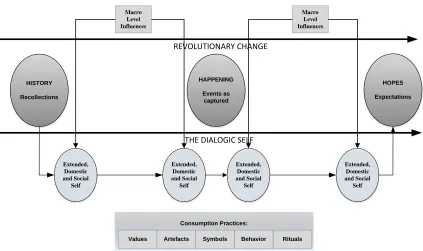
INSERT FIGURE 1 ABOUT HERE
In Figure 1, the linkages between the self and identities in different time perspectives are
relative to revolutionary events. The transformations of the self are relative to transformation
of identities. Consumption practices in our framework show the five identified constructs
(values, artifacts, symbols and rituals). At each stage (history, happening and hopes) there are
differences in consumption practices..
3.0: Methodology
Data was collected during a state of unrest (March-April 2013). Egypt and Libya were
Egyptian interviews were conducted locally and face-to-face, Libyan interviews were
conducted via Skype. Snowball sampling helped overcome the difficulties of recruiting
participants who were initially reticent about interviews. Prior to interviewing, a strong
rapport was developed to reduce elements of fear and distrust (Moustakas, 1994).
The use of semi-structured convergent depth interviews (Rao & Perry, 2003) allowed
for a historical narrative to be captured in which participants reflected on their past (history),
present experiences (happening) and future expectations (hopes). After each round, key
issues were identified and focused on in later rounds. Interviews were conducted amongst
Egyptian and Libyan participants from Arab Universities in Cairo and Tripoli. From a list of
ten universities in Egypt and five universities in Libya, only one Egyptian and one Libyan
university gave acceptance. Further, snowball sampling enabled the identification of
additional participants through recommendations. The final sample list incorporated twenty
six participants from Cairo and sixteen from Tripoli. Students were all current postgraduate
students and came from a range of age demographics and cultural backgrounds. Each
respective interview lasted between forty-five minutes to one hour (see appendix 1 for full
list of respondents).To maintain trustworthiness (Guba & Lincoln, 1994), transcripts were
sent to participants for review. The qualitative data coding process was facilitated through the
use of Nvivo 10. In line with using grounded theory methods, analytical memos were
constructed and served as a trail of reflective thoughts (Charmaz, 2006; Glaser, 2014).
The first step of grounded theory coding methods entailed initial, or open coding,
(synonymous terms that denote the first cycle of coding). Within initial coding, several sub
coding methods were followed. These methods were provisional coding, line-by-line coding,
simultaneous coding, values coding, versus coding and in-vivo coding (see Saldana, 2013).
Provisional coding helped to prevent the risk of premature coding disclosure by highlighting
13 or in some cases small paragraphs and assigning free codes. Charmaz (2006) noted that
line-by-line coding advocates a more trustworthy analysis and lowers the risk of personal bias
entering the coding process. Values coding guarded a sense of bracketing pre-conceived ideas
and assigned marketing codes to the responses. Versus coding was used to juxtapose
concepts (e.g. foreign consumption and local consumption). In-vivo coding was used to
record codes verbatim and preserved participants’ own spoken discourse.
4.0: Findings
We intend in our findings to provide a reading of images of self in the early stages of the
phenomenon that has become known as the Arab Spring. We contend that the early stage of
its unfolding afforded us a unique opportunity to access the candid thoughts of those people
caught up in its wake. In this section, we attempt to provide a temporally nuanced account in
which the present for the respondents is what we call happening, the past we refer to as
history, and their future expectations (expressed at the time of interviews) as hopes. Our
account therefore follows a pattern of history, happening and hopes. We cannot speak as yet
of an after from the perspective of the respondents but can perhaps offer a sense of at the
time of writing, of a re-volution occurring and the window of candidness once again closing.
4.1: Historical images of self- History
An important catalyst for transformations of the self during the Arab Spring were political
and religious thoughts because under previous regimes they were somewhat bottled up and
socially conditioned. Although a strong historically grounded self existed in both Libya and
Egypt before the beginning of the Arab Spring, it was hidden and constrained by a state that
exerted power on consumption behavior and projected desirable values that if breached could
The previous system played a very important role in putting down the Egyptian identity and karama [dignity]. (13)
Dignity and karama seem to be examples of the social self in Egypt and similarly, such
expression of a constrained social self seems evident in the accounts of both Egyptians and
Libyans. An interesting generational split emerged from the accounts of Egyptian
respondents. Older Egyptians who had lived through several political eras and who had seen
several regimes come and go expressed a view that they were very proud to be Egyptians, but
felt that the sense of karama differed in younger Egyptians.
Under the Nasser [Gamal Abdel Nasser, former Egyptian President] regime or Sadat [Anwar Sadat, former Egyptian President] […] they [young consumers] only saw the reign of Mubarak […] younger members of society did not really see the best part of Egypt. (14)
Hence, we can propose some generational difference in the social self. Equally, Libyan
respondents made similar allusions to a constrained sense of self:
We might have had our identity curbed by the old regime […] but we were still Libyan in our hearts and minds. (35)
We propose that these perceptions of a constrained self led to a historical lack of candidness
on the part of respondents and this was apparent in many of their accounts. The following
comment is typical:
Anyone you talked to in Libya could be with you or against you and that was the same thing abroad [...] you didn't freely just run your mouth about the regime because you did not know who you would come across. I think the fear was spread beyond Libya and to those living outside the country as well. We were really cautious with what we were saying with friends and to people inside the country as well. (39)
We note also throughout the transcripts, the constant dialectic interweaving between matters
of religion and matters of consumption in the accounts of respondents. Here we see the
beginnings of a significant tension and flux between what is sacred and what is profane. Belk
15 process through which different selves are compartmentalized and prioritized. The following
narrative seems to illustrate such a dialogic self.
I have always enjoyed purchasing western fashions. Even for headscarf's, I buy branded ones like Burberry and Louis Vuitton. Foods both western such as burgers, fries, pasta dishes and so forth and Arabic dishes have always played a central role in my diet. I mean… I felt like I had the best of both worlds. (30)
This respondent seems to speak of a dialectic process fusing western symbols of
consumerism with traditional consumption rituals. Indeed, notions of West and Western
symbols are often fused with notions of consumerism in the accounts of respondents.
There is still an orientalist view even amongst Arabs towards themselves. We always look at the west as being the leader, so we are still holding onto that mentality. (34)
The relationship between Egypt and the west was discussed for instance by many respondents
as grounded in the values of modernization, especially consumption. Historically, Egyptians
seem to have used Western consumption objects and artifacts to project there sense of
extended self and this extension was part of their domestic self. As participant 10 explained:
I mean before the revolution it was very obvious, we all wanted to look Americanized and wanted to look modernized and that’s how our parents used to do it so we followed that kind of attitude. At home or outdoors − citizens used to converse with friends and family but with ‘bil tabaruq’ [looking away from] their origins. (10)
Respondents seem to have historically consumed Western artifacts as a means of escape of
creating otherness in the extended self.
Consumption seemed fused with a desire for otherness in the reflections of some respondents.
However, a dialectic force in the historic sense of self was religion. Religiosity was the most
influential of values in both countries as it was important to the self and a constant process
embedded within sacred personal, family and the social rituals, and thus was central to
notions of self (Cleveland et al., 2013; Rice & Al-Mossawi, 2002). Religion was seen by
some respondents as secularized under preceding regimes,
Under Mubarak [Hosni Mubarak- a former Egyptian president], I could teach my children what I wanted to teach them. Religion really was a choice and not a threat…
… and the respondent makes a clear link to his fears of the sacrification of consumption and
Westernism. He continues:
I wouldn't see anything on TV that I would think is bad for my kids. (10)
However,, others saw profanity in the link between religion and state.
Religion is something between you and your God […] a government should not be run by any religion because religion is something completely separate to politics in my eyes. Christians, Jewish people, Muslims, everyone should [all] be entitled to live in their country. (24)
Our findings complement the view of Obeidi (2001) who found that religion and family are
the most significant elements of Libyan identity. We note a similar sentiment in Egypt,
except Egyptian society is more heterogeneous and contains other religious communities
such as Christians and Jews. The maintenance of sacred values across both countries seemed
historically grounded in tradition. Thus, religious values seemed key to reducing uncertainty,
because citizens referred to their faith as a means of guidance in the marketplace. To a wider
extent, the strong belief in fatalism (Sidani & Thornberry, 2009) and the state’s view of
desired behavior kept citizens compliant and pulled them back from calling for changes.
These comments and other therefore allows to conceive a starting point against which to
17 4.2: Images of self as the revolution happened - Happening
We characterize the period of flux as the beginning of events that were happening from the
perspective of our respondents.
Egypt can be imagined as a series of bumpy waves that are crashing back and forth at the moment. Hopefully things will stabilise but the picture is definitely so fuzzy and sometimes you feel frustrated. (13)
It is such fuzziness and frustration as indicators of environmental flux that we focus on in the
remainder of Section 4. As the sense of revolution took hold, Libyan participants spoke of
liberation and comments such as being like ‘human beings with a new found sense of
belonging’ (37) were typical. Similarly with Egypt, the personal and the social self appeared
for some, reinvented, and for others, rediscovered.
Egyptians in particular are very proud, especially since the Arab Spring, are very proud of what they have done. (19)
An apparent turning point was breaking out of the imposed boundaries and taking an
alternative road leading to the desire for rapid change or revolution, and to extend a sense of
self. We can therefore begin to explore the dialogic self in a sense of flux as contemporary to
the respondents. We spoke in the preceding sections of a potential period of candidness in the
early period of a revolution. Most of the accounts of our respondents in both countries
contain support for this assertion. Where historical accounts speak of guardedness, as the
revolution happened, respondents seemed inclined to shout their sense of a transitional self, a
form of self we consider here to include a liminal period of transition (after Noble & Walker,
1997), where the self enters an uncertain period and begins to search for a new form of
extended self. The transitional self is characterized by extreme compartmentalization of the
sacred and profane by some, and a dialogue within others that attempts to blend history, with
achieved to the extent that people were able to ritually socialize with others unconcerned
about who was watching or listening in to conversations.
…we are more patriotic than ever before as a result of what has happened […] our identity has definitely become stronger. It means a lot more to be Libyan now, you can actually feel the atmosphere around you and grab Libyan pulses that scream we love to be Libyan. These pulses were there before [the revolution] but they were fake or pretending to please the old regime. (31)
An observation is therefore that the social self is being extended and reformed through new
and deeper interactions. We argue that as much as the political environment brings about
radical transformations, it has also generated emergent consumption rituals that are fuelled by
the desire to encourage country development and create a new form of extended self in
transition.
Almost 80-90% of what I and my family consume are foreign products […] buying things does not excite me as much as it used [to] because there is so much suffering […] but buying products, socialising in western and traditional restaurants helps us forget about our current worries. (15)
As the revolution took hold, the transformation of personal and collective identities in Egypt
and Libya has allowed citizens to feel closer to each other and have a new desire to help the
local cause. This transitional identity for many respondents was therefore part re-discovered,
based on previously hidden images of self and citizens wanted more than anything to look
and sound as Egyptian as possible. Equally, the self seemed new and liminal with significant
compartmentalization between the traditional and Western notions of the sacred and profane.
Some Egyptian respondents expressed a new found desire to reconnect with their history
taken, a point which resonates with Belk’s (1990b) observation that the extended self is also
achieved by reconnecting with past memories, rituals, traditions and places of symbolic
values (e.g. historical sites). Connecting with history is important for Egyptians in developing
the domestic and social self as well as fostering a new identity. We see therefore here a
19 Me and all my friends were like I want to talk in Arabic. We need to reinforce
that [with our children] I want to go to the “Qalaa” [castle] and show the kids or take them to the pyramids, I have never been to “Kahun” [Pyramids village] …because you want your identity [implies back]. (10)
Historical sites are seen as important sacred community possessions and evoke a sense of
nostalgia. In the past, these possessions existed but it is only after a revolution that they
become of greater significance due to misplaced identities under previous regimes. As events
unfolded, Egyptians and Libyans had the flexibility to protest and set up movements in a
manner that was not possible under prior regimes. Since individuals had experienced limited
freedom, their sense of self had entered uncharted territory (several respondents speak of
fuzziness in the present tense) and with those unconstrained boundaries had come uncertainty
(liminality), which had led to a change in what could be described as anti-social consumption
practices but also buying artifacts that maintain a sense of security. However, we observe
here some differences in these respects between Libya and Egypt. In Libya, due to historical
sanctions and restriction on importation of Western goods, the revolution led to a sudden urge
to consume, or as one Libyan respondent stated, Libyan's have now gone consumer crazy
(30).
One of the greatest things I have noticed from the revolution however is that Libyan consumers are less utilitarian and are spending more lavishly on consumer goods than they used to. Maybe this is down to an increase in disposable incomes or down to the fact that they had been oppressed for decades and now want to show what they have been missing out on. (40)
It appears here that foreign, particularly Western goods have therefore become almost sacred
in this early part of the revolution and a key part of the extended self in transition. This
tension suggests that transitional selves in Libya are experimenting with Western
consumption symbols as a way to ease the transition to a new role within a liminal period. As
Noble and Walker (1997) noted, once the transition has been completed, the reliance on
possessions (western consumption symbols in this case) may decrease. Therefore, the
consumption) experienced during liminal periods than in postliminal periods. A danger with
the liminal period progressing too quickly is that it can result in negative consequences for
the social self. Our findings indicate that the sacrilization of consumption is seen as profane
by other respondents who link such extension of the self to negative aspects of anti-social
consumption.
They [consumers] are now trying to experience what they have never had and sometimes […] you act before you think which is why some people have resorted to taking drugs, drinking alcohol. (29)
For others, the tensions between different transitional selves in dialogue was very evident as
they tried to make sense of their transforming sense of self.
Before the revolution, women used to typically dress in traditional Libyan clothes, whereas now they dress like European women or they combine the two styles with each other like women in the Gulf. You see women in the UAE for example wearing the 'abaya' (traditional black dress) and beneath they will have t-shirts, dresses, shorts, skirts and so on). So they have the best of East and West. (36)
This comment shows the dilemma expressed by many respondents between the sacred and
profane. On one hand there is a leniency toward new Western consumption ideals and on the
other, a focus on maintaining religious values and traditions. The same respondent continues,
showing the dilemma and the dialogue she is going through in transition.
They are trying to maintain their traditions whilst accepting western dress codes at the same time. There is no problem with this at all but the problems for me come when they wear a headscarf or veil with the hair almost hanging out. Now if she is trying to cover her hair for religious reasons, why is her hair dangling from one half of her head?
In contrast, the ambiguous legitimacy of the political and the citizen/consumers’ role in
society was already leading to an increase in extreme compartmentalization in the self. In
Egypt, participants discussed fears that society was coalescing into sectarian groups, and new
political and religious conflicts were emerging, each with distinct notions of the sacred and
21 both focal countries if new political leaders fail to determine new boundaries for behavior;
and deliver on citizens expectations.
A number of respondents expressed views that religious values in transition were
important because citizens use their faith as a means of reducing uncertainty and a means of
guidance in turbulent times. In the dialogic self, it is still apparent in all respondents that
religion should be prioritized, but that its compartmentalization is relative in many cases to
consumerism, and that the degree to which consumption is profane differs between
respondents.
There is this fear of either the religion ruling or not ruling. […] I believe when you live together you need rules for your life. (11)
I know a lot of people become exposed to western societies and often lapse into a swamp of western ideals and norms, which is fine. But when they forget where they came from and who their parents are, then that is what is worrying. (30)
Other causes of marginalization were apparent in the accounts of respondents. Some rural
individuals such as those in tribal groups were discussed by respondents as more likely to
display greater ethnocentrism and resist a transitional self, due to affiliations with the old
ruling powers.
Libya is a massive canvas and has montage of different ethnicities […] some of these sects of people actually reject the idea of globalisation and want to remain tribal or archaic in their values and keep to their own personal traditions […]they live in their own bubble. […] Under the old Qaddafi regime […] they had a lot of comfort and […] he used to treat them and give them lands and cash. This favoritism has declined after the revolution which is why many Bedouins despise the new government and reject developments and government reforms. (27)
The revolution may have initially brought some tribal groups closer together, for the purposes
of resisting change. Indeed responses suggest that traditional values across a diverse Libyan
demographic have remained unchanged for many in the present. As the revolution unfolded,
emerging between tribal groups and citizens. However, even amongst tribal affiliates, there
seemed to be a dichotomy between preserving traditional values and advocating western
consumer behavior via the consumption of western products. This suggests that tribal clans
going through a liminal period are showing a reversal of traditional roles by embodying a
transitional self that seeks to emulate western consumption. In this liminality (i.e. the
happening), tribal clans have distanced themselves from modernity and are engaging in
postmodern activities to acquire a new sense of extended self that is in search of an ideal self
in which religion is prioritized. The above respondent continues.
Ironically though some may reject globalization and western products, you will find people wearing Levi's jeans or driving American cars or drinking Coca Cola […] the revolution has strengthened their own unique identities and brought them closer together. (27)
There appears to be a peculiarity, in that a desire for western goods is a more commonly
shared sense of self than tribal, religious and political affiliation, but that marginalization,
particularly in religious terms had led to an extreme sense of scarification in the consumption
of western goods.
We identify in the accounts of respondents, a rather deeper insight into consumerism
which extends beyond general observations of foreignness, Westernness and profanity. We
have above discussed how historically, Egyptians linked their extended self to the
conspicuous consumption of Western brands because they were perceived as symbols of
wealth, prestige and quality (this finding is in agreement with Abaza, (2005)). However, as
the revolution unfolded, respondents discussed a burgeoning epiphenomenon they called
ishtiri al masri (buy the local Egyptian products). This suggests that in the transitional self,
with a new sense of Egyptianness (karama), came a normative pressure to buy local products.
23 badges and anything that was Egyptian made […] but now not until we have
a proper president’ [in reference to the MB]. (10)
This was in contrast to Libya where the quest for foreign products seemed absolute. The
transitional self therefore had some distinct differences for Libyans than for Egyptians
People are even more inclined and hold even greater positive perceptions of US products for example, so they are favorable if anything. You have to remember now in Libya that before the revolution there weren't that many foreign products, like especially from European countries and the US. Now, after the revolution they are being flooded and exposed to these products and they have been very successful. […] So I would say consumerism and the propensity for the consumption of western products has massively increased (27).
In Libya, the previous denial of access to Western goods has seemingly driven desire for
Western goods in the transitional self.
What seems apparent in the accounts of both Libyans and Egyptians is that the
consumption of Western brands is a significant source of otherness, and that such
consumption still forms part of the extended self. In Libya, the initial burst of freedom had
led to a clamber for Western products, previous denied to them. The conspicuous
consumption of Western goods has evidently become part of the extended and social selves.
Our findings suggest that the dialogic self (i.e. the extended, domestic and social) is
instrumental in the making of the transitional self. Whilst in Egypt and Libya, for many the
domestic self and social self have retreated to tradition (these traditions are for some being
rediscovered, for other younger citizens, being newly discovered), foreign symbols have in
the this liminal period remained or increased in their dialogic prioritization in these same
people. What is interesting to note is the beginnings of ishtiri al masri in Egyptian consumers
which may lead eventually lead to increased prioritization for home produce in the near
future and for its consumption to be a stronger emphasis in the extended self in a post-liminal
period. Within a period of transitional liminality, the extended self appears to have its own
shaping the values of the domestic and the social self. In order to produce an ideal self, the
transitional self is in constant transitional liminality and is expressed through rituals, symbols
and artifacts. Hence, in the next section, hopes for the future are brought discussed.
4.3: And for the future -Hopes
It is interesting to note that many respondents had a clear sense of epoch, an epoch that began
with the first acts of revolution, and which many respondents felt they were still in at the time
of interview and would be for some time into the future, making it difficult to speak of a
before, during and after the revolution.
We will go through a dark era which will not be less than 10-15 years before we will be able to go in the right direction. (3)
However, rich metaphors of hope were apparent in a significant majority of the accounts
captured in this research.
If you imagine a fisherman catching fish, we were the fish and the bait for the fisherman for decades on end. Finally now, the net has broken free and we can swim for our future. (39)
In the accounts of respondents were a large number of such nuanced comments we therefore
brought together under the code we called hopes. We propose that hopes (and fears) from the
summer after the liminal spring are a driving motivation in our proposed notion of a
transitional self. The following respondent indicates the key dialogic tensions between the
sacred and profane in this set of expectations.
I do not want Libya to become a completely sharia ruled state but at the same time I do not want it to become too liberal either. We are not a western country and we never have been so we should try and maintain our morals and traditions and achieve some kind of balance between the way we behave and act in society and make sure that it reflects our history. (32)
The comments hint at a dialogic process yet to come in which the tension between
25 I will just keep optimistic and I think that pendulum will slowly go back and
hopefully move back to the middle. (13)
It seems apparent that foreign symbols and artifacts will remain significant elements of the
extended self in both Libya and Egypt, as the flux continues.
I might be getting less of them [foreign products] but I won't stop. (6)
There is however, cause to suggest that with a pendulum swing, a stronger sense of national
identity may emerge and a new sense of ethnocentrism (bil tabaraq) may gradually erode the
xenocentric consumption patterns observed in the proceeding section.
I would like to see it [Egypt] remain in a state of liberalism but still in a certain sense of control against particularly the west, USA and Britain’ […] I would like it to just very much gain independence. (22)
Hopefully people will grow to realize that they are being a bit too libertarian or too middle class on this by shopping in places and prioritising foreign products over so many accessible local products. (26)
Our three part analysis, history happening and hopes has allowed us to project forwards and
backwards from the contemporary state of flux within which respondents are speaking. This
approach has allowed us to consider a dialogic self and we have tentatively proposed a
concept of a transitional self, a self that is in flux and is liminal. That which is sacred and that
which is profane in the transitional self are in conflict resulting in rituals, artifacts, values that
are in a state constant reformation and re-evaluation. The transitional self we observe in our
account here is one which has an initial need for Western symbols to create a sense of escape
and otherness in transition, but that with a resurgence of national identity may be replaced by
Egyptian symbols and artifacts. There seems much confidence in the potential of the self to
grow stronger as the future unfolds.
Equally, many respondents want to see their influence in consumerism expand beyond that of
the national environment.
I want Egypt to be economically like Taiwan and these Asian countries, to have products and invade the whole world. (14)
A consistent theme throughout citizens hopes for the future is achieving a balance between
what is considered scared and what is profane. Whilst Egyptians are displaying ethnocentric
tendencies and encourage the growth of local consumption symbols (e.g. restaurants, clothing
brands and local souks/bazaars, Libyans are keen for foreign consumption to dominate in
order to lift the local economy. The transitional selves in both cases want to maintain
religious values and traditional rituals but keep them secular at the same time. The influence
of the dialogic self is key in allowing the transitional self to continue to progress through a
period of liminality. For instance, marginalization between political factions or civil conflicts
may interupt the pendulum and a sense of transitional self is distorted and replaced by a
marginalized potentially polarized self based on absolute prioritization of tradition over
modernity. Similarly, the excessive consumption of western consumption symbols is
concerning for the domestic self, as families’ worry that younger family members will
abandon traditional values.
5.0: Conclusion
In this paper, we have attempted to offer a challenge to the underlying assumptions in much
of the consumer research literature that have been derived from research conducted in
relatively stable environmental (social, political, economic) conditions. We have instead
examined two national environments that we have characterized as being in a state of flux or
revolution. Our approach to studying such flux has been to provide a three phase, history,
happening and hopes narrative and this has allowed us to further an understanding of change
27 studying conditions of revolution is the phenomenon of consumer candidness. Hofstede
(2001) and later DeMooij (2013) speak of a paradox between the behavior that is desirable
with reference to external norms; and the desired − the behavior desired by an individual if
free of constraint. That which is detectable in the accounts of respondents are their desires
relative to their previously constrained expressions. Research conducted in conditions where
historical constraints on candidness were apparent leads us to offer caution as to the veracity
of conclusions drawn in the pre-revolutionary period as relevant to the present and future, in
our focal countries. We have taken here an opportunity to access the unbounded thoughts of
consumers in Egypt and Libya, an opportunity that may end through a re-volution and the
period of candidness potentially ending. We highlight here the opportunity that may be
available to study other societies in the early stages of revolution with a view to accessing
candid thought. However, our research purpose in this paper was to examine images of self in
a period of flux and we have focused our discussion to this end.
A central contribution in our paper to the discussion of self is to propose a notion of a
transitional self in revolution. We have used this term to characterize the extended self in a
liminal period of transition, grounded in the present flux, but which is referent to history and
hopes. We offer a visual representation of the transitional self in Fig. 2 which is a
development of our conceptual framework, (Fig.1) and perhaps allows us to visualize, winter,
spring and summer from the perspective of our respondents.
INSERT FIG. 2 ABOUT HERE
Belk’s concept of the dialogic self (as illustrated in Fig.1) has been helpful to unpick
and contrapose the tensions in the transitional self. In the accounts of respondents, we detect
significant and wildly fluctuating compartmentalization of different priorities within the
transitional (dialogic) self, particularly in respect to what is sacred and what is profane. We
revolution. Indeed notions of profane and sacred consumption seem simultaneously to drive
marginalization and unity in our focal societies during this liminal period. We also identify
therefore that consumption hopes can be an important driving mechanism of flux as well as
being something that is constantly reformed as a result of the flux. Consideration of the
transitional self (including previously well respected notions of the extended, domestic and
social self) throughout the three phases (history, happening and hopes) is valuable because it
illustrates how consumers use rituals, values, symbols, and artifacts to reflect their sense of
self and make sense of their turbulent environment (as proposed in Fig. 1).
In their concluding comments, Belk et al, (1989), ask whether Western society can
generate transcendental common values which are influenced by, but not in dialectic tension
with religion (they refer to Harrington 1983 in this discussion). They propose that “like it or
not, to our benefit or peril, consumption has become a transcendental vehicle for many”
(p.32). Our findings here support the assertion of consumption being transcendental in a
liminal period, and to an extent in the histories of respondents. However, unlike Western
societies, we do not detect in the hopes of respondents, for religion to be transcended by
consumption in a way that Belk and colleagues perhaps suggest. Hopes for the future contain
strong notions of religiosity in the ideal (hoped for) self. Since our respondents have tended
to be from a younger generation which makes up a very significant proportion of the
population of the Middle East, we feel that religiosity is an important factor for further
research focus going forward. Further research may consider the concepts discussed by
Asgary and Walle (2002) of polarization and hybridization and how consumerism is in
dialectic tension with religion. Since our sample is mostly from a younger population, if a
broader sample from older, traditional and rural populations undergoing flux could be
29 marginalization could be drawn. However, the very definition of this sample makes is
accessing difficult and potentially dangerous during a period of revolution.
Rather than assuming the transcendence of consumption over religion, we propose
that further research should study the dialectic interplay between consumption and religion in
the Middle East. This underlying assumption of transcendence in the current body of work
seems to define a weakness when attempting to extend existing Western based consumer
research findings into more traditional, historical and religiously grounded societies such as
the Middle East. Going forward, there seems much more to learn about sacredness/profanity
and religion/consumption in the Middle East. The transcendence of consumption in a liminal
period does however; seem apparent in both Libya and Egypt, with Western symbolic
consumption (as a result of bil tabaruq) being a significant aspect of such transcendence for
the young urban population that make up the significant proportion of our sample. We have
therefore offered in this paper some initial bases on which to further an understanding of both
the transitional self and of Middle East consumer behavior in the future. The comparison
between Egypt and Libya has also been helpful in identifying that they are different phases of
liminal transition, with potentially with Egypt’s transition being more developed,
substantiality we argue because of its historical situation, being more engaged with
globalization in the memories of respondents. For instance, we have highlighted a distinction
between Egyptian and Libyan consumers in the form of ishitiri al masri − an awakening and
extension of the extended self that points to a movement away from Western Symbolism to
local Egyptian production. In this sense we identify a potential transition in the social self (or
karama) in Egypt that has important implications for markets and marketers. We propose that
that an understanding of the transitional self in leading transitional Middle Eastern countries
may inform future changes in lagging Middle Eastern countries. Understanding the
artifacts will be consumed in which symbolic way, and through which rituals. We have
offered some insight into these four facets in Appendix 2. We offer our reading and the
proposed notion of a transitional self as a contribution to the understanding of consumption in
31 Bibliography
Abaza, M. (2005). Today’s consumption in Egypt. ISIM Review, 15, 38-39.
Ahuvia, A. (2005). Beyond the extended self: Loved objects and consumers’ identity narratives. Journal of Consumer Research, 32(1), 171–184.
Alvesson, M., & Sandberg, J. (2011). Generating research questions through problematization. Academy of Management Review, 36(2), 247-271.
Argyrou, V. (2013). The gift of European thought and the cost of living. New York, Berghahn Books.
Arnould, E. J., Price, L. L., & Zinkham, G. M. (2004). Consumers (2nd ed.). New York, McGraw-Hill.
Asgary, N., & Walle, A. H. (2002). The cultural impact of globalisation: economic activity and social change. Cross Cultural Management, 9(3), 58-75.
Belk, R., Mayer, R., & Bahn, K. (1982). The eye of the beholder: individual differences in perceptions of consumption symbolism. Advances in consumer research, 9(1), 523-530.
Belk, R.W. (1988). Possessions and the extended self. Journal of Consumer Research, 15(2), 139–68.
Belk, R. W., Wallendorf, M. & Sherry Jr, J. F. (1989). The sacred and the profane in consumer behavior: Theodicy on the odyssey. Journal of consumer research, 16, (1), 1-38.
Belk, R. W. (1989). Extended self and extending paradigmatic perspective. Journal of
Consumer Research, 16(1), 129-132.
Belk, R. W. (1990a). Halloween: an evolving American consumption ritual. Advances in consumer research, 17(1), 508-517.
Belk, R. W. (1990b). The role of possessions in constructing and maintaining a sense of past.
Advances in consumer research, 17(1), 669-676.
Belk, R. W. (2013). Extended self in a digital world. Journal of Consumer Research, 40, (3), 477-500.
Belk, R.W. (2014a). Digital consumption and the extended self, Journal of Marketing Management, 30(11-12), 1101-1118.
Belk, R.W. (2014b). Alternative conceptualizations of the extended self. Advances in Consumer Research, 42, 251-254.
Castells, M. (1996). The rise of the network society. The information age: Economy, society and culture. Vol. 1. Oxford: Blackwell.
Charmaz, K. (2006). Constructing grounded theory. London, Sage.
Chernev, A., Hamilton, R., & Gal, D. (2011). Competing for consumer identity: limits to self-expression and the perils of lifestyle branding. Journal of Marketing, 75(3), 66-82. Chitakunye, P., & Maclaran, P. (2014). Materiality and family consumption: the role of the
television in changing mealtime rituals. Consumption Markets & Culture, 17(1), 50-70.
Cleveland, M., Laroche, M., & Hallab, R. (2013). Globalization, culture, religion, and values: Comparing consumption patterns of Lebanese Muslims and Christians. Journal of Business Research, 66(8), 958-967.
Cohen, N., & Arieli, T. (2011). Field research in conflict environments: Methodological challenges and snowball sampling. Journal of Peace Research, 48(4), 423-435.
Ekinci, Y., Sirakaya-Turk, E., & Preciado, S. (2013). Symbolic consumption of tourism destination brands. Journal of Business Research, 66(6), 711-718.
El-Bassiouny, N. (2014), “The one-billion-plus marginalization: Toward a scholarly understanding of Islamic consumers.” Journal of Business Research, 67(2), 42-49. Fromm, E. (1978). To have or to be? A blueprint for mankind. Reading, England: Cox &
Wyman Ltd.
Giddens, A. (1991). Modernity and Self-Identity. Stanford, CA: Stanford University Press. Giddens, A. (1999). Runaway world: How globalization is reshaping our lives. London:
Profile.
Glaser, B.G. (2014). Memoing: A vital grounded theory procedure. Mill Valley, CA: Sociology Press.
Guba, E. G., & Lincoln, Y. S. (1994). Competing paradigms in qualitative research. In N.K, Denzin, & Y.S, Lincoln, (Eds.), Handbook of qualitative research, 105-117. California, Thousand Oaks: Sage.
Harrington, M. (1983), The politics at God's funeral: the spiritual crisis of Western civilization. New York: Penguin.
Hofstede, G. (2001). Culture's consequences: Comparing values, behaviors, institutions, and organizations across nations (2nd ed.). California, Thousand Oaks: Sage.
Huang, V.Z., & Balakrishnan, M. (2013), Managing in uncertain times – a critical juncture for research in the MENA region. Journal of Strategy and Management, 6(2), 1-7.
Kienle, E. (2012), Egypt without Mubarak, Tunisia after Bin Ali: theory, history and the 'Arab Spring'. Economy and Society, 41(4), 532-557.
Kleine III, R. E., Kleine, S. S., & Kernan, J. B. (1993). Mundane consumption and the self: a social-identity perspective. Journal of Consumer Psychology, 2(3), 209-235.
Mahajan, V. (2013), Understanding the Arab Consumer. Harvard business review, 91(5), 128-132.
Mead, M. (1928/1973). Coming of age in Samoa. London: Penguin.
Midgley, G. (1992). The sacred and profane in critical systems thinking. Systems Practice, 5(1), 1-15.
Moaddel, M. (1992). The case of the Iranian revolution. American Sociological Review, 57(3), 353-379.
Mojab. S., & Abdo, N. (2004). Violence in the name of honour: Theoretical and political challenges. Istanbul: Istanbul Bilgi University Press.
Moustakas, C. (1994). Phenomenological research methods, Thousand Oaks, Calif, Sage. Noble, C. H., & Walker, B. A. (1997). Exploring the relationships among liminal transitions,
symbolic consumption, and the extended self. Psychology & Marketing, 14(1), 29-47. Obeidi, A. (2001). Political Culture in Libya. Richmond, Surrey: Curzon Press.
Osman, T. (2013). Egypt on the Brink: From Nasser to the Muslim Brotherhood. London, Yale University Press.
Pargeter, A. (2012). Libya: The rise and fall of Qaddafi. London, Yale University Press. Rao, S., & Perry, C. (2003). Convergent interviewing to build a theory in under-researched
areas: principles and an investigation of internet usage in inter-firm relationships. Qualitative Market Research, 6(4), 236-247.
Rice, G., & Al-Mossawi, M. (2002). The implications of Islam for advertising messages: The Middle Eastern context." Journal of Euro-marketing, 11(3), 1-16.
Rindfleish, J. (2005). Consuming the self: new-age spirituality as “social product” in consumer society. Consumption, Markets and Culture, 8(4), 343-360.
Rook, D. W. (1985). The ritual dimension of consumer behavior. Journal of Consumer Research, 12(3), 251-264.
33 Schouten, J. W. (1991). Selves in transition: symbolic consumption in personal rites of
passage and identity reconstruction. Journal of Consumer Research, 17(4), 412-425. Shankar, A., Elliott, R., & Fitchett, J.A. (2009). Identity, consumption and narratives of
socialization. Marketing Theory, 8(1), 75-94.
Sidani, Y. M. & Thornberry, J. (2000). The current Arab work ethic: antecedents, implications, and potential remedies. Journal of Business Ethics, 91(1), 35-49.
Springer, R., & Czinkota, M.R. (1999), Marketing's contribution to the transformation of central and eastern Europe. Thunderbird International Business Review, 41(1), 29-48. Thompson, C. J. (1997). Interpreting Consumers: A hermeneutical framework for deriving marketing insights from the texts of consumers’ Consumption Stories. Journal of Marketing Research, 34(4), 438–55.
Uskul, A. K., Oyserman, D., & Schwarz, N. (2010). Cultural emphasis on honor, modesty, or self-enhancement: Implications for the survey response process. In M. Braun, B. Edwards, J. Harkness, T. Johnson, L. Lyberg, P. Mohler, B.E. Pennell, & T.W. Smith. (Eds.) Survey methods in multinational, multiregional and multicultural context. NJ: John Wiley and Sons.
Vandewalle, D. (2008). Libya since 1969: Qadhafi’s revolution revisited. Basingstoke, Palgrave Macmillan
Wattanasuwan, K. (2005). The self and symbolic consumption. Journal of American Academy of Business, 6(1), 179-184.
Wehrey, F. (2013), Libya's revolution at two Years: perils and achievements. Mediterranean Politics, 18(1), 112-118.