Automated REA (AREA): a software toolset for a
machine-readable resource-event-agent (REA) ontology
specification
FALLON, Richard and POLOVINA, Simon <http://orcid.org/0000-0003-2961-6207>
Available from Sheffield Hallam University Research Archive (SHURA) at:
http://shura.shu.ac.uk/13067/
This document is the author deposited version. You are advised to consult the publisher's version if you wish to cite from it.
Published version
FALLON, Richard and POLOVINA, Simon (2016). Automated REA (AREA): a software toolset for a machine-readable resource-event-agent (REA) ontology specification. CEUR Workshop Proceedings, 1637, 10-18.
Copyright and re-use policy
Automated REA (AREA): A Software Toolset for a
Machine-readable Resource-Event-Agent (REA)
Ontology Specification
Richard L. Fallon Dr. Simon Polovina
Sheffield Hallam University, Sheffield, United Kingdom [email protected], [email protected]
Abstract. This paper demonstrates a toolset developed by the authors to enable a machine-readable REA ontology specification. Information modelling tech-niques are used to provide a unified enterprise ontology by capturing the busi-ness semantics using Conceptual Graphs (CGs) using Common Logic (CL) and the Conceptual Graph Interchange Format (CGIF) dialect for information ex-change and transmission. Formal Concept Analysis (FCA) is used for model verification, knowledge discovery and extraction. The enterprise design follows the Open Groups definition of the TOGAF Architecture Development Method (ADM) to define the system architecture and subsequently provide a method for defining and automating the (REA) design models for; Business Architecture, Information System Architecture and Technology Architecture.
Keywords: REA, ADM, Conceptual Graph, Ontology, FCA, Data integration, Semantics, Protégé
1 Introduction
2 System requirements
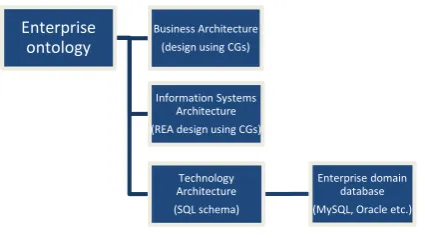
[image:3.595.193.406.407.526.2]The basis of the system requirements for AREA come from the Open Groups definition of the TOGAF Architecture Development Method (ADM) [2] which defines the Architecture Development Lifecycle. In addition to the ADM above we will add four further requirements; (i) to enable Model Automation (MA), the solution must be not only Human readable but also Machine readable, (ii) enable Model Visualization (MVi) and thus provide a Graphical view which can be used by domain modelling professionals, (iii) allow for Model Verification (MVe) so that domain modelling professionals can carry out tests against the pro-posed Enterprise ontology, (iv) provide a working solution via Model Implementation (MI) the point at which the model is converted into a usable Enterprise domain database. The diagram below in Fig. 1 identi-fies the components required for producing an Enterprise Architecture using AREA.
Fig. 1 - ADM Components of an Enterprise Architecture using AREA
2.1 Model Automation (MA)
Common Logic (CL).
The International Organisation for Standardisation (ISO) have defined Common Logic (CL) [3] which is a first order logic intended for infor-mation exchange and transmission. The core of the CL framework is the definition of an abstract syntax and abstract semantics for Common Logic, providing the structure for several concrete syntactic forms or dialects. One of the CL dialects is the Conceptual Graph Interchange Format (CGIF) and it is this dialect which we use for information
ex-Enterprise ontology
Business Architecture (design using CGs)
Technology Architecture (SQL schema)
Enterprise domain database (MySQL, Oracle etc.) Information Systems
change and the Automation of REA (AREA) using Conceptual Graphs (CGs).
Conceptual Graphs (CGs).
CGs have been shown to be useful in capturing and modelling business transactions and their semantics within an enterprise architecture [4]. Thus our solution uses CGs as the driving force behind MA providing a tool to define the Enterprise ontology. CGs provide both accurate mantic and syntactic refinement, aiding the designer in capturing se-mantics. Whilst CG’s in CGIF format are machine readable they can also be interpreted and edited manually (human readable) and are use-ful for documentation and maintenance.
REA.
McCarthy (1982) proposed his REA theory as the solution to a general-ised accounting framework in which both accountants and non-accounts could share the same enterprise data. McCarthy’s [5] enter-prise ontology determines that all the Economic transactions within an enterprise can be aligned to three separate entities or concepts; (i) Eco-nomic Resources, (ii) EcoEco-nomic Events and (iii) EcoEco-nomic Agents. Moreover, REA has also been demonstrated to be useful for modelling non-economic business transactions [6, 7].
2.2 Model Visualization (MVi)
Protégé.
CG Import.
The Protégé plugin CGImport [10] was developed by the authors as a tool to allow for the import of CGs defined using the CGIF Common Logic dialect directly into the Protégé ontology repository. Thus allow-ing the user to define both the Business Architecture and the Infor-mation System Architecture using CGs from within a text editor or to import the CGs designed using other available CG tools such as CharGer [11].
CG Export.
The Protégé plugin CGexport [12] was developed by the authors as a tool to allow for the export of CGs stored within the Protégé ontology repository into a file using the CGIF Common Logic dialect. Thus al-lowing for interoperability with other available CG tools such as CharGer [11].
2.3 Model Verification (MVe)
JESS.
JESS [13] is a tool available as a Protégé plugin, used to build an expert system which can then be used to build a set of rules which can be re-peatedly executed against a collection of facts such as an ontology de-scribing an enterprise system. Thus JESS is used to validate the En-terprise Model once it is stored within Protégé.
FCA.
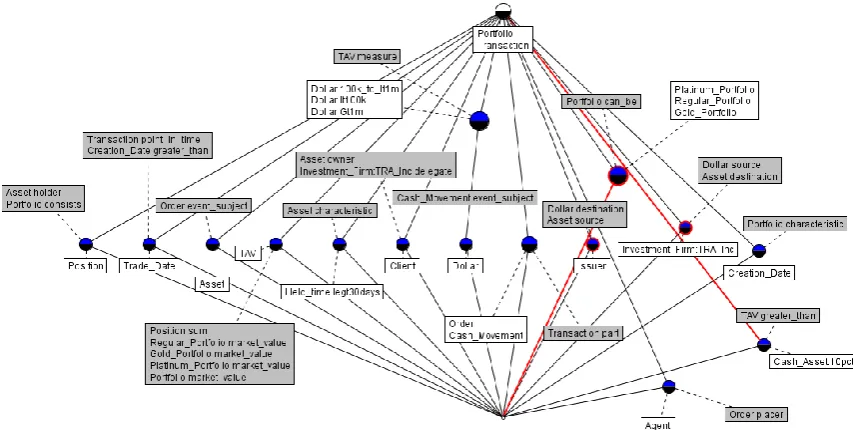
Several authors have shown the benefits of converting CGs into Formal Concepts [14] to allow for Formal Concept Analysis (FCA), to find out the hidden information and transactions within complex graphs. The tool FCAView[15] was further developed by the authors to allow for FCA on the enterprise model stored directly within Protégé [15-17].
2.4 Model Implementation (MI)
REAtoSQL.
The Protégé plugin REAtoSQL has been developed by the authors as a tool to allow for the export of the Technology Architecture in the form of an SQL schema from the REA ontology design stored within the Protégé repository. The SQL schema can then be used to initialize the enterprise domain database.
3 Solution demonstration
To demonstrate the solution, we use the example of a Financial Trading (FT) case study for the purpose of simplicity and to allow for compari-son with other solutions using this same case study.
3.1 Business Architecture
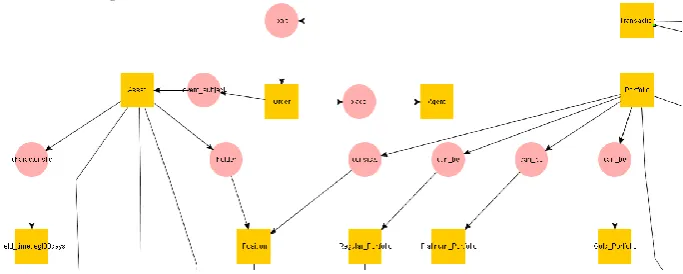
[image:6.595.134.476.483.620.2]Using MA, we define the Business Architecture using CGs by import-ing (usimport-ing CGimport) models from other tools (CharGer), or models defined manually in a text editor into Protégé for MVi. The complete Business Architecture defined using CGs can then be reviewed (MVi) in Protégé, further CGs can be added to define further business entities and expand the type hierarchy. Thus Protégé allows for MVi of the Business Architecture and to carry out further design work (Fig. 2).
Fig. 2 - Business Architecture Model Visualisation MVi (extract)
Fig. 3 - Business Architecture Model Verification FCA (MVe)
3.2 Information System Architecture
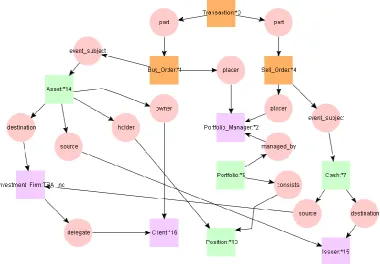
Fig. 4 - Information System Architecture - Model Visualisation – REA entities, key: Resources-green, Events-orange, Agents-lilac
The resulting design can then be used later for the basis of the Technol-ogy Architecture in the form of an SQL schema.
3.3 Technology Architecture
4 Conclusions
In this paper we have responded to the call [19] for the viability of hav-ing a machine-readable REA ontology specification. A correct formal representation of the REA-ontology offers great opportunities and will facilitate the operationalization of the REA-ontology [20]. UML modelling has also been proposed as the solution to this problem, how-ever, the solution presented in this paper uses CG’s as an alternative (instead of UML). Thus the AREA toolset allows the enterprise expert to follow TOGAF [2] and define; Business Architecture, Information System Architecture and the Technology Architecture using CGs, REA and the SQL Enterprise Domain Database, all from within a unified tool - Protégé.
References
1. Geerts GL, McCarthy WE (2002) An ontological analysis of the economic primi-tives of the extended-REA enterprise information architecture 3:1-16
2. TheOpenGroup (2016) TOGAF® 9.1 > Part II: Architecture Development Method (ADM), Introduction to the ADM. http://pubs.opengroup.org/architecture/togaf9-doc/arch/chap05.html
3. ISO (2016) Information technology -- Common Logic (CL): a framework for a family of logic-based languages ISO/IEC 24707:2007.
http://www.iso.org/iso/catalogue_detail.htm?csnumber=39175
4. Launders I (2012) The transaction graph: requirements in semantic enterprise archi-tectures. LAP LAMBERT Academic, Saarbrücken.
5. McCarthy WE (1982) The REA accounting model: A generalized framework for accounting systems in a shared data environment 57:554-578
6. O'Leary DE (2004) On the relationship between REA and SAP 5:65-81 7. Fallon RL, Polovina S (2013) REA analysis of SAP HCM; some initial findings 8. Enterprise Architecture Solutions (EAS) (2016) The Essential Project.
http://www.enterprise-architecture.org/ 9. Wang H (2015) Frames and OWL side by side.
http://protege.stanford.edu/conference/2006/submissions/slides/7.2wang_protege2 006.pdf
10. Fallon RL (2015) CGImport. https://github.com/RichardFallon/CGImport 11. Delugach H (2016) CharGer Conceptual Graph and knowledge modeling tool.
http://charger.sourceforge.net/
12. Fallon RL (2015) CGExport. https://github.com/RichardFallon/CGExport 13. Friedman-Hill E (2016) JESS the rule engine for the JAVA platform.
http://www.jessrules.com/jess/index.shtml
15. Jiang G, Fallon RL (2016) FCAView. https://github.com/FCAView/FCAView_V2.0
16. Andrews S (2016) CGFCA - Convertor of Conceptual Graph files to Formal Con-text files. http://sourceforge.net/projects/cgfca/
17. Fallon RL (2016) 3to2 - Convertor of Conceptual Graph files to Formal Context files. https://github.com/RichardFallon/3to2
18. Pavel. Hrubý, Kiehn J, Scheller CV (2006) Model-driven design using business patterns. Springer, Berlin.
19. Gailly F, Laurier W, Poels G (2008) Positioning and Formalizing the REA Enter-prise Ontology. J Inf Syst 22:219-248