A machine vision extension for the Ruby programming
language
WEDEKIND, J., AMAVASAI, B. P., DUTTON, K. and BOISSENIN, M.
Available from Sheffield Hallam University Research Archive (SHURA) at:
http://shura.shu.ac.uk/952/
This document is the author deposited version. You are advised to consult the
publisher's version if you wish to cite from it.
Published version
WEDEKIND, J., AMAVASAI, B. P., DUTTON, K. and BOISSENIN, M. (2008). A
machine vision extension for the Ruby programming language. In: Proceedings of
the IEEE 2008 International Conference on Information and Automation, Zhangjiajie,
China, 20-23 June 2008. 991-996.
Copyright and re-use policy
See
http://shura.shu.ac.uk/information.html
A Machine Vision Extension for the Ruby Programming
Language
∗
J. Wedekind, B. P. Amavasai, K. Dutton, M. Boissenin
Microsystem & Machine Vision Laboratory, Materials and Engineering Research Institute Sheffield Hallam University
Pond Street, Sheffield S1 1WB, United Kingdom
[email protected], [email protected], [email protected], [email protected]
Abstract—Dynamically typed scripting languages have be-come popular in recent years. Although interpreted languages allow for substantial reduction of software development time, they are often rejected due to performance concerns.
In this paper we present an extension for the programming language Ruby, called HornetsEye, which facilitates the devel-opment of real-time machine vision algorithms within Ruby. Apart from providing integration of crucial libraries for input and output, HornetsEye provides fast native implementations (compiled code) for a generic set of array operators. Different array operators were compared with equivalent implementa-tions in C++. Not only was it possible to achieve comparable real-time performance, but also to exceed the efficiency of the C++ implementation in several cases.
Implementations of several algorithms were given to demon-strate how the array operators can be used to create concise implementations.
Index Terms—Computer Vision, Image Processing, Signal Processing
I. I
Machine vision is a broad field and in many cases there are several independent approaches solving a particular problem. Also, it is often difficult to preconceive which approach will yield the best results. The machine vision software can only be tested in a particular environment after the hardware platform to run it on is sufficiently developed and the software can be installed. Experience shows that - since hardware and software developers in a project often get to start and finish at the same time - it is important to preserve the agility of the software to be able to implement necessary changes in the final stages of a project.
This paper presents HornetsEye1 which is an extension
for Y. Matsumoto’s programming language Ruby to facilitate rapid development of machine vision software. We have found that it is possible to provide a high amount of flexibility without sacrificing real-time capabilities. For example, in [1] the software library was used to implement the dual-tree complex wavelet transform.
The work presented in this paper was funded by the EPSRC Nanorobotics project. Furthermore, it benefits from
∗This work was supported by the Nanorobotics EPSRC Basic Technology
grant GR/S85696/01
1Available at http://rubyforge.org/projects/hornetseye/
Recognition
/
Tracking
Feature Description
Key-Point Localisation
[image:2.612.380.489.218.340.2]Filtering
Acquisition
Figure 1. Overview of typical object recognition algorithm
the accumulated experience of developing machine vision software within the EU MINIMAN and EU MiCRoN project and from a continued effort to develop software which is useful beyond a single project. While development of this software was driven by the demands of projects in the micro-and nano-environment, we believe that the results presented in this paper apply to other environments as well.
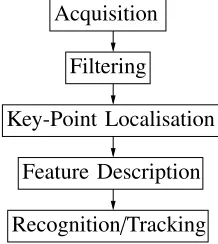
Figure 1 shows an overview of a typical object recognition algorithm.
In chapter II the current state of the art is discussed and the approach of developing a Ruby-extension is justified. Chapter III presents optimized array operations. Chapter IV shows how different applications facilitated by these generic oper-ations. Chapter V demonstrates the achieved performance. Chapter VI is the conclusion and VII is about future work.
II. S
There are a number of active free and open source software projects in the area of machine vision. These include ITK, NASA Vision Workbench, OpenCV, OpenVidia, Camellia, PyGPU, and Gamera to name only a few. Machine vision systems require software for handling video and image files, accessing cameras, and visualizing results. To keep the size of the project manageable it is mandatory to make use of existing software projects.
Altough open source packages and libraries are available for free, integrating it requires significant time and effort[2].
Proceedings of the 2008 IEEE
Furthermore with increasing size and adoption, software projects face the evolution dilemma[3]: As soon as there are multiple stakeholders, they require that it is a stable basis for development. But if making changes becomes too cumbersome, the project sooner or later will be superseded by a more progressive one.
The Ruby scripting language alleviates both problems. Ruby is a reflective, dynamically typed, object-oriented pro-gramming language. Furthermore Ruby uses code blocks as a unifying concept for loops, iterators, and function objects. Dynamically typed languages have become popular in recent years. For example Camellia, PyGPU, and Gamera are all making use of dynamically typed languages (the other projects listed above are implemented in C/C++). Dynamically typed languages are not new and many features of Ruby already can be found in Smalltalk-80[4]. Projects such as SageMath are successfully using dynamic scripting languages to integrate a wide range of other projects into a large solution.
Integrating software in Ruby is easy because
• interfacing with native code for writing extensions is simple
• classes can still be modified after declaration
• Ruby uses duck-typing, i.e.two objects are compatible if they support the same methods and properties The last feature also alleviates the evolution dilemma since changes do not propagate as far through the class-hierarchy as they do in statically typed languages.
It would be desirable to port all required software to Ruby so as to take full advantage of the language properties. However for input and output (e.g.capturing camera images and displaying videos) it is necessary to interface with native code. Furthermore it is necessary to implement computation-ally expensive parts of the code in C/C++ as long as there is no sufficiently strong run-time optimizer for Ruby.
III. O
The quickest way to integrate an existing C/C++ library into Ruby is to use the bindings-generator of the SWIG[5] project. However simply making the static data types of a C/C++ library visible in Ruby is insufficient for fully exploiting the features of Ruby.
An array data type to handle multi-dimensional arrays with elements of a single type was implemented. It is heavily in-spired by M. Tanaka’s NArray. NArray provides fast element-wise operations combined with methods to manipulate single elements or subarrays. However in contrast to NArray our data type is largely implemented in Ruby and thus allows definition of custom element-types.
Ruby offers methods to pack numerical data into a platform-dependent binary representation. E.g. integers can be converted to bytes and later on be retrieved as follows
[1,2].pack("cc") => "\001\002"
"\001\002".unpack("cc") => [1, 2]
Using this methods an array data type was implemented in Ruby which operates on binary data[1]. Similar as in the NArray implementation, array elements are only temporarily represented as Ruby objects. Because the many run-time checks make string objects in Ruby too slow for our purpose, a class named Malloc for storing raw data was added to the extension. An object of type Malloc is used by a class named Sequence for storing sequences of elements with same element-type.
In Ruby the the existence of a method with a certain name can be checked during run-time using the method Object::respond to?. This can be used to develop a method which tries to invoke an efficient native imple-mentation before falling back to using a slower generic implementation[1]. Fast native implementations for the fol-lowing operations on number sequences were added to the extension
• accumulative operations:min,max,sum
• element-wise unary operations:minus,abs,sqrt,cos,
sin, tan, cosh, sinh,tanh, acos, asin, atan, type conversions
• element-wise binary operations: bitwise and, bitwise or,
atan2,plus,minus,div,mul,pow,clip,binarise
• selecting/redistributing a subset of elements using a mask:mask,unmask
• element-wise application of a lookup table:map Note that each native implementation needs to be instantiated for some or all element types. The basic element-types are
• 6 integer types: 8-,16-, and 32-bit, signed/unsigned
• 2 floating-point types: single/double precision
• 2 complex number types: single/double precision
• 8 red-green-blue triples: integer/floating-point
Furthermore binary operations need to be instantiated for several combinations of element-types and they appear as array-array operations, array-scalar operations, and scalar-array operations.
The native implementations of binary operations were instantiated and registered using the three template classes
• WrapArrayArray< T1, T2, F >
• WrapElementArray< T1, T2, F >
• WrapArrayElement< T1, T2, F >
whereT1andT2are element-types andFis a function object wrapping a binary operation such as plus or pow. The different combinations were instantiated recursively by using the following template classes
• WrapBinaryFirst< T2, F, O >
• WrapBinarySecond< W, F, O >
• WrapBinaryAll< F, O >
were O is one of WrapArrayArray, WrapArrayElement, or WrapElementArray. In this case W always is WrapBinaryFirst. Note that in practise the implementation
Complex RGB
Scalar
Comple
x
Scalar RGB
x+y,x−y
Complex RGB
Scalar
Comple
x
Scalar RGB
x·y, x/y
Complex RGB
Scalar
Comple
x
Scalar RGB
xy
Complex RGB
Scalar
Comple
x
Scalar RGB
[image:4.612.74.278.67.276.2]x≤y,x≥y
Figure 2. Binary operations for different element types
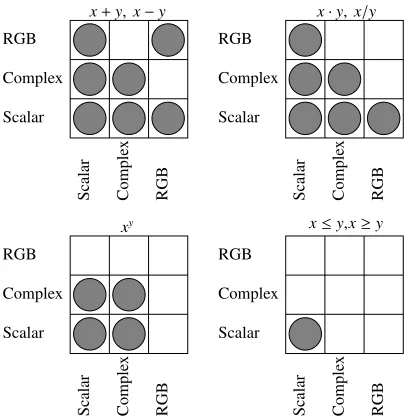
also needs to address the problem that binary operations usually only have a meaningful definition for some combinations of element-types as shown in fig. 2.
The remaining obstacle is that the native implementations needs to imitate the type coercions of Ruby at compile-time. These problems can be overcome by using template meta-programming techniques which were developed within the Boost project[6]. E.g. an entry of the default compile-time look-up table for return-types looks like this
template<>
struct _coercion< RGB< char >, double > {
typedef RGB< double > type; };
The function object representing the binary plus operator for example makes use of the default compile-time look-up table as follows
template< typename T1, typename T2 > struct _plus
{
typedef typename _coercion< T1, T2 >::type result_type;
result_type operator()( const T1 &x, const T2 &y ) const { return (result_type)x + (result_type)y; } };
Meta-programming techniques are also used to convert the C++data type of the return value to a Ruby-identifier.
Using the classSequence, a class namedMultiArraywas implemented which represents multidimensional arrays. In a similar fashion as forSequence, native implementations for the following operations which are specific to
multidimen-sional arrays were instantiated
• copying of sub-arrays
• convolutions with small filter kernels
• filling of sub-arrays
While within Ruby two objects supporting the same meth-ods are compatible, this is not sufficient if a native library is expecting a certain data type. For this reason both NArray and RMagick provide methods for importing and exporting raw data in the form of string objects. Our implementation also offers raw data to be imported and exported using the methodsimportandto s.
IV. A
Developing array operations as shown in the previous chapter is sophisticated and time consuming. We shall demonstrate however that due to its generic nature the current implementation already facilitates concise, real-time implementations of various algorithms.
A. Filtering
Both the Harris-Stephens combined corner- and edge-detector[7] as well as the Kanade-Lucas-Tomasi corner-detector[8] are based on the eigenvalues of the covariance matrix of gradient vectors taken from a local region of the image. Given a two-dimensional array of floating-point valuesimg, that represents a grey-level image, the following code computes the Sobel gradient and then the values of the symmetric covariance matrix for each pixel. A Gaussian blur filter is used to accumulate the gradient values over a local region of the image. Finally the trace and determinant of the covariance matrix are computed for each pixel
sigma = 1 x = img.sobel_x y = img.sobel_y
cxx = ( x ** 2 ).gauss_blur( sigma ) cyy = ( y ** 2 ).gauss_blur( sigma ) cxy = ( x * y ).gauss_blur( sigma ) tr = cxx + cyy
det = cxx * cyy - cxy * cxy
The Harris-Stephens corner- and edge-detector uses a heuristic value based on the trace and determinant of the local covariance matrix[7] and can be computed for each pixel as follows
k = 0.1
result = det - tr * tr * k
The Kanade-Lucas-Tomasi corner-detector simply uses the smallest eigenvalue as a heuristic[8]. The smallest eigenvalue of a 2×2 matrix can be computed for each pixel using the trace and determinant as follows
2 3 4 2 3 1 2 3 2 3 3
2
1 4 5
0 3 2
1 4 5
0 3 2
1 4 5
0 3 2
1 4 5
0 3 2
1 4 5
0 3 2
1 4 5
0
3
2 4
3 2
3 2 1
3 2
[image:5.612.95.257.64.157.2]1≤x≤4
Figure 3. Masking an x-ramp
The invocation of clip lower is required to deal with minor numerical deviations leading to negative values.
B. Bounding box
This section introduces x-ramps, y-ramps, and masking operations and gives an example on how they can be used to compute a bounding box.
A two-dimensional arrayimgof integer values represent-ing a grey-level image is given. The array is then binarized by thresholding (i.e.applying a step function to each element)
mask = 1 - img.binarise( 128 )
To find the bounding box with C/C++, one would usually use a nested loop which increments a pointer to the data and the body of the loop would update the parameters of the bounding box when a pixel of the mask is encountered. Implementing this in Ruby is not an option if there are real-time constraints. However using x-ramps and y-ramps which were inspired by the visualizations in [9] one can solve this problem using array operations. An x-ramp for example can be created using the following method
def xramp( *shape )
retval = MultiArray.new( MultiArray::LINT, *shape )
for x in 0...shape[0]
retval[ x, 0...shape[1] ] = x end
retval end
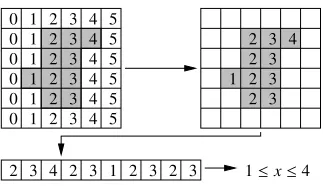
By selecting only the pixel of the x-ramp which are indi-cated by the mask one obtains an array of which the minimum and maximum are the lower and upper x-coordinates of the bounding box (see fig. 3).
The Ruby code is as follows
x = xramp( *mask.shape ) y = yramp( *mask.shape )
box = [ x.mask( mask ).range, y.mask( mask ).range ]
C. Warping images
[image:5.612.336.543.65.136.2]This section introduces warps. The functionmaptogether with the x- and y-ramps can be used to implement a function for warping images. The input image is warped using a three-dimensional array v of size w×h×2 containing the warp
Figure 4. Warping images
vectors. The warp vectors are computed by applying array operations to x- and y-ramps. The following code warps an equirectangular projection on an azimuthal projection
w, h = img.shape[0], img.shape[1] / 2
v = MultiArray.new( MultiArray::LINT, h, h, 2 ) x = xramp( h, h )
y = yramp( h, h ) c = 0.5 * h
v[ 0...h, 0...h, 0 ] =
( ( ( x - c ).atan2( y - c ) / PI + 1 ) * w / 2 - 0.5 )
v[ 0...h, 0...h, 1 ] =
( ( x - c ) ** 2 + ( y - c ) ** 2 ).sqrt result = img.warp_clipped( v )
The input image2 and result are shown in fig. 4
D. Lucas-Kanade Tracker
In this final example we want to use all techniques intro-duced in the previous sections to make a concise implemen-tation of the inverse compositional Lucas-Kanade tracker[9]. The Lucas-Kanade algorithm tracks an object by warping the input image on a template image and iteratively updating the transformation parameters to reduce the difference between the template and the warped image. In this example we are modelling two-dimensional translations and rotations as shown in the following equation.
W(x;p)=
xcos(p3)−ysin(p3)+p1
xsin(p3)+ycos(p3)+p2
(1)
The input image and the template are given as two-dimensional floating-point arrays imgandtpl. Furthermore a vectorpwith the initial parameters of the model is required. Then the gradient of the template (gx andgy), the product of the Jacobian and the gradients (c), and the Hessian (hs) are initialized as follows
# p = Vector[ ?, ?, ? ] w, h = *tpl.shape
x, y = xramp( w, h ), yramp( w, h ) sigma = 5.0
gx = tpl.gauss_gradient_x( sigma ) gy = tpl.gauss_gradient_y( sigma )
c = Matrix[ [ 1, 0 ], [ 0, 1 ], [ -y, x ] ] * Vector[ gx, gy ]
hs = ( c * c.covector ).collect { |e| e.sum }
2Image source: NASA Visible Earth project
Figure 5. Tracking template (left) and input image (right)
Table I
P L-K
load image track (5 iterations) display total
26 ms 128 ms 137 ms 290 ms
After that a new imageimgis acquired and the parameters of the model are updated a number of times until the error is sufficiently small. This requires computing the difference between the warped image and the template. The difference is used to estimate the change of the parameters using the Hessian and the product of Jacobian and gradients[9]. The code for performing a single update follows here
field = MultiArray.new( MultiArray::LINT, w, h, 2 ) field[ 0...w, 0...h, 0 ] =
x * cos( p[2] ) - y * sin( p[2] ) + p[0] field[ 0...w, 0...h, 1 ] =
x * sin( p[2] ) + y * cos( p[2] ) + p[1] diff = img.warp_clipped( field ).
to_type( MultiArray::SFLOAT ) - tpl s = c.collect { |e| ( e * diff ).sum } d = hs.inverse * s
p += Matrix[ [ cos(p[2]), -sin(p[2]), 0 ], [ sin(p[2]), cos(p[2]), 0 ],
[ 0, 0, 1 ] ] * d
Fig. 5 shows a video frame of a nano-indenter operating in a transmission electron microscope3. The tracking algorithm is able to track the object if the nano-indenter moves with a limited speed. The video was processed for demonstration purposes only with no specific application in mind. Table I shows the time the implementation requires to process a frame (AMD Athlon, 64-bit, 2.2 GHz, 1 GByte RAM, GCC version 4.1.3, Ruby version 1.8.6). The images have a size of 640×480 pixel and the size of the tracking template is 80×50 pixel.
V. R
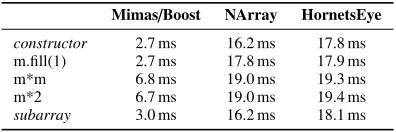
Table (II) shows the required processing time in millisec-onds for performing equivalent operations with Mimas (the
3Images courtesy of Sheffield University Nanorobotics Group
Table II
S
Mimas/Boost NArray HornetsEye
constructor 2.7 ms 16.2 ms 17.8 ms
m.fill(1) 2.7 ms 17.8 ms 17.9 ms
m*m 6.8 ms 19.0 ms 19.3 ms
m*2 6.7 ms 19.0 ms 19.4 ms
subarray 3.0 ms 16.2 ms 18.1 ms
Table III
S
Mimas/Boost NArray HornetsEye
constructor 2.7 ms 8.4 ms 7.8 ms
m.fill(1) 2.7 ms 2.7 ms 2.8 ms
m*m 6.8 ms 10.0 ms 8.1 ms
m*2 6.7 ms 8.9 ms 7.2 ms
subarray 3.0 ms 2.2 ms 3.7 ms
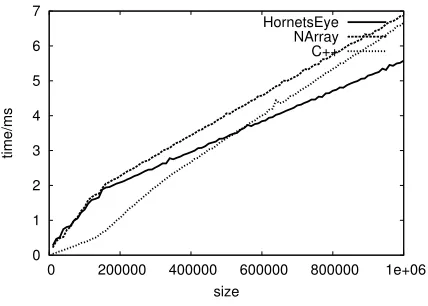
C++ library we developed in the MINIMAN and MiCRoN project), NArray, and HornetsEye. Different operations on a 1000 ×1000 single-precision floating-point array were executed 1000 times and the average time was taken.
The C++ library seems to be much faster when copying arrays or when filling them with a value is required. This is probably due to the fact that neither NArray nor HornetsEye are currently making use of the highly optimized routines of the C++ standard template library. However to ensure that equivalent operations are measured in Ruby and C++, the mark-and-sweep garbage collector of Ruby was invoked after every command to force destruction of the result as it happens in C++. This puts Ruby at a disadvantage.
Table (III) shows how the results change if the garbage collector of Ruby is only invoked once at the end of a measurement loop.
In this case NArray outperforms the C++implementation in some cases. As expected HornetsEye requires slightly more processing time than NArray since it is not implemented solely in C++. We have not yet found the reason why our implementation for copying subarrays is significantly slower than the one of NArray.
0 1 2 3 4 5 6 7
0 200000 400000 600000 800000 1e+06
time/ms
size
[image:7.612.70.284.86.239.2]HornetsEye NArray C++
Figure 6. Speed comparison for array-scalar multiplication
VI. C
A Ruby-extension providing native optimized implemen-tations of generic array manipulation methods for machine vision was presented. The Ruby-extension already facilitates implementation of various machine vision algorithms. We have shown that no major compromise in speed is required for adopting a dynamically typed language for machine vision algorithms, where the major part of the processing time is used for basic operations on arrays. We believe that this is the case for most machine vision algorithms. We are not aware of any other free and open source software package for machine vision which combines speed and flexibility in an equal way.
A drawback is increased memory requirements. The imple-mentations require intermediate results to be stored when a sequence of element-wise operations is performed. This could pose a problem for embedded platforms. The large number of instantiated array operations for different element-types also leads to a large shared library (currently 9.1 MByte).
Contrary to common belief, an interpreted language can be faster than a static implementation. Table III shows that the garbage collector of Ruby can be faster than the static memory management of a naive C++implementation.
In a similar way, as manually optimizing assembler pro-grams largely became redundant after optimizing compil-ers reached maturity, the labor of supporting interpreted languages with native extensions for the mere purpose of increasing performance could become unnecessary if inter-preters with sufficiently strong run-time optimization would become available.
VII. FW
Possible future work is the integration of GPU (graphical processing unit) operations and the use of parallel processing. This could be done in the same way as the current native implementations are integrated. Further opportunities for optimization are loop-ordering and -merging for operations on subarrays. Also the software is currently only tested by running a set of examples after compilation. An improvement would be to use the unit-testing library of Ruby. Also a number of I/O facilities still need to be integrated under GNU/Linux as well as Microsoft Windows Finally implemen-tations of a feature-based object-recognition and -tracking algorithm are planned.
R
[1] J. Wedekind, B. Amavasai, and K. Dutton, “Steerable filters generated with the hypercomplex dual-tree wavelet transform,” inIEEE Interna-tional Conference on Signal Processing and Communications, 2007, pp. 1291–1294.
[2] Zaljko Obrenovic and Dragan Gasevic, “Open source software: All you do is put it together,” IEEE Software, vol. 24, no. 5, pp. 86–95, 2007. [3] Marcus Denker and Stephane Ducasse, “Software evolution from the field. an experience report from the Squeak maintainers,” Electronic Notes in Theoretical Computer Science, vol. 166, pp. 81–91, 2007. [4] Laurence Tratt and Roel Wuyts, “Guest editors’ introduction:
Dynami-cally typed languages,”IEEE Software, vol. 24, no. 5, pp. 28–30, 2007. [5] D. M. Beazley, “Automated scientific software scripting with SWIG,”
Future Generation Computer Systems, vol. 19, no. 5, pp. 599–609, July 2003.
[6] A. Gurtovoy and D. Abrahams, “The Boost C++ metaprogramming library,” Tech. Rep., Mar. 2002, http://www.boost.org/libs/mpl/doc/paper/mpl paper.pdf.
[7] C. G. Harris and M. Stephens, “A combined corner and edge detector,”
Proceedings 4th Alvey Vision Conference, pp. 147–151, 1988. [8] Jianbo Shi and Carlo Tomasi, “Good features to track,” inIEEE
Com-puter Society Conference on ComCom-puter Vision and Pattern Recognition, 1994, pp. 593–600.
[9] S. Baker and I. Matthew, “Lucas-kanade 20 years on: a unifying framework,” International Journal of Computer Vision, vol. 56, no. 3, pp. 221–55, Feb. 2004.