Empirical assessment of patterns and guidelines for web
design.
KOUKOULETSOS, Konstantis.
Available from Sheffield Hallam University Research Archive (SHURA) at:
http://shura.shu.ac.uk/19927/
This document is the author deposited version. You are advised to consult the
publisher's version if you wish to cite from it.
Published version
KOUKOULETSOS, Konstantis. (2008). Empirical assessment of patterns and
guidelines for web design. Doctoral, Sheffield Hallam University (United Kingdom)..
Copyright and re-use policy
ProQuest Number: 10697233
All rights reserved
INFORMATION TO ALL USERS
The quality of this reproduction is dependent upon the quality of the copy submitted.
In the unlikely event that the author did not send a com plete manuscript and there are missing pages, these will be noted. Also, if material had to be removed,
a note will indicate the deletion.
uest
ProQuest 10697233
Published by ProQuest LLC(2017). Copyright of the Dissertation is held by the Author.
All rights reserved.
This work is protected against unauthorized copying under Title 17, United States C ode Microform Edition © ProQuest LLC.
ProQuest LLC.
789 East Eisenhower Parkway P.O. Box 1346
DESIGN
Konstantinos Koukouletsos
A thesis submitted in partial fulfilment of the requirements of the
Sheffield Hallam University
for the degree of Doctor of Philosophy
Declaration
This work or any part thereof has not previously been presented in any form to the University or to any other body whether for the purposes of assessment, publication or for any other purpose. Save for any express acknowledgements, references and/or bibliographies cited in the work, I confirm that the intellectual content of the work is the result of my own efforts and no other person.
The right of Konstantinos Koukouletsos to be identified as the author of this work is asserted in accordance with ss.77 and 78 of the Copyright, Designs and Patents Act 1988. At this date copyright is owned by the author.
Signature
The phenomenal and explosive growth of the internet makes the need for proven, dependable approaches to interaction and interface design more important. Efficient and effective design methods are needed, complete with appropriate techniques and tools that support designers in developing and delivering usable systems. Knowledge and experience significantly contribute to producing better design products. Traditionally, design knowledge and experience is conveyed in the form of guidelines. In recent years, there has been a growing interest in design patterns as an effective way of capturing and communicating design knowledge.
This thesis contributes to the ongoing debate concerning the benefits of patterns, as they are contrasted to another form of design guidance in the field of web design. The thesis investigates the effect of patterns and guidelines in the development of skills of students acting as novice designers. The aim is to empirically test how patterns and guidelines affect novice designers in creating and evaluating a web site. Its motivation is to advance the understanding of how novices employ and value patterns and guidelines after being introduced to usability issues with the help of these tools. Moreover, this study also highlighted participants’ attitudes and preferences towards patterns and guidelines.
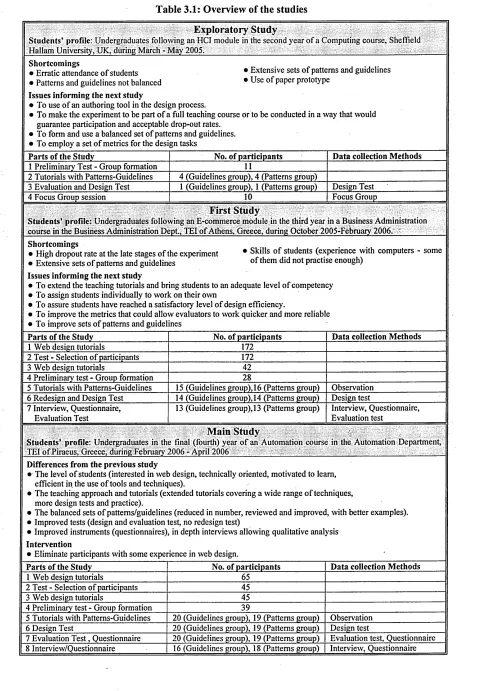
Three experiments were conducted for the purposes of this research. Each experiment contributed significantly to the understanding of how the next experiment should be carried out, and the findings and lessons learned at each stage have extensively influenced the next stage. Both quantitative and qualitative methods were used to collect and analyze data. Detailed descriptions of the experimental procedures are provided and give insights into the use of patterns and guidelines by novices.
The results indicate that patterns and guidelines can successfully communicate usability principles and knowledge to novice designers and can affect the design and evaluation skills of participants.
The difference in the overall scores in the design task between the two groups, using subjective and objective metrics, is statistically significant with the patterns group performing better. Results from the design task and the interviews suggest that compound patterns are inferior to simple patterns and do not create a clear picture of all the usability issues involved to novice designers. There is no significant difference between the performances of the two groups in the evaluation task. However, if a comparison is made using difficult to identify errors the patterns group perform significantly better than the guidelines group.
The overwhelming preference for a particular format in presenting guidance is patterns even by the participants trained with guidelines. Links to other patterns within the pattern collection and pattern names are not appreciated by participants, although guideline titles are considered to provide useful information and guidance. Patterns are considered by participants as better tools to introduce design principles to novices while guidelines are perceived as tools for more experienced designers. At the same time patterns are suggested as a useful pedagogic tool for teaching.
Acknowledgments
During the last four years, I was fortunate to be involved with a number of people that have encouraged, mentored and inspired me. I would like to thank my Director of Studies, Dr. Babak Khazaei for his help, advice, stimulating suggestions, support and encouragement during the development of the project. I am greatly indebted to my supervisor Dr. Andy Dearden for his help, contribution, guidance, provoking discussions, continuous enthusiasm and expertise in the field of design patterns. I would also like to acknowledge Dr. Mehmet Ozcan for his help and interest in my study.
Most of the experimental work would not have been carried out without the help, support and interest from numerous academics: Dr. Dimitrios Ninos, Natalia Papavasileiou, Dimitrios Fergadis, Dr. Periklis Lytras, Dr. Dimitrios Tseles, Nikos Vasilakis, Dr. Spyros Ferentinos, Dr. George Tzavellas, Vicky Kardasi, Georgios Germanos, Mike Grimsley, Dr. George Chliveros and many other members of the academic and technical staff. Thanks also go to my colleague and friend, Dr. Athanasios Paliatsos for his support and help.
In addition, I would like to thank the students who agreed to participate in the study, especially, the students of the two academic departments in Greece who devoted their time and provided the relevant data required to complete this thesis.
I would like to express my gratitude to the evaluators for their endless patience in working numerous hours and for their valuable discussions and input in the study: Dimitris Moutopoulos, Dr. Kostas Moysiadis, and Dimis Papageorgiou whom I have been very fortunate to have worked with.
Throughout this process, and throughout my life, I have been supported by my family. I am grateful to my parents for their love, support and encouragement, and my brother Lazaros for his help in finishing this research at various stages of the work. I am also deeply grateful to my wife Eleni for her love, patience and encouragement; Eleni was closely involved at every stage of the work presented in this dissertation.
Finally, I wish to say thank you, to all those friends, colleagues and relatives in Greece and in England whom I have not mentioned by name, but who have helped me in the process of making this thesis become a reality.
This work was partly funded by the Greek Ministry of Education and my Department at TEI of Piraeus.
FOR WEB DESIGN
Table of Contents
Declaration... ii
Abstract... T... iii
Dedication... iv
Acknowledgments... v
Table of Contents... ... vi
Appendices ...'...xi
List of Figures...xiii
List of Tables...xiv
Chapter 1 Introduction... 1
1.1 Introduction to the study... 1
1.2 Research aim and objectives... 3
1.3 Justification of the study... 5
1.4 Potential contribution to knowledge... 6
1.5 Dissertation outline... 7
Chapter 2 Literature Review... 10
2.1 Introduction... 10
2.2 Usability... 11
2.2.1 Definitions and dimensions of usability...11
2.2.2 Growth of web and e-commerce... 12
2.2.3 Growth of online shopping ... 13
2.2.4 Importance and benefits of usability ...13
2.2.5 Lack of usability...;... 14
2.3 Patterns and guidelines...16
2.3.1 Brief history of patterns...17
2.3.2 Definitions and characteristics of patterns...19
2.4 Patterns in HCI...23
2.4.1 Format and structure of patterns...24
2.4.2 Pattern-based approach to design and supporting tools...26
2.4.3 Patterns as a didactic tool in HCI ... 30
2.5 Guidelines... 31
2.5.1 Brief history and format of guidelines...32
2.5.2 Latest guideline developments...34
2.5.2.1 Format of the Koyani guidelines...34
2.5.3 Drawbacks of guidelines... 36
2.6 Patterns compared with guidelines... 36
2.7 Research into evaluation and use of patterns and guidelines... 38
2.8 Summary... 41
Chapter 3 Research Methodology...43
3.1 Introduction... 43
3.2 Empirical research...44
3.3 Research methodology... 44
3.3.1 Quantitative methodology... 45
3.3.2 Qualitative methodology... 45
3.3.3 Triangulation... 46
3.4 Research design and strategies... 47
3.4.1 Adopted research strategies...48
3.5.1 Experimental group design - true experiments and quasi-experiments...50
3.6 Quasi-experiments...51
3.6.1 Considerations of the quasi-experiment for the study...51
3.6.1.1 Experimental setting and environment... 52
3.6.1.2 Number of students... 52
3.6.1.3 Sampling and selection considerations... 52
3.6.1.4 Groups and extraneous variables...53
3.7 Group allocation...54
3.7.1 Rank sampling...55
3.7.2 Stratified sampling... 55
3.8 Survey...56
3.9 Methods of data collection and analysis...56
3.9.1 Questionnaires...57
3.9.2 Interviews... 57
3.9.3 Focus groups...58
3.9.4 Observation...58
3.10 Overview of the research design...58
3.11 Statistical methods of analysis...60
3.11.1 Parametric and non-parametric...60
3.12 Ethical issues... 61
3.13 Validity and reliability of research... 62
3.13.1 Internal validity in experiments...63
3.13.2 External validity in experiments...64
3.14 Measurement issues concerning research variables...65
3.14.1 Validity...65
3.14.2 Reliability... 66
3.14.2.1 Inter-rater reliability... 67
3.14.2.2 Measuring inter-rater reliability...67
3.15 Overview of the studies... 68
3.16 Summary...70
Chapter 4 Preparation for the Main Study... 71
4.1 Introduction... 71
4.2 Exploratory study... 72
4.2.1 Participants and preliminary test...72
4.2.2 Patterns and guidelines for the study ...73
4.2.3 Teaching usability... 73
4.2.4 Design and evaluation test...74
4.2.5 Early findings... 74
4.3 First study...76
4.3.1 General description... 77
4.3.2 Design tool for web sites...77
4.3.3 Participants and initial group... 78
4.3.4 Final group of participants... 79
4.3.5 Teaching web design...79
4.3.5.1 Use of template for tests...80
4.3.5.2 Preliminary assignment... 81
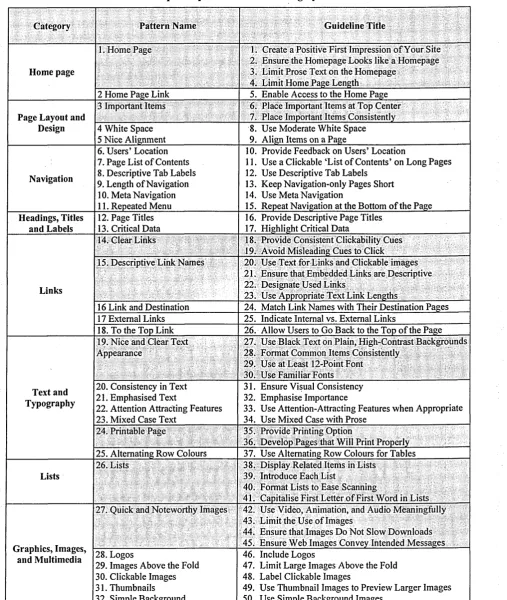
4.3.6 Patterns and guidelines for the first study... 84
4.3.6.1 Choosing patterns and guidelines...85
4.3.6.2 Forming balanced sets of patterns and guidelines...90
4.3.6.3 Guideline format for study...91
4.3.6.4 Pattern format for study...94
4.3.7 Teaching patterns and guidelines... 94
4.3.8 Post-treatment design task... 95
4.3.9 Post-treatment interviews and questionnaire...97
4.3.10 Post-treatment evaluation test...98
4.3.10.1 Usability evaluation methods... 98
4.3.10.2 Evaluation task...98
4.3.11 Metrics for scoring... 99
4.3.11.1 Work of evaluators...99
4.4 Results and discussion of the first study...100
4.4.1 Observations during the presentation... 100
4.4.1.3 Time taken to deliver patterns/guidelines...101
4.4.1.4 Unsuccessful examples...102
4.4.1.5 Technical questions about patterns/guidelines...102
4.4.2 Results of redesign task...102
4.4.3 Results of design task... 105
4.4.4 Analysis of questionnaires and interviews...106
4.4.4.1 Attitude towards patterns/guidelines... 106
4.4.4.2 Preference of students for patterns and guidelines...107
4.4.4.3 Other emerging issues ... 109
4.4.5 Results of evaluation task...110
4.4.5.1 False positives ...113
4.4.5.2 Comments and suggestions...113
4.4.5.3 Easy and difficult to identify errors... 115
4.4.6 Other observations...116
4.4.6.1 Use of patterns as a communication tool...116
4.4.6.2 Use of pattern language...116
4.4.6.3 Side effects of using patterns and guidelines...118
4.5 Shortcomings of the first study ...118
4.5.1 Students’ level of experience...119
4.5.1.1 Experience with computers... 119
4.5.1.2 Design competence...119
4.5.2 Structure of course and training procedures... 120
4.5.2.1 Restrictions on teaching design issues...120
4.5.2.2 The authoring tool...121
4.5.2.3 Design pairs of students...121
4.5.3 Set of patterns/guidelines as contributing factor...122
4.5.3.1 The number of patterns and guidelines... 122
4.5.3.2 Weak or unsuccessful examples... 123
4.5.3.3 General purpose patterns...124
4.6 Considerations for improvements...124
4.7 Summary... 126
Chapter 5 Patterns, Guidelines and Metrics... 127
5.1 Introduction... 127
5.2 Improved design of the experiment... 127
5.2.1 Level of students... 128
5.2.2 Teaching approach and tutorials...129
5.2.2.1 Improved tutorials...129
5.2.2.2 Principles and design concepts... 130
5.2.2.3 Use of template...131
5.2.3 Balanced sets of patterns and guidelines... 131
5.2.3.1 Number of patterns and guidelines...131
5.2.3.2 Improved sets of patterns/guidelines...133
5.2.3.3 Additional patterns/guidelines... 133
5.2.4 Design test... 134
5.3 Web design criteria... 135
5.4 Metrics...137
5.5 Metrics for Home Page... 140
5.5.1 Home Page Link... 140
5.5.2 Home Page Length... 141
5.6 Metrics for Page Layout and Design... 142
5.6.1 Consistent Important Items... 142
5.6.2 WhiteSpace... 143
5.6.3 Aligned Items...144
5.7 Metrics for Navigation... 145
5.7.1 Location Indication... 145
5.7.2 Descriptive Labels... 146
5.7.3 Repeated menu... 147
5.8 Metrics for Headings, Titles and Labels... 148
5.8.1 Headings...148
5.8.2 Page Titles...149
5.9.1 Links...150
5.9.2 Cues to Click...152
5.9.3 Clickable images ... 154
5.9.4 To the Top Link...154
5.10 Metrics for Text and Typography... ... 155
5.10.1 Consistency in text...155
5.10.2 Visible Text...158
5.10.3 Emphasised Text... 159
5.10.4 Aligned Text... 160
5.11 Metrics for Lists...161
5.11.1 Lists... 161
5.12 Summary...162
Chapter 6 Main Study... 163
6.1 Introduction...163
6.2 Setting and participants... ...164
6.2.1 Initial group of participants... 164
6.2.2 Final group of participants... 164
6.2.3 Teaching web design... 165
6.2.4 Preliminary assignment test ...166
6.2.5 Sample description...167
6.2.6 Further tests to ensure balanced groups ... 168
6.2.6.1 Background variables... ...168
62.62 Statistical analysis of students’ characteristics...168
6.2.63 General computer literacy... 169
6 2.6.4 Internet experience... 170
6.2.6.5 Design experience...172
6 2.6.6 Grade average...173
6.2.7 Teaching patterns and guidelines...174
6.2.8 Post treatment design test ;...174
6.3 Results of the design task... 175
6.3.1 Scoring procedure... 176
6.3.2 Analysis of the design scores...176
6.3.3 Subjective and objective metrics ...179
6.3.4 Inter-rater reliability...181
6.3.5 Impact of Compound Patterns...181
6.3.6 Metrics and compound patterns...183
6.4 Evaluation test and results...185
6.4.1 Description of the evaluation test...185
6.4.2 Results of the evaluation task... 187
6.4.3 Missed errors...189
6.4.4 False positives... ... 189
6.4.5 Easy and difficult to find errors... 192
6.4.6 A comparison based on the difficulty of identifying errors...194
6.5 Results of the questionnaires...195
6.5.1 Attitude towards patterns/guidelines...196
6.5.2 Suggestions for improvements...198
6.6 Interviews and results...199
6.6.1 Quantitative analysis... 199
6.6.1.1 Preference of students for patterns and guidelines...200
6.6.1.2 Format for presenting advice about web design...203
6.6.2 Qualitative analysis of interviews... 204
6.6.2.1 Rationale for preferring guidelines... 205
6.6.22 Perceived advantages of guidelines... 207
6.6.2.3 Negative opinion about guidelines... 208
6.62.4 Guidelines as chunks of knowledge...208
6.6.2.5 Rationale for preferring patterns...209
6.6.2.6 Perceived advantages of patterns... 210
6.62.1 Educational value of patterns...212
6.6.2.8 Impact of the format...212
6.6.2.9 Number of examples with patterns and guidelines...213
6.6.2.10 Use of patterns/guidelines by novices and experts...214
7.1 Introduction ... 217
7.2 Results of the study ... 217
7.2.1 Overview of main findings...218
7.2.2 Design ... 219
7.2.3 Evaluation... 221
7.2.3.1 Comparing groups using easy and difficult errors... 223
7.2.4 Attitude... 223
7.2.5 Preference... 225
7.2.5.1 Preference for a format... 225
1.2.52 Simple and compound patterns...228
1.2.53 Overall preference...229
7.3 Other observations and remarks... 23 0 7.3.1 Links... 230
7.3.2 Pattern names... 230
7.3.3 Guideline titles... 231
7.3.4 Pedagogic value of patterns...232
7.3.5 Target audience...233
7.4 Validity and reliability of the study...233
7.5 Limitations... 236
7.6 Summary...239
Chapter 8 A critical evaluation of guidelines and patterns used in the experiment...240
8.1 Introduction... 240
8.2 Overview of the approach to the study... 241
8.3 Forming the balanced sets of patterns and guidelines... 242
8.4 The set of guidelines... 242
8.5 Assessing the study patterns... 243
8.5.1 The origins of the study patterns... 244
8.5.2 The content of the study patterns... 245
8.5.3 The format of the study patterns... 245
8.5.4 Differences in the format of the study patterns/guidelines...246
8.6 Characteristics of the study patterns...247
8.6.1 Winn and Calder characteristics... 248
8.6.2 Added characteristics ... 254
8.7 Fincher’s framework... 257
8.8 Overview of the study patterns... 260
8.9 Summary... 262
Chapter 9 Conclusions and Future W ork...263
9.1 Introduction...263
9.2 Summary of study... 263
9.2.1 Summary of problem and research questions... 263
9.2.2 The experimental approach... 265
9.3 Implications of the research ...266
9.4 Contributions... 268
9.5 Future research... 270
Publications... 274
References ...275
Appendices
Appendix 2.1: A web design pattern (van Welie pattern collection)... 300
Appendix 2.2: A design pattern (Tidwell’s pattern collection)... 301
Appendix 4.1: Preliminary test for exploratory study...302
Appendix 4.2: Examples of patterns and guidelines...J... 306
Appendix 4.3: Task for final assignment (Exploratory study)... 308
Appendix 4.4: Pages to be evaluated (Exploratory study)...310
Appendix 4.5: Questionnaire for biographical information and level of experience...311
Appendix 4.6: Instructions for the preliminary assignment...312
Appendix 4.7: Five patterns from other pattern languages... 313
Appendix 4.8: Instructions for design test... 318
Appendix 4.9: Initial state of site and pages designed...319
Appendix 4.10: Questionnaire - opinion of students about patterns and guidelines...321
Appendix 4.11: Patterns and guidelines for comparison...324
Appendix 4.12: Web site for evaluation task...326
Appendix 4.13: Links for the patterns collection...330
Appendix 5.1: Set of patterns and guidelines (English version)...332
Appendix 5.2: Set of patterns and guidelines (Greek version)...365
Appendix 5.3: Metrics and scoring details... 398
Appendix 6.1: Questionnaire to collect information about the participants... 418
Appendix 6.2: Preliminary assignment (screenshots)...419
Appendix 6.3: Instructions for the preliminary assignment...427
Appendix 6.4: Example of web site created by participants...428
Appendix 6.5: Statistical tests about participants’ background...436
Table 6.5.1: Computer literacy...436
Table 6.5.2: Internet experience ...436
Table 6.5.3: Time using the Internet ...436
Table 6.5.4: Weekly access to the internet...436
Table 6.5.5: Daily access to the internet...437
Table 6.5.6: Design experience... 437
Table 6.5.7: Grade average... 437
Appendix 6.6: Forms completed by participants...438
Appendix 6.7: Instructions for design test... 440
Appendix 6.8: Initial state of site given to students...441
Appendix 6.9: Example of site delivered... 444
Appendix 6.10: Scores of the design test... 447
Appendix 6.11: Normality test...450
Table 6.11.1: Normality test (compound submetrics are averaged)...450
Table 6.11.2: Normality test (compound submetrics are added)...450
Appendix 6.12: Statistical analysis of the design test...450
Table 6.12.1: Design test - Parametric analysis...450
Table 6.12.2: Design test-Non-parametric analysis... 451
Table 6.12.3: Intraclass correlation coefficient...451
Table 6.12.4: Intraclass correlation coefficient... 451
Appendix 6.13: Questions about their opinion of patterns and guidelines...452
Appendix 6.14: Web site for evaluation (screenshots)...453
Appendix 6.15: Errors identified by participants... 458
Table 6.15.1: No. of errors and thoroughness of groups... 458
Table 6.15.2: Descriptions of errors... 459
Table 6.15.3: No. of errors and thoroughness of groups... 460
Appendix 6.16: Statistical analysis of the evaluation test...461
Table 6.16.1: Normality test... 461
Table 6.16.2: T-test...461
Table 6.16.3: Mann-Whitney test... 461
Table 6.16.4: Statistical analysis for False Positives...462
Appendix 6.17: Statistical analysis on group efficiency... 463
Table 6.17.1: Mann-Whitney test for difficult errors...463
Table 6.17.2: Mann-Whitney test for average errors... 463
Table 6.17.3: Mann-Whitney test for easy errors...464
Table 6.17.6: Mann-Whitney test -comparison of the groups...465
Table 6.17.7: Mann-Whitney test -comparison of the groups...466
Table 6.17.8: Mann-Whitney test -comparison of the groups ...466
Table 6.17.9: Mann-Whitney test -comparison of the groups...467
Appendix 6.18: Questionnaire - opinion of students about patterns/guidelines...468
Appendix 6.19: Attitude towards patterns and guidelines... 469
Appendix 6.20: Questionnaire template... 474
Appendix 6.21: Statistical test - Preference of students...476
Table 6.21.1: Chi-square test...476
Table 6.21.2: Chi-square test...477
Table 6.21.3: Chi-square test...477
Appendix 6.22: Patterns and guidelines for comparison... 478
[image:14.613.57.522.29.755.2]List of Figures
Figure 2.1: Growth of the internet (adapted from Netcraft, 2007)...13
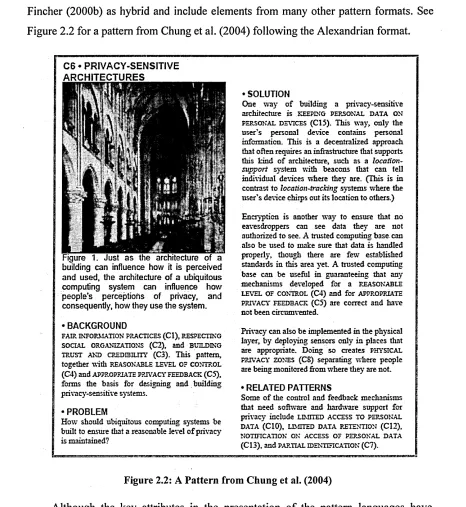
Figure 2.2: A Pattern from Chung et al. (2004)... 25
Figure 2.3: Two Smith and Mosier (1986) guidelines...32
Figure 2.4: A Koyani guideline (Koyani et al., 2003)...35
Figure 4.1: Pages of the preliminary assignment... 82
Figure 4.2: Sample pages of a participant (preliminary assignment) ...83
Figure 4.3: Use Site Maps (Koyani guideline)... . 87
Figure 4.4: Site Map (van Welie pattern)... 88
Figure 4.5: The format of a patterns and the corresponding guideline... 93
Figure 4.6: Preferences of all students...108
Figure 6.1: Preference of all participants... 202
Table 2.1: Characteristics of patterns (adapted from Dearden and Finlay, 2006)... 22
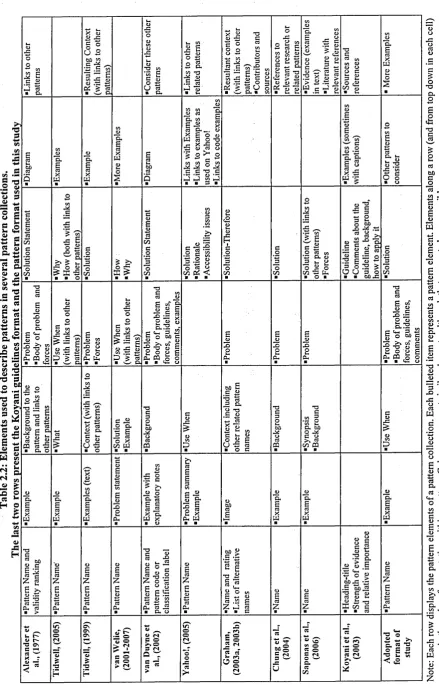
Table 2.2: Elements used to describe patterns in several pattern collections...27
Table 3.1: Overview of the studies... 69
Table 4.1: Timetable of the experiment ... 80
Table 4.2: Patterns and guidelines used in the first study...92
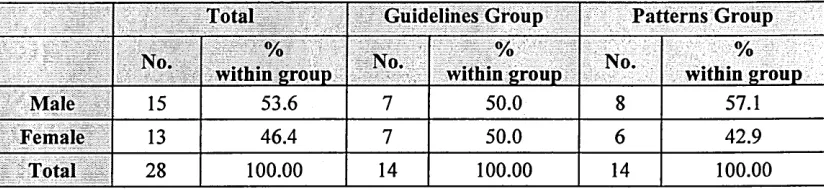
Table 4.3: Number of male and female students in each group...96
Table 4.4: Students’ attitudes to use and usefulness of patterns and guidelines... 107
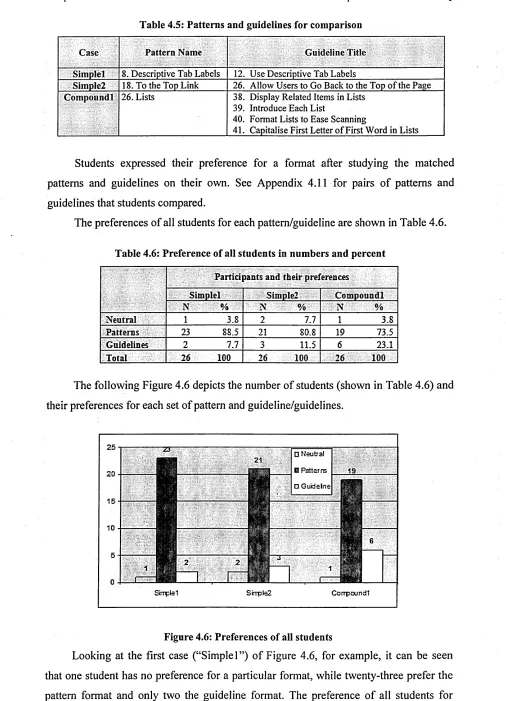
Table 4.5: Patterns and guidelines for comparison... 108
Table 4.6: Preference of all students in numbers and percent... 108
Table 4.7: Preference of students comparing patterns and guidelines...109
Table 4.8: Thoroughness on each page and overall for the site (all participants)... 111
Table 4.9: Errors in each page, missed and found errors (all participants)...112
Table 5.1: Patterns and guidelines for the main study... 132
Table 5.2: Website quality criteria...135
Table 5.3: Web awards criteria... 136
Table 5.4: Metrics, patterns and guidelines...139
Table 6.1: Timetable of the experiment...166
Table 6.2: Number of male and female students in each group... 168
Table 6.3: Self reported computer literacy by group...170
Table 6.4: Internet experience... 170
Table 6.5: Length of time using the internet...171
Table 6.6: Weekly access to the internet...171
Table 6.7: Daily access to the internet...172
Table 6.8: Web design experience... 172
Table 6.9: Average percentage scores of students...177
Table 6.10: T-Test analysis using all metrics...178
Table 6.11: Mann-Whitney test using all metrics...179
Table 6.12: Metrics in categories and group performance...180
Table 6.13: T-test for objective metrics... 180
Table 6.14: Mann-Whitney test for objective metrics... 181
Table 6.15: T-Test analysis without compound patterns...182
Table 6.16: Mann-Whitney test without compound patterns... 183
Table 6.17: Thoroughness on each page and overall for the site (all participants)... 187
Table 6.18: Thoroughness on each page and overall for the site (guidelines group) ...187
Table 6.19: Thoroughness on each page and overall for the site (patterns group)...188
Table 6.20: Number and percentage of errors missed and found in each page...189
Table 6.21: Number of false positives reported in a web site and number of students... 190
Table 6.22: Error categories and numbers of them in the site... 192
Table 6.23: Comparing group rates and group efficiency...:... 194
Table 6.24: Group comparison using group rates and group efficiency ...195
Table 6.25: Students’ attitudes towards patterns and guidelines... 196
Table 6.26: Comparison of opinions and attitudes...197
Table 6.27: Intention to use patterns and guidelines... 197
Table 6.28: Patterns and guidelines for comparison... 200
Table 6.29: Preference for simple and compound patterns (two groups)... 201
Table 6.30: Preference for simple and compound patterns (all participants)... 201
Table 6.31: Preference towards simple and compound patterns...202
Table 6.32: Themes of the qualitative analysis...205
Table 7.1: Metrics, group performance and differences... 220
Table 8.1: Patterns from the van Welie collection and the corresponding guidelines...244
Table 8.2: Formats used for the study patterns and the study guidelines...247
Chapter 1 Introduction
Chapter 1
Introduction
1.1 Introduction to the study
As the field of human-computer interaction (HCI) matures, the need for proven, dependable approaches to interface design becomes apparent. Efficient and effective design methods are needed, complete with appropriate techniques and tools that support designers in developing and delivering usable systems.
Knowledge and experience significantly contribute to producing more usable interfaces. Traditionally, design knowledge and experience is conveyed in the form of guidelines. In recent years, there has been a growing interest in design patterns as an effective way of capturing and communicating design knowledge in an effective way to support the design process (Dearden and Finlay, 2006). The pattern format is gaining wider acceptance with big company names starting to document knowledge in the form of patterns (SAP Info, 2006; Yahoo!, 2005).
Design patterns for the Web articulate and communicate experience into practical problem/solution pairs. Patterns describe the problem and discuss the context in which the pattern should be used. The rationale for the solution, the tradeoffs a designer should consider, and techniques of how to apply the solution are presented and explained in a section altogether. Finally, a short statement of the solution is given. Patterns capture good design practice, therefore examples are essential parts o f patterns. There is one example, usually after the pattern name and more examples after the solution section of the pattern. Examples highlight key issues and portray application o f the pattern solution as can be seen in artefacts. Pattern names can be part o f a vocabulary which can be used to discuss design problems and their solutions. Patterns are linked to other patterns and form a pattern language, a set o f interlinked patterns for a specific domain. Higher level patterns may use lower lever patterns in describing a solution.
Patterns may employ guidelines in the body o f solution, whereas guidelines quite often include elements o f a pattern, like rationale, links and examples (van Duyne et al., 2002). The author takes the view that that patterns and guidelines complement each other and are just two different formats serving as practical tools to present guidance to designers and practitioners about how to build better artefacts.
There are patterns and guidelines that address the same problems presenting the same solution at the same level o f abstraction. A guideline like “Provide Printing Options” (Koyani et al., 2003) to allow visitors to print a web page is presented in two widely known pattern languages as: (1) a “Printer Friendly Page” pattern (van Welie, 2001-2007), and (2) “Printable Pages” pattern (van Duyne et al., 2002). However, matched pairs o f guidelines and patterns are not very common in existing collections.
Patterns are characterised by a number of features that make them different and, it is claimed (M ahem off and Johnston, 2001; van Welie et al., 2000), better than guidelines. Their advantages as they are perceived by researchers lie mainly in their structure. The lack o f empirical evidence as to the benefit of using them in actual design practice is one of the weaknesses of patterns (Dearden and Finlay, 2006). Examining the use o f patterns in actual activities while employed by designers is essential to demonstrate any benefits of patterns and pattern languages. Additionally, improving understanding about patterns and guidelines will help the research community towards developing new methods, tools and approaches employing them.
Chapter 1 Introduction
aspects that differentiate this study from others. The first aspect is that the focus is on students acting as novice designers. The intention of using students as participants was to try to leave out most of the web design knowledge that a designer may have from previous work and experience. At the same time, usability issues are considered to be an important topic to be taught to the future web designers and any findings on successfully introducing usability issues to novices are valuable. The second differentiating aspect of this study is that the comparison is as close to a real design activity as possible. In the experiments, participants produced concrete web sites, rather than any form of prototype, using a widely accepted authoring tool. The third aspect is that using existing patterns and guidelines a balanced set of patterns and guidelines was formed, i.e. two sets that in essence present the same advice and knowledge. After the initial training in web design using authoring tools, students learned about usability and usability principles using balanced sets of patterns and guidelines. Finally, the two groups of novice designers were engaged in two common activities that real designers are involved in, that is, designing and evaluating web sites.
1.2 Research aim and objectives
Web systems represent the largest application of user interface principles today (White, 2002) and poor design of web pages affects more and more people. Despite the great investment made in web design, poor usability remains a major problem. Numerous studies and research point to this fact. For example, Forrester Research (2007) points out that, although sites have been improved in comparison to sites back in 2001, it is still hard for visitors to find value and there is vast room for improvement.
At the same time, it is envisaged that teaching and discussing the application of patterns and guidelines with many novice designers will help to discover the strengths and weaknesses of these two tools. The value and importance of this research is that the empirical work done will allow to assess the effectiveness and impact of patterns and guidelines using as criteria the attitude and preference of inexperienced designers towards them. The study will look into enhancements than can facilitate and improve the understanding of the principles conveyed by patterns and guidelines and will explore whether the available body of patterns and guidelines can also be adopted to teach usability principles and provide advice and help to novice or inexperienced designers.
The two main specific objectives of the study are:
• Objective 1: Assess the effectiveness of guidelines and patterns in the design activities of novice designers.
Patterns and guidelines encompass experience and usability principles. By measuring the application of patterns and guidelines in sites designed by novice designers will show any differences in the impact patterns and guidelines have on the usability and on the design habits of novice designers.
• Objective 2: Assess the effectiveness of guidelines and patterns on the evaluation skills of novice designers.
This objective aims to assess the evaluation skills of novice designer and how patterns and guidelines affect them. By measuring the performance designers had in evaluating a web site and identifying errors and existing usability violations will demonstrate any differences in the impact patterns and guidelines have on novice designers.
The focus of the two main objectives is to provide empirical evidence about how patterns and guidelines affect novice designers, to examine whether a pattern or a guideline-based approach leads to higher and better performance in designing and evaluating web sites, and to evaluate the advantages and drawbacks of patterns and guidelines as a design aid for novice designers.
There are also two other objectives that are to be addressed by this study. These are:
Chapter 1 Introduction
Attitude also includes appreciation for patterns and guidelines and intention to adopt them in future projects. Students, having used patterns and guidelines as design and evaluation aids will express their opinion about them.
• Objective 4: Investigate students’ preference towards the format and structure of patterns and guidelines and identify specific advantages and disadvantages of them.
This objective seeks to establish any strengths and shortcomings of both tools after being used by the participants.
Any useful conclusions will be used to improve patterns/guidelines and the impact they have on novice designers. The study will also examine shortcomings and advantages of pattern languages and possible usage by inexperience users. To address the above research objectives a series of studies that form the experimental part of the research were conducted.
The research started with an “exploratory study”, followed by the “first study”, and finally by the “main study”. The labels exploratory, first, and main are chosen in this thesis in order to imply the nature, the completeness, and the importance of each experiment. The exploratory study served as a preliminary study for subsequent experiments. The exploratory study was followed by a first study which, though successful in giving valuable data towards the objectives of the research, it had to be refined and focused even further to formulate the final main study. The three studies were carried out during three subsequent academic semesters, and each study informed the conduct of the next one. A balanced set of patterns and guidelines was formed and used; this set was evolved through the studies. Finally, to establish validity, the methodological triangulation of qualitative and quantitative approaches was implemented (Denzin, 1978; Golafshani, 2003; Guion, 2002).
1.3 Justification of the study
Seffah and Javahery (2002) confirm that very little is known about “developer experiences with pattern languages and the development of pattern-oriented designs” and express the need for more formal usability testing to measure “...both the user and the developers’ satisfaction, productivity and performance using patterns”. Also Dearden and Finlay (2006) observe that research so far has focused on generating patterns and developing pattern languages, and suggest that “...significant effort is now required to examine the use of these languages in actual design (e.g. via empirical and observational studies) to demonstrate what benefits might be gained from a patterns approach”.
Furthermore, web design consists of two main parts: the code that the software development team of programming engineers develops and the visual interface that the user sees and interacts with. Although these two elements are strongly interrelated, web developers and designers are rarely trained in the design or the evaluation of the interface. Sometimes the coverage of such topics is restricted and their importance is not emphasised. Very often users experience poorly designed interfaces that sometimes do not follow even simple usability rules. A teaching framework intended for training novice designers that presents usability principles, in the form of guidelines and/or patterns, is essential.
In conclusion, there is very little practical and empirical evaluation of the patterns and very little, if any, research into the use of patterns and the extent that patterns help in improving the usability of the final product.
This research will try to shed light towards this direction by focusing on the differences between a pattern training approach and guideline training approach to design and the degree to which these two tools contribute to the final product. In this way, the role of patterns and guidelines will become clearer for successful implementation by novice web designers. The research will reveal the strengths and weaknesses of each tool and suggest improvements pertinent to their format, presentation and their scope for effective implementation by novice designers.
1.4 Potential contribution to knowledge
Design patterns have been proposed as a very promising tool for capturing experience and knowledge (Appleton, 1998; Hobart, 2001; Pemberton, 2000), offering the designer the best solutions available in design problems.
Chapter 1 Introduction
patterns and guidelines in a large scale research with experimental data is the most certain way to identify advantages and drawbacks for each tool in helping designers create solutions o f high quality and improved usability. Furthermore, the study will provide evidence about the use of patterns and guidelines as evaluation tools for web pages.
The strengths of patterns and guidelines can be used to advance the skills of future web designers. During this study patterns and guidelines will be used to present to novice designers usability principles and best practices for web design. Patterns and guidelines can provide a mechanism to communicate design principles to students. A further contribution of this study will be to establish the best and more effective approach to training novice designers and improving their skills for the practice of their profession.
Finally, a by-product o f this study will be a teaching guide for better web sites/pages. It is envisaged that the extensive experience of teaching design patterns and the assessment o f the student participants’ design and evaluation o f web pages will contribute to the development of a teaching framework as a basis for a good usability course.
1.5 Dissertation outline
Chapter 1 o f the thesis provides a brief introduction to the study and the concepts o f patterns and guidelines for design. It states the research objectives, and presents the justification for the research. Finally, the potential contribution, which the study is
expected to make to knowledge, is discussed.
Chapter 2 provides an overview o f usability as an essential component o f web
design and discusses how the issue of usability affects web pages and web sites more than anything else. Patterns and guidelines are two formats of capturing advice and knowledge about usability, and the chapter presents a brief history of their development, their characteristics and their advantages and drawbacks. Existing empirical research into the use o f patterns is summarised, highlighting the gap in research relating to the comparison of patterns with other existing approaches, such as guidelines in web design activities.
Chapter 3 details the research methodology used, firstly by describing the
the adopted methodology and approaches. Considerations involving the experimental design and the sampling techniques employed are presented to ensure comparable groups of novice designers. Finally, ethical issues related to the research are discussed.
Chapter 4 presents the exploratory and the first study. The setting of both studies is presented, followed by details of the selection of participants, the teaching approach taken, the sets of patterns and guidelines employed for the experiment and the collection of data. The problems and issues in teaching web design and employing patterns and guidelines to highlight usability principles are raised. Analysis of the compilations of the results gained from observations, questionnaires, interviews and experimental tests are presented wherever applicable. Limitations of the study are discussed.
Chapter 5 describes in detail the improvements made to the design of the experiment, the set of patterns and guidelines used in the main study and the set of metrics used by the evaluators to rate the application of usability principles on web pages. Both sets have evolved through the exploratory study and the first study and have been improved to better accommodate the requirements of the test and to facilitate quick and accurate rating.
Chapter 6 describes the procedures associated with the experiment for the main study. The setting of the study is presented, followed by the steps taken for the selection of participants and the teaching approach. Details of how previous studies, presented in Chapter 4, have informed the main study are described and how stricter and improved procedures were followed in the collection of data. Statistical tests are presented exploring the relationship between each training approach, one using guidelines and one patterns, and the performance of the participants in order to test the hypotheses related to the research objectives. Finally, the analysis of the data gained through the questionnaire and in the interviews is presented and a comparison of the perceived advantages and drawbacks of patterns and guidelines is presented.
Chapter 1 Introduction
Chapter 8 examines in more detail the patterns and the guidelines used in the study. Patterns and guidelines were presented in such way as to communicate, to a great extent, the same information. Most of the patterns were formed by converting existing guidelines. The chapter assesses the study patterns and guidelines and compares them with patterns and guidelines from existing, widely accepted and validated collections.
Chapter 2
Literature Review
2.1 Introduction
In building a web site developers have used traditional techniques, methods and practices that were borrowed from software development, software engineering and HCI. After the early years of the web it was evident, with the simple, everyday user being the target of a web site, that user-centred and usability engineering approaches were the key elements of a successful web experience. Usability can benefit from tools that capture knowledge and experience; guidelines and patterns are two such tools.
Chapter 2 Literature Review
2.2 Usability
The aim of usability is to make a web site more efficient and enjoyable for average users to experience and is about making sure a person of average or even lower ability can use the site as intended without getting frustrated (Krug, 2000). The same writer puts the essence of usability more succinctly in one sentence: “Don’t Make Me Think”. This statement suggests that designers should avoid making users think too much while using and exploring a web site and that the flow of interaction should be as easy as possible without any effort and difficulty.
2.2.1 Definitions and dimensions of usability
One of the most widely cited definitions of usability is by the International Standards Organisation (1998). Usability is defined as “the extent to which a product can be used by specified users to achieve specified goals with effectiveness, efficiency, and satisfaction in a specified context of use.” Effectiveness relates to “the accuracy and completeness with which users achieve specified goals”; efficiency relates to “the resources expended in relation to the accuracy and completeness with which users achieve goals”; and satisfaction is said to have the two components of “comfort and acceptability of use”.
Shackel (1986, 1991) identifies four dimensions of usability: effectiveness, leamability, flexibility, and user attitude. Shackel considers utility and usability to be parameters of the acceptance of a model, with utility referring to how the functionality of the product meets the users’ needs and usability to the user being able to use this functionality. Nielsen (1993) also makes a distinction between usability and utility, and considers that usability together with utility form the usefulness of the product. Usefulness in turn is said to contribute to the acceptance of the product. Nielsen states that “...utility is the question of whether the functionality of the system in principle can do what is needed, and usability is the question of how well users can use that functionality”. Nielsen describes usability in terms of five attributes: learnability, efficiency, memorability, error recovery and satisfaction.
Preece et al. (2002) conceptualise usability in terms of the goals usability seeks to achieve: effectiveness, efficiency, safety, utility, leamability and memorability.
site. Brinck et al. (2002) point out that to achieve usability on the web the designer has to balance conflicting design objectives within the requirements and the context of the design. Usability affects the user and the extent to which they can carry out required tasks. The web design product should be all of the following: functionally correct, efficient to use, easy to learn, easy to remember, error tolerant and subjectively pleasing (Brinck et al., 2002).
Numerous other, similar or different, approaches to what is usability are to be found in the literature, depending on the perspective from which usability is examined. Other criteria and factors, apart from those already mentioned, are used to define or describe usability; such criteria are: attitude (Booth, 1989), usableness and usefulness (Gluck, 1997), likeability (Kengeri et al., 1999), control, helpfulness and adaptability (Oulanov and Pajarillo, 2002), and interactivity (Karoulis and Pombortsis, 2005).
The US Department of Health and Human Services (2006) adopts and extends N ielsen’s (1993) view o f usability to present a definition that accommodates recent technological developments: “Usability is the measure of the quality of a user’s experience when interacting with a product or system - whether a Web site, a software application, mobile technology, or any user-operated device.”
2.2.2 Growth of web and e-commerce
During the last decade there has been a phenomenal and explosive growth o f the internet. Web-related applications have now assumed a central role in the life o f people. Starting from simple sites with a few hyperlinked static documents, web pages are now the interface of large-scale web applications for e-commerce, banking, distribution of information, entertainment, collaborative working, education and several other activities (Offutt, 2002).
Chapter 2 Literature Review
compared with 3,282 sites in 1996, an average compound growth of 65% per year (Netcraft, 2007).
Figure 2.1 depicts the growth of the web during the last decade.
Total sites across all domains Number of secure sites
1997-2007 1997-2007
120000000 1000000
103000000 96000000 84000000
500000
60000000 48000000 36000000
1937 1998 1939 2000 2001 2002 2003 2004 2005 2006 2007
S' g S’ 2 S' S S’ S
I
Figure 2.1: Growth of the internet (adapted from Netcraft, 2007)
The graph on the left shows the number of sites and the one on the right the number of SSL sites worldwide for the period 1997-2007.
2.2.3 Growth of online shopping
E-Commerce has been at the centre of the World Wide Web (WWW) explosion. Online shopping figures for the UK reveal a dramatic recovery from the 2000 dotcom crash. The internet market has increased by more than 350% in just five years from 2000-2005. Meanwhile, Britons spent £8.2 billion online in 2005 - an increase of 29% over the previous year 2004 (Verdict Research, 2006).
British consumers spent £7.66 billion online in the ten-week period to Christmas 2006; this is 54% more than the £5 billion spent online during 2005, and more than double the £3.33 billion recorded for Christmas 2004 (IMRG, 2007).
The increasing level of broadband penetration and the improved online security has boosted confidence in internet shopping. Consumers are more comfortable buying goods over the internet although internet spending is still relatively small and the great increase forecast is yet to come in the next few years. It is predicted that the amount of money spent online will reach a cumulative £40 billion for the year 2007, which represents 15% of all UK retail sales (Moneynews, 2007). The number is set to rise to £162 billion by 2020, accounting for almost 40% of total UK retail sales.
2.2.4 Importance and benefits of usability
2005). However, usability more that anything else affects visitors and potential buyers of online sites.
Usability and e-commerce are closely linked (Barnard and Wesson, 2003). Visitors will leave a web site if it is too difficult to use; they think that it takes too much effort to navigate; they can not find easily what they are looking for; long downloading times are required; or the home page fails to supply the necessary information (Nielsen, 2003). Scapin et al. (2000) point out that usability is widely considered not only an important requirement for user acceptance but becomes critical for e-commerce web sites competing to attract and keep customers. Nielsen (2000a) claims that usability is essential for survival on the internet and emphasises the fact that competition or the next shop is only “one click” away.
Mayhew (2003) strongly supports the view that usability in web business ensures good or great customer service and summarises the benefits and the risks of investing in web usability for a business as follows:
• Customers can find what they want to buy and sales are not lost.
• Customers will return to shop again and not search for alternative sources. • Reduced cost in fixing and correcting usability problems.
• Satisfaction from user, little confusion and less time taken to accomplish desired goals.
• Customers are motivated to use online shopping, ensuring return of investment for the site and reduced costs for the business.
Nielsen (2000a) indicates that the usability of a web site directly impacts sales and the level of market capture. He illustrates this by explaining that the reason why usability is more important for the internet and the internet economy is that in product or software design users experience usability, bad or good, once they pay and buy the product, whereas on the web users experience usability first and consider buying the product later.
2.2.5 Lack of usability
Chapter 2 Literature Review
quoted below to illustrate the impact that usability can have on a web site (Nall, 2005; Rauterberg, 2003).
• Most sites will waste between $1.5 million and $2.1 million on redesigns in 1999.
• A dollar spent on advertising during the 1998 holiday season produced $5 in total revenue, while a dollar spent on customer experience improvements yielded more than $60.
• 50% of sales are lost because visitors can not easily find content. • 40% of visitors do not return due to a previous negative experience. • 85% of visitors abandon a new site due to poor design.
• 62% of web shoppers gave up looking for the item they wanted to buy online. • 39% of test shoppers failed in their buying attempts because sites were too
difficult to navigate. Additionally, 56% of search attempts failed.
• It is quite normal for e-commerce sites to increase sales by 100% or more as a result of their usability.
• While internet sales continue to soar, recent surveys indicate that between 27
and 66
% of users abandoned their shopping carts.
Forrester Research (2003), which specialises in business research data and analysis, after examining 375 sites between November 1999 and July 2003 for customer experience estimates that 60% of sites score below zero on a scale from -50 to +50. More specifically, the research examined 125 sites between March 2002 and July 2003. The review estimates that,
• 78% failed to provide comprehensive and precise search results.
• 66% failed to provide an in-depth overview of site contents on the home page. • 64% did not used space effectively in page layout.
• 50% used text that was not legible.
A recent evaluation of the four largest Australian banks shows that all four sites contained major usability flaws (Forrester Research, 2006). As a result of this the banks are losing money because customers are using more expensive call centres, bank branches or even switching to another bank. It is estimated that each bank could save more than $7 million a year by improving the sites and making them more user-friendly. In its latest report published this year, Forrester Research (2007) admits that, although scores have increased since 2001 when only 3% of the sites received pass scores, sites now provide better user experience but it is still hard for visitors to find value within a site and there is vast room for improvement.
All these reviews are focused on developed countries (USA, UK, EU, etc.) where the internet has taken off and designers have learned from their mistakes and have become more knowledgeable. In other countries it is expected that usability errors are more common and severe. To a frequent and experienced user of the Internet the above figures may seem overestimations; however, such users have already become accustomed to their favourite sites or have adjusted they preferences and visiting habits to sites that they like or find easy to use.
2.3 Patterns and guidelines
Given the tremendous growth in the number of web sites (implying demand for accelerated design processes) and the existing level of poor usability (implying demand for improvement), several researchers indicate that not only methodologies and processes are needed (Ivory, 2001; van Duyne et al., 2002) but also tools and techniques to help with design. The following are some of the available tools and techniques in design: principles (Dix et al., 2004; Norman, 1988; van Duyne et al., 2002), standards (International Standards Organisation, 1998), golden rules (Shneiderman, 1998), style guides (Apple Computer, 1996; Microsoft Corporation, 2001), heuristics (Nielsen, 1993; Nielsen, 1994), guidelines (Mayhew, 1992; Nielsen and Tahir, 2002; Smith and Mosier, 1986) and design patterns (Tidwell, 2002, 2005; van Duyne et al., 2002; van Welie, 2001-2007). Such tools should be based not only on theory but also on existing knowledge and experience.
Chapter 2 Literature Review
of guidelines (Borchers, 2001; Mahemoff and Johnston, 1998; Griffiths and Pemberton, n.d.; van Welie et al., 2000). According to these authors, guidelines are too simplistic or too abstract and sometimes difficult to interpret. Additionally, guidelines may offer contradictory advice and do not discuss the context to which they apply or the problem they address.
In recent years, there has been a growing interest in design patterns as an effective way of capturing and communicating design knowledge. A pattern describes a successful solution to a design problem within a certain context (Tidwell, 1999). Patterns communicate insights of the solution to a design problem, the forces involved in the problem, the rationale for a solution and the trade-offs in applying the solution. One or more diagrams of pictures are included presenting examples of the application of the pattern. A pattern contains links to both higher and lower-level patterns forming in this way a pattern language, a set of interlinked patterns for a specific domain.
Patterns are different from guidelines in a number of ways (Chung et al., 2004). First, guidelines focus mostly on small detailed issues of design while patterns provide more generic design guidance. Second, patterns are generative, helping designers create solutions by providing much richer information than guidelines. Third, patterns provide links to other patterns, helping designers address both high-level design issues and low-level problems.
2.3.1 Brief history of patterns
Design patterns were first introduced by Christopher Alexander and his colleagues in the domain of architecture (Alexander, 1979; Alexander et al., 1977). According to Alexander (Alexander, 1979, p. 247), “each pattern is a three-part rule, which expresses a relation between a certain context, a problem and a solution”. His pattern language is a set of 253 patterns organised hierarchically, with high-level patterns addressing design issues for cities, followed by patterns for parts of the community, down to low-level patterns for houses and rooms. There are links in each pattern pointing to both higher and lower-level patterns in the hierarchy. By traversing the hierarchy of patterns using these links, a set of patterns will be collected that will help to generate a physical design. A designer can start using patterns to build and plan towns. These patterns are linked to patterns for neighbourhoods, which are using patterns to design houses, and patterns for houses are using more patterns about room design, etc.
“Each pattern describes a problem which occurs over and over again in our environ ment, and then describes the core of the solution to that problem, in such a way that you can use this solution a million times over, without ever doing it the same way twice” (Alexander et al., 1977, p. x). Erickson (2000) highlights this further, explaining that, “perhaps the most common misconception about pattern languages is that they are sets of templates that are rigidly applied to situations. This is not the case”.
Patterns are used in software engineering to present and communicate design solutions to common problems (Gamma et al., 1994; Rising, 1998). The pattern captures the structure of the software components and their static and dynamic behaviour (Schmidt, 1995). The solution is presented in terms of suggested code structures (Dearden and Finlay, 2006).
Since gaining wide acceptance and success in the software engineering community, patterns have been the focus of interest in HCI. Borchers (2000) argues that patterns in architecture describe aspects of the environment people interact with while interface designers create artefacts users interact with. The shared focus on interaction of architectural design and interface design make HCI and architecture have much more in common than architecture and software engineering (Borchers 2000). This relationship suggests that the advantages of developing and using patterns may be even greater in HCI than in Software Engineering (Finlay et al., 2002).
Patterns, apart from general interaction design patterns, have been developed in a wide range of HCI areas as identified by Dearden and Finlay (2006): ubiquitous computing, safety-critical interactive systems, multimedia exhibits, hypertext and hypermedia, personal digital assistants, socio-technical systems, and games design.
More domain specific patterns, to name a few, include patterns for online newspapers, learning management systems, business modelling, cooperative interaction, e-books, interaction patterns for musical applications, personal authoring systems, e-shop environments, e-leaming design patterns, web-based educational systems, interaction design patterns for cooperative work, security patterns for web applications, patterns for groupware applications, and patterns for visualisation design.
Chapter 2 Literature Review
2006b). Sharp et al. (2003) suggest use of pedagogical patterns to capture and disseminate the essence of practice in a compact way easily accessible to instructors.
While patterns capture good practice anti-patterns on the other hand document solutions that look like a good idea but go wrong when applied. Anti-patterns describe solutions that should be avoided. The use of anti-patterns for knowledge transfer may have negative effects (Kotze et al., 2006a; van Biljon et al., 2004).
2.3.2 Definitions and characteristics of patterns
There is no formal and universally accepted definition of a design pattern. Dearden and Finlay (2006) point out that there is a consensus that, “a pattern is a structured description of an invariant solution to a recurrent problem in context” and comment that although this approach is not universal, it reflects Alexander’s problem oriented approach.
Borchers (2000) suggests that pattern languages should be a starting point for defining HCI patterns. Lea (1994, cited by Dearden and Finlay, 2006) notes that Alexander does not provide a formal definition of patterns and later points out that the mantra “a solution to a problem in a context” is acceptable but may cause confusion (Lea, 2000).
Alexander and several other researchers have offered and suggested different descriptions of patterns (Dearden and Finlay, 2006).
In order to better illustrate the concept of pattern, some frequently presented definitions in the pattern literature are repeated here:
Each pattern describes a problem which occurs over and over again in our environment, and then describes the core of the solution to that problem, in such a way that you can use this solution a million times over, without ever doing it the same way twice (Alexander et al., 1977, p. x).
A pattern is the abstraction from a concrete form which keeps recurring in specific non-arbitrary contexts (Riehle and Zullighoven, 1996, p. 3).
Each pattern is a three-part rule, which expresses a relation between a certain context, a problem, and a solution (Alexander, 1979, p. 247).
A pattern is a named nugget of insight which conveys the essence of a proven solution to a recurring problem within a certain context amidst competing concerns (Appleton, 1998, p. 2).
functional requirements that distinguish them from other forms or mechanisms of knowledge transfer:
• Capture of Practice: A pattern captures a specific practice and presents it in a problem-solution pair.
• Abstraction: The pattern represents an abstraction of the practice.
• Value System: A pattern encompasses and carries values to the target audiences.
• Structuring Principle: Patterns are organised in a pattern language or a catalogue.
• Presentational Form: Patterns are presented in a uniform way.
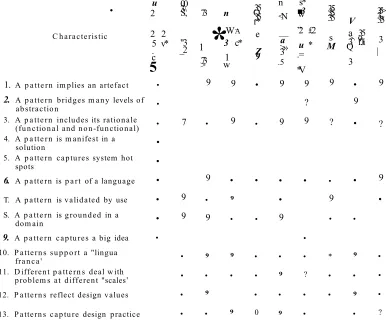
Winn and Calder (2002) argue that a definition that “captures the pattern concept is neither worthwhile nor possible”. Instead of a definition, Winn and Calder, following a similar approach to Fincher (1999a, 1999b), suggest and document nine essential characteristics of patterns as “a means of clarifying and developing our understanding of the concept and thus our ability to identify and use patterns” (Winn and Calder, 2002). These characteristics can be summarised as follows:
1) A pattern implies an artefact: The best way to present the artefact is a picture or a graphical representation that helps designers acquire a “big-picture understanding” of the pattern. This understanding is used to adapt the pattern to their specific needs and situations.
2) A pattern bridges many levels of abstraction: A pattern links high abstract levels of design or vague ideas to intermediate levels and low implementation details. For example, a teaching pattern for a programming course includes a general design paradigm together with the algorithm and the sample code.
3) A pattern is both functional and non-functional: The functional issues of a pattern refer to the presentation of a solution to a problem while the non-functional aspects of the pattern refer to its feasibility, the rationale behind the solution and how conflicting forces are balanced. The non-functional issues help designers adapt the documented solution to another context.
Chapter 2 Literature Review
5) A pattern captures system hot-spots: A solution to a problem should accommodate modifications as the developed system changes or evolves. Winn and Calder explain that a pattern captures not only the invariant elements of a good design but also