physical/digital assembly
CIOLFI, Luigina <http://orcid.org/0000-0003-4637-8239> and MCLOUGHLIN,
Marc
Available from Sheffield Hallam University Research Archive (SHURA) at:
http://shura.shu.ac.uk/17195/
This document is the author deposited version. You are advised to consult the
publisher's version if you wish to cite from it.
Published version
CIOLFI, Luigina and MCLOUGHLIN, Marc (2018). Supporting place-specific
interaction through a physical/digital assembly. Human-Computer Interaction, 33
(5-6), 499-543.
Copyright and re-use policy
See
http://shura.shu.ac.uk/information.html
Sheffield Hallam University Research Archive
Full Terms & Conditions of access and use can be found at
http://www.tandfonline.com/action/journalInformation?journalCode=hhci20
ISSN: 0737-0024 (Print) 1532-7051 (Online) Journal homepage: http://www.tandfonline.com/loi/hhci20
Supporting Place-Specific Interaction through a
Physical/Digital Assembly
Luigina Ciolfi & Marc McLoughlin
To cite this article: Luigina Ciolfi & Marc McLoughlin (2017): Supporting Place-Specific Interaction through a Physical/Digital Assembly, Human–Computer Interaction, DOI: 10.1080/07370024.2017.1399061
To link to this article: https://doi.org/10.1080/07370024.2017.1399061
Copyright © 2017 Taylor & Francis Group, LLC
Published online: 27 Nov 2017.
Submit your article to this journal
Article views: 288
View related articles
Supporting Place-Specific Interaction through a
Physical/Digital Assembly
Luigina Ciolfi1 and Marc McLoughlin2 1
Communication and Computing Research Centre, Sheffield Hallam University, Sheffield, UK 2
Interaction Design Centre, University of Limerick, Limerick, Ireland
This article examines visitor interactions with and through a physical/digital installation designed for an open-air museum that displays historic buildings and ways of life from the past. The installation was designed following the
“Assembly” design scheme proposed by Fraser et al. (2003), and centered around five principles for the design of interactive experiences. We discuss how the Assembly framework was adapted and applied to our work on the installation called Reminisce, and we then present qualitative data gathered through the shadowing and naturalistic observations of small groups of visitors using Reminisce during their exploration of the museum. Through these data excerpts, we illustrate how interaction occurred among visitors and with the assembly. We reflect on the guiding principles of the adapted Assembly framework and on their usefulness for the design of place-specific interactional opportunities in heritage settings. Results from the empirical study show that the adapted Assembly principles provide HCI (human–computer interaction) researchers and designers with ways in which to flexibly support collocated interactions at heritage sites across artifacts and locations in ways that both complement and enrich the physical setting of the visit and its character.
1. INTRODUCTION
Human–computer interaction (HCI) is increasingly concerned with interactions with and around distributed systems, where individual points of contact with digital
Luigina Ciolfi([email protected]) is Professor of Human Centred Computing in the Communica-tion and Computing Research Centre at Sheffield Hallam University (UK); she is interested in the understanding and designing of situated tangible experiences of technology, particularly at cultural heritage sites.Marc McLoughlin([email protected]) is a software engineer with an interest in HCI and User Experience Design; he is a recent PhD graduate of the University of Limerick (Ireland) and he is currently working in the software industry.
Color versions of one or more of the figures in the article can be found online atwww.tandfonline.com/HHCI. ISSN: 0737-0024 print / 1532-7051 online
interactive systems are part of an interconnected ecology of components, building up to a larger interactional narrative. From the exploration of ubiquitous computing systems that are diffused within spaces and everyday objects, to the growing role of mobile and personal technologies that connect and interact with each other and with technical infrastructures, the design and study of interactions between humans and interactive systems are now mindful of how a system may consist of a heterogeneous set of devices and input/output mechanisms populating the physical world. A body of work has been produced so far in HCI detailing how to approach the design of such systems, and reflecting on the nuances of interactions that occur with and around them.
In this paper, we present an empirical study of the interactions with and around an installation that was designed applying one of such existing HCI frameworks, that of
“Assembly”1(Fraser et al.,2003). The installation and the study pertain to the domain of cultural heritage, a long-established venue for HCI inquiry. Our work was conducted at a specific type of heritage site: an open-air living history museum in Ireland called Bunratty Folk Park, where the exhibition consists of historical buildings, artifacts, and demonstrations illustrating ways of life from the past.
In the paper, we critically discuss previous work on interactive installations at heritage sites, we present the Assembly framework, and how it was adapted and applied to our case. We then describe theReminisceproject at Bunratty Folk Park, and discuss data excerpts illustrating the various forms and layers of interaction that occurred around the assembly. In particular, through these examples we reflect on the guiding principles of Assembly and on their usefulness for the design of place-specific interactional opportu-nities in heritage settings. Our focus is on identifying ways in which to support collocated interactions across heritage artifacts and locations, and to do so in ways that take into account the setting of interaction asplace–the experienced and practiced qualities of a physical environment.
The proposed contribution of the article is twofold: to contribute to the empirical body of knowledge on collocated interaction at heritage sites; and, through the empirical findings, to revisit and extend the concept and framework of Assembly to guide the future design of installations at museums and other exhibition sites, as technology is increasingly distributed and embedded across spaces, bodies, and artifacts, and physical/ digital design requires greater attention to the material and embodied qualities of the environment (Dourish,2001; Gottlieb,2008; Messeter,2009). We argue that the Assem-bly framework is particularly relevant to current HCI research due to the proliferation of
“artifact ecologies” and “multi-device ecologies” in socio-technical systems (personal devices, smart objects such as in Internet of Things scenarios, etc.).
In the next section, we critically examine the body of related work and frame our intended contribution in the context of relevant HCI research. Subsequently, we present our study of Reminisce at Bunratty Folk Park, which was developed
1 From now on, we use the capitalized word“Assembly”when referring to the framework, and“assembly”when
according to an extended version of the Assembly principles. InSection 4, we then articulate a number of analytical themes through data excerpts, before concluding the paper with a discussion of the main findings that emerged from the empirical study of Reminisce.
2. RELATED WORK
HCI and related disciplines such as Computer-Supported Cooperative Work (CSCW) and Interaction Design have focused much attention on cultural heritage institutions as settings for both the deployment of novel digital technologies and the study of human interactions and practices with and around them (Brown et al.,2005; Ferris et al., 2004; Grinter et al., 2002; Koleva et al., 2009; Vom Lehn, Heath, & Hindmarsh,2001).
On their part, museums and cultural heritage institutions have been early adopters of novel forms of interactive technologies, such as – for example – mobile, context-aware applications, touch-based interaction, and auditory interfaces, with the main goal to explore how technology could aid visitors in comprehending and interpreting what they encounter in these settings in ways that are engaging and sensitive to their circumstances (Gammon & Burch,2008; Kalay, Kvan, & Affleck,2007).
Cultural heritage sites are particularly challenging environments for the intro-duction of interactive digital technologies given the educational, curatorial, cultural, and social concerns that must be taken into account when approaching them (Hooper-Greenhill, 2013; Kalay et al., 2007). Therefore, research about the heritage domain has emerged from the HCI field as some of the most significant research to encourage a human-centered approach focused on enhancing the visitor experience, rather than driven by technological developments only, as indeed heritage profes-sionals advocate (Maye, McDermott, Ciolfi, & Avram, 2014). This has also led to important HCI work adopting participatory approaches to design involving heritage staff and visitors (Iversen & Smith,2012; Roussou et al.,2015; Taxén,2004). Leading research on these topics has looked at how interactive technology can support sense-making and how, through interaction with digital resources, visitors can uncover and construct meanings in what they encounter (Fosh, Benford, Reeves, Koleva, & Brundell, 2013; Fosh et al., 2016; Grinter et al., 2002).
The wealth of knowledge developed within HCI regarding museums and other heritage sites includes nuanced understandings of visitor practices and behaviors, and particularly of the social and collaborative interactions among them (Vom Lehn et al.,
tangible artifacts (Ferris et al.,2004), and large interactive displays (Izadi et al., 2005), just to mention a few.
Heritage is also an important domain for the study of collocated interaction in HCI – interaction between both people and exhibits, and individuals and their companions, or among groups. Notable examples are the classic works of Jon Hindmarsh, Christian Heath, Dirk vom Lehn, and their colleagues (see, for exam-ple, Hindmarsh, Heath, Vom Lehn, & Cleverly,2002; Vom Lehn, Hindmarsh, Luff, & Heath, 2007), detailing the social and collaborative interactions occurring while visiting interactive exhibitions. More recent examples are studies of collocated interaction while actively responding to exhibits via tagging or annotating, as it could be enabled by social media platforms (O’Hara et al., 2007; Weilenmann, Hillman, & Jungselius, 2013).
Recently, many examples of HCI work in and for museums have focused on collaborative interaction on online platforms and communities that are linked to museums (such as, for example, social media). In our view, however, the study of collocated interaction in heritage settings should not leave behind the “same place” dimension, as it touches on a much-discussed issue in heritage studies and exhibition design: the place of an exhibition or of a heritage artifact. The place of an exhibition can be its “original” location (think, for example, of archeological sites), or a specially designated site such as a museum, gallery, or visitor center. In the latter case, the placement of certain artifacts in certain locations within a venue is also a critical curatorial activity, for example by choosing to contextualize an artifact within a certain period, or theme, or by its proximity to other related artifacts. Furthermore, the interactions among visitors in the same place are the result of people purposely visiting for a variety of reasons and motivations (Falk, 2012; Giaccardi & Palen, 2008; McCarthy & Ciolfi,2008). Another related aspect that needs further attention in HCI is the relationship between the material qualities of physical objects and spaces, and the layer of digital content of behaviors that is introduced at a heritage site (Dudley,2010). The design of interactive technologies in support of heritage experiences must be mindful of these place-related issues. Place and place-making are important aspects of the experience of cultural heritage that the presence of digital technologies can shape and mediate (Ferris et al., 2004). Although these issues have been touched upon in previous research, more work is needed to explore the interplay of physical and digital, and place-related concerns in examining collocated interaction in heritage settings.
Several approaches to capturing and understanding the environmental and spatial circumstances in which people interact have emerged from the HCI literature (Ciolfi, 2004; Dourish, 2001, 2004; Fitzpatrick, 2003; Harrison & Dourish, 1996, Suchman, 1987). Some examples of this work (Ciolfi & Bannon, 2005; Messeter,
rich meanings that shape our practices. Doing this, we can gain a better under-standing of human activities and of how design can support them. Dourish (2006), in particular, revisits the concepts of both space and place, arguing that they cannot be treated as distinct: they are both “products of social practice.” Dourish (2004) also argues how the context of interaction cannot be modeled or designed into ubiquitous technologies, as it is intrinsic to an activity. Thus, instead of attempting to model it, context must be seen as a dynamic interactional process where people “evolve systems of practice and meaning in the course of their interaction with information systems”(Dourish, 2004, p. 28).
Ciolfi (2004) and Ciolfi and Bannon (2005) examine the role of physical places in the design of interactive exhibitions. Extending the definition proposed by Harri-son and Dourish (1996) and drawing from the “experiential perspective” developed in the field of human geography (Tuan, 1977), they define place as the lived and practiced experience of an environment that is grounded in physical space: thus, space is the structural and material dimension of place. They state that to gather a thorough understanding of how people experience place and to produce a design that adds value to it, the personal, social, cultural, and structural aspects of place and their interrelationships must be understood and analyzed.
Hornecker (2005a) also examines space and place in her framework for the design of tangible interaction. She focuses on the interrelation between space and place and discusses the role of geometric space and the importance of“structural relations” as they affect how we experience place and the interactions that can occur there. In the tangible interaction framework, Hornecker (2005a, 2005b) proposes the theme of
“Embodied Facilitation” to describe how tangible interaction systems can embody a structure that orientates people’s situated actions. She discusses how interactive systems provide spaces and structures to act and move in, and how these structures foster experiences and shape people’s situated circumstances. For example, within Embodied Facilitation, Hornecker specifies the concept of “Tailored Representations,” where interaction is built on representations of people’s own experiences that connect and empower them to the use of a system.
Messeter (2009) introduces “Place-specific Computing” as a new “genre” of interaction design. Leveraging off existing research (Ciolfi, 2004; Dourish, 2001; Harrison & Dourish, 1996; Suchman, 1987), he provides examples of interventions whose design embodies and supports interaction with aspects of their environment. He touches on field study methods, such as observations and interviews, and on design tools such as mood boards, which inform design practice of the identity of place.
Other examples of research do show other appropriations of the notions of space and place for designing interactive installations for cultural heritage: Champion (2008) argues that the experience of being physically immersed in heritage environ-ments can be conveyed somewhat by means of Virtual Reality and particularly using gameplay as a narrative to engage users to explore a virtual heritage environment. Researchers such as Crivellaro et al. (2016) and Balestrini, Bird, Marshall, Zaro, and Rogers (2014) have argued how recognizing, capturing, and designing for cultural understandings of place are all key for engaging communities in preserving and contributing to their local heritage (particularly intangible heritage) through digital means. However, these examples do not provide detailed guidance for other designers on how to mindfully integrate digital interactions throughout shared places. Work in ubiquitous computing and mobile and distributed systems has brought to heritage sites an increasing number of systems where interaction is not focused solely around one device/location (such as, for example, a tabletop installation or a mobile guide), but rather relies on a variety of components that are distributed across an exhibition space, often including a portable element (Gammon & Burch, 2008; O’Hara et al.,2007; Petrelli, Dulake, Marshall, Pisetti, & Not,2016). The focus of the analysis in these cases explores complex trajectories of visitor interaction and of sense-making in these contexts (see, for example, Fosh et al.,2016).
Benford and Giannachi (2011) proposed a framework to assist in cases where the frame of interaction includes a series of encounters in mixed-reality environments linked by interaction trajectories. They focus in particular on the relationship between the“orchestrators”(e.g., designers, performers, etc.) of a public mixed-reality experi-ence and the spectators/visitors.
Reeves, Benford, O’Malley, and Fraser (2005) developed a framework for the design of spectator experience where progressive revelations and suspense are identified as key requirements of interaction with and around installations in the physical world.
As we have shown, the cultural heritage domain has been examined in a wide range of HCI projects, and it has led to conceptual frames that address several important aspects of people’s experience of museums and exhibitions, such as place experience, embodiment, sense-making, and enjoyment; however, only limited work has been carried out to address these aspects in conjunction. Therefore, we now focus on one specific framework applied to supporting ecologies of interaction with heritage installations –that of Assembly.
2.1. Assembly in HCI
In their work, the authors present examples where low-tech portable artifacts were at the core of interaction with a set of interactive displays. Fraser et al. (2003) detail “The History Hunt”: an interactive visitor experience at Nottingham Castle (UK) developed around the Assembly framework where an assembly of artifacts was used to mediate the visitors’interaction with the exhibits. This assembly of interactive technologies, which includes a number of tangible and mixed-reality installations and low-tech paper artifacts, supported the participants’ practices of assembling knowl-edge about the Castle site, and progressively discovering and connecting various locations and themes. The basis of the History Hunt is the definition of a core activity that was then supported over numerous points of engagement and that allowed people to progressively make sense of the context they found themselves in. Fraser et al. (2003) offer a “design scheme” centered around five principles of Assembly:
1. The definition of a unifying overall activity that people can engage in;
2. The design of an underlying information space that contains a variety of inter-related items that can be revealed as the activity progresses;
3. An assembly of interactive displays, with each display supporting a particular part of the common information space;
4. The use of common interaction or related techniques to promote the coherence of the experience across the different displays;
5. The role of a portable object/component to accumulate a record of their visit and/or support identification as the visitors move around the space.
The principles begin with establishing a situated activity–an overall interaction narrative– that visitors participate in, and then follow with constructing an informa-tion space that is intertwined with the activity, providing content and digital behaviors in response to interactions. These are composed in such a way so that people can progressively gather content and make connections. The focus then moves to the design of an assembly of interworking artifacts that supports the visitor activity, enabling people to encounter and interact with the content and functionalities.
overall experience. Importantly, the principles also make strong reference to the spatial aspects of the experience.
As we mentioned, the concept was originally based around the authors’research into designing physical/digital installations in museums. They conceptualized the museum space as an arrangement of displays representing the points of engagement with the heritage content, which forms the core of the visiting activity. To increase visitor engagement with the content (and knowledge) embedded in each display, they argue for the need to define an overall meaningful activity to enable visitors to actively gain insights as they progress through the points of engagement. Embedded in the activity is an arrangement of interactive artifacts supporting and facilitating interaction with the points of engagement. Fraser et al. suggest principles for designing an assembly of technologies that mediate specific parts of the museum experience: by understanding how to support the flow of the visit over numerous points of engagement, assemblies enable visitors to progressively make sense of the heritage context.
Their approach does not focus on designing arrays of ubiquitous technologies, but rather provides guidance at a higher level: how the whole visitor experience could be flexibly formulated.
Related work by Hindmarsh, Heath, Vom Lehn, and Cleverly (2005) employs the concept of Assembly to create interactive exhibitions that promote sociability in museums and galleries. They see these as assemblies of actions/practices, rather than a technical assembly of objects. They emphasize the importance of designing“action points” and“view points” of the interaction, and to understanding how the config-uration of these actions and effects can support the visitors’sense-making.2
We have now seen how assemblies are an interesting case for both examining and designing for collocated interaction with and around cultural heritage: the idea of an overarching narrative (also echoed in the framework by Benford & Giannachi,
2011) provides a coherent underlying support to visitor interaction with others and with the system, but at the same time such an interaction is also somewhat frag-mented due to the multiplicity of interaction points and their locations. An open question is how both overall interaction themes and“local”interaction episodes with specific components occur within an assembly.
Furthermore, as we mentioned, a duality exists within the Assembly framework: first, it relates to the activities that people carry out to make sense of heritage artifacts and content; in other words, they assemble together sources of information and opportunities for interaction in order to follow a narrative. Second, however, Assem-bly is also associated with the array of technologies mediating this sense-making. It can be said that the Assembly framework bridges between conceptual design and
2 Stuedahl and Smørdal (2011) propose a concept of Assembly based instead on Actor-Network Theory, which
technical design, thus providing a shared frame to match resources/devices with human activities.
This is important in our view as design practice can easily get caught up in technical design developed on the basis of a limited idea of how it can affect human activities, and a design intervention can become detached from the particular needs it attempts to support. When this happens at heritage sites, the visitor experience is significantly and negatively affected.
Assembly is also a powerful frame to guide design in support of the visitor experience. Reflecting on the dimensions proposed by McCarthy and Wright (2004), we can see how the Assembly principles resonate with salient points of how human experiences should be supported by digital technologies:“In a meaningful and satisfy-ing experience each act relates coherently to the total action and is felt by the experiencer to have a unity or wholeness that is fulfilling” (Wright & McCarthy,
2005, p. 11).
An assembly as a designed system in its entirety is also a relevant interactional artifact as it supports and mediates interaction at multiple locations/foci both with the technological components and with the people, structures, and other artifacts that enliven those locations. The Assembly principles provide a frame forwhereinteraction can occur around the system. Such practiced locations, or places, of interaction are very important in the context of heritage, as we have argued earlier. In the following section, we describe our reflection over and our own appropriation and extension of the framework and, subsequently, the physical/digital assembly we created for Bunratty Folk Park and calledReminisce.
3. THE
REMINISCE
PROJECT
Reminiscewas an assembly of physical/digital artifacts that we designed following the blueprint of Fraser et al. (2003) to provide novel opportunities for engagement to visitors at Bunratty Folk Park, an open-air living history museum in Ireland.
Bunratty Folk Park (opened in 1963) is a popular attraction, welcoming over 350,000 visitors per year. It is a large site, covering 26 acres and displaying 32 dwellings with the goal of reconstructing rural and traditional life in Ireland from the mid-1800s to the 1950s.3 The buildings on display include (among others) rural farmhouses (Figure 1), a village street (Figure 2), a church, a schoolhouse, and artisan cottages. Most of the buildings were carefully relocated to the Folk Park from various other rural areas of Ireland, whereas others were originally built on site.
Bunratty Folk Park offers to visitors a snapshot of Irish life from the past, with each particular building having a specific role in the history of Irish folk life (e.g., the schoolhouse, the poor farmer’s cottage, the rich landowner’s house, the forge, the working mill, etc.). Each site has been restored in a period-appropriate manner, and
FIGURE 1. Example of Cottage on Display at Bunratty Folk Park, Its Furnishings, and Animator Demonstrating Traditional Activities.
[image:12.504.82.418.390.603.2]the artifacts in each house have all been attentively selected on the basis of their fidelity and suitability to the particular buildings and their period.
In some cases, employees animate the activities that would have been originally carried out at the sites; e.g., in some of the farmhouses, female employees act as
“Bean An Tí’s” (Irish for “Women of the House”) (Figure 1). They bake using traditional recipes, tend to the turf fires, and oversee the running and cleaning of several of the houses and of the creamery. Another animator impersonates the
“Múinteoir,”the school teacher, holding brief classes in the schoolhouse where visitors are taught some words of the Irish language or simple folk songs. The animators also interact with the visitors in more informal ways, telling them about the activities that they are performing, the history of the site they are in, answering questions, and so on. Surrounding the dwellings, there are a number of outdoor attractions such as animal enclosures, gardens, trees and vegetable plantations, etc.
The landscape, the buildings, their contents, and the activities taking place in them, thanks to human animators, are all elements of a complex display that visitors encounter in their wanderings.
At the beginning of our project, we conducted a series of field studies at the Folk Park to understand the physical layout of the site and the way in which visitors encounter it. We then conducted interviews with staff and visitors in order to grasp the interpretation strategies that characterize the site and how they are deployed. On the basis of our findings from these studies, we ran a series of design workshops that led to a set of scenarios for an interactive installation. One scenario was collabora-tively chosen and developed into an installation. Using the Assembly principles, we guided the discussion on the design of various aspects of the installation, titled Reminisce. The design process and the impact of the design on the visitors’interpretive experience have been described in detail in previous publications (Ciolfi & McLough-lin,2012; McLoughlin & Ciolfi,2011). We now describe the installation in order to properly contextualize the data that we will present in subsequent sections.
Reminisce augmented seven historic buildings on display at Bunratty with personal character narratives that visitors could explore through various devices and in various media forms. The two characters delivering these narratives – “The Farmer of the Land” and “The Woman of the House” – were fictional but were inspired by original historical accounts and by the role-playing and characterizations performed by museum staff.
Visitors collected auditory memories about particular activities (e.g., making butter, cutting turf, etc.) from one or both characters. These memories were placed at different sites, and, as visitors progressed through the Park and collected them, they were given clues about where they could find more memories.
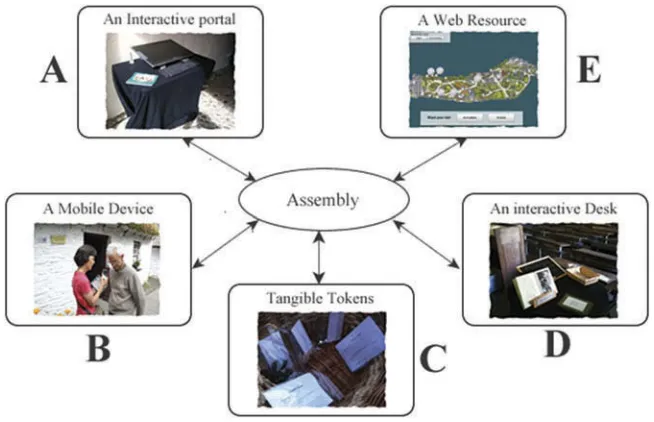
Visitors could use Reminisce free of charge, and the design team provided all the accompanying materials. The technical installation consisted of an array of interactive technologies each supporting specific parts of the activity. When visitors entered the Folk Park, they were directed to a central“portal”(Figure 3, A): here they could create a unique profile where all the content they collected and recorded during their journey would be stored. Here, they could also select the character(s) that they would like to hear memories from, and receive an initial clue about where to find the first memory. The portal was also where they could download the Reminisce mobile app onto their phone or collect a mobile phone that they could use to gather the memories and that we had made available for those visitors who did not wish to use their own phone.
At seven different sites, available memories were represented by QR codes, and using the Reminisce app visitors could scan the codes through the phone camera.
The auditory memories were short (about 10 sec on average) and provided simple descriptive snippets of life in times past from a character’s personal perspec-tive. For example:“We’d let the cows graze in the open fields all year round and we’d milk them morning and evening. If by chance they had eaten turnips the milk would be very strong and we’d add salt to mask the taste.”
[image:14.504.88.415.406.617.2]Seven buildings in Bunratty Folk Park were selected to be part of Reminisce: six cottages and the schoolhouse. These buildings were located within easy distance from each other and they constitute the most visited part of the Park. Each building had at
least two QR codes available, with the Loop Head House displaying three codes as it is a large cottage with outbuildings. Fourteen memories for each character (24 in total) were available overall to collect throughout the experience.
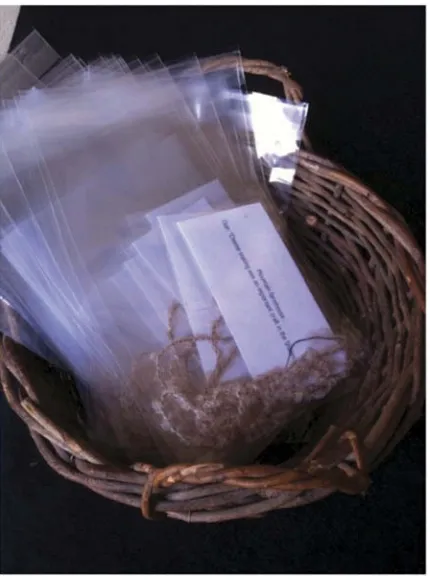
[image:15.504.145.360.327.617.2]Once a QR code was scanned, the app would display the specific memory or memories associated with a site in the form of audio recordings that could be played on the phone. Then, if they wished, visitors could use the application to record and save in real time their own memories or comments using the handset’s microphone. At six of the memory sites (the exception being the schoolhouse), visitors could collect specially designed packs of tangible tokens (Figure 3, C;Figure 4), containing a souvenir that they could bring home with them and that was connected with each building (recipes, pieces of turf, small hunks of wool, etc.) and a clue about where they could find other memories. There were six souvenirs to collect in total through-out the experience and the souvenir packs were located at visible locations near the entrance to each cottage. The purpose of these packs was threefold: to provide the visitors with a memento of their visit to a building, to guide them to other memories
available to them, and to allow them access to the memories and comments other people left at the site. The clues were printed on cards with RFID tags embedded in them (see one example inFigure 3, C). When visitors reached the schoolhouse, the last site on the Reminisce trail, they could use the tangible tokens as input for the Interactive Desk in the schoolhouse.
The Interactive Desk in the schoolhouse (Figure 3, D) allowed people to listen to the recordings that other visitors had left at the sites in the Park inspired by the character memories they had heard. Placed on the desk were two books with embedded RFID tags, each of them related to one of the characters that visitors could collect memories from. A bookholder and a basket with embedded RFID readers were also placed on the desk. When one of the books was placed on the holder and one of the tangible tokens was placed inside the basket, the corresponding recordings left by other visitors were played back, i.e., these recordings were from the site where the tangible token was collected from.
Furthermore, after the visit, participants could access their entire activity trail with Reminisce (sites visited, content listened to, and recordings they had generated) on the web (Figure 3, E) using the registration details they had entered at the central portal at the beginning of the visit.
The decision to provide the playback of other visitors’memories in the school-house (rather than in each of the cottages) was made following the testing of an earlier version of the prototype. The cottages are rather small and can easily become crowded, and early testers found that the memories played aloud in the cottages made the environment too noisy, and that people using Reminisce lingered there for very long, making it less attractive for other visitors to come inside. Playing the memories aloud in each cottage was also a distraction for visitors interacting with each other and with the animators in such small spaces. The decision was therefore to have the playback of visitor memories at a dedicated location, and to instead encourage the visitors to record their own at the cottages following the collection of each memory and (often) discussion with companions and animators.
To provide a quick overview of how the visitor experience unfolded, we give a brief walkthrough scenario:
Jean is an Irish-American Tourist visiting Bunratty Folk Park during a holiday with her husband. At the entrance, they receive maps of the Park, and they are made aware of the Reminisce installation. Jean wants to try it out to find out more about life in Ireland in the past, so the receptionist directs her to the start of the installation (the central portal). She chooses the Bean An Tí (Woman of the House) character and receives a mobile device that she can use to collect the characters memories and to record her own comments.
As she and her husband look around inside the small cottage, on the kitchen table they notice a basket full of small packages marked “Are you exploring
‘Reminisce’? Please Take One.” Each package contains a printed recipe for baking griddle bread. At the bottom of the sheet is a clue to another site that contains memories.
“Life in the mountains was difficult in the Winter”
This must mean that more memories are located at the Mountain Farmhouse marked on the map, so they make their way there and find several memories at the farmhouse. Jean here records her own childhood memory of her Irish great-grandmother doing embroidery, which her husband had never heard about. As they leave the house, they collect another souvenir pack: it contains a small piece of fresh turf and a card with the next clue:
“Cheese making was important in the Shannon area”
They keep exploring the buildings listening and recording their own memories, and interacting with other visitors and animators.
They finally arrive at the schoolhouse and at the entrance they find a memory of the Bean An Tí talking about the importance of education for families. Inside, they find the interactive table where–by placing inside the basket the souvenirs they have collected– they can hear other visitors’ memories from each house. Upon leaving Bunratty, Jean returns the phone and checks out at the Reminisce central portal.
The design of Reminisce is the result of the elaboration and application of the Assembly principles and we now discuss how we adapted and applied the framework.
3.1. Adapting and Applying the Assembly Framework
In order to apply the Assembly approach to the design of Reminisce, we divided the framework into: conceptual principles focused on conceptualizing activities and information spaces (principles 1 and 2 inSection 2.1); and prototyping principles that guide the prototyping of the technical infrastructure (principles 3, 4, and 5Section 2.1).
the Assembly should allow participants toactively add to the circumstances they find themselves in. We believe that such agency enables visitors to better assemble (and make sense of) the overall narrative. Participative models of encounters between visitors and heritage are also increasingly adopted by museum professionals when designing exhibitions and interpretation aids (Proctor,2015), and therefore we argue that incorporating this concern explicitly into the Assembly framework makes it even more relevant for the cultural heritage domain. Therefore, when defining an overall activity, it is necessary in our view to ensure that it provides opportunities for active participation. Embedded in this structure are the interactive artifacts that make up the technical assembly and that support the activity as a whole. Particular approaches to aid in the conceptual development of the activity and of the related information space have not been discussed by Fraser et al.
In order to extend this underdeveloped aspect of the Assembly framework, we draw from place sensitivities, e.g. how people live and experience a physical environ-ment investing it with actions, meanings, and values. As we discussed inSection 2, place-making has been considered by HCI researchers as a way to shape interaction narratives (Ciolfi & Bannon,2005; Hornecker,2005a; Messeter,2009), particularly in heritage settings. Therefore, developing an understanding of how people experience place, its physical, social, cultural, and emotional nature is in our view a valuable dimension to introduce into the Assembly framework. Introducing a concern for place and place-making can lead to the designing of overall activity narratives and content to engage and support the visitor experience in connection with the rich and evocative environment where it occurs.
The remaining principles of designing assemblies introduce the dimension of technical design, of identifying a set of physical/digital components. Principle 3 is about developing artifacts that work in concert to support the mediation of the overall narrative. Fraser et al. talk about“interactive displays,” each support-ing a part of the overall experience and revealsupport-ing a subset of the common information space. This principle allows for a fairly open interpretation of the forms and modes of interaction and of the interactive elements that make up an assembly. We feel, however, that the label “interactive displays” needs to be reconsidered. An “interactive display” suggests a one-way process of interaction between the user and the display (presenting content that could be visual, auditory, etc.), thus limiting the technical Assembly to simply delivering content. We suggest redefining this principle so it refers to a set of “interactive compo-nents” rather than “displays.” This takes into account a wider range of possi-bilities, including components that are not just devoted to displaying content, but also to support a more dialogical and participatory interaction with the visitors.
this principle with the third principle by emphasizing that the interactive compo-nents needn’t be only “interactive displays,” but that they can also be low-tech components that play a role in engagement and interaction. The resulting overall assembly will always be spatially situated within a heritage site and will add to place experience. Therefore, it should be in keeping with the locale and existing practices.
The fourth Assembly principle is concerned with the interactional qualities that the interactive components support. It emphasizes the need for common modes of interaction to provide a more coherent experience as people negotiate the assembly. Given the assembly’s multiple components, there is a need to consider interaction modalities that can be interworked and supported across them. This principle involves more than simply selecting different modes of interaction; it must also examine how they can complement each other as people encounter different parts of the assembly. The idea of “common modes of interaction” must also include the consideration of how these integrate with the visitor activities in place.
The following are the revised principles that we propose and adopt:
1. Define an overall activity that people can actively participate in, informed by the understanding of visitors’situated activities.
2. Based on the overall activity, develop an underlying information space that allows visitors to actively make sense of their situated experiences. This must be struc-tured so it can be progressively revealed and responded to by visitors at different points of engagement.
3. Develop an assembly of interactive components that support aspects of the overall activity and mediate the information space. These components should mediate elements of the information space in a way that is coherent and in keeping with the overall activity narrative and with the locale. Emphasis should be placed not only on developing interactive components to provide opportu-nities for interaction, but also on developing components that enhance the coherence of the whole assembly, specifically, low-tech components that can offer interesting opportunities for engaging interactions and for mediating the information space.
4. Provide related modes of interaction across components so as to connect them and provide a more coherent overall experience. These modes of interaction must complement each other and be in keeping with visitors’situated interactions at the heritage site.
We now present our empirical study of how the components of Reminisce and its whole mediated visitor interactions and practices, highlighting how the assembly enabled specific instances of collocated interaction within the museum visit. As established by the extended Assembly principles, the design of Reminisce paid particular attention to the qualities of the Folk Park as a place and to the place-specific aspects of interaction, including choice of building materials, con-tent, and narrative sequence. Interaction with Reminisce was not limited to a single device and/or location in the Park: it occurred in multiple forms depending on which part(s) of the assembly visitors approached and used, and how. These instances of interaction emerged in a variety of configurations and patterns (e.g., collocated around the same device/component, or around different devices/ components at the same location, or at adjacent locations in the Park) and were mediated by various aspects of the installation.
4. STUDYING VISITOR INTERACTIONS AROUND
‘
REMINISCE
’
The qualitative data presented in this section were gathered through the sha-dowing and naturalistic observations of small groups of visitors using Reminisce during their exploration of Bunratty Folk Park. We have chosen vignettes that are useful for identifying ways in which the Assembly supported interactions across artifacts and locations, and in ways that it supported connections to the place.
The data were collected throughout three full consecutive days during the public trial of Reminisce in August 2011. Given the prototypical nature of the installation, the user trials were facilitated to some extent by the research team, by giving participants an overview of the project at the beginning of their visit and providing them with mobile phones with the Reminisce application preloaded onto it. Visitors could use their own mobiles if they ran on Android. However, none of the people who agreed to participate wished to do this, as it would have required downloading the app using their own mobile data network. Free public wi-fi was not available at Bunratty at the time of the trial.
Given the scale of the Park and the distributed nature of the installation, two main methods were used to document the visits.
Still photographs were also taken occasionally during shadowing, especially in dark places where the video footage would be hard to make out on its own during data analysis. All members of the research team wore identification badges so as to be recognizable to all the Folk Park visitors, even those not participating in the trial, while conducting the study.
● Informal Interviews: After the visit, participants were informally interviewed by one member of the team to gather specific feedback on issues that may not have been apparent or explicit through the shadowing sessions, and also to allow visitors give their own insights and comments into the use of the installation and their opinion of it.
Regarding recruitment, our pool of participants included visitors whom we approached at the entrance to the Folk Park at busy times, volunteers recruited through other channels (e.g., the University’s “Events” mailing list, where we advertised Reminisce), and people who had contacted us after seeing Reminisce mentioned in the local press. Participants who agreed to try out the system were excused the admission fee to the Park as thank-you.
We documented 23 visiting units using the full installation on their journey around the Park through shadowing and interviews, and observed approximately another 50 instances of some partial interaction with individual components of the Reminisce by lone visitors and small groups. We refer to“visiting units”to describe the instances of visits by either lone visitors or by pairs/small groups that we documented. The data upon which we draw for this paper pertains to the 23 visiting units that we documented in full. This pool of participants included six lone visitors and 17 pairs/small groups. In the case of lone visitors, the visiting unit comprised only one person. The small groups we documented ranged from two to six people. Large groups were not recruited for the trial. On average, each trial lasted between 40 min and 1 h. No more than two visits aided by Reminisce were ongoing in the Folk Park at any time. This means that, while there was a chance that two sets of visitors using Reminisce would meet each other during the visit, this happened relatively rarely, also due to the large size of Bunratty Folk Park. As Reminisce was available only in English, only English-speaking participants were recruited. The large majority of visitors we observed were Irish, with one group from Sweden, one group from the USA, and one pair from the UK. Of the lone visitors, all were Irish but one, who was originally from Germany but living in Ireland. All participants were first-time visitors to Bunratty.
In the following section, we present excerpts from data articulating themes that illustrate how Reminisce as a physical-digital assembly mediated and supported collocated visitor interaction: the roles of the assembly components (individually and in combination) in mediating interaction and collaborative understanding among visitors; how interactions through the assembly enabled visitors to make sense of the place; and how interaction with the assembly sustained coherence throughout the visitor experience.
We selected the majority of the examples as they illustrate particularly well certain types of interaction that were documented throughout the study and that coalesced into themes throughout the analysis. One example (Figure 7) shows instead a unique occurrence (two co-visitors each using a phone) that we include here as it is notable in illustrating one of the analytical themes. All examples are presented in the form of“vignettes”depicting both the visitor behaviors in relation to the space and their conversations.
The general pattern of engagement with Reminisce showed participants visiting and collecting memories at all the seven sites included in the experience. All the visiting units that we documented followed the order of the buildings that was suggested by the official visitor map. While all visiting groups collected all the memories at each site, not all of them recorded content of their own at every site. Of the 23 visiting units, however, only three did not record any content at all: the family group from Sweden, one lone Irish visitor, and one pair (also Irish). When asked why they did not record any memories in the post-visit interview, the Swedish group said that they were conscious of time and did not want to make the visit even longer; the lone Irish visitor stated that, while he loved hearing other visitors’recordings in the schoolhouse, he was more comfortable without recording his own voice; the pair explained that they were following the story of the character and did not think that their own recordings would have added to it. Although these people did not record their own content, the observations of their interaction show that they discussed what they heard among each other. The lone visitor had conversations with the animators he met at two of the Reminisce cottages that were triggered by the character memories. In the post-visit interview, he commented on how moved he was while listening to the“Farmer of the Land” story as it reminded him of his late father.
Overall, the large majority of the visitors we observed were happy to contribute and felt comfortable about it, and the data documenting the experience of those people who did not contribute content shows that they were nonetheless engaged in the Reminisce experience.
4.1. The Roles of the Assembly Components in Mediating Collocated Interaction
“ecology” of how to use Reminisce: by assigning roles for using the different components, deciding when these roles would change, and establishing the pace of the visit and of the interaction with the assembly. For example, within a visiting unit, one member could be in charge of scanning the QR codes with the phone and playing the memories audio files, while another member could be collecting and carrying the tangible tokens, and another helping work out the clues about where to go next by looking at the Folk Park’s visitor map. These configurations emerged in some cases from explicit discussion about who should do what and from mutual agreement. In other cases, they emerged without an explicit agreement among the members of a visiting unit, but simply due to convenience or unspoken preference. In some instances, these roles within the group would remain constant through-out the visit; in other instances, the group would coordinate turn-taking and periodi-cally reassign the various assembly components to other members. In the latter case, the transition between one member and another in using a component, such as the phone, happened either by agreement, or by responding to specific interactions or events–e.g., when listening to a particular character memory played on the phone by one member prompted another member of the group to take over the phone so that they could record their own content in response.
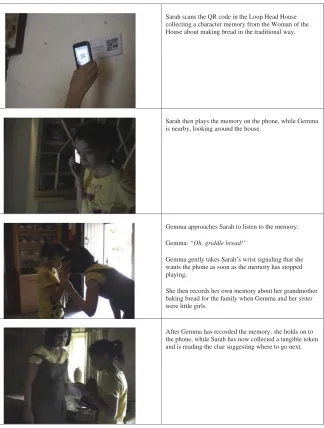
An example of an unplanned shift in roles is detailed in Vignette 1 below (Figure 5). At the beginning of their visit, Gemma and her young daughter Sarah4 mutually agreed that Gemma will be in charge of collecting the tangible tokens and that Sarah will use the mobile phone to collect the memories.
In Vignette 1 the reversal of roles is prompted by a particular event: the character memory being about something that particularly touches Gemma, as it evokes her own memories of her grandmother. Gemma waits for the sound to finish playing having signaled to Sarah that she wants the mobile phone. While Gemma records her memory, Sarah takes over the tangible token, and mother and daughter then continue the visit having swapped their roles.
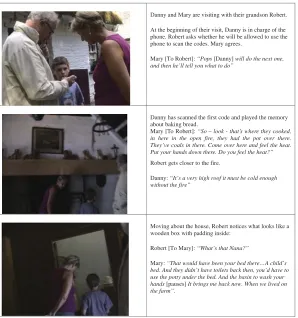
In contrast, one example of “agreed” turn-taking is illustrated in Vignette 2 (Figure 6).
The two vignettes mentioned above show not only the mechanisms of coordi-nation among visitors around the assembly components, but also how the visits with Reminisce were a constant interweaving of artifact handling, placement, and overlap, of active interactions with the assembly (e.g., scanning, playing, recording, etc.), and of linked interpersonal and collaborative interactions among the group. The dialogue in Vignette 2 shows how the content was both used to gain a clearer understanding of the site (e.g., Mary explaining to Robert about the child’s bed, Mary and Danny explaining to Robert why the fire is needed) and effective in evoking personal reactions and memories (e.g., Mary remembering when she used to live on a farm). Both vignettes show that the role takeovers and transitions happened smoothly and without the need for the visitors to give time to figure out how the assembly
“worked” in order to take up a new role during the visit.
In both vignettes 1 and 2 we also see the assembly fully interfacing with the site, the buildings, the artifacts, and other resources that are part of the regular visit, such as, for instance, the map, which became seamlessly embedded in the interaction with Reminisce. In fact, we can say that the map became – for all intents and purposes – a part of the assembly for all the visitors, although it was
FIGURE 5. Vignette 1: Gemma and Sarah.
Sarah scans the QR code in the Loop Head House collecting a character memory from the Woman of the House about making bread in the traditional way.
Sarah then plays the memory on the phone, while Gemma is nearby, looking around the house.
Gemma approaches Sarah to listen to the memory.
Gemma: “Oh, griddle bread!”
Gemma gently takes Sarah’s wrist signaling that she wants the phone as soon as the memory has stopped playing.
She then records her own memory about her grandmother baking bread for the family when Gemma and her sister were little girls.
not designed to be so. In the post-visit interviews, when asked about the ease of use of the installation, many visitors commented on how the map made it very easy to figure out the clues.
The assembly was flexible enough to be appropriated and reconfigured in terms of use; it became embedded into the visit and into the conversations.
“Seams” – moments where the focus of the interaction shifted from the visiting experience to the workings of the installation (Chalmers & Galani,2004)–came to the surface when some aspects of the interactions with the assembly had to be renegotiated or explained.
[image:25.504.105.403.288.606.2]This was particularly evident in the only visiting unit that we documented where the two people involved, friends Nuala and James, each chose to take one phone and
FIGURE 6. Vignette 2: Danny, Mary, and Robert.
Danny and Mary are visiting with their grandson Robert.
At the beginning of their visit, Danny is in charge of the phone. Robert asks whether he will be allowed to use the phone to scan the codes. Mary agrees.
Mary [To Robert]: “Pops [Danny] will do the next one, and then he’ll tell you what to do”
Danny has scanned the first code and played the memory about baking bread.
Mary [To Robert]: “So – look - that’s where they cooked, in here in the open fire, they had the pot over there. They’ve coals in there. Come over here and feel the heat. Put your hands down there. Do you feel the heat?”
Robert gets closer to the fire.
Danny: “It’s a very high roof it must be cold enough without the fire”
Moving about the house, Robert notices what looks like a wooden box with padding inside:
Robert [To Mary]: “What’s that Nana?”
follow one character, rather than share one device and one character narrative between them (Figure 7).
In Vignette 3 (Figure 7), we see yet another instance of how the visitors weaved a set of interactions among themselves, the site, and the components of the assembly. We also see two moments where their attention shifts onto the installation itself, and their focus on the narrative is temporarily redirected onto the workings of Reminisce. The first moment is when Nuala and James collect the first token (and thus the first clue) in the Loop Head House. Nuala asks for James’help in figuring out how to work out the next step, also noting the RFID tag embedded in the sheet of paper she is holding as it could provide a way to work out the clue. James suggests that they focus on the map instead.
The second moment occurs later in the visit at the Shannon Farmhouse, when James’ repeated attempts to scan a QR code fail because of the poor light. Nuala
FIGURE 6. (Continued).
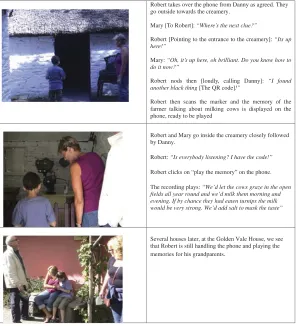
Robert takes over the phone from Danny as agreed. They go outside towards the creamery.
Mary [To Robert]: “Where’s the next clue?”
Robert [Pointing to the entrance to the creamery]: “Its up here!”
Mary: “Oh, it’s up here, oh brilliant. Do you know how to do it now?”
Robert nods then [loudly, calling Danny]: “I found another black thing [The QR code]!”
Robert then scans the marker and the memory of the farmer talking about milking cows is displayed on the phone, ready to be played
Robert and Mary go inside the creamery closely followed by Danny.
Robert: “Is everybody listening? I have the code!”
Robert clicks on “play the memory” on the phone.
The recording plays: “We’d let the cows graze in the open fields all year round and we’d milk them morning and evening. If by chance they had eaten turnips the milk would be very strong. We’d add salt to mask the taste”
[image:26.504.105.403.104.430.2]interrupts her own collecting of memories and uses her phone as a flashlight to enable James to scan the code. She knows how the technology works and quickly finds a workaround to make the camera on James’phone pick up the marker. Both moments are small alterations of the flow of the visit, which soon continues as
FIGURE 7. Vignette 3: Nuala and James Using Separate Phones.
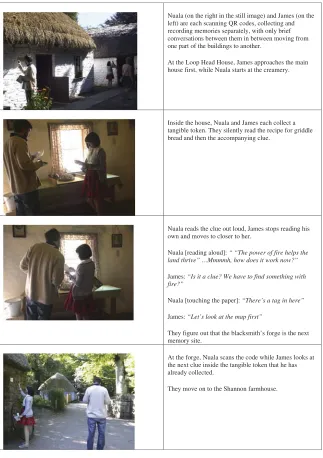
Nuala (on the right in the still image) and James (on the left) are each scanning QR codes, collecting and recording memories separately, with only brief conversations between them in between moving from one part of the buildings to another.
At the Loop Head House, James approaches the main house first, while Nuala starts at the creamery.
Inside the house, Nuala and James each collect a tangible token. They silently read the recipe for griddle bread and then the accompanying clue.
Nuala reads the clue out loud, James stops reading his own and moves to closer to her.
Nuala [reading aloud]: “ “The power of fire helps the land thrive” …Mmmmh, how does it work now?”
James: “Is it a clue? We have to find something with fire?”
Nuala [touching the paper]: “There’s a tag in here”
James: “Let’s look at the map first”
They figure out that the blacksmith’s forge is the next memory site.
At the forge, Nuala scans the code while James looks at the next clue inside the tangible token that he has already collected.
before. This seemed to be the case with other similar occurrences that we documen-ted for other visiting units.
Vignette 3 also provides another example of how a pair of visitors coordinated activities between themselves, in comparison to Vignette 1 and Vignette 2. Mostly due to the fact that Nuala and James had chosen to use separate phones, their interpersonal interactions occurred most frequently in between interactions with the assembly inside each house, and then as the two friends walked from one building to another. The interactions between Nuala and James inside the houses were briefer than those we documented for visiting units using a shared phone, while they had longer conversations in between buildings.
Overall, the assembly effectively supported several different styles of visiting: most groups shared one set of components, taking turns or sharing“duties;” on the other hand, in the Nuala and James example, we see two phones and two sets of
FIGURE 7. (Continued).
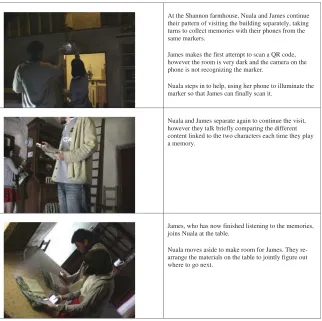
At the Shannon farmhouse, Nuala and James continue their pattern of visiting the building separately, taking turns to collect memories with their phones from the same markers.
James makes the first attempt to scan a QR code, however the room is very dark and the camera on the phone is not recognizing the marker.
Nuala steps in to help, using her phone to illuminate the marker so that James can finally scan it.
Nuala and James separate again to continue the visit, however they talk briefly comparing the different content linked to the two characters each time they play a memory.
James, who has now finished listening to the memories, joins Nuala at the table.
[image:28.504.92.414.102.423.2]clues being used, independent interaction with the components by the two visitors, but discussions in between and during transitions between points of interaction. Even in the latter example, the content (both given and user-generated) and overall narrative fed interpersonal interaction, despite the interaction with the technical assembly inside the houses being individual.
Besides these different patterns of visiting, the examples presented thus far also illustrate how the different components making up the assembly (with the addition of the map) came to be handled, shared, passed, laid out on the table, and compared as visitors experienced and discussed Reminisce.
Again, these are only a few select examples of the multiple ways in which these interactions took place, and more will be seen in the excerpts we present in the following sections. As with the coordination of roles around the assembly, in the examples we presented in this subsection we also saw that the components of the assembly could be flexibly rearranged in a variety of ways during each visit. The portable elements had naturally the highest degree of flexibility, but visitors appro-priated other aspects of the assembly, such as the suggested order of the buildings to visit, the number of memory markers (RFID codes) they decided to scan, and those they decided to respond to with their own content.
4.2. Interaction through the Assembly and Place-making
One of the key goals of the design of Reminisce was that of connecting to and resonating with the qualities of the place, and highlighting them to visitors, thus becoming a dimension of their own place-making at Bunratty. The features of buildings, of the landscape, and of the activities that took place there in the past were all important aspects to be made more visible to visitors through the techno-logical augmentation of the Folk Park by means of the assembly. In our re-elabora-tion and extension of the Assembly principles, we adopted the definire-elabora-tion of place as practiced and experienced space (Tuan,1977), where activities, meanings, and values are associated by people to the physical environment and to the material artifacts on display.
Because of the scale and complexity of the exhibitions in the Park, visitors encountered physical elements and qualities of the place at different levels of granularity, size, and scope: from a whole village scene (Figure 2) to entire buildings (Figure 1), to rooms, to smaller objects inside a particular room, and to other sensory qualities such as smells, different lighting conditions, and even tastes (e.g., in the houses where samples of bread or cake were handed out to visitors).
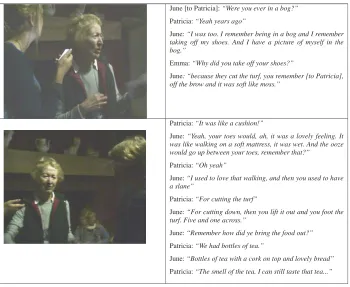
memories, the tangible tokens, and the interactive desk all provided prompts for reflection and commentary about the place. The first excerpt that we present to illustrate how this happened (Figure 8) features a family of four: a grandmother (June), her daughter-in-law (Patricia), and June’s granddaughter (Emma) and grand-son (Paul). Patricia is Emma and Paul’s mother.
[image:30.504.78.421.251.617.2]In Vignette 4 (Figure 8), we see how the character memories subtly conveyed to the visitors knowledge that otherwise would be not be apparent. The memories were scripted on the basis of the location for their collection at the houses so that visitors could relate the memories to their interactions in the space, and provide a better sense of what they were experiencing. We can see how June’s family could coherently
FIGURE 8. Vignette 4:“It Can’t Be before the Famine”.
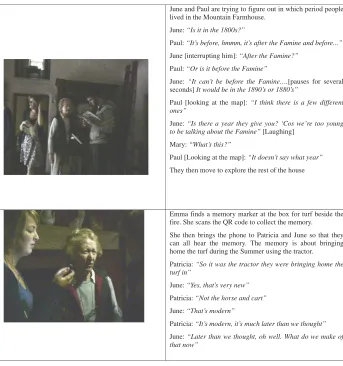
June and Paul are trying to figure out in which period people lived in the Mountain Farmhouse.
June: “Is it in the 1800s?”
Paul: “It’s before, hmmm, it’s after the Famine and before...”
June [interrupting him]: “After the Famine?”
Paul: “Or is it before the Famine”
June: “It can’t be before the Famine….[pauses for several seconds] It would be in the 1890’s or 1880’s”
Paul [looking at the map]: “I think there is a few different ones”
June: “Is there a year they give you? ‘Cos we’re too young
to be talking about the Famine” [Laughing]
Mary: “What’s this?”
Paul [Looking at the map]: “It doesn’t say what year”
They then move to explore the rest of the house
Emma finds a memory marker at the box for turf beside the fire. She scans the QR code to collect the memory.
She then brings the phone to Patricia and June so that they can all hear the memory. The memory is about bringing home the turf during the Summer using the tractor.
Patricia: “So it was the tractor they were bringing home the turf in”
June: “Yes, that’s very new”
Patricia: “Not the horse and cart”
June: “That’s modern”
Patricia: “It’s modern, it’s much later than we thought”
assemble together their experience of the Mountain Farmhouse with the information available on the map and with the characters’memories in order to understand more about the period that the house represents. Indeed, we see Paul and June using the map to help find out the period of the Mountain Farmhouse display; Emma collects a memory about the house from the Bean An Tí character’s perspective and brings it to Patricia and June for them to listen to. This memory mentions the use of a tractor to bring turf from the bog back to the farmhouse, and from this they deduce that the period that the house display recreates is much more recent than what they initially thought. Then, sparked by the mention of the bog, Patricia and June begin a conversation around their own memories of going to the bog, while Emma and Paul listen in. Interestingly, the family not only draws additional factual information about the house from their interaction with Reminisce, but also actively contributes their own memories and recollections, thus making the Mountain Farmhouse the setting for an engaging family discussion.
In Vignette 5 (Figure 9), Anna, who was born in Germany and is now living in Ireland, is visiting the Mountain Farmhouse. She scans a QR code near the entrance to one of the bedrooms in the house. She listens to the memory from the Bean An Tí
FIGURE 8. (Continued).
June [to Patricia]: “Were you ever in a bog?”
Patricia: “Yeah years ago”
June: “I was too. I remember being in a bog and I remember taking off my shoes. And I have a picture of myself in the bog.”
Emma: “Why did you take off your shoes?”
June: “because they cut the turf, you remember [to Patricia],
off the brow and it was soft like moss.”
Patricia: “It was like a cushion!”
June: “Yeah, your toes would, ah, it was a lovely feeling. It was like walking on a soft mattress, it was wet. And the ooze would go up between your toes, remember that?”
Patricia: “Oh yeah”
June: “I used to love that walking, and then you used to have a slane”
Patricia: “For cutting the turf”
June: “For cutting down, then you lift it out and you foot the turf. Five and one across.”
June: “Remember how did ye bring the food out?”
Patricia: “We had bottles of tea.”
June: “Bottles of tea with a cork on top and lovely bread”
[image:31.504.78.428.101.388.2]and then examines the bedroom space whilst listening to the memory so as to find relationships between the narrative in the recording and the space itself.
[image:32.504.93.411.102.461.2]Here we can see how the character memory highlighted an aspect of the site that otherwise might not have been apparent to visitors. We see Anna scanning the code and then moving into the center of the house as she listens; however, she quickly moves back toward the bedroom searching for what is mentioned in the memory–the handcrafted linens. However, her comment illustrates that she did not simply listen to the audio content. Even without prior personal knowledge of such a space (Anna grew up in Germany and confirmed in the post-visit interview that she had not seen a farmhouse such as this in the past), she developed some personal relationship with the space, imagining herself“upstairs in bed.”
FIGURE 9. Vignette 5:“I Would like to Be Upstairs in Bed”.
Anna chose the Bean An Tí as character of interest. On entering the Mountain Farmhouse, she notices the QR marker over the doorway into one of the bedrooms and scans the code.
The memory from the Bean An Tí is displayed and Anna plays it.
She listens to the Bean An Tí reminiscing about making blankets, sheets and clothing for the entire household.
While the recording is still playing, Anna walks around and moves closer to the bedroom where blankets and sheets similar to those the Bean An Tí is talking about are displayed.
Anna then records her own comment:
“Its very cold in here I would like to be upstairs in bed”
In this example, Reminisce functioned more as a light guidance system to point out interesting details of the house to the visitor. Nonetheless, the place evoked a personal reaction from Anna, who saw the house not just as a museum display but as a domestic environment where she could imagine herself.
[image:33.504.83.418.312.614.2]Visitors created their own content relating to what they encountered. This content varied from reflections on what they found at the sites to reminiscing on their own life experiences, and shows how visitors saw, reacted to, and engaged with places. Visitors contributed many rich recordings of them reminiscing about experiences in their own lives. For example, Vignette 6 (Figure 10) shows the family previously featuring in Vignette 4 at the Mountain Farmhouse. Now in the Shannon Farmhouse, June’s grand-daughter Emma is looking for memories to collect while June and Patricia are resting on a bench in the kitchen. Emma then comes back with another memory on the phone for them to listen to together, and this leads June to reminisce about the use of christening gowns in her family. As she talks, Emma records what she says.
FIGURE 10. Vignette 6: The Christening Robe.
Emma collects a memory about using linen tablecloths for special occasions and brings it to June and Patricia for them to listen to.
Emma then collects another memory. She comes back and plays it for Mary and June.
The memory is about making clothes, blankets and Christening gowns.
When the memory has finished playing, June tells a story about how her own mother’s christening gown was used to christen her children and grandchildren. As June talks, Emma records what she says.
Patricia [to June]: “Can you remember whose Christening robe did we have?”