organic papers
o246
Wanget al. C24H17N5 doi:10.1107/S1600536805041000 Acta Cryst.(2006). E62, o246–o248
Acta Crystallographica Section E
Structure Reports
Online
ISSN 1600-5368
4
000-[4-(Imidazol-1-yl)phenyl]-2,2
000:6
000,2
000000-terpyridine (IPTP)
Cai Xia Wang,aLin Li,aWen Tao Yu,bJia Xiang Yangaand
Jie Ying Wua*
aDeparment of Chemistry, Anhui University,
Hefei 230039, People’s Republic of China, and bState Key Laboratory of Crystal Materials,
Institute of Crystal Materials, Shandong University, Jinan 250100, People’s Republic of China
Correspondence e-mail: [email protected]
Key indicators
Single-crystal X-ray study
T= 293 K
Mean(C–C) = 0.004 A˚
Rfactor = 0.051
wRfactor = 0.156
Data-to-parameter ratio = 13.8
For details of how these key indicators were automatically derived from the article, see http://journals.iucr.org/e.
#2006 International Union of Crystallography
Printed in Great Britain – all rights reserved
The title compound (IPTP), C24H17N5, has been synthesized
and characterized by 1H NMR,13C NMR and single-crystal
X-ray diffraction. The three pyridyl rings are almost coplanar. The benzene ring forms dihedral angles of 49.59 (17) and 19.18 (13)with the central pyridyl ring and the imidazole ring,
respectively.
Comment
Polypyridine ligands have played an important role in many areas. In particular, the chelating ligand terpyridine (terpy) and its functionalized derivatives have been studied exten-sively as outstanding complexing agents for a wide range of transition metal ions (Heller & Schubert, 2003). This property has been widely used in analytical chemistry (Schubert & Eschbaumer, 2002), in photochemistry for the design of luminescent devices (Harriman & Ziessel, 1998) and in biochemistry (Trawick et al., 1998). Although the number of publications or investigations of terpyridine complexes has increased enormously, comparably few preparations of func-tionalized terpyridine derivatives have been reported as yet. The title compound, IPTP or (I), is a novel compound containing terpyridine and imidazole coordination sites. We report here the synthesis, characterization and crystal struc-ture of (I).
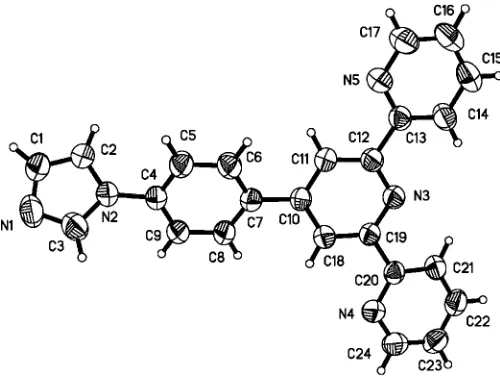
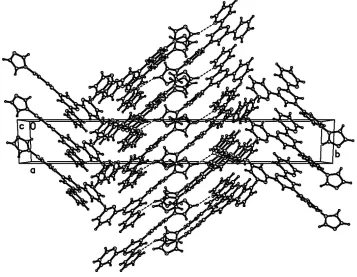
The molecular structure of the title compound was deter-mined by single-crystal X-ray diffraction and is shown in Fig. 1. A packing diagram is shown in Fig. 2. Bond lengths and angles in the compound are given in Table 1. The three pyridyl rings are almost co-planar, with interplanar angles of 7.15 (4) (between ring N5/C13–C17 and the central pyridyl ring), 8.38 (15) (between rings N5/C13–C17 and N4/C20–C24) and
11.67 (14) (between ring N4/C20–C24 ring and the central
pyridyl ring). The benzene ring forms dihedral angles of 49.59 (17) and 19.18 (13), respectively, with the central pyridyl ring and the imidazole ring.
Experimental
For the preparation of 3-(ylphenyl)-1-(pyridin-2-yl)prop-2-en-1-one, a flask charged with a mixture of
benzaldehyde (8.6 g, 50 mmol), 2-acetylpyridine (6.1 g, 50 mmol) and 2% aqueous sodium hydroxide (150 ml) was stirred vigorously at room temperature for 30 min, and was then heated to about 333 K for 6 h. The reaction was monitored by thin-layer chromatography. After the reaction was complete, the reaction mixture was cooled to room temperature. A light-yellow solid was precipitated which was then filtered, washed thoroughly with water and air-dried to give 13.6 g of 3-(4-imidazole-1-ylphenyl)-1-(pyridin-2-yl)prop-2-en-1-one (yield 98.0%).
For the preparation of IPTP, 2-acetylpyridine (1.8 g, 15 mmol) and 3-(4-imidazole-1-ylphenyl)-1-(pyridin-2-yl)-prop-2-en-1-one (4.1 g, 15 mmol) and NaOH (2.4 g, 60 mmol) powder were crushed together with a pestle and mortar for 2 h. The yellow powder was added to a stirred solution of ammonium acetate (10 g, excess) in ethanol (100 ml). The reaction mixture was heated at reflux for 10 h. Upon cooling to room temperature, the precipitate was filtered, washed with water three times and dried to afford the product. Recrystalli-zation from ethanol afforded pale-yellow plate-shaped crystals. 1H
NMR (CDCl3):7.27 (t, 1H), 7.37 (m, 3H), 7.55 (d, 2H), 7.90 (m, 2H),
7.98 (s, 1H), 8.04 (d, 2H), 8.67 (s, 1H), 8.70 (s, 1H), 8.74 (m, 2H), 8.76 (s, 2H).13C NMR (CDCl
3):117.7, 118.2, 120.9, 121.2, 123.5, 128.5,
129.9, 134.9, 136.3, 136.5, 148.5, 148.7, 155.3, 155.5, 155.7.
Crystal data
C24H17N5
Mr= 375.43
Monoclinic, P21=n
a= 5.4807 (5) A˚
b= 38.653 (5) A˚
c= 8.953 (1) A˚
= 103.470 (9)
V= 1844.5 (4) A˚3
Z= 4
Dx= 1.352 Mg m
3
MoKradiation
Cell parameters from 41 reflections
= 5.2–12.5
= 0.08 mm1
T= 293 (2) K
Plate, pale yellow
0.450.340.10 mm
Data collection
BrukerP4 diffractometer
!scans
Absorption correction: scan
(Northet al., 1968)
Tmin= 0.918,Tmax= 0.992
4935 measured reflections 3625 independent reflections
1574 reflections withI> 2(I)
Rint= 0.035
max= 26.0
h=6!1
k=1!47
l=11!11 3 standard reflections
every 97 reflections intensity decay: none
Refinement
Refinement onF2
R[F2> 2(F2)] = 0.051
wR(F2) = 0.156
S= 0.93
3625 reflections 263 parameters
H-atom parameters constrained
w= 1/[2(F
o2) + (0.0662P)2]
whereP= (Fo2+ 2Fc2)/3
(/)max< 0.001
max= 0.19 e A˚
3
min=0.18 e A˚
3
Extinction correction:SHELXTL
Extinction coefficient: 0.025 (2)
Table 1
Selected geometric parameters (A˚ ,).
C1—N1 1.343 (4)
C2—N2 1.370 (4)
C3—N1 1.314 (4)
C3—N2 1.342 (3)
C4—N2 1.425 (3)
C7—C10 1.484 (4)
C12—N3 1.345 (3)
C13—N5 1.338 (3)
C17—N5 1.333 (3)
C19—N3 1.339 (3)
C20—N4 1.336 (3)
C24—N4 1.331 (3)
C3—N1—C1 104.3 (3)
C3—N2—C2 104.9 (3)
C3—N2—C4 128.6 (3)
C2—N2—C4 126.4 (2)
C19—N3—C12 117.5 (2)
C24—N4—C20 116.5 (3)
C17—N5—C13 118.0 (3)
All H atoms were positioned geometrically and allowed to ride on their attached atoms, with C—H = 0.93 A˚ andUiso(H)= 1.2Ueq(C).
Data collection: XSCANS (Bruker, 1996); cell refinement:
XSCANS; data reduction: SHELXTL (Bruker, 1997); program(s) used to solve structure: SHELXTL; program(s) used to refine structure:SHELXTL; molecular graphics:SHELXTL; software used to prepare material for publication:SHELXTL.
The authors gratefully acknowledge financial support from the State National Natural Science Foundation of China (grant Nos. 50272001, 50335050, and 50532030) and the Foundation of Anhui Province.
References
Bruker (1996). XSCANSUser’s Manual. Version 2.2. Bruker AXS Inc.,
Madison, Wisconsin, USA.
Bruker (1997). SHELXTL. Version 5.1. Bruker AXS Inc., Madison,
Wisconsin, USA.
organic papers
Acta Cryst.(2006). E62, o246–o248 Wanget al. C
[image:2.610.45.295.70.258.2] [image:2.610.47.294.306.498.2]24H17N5
o247
Figure 1The molecular structure of IPTP, showing 50% probability displacement ellipsoids.
Figure 2
Harriman, A. & Ziessel, R. (1998).Coord. Chem. Rev.171, 331–339.
Heller, M. & Schubert, U. S. (2003).Eur. J. Org. Chem., 947–961.
North, A. C. T., Phillips, D. C. & Mathews, F. S. (1968).Acta Cryst.A24, 351–
359.
Schubert, U. S. & Eschbaumer, C. (2002).Angew. Chem. Int. Ed.41, 2892–
2926.
Trawick, B. N., Daniher, A. T. & Bashkin, J. K. (1998).Chem. Rev.98, 939–
960.
organic papers
o248
Wanget al. Csupporting information
sup-1
Acta Cryst. (2006). E62, o246–o248supporting information
Acta Cryst. (2006). E62, o246–o248 [doi:10.1107/S1600536805041000]
4
′
-[4-(Imidazol-1-yl)phenyl]-2,2
′
:6
′
,2
′′
-terpyridine (IPTP)
Cai Xia Wang, Lin Li, Wen Tao Yu, Jia Xiang Yang and Jie Ying Wu
S1. Comment
Polypyridine ligands have played an important role in many areas. In particular, the chelating ligand terpyridine (terpy)
and its functionalized derivatives have been studied extensively as outstanding complexing agents for a wide range of
transition metal ions (Heller & Schubert, 2003). This property has been widely used in analytical chemistry (Schubert &
Eschbaumer, 2002), photochemistry for the design of luminescent devices (Harriman & Ziessel, 1998) and biochemistry
(Trawick et al., 1998). Although the number of publications or investigations of terpyridine complexes has increased
enormously, comparably few preparations of functionalized terpyridine derivatives have been reported as yet.
4-(4-Imidazole-1-yl-phenyl)-[2,2′:6′,2"] terpyridine is a novel compound containing terpyridine and imidazole coordination
sites. We report here the synthesis, characterization and crystal structure of the title compound, IPTP or (I).
The molecular structure of the title compound was determined by single-crystal X-ray diffraction and shown in Fig. 1.
The packing diagram is shown in Fig. 2. Bond lengths and angles in the compound are given in Table 1. The three pyridyl
rings are almost co-planar, with interplanar angles of 7.1 (su?), 171 (su?) and 168.3 (su?)°, respectively. The benzene ring
forms dihedral angles of 49.6 (su?) and 19.2 (su?)° with the medial pyridyl ring and imidazole ring.
S2. Experimental
For the preparation of 3-(imidazole-1-yl-phenyl)-1-(pyridin-2-yl)-prop-2-en-1-one, a flask charged with a mixture of
4-imidazole-1-benzaldehyde (8.6 g, 50 mmol), 2-acetylpyridine (6.1 g, 50 mmol) and 2% aqueous sodium hydroxide (150
ml) was stirred vigorously at room temperature for 30 min, and was then heated to about 333 K for 6 h. The reaction was
monitored by TLC. After the reaction was complete, the reaction mixture was cooled to room temperature. A light-yellow
solid was precipitated which was then filtered, washed thoroughly with water and air-dried to give 13.6 g of
3-(4-imidazole-1-yl-phenyl)-1-(pyridin-2-yl)-prop-2-en-1-one (yield: 98.0%).
For the preparation of IPTP, 2-acetylpyridine (1.8 g, 15 mmol) and 3-(4-imidazole-1-yl-phenyl)-1-
(pyridin-2-yl)-prop-2-en-1-one (4.1 g, 15 mmol) and NaOH (2.4 g, 60 mmol) powder were crushed together with a pestle and mortar for
2 h. The yellow powder was added to a stirred solution of ammonium acetate (10 g, excess) in ethanol (100 ml). The
reaction mixture was heated at reflux for 10 h. Upon cooling to room temperature, the precipitate was filtered, washed
with water three times and dried to afford the product. Recrystallization from ethanol afforded white needle crystals. 1H
NMR (CDCl3): δ 7.27 (t, 1H), 7.37 (m, 3H), 7.55 (d, 2H), 7.90 (m, 2H), 7.98 (s, 1H), 8.04 (d, 2H), 8.67 (s, 1H), 8.70 (s,
1H), 8.74 (m, 2H), 8.76 (s, 2H). 13C NMR (CDCl
3): δ 117.7, 118.2, 120.9, 121.2, 123.5, 128.5, 129.9, 134.9, 136.3, 136.5,
148.5, 148.7, 155.3, 155.5, 155.7.
S3. Refinement
All H atoms were positioned geometricallyd and allowed to ride on their attached atoms, with C—H = 0.93 Å and
supporting information
[image:5.610.125.484.74.340.2]sup-2
Acta Cryst. (2006). E62, o246–o248Figure 1
The molecular structure of IPTP showing 50% probability displacement ellipsoids.
Figure 2
[image:5.610.127.484.378.655.2]supporting information
sup-3
Acta Cryst. (2006). E62, o246–o2484′-[4-(Imidazol-1-yl)phenyl]-2,2′:6′,2′′-terpyridine
Crystal data
C24H17N5
Mr = 375.43
Monoclinic, P21/n
Hall symbol: -P 2yn
a = 5.4807 (5) Å
b = 38.653 (5) Å
c = 8.953 (1) Å
β = 103.470 (9)°
V = 1844.5 (4) Å3
Z = 4
F(000) = 784
Dx = 1.352 Mg m−3
Mo Kα radiation, λ = 0.71073 Å Cell parameters from 41 reflections
θ = 5.2–12.5°
µ = 0.08 mm−1
T = 293 K Plate, pale yellow 0.45 × 0.34 × 0.10 mm
Data collection
Bruker P4 diffractometer
Radiation source: fine-focus sealed tube Graphite monochromator
ω scans
Absorption correction: ψ scan (North et al., 1968)
Tmin = 0.918, Tmax = 0.992
4935 measured reflections
3625 independent reflections 1574 reflections with I > 2σ(I)
Rint = 0.035
θmax = 26.0°, θmin = 2.4°
h = −6→1
k = −1→47
l = −11→11
3 standard reflections every 97 reflections intensity decay: none
Refinement
Refinement on F2
Least-squares matrix: full
R[F2 > 2σ(F2)] = 0.051
wR(F2) = 0.156
S = 0.93 3625 reflections 263 parameters 0 restraints
Primary atom site location: structure-invariant direct methods
Secondary atom site location: difference Fourier map
Hydrogen site location: inferred from neighbouring sites
H-atom parameters constrained
w = 1/[σ2(F
o2) + (0.0662P)2]
where P = (Fo2 + 2Fc2)/3
(Δ/σ)max < 0.001
Δρmax = 0.19 e Å−3
Δρmin = −0.18 e Å−3
Extinction correction: SHELXTL, Fc*=kFc[1+0.001xFc2λ3/sin(2θ)]-1/4
Extinction coefficient: 0.025 (2)
Special details
Geometry. All e.s.d.'s (except the e.s.d. in the dihedral angle between two l.s. planes) are estimated using the full covariance matrix. The cell e.s.d.'s are taken into account individually in the estimation of e.s.d.'s in distances, angles and torsion angles; correlations between e.s.d.'s in cell parameters are only used when they are defined by crystal symmetry. An approximate (isotropic) treatment of cell e.s.d.'s is used for estimating e.s.d.'s involving l.s. planes.
Refinement. Refinement of F2 against ALL reflections. The weighted R-factor wR and goodness of fit S are based on F2,
conventional R-factors R are based on F, with F set to zero for negative F2. The threshold expression of F2 > 2σ(F2) is
used only for calculating R-factors(gt) etc. and is not relevant to the choice of reflections for refinement. R-factors based on F2 are statistically about twice as large as those based on F, and R- factors based on ALL data will be even larger.
Fractional atomic coordinates and isotropic or equivalent isotropic displacement parameters (Å2)
x y z Uiso*/Ueq
C1 −0.4512 (7) −0.04771 (9) 0.2268 (3) 0.0733 (10)
supporting information
sup-4
Acta Cryst. (2006). E62, o246–o248C2 −0.2582 (7) −0.02841 (9) 0.2078 (4) 0.0804 (11)
H2A −0.1282 −0.0354 0.1640 0.096*
C3 −0.4990 (6) 0.00118 (9) 0.3178 (4) 0.0744 (10)
H3A −0.5633 0.0193 0.3654 0.089*
C4 −0.1317 (5) 0.03304 (7) 0.2661 (3) 0.0499 (7)
C5 −0.0669 (6) 0.04179 (7) 0.1325 (3) 0.0613 (8)
H5A −0.1328 0.0295 0.0428 0.074*
C6 0.0977 (6) 0.06907 (7) 0.1314 (3) 0.0605 (8)
H6A 0.1413 0.0748 0.0401 0.073*
C7 0.1989 (5) 0.08803 (7) 0.2626 (3) 0.0482 (7)
C8 0.1219 (6) 0.07932 (7) 0.3943 (3) 0.0591 (8)
H8A 0.1809 0.0921 0.4834 0.071*
C9 −0.0417 (6) 0.05193 (7) 0.3969 (3) 0.0584 (8)
H9A −0.0897 0.0465 0.4871 0.070*
C10 0.3796 (5) 0.11633 (6) 0.2575 (3) 0.0468 (7)
C11 0.5083 (5) 0.11794 (7) 0.1412 (3) 0.0528 (7)
H11A 0.4864 0.1006 0.0674 0.063*
C12 0.6693 (5) 0.14529 (7) 0.1343 (3) 0.0499 (7)
C13 0.7993 (5) 0.14817 (7) 0.0071 (3) 0.0517 (7)
C14 0.9829 (6) 0.17280 (8) 0.0081 (3) 0.0639 (8)
H14A 1.0220 0.1888 0.0876 0.077*
C15 1.1069 (6) 0.17355 (9) −0.1083 (4) 0.0754 (10)
H15A 1.2316 0.1899 −0.1079 0.090*
C16 1.0451 (7) 0.15002 (10) −0.2246 (4) 0.0747 (10)
H16A 1.1280 0.1497 −0.3042 0.090*
C17 0.8564 (7) 0.12678 (9) −0.2208 (4) 0.0780 (10)
H17A 0.8114 0.1111 −0.3012 0.094*
C18 0.4279 (5) 0.14264 (7) 0.3670 (3) 0.0519 (7)
H18A 0.3462 0.1428 0.4471 0.062*
C19 0.5981 (5) 0.16861 (6) 0.3561 (3) 0.0475 (7)
C20 0.6595 (5) 0.19635 (6) 0.4745 (3) 0.0463 (7)
C21 0.8600 (6) 0.21828 (7) 0.4796 (3) 0.0570 (8)
H21A 0.9587 0.2160 0.4086 0.068*
C22 0.9126 (6) 0.24360 (7) 0.5913 (4) 0.0637 (8)
H22A 1.0456 0.2588 0.5957 0.076*
C23 0.7665 (6) 0.24595 (8) 0.6951 (4) 0.0641 (8)
H23A 0.7980 0.2625 0.7726 0.077*
C24 0.5715 (6) 0.22305 (8) 0.6814 (4) 0.0674 (9)
H24A 0.4714 0.2249 0.7519 0.081*
N1 −0.6040 (5) −0.02951 (7) 0.2949 (3) 0.0787 (9)
N2 −0.2893 (4) 0.00369 (6) 0.2655 (3) 0.0545 (6)
N3 0.7155 (4) 0.17048 (5) 0.2408 (2) 0.0508 (6)
N4 0.5142 (5) 0.19843 (6) 0.5750 (3) 0.0593 (7)
supporting information
sup-5
Acta Cryst. (2006). E62, o246–o248Atomic displacement parameters (Å2)
U11 U22 U33 U12 U13 U23
C1 0.080 (2) 0.071 (2) 0.072 (2) −0.024 (2) 0.0217 (19) −0.0142 (17)
C2 0.093 (3) 0.070 (2) 0.093 (2) −0.030 (2) 0.051 (2) −0.0287 (19)
C3 0.066 (2) 0.065 (2) 0.102 (3) 0.0005 (19) 0.040 (2) 0.0008 (19)
C4 0.0511 (18) 0.0487 (16) 0.0517 (16) −0.0092 (14) 0.0154 (14) −0.0025 (13)
C5 0.071 (2) 0.0618 (19) 0.0518 (17) −0.0178 (17) 0.0145 (16) −0.0059 (15)
C6 0.072 (2) 0.0613 (18) 0.0507 (17) −0.0102 (17) 0.0201 (16) 0.0041 (14)
C7 0.0536 (17) 0.0434 (15) 0.0487 (15) −0.0021 (14) 0.0140 (14) 0.0004 (13)
C8 0.070 (2) 0.0538 (17) 0.0575 (17) −0.0168 (16) 0.0222 (16) −0.0091 (14)
C9 0.069 (2) 0.0574 (17) 0.0548 (17) −0.0132 (17) 0.0257 (16) −0.0057 (14)
C10 0.0520 (18) 0.0400 (14) 0.0490 (15) 0.0001 (13) 0.0132 (14) 0.0047 (12)
C11 0.0589 (19) 0.0441 (15) 0.0578 (17) −0.0037 (15) 0.0186 (15) −0.0014 (13)
C12 0.0527 (18) 0.0448 (15) 0.0544 (16) 0.0037 (14) 0.0169 (14) 0.0043 (13)
C13 0.0541 (18) 0.0457 (16) 0.0581 (17) 0.0031 (15) 0.0186 (15) 0.0062 (14)
C14 0.067 (2) 0.0626 (19) 0.0672 (19) −0.0034 (18) 0.0263 (17) 0.0092 (16)
C15 0.069 (2) 0.083 (2) 0.083 (2) −0.008 (2) 0.034 (2) 0.016 (2)
C16 0.078 (2) 0.088 (2) 0.068 (2) 0.013 (2) 0.037 (2) 0.022 (2)
C17 0.095 (3) 0.079 (2) 0.070 (2) 0.002 (2) 0.039 (2) 0.0034 (18)
C18 0.0560 (18) 0.0473 (15) 0.0556 (16) −0.0013 (15) 0.0196 (15) 0.0024 (13)
C19 0.0502 (17) 0.0400 (14) 0.0539 (16) 0.0007 (14) 0.0155 (14) 0.0020 (13)
C20 0.0441 (16) 0.0408 (14) 0.0536 (16) 0.0020 (13) 0.0103 (14) 0.0044 (13)
C21 0.0561 (19) 0.0532 (17) 0.0654 (19) −0.0051 (15) 0.0218 (16) 0.0035 (15)
C22 0.062 (2) 0.0505 (17) 0.078 (2) −0.0080 (16) 0.0142 (18) −0.0019 (16)
C23 0.062 (2) 0.0540 (18) 0.075 (2) −0.0015 (17) 0.0126 (18) −0.0120 (16)
C24 0.064 (2) 0.0657 (19) 0.078 (2) −0.0029 (18) 0.0260 (18) −0.0155 (17)
N1 0.0642 (19) 0.0696 (18) 0.107 (2) −0.0169 (16) 0.0293 (17) 0.0019 (17)
N2 0.0526 (15) 0.0550 (15) 0.0579 (14) −0.0115 (13) 0.0173 (12) −0.0058 (12)
N3 0.0514 (14) 0.0448 (13) 0.0584 (14) 0.0010 (12) 0.0175 (12) 0.0017 (11)
N4 0.0579 (16) 0.0551 (15) 0.0701 (16) −0.0050 (13) 0.0252 (14) −0.0100 (13)
N5 0.082 (2) 0.0620 (16) 0.0618 (15) −0.0047 (15) 0.0334 (15) −0.0008 (13)
Geometric parameters (Å, º)
C1—C2 1.338 (4) C12—C13 1.482 (4)
C1—N1 1.343 (4) C13—N5 1.338 (3)
C1—H1A 0.9300 C13—C14 1.384 (4)
C2—N2 1.370 (4) C14—C15 1.370 (4)
C2—H2A 0.9300 C14—H14A 0.9300
C3—N1 1.314 (4) C15—C16 1.365 (4)
C3—N2 1.342 (3) C15—H15A 0.9300
C3—H3A 0.9300 C16—C17 1.376 (4)
C4—C5 1.367 (3) C16—H16A 0.9300
C4—C9 1.371 (3) C17—N5 1.333 (3)
C4—N2 1.425 (3) C17—H17A 0.9300
C5—C6 1.389 (4) C18—C19 1.389 (3)
supporting information
sup-6
Acta Cryst. (2006). E62, o246–o248C6—C7 1.386 (4) C19—N3 1.339 (3)
C6—H6A 0.9300 C19—C20 1.490 (3)
C7—C8 1.384 (3) C20—N4 1.336 (3)
C7—C10 1.484 (4) C20—C21 1.380 (4)
C8—C9 1.391 (4) C21—C22 1.381 (4)
C8—H8A 0.9300 C21—H21A 0.9300
C9—H9A 0.9300 C22—C23 1.364 (4)
C10—C11 1.388 (3) C22—H22A 0.9300
C10—C18 1.394 (3) C23—C24 1.371 (4)
C11—C12 1.388 (4) C23—H23A 0.9300
C11—H11A 0.9300 C24—N4 1.331 (3)
C12—N3 1.345 (3) C24—H24A 0.9300
C2—C1—N1 111.1 (3) C15—C14—H14A 120.1
C2—C1—H1A 124.4 C13—C14—H14A 120.1
N1—C1—H1A 124.4 C16—C15—C14 119.2 (3)
C1—C2—N2 106.6 (3) C16—C15—H15A 120.4
C1—C2—H2A 126.7 C14—C15—H15A 120.4
N2—C2—H2A 126.7 C15—C16—C17 118.0 (3)
N1—C3—N2 113.0 (3) C15—C16—H16A 121.0
N1—C3—H3A 123.5 C17—C16—H16A 121.0
N2—C3—H3A 123.5 N5—C17—C16 123.7 (3)
C5—C4—C9 120.0 (3) N5—C17—H17A 118.1
C5—C4—N2 118.3 (2) C16—C17—H17A 118.1
C9—C4—N2 121.7 (2) C19—C18—C10 119.9 (3)
C4—C5—C6 119.7 (3) C19—C18—H18A 120.1
C4—C5—H5A 120.2 C10—C18—H18A 120.1
C6—C5—H5A 120.2 N3—C19—C18 122.9 (2)
C7—C6—C5 121.8 (3) N3—C19—C20 116.1 (2)
C7—C6—H6A 119.1 C18—C19—C20 120.9 (2)
C5—C6—H6A 119.1 N4—C20—C21 122.4 (3)
C8—C7—C6 116.9 (3) N4—C20—C19 116.8 (2)
C8—C7—C10 123.0 (2) C21—C20—C19 120.8 (3)
C6—C7—C10 120.1 (2) C20—C21—C22 119.3 (3)
C7—C8—C9 121.7 (3) C20—C21—H21A 120.3
C7—C8—H8A 119.1 C22—C21—H21A 120.3
C9—C8—H8A 119.1 C23—C22—C21 118.9 (3)
C4—C9—C8 119.8 (3) C23—C22—H22A 120.5
C4—C9—H9A 120.1 C21—C22—H22A 120.5
C8—C9—H9A 120.1 C22—C23—C24 117.7 (3)
C11—C10—C18 116.6 (3) C22—C23—H23A 121.1
C11—C10—C7 121.0 (2) C24—C23—H23A 121.1
C18—C10—C7 122.3 (2) N4—C24—C23 125.1 (3)
C12—C11—C10 120.5 (3) N4—C24—H24A 117.5
C12—C11—H11A 119.8 C23—C24—H24A 117.5
C10—C11—H11A 119.8 C3—N1—C1 104.3 (3)
N3—C12—C11 122.5 (2) C3—N2—C2 104.9 (3)
supporting information
sup-7
Acta Cryst. (2006). E62, o246–o248C11—C12—C13 121.1 (3) C2—N2—C4 126.4 (2)
N5—C13—C14 121.2 (3) C19—N3—C12 117.5 (2)
N5—C13—C12 117.1 (3) C24—N4—C20 116.5 (3)
C14—C13—C12 121.7 (3) C17—N5—C13 118.0 (3)
C15—C14—C13 119.9 (3)
N1—C1—C2—N2 −0.4 (4) C10—C18—C19—C20 −177.9 (2)
C9—C4—C5—C6 2.4 (4) N3—C19—C20—N4 168.8 (2)
N2—C4—C5—C6 −176.4 (3) C18—C19—C20—N4 −11.1 (4)
C4—C5—C6—C7 −0.3 (4) N3—C19—C20—C21 −12.1 (4)
C5—C6—C7—C8 −2.1 (4) C18—C19—C20—C21 168.1 (2)
C5—C6—C7—C10 178.3 (3) N4—C20—C21—C22 −0.6 (4)
C6—C7—C8—C9 2.5 (4) C19—C20—C21—C22 −179.7 (2)
C10—C7—C8—C9 −177.9 (3) C20—C21—C22—C23 0.9 (4)
C5—C4—C9—C8 −2.0 (4) C21—C22—C23—C24 −0.8 (5)
N2—C4—C9—C8 176.8 (3) C22—C23—C24—N4 0.5 (5)
C7—C8—C9—C4 −0.5 (5) N2—C3—N1—C1 1.1 (4)
C8—C7—C10—C11 160.8 (3) C2—C1—N1—C3 −0.4 (4)
C6—C7—C10—C11 −19.7 (4) N1—C3—N2—C2 −1.3 (4)
C8—C7—C10—C18 −19.7 (4) N1—C3—N2—C4 177.9 (3)
C6—C7—C10—C18 159.8 (3) C1—C2—N2—C3 1.0 (4)
C18—C10—C11—C12 −2.1 (4) C1—C2—N2—C4 −178.3 (3)
C7—C10—C11—C12 177.5 (2) C5—C4—N2—C3 −130.4 (3)
C10—C11—C12—N3 2.5 (4) C9—C4—N2—C3 50.8 (4)
C10—C11—C12—C13 −177.3 (2) C5—C4—N2—C2 48.7 (4)
N3—C12—C13—N5 −172.9 (2) C9—C4—N2—C2 −130.1 (3)
C11—C12—C13—N5 6.9 (4) C18—C19—N3—C12 −2.0 (4)
N3—C12—C13—C14 8.2 (4) C20—C19—N3—C12 178.2 (2)
C11—C12—C13—C14 −172.0 (3) C11—C12—N3—C19 −0.4 (4)
N5—C13—C14—C15 −2.0 (4) C13—C12—N3—C19 179.3 (2)
C12—C13—C14—C15 176.9 (3) C23—C24—N4—C20 −0.2 (5)
C13—C14—C15—C16 0.6 (5) C21—C20—N4—C24 0.3 (4)
C14—C15—C16—C17 1.0 (5) C19—C20—N4—C24 179.4 (2)
C15—C16—C17—N5 −1.5 (5) C16—C17—N5—C13 0.1 (5)
C11—C10—C18—C19 −0.2 (4) C14—C13—N5—C17 1.6 (4)
C7—C10—C18—C19 −179.7 (2) C12—C13—N5—C17 −177.4 (3)